

ASTM C1131-20
(Practice)Standard Practice for Least Cost (Life Cycle) Analysis of Concrete Culvert, Storm Sewer, and Sanitary Sewer Systems
General Information
- Abstract
SIGNIFICANCE AND USE
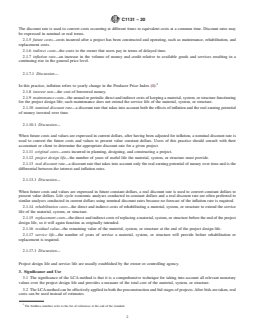
3.1 The significance of the LCA method is that it is a comprehensive technique for taking into account all relevant monetary values over the project design life and provides a measure of the total cost of the material, system, or structure.
3.2 The LCA method can be effectively applied in both the preconstruction and bid stages of projects. After bids are taken, real costs can be used instead of estimates.
SCOPE
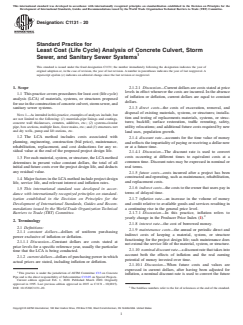
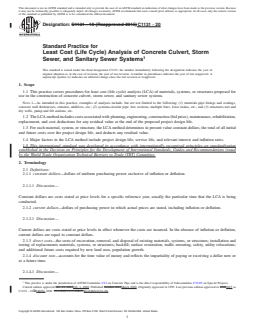
1.1 This practice covers procedures for least cost (life cycle) analysis (LCA) of materials, systems, or structures proposed for use in the construction of concrete culvert, storm sewer, and sanitary sewer systems.
Note 1: As intended in this practice, examples of analyses include, but are not limited to the following: (1) materials-pipe linings and coatings, concrete wall thicknesses, cements, additives, etc.; (2) systems-circular pipe, box sections, multiple lines, force mains, etc.; and (3) structures-wet and dry wells, pump and lift stations, etc.
1.2 The LCA method includes costs associated with planning, engineering, construction (bid price), maintenance, rehabilitation, replacement, and cost deductions for any residual value at the end of the proposed project design life.
1.3 For each material, system, or structure, the LCA method determines in present value constant dollars, the total of all initial and future costs over the project design life, and deducts any residual value.
1.4 Major factors in the LCA method include project design life, service life, and relevant interest and inflation rates.
1.5 This international standard was developed in accordance with internationally recognized principles on standardization established in the Decision on Principles for the Development of International Standards, Guides and Recommendations issued by the World Trade Organization Technical Barriers to Trade (TBT) Committee.
- Status
- Published
- Publication Date
- 31-Jan-2020
- Technical Committee
- C13 - Concrete Pipe
- Drafting Committee
- C13.05 - Special Projects
Buy Documents
ASTM C1131-20 - Standard Practice for Least Cost (Life Cycle) Analysis of Concrete Culvert, Storm Sewer, and Sanitary Sewer Systems
REDLINE ASTM C1131-20 - Standard Practice for Least Cost (Life Cycle) Analysis of Concrete Culvert, Storm Sewer, and Sanitary Sewer Systems
Overview
ASTM C1131-20: Standard Practice for Least Cost (Life Cycle) Analysis of Concrete Culvert, Storm Sewer, and Sanitary Sewer Systems establishes comprehensive procedures for performing least cost (life cycle) analysis (LCA). This standard provides an objective methodology to evaluate all relevant monetary values associated with the selection of materials, systems, or structures for concrete culvert, storm sewer, and sanitary sewer construction projects.
The intent of ASTM C1131-20 is to help decision-makers measure the total cost over a project’s design life, enabling informed choices that account for initial costs, future expenses, and end-of-life value. This practice is particularly useful during both the preconstruction planning and bidding stages, allowing for fair and value-driven comparisons between alternatives.
Key Topics
Life Cycle Analysis (LCA) Framework
The LCA method addresses all direct and indirect costs incurred throughout the project timeline, including:- Planning and design
- Engineering
- Construction (bid price)
- Maintenance
- Rehabilitation
- Replacement
- Residual value at project end
Evaluation Criteria
The analysis uses present value constant dollars to ensure consistent and fair cost comparison. Important factors considered include:- Project design life and service life
- Relevant interest and inflation rates
- Discount rates that account for the time value of money
Process Steps for LCA
ASTM C1131-20 outlines a five-step process:- Identify objectives, alternatives, and constraints
- Establish basic criteria for evaluation
- Compile necessary cost data
- Compute the LCA for each alternative
- Evaluate and compare results for decision-making
Cost Elements Defined
- Original costs: Planning, design, and construction expenses
- Maintenance and rehabilitation costs: Periodic upkeep and restorative work to prolong service life
- Replacement costs: Expenses incurred if replacement is necessary before the end of project design life
- Residual value: Remaining value of the asset at the end of design life
Applications
ASTM C1131-20 is widely applied in civil infrastructure, particularly for municipal, state, and private developments involving:
- Design and specification of concrete culvert, storm sewer, and sanitary sewer systems
- Preconstruction evaluations and value engineering exercises
- Competitive bidding and procurement for infrastructure projects
- Long-term capital planning and budgeting for utility assets
Construction professionals and decision-makers use this standard to:
- Compare alternative materials and systems (e.g., pipe linings, coatings, wall thicknesses, various pipe shapes)
- Analyze long-term costs versus initial expenditures
- Account for project specific constraints such as maximum culvert head, installation methods, slopes, and depths
- Consider economic factors that impact ongoing and future project costs
Related Standards
Several standards complement and support the effective application of ASTM C1131-20, including:
- ASTM C76 - Standard Specification for Reinforced Concrete Culvert, Storm Drain, and Sewer Pipe
- ASTM C497 - Standard Test Methods for Concrete Pipe, Manhole Sections, or Tile
- ASTM D2321 - Standard Practice for Underground Installation of Thermoplastic Pipe for Sewers and Other Gravity-Flow Applications
- AASHTO LRFD Bridge Construction Specifications - For structural and lifespan requirements in bridge and culvert installation
Keywords: life cycle analysis, least cost analysis, concrete culvert, storm sewer, sanitary sewer, ASTM C1131, infrastructure cost analysis, project design life, maintenance costs, replacement costs, present value, inflation rate, interest rate.
By following ASTM C1131-20, engineers and asset managers can confidently select the most cost-effective solutions, ensuring sustainable and economic investments in public infrastructure.
Relations
- Effective Date
- 01-Feb-2020
Buy Documents
ASTM C1131-20 - Standard Practice for Least Cost (Life Cycle) Analysis of Concrete Culvert, Storm Sewer, and Sanitary Sewer Systems
REDLINE ASTM C1131-20 - Standard Practice for Least Cost (Life Cycle) Analysis of Concrete Culvert, Storm Sewer, and Sanitary Sewer Systems
Get Certified
Connect with accredited certification bodies for this standard

DIBt (Deutsches Institut für Bautechnik)
German Institute for Building Technology.
DIN CERTCO
DIN Group product certification.

Aboma Certification B.V.
Specialized in construction, metal, and transport sectors.
Sponsored listings
Frequently Asked Questions
ASTM C1131-20 is a standard published by ASTM International. Its full title is "Standard Practice for Least Cost (Life Cycle) Analysis of Concrete Culvert, Storm Sewer, and Sanitary Sewer Systems". This standard covers: SIGNIFICANCE AND USE 3.1 The significance of the LCA method is that it is a comprehensive technique for taking into account all relevant monetary values over the project design life and provides a measure of the total cost of the material, system, or structure. 3.2 The LCA method can be effectively applied in both the preconstruction and bid stages of projects. After bids are taken, real costs can be used instead of estimates. SCOPE 1.1 This practice covers procedures for least cost (life cycle) analysis (LCA) of materials, systems, or structures proposed for use in the construction of concrete culvert, storm sewer, and sanitary sewer systems. Note 1: As intended in this practice, examples of analyses include, but are not limited to the following: (1) materials-pipe linings and coatings, concrete wall thicknesses, cements, additives, etc.; (2) systems-circular pipe, box sections, multiple lines, force mains, etc.; and (3) structures-wet and dry wells, pump and lift stations, etc. 1.2 The LCA method includes costs associated with planning, engineering, construction (bid price), maintenance, rehabilitation, replacement, and cost deductions for any residual value at the end of the proposed project design life. 1.3 For each material, system, or structure, the LCA method determines in present value constant dollars, the total of all initial and future costs over the project design life, and deducts any residual value. 1.4 Major factors in the LCA method include project design life, service life, and relevant interest and inflation rates. 1.5 This international standard was developed in accordance with internationally recognized principles on standardization established in the Decision on Principles for the Development of International Standards, Guides and Recommendations issued by the World Trade Organization Technical Barriers to Trade (TBT) Committee.
SIGNIFICANCE AND USE 3.1 The significance of the LCA method is that it is a comprehensive technique for taking into account all relevant monetary values over the project design life and provides a measure of the total cost of the material, system, or structure. 3.2 The LCA method can be effectively applied in both the preconstruction and bid stages of projects. After bids are taken, real costs can be used instead of estimates. SCOPE 1.1 This practice covers procedures for least cost (life cycle) analysis (LCA) of materials, systems, or structures proposed for use in the construction of concrete culvert, storm sewer, and sanitary sewer systems. Note 1: As intended in this practice, examples of analyses include, but are not limited to the following: (1) materials-pipe linings and coatings, concrete wall thicknesses, cements, additives, etc.; (2) systems-circular pipe, box sections, multiple lines, force mains, etc.; and (3) structures-wet and dry wells, pump and lift stations, etc. 1.2 The LCA method includes costs associated with planning, engineering, construction (bid price), maintenance, rehabilitation, replacement, and cost deductions for any residual value at the end of the proposed project design life. 1.3 For each material, system, or structure, the LCA method determines in present value constant dollars, the total of all initial and future costs over the project design life, and deducts any residual value. 1.4 Major factors in the LCA method include project design life, service life, and relevant interest and inflation rates. 1.5 This international standard was developed in accordance with internationally recognized principles on standardization established in the Decision on Principles for the Development of International Standards, Guides and Recommendations issued by the World Trade Organization Technical Barriers to Trade (TBT) Committee.
ASTM C1131-20 is classified under the following ICS (International Classification for Standards) categories: 91.140.80 - Drainage systems. The ICS classification helps identify the subject area and facilitates finding related standards.
ASTM C1131-20 has the following relationships with other standards: It is inter standard links to ASTM C1131-10(2015). Understanding these relationships helps ensure you are using the most current and applicable version of the standard.
ASTM C1131-20 is available in PDF format for immediate download after purchase. The document can be added to your cart and obtained through the secure checkout process. Digital delivery ensures instant access to the complete standard document.
Standards Content (Sample)
This international standard was developed in accordance with internationally recognized principles on standardization established in the Decision on Principles for the
Development of International Standards, Guides and Recommendations issued by the World Trade Organization Technical Barriers to Trade (TBT) Committee.
Designation: C1131 − 20
Standard Practice for
Least Cost (Life Cycle) Analysis of Concrete Culvert, Storm
Sewer, and Sanitary Sewer Systems
This standard is issued under the fixed designation C1131; the number immediately following the designation indicates the year of
original adoption or, in the case of revision, the year of last revision. A number in parentheses indicates the year of last reapproval. A
superscript epsilon (´) indicates an editorial change since the last revision or reapproval.
1. Scope 2.1.2.1 Discussion—Current dollars are costs stated at price
levels in effect whenever the costs are incurred. In the absence
1.1 Thispracticecoversproceduresforleastcost(lifecycle)
of inflation or deflation, current dollars are equal to constant
analysis (LCA) of materials, systems, or structures proposed
dollars.
foruseintheconstructionofconcreteculvert,stormsewer,and
2.1.3 direct costs—the costs of excavation, removal, and
sanitary sewer systems.
disposal of existing materials, systems, or structures; installa-
NOTE1—Asintendedinthispractice,examplesofanalysesinclude,but
tion and testing of replacements materials, systems, or struc-
are not limited to the following: (1) materials-pipe linings and coatings,
tures; backfill; surface restoration, traffic rerouting, safety,
concrete wall thicknesses, cements, additives, etc.; (2) systems-circular
pipe, box sections, multiple lines, force mains, etc.; and (3) structures-wet utility relocations; and additional future costs required by new
and dry wells, pump and lift stations, etc.
land uses, population growth.
1.2 The LCA method includes costs associated with
2.1.4 discount rate—accounts for the time value of money
planning, engineering, construction (bid price), maintenance,
andreflectstheimpartialityofpayingorreceivingadollarnow
rehabilitation, replacement, and cost deductions for any re-
or at a future time.
sidual value at the end of the proposed project design life.
2.1.4.1 Discussion—The discount rate is used to convert
costs occurring at different times to equivalent costs at a
1.3 For each material, system, or structure, the LCAmethod
common time. Discount rates may be expressed in nominal or
determines in present value constant dollars, the total of all
real terms.
initial and future costs over the project design life, and deducts
any residual value.
2.1.5 future costs—costs incurred after a project has been
constructed and operating, such as maintenance, rehabilitation,
1.4 Major factors in the LCAmethod include project design
and replacement costs.
life, service life, and relevant interest and inflation rates.
2.1.6 indirect costs—the costs to the owner that users pay in
1.5 This international standard was developed in accor-
terms of delayed time.
dance with internationally recognized principles on standard-
ization established in the Decision on Principles for the 2.1.7 inflation rate—an increase in the volume of money
Development of International Standards, Guides and Recom- and credit relative to available goods and services resulting in
mendations issued by the World Trade Organization Technical a continuing rise in the general price level.
Barriers to Trade (TBT) Committee. 2.1.7.1 Discussion—In this practice, inflation refers to
yearly change in the Producer Price Index (1).
2. Terminology
2.1.8 interest rate—the cost of borrowed money.
2.1 Definitions:
2.1.9 maintenance costs—the annual or periodic direct and
2.1.1 constant dollars—dollars of uniform purchasing
indirect costs of keeping a material, system, or structure
power exclusive of inflation or deflation.
functioning for the project design life; such maintenance does
2.1.1.1 Discussion—Constant dollars are costs stated at
not extend the service life of the material, system, or structure.
price levels for a specific reference year, usually the particular
2.1.10 nominal discount rate—adiscountratethattakesinto
time that the LCA is being conducted.
account both the effects of inflation and the real earning
2.1.2 current dollars—dollars of purchasing power in which
potential of money invested over time.
actual prices are stated, including inflation or deflation.
2.1.10.1 Discussion—When future costs and values are
expressed in current dollars, after having been adjusted for
This practice is under the jurisdiction of ASTM Committee C13 on Concrete
inflation, a nominal discount rate is used to convert the future
Pipe and is the direct responsibility of Subcommittee C13.05 on Special Projects.
Current edition approved Feb. 1, 2020. Published March 2020. Originally
approved in 1995. Last previous edition approved in 2015 as C1131 – 10(2015).
DOI: 10.1520/C1131–20. The boldface numbers refer to the list of references at the end of the standard.
Copyright © ASTM International, 100 Barr Harbor Drive, PO Box C700, West Conshohocken, PA 19428-2959. United States
C1131 − 20
costs and values to present value constant dollars. Users of this or tail water, maximum and minimum slopes and depths of
practice should consult with their accountant or client to burial, installation methods, etc.
determine the appropriate discount rate for a given project.
4.3 Criteria—Establish basic criteria that should be fol-
2.1.11 original costs—costsincurredinplanning,designing,
lowed in applying the LCA method, including project design
and constructing a project.
life; the material, system, or structure service life; direct and
2.1.12 project design life—thenumberofyearsofusefullife indirect costs and timing of maintenance, rehabilitation and
the material, system, or structure must provide.
replacement; real or nominal discount rate; and the compre-
hensiveness of the LCA evaluation.
2.1.13 real discount rate—a discount rate that takes into
account only the real earning potential of money over time and
4.4 Compile Data—Compile basic data required to compute
is the differential between the interest and inflation rates.
the LCA of potential alternatives, including costs of planning,
2.1.13.1 Discussion—When future costs and values are
design, engineering and construction; maintenance costs; reha-
expressed in future constant dollars, a real discount rate is used
bilitation costs; replacement costs; residual values; and the
to convert constant dollars to present value dollars. Life cycle
time periods for all future costs.
economic analyses conducted in constant dollars and a real
4.5 Compute LCA—The LCA of a material, system, or
discount rate are often preferred to similar analyses conducted
structure can be formulated in simple terms with all costs and
in current dollars using nominal discount rates because no
values in present value constant dollars:
forecast of the inflation rate is required.
2.1.14 rehabilitation costs—the direct and indirect costs of
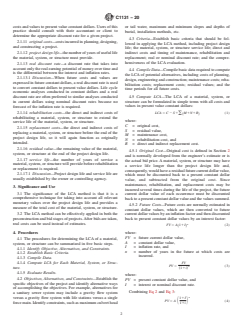
LCA 5 C 2 S1 ~M1N1R! (1)
(
rehabilitating a material, system, or structure to extend the
where:
service life of the material, system, or structure.
C = original cost,
2.1.15 replacement costs—the direct and indirect costs of
S = residual value,
replacing a material, system, or structure before the end of the
M = maintenance cost,
project design life, so it will again function as originally
N = rehabilitation cost, and
intended.
R = direct and indirect replacement cost.
2.1.16 residual value—the remaining value of the material,
4.5.1 Original Cost—Original cost is defined in Section 2
system, or structure at the end of the project design life.
and is normally developed from the engineer’s estimate or is
2.1.17 service life—the number of years of service a
the actual bid price. A material, system, or structure may have
material, system, or structure will provide before rehabilitation
a service life longer than the project design life and,
or replacement is required.
consequently,wouldhavearesidualfuturecurrentdollarvalue,
2.1.17.1 Discussion—Project design life and service life are
which must be discounted back to a present constant dollar
usually established by the owner or controlling agency.
value, and subtracted from the original cost. Since
maintenance, rehabilitation, and replacement costs may be
3. Significance and Use
incurred several times during the life of the project, the future
3.1 The significance of the LCA method is that it is a
current dollar value of each occurrence must be discounted
comprehensive technique for taking into account all relevant
back to a present constant dollar value and the values summed.
monetary values over the project design life and provides a
4.5.2 Future Costs—Future costs are normally estimated in
measure of the total cost of the material, system, or structure.
constant dollar values, which are then converted to future
3.2 The LCA method can be effectively applied in both the current dollar values by an inflation factor and then discounted
preconstruction and bid stages of projects.After bids are taken, back to present constant dollar values by an interest factor:
real costs can be used instead of estimates. n
FV 5 A 11I (2)
~ !
4. Procedures where:
FV = future current dollar value,
4.1 The procedures for determining the LCA of a material,
A = constant dollar value,
system, or structure can be summarized in five basic steps.
I = inflation rate, and
4.1.1 Identify Objective, Alternatives, and Constraints.
n = number of years in the future at which costs are
4.1.2 Establish Basic Criteria.
incurred.
4.1.3 Compile Data.
4.1.4 Compute LCA for Each Material, System, or Struc- FV
PV 5 (3)
n
11i
ture. ~ !
4.1.5 Evaluate Results.
where:
4.2 Objectives, Alternatives, and Constraints—Establish the
PV = present constant dollar value, and
specific objectives of the project and identify alternative ways
I = interest or nominal discount rate.
of accomplishing the objectives. For example, alternatives for
Combining Eq 2 and Eq 3:
a sanitary sewer system may include a gravity flow system
n
versus a gravity flow system with life stations versus a single 11I
PV 5 A (4)
S D
forcemain.Identifyconstraints,suchasmaximumculverthead 11i
C1131 − 20
Eq 4 is usable, but requires assumptions of both interest and
n = number of years in maintenance cycle, and
inflation rates. Although interest and inflation rates can vary
m = number of maintenance cycles in project design life.
widely, historical records indicate that the differential between
If a maintenance cycle ends in a year in which rehabilitation
interest and inflation rates has been relatively stable over the
or replacement work is scheduled, then the total present value
long term.Therefore, by defining an inflation/interest factor, F,
of maintenance costs should be refined by omitting the costs of
as:
that maintenance cycle.Where future maintenance costs are on
11I
an annual basis, the total present value of all maintenance costs
F 5 (5)
S D
11i
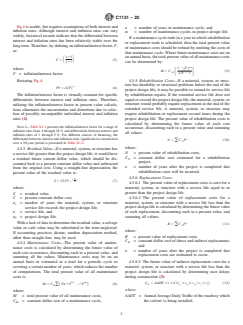
can be determined by:
mn
1 2 ~F!
where:
M 5 C (9)
F G
M
1/F 2 1
F = inflation/interest factor.
4.5.5 Rehabilitation Costs—If a material, system, or struc-
Restating Eq 4:
ture has durability or structural problems before the end of the
n
PV 5 A~F! (6)
project design life, it may be possible to extend its service life
by rehabilitation repairs. If the extended service life does n
...
This document is not an ASTM standard and is intended only to provide the user of an ASTM standard an indication of what changes have been made to the previous version. Because
it may not be technically possible to adequately depict all changes accurately, ASTM recommends that users consult prior editions as appropriate. In all cases only the current version
of the standard as published by ASTM is to be considered the official document.
Designation: C1131 − 10 (Reapproved 2015) C1131 − 20
Standard Practice for
Least Cost (Life Cycle) Analysis of Concrete Culvert, Storm
Sewer, and Sanitary Sewer Systems
This standard is issued under the fixed designation C1131; the number immediately following the designation indicates the year of
original adoption or, in the case of revision, the year of last revision. A number in parentheses indicates the year of last reapproval. A
superscript epsilon (´) indicates an editorial change since the last revision or reapproval.
1. Scope
1.1 This practice covers procedures for least cost (life cycle) analysis (LCA) of materials, systems, or structures proposed for
use in the construction of concrete culvert, storm sewer, and sanitary sewer systems.
NOTE 1—As intended in this practice, examples of analyses include, but are not limited to the following: (1) materials-pipe linings and coatings,
concrete wall thicknesses, cements, additives, etc.; (2) systems-circular pipe, box sections, multiple lines, force mains, etc.; and (3) structures-wet and
dry wells, pump and lift stations, etc.
1.2 The LCA method includes costs associated with planning, engineering, construction (bid price), maintenance, rehabilitation,
replacement, and cost deductions for any residual value at the end of the proposed project design life.
1.3 For each material, system, or structure, the LCA method determines in present value constant dollars, the total of all initial
and future costs over the project design life, and deducts any residual value.
1.4 Major factors in the LCA method include project design life, service life, and relevant interest and inflation rates.
1.5 This international standard was developed in accordance with internationally recognized principles on standardization
established in the Decision on Principles for the Development of International Standards, Guides and Recommendations issued
by the World Trade Organization Technical Barriers to Trade (TBT) Committee.
2. Terminology
2.1 Definitions:
2.1.1 constant dollars—dollars of uniform purchasing power exclusive of inflation or deflation.
2.1.1.1 Discussion—
Constant dollars are costs stated at price levels for a specific reference year, usually the particular time that the LCA is being
conducted.
2.1.2 current dollars—dollars of purchasing power in which actual prices are stated, including inflation or deflation.
2.1.2.1 Discussion—
Current dollars are costs stated at price levels in effect whenever the costs are incurred. In the absence of inflation or deflation,
current dollars are equal to constant dollars.
2.1.3 direct costs—the costs of excavation, removal, and disposal of existing materials, systems, or structures; installation and
testing of replacements materials, systems, or structures; backfill; surface restoration, traffic rerouting, safety, utility relocations;
and additional future costs required by new land uses, population growth.
2.1.4 discount rate—accounts for the time value of money and reflects the impartiality of paying or receiving a dollar now or
at a future time.
2.1.4.1 Discussion—
This practice is under the jurisdiction of ASTM Committee C13 on Concrete Pipe and is the direct responsibility of Subcommittee C13.05 on Special Projects.
Current edition approved Oct. 15, 2015Feb. 1, 2020. Published October 2015March 2020. Originally approved in 1995. Last previous edition approved in 20102015 as
ɛ1
C1131 – 10 .(2015). DOI: 10.1520/C1131–10R15.10.1520/C1131–20.
Copyright © ASTM International, 100 Barr Harbor Drive, PO Box C700, West Conshohocken, PA 19428-2959. United States
C1131 − 20
The discount rate is used to convert costs occurring at different times to equivalent costs at a common time. Discount rates may
be expressed in nominal or real terms.
2.1.5 future costs—costs incurred after a project has been constructed and operating, such as maintenance, rehabilitation, and
replacement costs.
2.1.6 indirect costs—the costs to the owner that users pay in terms of delayed time.
2.1.7 inflation rate—an increase in the volume of money and credit relative to available goods and services resulting in a
continuing rise in the general price level.
2.1.7.1 Discussion—
In this practice, inflation refers to yearly change in the Producer Price Index (1).
2.1.8 interest rate—the cost of borrowed money.
2.1.9 maintenance costs—the annual or periodic direct and indirect costs of keeping a material, system, or structure functioning
for the project design life; such maintenance does not extend the service life of the material, system, or structure.
2.1.10 nominal discount rate—a discount rate that takes into account both the effects of inflation and the real earning potential
of money invested over time.
2.1.10.1 Discussion—
When future costs and values are expressed in current dollars, after having been adjusted for inflation, a nominal discount rate is
used to convert the future costs and values to present value constant dollars. Users of this practice should consult with their
accountant or client to determine the appropriate discount rate for a given project.
2.1.11 original costs—costs incurred in planning, designing, and constructing a project.
2.1.12 project design life—the number of years of useful life the material, system, or structure must provide.
2.1.13 real discount rate—a discount rate that takes into account only the real earning potential of money over time and is the
differential between the interest and inflation rates.
2.1.13.1 Discussion—
When future costs and values are expressed in future constant dollars, a real discount rate is used to convert constant dollars to
present value dollars. Life cycle economic analyses conducted in constant dollars and a real discount rate are often preferred to
similar analyses conducted in current dollars using nominal discount rates because no forecast of the inflation rate is required.
2.1.14 rehabilitation costs—the direct and indirect costs of rehabilitating a material, system, or structure to extend the service
life of the material, system, or structure.
2.1.15 replacement costs—the direct and indirect costs of replacing a material, system, or structure before the end of the project
design life, so it will again function as originally intended.
2.1.16 residual value—the remaining value of the material, system, or structure at the end of the project design life.
2.1.17 service life—the number of years of service a material, system, or structure will provide before rehabilitation or
replacement is required.
2.1.17.1 Discussion—
Project design life and service life are usually established by the owner or controlling agency.
3. Significance and Use
3.1 The significance of the LCA method is that it is a comprehensive technique for taking into account all relevant monetary
values over the project design life and provides a measure of the total cost of the material, system, or structure.
3.2 The LCA method can be effectively applied in both the preconstruction and bid stages of projects. After bids are taken, real
costs can be used instead of estimates.
The boldface numbers refer to the list of references at the end of the standard.
C1131 − 20
4. Procedures
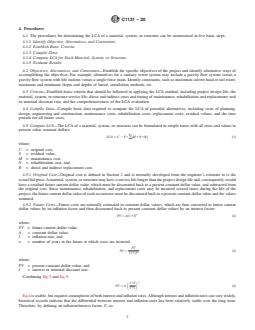
4.1 The procedures for determining the LCA of a material, system, or structure can be summarized in five basic steps.
4.1.1 Identify Objective, Alternatives, and Constraints.
4.1.2 Establish Basic Criteria.
4.1.3 Compile Data.
4.1.4 Compute LCA for Each Material, System, or Structure.
4.1.5 Evaluate Results.
4.2 Objectives, Alternatives, and Constraints—Establish the specific objectives of the project and identify alternative ways of
accomplishing the objectives. For example, alternatives for a sanitary sewer system may include a gravity flow system versus a
gravity flow system with life stations versus a single force main. Identify constraints, such as maximum culvert head or tail water,
maximum and minimum slopes and depths of burial, installation methods, etc.
4.3 Criteria—Establish basic criteria that should be followed in applying the LCA method, including project design life; the
material, system, or structure service life; direct and indirect costs and timing of maintenance, rehabilitation and replacement; real
or nominal discount rate; and the comprehensiveness of the LCA evaluation.
4.4 Compile Data—Compile basic data required to compute the LCA of potential alternatives, including costs of planning,
design, engineering and construction; maintenance costs; rehabilitation costs; replacement costs; residual values; and the time
periods for all future costs.
4.5 Compute LCA—The LCA of a material, system, or structure can be formulated in simple terms with all costs and values in
present value constant dollars:
LCA 5 C 2 S1 M1N1R (1)
~ !
(
where:
C = original cost,
S = residual value,
M = maintenance cost,
N = rehabilitation cost, and
R = direct and indirect replacement cost.
4.5.1 Original Cost—Original cost is defined in Section 2 and is normally developed from the engineer’s estimate or is the
actual bid price. A material, system, or structure may have a service life longer than the project design life and, consequently, would
have a residual future current dollar value, which must be discounted back to a present constant dollar value, and subtracted from
the original cost. Since maintenance, rehabilitation, and replacement costs may be incurred several times during the life of the
project, the future current dollar value of each occurrence must be discounted back to a present constant dollar value and the values
summed.
4.5.2 Future Costs—Future costs are normally estimated in constant dollar values, which are then converted to future current
dollar values by an inflation factor and then discounted back to present constant dollar values by an interest factor:
n
FV 5 A 11I (2)
~ !
where:
FV = future current dollar value,
A = constant dollar value,
I = inflation rate, and
n = number of years in the future at which costs are incurred.
FV
PV 5 (3)
n
11i
~ !
where:
PV = present constant dollar value, and
I = interest or nominal discount rate.
Combining Eq 2 and Eq 3:
n
11I
PV 5 A (4)
S D
11i
Eq 4 is usable, but requires assumptions of both interest and inflation rates. Although interest and inflation rates can vary widely,
historical records indicate that the differential between interest and inflation rates has been relatively stable over the long term.
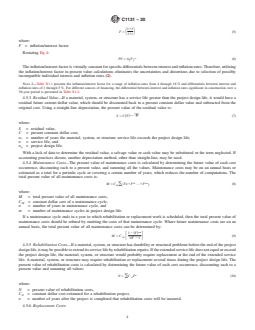
Therefore, by defining an inflation/interest factor, F, as:
C1131 − 20
11I
F 5 (5)
S D
11i
where:
F = inflation/interest factor.
Restating Eq 4:
n
PV 5 A F (6)
~ !
The inflation/interest factor is virtually constant for specific differentials between interest and inflation rates. Therefore, utilizing
the inflation/interest factor in present value calculations eliminates the uncertainties and distortions due to selection of possibly
incompatible individual interest and inflation rates (2).
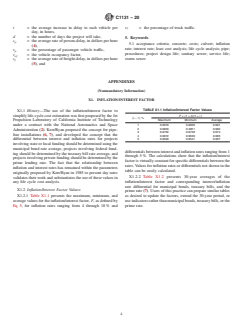
NOTE 2—Table X1.1 presents the inflation/interest factor for a range of inflation rates from 4 through 18 % and differentials between interest and
inflation rates of 1 through 5 %. For different sources of financing, the differential between interest and inflation rates significant in construction over a
30-year period is presented in Table X1.2.
4.5.3 Residual Value—If a material, system, or structure has a service life greater than the project design life, it would have a
residual future current dollar value, which should be discounted back to a present constant dollar value and subtracted from the
original cost. Using a straight-l
...