

ASTM D509-20
(Test Method)Standard Test Methods of Sampling and Grading Rosin
General Information
- Abstract
SIGNIFICANCE AND USE
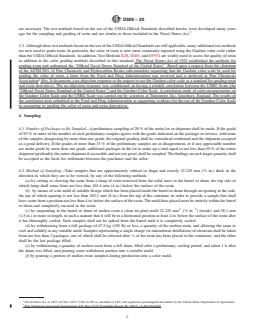
3.1 Rosin is an important product of the centuries old Naval Stores industry, now known as the Pine Chemical industry, and is produced and consumed in many countries throughout the world. Consequently, reliable methods of sampling and grading rosin are necessary. The test methods based on the use of the USDA Official Standards described herein, were developed many years ago for the sampling and grading of rosin and are similar to those included in the Naval Stores Act.3
3.2 Although these test methods based on the use of the USDA Official Standards are still applicable, many additional test methods are now used to grade rosin. In particular, the color of rosin is now more commonly reported using the Gardner color scale rather than the USDA Official Standards. In addition, Test Methods E28, D465, and D5974 are widely used to assess the quality of rosin in addition to the color grading methods described in this standard. The Naval Stores Act of 1923 established the methods for grading rosin and authorized the “Official Naval Stores Standard of the United States”. Based upon a request from the chairman of the ASTM D01.34 Pine Chemicals and Hydrocarbon Resins subcommittee requesting that the Gardner color scale be used for grading the color of rosin, a letter from the Food and Drug Administration was received and is archived in Pine Chemicals Association4 files. It documents a no-objection response to the request to use the Gardner color scale as a standard for grading rosin and rosin derivatives. The no-objection response was conditioned on having a reliable correlation between the USRG Scale (the “Official Naval Stores Standard of the United States”) and the Gardner Color Scale. A correlation study of color measurements on the Gardner Color Scale and the USRG Scale was carried out by scientists at Tintometer, Inc, Amesbury, England. The results of the correlation were submitted to the Food and Drug Administration as supporting evidence for the use of the Gardner Co...
SCOPE
1.1 These test methods cover procedures for sampling and determining the grade of rosin delivered in commercial bags, barrels, drums or in molten form. Although developed for rosin, these methods can also be used for the grading of modified rosins and rosin based resins.
Note 1: All rosin sold in interstate commerce must be described by reference to the U. S. Standards for rosin, and is therefore subject to grading prior to such sale. The grading procedure described in these test methods is used for checking grades or regrading after the rosin has moved from the primary markets to distributing or consuming points.
1.2 The values stated in SI units are to be regarded as the standard. The values given in parentheses are for information only.
1.3 This standard does not purport to address all of the safety concerns, if any, associated with its use. It is the responsibility of the user of this standard to establish appropriate safety, health, and environmental practices and determine the applicability of regulatory limitations prior to use.
1.4 This international standard was developed in accordance with internationally recognized principles on standardization established in the Decision on Principles for the Development of International Standards, Guides and Recommendations issued by the World Trade Organization Technical Barriers to Trade (TBT) Committee.
- Status
- Published
- Publication Date
- 31-Aug-2020
- Technical Committee
- D01 - Paint and Related Coatings, Materials, and Applications
- Drafting Committee
- D01.34 - Pine Chemicals and Hydrocarbon Resins

Overview
ASTM D509-20: Standard Test Methods of Sampling and Grading Rosin is a globally recognized standard developed by ASTM International. This standard provides detailed procedures for sampling and grading rosin, a key product of the pine chemical industry with significant commercial use worldwide. Originally founded on methodologies established by the historic Naval Stores Act, ASTM D509-20 remains essential for maintaining quality and consistency in the trade and processing of rosin, including modified rosins and rosin-based resins. Reliable sampling and grading practices are critical, as rosin is marketed and consumed internationally in varied shipping forms, including bags, barrels, drums, and molten states.
Key Topics
- Sampling Procedures: The standard outlines systematic procedures for sampling rosin from commercial shipments, ensuring that representative samples are obtained whether the product is in solid or molten form.
- Color Grading: Rosin is graded primarily by color, using either the USDA Official Standards or the Gardner color scale. Color grading is determined by comparing samples to established standards under controlled lighting, ensuring uniformity and reliability.
- Quality Assessment: In addition to color assessment, ASTM D509-20 references several other test methods for evaluating the overall quality of rosin, such as acid number determination and softening point testing.
- Tolerance and Regrading: The standard provides protocols for regrading and managing allowable grade tolerances, facilitating dispute resolution and quality assurance during distribution and consumption phases.
Applications
- Pine Chemical Industry: Essential for producers, processors, and traders of rosin and derivatives to maintain product quality and ensure compliance with U.S. and international grading systems.
- Quality Control Laboratories: Laboratories use ASTM D509-20 procedures for incoming quality checks and certification of rosin shipments, supporting fair and transparent trade.
- Trading and Distribution: The grading process described is used to confirm grades or regrade rosin that has moved from primary markets to distribution or consumption points, covering both local and international commerce.
- Regulatory Compliance: All rosin sold in interstate commerce in the U.S. must be described by reference to official standards, making ASTM D509-20 a key document for regulatory adherence.
- Research and Development: The standard supports ongoing industry R&D, as developments in color measurement (e.g., transition to the Gardner color scale) are integrated through correlation studies and additional referenced test methods.
Related Standards
- ASTM D465 - Test Methods for Acid Number of Pine Chemical Products.
- ASTM D1544 - Test Method for Color of Transparent Liquids (Gardner Color Scale).
- ASTM E28 - Test Methods for Softening Point of Resins.
- ASTM D5974 - Test Methods for Fatty and Rosin Acids in Tall Oil Fractionation Products by Capillary Gas Chromatography.
- ASTM D6090 - Test Method for Softening Point Resins (Mettler Cup and Ball Method).
- ASTM D6166 - Test Method for Instrumental Determination of Gardner Color.
Practical Value
Implementing ASTM D509-20 supports the pine chemical industry with consistent, internationally accepted methods for sampling and grading rosin. Adherence to these test methods ensures uniform quality, transparency in trade, regulatory compliance, and buyer-seller confidence across markets. By referencing modern practices such as the Gardner color scale and providing guidance for emerging methodologies, ASTM D509-20 remains a relevant and vital resource for industry stakeholders.
Keywords: rosin sampling, rosin grading, ASTM D509-20, pine chemicals, Gardner color scale, quality control, rosin standards, pine chemical industry, colorimetric standards.
Relations
- Effective Date
- 01-Jun-2020
- Effective Date
- 01-Dec-2015
- Effective Date
- 01-Nov-2012
- Effective Date
- 01-Nov-2012
- Effective Date
- 01-Jun-2010
- Effective Date
- 01-Jun-2010
- Refers
ASTM D1544-04(2010) - Standard Test Method for Color of Transparent Liquids (Gardner Color Scale) - Effective Date
- 01-Jun-2010
- Effective Date
- 01-Jun-2009
- Effective Date
- 01-Jul-2008
- Refers
ASTM D6090-99(2008) - Standard Test Method for Softening Point Resins (Mettler Cup and Ball Method) - Effective Date
- 01-Jun-2008
- Effective Date
- 01-Dec-2005
- Effective Date
- 01-Dec-2005
- Effective Date
- 01-Jun-2004
- Refers
ASTM D6090-99(2004) - Standard Test Method for Softening Point Resins (Mettler Cup and Ball Method) - Effective Date
- 01-Jun-2004
- Effective Date
- 01-Jun-2004
Frequently Asked Questions
ASTM D509-20 is a standard published by ASTM International. Its full title is "Standard Test Methods of Sampling and Grading Rosin". This standard covers: SIGNIFICANCE AND USE 3.1 Rosin is an important product of the centuries old Naval Stores industry, now known as the Pine Chemical industry, and is produced and consumed in many countries throughout the world. Consequently, reliable methods of sampling and grading rosin are necessary. The test methods based on the use of the USDA Official Standards described herein, were developed many years ago for the sampling and grading of rosin and are similar to those included in the Naval Stores Act.3 3.2 Although these test methods based on the use of the USDA Official Standards are still applicable, many additional test methods are now used to grade rosin. In particular, the color of rosin is now more commonly reported using the Gardner color scale rather than the USDA Official Standards. In addition, Test Methods E28, D465, and D5974 are widely used to assess the quality of rosin in addition to the color grading methods described in this standard. The Naval Stores Act of 1923 established the methods for grading rosin and authorized the “Official Naval Stores Standard of the United States”. Based upon a request from the chairman of the ASTM D01.34 Pine Chemicals and Hydrocarbon Resins subcommittee requesting that the Gardner color scale be used for grading the color of rosin, a letter from the Food and Drug Administration was received and is archived in Pine Chemicals Association4 files. It documents a no-objection response to the request to use the Gardner color scale as a standard for grading rosin and rosin derivatives. The no-objection response was conditioned on having a reliable correlation between the USRG Scale (the “Official Naval Stores Standard of the United States”) and the Gardner Color Scale. A correlation study of color measurements on the Gardner Color Scale and the USRG Scale was carried out by scientists at Tintometer, Inc, Amesbury, England. The results of the correlation were submitted to the Food and Drug Administration as supporting evidence for the use of the Gardner Co... SCOPE 1.1 These test methods cover procedures for sampling and determining the grade of rosin delivered in commercial bags, barrels, drums or in molten form. Although developed for rosin, these methods can also be used for the grading of modified rosins and rosin based resins. Note 1: All rosin sold in interstate commerce must be described by reference to the U. S. Standards for rosin, and is therefore subject to grading prior to such sale. The grading procedure described in these test methods is used for checking grades or regrading after the rosin has moved from the primary markets to distributing or consuming points. 1.2 The values stated in SI units are to be regarded as the standard. The values given in parentheses are for information only. 1.3 This standard does not purport to address all of the safety concerns, if any, associated with its use. It is the responsibility of the user of this standard to establish appropriate safety, health, and environmental practices and determine the applicability of regulatory limitations prior to use. 1.4 This international standard was developed in accordance with internationally recognized principles on standardization established in the Decision on Principles for the Development of International Standards, Guides and Recommendations issued by the World Trade Organization Technical Barriers to Trade (TBT) Committee.
SIGNIFICANCE AND USE 3.1 Rosin is an important product of the centuries old Naval Stores industry, now known as the Pine Chemical industry, and is produced and consumed in many countries throughout the world. Consequently, reliable methods of sampling and grading rosin are necessary. The test methods based on the use of the USDA Official Standards described herein, were developed many years ago for the sampling and grading of rosin and are similar to those included in the Naval Stores Act.3 3.2 Although these test methods based on the use of the USDA Official Standards are still applicable, many additional test methods are now used to grade rosin. In particular, the color of rosin is now more commonly reported using the Gardner color scale rather than the USDA Official Standards. In addition, Test Methods E28, D465, and D5974 are widely used to assess the quality of rosin in addition to the color grading methods described in this standard. The Naval Stores Act of 1923 established the methods for grading rosin and authorized the “Official Naval Stores Standard of the United States”. Based upon a request from the chairman of the ASTM D01.34 Pine Chemicals and Hydrocarbon Resins subcommittee requesting that the Gardner color scale be used for grading the color of rosin, a letter from the Food and Drug Administration was received and is archived in Pine Chemicals Association4 files. It documents a no-objection response to the request to use the Gardner color scale as a standard for grading rosin and rosin derivatives. The no-objection response was conditioned on having a reliable correlation between the USRG Scale (the “Official Naval Stores Standard of the United States”) and the Gardner Color Scale. A correlation study of color measurements on the Gardner Color Scale and the USRG Scale was carried out by scientists at Tintometer, Inc, Amesbury, England. The results of the correlation were submitted to the Food and Drug Administration as supporting evidence for the use of the Gardner Co... SCOPE 1.1 These test methods cover procedures for sampling and determining the grade of rosin delivered in commercial bags, barrels, drums or in molten form. Although developed for rosin, these methods can also be used for the grading of modified rosins and rosin based resins. Note 1: All rosin sold in interstate commerce must be described by reference to the U. S. Standards for rosin, and is therefore subject to grading prior to such sale. The grading procedure described in these test methods is used for checking grades or regrading after the rosin has moved from the primary markets to distributing or consuming points. 1.2 The values stated in SI units are to be regarded as the standard. The values given in parentheses are for information only. 1.3 This standard does not purport to address all of the safety concerns, if any, associated with its use. It is the responsibility of the user of this standard to establish appropriate safety, health, and environmental practices and determine the applicability of regulatory limitations prior to use. 1.4 This international standard was developed in accordance with internationally recognized principles on standardization established in the Decision on Principles for the Development of International Standards, Guides and Recommendations issued by the World Trade Organization Technical Barriers to Trade (TBT) Committee.
ASTM D509-20 is classified under the following ICS (International Classification for Standards) categories: 87.060.20 - Binders; 87.060.30 - Solvents. The ICS classification helps identify the subject area and facilitates finding related standards.
ASTM D509-20 has the following relationships with other standards: It is inter standard links to ASTM D465-15(2020), ASTM D465-15, ASTM D6090-12, ASTM D6166-12, ASTM D465-05(2010), ASTM D5974-00(2010), ASTM D1544-04(2010), ASTM E28-99(2009), ASTM D6166-08, ASTM D6090-99(2008), ASTM D465-05, ASTM D5974-00(2005), ASTM D1544-04, ASTM D6090-99(2004), ASTM E28-99(2004). Understanding these relationships helps ensure you are using the most current and applicable version of the standard.
ASTM D509-20 is available in PDF format for immediate download after purchase. The document can be added to your cart and obtained through the secure checkout process. Digital delivery ensures instant access to the complete standard document.
Standards Content (Sample)
This international standard was developed in accordance with internationally recognized principles on standardization established in the Decision on Principles for the
Development of International Standards, Guides and Recommendations issued by the World Trade Organization Technical Barriers to Trade (TBT) Committee.
Designation:D509 −20
Standard Test Methods of
Sampling and Grading Rosin
This standard is issued under the fixed designation D509; the number immediately following the designation indicates the year of
original adoption or, in the case of revision, the year of last revision. A number in parentheses indicates the year of last reapproval. A
superscript epsilon (´) indicates an editorial change since the last revision or reapproval.
1. Scope Fractionation Products by Capillary Gas Chromatography
D6090 Test Method for Softening Point Resins (Mettler Cup
1.1 These test methods cover procedures for sampling and
and Ball Method)
determining the grade of rosin delivered in commercial bags,
D6166 Test Method for Color of Pine Chemicals and Re-
barrels, drums or in molten form. Although developed for
lated Products (Instrumental Determination of Gardner
rosin, these methods can also be used for the grading of
Color)
modified rosins and rosin based resins.
E28 Test Methods for Softening Point of Resins Derived
NOTE 1—All rosin sold in interstate commerce must be described by
from Pine Chemicals and Hydrocarbons, by Ring-and-
reference to the U. S. Standards for rosin, and is therefore subject to
Ball Apparatus
grading prior to such sale. The grading procedure described in these test
methods is used for checking grades or regrading after the rosin has
3. Significance and Use
moved from the primary markets to distributing or consuming points.
3.1 Rosin is an important product of the centuries old Naval
1.2 The values stated in SI units are to be regarded as the
Stores industry, now known as the Pine Chemical industry, and
standard. The values given in parentheses are for information
is produced and consumed in many countries throughout the
only.
world.Consequently,reliablemethodsofsamplingandgrading
1.3 This standard does not purport to address all of the
rosin are necessary. The test methods based on the use of the
safety concerns, if any, associated with its use. It is the
USDA Official Standards described herein, were developed
responsibility of the user of this standard to establish appro-
many years ago for the sampling and grading of rosin and are
priate safety, health, and environmental practices and deter-
similar to those included in the Naval Stores Act.
mine the applicability of regulatory limitations prior to use.
3.2 Although these test methods based on the use of the
1.4 This international standard was developed in accor-
USDA Official Standards are still applicable, many additional
dance with internationally recognized principles on standard-
test methods are now used to grade rosin. In particular, the
ization established in the Decision on Principles for the
color of rosin is now more commonly reported using the
Development of International Standards, Guides and Recom-
Gardner color scale rather than the USDA Official Standards.
mendations issued by the World Trade Organization Technical
In addition, Test Methods E28, D465, and D5974 are widely
Barriers to Trade (TBT) Committee.
used to assess the quality of rosin in addition to the color
2. Referenced Documents grading methods described in this standard. The Naval Stores
Act of 1923 established the methods for grading rosin and
2.1 ASTM Standards:
authorized the “Official Naval Stores Standard of the United
D465 Test Methods for Acid Number of Pine Chemical
States”. Based upon a request from the chairman of theASTM
Products Including Tall Oil and Other Related Products
D01.34 Pine Chemicals and Hydrocarbon Resins subcommit-
D1544 Test Method for Color of Transparent Liquids (Gard-
tee requesting that the Gardner color scale be used for grading
ner Color Scale)
the color of rosin, a letter from the Food and Drug Adminis-
D5974 Test Methods for Fatty and Rosin Acids in Tall Oil
tration was received and is archived in Pine Chemicals
Association files. It documents a no-objection response to the
These test methods are under the jurisdiction of ASTM Committee D01 on request to use the Gardner color scale as a standard for grading
Paint and Related Coatings, Materials, and Applications and are the direct
rosin and rosin derivatives. The no-objection response was
responsibility of Subcommittee D01.34 on Pine Chemicals and Hydrocarbon
conditionedonhavingareliablecorrelationbetweentheUSRG
Resins.
Scale (the “Official Naval Stores Standard of the United
Current edition approved Sept. 1, 2020. Published September 2020. Originally
approved in 1938. Last previous edition approved in 2015 as D509 – 15. DOI:
10.1520/D0509-20.
2 3
For referenced ASTM standards, visit the ASTM website, www.astm.org, or Naval StoresAct of 1923 (42 Stat 1435.7 USC-91-99) as amended in 1951 and
contact ASTM Customer Service at service@astm.org. For Annual Book of ASTM regulationspromulgatedthereunderbytheUnitedStatesDepartmentofAgriculture.
Standards volume information, refer to the standard’s Document Summary page on Pine Chemicals Association International, P.O. Box 17136 Fernandina Beach,
the ASTM website. FL 32035; +1-404-994-6267
Copyright © ASTM International, 100 Barr Harbor Drive, PO Box C700, West Conshohocken, PA 19428-2959. United States
D509−20
States”) and the Gardner Color Scale. A correlation study of 5. Apparatus
color measurements on the Gardner Color Scale and the USRG
5.1 Offıcial Rosin Standards—The official standards for use
Scale was carried out by scientists at Tintometer, Inc,
in grading rosin, plus three standards lighter than “X” consists
Amesbury, England. The results of the correlation were sub-
of assemblies of colored glass plates, cemented together, as
mitted to the Food and Drug Administration as supporting 5
issued on loan by the U.S. Department of Agriculture. The
evidence for the use of the Gardner Color Scale in measuring
grades and standards are designated as follows: XC, XB, XA,
or grading the color of rosin and rosin derivatives.
X, WW, WG, N, M, K, I, H, G, F, E, and D. A special grade,
FF, is used for dark wood rosins. Grades XA, XB, and XC are
4. Sampling
not available from the U.S. Department ofAgriculture but may
be purchased commercially. The standards issued by the
4.1 Number of Packages to Be Sampled—A preliminary
Department of Agriculture (except FF), consist of combina-
sampling of 20 % of the entire lot or shipment shall be made.
tions of plates cut, ground, and polished to specified thick-
Ifthegradeof85 %ormoreofthenumberofsuchpreliminary
nesses from selected melts of Corning and Jena colored glass.
samples agrees with the grade indicated on the package or
The colorimetric specifications of the standards, based on the
invoice, with none of the samples disagreeing by more than
1931 CIE Coordinate System, for a standard observer using
one grade, the original grading shall be considered confirmed
standard Illuminant C, are given in Table 1. The colorimetric
and the shipment accepted as a good delivery. If the grades of
specifications for the U.S. Rosin Standards, Master Cubes XA,
more than 15 % of the preliminary samples are in
XB, and XC, are given in Table 2.
disagreement, or if any appreciable number are under grade by
more than one grade, additional packages in the lot to make up
5.2 Secondary standards or “type samples” are sometimes
a total equal to not less than 50 % of the entire shipment
used for approximate grading, in the absence of permanent
(preferably the entire shipment if accessible and not too great)
official standards of glass. Such samples may consist of cubes
shall be sampled. The findings on such larger quantity shall be
of specially selected rosin or other colored transparent me-
accepted as the basis for settlement between the purchaser and
dium; solutions are also sometimes used (Note 2).
the seller.
5.3 Rosin Color Molds, 22.225 mm ( ⁄8 in.), standard size or
4.2 Method of Sampling—Take samples that are approxi- 7 7
Rosin Sample Trays, 22.225 by 22.225 by 22.225 mm ( ⁄8 by ⁄8
matelycubicalinshapeandexactly22.225mm( ⁄8in.)thickin
by 1 in.), white cover without labels.
the direction in which they are to be viewed, by any of the
NOTE 2—It is not possible to dissolve a specified quantity of rosin in a
following methods:
solvent and use such solution as a standard for grading the rosin because
(a) by cutting or cleaving the same from a lump of rosin
there is no constant relationship between the color of the original solid
removed from the solid mass in the barrel or drum, the top side
of which lump shall come from not less than 101.6 mm (4 in.)
below the surface of the rosin.
The U.S. Rosin Standards are issued only by the Agricultural Marketing
(b) by means of a tin mold of suitable design which has Service, Tobacco Division, U.S. Department of Agriculture, P.O. Box 96456,
Washington, DC 20090-6456. To obtain a set of standards, a Form N.S.A. 2
beenplacedinsidethebarrelordrumthroughanopeninginthe
“Request for Loan of Official United States Rosin Standards” and a security deposit
side, the top of which opening is not less than 203.2 mm (8 in.)
of $100.00 should be sent to the above address.
from the top of the container, in order to provide a sample that
If an applicant is unable to borrow a set of the U. S. Rosin Standards, because
of the limited number of sets in existence, secondary sets are available. The
...
This document is not an ASTM standard and is intended only to provide the user of an ASTM standard an indication of what changes have been made to the previous version. Because
it may not be technically possible to adequately depict all changes accurately, ASTM recommends that users consult prior editions as appropriate. In all cases only the current version
of the standard as published by ASTM is to be considered the official document.
Designation: D509 − 15 D509 − 20
Standard Test Methods of
Sampling and Grading Rosin
This standard is issued under the fixed designation D509; the number immediately following the designation indicates the year of
original adoption or, in the case of revision, the year of last revision. A number in parentheses indicates the year of last reapproval. A
superscript epsilon (´) indicates an editorial change since the last revision or reapproval.
1. Scope
1.1 These test methods cover procedures for sampling and determining the grade of rosin delivered in commercial bags, barrels,
drums or in molten form. Although developed for rosin, these methods can also be used for the grading of modified rosins and
rosin based resins.
NOTE 1—All rosin sold in interstate commerce must be described by reference to the U. S. Standards for rosin, and is therefore subject to grading prior
to such sale. The grading procedure described in these test methods is used for checking grades or regrading after the rosin has moved from the primary
markets to distributing or consuming points.
1.2 The values stated in SI units are to be regarded as the standard. The values given in parentheses are for information only.
1.3 This standard does not purport to address all of the safety concerns, if any, associated with its use. It is the responsibility
of the user of this standard to establish appropriate safety safety, health, and healthenvironmental practices and determine the
applicability of regulatory limitations prior to use.
1.4 This international standard was developed in accordance with internationally recognized principles on standardization
established in the Decision on Principles for the Development of International Standards, Guides and Recommendations issued
by the World Trade Organization Technical Barriers to Trade (TBT) Committee.
2. Referenced Documents
2.1 ASTM Standards:
D465 Test Methods for Acid Number of Pine Chemical Products Including Tall Oil and Other Related Products
D1544 Test Method for Color of Transparent Liquids (Gardner Color Scale)
D5974 Test Methods for Fatty and Rosin Acids in Tall Oil Fractionation Products by Capillary Gas Chromatography
D6090 Test Method for Softening Point Resins (Mettler Cup and Ball Method)
D6166 Test Method for Color of Pine Chemicals and Related Products (Instrumental Determination of Gardner Color)
E28 Test Methods for Softening Point of Resins Derived from Pine Chemicals and Hydrocarbons, by Ring-and-Ball Apparatus
3. Significance and Use
3.1 Rosin is an important product of the centuries old Naval Stores industry, now known as the Pine Chemical industry, and is
produced and consumed in many countries throughout the world. Consequently, reliable methods of sampling and grading rosin
These test methods are under the jurisdiction of ASTM Committee D01 on Paint and Related Coatings, Materials, and Applications and are the direct responsibility of
Subcommittee D01.34 on Pine Chemicals and Hydrocarbon Resins.
Current edition approved Dec. 1, 2015Sept. 1, 2020. Published December 2015September 2020. Originally approved in 1938. Last previous edition approved in 20112015
ɛ1
as D509 – 05 (2011)D509 – 15. . DOI: 10.1520/D0509-15.10.1520/D0509-20.
For referenced ASTM standards, visit the ASTM website, www.astm.org, or contact ASTM Customer Service at service@astm.org. For Annual Book of ASTM Standards
volume information, refer to the standard’s Document Summary page on the ASTM website.
Copyright © ASTM International, 100 Barr Harbor Drive, PO Box C700, West Conshohocken, PA 19428-2959. United States
D509 − 20
are necessary. The test methods based on the use of the USDA Official Standards described herein, were developed many years
ago for the sampling and grading of rosin and are similar to those included in the Naval Stores Act.
3.2 Although these test methods based on the use of the USDA Official Standards are still applicable, many additional test methods
are now used to grade rosin. In particular, the color of rosin is now more commonly reported using the Gardner color scale rather
than the USDA Official Standards. In addition, Test Methods E28, D465, and D5974 are widely used to assess the quality of rosin
in addition to the color grading methods described in this standard. The Naval Stores Act of 1923 established the methods for
grading rosin and authorized the “Official Naval Stores Standard of the United States”. Based upon a request from the chairman
of the ASTM D01.34 Pine Chemicals and Hydrocarbon Resins subcommittee requesting that the Gardner color scale be used for
grading the color of rosin, a letter from the Food and Drug Administration was received and is archived in Pine Chemicals
Association files. It documents a no-objection response to the request to use the Gardner color scale as a standard for grading rosin
and rosin derivatives. The no-objection response was conditioned on having a reliable correlation between the USRG Scale (the
“Official Naval Stores Standard of the United States”) and the Gardner Color Scale. A correlation study of color measurements on
the Gardner Color Scale and the USRG Scale was carried out by scientists at Tintometer, Inc, Amesbury, England. The results of
the correlation were submitted to the Food and Drug Administration as supporting evidence for the use of the Gardner Color Scale
in measuring or grading the color of rosin and rosin derivatives.
4. Sampling
4.1 Number of Packages to Be Sampled—A preliminary sampling of 20 % of the entire lot or shipment shall be made. If the grade
of 85 % or more of the number of such preliminary samples agrees with the grade indicated on the package or invoice, with none
of the samples disagreeing by more than one grade, the original grading shall be considered confirmed and the shipment accepted
as a good delivery. If the grades of more than 15 % of the preliminary samples are in disagreement, or if any appreciable number
are under grade by more than one grade, additional packages in the lot to make up a total equal to not less than 50 % of the entire
shipment (preferably the entire shipment if accessible and not too great) shall be sampled. The findings on such larger quantity shall
be accepted as the basis for settlement between the purchaser and the seller.
4.2 Method of Sampling—Take samples that are approximately cubical in shape and exactly 22.225 mm ( ⁄8 in.) thick in the
direction in which they are to be viewed, by any of the following methods:
(a) by cutting or cleaving the same from a lump of rosin removed from the solid mass in the barrel or drum, the top side of
which lump shall come from not less than 101.6 mm (4 in.) below the surface of the rosin.
(b) by means of a tin mold of suitable design which has been placed inside the barrel or drum through an opening in the side,
the top of which opening is not less than 203.2 mm (8 in.) from the top of the container, in order to provide a sample that shall
have come from a position not less than 4 in. below the surface of the rosin. The mold thus placed must be entirely within the barrel
or drum and completely encased in the rosin.
2 2
(c) by suspending in the barrel or drum of molten rosin a clean tin plate mold 22.225 mm ( ⁄8 in. ) (inside) and 38.1 mm
(1.5 in.) or more in length, in such a manner that it will be in a horizontal position at least 4 in. below the surface of the rosin after
it has thoroughly cooled. Such samples shall not be spiked from the barrel until it is completely cooled.
(d) by withdrawing from a full package of 67.5 kg (150 lb) or less, a quantity of the molten rosin, and allowing the same to
cool and solidify in any suitable mold. Samples representing a single charge (or intermittent distillation) of oleoresin shall be taken
from not less than 2 packages, one of which shall be selected after ⁄4 of the rosin has been placed in the containers, and the other
shall be the last package filled.
(e) by withdrawing a quantity of molten rosin from a full drum, filled after a preliminary cooling period, and taken 1 h after
the drum was filled, and pouring some withdrawn portion into a suitable mold.
(f) by pouring a portion of molten rosin sampled during production into a color mold.
Naval Stores Act of 1923 (42 Stat 1435.7 USC-91-99) as amended in 1951 and regulations promulgated thereunder by the United States Department of Agriculture.
Pine Chemicals Association International, P.O. Box 17136 Fernandina Beach, FL 32035; +1-404-994-6267
D509 − 20
5. Apparatus
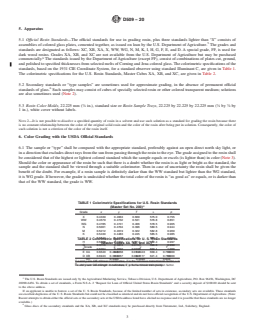
5.1 Offıcial Rosin Standards—The official standards for use in grading rosin, plus three standards lighter than “X” consists of
assemblies of colored glass plates, cemented together, as issued on loan by the U.S. Department of Agriculture. The grades and
standards are designated as follows: XC, XB, XA, X, WW, WG, N, M, K, I, H, G, F, E, and D. A special grade, FF, is used for
dark wood rosins. Grades XA, XB, and XC are not available from the U.S. Department of Agriculture but may be purchased
commercially. The standards issued by the Department of Agriculture (except FF), consist of combinations of plates cut, ground,
and polished to specified thicknesses from selected melts of Corning and Jena colored glass. The colorimetric specifications of the
standards, based on the 1931 CIE Coordinate System,
...