

ASTM D4872-14(2020)
(Test Method)Standard Test Method for Dielectric Testing of Wire and Cable Filling Compounds
General Information
- Abstract
SIGNIFICANCE AND USE
5.1 Dissipation factor, permittivity, and dc volume resistivity are properties of communication cable fillers and filler components that are controlled in order that the cable's electrical performance falls within its design limits. Relatively small amounts of contaminants, such as polar compounds, water, or salts degrade the cable's electrical properties. Limits on the dielectric properties of the cable filling compound are usually specified by the cable manufacturer, by industry standards or both.
SCOPE
1.1 This test method covers the determination of dissipation factor, permittivity (dielectric constant), and ac volume resistivity of wire and cable filling compounds and related materials that are solid at room temperature, but capable of being melted at elevated temperature.
1.2 Whenever two sets of values are presented, in different units, the values in the first set are the standard, while those in parentheses are for information only.
1.3 This standard does not purport to address all of the safety concerns, if any, associated with its use. It is the responsibility of the user of this standard to establish appropriate safety, health, and environmental practices and determine the applicability of regulatory limitations prior to use. Specific hazard statements are given in Section 7.
1.4 This international standard was developed in accordance with internationally recognized principles on standardization established in the Decision on Principles for the Development of International Standards, Guides and Recommendations issued by the World Trade Organization Technical Barriers to Trade (TBT) Committee.
- Status
- Published
- Publication Date
- 31-Jul-2020
- Technical Committee
- D09 - Electrical and Electronic Insulating Materials
- Drafting Committee
- D09.07 - Electrical Insulating Materials


Overview
ASTM D4872-14(2020) is the internationally recognized standard test method for dielectric testing of wire and cable filling compounds, developed by ASTM International. This standard provides procedures for determining essential electrical properties, including dissipation factor, permittivity (dielectric constant), and AC volume resistivity in wire and cable filling materials that are solid at room temperature but can be melted for testing. These measurements play a critical role in assessing the suitability of cable filling compounds for use in communication and electrical cables, directly impacting cable performance and reliability.
Key Topics
Dielectric Properties: The standard focuses on evaluating three key dielectric parameters:
- Dissipation factor: Measures energy loss from the insulating material.
- Permittivity (Dielectric Constant): Indicates the material’s ability to store electrical energy.
- AC Volume Resistivity: Assesses how well the material resists electrical flow.
Sample Preparation and Testing: The method describes the preparation of representative specimens, conditioning requirements, and the use of specialized equipment such as specimen dishes, cover electrodes, and temperature-controlled ovens to ensure consistent, reliable results.
Contaminant Sensitivity: Strict control of contaminants like water, salts, or polar compounds is emphasized, as even minimal amounts can degrade dielectric properties and cable performance.
Reporting Requirements: Includes guidelines on reporting test results, including measurements, material descriptions, conditioning methods, and calculation of dielectric properties.
Applications
ASTM D4872-14(2020) is crucial for manufacturers and testing laboratories involved in the production or quality control of wire and cable products. Typical practical applications include:
- Quality Assurance: Ensuring cable filling compounds used in communication cables meet industry and manufacturer dielectric standards.
- Material Comparison: Supporting the selection or approval of new materials and suppliers by providing objective dielectric property data.
- R&D in Cable Insulation: Aiding research and development projects focused on improving the electrical insulation and performance of new cable products.
- Compliance Testing: Demonstrating adherence to regulatory or contractual specifications for products intended for international markets.
By following this standard, organizations can verify that their filling compounds will not introduce unwanted electrical losses or compromise the reliability of cabling systems, especially for high-performance communication and power transmission cables.
Related Standards
For comprehensive wire and cable insulation testing, the following ASTM standards are frequently referenced alongside ASTM D4872-14(2020):
- ASTM D150: Test Methods for AC Loss Characteristics and Permittivity (Dielectric Constant) of Solid Electrical Insulation.
- ASTM D257: Test Methods for DC Resistance or Conductance of Insulating Materials.
- ASTM D1321: Test Method for Needle Penetration of Petroleum Waxes (useful in characterizing compound consistency).
- ASTM D6054: Practice for Conditioning Electrical Insulating Materials for Testing.
These related standards provide additional procedures for characterization and evaluation of electrical insulating materials used in the wire and cable industry.
Keywords: dielectric testing, cable filling compounds, dissipation factor, permittivity, dielectric constant, volume resistivity, wire insulation, communication cables, ASTM D4872, electrical testing standards, insulating materials.
Relations
- Effective Date
- 01-Mar-2024
- Effective Date
- 01-Dec-2023
- Effective Date
- 01-Jun-2016
- Effective Date
- 01-Nov-2015
- Effective Date
- 01-Nov-2014
- Effective Date
- 01-May-2014
- Effective Date
- 01-Nov-2013
- Effective Date
- 01-Aug-2011
- Effective Date
- 01-May-2008
- Effective Date
- 15-May-2007
- Refers
ASTM D257-99(2005) - Standard Test Methods for DC Resistance or Conductance of Insulating Materials - Effective Date
- 01-Sep-2005
- Effective Date
- 01-Nov-2004
- Effective Date
- 01-Mar-2004
- Effective Date
- 10-Nov-2002
- Effective Date
- 10-Sep-2002
Get Certified
Connect with accredited certification bodies for this standard

IMQ S.p.A. (Certification)
Italian electrical product certification.

SLG Prüf- und Zertifizierungs GmbH
German testing and certification body.

UL Solutions
Global safety science company with testing, inspection and certification.
Sponsored listings
Frequently Asked Questions
ASTM D4872-14(2020) is a standard published by ASTM International. Its full title is "Standard Test Method for Dielectric Testing of Wire and Cable Filling Compounds". This standard covers: SIGNIFICANCE AND USE 5.1 Dissipation factor, permittivity, and dc volume resistivity are properties of communication cable fillers and filler components that are controlled in order that the cable's electrical performance falls within its design limits. Relatively small amounts of contaminants, such as polar compounds, water, or salts degrade the cable's electrical properties. Limits on the dielectric properties of the cable filling compound are usually specified by the cable manufacturer, by industry standards or both. SCOPE 1.1 This test method covers the determination of dissipation factor, permittivity (dielectric constant), and ac volume resistivity of wire and cable filling compounds and related materials that are solid at room temperature, but capable of being melted at elevated temperature. 1.2 Whenever two sets of values are presented, in different units, the values in the first set are the standard, while those in parentheses are for information only. 1.3 This standard does not purport to address all of the safety concerns, if any, associated with its use. It is the responsibility of the user of this standard to establish appropriate safety, health, and environmental practices and determine the applicability of regulatory limitations prior to use. Specific hazard statements are given in Section 7. 1.4 This international standard was developed in accordance with internationally recognized principles on standardization established in the Decision on Principles for the Development of International Standards, Guides and Recommendations issued by the World Trade Organization Technical Barriers to Trade (TBT) Committee.
SIGNIFICANCE AND USE 5.1 Dissipation factor, permittivity, and dc volume resistivity are properties of communication cable fillers and filler components that are controlled in order that the cable's electrical performance falls within its design limits. Relatively small amounts of contaminants, such as polar compounds, water, or salts degrade the cable's electrical properties. Limits on the dielectric properties of the cable filling compound are usually specified by the cable manufacturer, by industry standards or both. SCOPE 1.1 This test method covers the determination of dissipation factor, permittivity (dielectric constant), and ac volume resistivity of wire and cable filling compounds and related materials that are solid at room temperature, but capable of being melted at elevated temperature. 1.2 Whenever two sets of values are presented, in different units, the values in the first set are the standard, while those in parentheses are for information only. 1.3 This standard does not purport to address all of the safety concerns, if any, associated with its use. It is the responsibility of the user of this standard to establish appropriate safety, health, and environmental practices and determine the applicability of regulatory limitations prior to use. Specific hazard statements are given in Section 7. 1.4 This international standard was developed in accordance with internationally recognized principles on standardization established in the Decision on Principles for the Development of International Standards, Guides and Recommendations issued by the World Trade Organization Technical Barriers to Trade (TBT) Committee.
ASTM D4872-14(2020) is classified under the following ICS (International Classification for Standards) categories: 29.035.01 - Insulating materials in general. The ICS classification helps identify the subject area and facilitates finding related standards.
ASTM D4872-14(2020) has the following relationships with other standards: It is inter standard links to ASTM D1711-24, ASTM D1321-23, ASTM D1321-16, ASTM D1711-15, ASTM D1711-14a, ASTM D1711-14, ASTM D1711-13, ASTM D1711-11a, ASTM D1711-08, ASTM D257-07, ASTM D257-99(2005), ASTM D1321-04, ASTM D150-98(2004), ASTM D1321-02a, ASTM D1321-02. Understanding these relationships helps ensure you are using the most current and applicable version of the standard.
ASTM D4872-14(2020) is available in PDF format for immediate download after purchase. The document can be added to your cart and obtained through the secure checkout process. Digital delivery ensures instant access to the complete standard document.
Standards Content (Sample)
This international standard was developed in accordance with internationally recognized principles on standardization established in the Decision on Principles for the
Development of International Standards, Guides and Recommendations issued by the World Trade Organization Technical Barriers to Trade (TBT) Committee.
Designation: D4872 − 14 (Reapproved 2020)
Standard Test Method for
Dielectric Testing of Wire and Cable Filling Compounds
This standard is issued under the fixed designation D4872; the number immediately following the designation indicates the year of
original adoption or, in the case of revision, the year of last revision. A number in parentheses indicates the year of last reapproval. A
superscript epsilon (´) indicates an editorial change since the last revision or reapproval.
1. Scope D1711 Terminology Relating to Electrical Insulation
D6054 Practice for Conditioning Electrical Insulating Mate-
1.1 This test method covers the determination of dissipation
rials for Testing (Withdrawn 2012)
factor, permittivity (dielectric constant), and ac volume resis-
tivity of wire and cable filling compounds and related materials
3. Terminology
that are solid at room temperature, but capable of being melted
3.1 Definitions:
at elevated temperature.
3.1.1 For definitions of terms used in this test method, refer
1.2 Whenever two sets of values are presented, in different
to Terminology D1711.
units, the values in the first set are the standard, while those in
parentheses are for information only.
4. Summary of Test Method
1.3 This standard does not purport to address all of the
4.1 Place a measured volume of melted sample, free of
safety concerns, if any, associated with its use. It is the
entrapped air, into a level preheated specimen dish. Allow the
responsibility of the user of this standard to establish appro-
specimen to cool and place primary and secondary electrodes
priate safety, health, and environmental practices and deter-
in uniform contact with the specimen surface. Connect test
mine the applicability of regulatory limitations prior to use.
leads to the specimen dish and the cover plate electrode; make
Specific hazard statements are given in Section 7.
measurements to obtain values from which dissipation factor,
1.4 This international standard was developed in accor-
permittivity, and dc volume resistivity are calculated.
dance with internationally recognized principles on standard-
ization established in the Decision on Principles for the
5. Significance and Use
Development of International Standards, Guides and Recom-
5.1 Dissipation factor, permittivity, and dc volume resistiv-
mendations issued by the World Trade Organization Technical
ity are properties of communication cable fillers and filler
Barriers to Trade (TBT) Committee.
components that are controlled in order that the cable’s
electrical performance falls within its design limits. Relatively
2. Referenced Documents
small amounts of contaminants, such as polar compounds,
2.1 ASTM Standards:
water, or salts degrade the cable’s electrical properties. Limits
D150 Test Methods forAC Loss Characteristics and Permit-
on the dielectric properties of the cable filling compound are
tivity (Dielectric Constant) of Solid Electrical Insulation
usually specified by the cable manufacturer, by industry
D257 Test Methods for DC Resistance or Conductance of
standards or both.
Insulating Materials
D1321 Test Method for Needle Penetration of Petroleum
6. Apparatus
Waxes
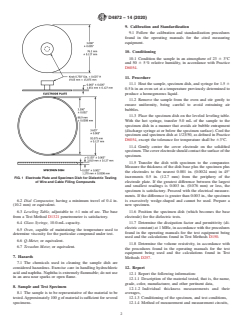
6.1 Specimen Dish and Cover Electrode, as shown in Fig. 1.
Use a gold- or nickel-plated specimen dish and cover electrode
plate to ensure a corrosion resistant, high conductivity surface.
This test method is under the jurisdiction of ASTM Committee D09 on
6.1.1 Clean the specimen dish and electrode plate of oxida-
Electrical and Electronic Insulating Materials and is the direct responsibility of
Subcommittee D09.07 on Electrical Insulating Materials.
tion by rinsing in a 5 % hydrochloric acid solution for a
Current edition approved Aug. 1, 2020. Published August 2020. Originally
maximum of 5 s, followed by distilled water, isopropyl alcohol
approved in 1988. Last previous edition approved in 2014 as D4872 – 14. DOI:
and,finally,byalowboilingpetroleumdistillate(naphtha)(see
10.1520/D4872-14R20.
Section 7). Alternatively (preferred), use an ultrasonic cleans-
For referenced ASTM standards, visit the ASTM website, www.astm.org, or
contact ASTM Customer Service at service@astm.org. For Annual Book of ASTM
ing bath. Store the dish and cover, wrapped in paper towels, in
Standards volume information, refer to the standard’s Document Summary page on
a desiccator or in an oven maintained at 50°C.
the ASTM website.
For referenced ASTM standards, visit the ASTM website, www.astm.org, or
contact ASTM Customer Service at service@astm.org. For Annual Book of ASTM
Standards volume information, refer to the standard’s Document Summary page on The last approved version of this historical standard is referenced on
the ASTM website. www.astm.org.
*A Summary of Changes section appears at the end of this standard
Copyright © ASTM International, 100 Barr Harbor Drive, PO Box C700, West Conshohocken, PA 19428-2959. United States
D4872 − 14 (2020)
9. Calibration and Standardization
9.1 Follow the calibration and standardizat
...