

ASTM F1646-16
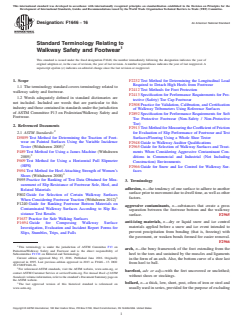
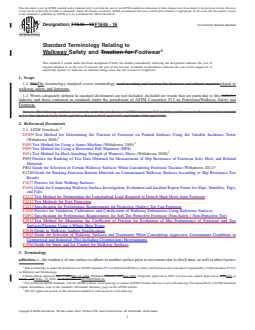
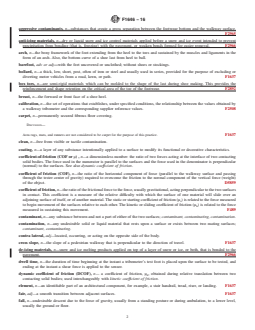
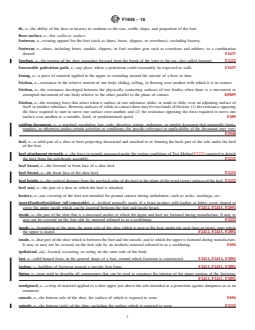
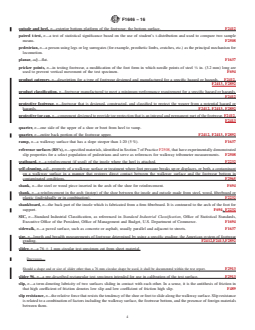
(Terminology)Standard Terminology Relating to Walkway Safety and Footwear
General Information
- Abstract
SCOPE
1.1 The terminology standard covers terminology related to walkway safety and footwear.
1.2 Words adequately defined in standard dictionaries are not included. Included are words that are particular to this industry and those contained in standards under the jurisdiction of ASTM Committee F13 on Pedestrian/Walkway Safety and Footwear.
- Status
- Published
- Publication Date
- 14-May-2016
- Technical Committee
- F13 - Pedestrian/Walkway Safety and Footwear
- Drafting Committee
- F13.91 - Editorial and Terminology
Overview
ASTM F1646-16: Standard Terminology Relating to Walkway Safety and Footwear is a key reference published by ASTM International to establish clear and consistent terms used in the fields of walkway safety and footwear. Developed under the jurisdiction of ASTM Committee F13 on Pedestrian/Walkway Safety and Footwear, this standard is essential for manufacturers, safety professionals, and anyone involved in the design, testing, and inspection of pedestrian walkways and related footwear.
This standard brings together industry-specific definitions and terms relevant to walkway traction, footwear safety features, and materials used in both personal protective equipment and pedestrian environments. The scope intentionally excludes terms adequately defined in general dictionaries, focusing instead on terms with specialized meanings within this sector.
Key Topics
ASTM F1646-16 provides comprehensive terminology covering the following key areas:
- Walkway Safety: Definitions related to slip resistance, friction, walkway surfaces, ramps, cross slopes, and contaminants that can affect pedestrian safety.
- Footwear Components: Terms describing shoes and boots, including heels, arches, insoles, outsoles, linings, protective toe caps, and box toes.
- Testing and Measurement: Vocabulary for instruments and methods, such as walkway tribometers, coefficient of friction (COF), and testing procedures for slip resistance.
- Environmental and Maintenance Factors: Terminology on aggressive contaminants, anti-icing and de-icing materials, and self-cleaning surfaces.
- General Pedestrian Safety: Descriptions of pedestrian paths, sidewalks, walkway hardware, and walkway auditor qualifications.
Understanding this terminology is vital for accurate communication across safety audits, product design, compliance efforts, and incident investigations within pedestrian environments.
Applications
ASTM F1646-16 is widely applied in standards development, manufacturing, safety management, and facility design. Practical applications include:
- Footwear Design and Testing: Ensures consistent language when specifying, testing, and certifying safety footwear, including both protective and soft-toe varieties.
- Walkway Design and Maintenance: Assists architects, engineers, and maintenance professionals in designing and evaluating safe pedestrian pathways, walkways, stairs, and ramps.
- Safety Compliance and Auditing: Provides a terminology framework for conducting safety audits, writing incident reports, and understanding requirements for slip resistance and other safety features.
- Regulatory and Legal Contexts: Supports consistency in regulatory documentation, compliance reports, and legal proceedings involving slips, trips, and falls.
By utilizing these terms, stakeholders improve safety, reduce the risk of accidents, and facilitate compliance with occupational safety and public walkway standards.
Related Standards
Several related ASTM standards are referenced in ASTM F1646-16, providing test methods, guidelines, and practices that complement the terminology:
- ASTM F1637 - Practice for Safe Walking Surfaces
- ASTM F609 - Test Method for Using a Horizontal Pull Slipmeter (HPS) for slip resistance
- ASTM F2913 - Test Method for Measuring the Coefficient of Friction for Footwear and Test Surfaces
- ASTM F2508 - Practice for Validation, Calibration, and Certification of Walkway Tribometers
- ASTM F2412 & F2413 - Performance requirements and test methods for protective footwear
- ASTM F1240 - Guide for Ranking Footwear Bottom Materials on Contaminated Walkway Surfaces
- ASTM F2948 - Guide to Walkway Auditor Qualifications
Consulting these referenced documents, in conjunction with ASTM F1646-16, provides a thorough understanding of pedestrian safety, slip resistance, and footwear design terminology, contributing to safer environments and standardized communication throughout the industry.
Relations
- Effective Date
- 15-May-2016
- Effective Date
- 01-Feb-2020
- Effective Date
- 01-Aug-2018
- Effective Date
- 01-Feb-2018
- Effective Date
- 01-Nov-2017
- Effective Date
- 01-Nov-2017
- Effective Date
- 01-Sep-2017
- Effective Date
- 01-Jul-2016
- Effective Date
- 01-May-2015
- Effective Date
- 01-Jun-2014
- Effective Date
- 01-Aug-2013
- Effective Date
- 01-Jul-2013
- Effective Date
- 01-Apr-2013
- Effective Date
- 01-Nov-2012
- Effective Date
- 15-Oct-2012
Frequently Asked Questions
ASTM F1646-16 is a standard published by ASTM International. Its full title is "Standard Terminology Relating to Walkway Safety and Footwear". This standard covers: SCOPE 1.1 The terminology standard covers terminology related to walkway safety and footwear. 1.2 Words adequately defined in standard dictionaries are not included. Included are words that are particular to this industry and those contained in standards under the jurisdiction of ASTM Committee F13 on Pedestrian/Walkway Safety and Footwear.
SCOPE 1.1 The terminology standard covers terminology related to walkway safety and footwear. 1.2 Words adequately defined in standard dictionaries are not included. Included are words that are particular to this industry and those contained in standards under the jurisdiction of ASTM Committee F13 on Pedestrian/Walkway Safety and Footwear.
ASTM F1646-16 is classified under the following ICS (International Classification for Standards) categories: 01.040.61 - Clothing industry (Vocabularies); 61.020 - Clothes. The ICS classification helps identify the subject area and facilitates finding related standards.
ASTM F1646-16 has the following relationships with other standards: It is inter standard links to ASTM F1646-13, ASTM F2232-14(2020), ASTM F2412-18a, ASTM F2412-18, ASTM F2892-17, ASTM F2413-17, ASTM F2913-17, ASTM F2508-16, ASTM F2508-15, ASTM F2232-14, ASTM F1637-13, ASTM F2966-13, ASTM F2508-13, ASTM F2508-12a, ASTM F2508-12. Understanding these relationships helps ensure you are using the most current and applicable version of the standard.
ASTM F1646-16 is available in PDF format for immediate download after purchase. The document can be added to your cart and obtained through the secure checkout process. Digital delivery ensures instant access to the complete standard document.
Standards Content (Sample)
This international standard was developed in accordance with internationally recognized principles on standardization established in the Decision on Principles for the
Development of International Standards, Guides and Recommendations issued by the World Trade Organization Technical Barriers to Trade (TBT) Committee.
Designation: F1646 − 16 An American National Standard
Standard Terminology Relating to
Walkway Safety and Footwear
This standard is issued under the fixed designation F1646; the number immediately following the designation indicates the year of
original adoption or, in the case of revision, the year of last revision. A number in parentheses indicates the year of last reapproval. A
superscript epsilon (´) indicates an editorial change since the last revision or reapproval.
1. Scope F2232 Test Method for Determining the Longitudinal Load
Required to Detach High Heels from Footwear
1.1 The terminology standard covers terminology related to
F2412 Test Methods for Foot Protection
walkway safety and footwear.
F2413 Specification for Performance Requirements for Pro-
1.2 Words adequately defined in standard dictionaries are
tective (Safety) Toe Cap Footwear
not included. Included are words that are particular to this
F2508 Practice for Validation, Calibration, and Certification
industryandthosecontainedinstandardsunderthejurisdiction
of Walkway Tribometers Using Reference Surfaces
of ASTM Committee F13 on Pedestrian/Walkway Safety and
F2892 Specification for Performance Requirements for Soft
Footwear.
Toe Protective Footwear (Non-Safety / Non-Protective
Toe)
2. Referenced Documents
F2913 TestMethodforMeasuringtheCoefficientofFriction
2.1 ASTM Standards:
for Evaluation of Slip Performance of Footwear and Test
D5859 Test Method for Determining the Traction of Foot-
Surfaces/Flooring Using a Whole Shoe Tester
wear on Painted Surfaces Using the Variable Incidence
F2948 Guide to Walkway Auditor Qualifications
Tester (Withdrawn 2005)
F2965 Guide for Selection of Walkway Surfaces and Treat-
F489 Test Method for Using a James Machine (Withdrawn
ments When Considering Aggressive Contaminant Con-
2005)
ditions in Commercial and Industrial (Not Including
F609 Test Method for Using a Horizontal Pull Slipmeter
Construction) Environments
(HPS)
F2966 Guide for Snow and Ice Control for Walkway Sur-
F694 Test Method for Heel-Attaching Strength of Women’s
faces
Shoes (Withdrawn 2008)
F695 Practice for Ranking of Test Data Obtained for Mea-
3. Terminology
surement of Slip Resistance of Footwear Sole, Heel, and
adhesion, n—the tendency of one surface to adhere to another
Related Materials
surfacepriortomovementduetodwelltime,aswellasother
F802 Guide for Selection of Certain Walkway Surfaces
3 factors.
When Considering Footwear Traction (Withdrawn 2012)
F1240 Guide for Ranking Footwear Bottom Materials on
aggressive contaminants, n—substances that create a gross
Contaminated Walkway Surfaces According to Slip Re-
separation between the footwear bottom and the walkway
sistance Test Results
surface. F2965
F1637 Practice for Safe Walking Surfaces
anti-icing materials, n—dry or liquid snow and ice control
F1694 Guide for Composing Walkway Surface
materials applied before a snow and ice event intended to
Investigation, Evaluation and Incident Report Forms for
prevent precipitation from bonding (that is, freezing) with
Slips, Stumbles, Trips, and Falls
the pavement, or weaken bonds formed for easier removal.
F2966
This terminology is under the jurisdiction of ASTM Committee F13 on
arch, n—the bony framework of the foot extending from the
Pedestrian/Walkway Safety and Footwear and is the direct responsibility of
heel to the toes and sustained by the muscles and ligaments
Subcommittee F13.91 on Editorial and Terminology.
Current edition approved May 15, 2016. Published June 2016. Originally
in the form of an arch.Also, the bottom curve of a shoe last
approved in 1995. Last previous edition approved in 2013 as F1646 – 13. DOI:
from heel to ball.
10.1520/F1646-16.
For referenced ASTM standards, visit the ASTM website, www.astm.org, or
barefoot, adv or adj—with the feet uncovered or unclothed;
contact ASTM Customer Service at service@astm.org. For Annual Book of ASTM
without shoes or stockings.
Standards volume information, refer to the standard’s Document Summary page on
the ASTM website.
bollard, n—a thick, low, short, post, often of iron or steel and
The last approved version of this historical standard is referenced on
www.astm.org. usually used in series, provided for the purpose of excluding
Copyright © ASTM International, 100 Barr Harbor Drive, PO Box C700, West Conshohocken, PA 19428-2959. United States
F1646 − 16
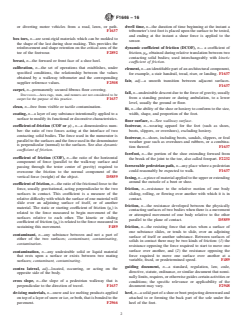
or diverting motor vehicles from a road, lawn, or path. dwell time, n—the duration of time beginning at the instant a
F1637 tribometer’s test foot is placed upon the surface to be tested,
and ending at the instant a shear force is applied to the
box toes, n—are semi-rigid materials which can be molded to
sensor.
the shape of the last during shoe making. This provides the
dynamic coefficient of friction (DCOF), n— a coefficient of
reinforcement and shape retention on the critical area of the
friction, µ , obtained during relative translation between two
toe of the footwear. F2892
d
contacting solid bodies; used interchangeably with kinetic
breast, n—the forward or front face of a shoe heel.
coeffıcient of friction.
calibration, n—the set of operations that establishes, under
element, n—an identifiable part of an architectural component,
specified conditions, the relationship between the values
for example, a stair handrail, tread, riser, or landing. F1637
obtained by a walkway tribometer and the corresponding
fair, adj—a smooth transition between adjacent surfaces.
supplier reference values. F2508
F1637
carpet, n—permanently secured fibrous floor covering.
fall, n—undesirable descent due to the force of gravity, usually
DISCUSSION—Area rugs, mats, and runners are not considered to be
from a standing posture or during ambulation, to a lower
carpet for the purpose of this practice. F1637
level, usually the ground or floor.
clean, n—free from visible or tactile contamination.
fit, n—the ability of the shoe or hosiery to conform to the size,
coating, n—a layer of any substance intentionally applied to a
width, shape, and proportion of the foot.
surface to modify its functional or decorative characteristics.
floor surface, n—See walkway surface.
footwear, n—wearing apparel for the feet (such as shoes,
coefficient-of-friction (COF or µ), n—a dimensionless num-
boots, slippers, or overshoes), excluding hosiery.
ber: the ratio of two forces acting at the interface of two
contacting solid bodies. The force used in the numerator is
footwear, n—shoes, including boots, sandals, slippers, or foul
paralleltothesurfacesandtheforceusedinthedenominator
weather gear such as overshoes and rubbers, or a combina-
is perpendicular (normal) to the surfaces. See also dynamic
tion thereof. F1637
coeffıcient of friction.
forefoot, n—the portion of the shoe extending forward from
coefficient of friction (COF), n—the ratio of the horizontal
the break of the joint to the toe, also called forepart. F2232
component of force (parallel to the walkway surface and
foreseeable pedestrian path, n—any place where a pedestrian
passing through the tester center of gravity) required to
could reasonably be expected to walk. F1637
overcome the friction to the normal component of the
vertical force (weight) of the object. D5859
foxing, n—apieceofmaterialappliedtotheupperorextending
around the outsole of a boot or shoe.
coefficient of friction, n—the ratio of the frictional force to the
force, usually gravitational, acting perpendicular to the two
friction, n—resistance to the relative motion of one body
surfaces in contact. This coefficient is a measure of the sliding, rolling, or flowing over another with which it is in
relative difficulty with which the surface of one material will
contact.
slide over an adjoining surface of itself, or of another
friction, n—the resistance developed between the physically
material. The static or starting coefficient of friction (µ)is
s
contacting surfaces of two bodies when there is a movement
related to the force measured to begin movement of the
or attempted movement of one body relative to the other
surfaces relative to each other. The kinetic or sliding
parallel to the plane of contact. D5859
coefficient of friction (µ ) is related to the force measured in
k
sustaining this movement. F489 friction, n—the resisting force that arises when a surface of
one substance slides, or tends to slide, over an adjoining
contaminant, n—any substance between and not a part of
surface of itself or another substance. Between surfaces of
either of the two surfaces; contaminant, contaminating,
solids in contact there may be two kinds of friction: (1) the
contamination.
resistance opposing the force required to start to move one
surface over another, and (2) the resistance opposing the
contamination, n—any undesirable solid or liquid material
force required to move one surface over another at a
that rests upon a surface or exists between two mating
variable, fixed, or predetermined speed. F489
surfaces; contaminant, contaminating.
guiding document, n—a standard, regulation, law, code,
contra lateral, adj—located, occurring, or acting on the
directive, statute, ordinance, or similar document that nomi-
opposite side of the body.
nallylimits,requires,orotherwiseguidescertainactivitiesor
cross slope, n—the slope of a pedestrian walkway that is
conditions; the specific relevance or applicability of the
perpendicular to the direction of travel. F1637
document may vary. F2948
de-icing materials, n—snow and ice melting products applied heel, n—asolidpartofashoeorbootprojectingdownwardand
ontopofalayerofsnoworice,orboth,thatisbondedtothe attached to or forming the back part of the sole under the
pavement. F2966 heel of the foot.
F1646 − 16
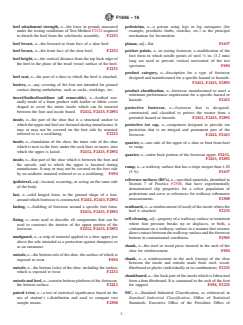
heel attachment strength, n—the force in pounds measured pedestrian, n—a person using legs or leg surrogates (for
under the testing conditions of Test Method F2232 required example, prosthetic limbs, crutches, etc.) as the principal
to detach the heel from the sole/insole assembly. F2232 mechanism for locomotion.
planar, adj—flat. F1637
heel breast, n—the forward or front face of a shoe heel.
pricker points, n—in testing footwear, a modification of the
heel breast
...
This document is not an ASTM standard and is intended only to provide the user of an ASTM standard an indication of what changes have been made to the previous version. Because
it may not be technically possible to adequately depict all changes accurately, ASTM recommends that users consult prior editions as appropriate. In all cases only the current version
of the standard as published by ASTM is to be considered the official document.
Designation: F1646 − 13 F1646 − 16 An American National Standard
Standard Terminology Relating to
Walkway Safety and Traction for Footwear
This standard is issued under the fixed designation F1646; the number immediately following the designation indicates the year of
original adoption or, in the case of revision, the year of last revision. A number in parentheses indicates the year of last reapproval. A
superscript epsilon (´) indicates an editorial change since the last revision or reapproval.
1. Scope
1.1 ThisThe terminology standard covers terminology used in safety and traction for footwear and related material.related to
walkway safety and footwear.
1.2 Words adequately defined in standard dictionaries are not included. Included are words that are particular to this industry.
industry and those contained in standards under the jurisdiction of ASTM Committee F13 on Pedestrian/Walkway Safety and
Footwear.
NOTE 1—The following standards are currently under the jurisdiction of ASTM Committee F13 on Safety and Traction for Footwear and are included
in 2.1: Test Methods F489, F609, and F694; Practices F695 and F1637; and Guides F802 and F1240.
2. Referenced Documents
2.1 ASTM Standards:
D5859 Test Method for Determining the Traction of Footwear on Painted Surfaces Using the Variable Incidence Tester
(Withdrawn 2005)
F489 Test Method for Using a James Machine (Withdrawn 2005)
F609 Test Method for Using a Horizontal Pull Slipmeter (HPS)
F694 Test Method for Heel-Attaching Strength of Women’s Shoes (Withdrawn 2008)
F695 Practice for Ranking of Test Data Obtained for Measurement of Slip Resistance of Footwear Sole, Heel, and Related
Materials
F802 Guide for Selection of Certain Walkway Surfaces When Considering Footwear Traction (Withdrawn 2012)
F1240 Guide for Ranking Footwear Bottom Materials on Contaminated Walkway Surfaces According to Slip Resistance Test
Results
F1637 Practice for Safe Walking Surfaces
F1694 Guide for Composing Walkway Surface Investigation, Evaluation and Incident Report Forms for Slips, Stumbles, Trips,
and Falls
F2232 Test Method for Determining the Longitudinal Load Required to Detach High Heels from Footwear
F2412 Test Methods for Foot Protection
F2413 Specification for Performance Requirements for Protective (Safety) Toe Cap Footwear
F2508 Practice for Validation, Calibration, and Certification of Walkway Tribometers Using Reference Surfaces
F2892 Specification for Performance Requirements for Soft Toe Protective Footwear (Non-Safety / Non-Protective Toe)
F2913 Test Method for Measuring the Coefficient of Friction for Evaluation of Slip Performance of Footwear and Test
Surfaces/Flooring Using a Whole Shoe Tester
F2948 Guide to Walkway Auditor Qualifications
F2965 Guide for Selection of Walkway Surfaces and Treatments When Considering Aggressive Contaminant Conditions in
Commercial and Industrial (Not Including Construction) Environments
F2966 Guide for Snow and Ice Control for Walkway Surfaces
3. Terminology
adhesion, n—the tendency of one surface to adhere to another surface prior to movement due to dwell time, as well as other factors.
This terminology is under the jurisdiction of ASTM Committee F13 on Pedestrian/Walkway Safety and Footwear and is the direct responsibility of Subcommittee F13.91
on Editorial and Terminology.
Current edition approved Jan. 1, 2013May 15, 2016. Published February 2013June 2016. Originally approved in 1995. Last previous edition approved in 20122013 as
F1646 – 12.F1646 – 13. DOI: 10.1520/F1646-13.10.1520/F1646-16.
For referenced ASTM standards, visit the ASTM website, www.astm.org, or contact ASTM Customer Service at service@astm.org. For Annual Book of ASTM Standards
volume information, refer to the standard’s Document Summary page on the ASTM website.
The last approved version of this historical standard is referenced on www.astm.org.
Copyright © ASTM International, 100 Barr Harbor Drive, PO Box C700, West Conshohocken, PA 19428-2959. United States
F1646 − 16
aggressive contaminants, n—substances that create a gross separation between the footwear bottom and the walkway surface.
F2965
anti-icing materials, n—dry or liquid snow and ice control materials applied before a snow and ice event intended to prevent
precipitation from bonding (that is, freezing) with the pavement, or weaken bonds formed for easier removal. F2966
arch, n—the bony framework of the foot extending from the heel to the toes and sustained by the muscles and ligaments in the
form of an arch. Also, the bottom curve of a shoe last from heel to ball.
barefoot, adv or adj—with the feet uncovered or unclothed; without shoes or stockings.
bollard, n—a thick, low, short, post, often of iron or steel and usually used in series, provided for the purpose of excluding or
diverting motor vehicles from a road, lawn, or path. F1637
box toes, n—are semi-rigid materials which can be molded to the shape of the last during shoe making. This provides the
reinforcement and shape retention on the critical area of the toe of the footwear. F2892
breast, n—the forward or front face of a shoe heel.
calibration, n—the set of operations that establishes, under specified conditions, the relationship between the values obtained by
a walkway tribometer and the corresponding supplier reference values. F2508
carpet, n—permanently secured fibrous floor covering.
DISCUSSION—
Area rugs, mats, and runners are not considered to be carpet for the purpose of this practice. F1637
clean, n—free from visible or tactile contamination.
coating, n—a layer of any substance intentionally applied to a surface to modify its functional or decorative characteristics.
coefficient-of-friction (COF or μ) , n—a dimensionless number: the ratio of two forces acting at the interface of two contacting
solid bodies. The force used in the numerator is parallel to the surfaces and the force used in the denominator is perpendicular
(normal) to the surfaces. See also dynamic coeffıcient of friction.
coefficient of friction (COF), n—the ratio of the horizontal component of force (parallel to the walkway surface and passing
through the tester center of gravity) required to overcome the friction to the normal component of the vertical force (weight)
of the object. D5859
coefficient of friction, n—the ratio of the frictional force to the force, usually gravitational, acting perpendicular to the two surfaces
in contact. This coefficient is a measure of the relative difficulty with which the surface of one material will slide over an
adjoining surface of itself, or of another material. The static or starting coefficient of friction (μ ) is related to the force measured
s
to begin movement of the surfaces relative to each other. The kinetic or sliding coefficient of friction (μ ) is related to the force
k
measured in sustaining this movement. F489
contaminant, n—any substance between and not a part of either of the two surfaces; contaminant, contaminating, contamination.
contamination, n—any undesirable solid or liquid material that rests upon a surface or exists between two mating surfaces;
contaminant, contaminating.
contra lateral, adj—located, occurring, or acting on the opposite side of the body.
cross slope, n—the slope of a pedestrian walkway that is perpendicular to the direction of travel. F1637
de-icing materials, n—snow and ice melting products applied on top of a layer of snow or ice, or both, that is bonded to the
pavement. F2966
dwell time, n—the duration of time beginning at the instant a tribometer’s test foot is placed upon the surface to be tested, and
ending at the instant a shear force is applied to the sensor.
dynamic coefficient of friction (DCOF), n— a coefficient of friction, μ , obtained during relative translation between two
d
contacting solid bodies; used interchangeably with kinetic coeffıcient of friction.
element, n—an identifiable part of an architectural component, for example, a stair handrail, tread, riser, or landing. F1637
fair, adj—a smooth transition between adjacent surfaces. F1637
fall, n—undesirable descent due to the force of gravity, usually from a standing posture or during ambulation, to a lower level,
usually the ground or floor.
F1646 − 16
fit, n—the ability of the shoe or hosiery to conform to the size, width, shape, and proportion of the foot.
floor surface, n—See walkway surface.
footwear, n—wearing apparel for the feet (such as shoes, boots, slippers, or overshoes), excluding hosiery.
footwear, n—shoes, including boots, sandals, slippers, or foul weather gear such as overshoes and rubbers, or a combination
thereof. F1637
forefoot, n—the portion of the shoe extending forward from the break of the joint to the toe, also called forepart. F2232
foreseeable pedestrian path, n—any place where a pedestrian could reasonably be expected to walk. F1637
foxing, n—a piece of material applied to the upper or extending around the outsole of a boot or shoe.
friction, n—resistance to the relative motion of one body sliding, rolling, or flowing over another with which it is in contact.
friction, n—the resistance developed between the physically contacting surfaces of two bodies when there is a movement or
attempted movement of one body relative to the other parallel to the plane of contact. D5859
friction, n—the resisting force that arises when a surface of one substance slides, or tends to slide, over an adjoining surface of
itself or another substance. Between surfaces of solids in contact there may be two kinds of friction: (1) the resistance opposing
the force required to start to move one surface over another, and (2) the resistance opposing the force required to move one
surface over another at a variable, fixed, or predetermined speed. F489
guiding document, n—a standard, regulation, law, code, directive, statute, ordinance, or similar document that nominally limits,
requires, or otherwise guides certain activities or conditions; the specific relevance or applicability of the document may vary.
F2948
heel, n—a solid part of a shoe or boot projecting downward and attached to or forming the back part of the sole under the heel
of the foot.
heel attachment strength, n—the force in pounds measured under the testing conditions of Test Method F2232 required to detach
the heel from the sole/insole assembly. F2232
heel breast, n—the forward or front face of a shoe heel.
h
...