

ASTM C1402-17
(Guide)Standard Guide for High-Resolution Gamma-Ray Spectrometry of Soil Samples
General Information
- Abstract
SIGNIFICANCE AND USE
5.1 Gamma-ray spectrometry of soil samples is used to identify and quantify certain gamma-ray emitting radionuclides. Use of a germanium semiconductor detector is necessary for high-resolution gamma-ray measurements.
5.2 Much of the data acquisition and analysis can be automated with the use of commercially available systems that include both hardware and software. For a general description of the typical hardware in more detail than discussed in Section 7, see Ref (19). For best practices on set-up, calibration, and quality control of utilized spectrometry systems, see Practice D7282.
5.3 Both qualitative and quantitative analyses may be performed using the same measurement data.
5.4 The procedures described in this guide may be used for a wide variety of activity levels, from natural background levels and fallout-type problems, to determining the effectiveness of cleanup efforts after a spill or an industrial accident, to tracing contamination at older production sites, where wastes were purposely disposed of in soil. In some cases, the combination of radionuclide identities and concentration ratios can be used to determine the source of the radioactive materials.
5.5 Collecting samples and bringing them to a data acquisition system for analysis may be used as the primary method to detect deposition of radionuclides in soil. For obtaining a representative set of samples that cover a particular area, see Practice C998. Soil can also be measured by taking the data acquisition system to the field and measuring the soil in place (in situ). In situ measurement techniques are not discussed in this guide.
SCOPE
1.1 This guide covers the identification and quantitative determination of gamma-ray emitting radionuclides in soil samples by means of gamma-ray spectrometry. It is applicable to nuclides emitting gamma rays with an approximate energy range of 20 to 2000 keV. For typical gamma-ray spectrometry systems and sample types, activity levels of about 5 Bq (135 pCi) are measured easily for most nuclides, and activity levels as low as 0.1 Bq (2.7 pCi) can be measured for many nuclides. It is not applicable to radionuclides that emit no gamma rays such as the pure beta-emitting radionuclides hydrogen-3, carbon-14, strontium-90, and becquerel quantities of most transuranics. This guide does not address the in situ measurement techniques, where soil is analyzed in place without sampling. Guidance for in situ techniques can be found in Ref (1) and (2).2 This guide also does not discuss methods for determining lower limits of detection. Such discussions can be found in Refs (3), (4), (5) , and (6).
1.2 This guide can be used for either quantitative or relative determinations. For quantitative assay, the results are expressed in terms of absolute activities or activity concentrations of the radionuclides found to be present. This guide may also be used for qualitative identification of the gamma-ray emitting radionuclides in soil without attempting to quantify their activities. It can also be used to only determine their level of activities relative to each other but not in an absolute sense. General information on radioactivity and its measurement may be found in Refs (7), (8), (9), (10) , and (11) and Standard Test Methods E181. Information on specific applications of gamma-ray spectrometry is also available in Refs (12) or (13). Practice D3649 may be a valuable source of information.
1.3 The values stated in SI units are to be regarded as standard. No other units of measurement are included in this standard.
1.4 This standard may involve hazardous material, operations, and equipment. This standard does not purport to address all of the safety concerns, if any, associated with its use. It is the responsibility of the user of this standard to establish appropriate safety and health practices and determine the applicability of regulatory limitations prior to use.
1.5 This inter...
- Status
- Published
- Publication Date
- 31-May-2017
- Technical Committee
- C26 - Nuclear Fuel Cycle
- Drafting Committee
- C26.05 - Methods of Test
Overview
ASTM C1402-17: Standard Guide for High-Resolution Gamma-Ray Spectrometry of Soil Samples provides comprehensive guidance for identifying and quantitatively determining gamma-ray emitting radionuclides in soil samples. High-resolution gamma-ray spectrometry, particularly using germanium semiconductor detectors, is critical for accurate measurement in environmental, industrial, and nuclear site assessments. The guide addresses sample preparation, system calibration, measurement procedures, and interpretation of results, ensuring reliable data for regulatory compliance, risk assessment, and remediation verification tasks.
Gamma-ray spectrometry is applicable to radionuclides emitting gamma rays in the energy range of approximately 20 to 2000 keV and enables detection of activity levels from natural background to elevated contamination. The method is not suitable for pure beta emitters or for in situ soil analysis.
Key Topics
- Identification and Quantification: The guide details methods to identify radionuclides by comparing observed gamma-ray energies to library references and to quantify their activity through calibrated measurements.
- Instrument Requirements: Emphasis is placed on the use of high-resolution germanium detectors, multichannel analyzers, and shielded sample holders to minimize background interference and optimize accuracy.
- Calibration and Quality Control: Essential procedures for energy, shape, and efficiency calibrations are outlined, including the use of NIST-traceable sources and regular performance checks to ensure measurement reliability.
- Sample Handling: Standards for reproducible soil sample geometry, container selection, and sample preparation are specified to maintain data integrity. Precautions for volatile radionuclides and high-beta activity samples are also included.
- Data Analysis: The guide provides systematic calculation protocols for net peak areas, background subtraction, and uncertainty evaluation, enabling both qualitative and quantitative radionuclide analysis.
- Interferences and Corrections: Addresses challenges such as overlapping peaks, coincidence summing, and matrix attenuation, with recommendations for correction and mitigation to improve measurement precision and reduce bias.
Applications
- Environmental Monitoring: Utilized for routine assessment of radionuclide distribution and concentration in soils around nuclear facilities, waste sites, and in response to radiological incidents.
- Remediation Verification: Critical in evaluating the effectiveness of soil decontamination and cleanup operations, confirming that radionuclide levels meet regulatory limits.
- Historical Site Assessment: Applied in tracing legacy contamination from prior industrial or nuclear activities, identifying both source and spread of radioactive materials.
- Regulatory Compliance: Supports documentation for compliance with environmental and safety regulations by providing standardized measurement and reporting of gamma-emitting radionuclides.
- Research and Development: Facilitates studies on natural and anthropogenic radionuclide behavior in terrestrial environments, supporting both academic and applied investigations.
Related Standards
- ASTM C998: Practice for Sampling Surface Soil for Radionuclides
- ASTM C999: Practice for Soil Sample Preparation for the Determination of Radionuclides
- ASTM C1009: Guide for Establishing and Maintaining a Quality Assurance Program for Analytical Laboratories Within the Nuclear Industry
- ASTM D3649: Practice for High-Resolution Gamma-Ray Spectrometry of Water
- ASTM D7282: Practice for Set-up, Calibration, and Quality Control of Instruments Used for Radioactivity Measurements
- ASTM E181: Test Methods for Detector Calibration and Analysis of Radionuclides
- ANSI N42.14: Calibration and Use of Germanium Spectrometers for the Measurement of Gamma-Ray Emission Rates of Radionuclides
For additional terminology and measurement practices, refer to ASTM C859 and IEEE/ASTM SI-10, which support consistent application of the International System of Units (SI).
ASTM C1402-17 is a valuable resource for professionals involved in environmental radiological assessment, nuclear decommissioning, and laboratory analysis, offering a robust framework for high-resolution gamma-ray spectrometry of soil samples. Proper implementation ensures accurate, reproducible, and defensible results essential for environmental protection and public health.
Relations
- Replaces
ASTM C1402-04(2009) - Standard Guide for High-Resolution Gamma-Ray Spectrometry of Soil Samples - Effective Date
- 01-Jun-2017
- Effective Date
- 01-Jan-2024
- Refers
ASTM C999-17 - Standard Practice for Soil Sample Preparation for the Determination of Radionuclides - Effective Date
- 01-Jun-2017
- Effective Date
- 01-Jun-2017
- Effective Date
- 15-Jun-2014
- Effective Date
- 15-Jan-2014
- Effective Date
- 01-Jun-2013
- Effective Date
- 01-May-2013
- Effective Date
- 01-Jan-2013
- Effective Date
- 01-Nov-2010
- Effective Date
- 01-Aug-2010
- Effective Date
- 01-Jun-2010
- Effective Date
- 01-Jun-2010
- Effective Date
- 01-Feb-2010
- Effective Date
- 01-Jan-2010
Get Certified
Connect with accredited certification bodies for this standard

CIS Institut d.o.o.
Personal Protective Equipment (PPE) certification body. Notified Body NB-2890 for EU Regulation 2016/425 PPE.

Kiwa BDA Testing
Building and construction product certification.
Kmetijski inštitut Slovenije
Agricultural Institute of Slovenia. Soil testing, plant health, agricultural product analysis.
Sponsored listings
Frequently Asked Questions
ASTM C1402-17 is a guide published by ASTM International. Its full title is "Standard Guide for High-Resolution Gamma-Ray Spectrometry of Soil Samples". This standard covers: SIGNIFICANCE AND USE 5.1 Gamma-ray spectrometry of soil samples is used to identify and quantify certain gamma-ray emitting radionuclides. Use of a germanium semiconductor detector is necessary for high-resolution gamma-ray measurements. 5.2 Much of the data acquisition and analysis can be automated with the use of commercially available systems that include both hardware and software. For a general description of the typical hardware in more detail than discussed in Section 7, see Ref (19). For best practices on set-up, calibration, and quality control of utilized spectrometry systems, see Practice D7282. 5.3 Both qualitative and quantitative analyses may be performed using the same measurement data. 5.4 The procedures described in this guide may be used for a wide variety of activity levels, from natural background levels and fallout-type problems, to determining the effectiveness of cleanup efforts after a spill or an industrial accident, to tracing contamination at older production sites, where wastes were purposely disposed of in soil. In some cases, the combination of radionuclide identities and concentration ratios can be used to determine the source of the radioactive materials. 5.5 Collecting samples and bringing them to a data acquisition system for analysis may be used as the primary method to detect deposition of radionuclides in soil. For obtaining a representative set of samples that cover a particular area, see Practice C998. Soil can also be measured by taking the data acquisition system to the field and measuring the soil in place (in situ). In situ measurement techniques are not discussed in this guide. SCOPE 1.1 This guide covers the identification and quantitative determination of gamma-ray emitting radionuclides in soil samples by means of gamma-ray spectrometry. It is applicable to nuclides emitting gamma rays with an approximate energy range of 20 to 2000 keV. For typical gamma-ray spectrometry systems and sample types, activity levels of about 5 Bq (135 pCi) are measured easily for most nuclides, and activity levels as low as 0.1 Bq (2.7 pCi) can be measured for many nuclides. It is not applicable to radionuclides that emit no gamma rays such as the pure beta-emitting radionuclides hydrogen-3, carbon-14, strontium-90, and becquerel quantities of most transuranics. This guide does not address the in situ measurement techniques, where soil is analyzed in place without sampling. Guidance for in situ techniques can be found in Ref (1) and (2).2 This guide also does not discuss methods for determining lower limits of detection. Such discussions can be found in Refs (3), (4), (5) , and (6). 1.2 This guide can be used for either quantitative or relative determinations. For quantitative assay, the results are expressed in terms of absolute activities or activity concentrations of the radionuclides found to be present. This guide may also be used for qualitative identification of the gamma-ray emitting radionuclides in soil without attempting to quantify their activities. It can also be used to only determine their level of activities relative to each other but not in an absolute sense. General information on radioactivity and its measurement may be found in Refs (7), (8), (9), (10) , and (11) and Standard Test Methods E181. Information on specific applications of gamma-ray spectrometry is also available in Refs (12) or (13). Practice D3649 may be a valuable source of information. 1.3 The values stated in SI units are to be regarded as standard. No other units of measurement are included in this standard. 1.4 This standard may involve hazardous material, operations, and equipment. This standard does not purport to address all of the safety concerns, if any, associated with its use. It is the responsibility of the user of this standard to establish appropriate safety and health practices and determine the applicability of regulatory limitations prior to use. 1.5 This inter...
SIGNIFICANCE AND USE 5.1 Gamma-ray spectrometry of soil samples is used to identify and quantify certain gamma-ray emitting radionuclides. Use of a germanium semiconductor detector is necessary for high-resolution gamma-ray measurements. 5.2 Much of the data acquisition and analysis can be automated with the use of commercially available systems that include both hardware and software. For a general description of the typical hardware in more detail than discussed in Section 7, see Ref (19). For best practices on set-up, calibration, and quality control of utilized spectrometry systems, see Practice D7282. 5.3 Both qualitative and quantitative analyses may be performed using the same measurement data. 5.4 The procedures described in this guide may be used for a wide variety of activity levels, from natural background levels and fallout-type problems, to determining the effectiveness of cleanup efforts after a spill or an industrial accident, to tracing contamination at older production sites, where wastes were purposely disposed of in soil. In some cases, the combination of radionuclide identities and concentration ratios can be used to determine the source of the radioactive materials. 5.5 Collecting samples and bringing them to a data acquisition system for analysis may be used as the primary method to detect deposition of radionuclides in soil. For obtaining a representative set of samples that cover a particular area, see Practice C998. Soil can also be measured by taking the data acquisition system to the field and measuring the soil in place (in situ). In situ measurement techniques are not discussed in this guide. SCOPE 1.1 This guide covers the identification and quantitative determination of gamma-ray emitting radionuclides in soil samples by means of gamma-ray spectrometry. It is applicable to nuclides emitting gamma rays with an approximate energy range of 20 to 2000 keV. For typical gamma-ray spectrometry systems and sample types, activity levels of about 5 Bq (135 pCi) are measured easily for most nuclides, and activity levels as low as 0.1 Bq (2.7 pCi) can be measured for many nuclides. It is not applicable to radionuclides that emit no gamma rays such as the pure beta-emitting radionuclides hydrogen-3, carbon-14, strontium-90, and becquerel quantities of most transuranics. This guide does not address the in situ measurement techniques, where soil is analyzed in place without sampling. Guidance for in situ techniques can be found in Ref (1) and (2).2 This guide also does not discuss methods for determining lower limits of detection. Such discussions can be found in Refs (3), (4), (5) , and (6). 1.2 This guide can be used for either quantitative or relative determinations. For quantitative assay, the results are expressed in terms of absolute activities or activity concentrations of the radionuclides found to be present. This guide may also be used for qualitative identification of the gamma-ray emitting radionuclides in soil without attempting to quantify their activities. It can also be used to only determine their level of activities relative to each other but not in an absolute sense. General information on radioactivity and its measurement may be found in Refs (7), (8), (9), (10) , and (11) and Standard Test Methods E181. Information on specific applications of gamma-ray spectrometry is also available in Refs (12) or (13). Practice D3649 may be a valuable source of information. 1.3 The values stated in SI units are to be regarded as standard. No other units of measurement are included in this standard. 1.4 This standard may involve hazardous material, operations, and equipment. This standard does not purport to address all of the safety concerns, if any, associated with its use. It is the responsibility of the user of this standard to establish appropriate safety and health practices and determine the applicability of regulatory limitations prior to use. 1.5 This inter...
ASTM C1402-17 is classified under the following ICS (International Classification for Standards) categories: 13.080.20 - Physical properties of soils. The ICS classification helps identify the subject area and facilitates finding related standards.
ASTM C1402-17 has the following relationships with other standards: It is inter standard links to ASTM C1402-04(2009), ASTM C859-24, ASTM C999-17, ASTM C998-17, ASTM C859-14a, ASTM C859-14, ASTM C859-13a, ASTM C859-13, ASTM C1009-13, ASTM C859-10b, ASTM C859-10a, ASTM C998-05(2010)e1, ASTM C999-05(2010)e1, ASTM C859-10, ASTM E181-10. Understanding these relationships helps ensure you are using the most current and applicable version of the standard.
ASTM C1402-17 is available in PDF format for immediate download after purchase. The document can be added to your cart and obtained through the secure checkout process. Digital delivery ensures instant access to the complete standard document.
Standards Content (Sample)
This international standard was developed in accordance with internationally recognized principles on standardization established in the Decision on Principles for the
Development of International Standards, Guides and Recommendations issued by the World Trade Organization Technical Barriers to Trade (TBT) Committee.
Designation: C1402 − 17
Standard Guide for
High-Resolution Gamma-Ray Spectrometry of Soil Samples
This standard is issued under the fixed designation C1402; the number immediately following the designation indicates the year of
original adoption or, in the case of revision, the year of last revision. A number in parentheses indicates the year of last reapproval. A
superscript epsilon (´) indicates an editorial change since the last revision or reapproval.
1. Scope address all of the safety concerns, if any, associated with its
use. It is the responsibility of the user of this standard to
1.1 This guide covers the identification and quantitative
establish appropriate safety and health practices and deter-
determination of gamma-ray emitting radionuclides in soil
mine the applicability of regulatory limitations prior to use.
samples by means of gamma-ray spectrometry. It is applicable
1.5 This international standard was developed in accor-
to nuclides emitting gamma rays with an approximate energy
dance with internationally recognized principles on standard-
range of 20 to 2000 keV. For typical gamma-ray spectrometry
ization established in the Decision on Principles for the
systems and sample types, activity levels of about 5 Bq (135
Development of International Standards, Guides and Recom-
pCi) are measured easily for most nuclides, and activity levels
mendations issued by the World Trade Organization Technical
as low as 0.1 Bq (2.7 pCi) can be measured for many nuclides.
Barriers to Trade (TBT) Committee.
It is not applicable to radionuclides that emit no gamma rays
such as the pure beta-emitting radionuclides hydrogen-3,
2. Referenced Documents
carbon-14, strontium-90, and becquerel quantities of most
2.1 ASTM Standards:
transuranics. This guide does not address the in situ measure-
C859 Terminology Relating to Nuclear Materials
ment techniques, where soil is analyzed in place without
C998 Practice for Sampling Surface Soil for Radionuclides
sampling. Guidance for in situ techniques can be found in Ref
C999 Practice for Soil Sample Preparation for the Determi-
(1) and (2). This guide also does not discuss methods for
nation of Radionuclides
determining lower limits of detection. Such discussions can be
C1009 Guide for Establishing and Maintaining a Quality
found in Refs (3), (4), (5), and (6).
AssuranceProgramforAnalyticalLaboratoriesWithinthe
1.2 This guide can be used for either quantitative or relative
Nuclear Industry
determinations.Forquantitativeassay,theresultsareexpressed
D3649 PracticeforHigh-ResolutionGamma-RaySpectrom-
in terms of absolute activities or activity concentrations of the
etry of Water
radionuclides found to be present.This guide may also be used
D7282 Practice for Set-up, Calibration, and Quality Control
for qualitative identification of the gamma-ray emitting radio-
of Instruments Used for Radioactivity Measurements
nuclides in soil without attempting to quantify their activities.
E181 Test Methods for Detector Calibration andAnalysis of
It can also be used to only determine their level of activities
Radionuclides
relative to each other but not in an absolute sense. General
IEEE/ASTM-SI-10 Standard for Use of the International
information on radioactivity and its measurement may be
System of Units (SI) the Modern Metric System
found in Refs (7), (8), (9), (10), and (11) and Standard Test
2.2 ANSI Standards:
MethodsE181.Informationonspecificapplicationsofgamma-
N13.30 Performance Criteria for Radiobioassay
ray spectrometry is also available in Refs (12) or (13). Practice
N42.14 Calibration and Use of Germanium Spectrometers
D3649 may be a valuable source of information.
for the Measurement of Gamma-Ray Emission Rates of
1.3 The values stated in SI units are to be regarded as
Radionuclides
standard. No other units of measurement are included in this
N42.23 American National Standard Measurement and As-
standard.
sociated Instrumentation
1.4 This standard may involve hazardous material,
IEEE-325 Standard Test Procedures for Germanium
operations, and equipment. This standard does not purport to
Gamma-Ray Detectors
This guide is under the jurisdiction ofASTM Committee C26 on Nuclear Fuel
Cycle and is the direct responsibility of Subcommittee C26.05 on Methods of Test. For referenced ASTM standards, visit the ASTM website, www.astm.org, or
CurrenteditionapprovedJune1,2017.PublishedJuly2017.Originallyapproved contact ASTM Customer Service at service@astm.org. For Annual Book of ASTM
in 1998. Last previous edition approved in 2009 as C1402 – 04 (2009). DOI: Standards volume information, refer to the standard’s Document Summary page on
10.1520/C1402-17. the ASTM website.
The boldface numbers in parentheses refer to the list of references at the end of Available fromAmerican National Standards Institute (ANSI), 25 W. 43rd St.,
this standard. 4th Floor, New York, NY 10036, http://www.ansi.org.
Copyright © ASTM International, 100 Barr Harbor Drive, PO Box C700, West Conshohocken, PA 19428-2959. United States
C1402 − 17
3. Terminology 5.5 Collecting samples and bringing them to a data acqui-
sition system for analysis may be used as the primary method
3.1 Except as otherwise defined herein, definitions of terms
to detect deposition of radionuclides in soil. For obtaining a
are as given in Terminology C859.
representative set of samples that cover a particular area, see
Practice C998. Soil can also be measured by taking the data
4. Summary of Guide
acquisition system to the field and measuring the soil in place
4.1 High-resolution germanium detectors and multichannel
(in situ). In situ measurement techniques are not discussed in
analyzers are used to ensure the identification of the gamma-
this guide.
ray emitting radionuclides that are present and to provide the
6. Interferences
best possible accuracy for quantitative activity determinations.
6.1 In complex mixtures of gamma-ray emitters, the degree
4.2 For qualitative radionuclide identifications, the system
of interference of one nuclide in the determination of another
must be energy calibrated. For quantitative determinations, the
isgovernedbyseveralfactors.Interferencewilloccurwhenthe
system must also be shape and efficiency calibrated. The
photopeaks from two separate nuclides overlap within the
standard sample/detector geometries must be established as
resolutionofthegamma-rayspectrometer.Mostmodernanaly-
part of the efficiency calibration procedure.
sissoftwarecandeconvolutemultipletswheretheseparationof
4.3 The soil samples typically need to be pretreated (for
any two adjacent peaks is more than 0.5 FWHM (see Refs (20)
example, dried), weighed, and placed in a standard container.
and (21)). For peak separations that are smaller than 0.5
Forquantitativemeasurements,thedimensionsofthecontainer
FWHM, most interference situations can be resolved with the
holding the sample and its placement in front of the detector
use of automatic interference correction algorithms (22).
must match one of the efficiency-calibrated geometries. If
6.2 Ifthenuclidesarepresentinthemixtureinveryunequal
multiple geometries can be selected, the geometry chosen
radioactive portions and if nuclides of higher gamma-ray
should reflect the detection limit and count rate limitations of
energy are predominant, the interpretation of minor, less
the system. Qualitative measurements may be performed in
energetic gamma-ray photopeaks becomes difficult due to the
non-calibrated geometries.
high Compton continuum and backscatter.
4.4 The identification of the radionuclides present is based
6.3 True coincidence summing (also called cascade sum-
on matching the energies of the observed gamma rays in the
ming) occurs regardless of the overall count rate for any
spectrum to computer-based libraries of literature references
radionuclide that emits two or more gamma rays in coinci-
[see Refs (14), (15), (16), (17),or (18)]. The quantitative
dence. Cobalt-60 is an example where both a 1173-keV and a
determinations are based on comparisons of observed count
1332-keV gamma ray are emitted from a single decay. If the
rates to previously obtained counting efficiency versus energy
sample is placed close to the detector, there is a finite
calibration data, and published branching ratios for the radio-
probability that both gamma rays from each decay interact
nuclides identified.
within the resolving time of the detector resulting in a loss of
counts from both full energy peaks. Coincidence summing and
5. Significance and Use
the resulting losses to the photopeak areas can be considerable
5.1 Gamma-ray spectrometry of soil samples is used to (>10 %)beforeasumpeakatanenergyequaltothesumofthe
identify and quantify certain gamma-ray emitting radionu- coincident gamma-ray energies becomes visible. Coincidence
clides. Use of a germanium semiconductor detector is neces- summing and the resulting losses to the two individual photo-
sary for high-resolution gamma-ray measurements. peak areas can be reduced to the point of being negligible by
increasing the source to detector distance or by using a small
5.2 Much of the data acquisition and analysis can be
detector. Coincidence summing can be a severe problem if a
automated with the use of commercially available systems that
well-type detector is used. See Test Methods E181 and (7) for
include both hardware and software. For a general description
more information.
ofthetypicalhardwareinmoredetailthandiscussedinSection
7, see Ref (19). For best practices on set-up, calibration, and 6.4 Random summing is a function of count rate (not dead
time) and occurs in all measurements. The random summing
quality control of utilized spectrometry systems, see Practice
D7282. rate is proportional to the total count squared and to the
resolving time of the detector and electronics. For most
5.3 Both qualitative and quantitative analyses may be per-
systems, uncorrected random summing losses can be held to
formed using the same measurement data.
less than1%by limiting the total counting rate to less than
5.4 The procedures described in this guide may be used for
1000 counts/s. However, high-precision analyses can be per-
a wide variety of activity levels, from natural background
formed at high count rates by the use of pileup rejection
levels and fallout-type problems, to determining the effective-
circuitry and dead-time correction techniques. Refer to Test
ness of cleanup efforts after a spill or an industrial accident, to
Methods E181 for more information.
tracing contamination at older production sites, where wastes
7. Apparatus
were purposely disposed of in soil. In some cases, the
combination of radionuclide identities and concentration ratios 7.1 Germanium Detector Assembly—The detector should
can be used to determine the source of the radioactive have an active volume of greater than 50 cm , with a full width
materials. at one half the peak maximum (FWHM) less than 2.0 keV for
C1402 − 17
the cobalt-60 gamma ray at 1332 keV, certified by the the MCA, a separate count rate meter may be used for this
manufacturer. A charge-sensitive preamplifier should be an purpose. In the absence of a rate meter, count rates that are too
integral part of the detector assembly. high to provide reliable results may also be detected by
monitoring the system dead time or peak resolution, or both.
7.2 Sample Holder Assembly—As reproducibility of results
7.8 Pulser—Required only if random summing effects are
depends directly on reproducibility of geometry, the system
corrected with the use of a stable pulser (23) and (24).
should be equipped with a sample holder that will permit using
reproducible sample/detector geometries for all sample con-
7.9 Computer—Most modern gamma-ray spectrometers are
tainer types that are expected to be used at several different
equipped with a computer for control of the data acquisition as
sample-to-detector distances.
well as automated analysis of the resulting spectra. Such
computer-based systems are readily available from several
7.3 Shield—The detector assembly should be surrounded by
commercial vendors. Their analysis philosophies and capabili-
a radiation shield made of material of high atomic number
ties do differ from each other somewhat. SeeANSI N42.14 for
providingtheequivalentattenuationof100mm(ormoreinthe
a series of tests on how to tell if a particular gamma-
case of high background radiation) of low-activity lead. It is
spectrometry software package has adequate analysis capabili-
desirable that the inner walls of the shield be at least 125 mm
ties. In addition to the analysis capabilities, it is important to
distant from the detector surfaces to reduce backscatter and
consider the overall user interface and architecture of the
annihilationradiation.Iftheshieldismadeofleadorhasalead
software. For small-scale operations, a few samples per week,
liner, the shield should have a graded inner shield of appropri-
a user interface that requires a lot of user intervention is
ate materials, for example, 1.6 mm of cadmium or tin-lined
sufficient. For larger-scale operations, with hundreds of
with 0.4 mm of copper, to attenuate the induced 88-keV lead
samples per week on multiple detectors, a software package
fluorescent X-rays. The shield should have a door or port for
that permits some kind of batch processing and automated
inserting and removing samples. The materials used to con-
operation is recommended.
struct the shield should be prescreened to ensure that they are
not contaminated with unacceptable levels of natural or man-
8. Container for a Test Sample
made radionuclides.The lower the desired detection capability,
themoreimportantitistoreducethebackground.Forverylow 8.1 Sampleholdersandcontainersmusthaveareproducible
activity samples, the detector assembly itself, including the geometry.Considerationsincludecommercialavailability,ease
preamplifer, should be made of carefully selected low back- of use and disposal, and the containment of radioactivity for
ground materials. protection of the working environment, personnel, and the
gamma-ray spectrometer from contamination. For small soil
7.4 High-Voltage Power/Bias Supply—The bias supply re-
samples (up to a few grams), plastic bottles are convenient
quired for germanium detectors usually provides a voltage up
containers, while large samples (up to several kilograms),
to 65000 V and 1 to 100 µA. The power supply should be
which require greater sensitivity, are frequently packaged in
regulatedto0.1 %witharippleofnotmorethan0.01 %.Noise
Marinelli beakers. For analyzing low-energy gamma rays at
caused by other equipment should be removed with r-f filters
close geometries, the consistency of the wall thickness of the
and power line regulators.
sample container facing the detector becomes an important
7.5 Amplifier—A spectroscopy amplifier which is compat-
factor in the variability of the analysis results.
ible with the preamplifier. If used at high count rates, a model
8.2 Measurements may require precautions to prevent the
with pile-up rejection should be used. The amplifier should be
loss of volatile radionuclides. For example, the direct determi-
pole-zeroed properly prior to use.
nation of radium-226 in soil by the measurement of the
609-keV gamma ray of bismuth-214 assumes secular equilib-
7.6 Data Acquisition Equipment—A multichannel pulse-
rium between radium-226 and its bismuth-214 progency and
height analyzer (MCA) with a built-in or stand-alone analog-
that the radon-222 daughter was not lost from the sample.
to-digital converter (ADC) compatible with the amplifier
output and pileup rejection scheme. The MCA(hardwired or a
8.3 Abeta absorber consisting of about 6 mm of aluminum,
computer-software-based) collects the data, provides a visual
beryllium, or plastic should be placed between the detector and
display, and stores and processes the gamma-ray spectral data.
sample for samples that have significant quantities of high-
The four major components of an MCA are: ADC, memory,
energy beta emitters.
control, and input/output. TheADC digitizes the analog pulses
fromtheamplifier.Theheightofthesepulsesrepresentsenergy
9. Calibration and Standardization
deposited in the detector.The digital result is used by the MCA
9.1 Overview:
to select a memory location (channel number) which is used to
9.1.1 Commission and operate the instrumentation and de-
store the number of events which have occurred at the energy.
tector in accordance with the manufacturer’s instructions and
The MCAmust also be able to extend the data collection time
best practices such as may be contained in Practice D7282.
for the amount of time that the system is dead while processing
Initial set-up includes all electronic adjustments to provide
pulses (live time correction).
constant operating conditions consistent with the application
7.7 Count Rate Meter—It is useful but not mandatory to and life expectancy of the calibrations. The analog-to-digital
have a means to measure the total count rate for pulses above converter gain and range, amplifier gain, and zero-level must
the amplifier noise during the measurement. If not provided by be adjusted to yield an optimum energy calibration. Both the
C1402 − 17
energy and efficiency calibration must be accomplished with also be used. Energy and shape calibration can be performed
radioactive sources covering the entire energy range of interest without NIST traceable sources.
(6, 7 and Test Methods E181). Subsequent efficiency calibra- 9.2.2 Verify the radionuclide purity of the standard periodi-
tions and source analyses are performed with the same gain cally to ensure against accidental contamination or the pres-
settings and the same high-voltage setting. Prepare efficiency ence of long-lived impurities by comparing the observed
calibration standards by weighing an appropriate amount of a gamma rays with the data published in the literature. Careful
radionuclide standard solutions containing 100 to 10 000 Bq adherencetoprecautionsandcertificatecalibrationinstructions
each onto a soil matrix in an appropriate container, drying it, are necessary when using the calibration standards.
and mixing thoroughly. Standardized dried soil and bottom 9.2.3 Calibrate a multichannel analyzer for energy, shape,
sediment are also available from the U.S. National Institute of andefficiencytocovertheenergyrangeorinterest.Iftherange
Standards andTechnology (NIST) or other appropriate sources ofinterestisfrom20to2000keV,adjustthegainofthesystem
which can be used directly or diluted with ambient soil to a until the centroid of the cesium-137 photopeak, 661.6 keV, is
measured weight or volume. Prepare blank sources containing about one-third full-scale. Leaving the gain constant, locate at
the same quantity of unspiked soil to account for any naturally least three other photopeaks of different energies within the
occurring radionuclides that may be present. Commercially energy range of interest. Determine and record the peak
available epoxy soil-equivalent standards with an appropriate centroid for each of the four gamma energies. A linear
mixture of radionuclides can also be used. It should be noted relationshipbetweenthegamma-rayenergiesandtheirchannel
that soils that contain high atomic number materials will numbers should be observed if the equipment is operating
significantly alter the expected self-attenuation. properly. Calculate the slope and intercept of the line using a
least-squares calculation. If the spectrometry system is
9.1.2 Follow the manufacturer’s instructions, limitations,
computerized, follow the appropriate manufacturer input in-
and cautions for the setup and the preliminary testing for all of
structions for the determination of the slope and intercept.
the spectrometry equipment to be used in the analysis. This
9.2.4 Ifthesystemisbeingcalibratedwiththeradionuclides
equipment would include, as applicable, detector, power
of interest, fewer lines may be used for calibration and the
supplies, preamplifiers, amplifiers, multichannel analyzers, and
linearity of the MCA is not an issue as long as the peaks of
computing systems. For example, ensure that the detector has
interest are identified and quantified consistently.
had ample time (typically 6–8 h) to cool down after the first
filling with liquid nitrogen before turning on the high voltage.
9.3 Effıciency Calibration:
Also, ensure that the high-voltage bias supply is set for the
9.3.1 Efficiency calibration must be performed with sources
recommended operating voltage and the correct polarity.
that are traceable to a national standards laboratory, such as
9.1.3 Place an appropriate weight of standardized dried soil
NIST. A mixed gamma-ray standard for both energy and
in an appropriate soil matrix in a sealed container and place the
efficiency calibration containing Am-241, Cd-109, Co-57,
container at a desirable and reproducible source-to-detector
Ce-139, Hg-203, Sn-113, Sr-85, Cs-137, Y-88, and Co-60 is
distance. The standard (traceable to a designated standards
available from many commercial source manufacturers who
organization) should provide enough counts in each calibration
provide NIST traceable sources. The gamma-ray energies of
peak (typically 20 000 or more, see Test Methods E181 or
this mixed standard as well as some other commercially
ANSI N42.14) in a reasonable amount of time (4–12 h). In all
available NIST traceable radionuclides that are suitable for
radionuclide measurements, the volumes, shape, and physical
efficiency calibration (and energy and shape calibration) are
and chemical characteristics of all the samples and standards
shown in Table 1. As another example, an antimony-125/
and their containers must be as identical as practical for the
europium-154,155 mixture from NIST (SRM 4275B or its
most accurate results. For situations where it is not possible or
replacement) has 19 major photopeaks between 100 and 1600
practical to produce standards that are identical to the samples,
keV.
standard matrices that are different from the sample matrices
have been found to provide acceptable results when coupled
with attenuation correction methods.
TABLE 1 Radionuclides Useful for Energy Calibration
9.2 Energy and Shape Calibration:
Radionuclide Gamma-Ray Energy, keV
9.2.1 The energy and shape calibration (the peak gamma-
Lead-210 46.5
Americium-241 59.5
rayenergyversuschannelnumberofthemultichannelanalyzer
Cadmium-109 88.0
and peak shape versus the peak gamma-ray energy) of the
Cobalt-57 122.1 and 136.5
detector system is determined at a specific gain setting (typi- Cerium-141 145.5
Cerium-139 165.9
cally 0.5 keV/channel) using standards containing known
Mercury-203 279.2
radionuclides. The peak shape calibration may involve only
Chromium-51 320.1
calculating the peak resolution (full-width-at-half-maximum, Barium-133 356.0
Tin-113 391.7
or FWHM), or include other, nonsymmetrical components as
Strontium-85 514.0
well. The standards should be in sealed containers and should
Cesium-137 661.6
emit at least eight different gamma-ray energies covering the Manganese-54 834.8
Sodium-22 511.0 and 1274.5
range of interest, usually from 20 to 2000 keV, in order to test
Yttrium-88 898.0 and 1836.0
for system linearity. If the calibration is performed with only
Cobalt-60 1173.2 and 1332.4
the radionuclides of interest, fewer gamma-ray energies can
C1402 − 17
9.3.2 For environmental or low-activity samples (0.01 to 1 where:
Bq/g), typically, 300 to 500 g of prepared soil are used. If a
A = number of nuclear decays per second, and
fixed volume is used, the mass will var
...
This document is not an ASTM standard and is intended only to provide the user of an ASTM standard an indication of what changes have been made to the previous version. Because
it may not be technically possible to adequately depict all changes accurately, ASTM recommends that users consult prior editions as appropriate. In all cases only the current version
of the standard as published by ASTM is to be considered the official document.
Designation: C1402 − 04 (Reapproved 2009) C1402 − 17
Standard Guide for
High-Resolution Gamma-Ray Spectrometry of Soil Samples
This standard is issued under the fixed designation C1402; the number immediately following the designation indicates the year of
original adoption or, in the case of revision, the year of last revision. A number in parentheses indicates the year of last reapproval. A
superscript epsilon (´) indicates an editorial change since the last revision or reapproval.
1. Scope
1.1 This guide covers the identification and quantitative determination of gamma-ray emitting radionuclides in soil samples by
means of gamma-ray spectrometry. It is applicable to nuclides emitting gamma rays with an approximate energy range of 20 to
2000 keV. For typical gamma-ray spectrometry systems and sample types, activity levels of about 5 Bq (135 pCi) are measured
easily for most nuclides, and activity levels as low as 0.1 Bq (2.7 pCi) can be measured for many nuclides. It is not applicable to
radionuclides that emit no gamma rays such as the pure beta-emitting radionuclides hydrogen-3, carbon-14, strontium-90, and
becquerel quantities of most transuranics. This guide does not address the in situ measurement techniques, where soil is analyzed
in place without sampling. Guidance for in situ techniques can be found in Ref (1) and (2). This guide also does not discuss
methods for determining lower limits of detection. Such discussions can be found in Refs (3),(4),(5), and (6).
1.2 This guide can be used for either quantitative or relative determinations. For quantitative assay, the results are expressed in
terms of absolute activities or activity concentrations of the radionuclides found to be present. This guide may also be used for
qualitative identification of the gamma-ray emitting radionuclides in soil without attempting to quantify their activities. It can also
be used to only determine their level of activities relative to each other but not in an absolute sense. General information on
radioactivity and its measurement may be found in Refs (7),(8),(9),(10), and (11) and Standard Test Methods E181. Information
on specific applications of gamma-ray spectrometry is also available in Refs (12) or (13). Practice D3649 may be a valuable source
of information.
1.3 The values stated in SI units are to be regarded as standard. No other units of measurement are included in this standard.
1.4 This standard may involve hazardous material, operations, and equipment. This standard does not purport to address all
of the safety concerns, if any, associated with its use. It is the responsibility of the user of this standard to establish appropriate
safety and health practices and determine the applicability of regulatory limitations prior to use.
1.5 This international standard was developed in accordance with internationally recognized principles on standardization
established in the Decision on Principles for the Development of International Standards, Guides and Recommendations issued
by the World Trade Organization Technical Barriers to Trade (TBT) Committee.
2. Referenced Documents
2.1 ASTM Standards:
C859 Terminology Relating to Nuclear Materials
C998 Practice for Sampling Surface Soil for Radionuclides
C999 Practice for Soil Sample Preparation for the Determination of Radionuclides
C1009 Guide for Establishing and Maintaining a Quality Assurance Program for Analytical Laboratories Within the Nuclear
Industry
D3649 Practice for High-Resolution Gamma-Ray Spectrometry of Water
D7282 Practice for Set-up, Calibration, and Quality Control of Instruments Used for Radioactivity Measurements
E181 Test Methods for Detector Calibration and Analysis of Radionuclides
IEEE/ASTM-SI-10 Standard for Use of the International System of Units (SI) the Modern Metric System
This guide is under the jurisdiction of ASTM Committee C26 on Nuclear Fuel Cycle and is the direct responsibility of Subcommittee C26.05 on Methods of Test.
Current edition approved June 1, 2009June 1, 2017. Published July 2009July 2017. Originally approved in 1998. Last previous edition approved in 20042009 as
C1402 – 04.C1402 – 04 (2009). DOI: 10.1520/C1402-04R09.10.1520/C1402-17.
The boldface numbers in parentheses refer to the list of references at the end of this standard.
For referenced ASTM standards, visit the ASTM website, www.astm.org, or contact ASTM Customer Service at service@astm.org. For Annual Book of ASTM Standards
volume information, refer to the standard’s Document Summary page on the ASTM website.
Copyright © ASTM International, 100 Barr Harbor Drive, PO Box C700, West Conshohocken, PA 19428-2959. United States
C1402 − 17
2.2 ANSI Standards:
N13.30 Performance Criteria for Radiobioassay
N42.14 Calibration and Use of Germanium Spectrometers for the Measurement of Gamma-Ray Emission Rates of
Radionuclides
N42.23 Measurement Quality Assurance for Radioassay LaboratoriesAmerican National Standard Measurement and Associated
Instrumentation
ANSI/IEEE-645IEEE-325 Standard Test Procedures for High Purity Germanium Detectors for Ionizing RadiationGermanium
Gamma-Ray Detectors
3. Terminology
3.1 Except as otherwise defined herein, definitions of terms are as given in Terminology C859.
4. Summary of Guide
4.1 High-resolution germanium detectors and multichannel analyzers are used to ensure the identification of the gamma-ray
emitting radionuclides that are present and to provide the best possible accuracy for quantitative activity determinations.
4.2 For qualitative radionuclide identifications, the system must be energy calibrated. For quantitative determinations, the
system must also be shape and efficiency calibrated. The standard sample/detector geometries must be established as part of the
efficiency calibration procedure.
4.3 The soil samples typically need to be pretreated (for example, dried), weighed, and placed in a standard container. For
quantitative measurements, the dimensions of the container holding the sample and its placement in front of the detector must
match one of the efficiency-calibrated geometries. If multiple geometries can be selected, the geometry chosen should reflect the
detection limit and count rate limitations of the system. Qualitative measurements may be performed in non-calibrated geometries.
4.4 The identification of the radionuclides present is based on matching the energies of the observed gamma rays in the spectrum
to computer-based libraries of literature references [see Refs (14),(15),(16),(17), or (18)]. The quantitative determinations are based
on comparisons of observed count rates to previously obtained counting efficiency versus energy calibration data, and published
branching ratios for the radionuclides identified.
5. Significance and Use
5.1 Gamma-ray spectrometry of soil samples is used to identify and quantify certain gamma-ray emitting radionuclides. Use of
a germanium semiconductor detector is necessary for high-resolution gamma-ray measurements.
5.2 Much of the data acquisition and analysis can be automated with the use of commercially available systems that include both
hardware and software. For a general description of the typical hardware in more detail than discussed in Section 67, see Ref (19).
For best practices on set-up, calibration, and quality control of utilized spectrometry systems, see Practice D7282.
5.3 Both qualitative and quantitative analyses may be performed using the same measurement data.
5.4 The procedures described in this guide may be used for a wide variety of activity levels, from natural background levels
and fallout-type problems, to determining the effectiveness of cleanup efforts after a spill or an industrial accident, to tracing
contamination at older production sites, where wastes were purposely disposed of in soil. In some cases, the combination of
radionuclide identities and concentration ratios can be used to determine the source of the radioactive materials.
5.5 Collecting samples and bringing them to a data acquisition system for analysis may be used as the primary method to detect
deposition of radionuclides in soil. For obtaining a representative set of samples that cover a particular area, see Practice C998.
Soil can also be measured by taking the data acquisition system to the field and measuring the soil in place (in situ). In situ
measurement techniques are not discussed in this guide.
6. Interferences
6.1 In complex mixtures of gamma-ray emitters, the degree of interference of one nuclide in the determination of another is
governed by several factors. Interference will occur when the photopeaks from two separate nuclides overlap within the resolution
of the gamma-ray spectrometer. Most modern analysis software can deconvolute multiplets where the separation of any two
adjacent peaks is more than 0.5 FWHM (see Refs (20) and (21)). For peak separations that are smaller than 0.5 FWHM, most
interference situations can be resolved with the use of automatic interference correction algorithms (22).
6.2 If the nuclides are present in the mixture in very unequal radioactive portions and if nuclides of higher gamma-ray energy
are predominant, the interpretation of minor, less energetic gamma-ray photopeaks becomes difficult due to the high Compton
continuum and backscatter.
Available from American National Standards Institute (ANSI), 25 W. 43rd St., 4th Floor, New York, NY 10036, http://www.ansi.org.
C1402 − 17
6.3 True coincidence summing (also called cascade summing) occurs regardless of the overall count rate for any radionuclide
that emits two or more gamma rays in coincidence. Cobalt-60 is an example where both a 1173-keV and a 1332-keV gamma ray
are emitted from a single decay. If the sample is placed close to the detector, there is a finite probability that both gamma rays from
each decay interact within the resolving time of the detector resulting in a loss of counts from both full energy peaks. Coincidence
summing and the resulting losses to the photopeak areas can be considerable (>10 %) before a sum peak at an energy equal to the
sum of the coincident gamma-ray energies becomes visible. Coincidence summing and the resulting losses to the two individual
photopeak areas can be reduced to the point of being negligible by increasing the source to detector distance or by using a small
detector. Coincidence summing can be a severe problem if a well-type detector is used. See Test Methods E181 and (7) for more
information.
6.4 Random summing is a function of count rate (not dead time) and occurs in all measurements. The random summing rate
is proportional to the total count squared and to the resolving time of the detector and electronics. For most systems, uncorrected
random summing losses can be held to less than 1 % by limiting the total counting rate to less than 1000 count/s.counts/s. However,
high-precision analyses can be performed at high count rates by the use of pileup rejection circuitry and dead-time correction
techniques. Refer to Test Methods E181 for more information.
7. Apparatus
7.1 Germanium Detector Assembly—The detector should have an active volume of greater than 50 cm , with a full width at one
half the peak maximum (FWHM) less than 2.0 keV for the cobalt-60 gamma ray at 1332 keV, certified by the manufacturer. A
charge-sensitive preamplifier should be an integral part of the detector assembly.
7.2 Sample Holder Assembly—As reproducibility of results depends directly on reproducibility of geometry, the system should
be equipped with a sample holder that will permit using reproducible sample/detector geometries for all sample container types
that are expected to be used at several different sample-to-detector distances.
7.3 Shield—The detector assembly should be surrounded by a radiation shield made of material of high atomic number
providing the equivalent attenuation of 100 mm (or more in the case of high background radiation) of low-activity lead. It is
desirable that the inner walls of the shield be at least 125 mm distant from the detector surfaces to reduce backscatter and
annihilation radiation. If the shield is made of lead or has a lead liner, the shield should have a graded inner shield of appropriate
materials, for example, 1.6 mm of cadmium or tin-lined with 0.4 mm of copper, to attenuate the induced 88-keV lead fluorescent
X-rays. The shield should have a door or port for inserting and removing samples. The materials used to construct the shield should
be prescreened to ensure that they are not contaminated with unacceptable levels of natural or man-made radionuclides. The lower
the desired detection capability, the more important it is to reduce the background. For very low activity samples, the detector
assembly itself, including the preamplifer, should be made of carefully selected low background materials.
7.4 High-Voltage Power/Bias Supply—The bias supply required for germanium detectors usually provides a voltage up to
65000 V and 1 to 100 μA. The power supply should be regulated to 0.1 % with a ripple of not more than 0.01 %. Noise caused
by other equipment should be removed with r-f filters and power line regulators.
7.5 Amplifier—A spectroscopy amplifier which is compatible with the preamplifier. If used at high count rates, a model with
pile-up rejection should be used. The amplifier should be pole-zeroed properly prior to use.
7.6 Data Acquisition Equipment—A multichannel pulse-height analyzer (MCA) with a built-in or stand-alone analog-to-digital
converter (ADC) compatible with the amplifier output and pileup rejection scheme. The MCA (hardwired or a computer-software-
based) collects the data, provides a visual display, and stores and processes the gamma-ray spectral data. The four major
components of an MCA are: ADC, memory, control, and input/output. The ADC digitizes the analog pulses from the amplifier. The
height of these pulses represents energy deposited in the detector. The digital result is used by the MCA to select a memory location
(channel number) which is used to store the number of events which have occurred at the energy. The MCA must also be able to
extend the data collection time for the amount of time that the system is dead while processing pulses (live time correction).
7.7 Count Rate Meter—It is useful but not mandatory to have a means to measure the total count rate for pulses above the
amplifier noise during the measurement. If not provided by the MCA, a separate count rate meter may be used for this purpose.
In the absence of a rate meter, count rates that are too high to provide reliable results may also be detected by monitoring the system
dead time or peak resolution, or both.
7.8 Pulser—Required only if random summing effects are corrected with the use of a stable pulser (23) and (24).
7.9 Computer—Most modern gamma-ray spectrometers are equipped with a computer for control of the data acquisition as well
as automated analysis of the resulting spectra. Such computer-based systems are readily available from several commercial
vendors. Their analysis philosophies and capabilities do differ from each other somewhat. See ANSI N42.14 for a series of tests
on how to tell if a particular gamma-spectrometry software package has adequate analysis capabilities. In addition to the analysis
capabilities, it is important to consider the overall user interface and architecture of the software. For small-scale operations, a few
samples per week, a user interface that requires a lot of user intervention is sufficient. For larger-scale operations, with hundreds
of samples per week on multiple detectors, a software package that permits some kind of batch processing and automated operation
is recommended.
C1402 − 17
8. Container for a Test Sample
8.1 Sample holders and containers must have a reproducible geometry. Considerations include commercial availability, ease of
use and disposal, and the containment of radioactivity for protection of the working environment, personnel, and the gamma-ray
spectrometer from contamination. For small soil samples (up to a few grams), plastic bottles are convenient containers, while large
samples (up to several kilograms), which require greater sensitivity, are frequently packaged in Marinelli beakers. For analyzing
low-energy gamma rays at close geometries, the consistency of the wall thickness of the sample container facing the detector
becomes an important factor in the variability of the analysis results.
8.2 Measurements may require precautions to prevent the loss of volatile radionuclides. For example, the direct determination
of radium-226 in soil by the measurement of the 609-keV gamma ray of bismuth-214 assumes secular equilibrium between
radium-226 and its bismuth-214 progency and that the radon-222 daughter was not lost from the sample.
8.3 A beta absorber consisting of about 6 mm of aluminum, beryllium, or plastic should be placed between the detector and
sample for samples that have significant quantities of high-energy beta emitters.
9. Calibration and Standardization
9.1 Overview:
9.1.1 Commission and operate the instrumentation and detector in accordance with the manufacturer’s instructions. instructions
and best practices such as may be contained in Practice D7282. Initial set-up includes all electronic adjustments to provide constant
operating conditions consistent with the application and life expectancy of the calibrations. The analog-to-digital converter gain
and range, amplifier gain, and zero-level must be adjusted to yield an optimum energy calibration. Both the energy and efficiency
calibration must be accomplished with radioactive sources covering the entire energy range of interest (6, 7 and Test Methods
E181). Subsequent efficiency calibrations and source analyses are performed with the same gain settings and the same high-voltage
setting. Prepare efficiency calibration standards by weighing an appropriate amount of a radionuclide standard solutions containing
100 to 10 000 Bq each onto a soil matrix in an appropriate container, drying it, and mixing thoroughly. Standardized dried soil
and bottom sediment are also available from the U.S. National Institute of Standards and Technology (NIST) or other appropriate
sources which can be used directly or diluted with ambient soil to a measured weight or volume. Prepare blank sources containing
the same quantity of unspiked soil to account for any naturally occurring radionuclides that may be present. Commercially
available epoxy soil-equivalent standards with an appropriate mixture of radionuclides can also be used. It should be noted that
soils that contain high atomic number materials will significantly alter the expected self-attenuation.
9.1.2 Follow the manufacturer’s instructions, limitations, and cautions for the setup and the preliminary testing for all of the
spectrometry equipment to be used in the analysis. This equipment would include, as applicable, detector, power supplies,
preamplifiers, amplifiers, multichannel analyzers, and computing systems. For example, ensure that the detector has had ample
time (typically 6–8 h) to cool down after the first filling with liquid nitrogen before turning on the high voltage. Also, ensure that
the high-voltage bias supply is set for the recommended operating voltage and the correct polarity.
9.1.3 Place an appropriate weight of standardized dried soil in an appropriate soil matrix in a sealed container and place the
container at a desirable and reproducible source-to-detector distance. The standard (traceable to a designated standards
organization) should provide enough counts in each calibration peak (typically 20 000 or more, see Test Methods E181 or ANSI
N42.14) in a reasonable amount of time (4–12 h). In all radionuclide measurements, the volumes, shape, and physical and chemical
characteristics of all the samples and standards and their containers must be as identical as practical for the most accurate results.
For situations where it is not possible or practical to produce standards that are identical to the samples, standard matrices that are
different from the sample matrices have been found to provide acceptable results when coupled with attenuation correction
methods.
9.2 Energy and Shape Calibration:
9.2.1 The energy and shape calibration (the peak gamma-ray energy versus channel number of the multichannel analyzer and
peak shape versus the peak gamma-ray energy) of the detector system is determined at a specific gain setting (typically 0.5
keV/channel) using standards containing known radionuclides. The peak shape calibration may involve only calculating the peak
resolution (full-width-at-half-maximum, or FWHM), or include other, nonsymmetrical components as well. The standards should
be in sealed containers and should emit at least eight different gamma-ray energies covering the range of interest, usually from 20
to 2000 keV, in order to test for system linearity. If the calibration is performed with only the radionuclides of interest, fewer
gamma-ray energies can also be used. Energy and shape calibration can be performed without NIST traceable sources.
9.2.2 Verify the radionuclide purity of the standard periodically to ensure against accidental contamination or the presence of
long-lived impurities by comparing the observed gamma rays with the data published in the literature. Careful adherence to
precautions and certificate calibration instructions are necessary when using the calibration standards.
9.2.3 Calibrate a multichannel analyzer for energy, shape, and efficiency to cover the energy range or interest. If the range of
interest is from 20 to 2000 keV, adjust the gain of the system until the centroid of the cesium-137 photopeak, 661.6 keV, is about
one-third full-scale. Leaving the gain constant, locate at least three other photopeaks of different energies within the energy range
of interest. Determine and record the peak centroid for each of the four gamma energies. A linear relationship between the
gamma-ray energies and their channel numbers should be observed if the equipment is operating properly. Calculate the slope and
C1402 − 17
intercept of the line using a least-squares calculation. If the spectrometry system is computerized, follow the appropriate
manufacturer input instructions for the determination of the slope and intercept.
9.2.4 If the system is being calibrated with the radionuclides of interest, fewer lines may be used for calibration and the linearity
of the MCA is not an issue as long as the peaks of interest are identified and quantified consistently.
9.3 Effıciency Calibration:
9.3.1 Efficiency calibration must be performed with sources that are traceable to a national standards laboratory, such as NIST.
A mixed gamma-ray standard for both energy and efficiency calibration containing Am-241, Cd-109, Co-57, Ce-139, Hg-203,
Sn-113, Sr-85, Cs-137, Y-88, and Co-60 is available from many commercial source manufacturers who provide NIST traceable
sources. The gamma-ray energies of this mixed standard as well as some other commercially available NIST traceable
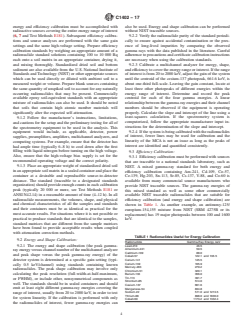
radionuclides that are suitable for efficiency calibration (and energy and shape calibration) are shown in Table 1. As another
example, an antimony-125/europium-154,155 mixture from NIST (SRM 4275B or its replacement) has 19 major photopeaks
between 100 and 1600 keV.
9.3.2 For environmental or low-activity samples (0.01 to 1 Bq/g), typically, 300 to 500 g of prepared soil are used. If a fixed
volume is used, the mass will vary according to the density. High-density samples may cause significant self-absorption of
low-energy gamma rays and degrade the higher-energy gammas. Therefore, it is important to calibrate the detector with standards
of the same geometry, composition, and density, or use appropriate attenuation and geometry cor
...