

ASTM D4740-20
(Test Method)Standard Test Method for Cleanliness and Compatibility of Residual Fuels by Spot Test
General Information
- Abstract
SIGNIFICANCE AND USE
5.1 The four procedures in this test method are used alone or in combination to identify fuels or blends that could result in excessive centrifuge loading, strainer plugging, tank sludge formation, or similar operating problems.
5.2 A spot rating of Number 3 or higher on a finished fuel oil by the cleanliness procedure indicates that the fuel contains excessive suspended solids and is likely to cause operating problems.
5.3 Although a fuel may test clean when subjected to the cleanliness procedures (manual and automated), suspended solids can precipitate when the fuel is mixed with a blend stock. Evidence of such incompatibility is indicated by a spot rating of Number 3 or higher in the compatibility procedures (manual and automated).
SCOPE
1.1 This test method covers separate procedures for determining the cleanliness of residual fuel oil and the compatibility of a residual fuel oil with a blend stock. It is applicable to residual fuel oils with viscosities up to 50 cSt (1 cSt = 1 mm2s) at 100 °C. This test method describes two protocols: one manual and one automated.
Note 1: This test method has not been evaluated for heavy distillate having the propensity to leave a wax sediment on the filter paper and contain no residual asphaltene.
1.2 The values stated in SI units are to be regarded as standard. No other units of measurement are included in this standard.
1.3 This standard does not purport to address all of the safety concerns, if any, associated with its use. It is the responsibility of the user of this standard to establish appropriate safety, health, and environmental practices and determine the applicability of regulatory limitations prior to use.
1.4 This international standard was developed in accordance with internationally recognized principles on standardization established in the Decision on Principles for the Development of International Standards, Guides and Recommendations issued by the World Trade Organization Technical Barriers to Trade (TBT) Committee.
- Status
- Published
- Publication Date
- 31-Aug-2020
- Technical Committee
- D02 - Petroleum Products, Liquid Fuels, and Lubricants
- Drafting Committee
- D02.14 - Stability, Cleanliness and Compatibility of Liquid Fuels
Buy Documents
ASTM D4740-20 - Standard Test Method for Cleanliness and Compatibility of Residual Fuels by Spot Test
REDLINE ASTM D4740-20 - Standard Test Method for Cleanliness and Compatibility of Residual Fuels by Spot Test
Overview
ASTM D4740-20 is the standard test method for evaluating the cleanliness and compatibility of residual fuel oils using the spot test. Developed by ASTM International, this standard provides both manual and automated procedures to assess whether residual fuels or fuel blends are likely to cause operational issues such as centrifuge overloading, strainer plugging, or tank sludge formation. The method is applicable to residual fuel oils with viscosities up to 50 cSt at 100 °C and is a key procedure for quality control and fuel management in the petroleum industry.
Key Topics
Cleanliness Assessment of Residual Fuels
- Measures the concentration of suspended solids in a finished fuel sample, indicating potential for operational difficulties.
- A cleanliness rating of 3 or higher signals excessive contamination likely to cause equipment or processing problems.
Compatibility of Fuel Blends
- Tests for the potential formation of precipitates when residual fuels are mixed with blend stocks.
- A compatibility spot rating of 3 or higher denotes a high risk that blending will introduce operational issues, even if the base fuel tests as clean.
Manual and Automated Testing Procedures
- The manual protocol involves heating and mixing the sample, applying a drop to filter paper, and visually comparing the resultant spot to reference standards.
- The automated method streamlines sample preparation, application, and measurement, incorporating digital image analysis and data storage for greater efficiency and consistency.
Interpretation and Reporting
- Results are reported on an integer scale from 1 to 5, referencing the D4740 Adjunct Reference Spot Sheet.
- The method clearly defines the criteria for rating and specifies reporting the blend ratio if it deviates from a 50:50 mix.
Applications
ASTM D4740-20 spot test is essential in several areas of residual fuel oil management:
Fuel Quality Control
- Used by refineries, fuel suppliers, and end users to detect problematic fuel qualities before storage, transport, or combustion.
- Reduces the risk of costly downtime due to blockages, excessive sludge, or equipment damage.
Blending Operations
- Helps determine the compatibility of various blend stocks with residual fuels to ensure stable, homogeneous mixtures.
- Supports decision-making when sourcing or reformulating fuels for specific applications, especially in marine and power generation sectors.
Regulatory Compliance and Best Practices
- Aligns with international fuel handling and quality assurance standards, supporting safer and more efficient operations.
Operational Troubleshooting
- Diagnoses fuel causes for operational issues by identifying whether fuel composition or blending is the root of filter clogging or sludge accumulation.
Related Standards
For comprehensive residual fuel testing and terminology, ASTM D4740-20 should be used in conjunction with:
- ASTM D4057 – Practice for Manual Sampling of Petroleum and Petroleum Products
- ASTM D4175 – Terminology Relating to Petroleum Products, Liquid Fuels, and Lubricants
- ASTM D4177 – Practice for Automatic Sampling of Petroleum and Petroleum Products
- ASTM D4870 – Test Method for Determination of Total Sediment in Residual Fuels
Practical Value
Implementing ASTM D4740-20 provides stakeholders with a reliable, standardized way to prevent operational hazards associated with dirty or incompatible residual fuels. By identifying at-risk fuels or blends before they enter service, organizations can avoid costly repairs, unplanned maintenance, and efficiency losses. Both manual and automated testing options provide flexibility to suit laboratory or field environments, ensuring robust fuel quality management across the supply chain.
Keywords: ASTM D4740-20, residual fuel oil, spot test, fuel cleanliness, fuel compatibility, suspended solids, blend stock, fuel quality testing, ASTM fuel standards, petroleum testing methods.
Relations
- Refers
ASTM D4175-23a - Standard Terminology Relating to Petroleum Products, Liquid Fuels, and Lubricants - Effective Date
- 15-Dec-2023
- Refers
ASTM D4175-23e1 - Standard Terminology Relating to Petroleum Products, Liquid Fuels, and Lubricants - Effective Date
- 01-Jul-2023
- Refers
ASTM D4870-09(2014) - Standard Test Method for Determination of Total Sediment in Residual Fuels - Effective Date
- 01-Dec-2014
- Refers
ASTM D4057-06(2011) - Standard Practice for Manual Sampling of Petroleum and Petroleum Products - Effective Date
- 01-Jun-2011
- Effective Date
- 15-Apr-2009
- Effective Date
- 01-Jul-2007
- Effective Date
- 01-Feb-2007
- Effective Date
- 01-Apr-2004
- Refers
ASTM D4057-95(2000) - Standard Practice for Manual Sampling of Petroleum and Petroleum Products - Effective Date
- 10-Apr-2000
- Effective Date
- 10-Jun-1999
Buy Documents
ASTM D4740-20 - Standard Test Method for Cleanliness and Compatibility of Residual Fuels by Spot Test
REDLINE ASTM D4740-20 - Standard Test Method for Cleanliness and Compatibility of Residual Fuels by Spot Test
Get Certified
Connect with accredited certification bodies for this standard

Element Materials Technology
Materials testing and product certification.

ABS Group Brazil
ABS Group certification services in Brazil.

ABS Quality Evaluations Inc.
American Bureau of Shipping quality certification.
Sponsored listings
Frequently Asked Questions
ASTM D4740-20 is a standard published by ASTM International. Its full title is "Standard Test Method for Cleanliness and Compatibility of Residual Fuels by Spot Test". This standard covers: SIGNIFICANCE AND USE 5.1 The four procedures in this test method are used alone or in combination to identify fuels or blends that could result in excessive centrifuge loading, strainer plugging, tank sludge formation, or similar operating problems. 5.2 A spot rating of Number 3 or higher on a finished fuel oil by the cleanliness procedure indicates that the fuel contains excessive suspended solids and is likely to cause operating problems. 5.3 Although a fuel may test clean when subjected to the cleanliness procedures (manual and automated), suspended solids can precipitate when the fuel is mixed with a blend stock. Evidence of such incompatibility is indicated by a spot rating of Number 3 or higher in the compatibility procedures (manual and automated). SCOPE 1.1 This test method covers separate procedures for determining the cleanliness of residual fuel oil and the compatibility of a residual fuel oil with a blend stock. It is applicable to residual fuel oils with viscosities up to 50 cSt (1 cSt = 1 mm2s) at 100 °C. This test method describes two protocols: one manual and one automated. Note 1: This test method has not been evaluated for heavy distillate having the propensity to leave a wax sediment on the filter paper and contain no residual asphaltene. 1.2 The values stated in SI units are to be regarded as standard. No other units of measurement are included in this standard. 1.3 This standard does not purport to address all of the safety concerns, if any, associated with its use. It is the responsibility of the user of this standard to establish appropriate safety, health, and environmental practices and determine the applicability of regulatory limitations prior to use. 1.4 This international standard was developed in accordance with internationally recognized principles on standardization established in the Decision on Principles for the Development of International Standards, Guides and Recommendations issued by the World Trade Organization Technical Barriers to Trade (TBT) Committee.
SIGNIFICANCE AND USE 5.1 The four procedures in this test method are used alone or in combination to identify fuels or blends that could result in excessive centrifuge loading, strainer plugging, tank sludge formation, or similar operating problems. 5.2 A spot rating of Number 3 or higher on a finished fuel oil by the cleanliness procedure indicates that the fuel contains excessive suspended solids and is likely to cause operating problems. 5.3 Although a fuel may test clean when subjected to the cleanliness procedures (manual and automated), suspended solids can precipitate when the fuel is mixed with a blend stock. Evidence of such incompatibility is indicated by a spot rating of Number 3 or higher in the compatibility procedures (manual and automated). SCOPE 1.1 This test method covers separate procedures for determining the cleanliness of residual fuel oil and the compatibility of a residual fuel oil with a blend stock. It is applicable to residual fuel oils with viscosities up to 50 cSt (1 cSt = 1 mm2s) at 100 °C. This test method describes two protocols: one manual and one automated. Note 1: This test method has not been evaluated for heavy distillate having the propensity to leave a wax sediment on the filter paper and contain no residual asphaltene. 1.2 The values stated in SI units are to be regarded as standard. No other units of measurement are included in this standard. 1.3 This standard does not purport to address all of the safety concerns, if any, associated with its use. It is the responsibility of the user of this standard to establish appropriate safety, health, and environmental practices and determine the applicability of regulatory limitations prior to use. 1.4 This international standard was developed in accordance with internationally recognized principles on standardization established in the Decision on Principles for the Development of International Standards, Guides and Recommendations issued by the World Trade Organization Technical Barriers to Trade (TBT) Committee.
ASTM D4740-20 is classified under the following ICS (International Classification for Standards) categories: 75.160.20 - Liquid fuels. The ICS classification helps identify the subject area and facilitates finding related standards.
ASTM D4740-20 has the following relationships with other standards: It is inter standard links to ASTM D4175-23a, ASTM D4175-23e1, ASTM D4870-09(2014), ASTM D4057-06(2011), ASTM D4870-09, ASTM D4870-07a, ASTM D4870-07, ASTM D4870-04, ASTM D4057-95(2000), ASTM D4870-99. Understanding these relationships helps ensure you are using the most current and applicable version of the standard.
ASTM D4740-20 is available in PDF format for immediate download after purchase. The document can be added to your cart and obtained through the secure checkout process. Digital delivery ensures instant access to the complete standard document.
Standards Content (Sample)
This international standard was developed in accordance with internationally recognized principles on standardization established in the Decision on Principles for the
Development of International Standards, Guides and Recommendations issued by the World Trade Organization Technical Barriers to Trade (TBT) Committee.
Designation: D4740 − 20
Standard Test Method for
Cleanliness and Compatibility of Residual Fuels by Spot
Test
This standard is issued under the fixed designation D4740; the number immediately following the designation indicates the year of
original adoption or, in the case of revision, the year of last revision. A number in parentheses indicates the year of last reapproval. A
superscript epsilon (´) indicates an editorial change since the last revision or reapproval.
1. Scope* D4870 Test Method for Determination of Total Sediment in
Residual Fuels
1.1 This test method covers separate procedures for deter-
2.2 ASTM Adjuncts:
miningthecleanlinessofresidualfueloilandthecompatibility
Reference Spot Sheet
of a residual fuel oil with a blend stock. It is applicable to
residual fuel oils with viscosities up to 50 cSt (1 cSt = 1 mm s)
3. Terminology
at 100 °C. This test method describes two protocols: one
3.1 For definitions of terms used in this standard, see
manual and one automated.
Terminology D4175.
NOTE 1—This test method has not been evaluated for heavy distillate
3.2 Definitions of Terms Specific to This Standard:
having the propensity to leave a wax sediment on the filter paper and
contain no residual asphaltene.
3.2.1 blend stock, n—one component or more components
used to make a final fuel product.
1.2 The values stated in SI units are to be regarded as
3.2.1.1 Discussion—In heavy fuel oils, blend stocks include
standard. No other units of measurement are included in this
various refinery streams ranging from kerosine to heavy
standard.
distillates, residuals, and asphalts.
1.3 This standard does not purport to address all of the
3.2.2 cleanliness, n—of residual fuel, the concentration of
safety concerns, if any, associated with its use. It is the
suspended solids in a finished sample.
responsibility of the user of this standard to establish appro-
3.2.2.1 Discussion—The lower the concentration of sus-
priate safety, health, and environmental practices and deter-
pended solids, the cleaner the residual fuel.
mine the applicability of regulatory limitations prior to use.
1.4 This international standard was developed in accor- 3.2.3 compatibility, n—of residual fuel, the absence of
dance with internationally recognized principles on standard-
suspended solids when equal volumes of a sample and a blend
ization established in the Decision on Principles for the
stock are mixed together.
Development of International Standards, Guides and Recom-
4. Summary of Test Method
mendations issued by the World Trade Organization Technical
Barriers to Trade (TBT) Committee.
4.1 Cleanliness Procedures, Manual and Automated—A
drop of the preheated and thoroughly mixed sample is put on
2. Referenced Documents
a test paper and placed in an oven at 100 °C.After 1 h, the test
2.1 ASTM Standards:
paper is removed from the oven and the resultant spot is
D4057 Practice for Manual Sampling of Petroleum and
examined for evidence of suspended solids and rated for
Petroleum Products
cleanliness using the D4740 Adjunct Reference Spot Sheet.
D4175 Terminology Relating to Petroleum Products, Liquid
4.2 Compatibility Procedures, Manual and Automated—A
Fuels, and Lubricants
blend composed of equal volumes of the sample fuel oil and
D4177 Practice for Automatic Sampling of Petroleum and
the blend stock is tested in the same way as described in 4.1
Petroleum Products
and rated for compatibility against D4740 Adjunct Reference
Spot Sheet.
This test method is under the jurisdiction of ASTM Committee D02 on
Petroleum Products, Liquid Fuels, and Lubricants and is the direct responsibility of
5. Significance and Use
Subcommittee D02.14 on Stability, Cleanliness and Compatibility of Liquid Fuels.
Current edition approved Sept. 1, 2020. Published September 2020. Originally
5.1 Thefourproceduresinthistestmethodareusedaloneor
approved in 1992. Last previous edition approved in 2019 as D4740 – 19. DOI:
in combination to identify fuels or blends that could result in
10.1520/D4740-20.
For referenced ASTM standards, visit the ASTM website, www.astm.org, or
contact ASTM Customer Service at service@astm.org. For Annual Book of ASTM
Standards volume information, refer to the standard’s Document Summary page on Available from ASTM International Headquarters. Order Adjunct No.
the ASTM website. ADJD4740. Original adjunct produced in 2000.
*A Summary of Changes section appears at the end of this standard
Copyright © ASTM International, 100 Barr Harbor Drive, PO Box C700, West Conshohocken, PA 19428-2959. United States
D4740 − 20
excessive centrifuge loading, strainer plugging, tank sludge for multiple samples spotted on the same test paper, which
formation, or similar operating problems. shall be supported in a horizontal position so nothing touches
test areas of the paper.
5.2 A spot rating of Number 3 or higher on a finished fuel
6.1.3 Oven—Any convection oven capable of maintaining
oil by the cleanliness procedure indicates that the fuel contains
an air temperature of 100 °C 6 2 °C.
excessive suspended solids and is likely to cause operating
6.1.4 Reference Spot Sheet—Adjunct for D4740.
problems.
6.1.5 Conical Flask, 100 mL capacity.
5.3 Although a fuel may test clean when subjected to the
6.1.6 Heating Bath or Hot Plate, capable of heating sample
cleanliness procedures (manual and automated), suspended
to a temperature between 90 °C and 95 °C.
solids can precipitate when the fuel is mixed with a blend
6.1.7 Temperature Measuring Device, capable of accurately
stock. Evidence of such incompatibility is indicated by a spot
measuring the temperature within the tolerances required in
rating of Number 3 or higher in the compatibility procedures
6.1.3 and 6.1.6, such as ASTM 1C thermometer, or liquid-in-
(manual and automated).
glass thermometers, thermocouples, or platinum-resistance
thermometers that provide equivalent or better accuracy and
6. Apparatus
precision may be used.
6.1 Manual Apparatus:
6.2 Automated Apparatus:
6.1.1 Test Paper—Chromatographic or filter paper cut or
6.2.1 The automated instrument (Fig. 2) shall include the
divided into appropriately sized squares, strips, or circles.
following:
Whatman #2 Qualitative filter paper has been found to be
6.2.1.1 Test Paper—Whatman #2 Qualitative filter paper,
suitable and was used in the interlaboratory round robin study.
Grade 2, circles, diameter 55 mm.
In case of dispute, use Whatman #2 Qualitative filter paper.
6.2.1.2 Vial—Disposable, 15 mL capacity, proprietary de-
Store the paper, without folding, rolling, or bending, in a
signed for use in this apparatus.
tightly closed container.
6.2.2 Micropipette—Capable of delivering 25 µL 61µLof
6.1.2 Test Paper Support—Fig. 1 shows a suitable support
sample. Positive displacement type micropipette with capillary
pistonispreferredforuse.Air-displacementtypemicropipettes
are not recommended for viscous samples.
The sole source of supply of Whatman paper No. 2 known to the committee at
6.2.3 Oven—Equipped with three stations, two wells main-
this time is Whatman, Inc., 9 Bridewell Place, Clifton, NJ 07014. If you are aware
tained at 93 °C 6 2 °C for the sample preheating and one
of alternative suppliers, please provide this information to ASTM International
Headquarters.Your comments will receive careful consideration at a meeting of the
station maintained at 100 °C 6 2 °C for the filter paper
responsible technical committee, which you may attend.
preheating, proprietary designed for use in this apparatus.
6.2.4 Digital Camera—Color, 5 megapixels, connected to a
computer to analyze and record the resultant spot.
6.2.5 Filter Paper Displacement System—To move the filter
paper during the analysis phases, proprietary designed for use
in this apparatus.
6.2.6 Computer—Associated to a database to analyze the
resultant spot, capable to rate the spot according to the rating
scale of the adjunct and store the result with the spot image.
7. Sampling
7.1 Samples for this test can come from tanks, lines, drums,
or small containers. Use the applicable apparatus and tech-
niques described in Practice D4057 or D4177.
8. Cleanliness Procedure
8.1 Manual Procedure:
8.1.1 Heatthesampleintheoriginalcontainerintheheating
bath or on a hot plate to above 90 °C to ensure the sample is in
a fluid state.
8.1.2 Mix thoroughly.
The sole source of supply of the automated apparatus known to the committee
at this time is AD Systems (www.adsystems-sa.com), Model ST 10 – Portable/on-
board heavy fuel compatibility tester, available fromAD Systems, P.A. Portes de la
SuisseNormande,AlléedeCindais,14320Saint-André-sur-Orne,France.Ifyouare
aware of alternative suppliers, please provide this information to ASTM Interna-
tional Headquarters.Your comments will receive careful consideration at a meeting
FIG. 1 Support for Test Paper of the responsible technical committee, which you may attend.
D4740 − 20
FIG. 2 Principle of the Automated Apparatus
TABLE 1 Reference Spot Description
Reference
Characterizing Features
NOTE 2—Mechanical shaking or mechanical mixing is recommended.
Spot No.
8.1.3 Pour approximately 50 mL of the sample into a 1 Homogeneous spot (no inner ring)
2 Faint or poorly defined inner ring
100 mL conical flask and place the flask in the heating bath or
3 Well-defined thin inner ring, only slightly darker than the back-
on a hot plate.
ground
8.1.4 Heat the sample uniformly by stirring and maintain 4 Well-defined inner ring, thicker than the ring in reference spot No. 3
and somewhat darker than the background
the sample temperature between 90 °C and 95 °C for 15 min to
5 Very dark solid or nearly solid area in the center. The central area is
20 min.
much darker than the background
8.1.5 Position the test paper so the test portion is clear of
any support (Fig. 1), and place in the oven for a minimum of
8.2.1 Prepare the apparatus according to the manufacturer’s
5 min, allowing the paper temperature to attain the oven
instructions.
temperature.
8.2.2 Heatthesampleintheoriginalcontainerintheheating
8.1.6 Preheat the glass rod by dipping into and stirring the
bath or on a hot plate to above 90 °C to ensure the sample is in
heated sample for about 20 s. Withdraw the rod and allow the
a fluid state.
first drop to fall back into the conical flask. Allow the second
8.2.3 Mix thoroughly.
drop to fall onto the test paper which is supported horizontally
in the oven heated to a temperature of 100 °C.
NOTE 4—Mechanical shaking or mechanical mixing is recommended.
8.1.6.1 Multiple samples may be spotted on the same test
8.2.4 Pour approximately 10 mLof the sample into a 15 mL
paper. The spot centers shall not be closer than 50 mm and at
disposable vial and place the vial in one of the two the oven
least 25 mm from the edge of the test paper.
wells.
8.1.7 Dry the test paper in the oven maintained at 100 °C 6
8.2.5 Position a filter paper on the filter paper support.
2°Cfor1h.
8.2.6 Select the CLEANLINESS mode in the test mode
8.1.8 After 1 h, remove the test paper from the oven. Refer
menu of the apparatus.
to the reference spot adjunct and to the reference spot descrip-
8.2.7 Key in all requested information related to the test
tions given in Table 1. Compare the spot with the standard
(sample number, operator name, etc.) and start the test proce-
spots on the adjunct and record the spot number having the
dure according to the manufacturer’s instructions. The sample
closest resemblance. If the sample spot is rated between two
is preheated at 93 °C for 15 min and the filter paper is
consecutive spots on the adjunct, record the larger number.
positioned in the oven at 100 °C.
NOTE 3—Ignore differences in overall darkness, color, size, and
8.2.8 After 15 min, an audible alarm warns the operator and
appearance of the ou
...
This document is not an ASTM standard and is intended only to provide the user of an ASTM standard an indication of what changes have been made to the previous version. Because
it may not be technically possible to adequately depict all changes accurately, ASTM recommends that users consult prior editions as appropriate. In all cases only the current version
of the standard as published by ASTM is to be considered the official document.
Designation: D4740 − 19 D4740 − 20
Standard Test Method for
Cleanliness and Compatibility of Residual Fuels by Spot
Test
This standard is issued under the fixed designation D4740; the number immediately following the designation indicates the year of
original adoption or, in the case of revision, the year of last revision. A number in parentheses indicates the year of last reapproval. A
superscript epsilon (´) indicates an editorial change since the last revision or reapproval.
1. Scope*
1.1 This test method covers separate procedures for determining the cleanliness of residual fuel oil and the compatibility of a
residual fuel oil with a blend stock. It is applicable to residual fuel oils with viscosities up to 50 cSt (1 cSt = 1 mm s) at 100 °C.
This test method describes two protocols: one manual and one automated.
NOTE 1—This test method has not been evaluated for heavy distillate having the propensity to leave a wax sediment on the filter paper and contain no
residual asphaltene.
1.2 The values stated in SI units are to be regarded as standard. No other units of measurement are included in this standard.
1.3 This standard does not purport to address all of the safety concerns, if any, associated with its use. It is the responsibility
of the user of this standard to establish appropriate safety, health, and environmental practices and determine the applicability of
regulatory limitations prior to use.
1.4 This international standard was developed in accordance with internationally recognized principles on standardization
established in the Decision on Principles for the Development of International Standards, Guides and Recommendations issued
by the World Trade Organization Technical Barriers to Trade (TBT) Committee.
2. Referenced Documents
2.1 ASTM Standards:
D4057 Practice for Manual Sampling of Petroleum and Petroleum Products
D4175 Terminology Relating to Petroleum Products, Liquid Fuels, and Lubricants
D4177 Practice for Automatic Sampling of Petroleum and Petroleum Products
D4870 Test Method for Determination of Total Sediment in Residual Fuels
2.2 ASTM Adjuncts:
Reference Spot Sheet
3. Terminology
3.1 For definitions of terms used in this standard, see Terminology D4175.
This test method is under the jurisdiction of ASTM Committee D02 on Petroleum Products, Liquid Fuels, and Lubricants and is the direct responsibility of Subcommittee
D02.14 on Stability, Cleanliness and Compatibility of Liquid Fuels.
Current edition approved May 1, 2019Sept. 1, 2020. Published June 2019September 2020. Originally approved in 1992. Last previous edition approved in 20142019 as
D4740 – 04 (2014).D4740 – 19. DOI: 10.1520/D4740-19.10.1520/D4740-20.
For referenced ASTM standards, visit the ASTM website, www.astm.org, or contact ASTM Customer Service at service@astm.org. For Annual Book of ASTM Standards
volume information, refer to the standard’s Document Summary page on the ASTM website.
Available from ASTM International Headquarters. Order Adjunct No. ADJD4740. Original adjunct produced in 2000.
*A Summary of Changes section appears at the end of this standard
Copyright © ASTM International, 100 Barr Harbor Drive, PO Box C700, West Conshohocken, PA 19428-2959. United States
D4740 − 20
3.2 Definitions of Terms Specific to This Standard:
3.2.1 blend stock, n—one component or more components used to make a final fuel product.
3.2.1.1 Discussion—
In heavy fuel oils, blend stocks include various refinery streams ranging from kerosine to heavy distillates, residuals, and asphalts.
3.2.2 cleanliness, n—of residual fuel, the concentration of suspended solids in a finished sample.
3.2.2.1 Discussion—
The lower the concentration of suspended solids, the cleaner the residual fuel.
3.2.3 compatibility, n—of residual fuel, the absence of suspended solids when equal volumes of a sample and a blend stock are
mixed together.
4. Summary of Test Method
4.1 Cleanliness Procedures, Manual and Automated—A drop of the preheated and thoroughly mixed sample is put on a test paper
and placed in an oven at 100 °C. After 1 h, the test paper is removed from the oven and the resultant spot is examined for evidence
of suspended solids and rated for cleanliness using the D4740 Adjunct Reference Spot Sheet.
4.2 Compatibility Procedures, Manual and Automated—A blend composed of equal volumes of the sample fuel oil and the blend
stock is tested in the same way as described in 4.1 and rated for compatibility against D4740 Adjunct Reference Spot Sheet.
5. Significance and Use
5.1 The four procedures in this test method are used alone or in combination to identify fuels or blends that could result in
excessive centrifuge loading, strainer plugging, tank sludge formation, or similar operating problems.
5.2 A spot rating of Number 3 or higher on a finished fuel oil by the cleanliness procedure indicates that the fuel contains excessive
suspended solids and is likely to cause operating problems.
5.3 Although a fuel may test clean when subjected to the cleanliness procedures (manual and automated), suspended solids can
precipitate when the fuel is mixed with a blend stock. Evidence of such incompatibility is indicated by a spot rating of Number
3 or higher in the compatibility procedures (manual and automated).
6. Apparatus
6.1 Manual Apparatus:
6.1.1 Test Paper—Chromatographic or filter paper cut or divided into appropriately sized squares, strips, or circles. Whatman #2
Qualitative filter paper has been found to be suitable and was used in the interlaboratory round robin study. In case of dispute,
use Whatman #2 Qualitative filter paper. Store the paper, without folding, rolling, or bending, in a tightly closed container.
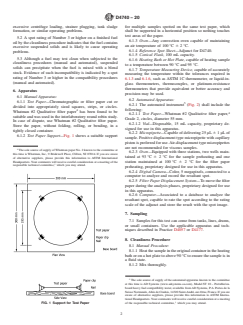
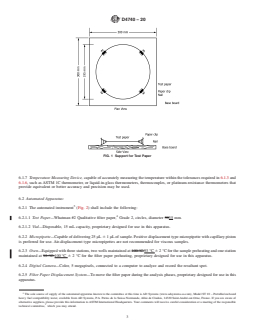
6.1.2 Test Paper Support—Fig. 1 shows a suitable support for multiple samples spotted on the same test paper, which shall be
supported in a horizontal position so nothing touches test areas of the paper.
6.1.3 Oven—Any convection oven capable of maintaining an air temperature of 100 °C 6 2 °C.
6.1.4 Reference Spot Sheet—Adjunct for D4740.
6.1.5 Conical Flask, 100 mL capacity.
6.1.6 Heating Bath or Hot Plate, capable of heating sample to a temperature between 90 °C and 95 °C.
The sole source of supply of Whatman paper No. 2 known to the committee at this time is Whatman, Inc., 9 Bridewell Place, Clifton, NJ 07014. If you are aware of
alternative suppliers, please provide this information to ASTM International Headquarters. Your comments will receive careful consideration at a meeting of the responsible
technical committee, which you may attend.
D4740 − 20
FIG. 1 Support for Test Paper
6.1.7 Temperature Measuring Device, capable of accurately measuring the temperature within the tolerances required in 6.1.3 and
6.1.6, such as ASTM 1C thermometer, or liquid-in-glass thermometers, thermocouples, or platinum-resistance thermometers that
provide equivalent or better accuracy and precision may be used.
6.2 Automated Apparatus:
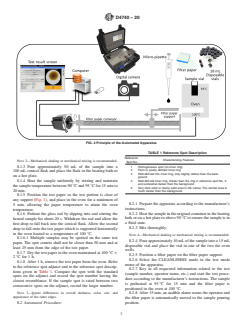
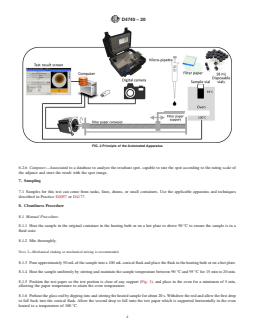
6.2.1 The automated instrument (Fig. 2) shall include the following:
6.2.1.1 Test Paper—Whatman #2 Qualitative filter paper, Grade 2, circles, diameter 5055 mm.
6.2.1.2 Vial—Disposable, 15 mL capacity, proprietary designed for use in this apparatus.
6.2.2 Micropipette—Capable of delivering 25 μL 6 1 μL of sample. Positive displacement type micropipette with capillary piston
is preferred for use. Air-displacement type micropipettes are not recommended for viscous samples.
6.2.3 Oven—Equipped with three stations, two wells maintained at 100 °C 93 °C 6 2 °C for the sample preheating and one station
maintained at 93 °C 100 °C 6 2 °C for the filter paper preheating, proprietary designed for use in this apparatus.
6.2.4 Digital Camera—Color, 5 megapixels, connected to a computer to analyze and record the resultant spot.
6.2.5 Filter Paper Displacement System—To move the filter paper during the analysis phases, proprietary designed for use in this
apparatus.
The sole source of supply of the automated apparatus known to the committee at this time is AD Systems (www.adsystems-sa.com), Model ST 10 – Portable/on-board
heavy fuel compatibility tester, available from AD Systems, P.A. Portes de la Suisse Normande, Allée de Cindais, 14320 Saint-André-sur-Orne, France. If you are aware of
alternative suppliers, please provide this information to ASTM International Headquarters. Your comments will receive careful consideration at a meeting of the responsible
technical committee, which you may attend.
D4740 − 20
FIG. 2 Principle of the Automated Apparatus
6.2.6 Computer—Associated to a database to analyze the resultant spot, capable to rate the spot according to the rating scale of
the adjunct and store the result with the spot image.
7. Sampling
7.1 Samples for this test can come from tanks, lines, drums, or small containers. Use the applicable apparatus and techniques
described in Practice D4057 or D4177.
8. Cleanliness Procedure
8.1 Manual Procedure:
8.1.1 Heat the sample in the original container in the heating bath or on a hot plate to above 90 °C to ensure the sample is in a
fluid state.
8.1.2 Mix thoroughly.
NOTE 2—Mechanical shaking or mechanical mixing is recommended.
8.1.3 Pour approximately 50 mL of the sample into a 100 mL conical flask and place the flask in the heating bath or on a hot plate.
8.1.4 Heat the sample uniformly by stirring and maintain the sample temperature between 90 °C and 95 °C for 15 min to 20 min.
8.1.5 Position the test paper so the test portion is clear of any support (Fig. 1), and place in the oven for a minimum of 5 min,
allowing the paper temperature to attain the oven temperature.
8.1.6 Preheat the glass rod by dipping into and stirring the heated sample for about 20 s. Withdraw the rod and allow the first drop
to fall back into the conical flask. Allow the second drop to fall onto the test paper which is supported horizontally in the oven
heated to a temperature of 100 °C.
D4740 − 20
8.1.6.1 Multiple samples may be spotted on the same test paper. The spot centers shall not be closer than 50 mm and at least 25
mm from the edge of the test paper.
8.1.7 Dry the test paper in the oven maintained at 100 °C 6 2 °C for 1 h.
8.1.8 After 1 h, remove the test paper from the oven. Refer to the reference spot adjunct and to the reference spot descriptions
given in Table 1. Compare the spot with the standard spots on the adjunct and record the spot number having the closest
resemblance. If the sample spot is rated between two consecutive spots on the adjunct, record the larger number.
NOTE 3—Ignore differences in overall darkness, color, size, and appearance of the outer edges.
8.2 Automated Procedure:
8.2.1 Prepare the apparatus according to the manufacturer’s instructions.
8.2.2 Heat the sample in the original container in the heating bath or on a hot plate to above 90 °C to ensure the sample is in a
fluid state.
8.2.3 Mix thoroughly.
NOTE 4—Mechanical shaking or mechanical mixing is recommended.
8.2.4 Pour approximately 10 mL of the sample into a 15 mL disposable vial and place the vial in one of the two the oven wells.
8.2.5 Position a filter paper on the filter paper support.
8.2.6 Select the CLEANLINESS mode in the test mode menu of the apparatus.
8.2.7 Key in all requested information related to the test (sample number, operator name, etc.) and start the test procedure
according to the manufacturer’s instructions. The sample is preheated at 93 °C for 15 min and the filter paper is positioned in the
oven at 100 °C.
8.2.8 After 15 min, an audible alarm warns the operator and the filter paper is automatically moved to the sample pouring position.
8.2.8.1 With the micropipette, the operator samples 25 μL from the 15 mL vial previously positioned in the oven well and pours
the 25 μL sample on the filter paper.
8.2.8.2 The operator instructs the instrument that the sample is dropped on the filter paper.
8.2.8.3 The filter paper is automatically mov
...