

ASTM E2075/E2075M-15(2020)
(Practice)Standard Practice for Verifying the Consistency of AE-Sensor Response Using an Acrylic Rod
General Information
- Abstract
SIGNIFICANCE AND USE
3.1 Degradation in sensor performance can occur due to dropping, mechanical shock while mounted on the test structure, temperature cycles, and so forth. It is necessary and desirable to have a simple measurement procedure that will check the consistency of sensor response, while holding all other variables constant.
3.2 While test blocks of many different kinds have been used for this purpose for many years, an acrylic polymer rod offers the best all-around combination of suitable acoustic properties, practical convenience, ease of procurement and low cost.
3.3 Because the acoustic properties of the acrylic rod are known to depend on temperature, this practice requires that the rod, sensors, and couplant be stabilized at the same working temperature, prior to verifying the sensors.
3.4 Attention should be paid to storage conditions for the acrylic polymer rod. For example, it should not be left in a freezing or hot environment overnight, unless it is given time for temperature stabilization before use.
3.5 Properly applied and with proper record keeping, this practice can be used in many ways. The user organization must determine the context for its use, the acceptance standards and the actions to be taken based on the lead break results. The following uses are suggested:
3.5.1 To determine when a sensor is no longer suitable for use.
3.5.2 To check sensors that have been exposed to high-risk conditions, such as dropping, overheating, and so forth.
3.5.3 To get an early warning of sensor degradation over time. This can lead to identifying conditions of use, which are damaging sensors, and thus, to better equipment care and lower replacement costs.
3.5.4 To obtain matched sets of sensors, preamplifiers, instrumentation channels, or a combination thereof, for more uniform performance of the total system.
3.5.5 To save time and money, by eliminating the installation of bad sensors.
3.5.6 To verify sensors quickly but consistently in the fi...
SCOPE
1.1 This practice is used for routinely checking the sensitivity of acoustic emission (AE) sensors. It is intended to provide a reliable, precisely specified way of comparing a set of sensors, or telling whether an individual sensor's sensitivity has degraded during its service life, or both.
1.2 This practice is not a “calibration” nor does it give frequency response information.
1.3 Units—The values stated in SI units or inch-pound units are to be regarded separately as standard. The values stated in each system may not be exact equivalents; therefore, each system shall be used independently of the other. Combining values from the two systems may result in non-conformance with the standard.
1.4 This standard does not purport to address all of the safety concerns, if any, associated with its use. It is the responsibility of the user of this standard to establish appropriate safety, health, and environmental practices and determine the applicability of regulatory limitations prior to use.
1.5 This international standard was developed in accordance with internationally recognized principles on standardization established in the Decision on Principles for the Development of International Standards, Guides and Recommendations issued by the World Trade Organization Technical Barriers to Trade (TBT) Committee.
- Status
- Published
- Publication Date
- 31-May-2020
- Technical Committee
- E07 - Nondestructive Testing
- Drafting Committee
- E07.04 - Acoustic Emission Method
Overview
ASTM E2075/E2075M-15(2020), titled Standard Practice for Verifying the Consistency of AE-Sensor Response Using an Acrylic Rod, is a widely recognized guideline developed by ASTM International. This standard provides a reliable, repeatable practice for assessing the sensitivity of acoustic emission (AE) sensors. As part of routine quality assurance in non-destructive testing, it enables users to determine if an AE sensor has degraded or remains consistent over time, helping maintain accuracy and reliability in structural health monitoring and related fields.
The method uses an acrylic polymer rod for comparative testing due to its optimal acoustic properties, affordability, and ease of handling. While it checks sensor consistency, it is not a calibration standard and does not provide frequency response data.
Key Topics
Sensor Performance Verification
The practice focuses on detecting degradation in AE sensors from mechanical shock, temperature cycling, or accidental dropping. Regular checks help ensure sensors perform within expected parameters.Use of Acrylic Polymer Rod
An acrylic rod is employed as the transfer medium for AE signals. The rod's acoustic consistency, practicality, and low cost make it an excellent choice for routine checks. The rod, sensors, and couplant must be stabilized to the same temperature before use to ensure accurate results.Procedural Consistency
The practice mandates a well-defined and standardized measurement approach. Storage and handling recommendations for the acrylic rod help maintain its acoustic properties.Application Scenarios
Suggested uses include:- Identifying when a sensor is no longer suitable for use
- Checking sensors subjected to high-risk events (e.g., dropped, overheated)
- Gaining early warning of gradual degradation over time
- Forming matched sensor sets for uniform system performance
- Reducing downtime and costs by avoiding faulty sensor installations
- Enabling rapid field verification and troubleshooting
Documentation and Acceptance Criteria
Proper record keeping and user-defined acceptance criteria support traceability, trend monitoring, and preventive maintenance.
Applications
ASTM E2075/E2075M-15(2020) is broadly utilized in industries requiring non-destructive evaluation and continuous condition monitoring, such as:
Structural Health Monitoring
Regular sensor checks under this standard are vital for reliable data in bridge, building, and infrastructure monitoring.Aerospace, Energy, and Manufacturing
Companies use this standard to ensure sensor integrity during equipment operation, maintenance cycles, and after transportation or possible mishandling.Quality Assurance in NDT Labs
The method is suitable for validating new sensors before installation and for periodic checks as part of ISO-compliant quality procedures.Research and Development
Laboratories use the standard to create matched sensor sets and ensure consistent performance across test campaigns and experiments.
This practice enhances productivity, minimizes maintenance costs, and upholds safety and compliance standards in critical operations.
Related Standards
For holistic acoustic emission sensor verification and system performance, the following ASTM standards are commonly referenced alongside ASTM E2075/E2075M:
ASTM E650 - Guide for Mounting Piezoelectric Acoustic Emission Sensors
Addresses installation practices to ensure optimal sensor coupling and reliable measurements.ASTM E750 - Practice for Characterizing Acoustic Emission Instrumentation
Covers procedures for evaluating system components, including preamplifiers and acquisition channels.ASTM E976 - Guide for Determining the Reproducibility of Acoustic Emission Sensor Response
Provides additional guidelines for repeatable sensor testing.ASTM E2374 - Guide for Acoustic Emission System Performance Verification
Supports comprehensive performance checks for entire AE monitoring systems.
By integrating ASTM E2075/E2075M-15(2020) with these related standards, users achieve a robust approach to acoustic emission technology reliability and consistency.
Relations
- Effective Date
- 01-Jun-2020
- Effective Date
- 01-Jun-2020
- Effective Date
- 01-Dec-2015
- Effective Date
- 01-Dec-2015
- Effective Date
- 01-Jun-2010
- Effective Date
- 01-Jan-2010
- Effective Date
- 01-Jan-2010
- Effective Date
- 01-Dec-2005
- Effective Date
- 01-May-2004
- Effective Date
- 01-May-2004
- Effective Date
- 10-Dec-2000
- Effective Date
- 10-May-1998
- Effective Date
- 10-Dec-1997
- Effective Date
- 10-Dec-1997
Get Certified
Connect with accredited certification bodies for this standard

IMP NDT d.o.o.
Non-destructive testing services. Radiography, ultrasonic, magnetic particle, penetrant, visual inspection.
Inštitut za kovinske materiale in tehnologije
Institute of Metals and Technology. Materials testing, metallurgical analysis, NDT.
Q Techna d.o.o.
NDT and quality assurance specialist. 30+ years experience. NDT personnel certification per ISO 9712, nuclear and thermal power plant inspections, QA/
Sponsored listings
Frequently Asked Questions
ASTM E2075/E2075M-15(2020) is a standard published by ASTM International. Its full title is "Standard Practice for Verifying the Consistency of AE-Sensor Response Using an Acrylic Rod". This standard covers: SIGNIFICANCE AND USE 3.1 Degradation in sensor performance can occur due to dropping, mechanical shock while mounted on the test structure, temperature cycles, and so forth. It is necessary and desirable to have a simple measurement procedure that will check the consistency of sensor response, while holding all other variables constant. 3.2 While test blocks of many different kinds have been used for this purpose for many years, an acrylic polymer rod offers the best all-around combination of suitable acoustic properties, practical convenience, ease of procurement and low cost. 3.3 Because the acoustic properties of the acrylic rod are known to depend on temperature, this practice requires that the rod, sensors, and couplant be stabilized at the same working temperature, prior to verifying the sensors. 3.4 Attention should be paid to storage conditions for the acrylic polymer rod. For example, it should not be left in a freezing or hot environment overnight, unless it is given time for temperature stabilization before use. 3.5 Properly applied and with proper record keeping, this practice can be used in many ways. The user organization must determine the context for its use, the acceptance standards and the actions to be taken based on the lead break results. The following uses are suggested: 3.5.1 To determine when a sensor is no longer suitable for use. 3.5.2 To check sensors that have been exposed to high-risk conditions, such as dropping, overheating, and so forth. 3.5.3 To get an early warning of sensor degradation over time. This can lead to identifying conditions of use, which are damaging sensors, and thus, to better equipment care and lower replacement costs. 3.5.4 To obtain matched sets of sensors, preamplifiers, instrumentation channels, or a combination thereof, for more uniform performance of the total system. 3.5.5 To save time and money, by eliminating the installation of bad sensors. 3.5.6 To verify sensors quickly but consistently in the fi... SCOPE 1.1 This practice is used for routinely checking the sensitivity of acoustic emission (AE) sensors. It is intended to provide a reliable, precisely specified way of comparing a set of sensors, or telling whether an individual sensor's sensitivity has degraded during its service life, or both. 1.2 This practice is not a “calibration” nor does it give frequency response information. 1.3 Units—The values stated in SI units or inch-pound units are to be regarded separately as standard. The values stated in each system may not be exact equivalents; therefore, each system shall be used independently of the other. Combining values from the two systems may result in non-conformance with the standard. 1.4 This standard does not purport to address all of the safety concerns, if any, associated with its use. It is the responsibility of the user of this standard to establish appropriate safety, health, and environmental practices and determine the applicability of regulatory limitations prior to use. 1.5 This international standard was developed in accordance with internationally recognized principles on standardization established in the Decision on Principles for the Development of International Standards, Guides and Recommendations issued by the World Trade Organization Technical Barriers to Trade (TBT) Committee.
SIGNIFICANCE AND USE 3.1 Degradation in sensor performance can occur due to dropping, mechanical shock while mounted on the test structure, temperature cycles, and so forth. It is necessary and desirable to have a simple measurement procedure that will check the consistency of sensor response, while holding all other variables constant. 3.2 While test blocks of many different kinds have been used for this purpose for many years, an acrylic polymer rod offers the best all-around combination of suitable acoustic properties, practical convenience, ease of procurement and low cost. 3.3 Because the acoustic properties of the acrylic rod are known to depend on temperature, this practice requires that the rod, sensors, and couplant be stabilized at the same working temperature, prior to verifying the sensors. 3.4 Attention should be paid to storage conditions for the acrylic polymer rod. For example, it should not be left in a freezing or hot environment overnight, unless it is given time for temperature stabilization before use. 3.5 Properly applied and with proper record keeping, this practice can be used in many ways. The user organization must determine the context for its use, the acceptance standards and the actions to be taken based on the lead break results. The following uses are suggested: 3.5.1 To determine when a sensor is no longer suitable for use. 3.5.2 To check sensors that have been exposed to high-risk conditions, such as dropping, overheating, and so forth. 3.5.3 To get an early warning of sensor degradation over time. This can lead to identifying conditions of use, which are damaging sensors, and thus, to better equipment care and lower replacement costs. 3.5.4 To obtain matched sets of sensors, preamplifiers, instrumentation channels, or a combination thereof, for more uniform performance of the total system. 3.5.5 To save time and money, by eliminating the installation of bad sensors. 3.5.6 To verify sensors quickly but consistently in the fi... SCOPE 1.1 This practice is used for routinely checking the sensitivity of acoustic emission (AE) sensors. It is intended to provide a reliable, precisely specified way of comparing a set of sensors, or telling whether an individual sensor's sensitivity has degraded during its service life, or both. 1.2 This practice is not a “calibration” nor does it give frequency response information. 1.3 Units—The values stated in SI units or inch-pound units are to be regarded separately as standard. The values stated in each system may not be exact equivalents; therefore, each system shall be used independently of the other. Combining values from the two systems may result in non-conformance with the standard. 1.4 This standard does not purport to address all of the safety concerns, if any, associated with its use. It is the responsibility of the user of this standard to establish appropriate safety, health, and environmental practices and determine the applicability of regulatory limitations prior to use. 1.5 This international standard was developed in accordance with internationally recognized principles on standardization established in the Decision on Principles for the Development of International Standards, Guides and Recommendations issued by the World Trade Organization Technical Barriers to Trade (TBT) Committee.
ASTM E2075/E2075M-15(2020) is classified under the following ICS (International Classification for Standards) categories: 19.100 - Non-destructive testing. The ICS classification helps identify the subject area and facilitates finding related standards.
ASTM E2075/E2075M-15(2020) has the following relationships with other standards: It is inter standard links to ASTM E2075/E2075M-15, ASTM E750-15(2020), ASTM E750-15, ASTM E2374-15, ASTM E976-10, ASTM E750-10, ASTM E2374-10, ASTM E976-05, ASTM E2374-04, ASTM E750-04, ASTM E976-00, ASTM E750-98, ASTM E650-97(2007), ASTM E650-97(2002)e1. Understanding these relationships helps ensure you are using the most current and applicable version of the standard.
ASTM E2075/E2075M-15(2020) is available in PDF format for immediate download after purchase. The document can be added to your cart and obtained through the secure checkout process. Digital delivery ensures instant access to the complete standard document.
Standards Content (Sample)
This international standard was developed in accordance with internationally recognized principles on standardization established in the Decision on Principles for the
Development of International Standards, Guides and Recommendations issued by the World Trade Organization Technical Barriers to Trade (TBT) Committee.
Designation: E2075/E2075M − 15 (Reapproved 2020)
Standard Practice for
Verifying the Consistency of AE-Sensor Response Using an
Acrylic Rod
ThisstandardisissuedunderthefixeddesignationE2075/E2075M;thenumberimmediatelyfollowingthedesignationindicatestheyear
of original adoption or, in the case of revision, the year of last revision. A number in parentheses indicates the year of last reapproval.
A superscript epsilon (´) indicates an editorial change since the last revision or reapproval.
1. Scope* E976 GuideforDeterminingtheReproducibilityofAcoustic
Emission Sensor Response
1.1 This practice is used for routinely checking the sensi-
E2374 Guide for Acoustic Emission System Performance
tivity of acoustic emission (AE) sensors. It is intended to
Verification
provide a reliable, precisely specified way of comparing a set
of sensors, or telling whether an individual sensor’s sensitivity
3. Significance and Use
has degraded during its service life, or both.
3.1 Degradation in sensor performance can occur due to
1.2 This practice is not a “calibration” nor does it give
dropping, mechanical shock while mounted on the test
frequency response information.
structure, temperature cycles, and so forth. It is necessary and
1.3 Units—The values stated in SI units or inch-pound units
desirable to have a simple measurement procedure that will
are to be regarded separately as standard. The values stated in
check the consistency of sensor response, while holding all
each system may not be exact equivalents; therefore, each
other variables constant.
system shall be used independently of the other. Combining
3.2 While test blocks of many different kinds have been
values from the two systems may result in non-conformance
used for this purpose for many years, an acrylic polymer rod
with the standard.
offers the best all-around combination of suitable acoustic
1.4 This standard does not purport to address all of the
properties, practical convenience, ease of procurement and low
safety concerns, if any, associated with its use. It is the
cost.
responsibility of the user of this standard to establish appro-
3.3 Because the acoustic properties of the acrylic rod are
priate safety, health, and environmental practices and deter-
known to depend on temperature, this practice requires that the
mine the applicability of regulatory limitations prior to use.
rod, sensors, and couplant be stabilized at the same working
1.5 This international standard was developed in accor-
temperature, prior to verifying the sensors.
dance with internationally recognized principles on standard-
ization established in the Decision on Principles for the
3.4 Attention should be paid to storage conditions for the
Development of International Standards, Guides and Recom-
acrylic polymer rod. For example, it should not be left in a
mendations issued by the World Trade Organization Technical
freezing or hot environment overnight, unless it is given time
Barriers to Trade (TBT) Committee.
for temperature stabilization before use.
3.5 Properly applied and with proper record keeping, this
2. Referenced Documents
practice can be used in many ways.The user organization must
2.1 ASTM Standards:
determine the context for its use, the acceptance standards and
E650 Guide for Mounting Piezoelectric Acoustic Emission
the actions to be taken based on the lead break results. The
Sensors
following uses are suggested:
E750 Practice for Characterizing Acoustic Emission Instru-
3.5.1 To determine when a sensor is no longer suitable for
mentation
use.
3.5.2 To check sensors that have been exposed to high-risk
This practice is under the jurisdiction of ASTM Committee E07 on Nonde- conditions, such as dropping, overheating, and so forth.
structive Testing and is the direct responsibility of Subcommittee E07.04 on
3.5.3 To get an early warning of sensor degradation over
Acoustic Emission Method.
time. This can lead to identifying conditions of use, which are
CurrenteditionapprovedJune1,2020.PublishedJuly2020.Originallyapproved
damagingsensors,andthus,tobetterequipmentcareandlower
in 2000. Last previous edition approved in 2015 as E2075/E2075M – 15. DOI:
10.1520/E2075_E2075M-15R20.
replacement costs.
For referenced ASTM standards, visit the ASTM website, www.astm.org, or
3.5.4 To obtain matched sets of sensors, preamplifiers,
contact ASTM Customer Service at service@astm.org. For Annual Book of ASTM
instrumentation channels, or a combination thereof, for more
Standards volume information, refer to the standard’s Document Summary page on
the ASTM website. uniform performance of the total system.
*A Summary of Changes section appears at the end of this standard
Copyright © ASTM International, 100 Barr Harbor Drive, PO Box C700, West Conshohocken, PA 19428-2959. United States
E2075/E2075M − 15 (2020)
3.5.5 To save time and money, by eliminating the installa- 4.5 Couplant, to be standardized and documented by the
tion of bad sensors. user of this practice.
3.5.6 To verify sensors quickly but consistently in the field
5. Procedure
and to assist trouble-shooting when a channel does not pass a
performance check.
FIG. 1 Acrylic Rod Description
3.6 All the above uses are recommended for consideration. 5.1 Ensure that the acrylic rod, sensors and couplant have
Thepurposeofthispracticeisnottocallouthowtheseusesare been allowed to stabilize to the ambient temperature of the
to be implemented, but only to state how the test itself is to be examination environment.
performed so that the results obtained will be accurate and
5.2 Place the prepared acrylic rod horizontally on a suitable
reliable.
hard, flat surface, such as a benchtop, with the reference
mark(s) facing vertically up (12 o’clock). The rod may be
4. Apparatus
secured with tape or other means no closer than 30.5 cm
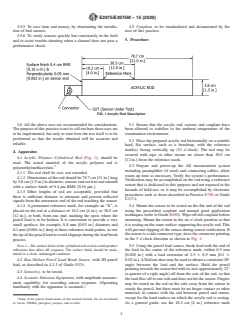
4.1 Acrylic Polymer Cylindrical Rod (Fig. 1), should be
[12 in.] from the reference mark.
used. The actual material of the acrylic polymer rod is
5.3 Prepare and power-up the AE measurement system
polymethylmethacrylate.
including preamplifier (if used) and connecting cables; allow
4.1.1 The rod shall be cast, not extruded.
warm up time as necessary. Verify the system’s performance.
4.1.2 Dimensions of the rod should be 78.7 cm [31 in.] long
Verification may be accomplished on the rod using a reference
by3.8cm[1.5in.]indiameter,sensorsendcuttrueandsmooth
sensor that is dedicated to this purpose and not exposed to the
with a surface finish of 0.4 µm RMS [0.16 µin.].
hazards of field use; or, it may be accomplished by electronic
4.1.3 Other lengths of rod are acceptable
...