

ASTM B214-22
(Test Method)Standard Test Method for Sieve Analysis of Metal Powders
General Information
- Abstract
SIGNIFICANCE AND USE
4.1 The particle size distribution of a metal powder affects its behavior in PM processing and other applications of these materials. The test method may be part of the purchase agreement between powder supplier and user, or it may be an internal quality control test for either.
SCOPE
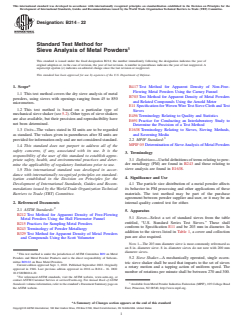
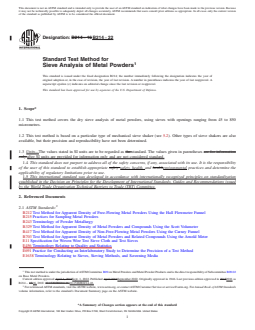
1.1 This test method covers the dry sieve analysis of metal powders, using sieves with openings ranging from 45 to 850 micrometres.
1.2 This test method is based on a particular type of mechanical sieve shaker (see 5.2). Other types of sieve shakers are also available, but their precision and reproducibility have not been determined.
1.3 Units—The values stated in SI units are to be regarded as standard. The values given in parentheses after SI units are provided for information only and are not considered standard.
1.4 This standard does not purport to address all of the safety concerns, if any, associated with its use. It is the responsibility of the user of this standard to establish appropriate safety, health, and environmental practices and determine the applicability of regulatory limitations prior to use.
1.5 This international standard was developed in accordance with internationally recognized principles on standardization established in the Decision on Principles for the Development of International Standards, Guides and Recommendations issued by the World Trade Organization Technical Barriers to Trade (TBT) Committee.
- Status
- Published
- Publication Date
- 31-Aug-2022
- Technical Committee
- B09 - Metal Powders and Metal Powder Products
- Drafting Committee
- B09.02 - Base Metal Powders

Overview
ASTM B214-22 - Standard Test Method for Sieve Analysis of Metal Powders - is an internationally recognized guideline developed by ASTM International. This standard describes the dry sieve analysis method for determining the particle size distribution of metal powders. The procedure uses mechanical sieve shakers and a defined range of sieve sizes-from 45 to 850 micrometres-to accurately classify metal powder particles for quality control, process optimization, and compliance verification throughout the powder metallurgy (PM) industry.
The particle size of metal powders directly influences their behavior during processing and in end-use applications. ASTM B214-22 is widely used by metal powder suppliers and users as a basis for purchase agreements, as well as by QA/QC departments to ensure product consistency.
Key Topics
- Particle Size Distribution: Details best practices for measuring and reporting the distribution of particle sizes in a sample of metal powder.
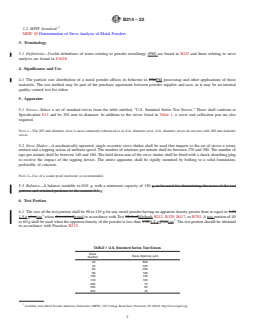
- Sieve Equipment: Recommends the use of 203 mm (8-inch) diameter sieves meeting ASTM E11 specifications and describes requirements for mechanical sieve shakers, ensuring consistent rotary and tapping motions.
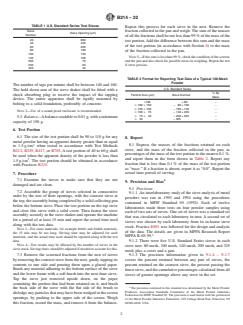
- Sample Preparation: Outlines specimen size requirements based on powder apparent density, with specific mass ranges for various powder types.
- Test Procedure:
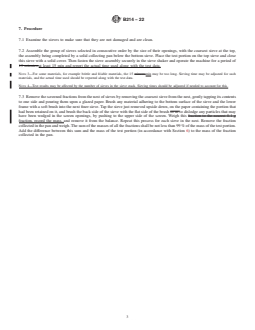
- Sieve stacks assembled by decreasing mesh size, with a solid pan at the bottom to collect fines.
- Mechanical sieving for a minimum of 15 minutes, with the actual sieving time reported in test data.
- Careful removal and weighing of fractions retained on each sieve, and the combined total must account for at least 99% of the test portion mass.
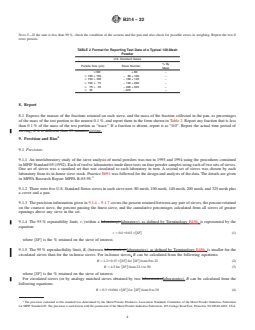
- Data Reporting: Results are expressed as the mass fraction retained on each sieve, rounded and reported according to established formats for traceability and repeatability.
- Precision & Repeatability: Provides statistical limits for repeatability within a laboratory and reproducibility between laboratories, supporting data reliability in both supplier and customer settings.
Applications
- Quality Control in Powder Metallurgy: Ensures uniformity and consistency of metal powders for component manufacturing, additive manufacturing, and other PM processes.
- Purchase Specifications: Used as a contractual method between powder producers and end users to guarantee that delivered products meet agreed particle size specifications.
- Product Development: Supports R&D and process optimization efforts by providing insight into how particle size distribution may affect properties of finished components, processing behavior, blending, and sintering outcomes.
- Compliance and Traceability: Forms an integral part of internal and external audits, providing documented evidence of product quality and lot-to-lot consistency.
Related Standards
For further reference and correlation, the following standards are commonly used alongside ASTM B214-22:
- ASTM E11: Specification for Woven Wire Test Sieve Cloth and Test Sieves
- ASTM B212: Test Method for Apparent Density of Free-Flowing Metal Powders Using the Hall Flowmeter Funnel
- ASTM B215: Practices for Sampling Metal Powders
- ASTM B329: Test Method for Apparent Density of Metal Powders and Compounds Using the Scott Volumeter
- ASTM B243: Terminology of Powder Metallurgy
- MPIF Standard 05: Determination of Sieve Analysis of Metal Powders
- ASTM E1638: Terminology Relating to Sieves, Sieving Methods, and Screening Media
Practical Value
By applying ASTM B214-22, organizations in the metal powder sector can:
- Achieve consistent and verifiable powder sizing, directly impacting product quality
- Satisfy procurement, customer, and regulatory requirements
- Streamline laboratory procedures with clear, reproducible methods
- Mitigate risk in PM process scale-up and production
Consistent sieve analysis according to ASTM B214-22 ensures optimal performance in powder metallurgy applications and builds confidence in the supply chain for metal powders globally.
Relations
- Effective Date
- 01-Apr-2022
- Effective Date
- 01-May-2020
- Effective Date
- 01-Oct-2018
- Effective Date
- 01-Oct-2018
- Effective Date
- 01-Oct-2017
- Effective Date
- 01-Oct-2017
- Effective Date
- 01-Jul-2016
- Effective Date
- 01-Dec-2014
- Effective Date
- 15-Nov-2013
- Effective Date
- 15-Nov-2013
- Effective Date
- 15-Nov-2013
- Effective Date
- 15-Nov-2013
- Effective Date
- 01-Nov-2013
- Effective Date
- 01-Oct-2013
- Effective Date
- 01-Oct-2013
Get Certified
Connect with accredited certification bodies for this standard

Element Materials Technology
Materials testing and product certification.

Inštitut za kovinske materiale in tehnologije
Institute of Metals and Technology. Materials testing, metallurgical analysis, NDT.
Sponsored listings
Frequently Asked Questions
ASTM B214-22 is a standard published by ASTM International. Its full title is "Standard Test Method for Sieve Analysis of Metal Powders". This standard covers: SIGNIFICANCE AND USE 4.1 The particle size distribution of a metal powder affects its behavior in PM processing and other applications of these materials. The test method may be part of the purchase agreement between powder supplier and user, or it may be an internal quality control test for either. SCOPE 1.1 This test method covers the dry sieve analysis of metal powders, using sieves with openings ranging from 45 to 850 micrometres. 1.2 This test method is based on a particular type of mechanical sieve shaker (see 5.2). Other types of sieve shakers are also available, but their precision and reproducibility have not been determined. 1.3 Units—The values stated in SI units are to be regarded as standard. The values given in parentheses after SI units are provided for information only and are not considered standard. 1.4 This standard does not purport to address all of the safety concerns, if any, associated with its use. It is the responsibility of the user of this standard to establish appropriate safety, health, and environmental practices and determine the applicability of regulatory limitations prior to use. 1.5 This international standard was developed in accordance with internationally recognized principles on standardization established in the Decision on Principles for the Development of International Standards, Guides and Recommendations issued by the World Trade Organization Technical Barriers to Trade (TBT) Committee.
SIGNIFICANCE AND USE 4.1 The particle size distribution of a metal powder affects its behavior in PM processing and other applications of these materials. The test method may be part of the purchase agreement between powder supplier and user, or it may be an internal quality control test for either. SCOPE 1.1 This test method covers the dry sieve analysis of metal powders, using sieves with openings ranging from 45 to 850 micrometres. 1.2 This test method is based on a particular type of mechanical sieve shaker (see 5.2). Other types of sieve shakers are also available, but their precision and reproducibility have not been determined. 1.3 Units—The values stated in SI units are to be regarded as standard. The values given in parentheses after SI units are provided for information only and are not considered standard. 1.4 This standard does not purport to address all of the safety concerns, if any, associated with its use. It is the responsibility of the user of this standard to establish appropriate safety, health, and environmental practices and determine the applicability of regulatory limitations prior to use. 1.5 This international standard was developed in accordance with internationally recognized principles on standardization established in the Decision on Principles for the Development of International Standards, Guides and Recommendations issued by the World Trade Organization Technical Barriers to Trade (TBT) Committee.
ASTM B214-22 is classified under the following ICS (International Classification for Standards) categories: 77.160 - Powder metallurgy. The ICS classification helps identify the subject area and facilitates finding related standards.
ASTM B214-22 has the following relationships with other standards: It is inter standard links to ASTM E456-13a(2022)e1, ASTM B329-20, ASTM B243-18, ASTM B329-18, ASTM E456-13A(2017)e1, ASTM E456-13A(2017)e3, ASTM B243-16, ASTM B329-14, ASTM E456-13ae2, ASTM E456-13a, ASTM E456-13ae3, ASTM E456-13ae1, ASTM B243-13, ASTM B417-13, ASTM E11-13. Understanding these relationships helps ensure you are using the most current and applicable version of the standard.
ASTM B214-22 is available in PDF format for immediate download after purchase. The document can be added to your cart and obtained through the secure checkout process. Digital delivery ensures instant access to the complete standard document.
Standards Content (Sample)
This international standard was developed in accordance with internationally recognized principles on standardization established in the Decision on Principles for the
Development of International Standards, Guides and Recommendations issued by the World Trade Organization Technical Barriers to Trade (TBT) Committee.
Designation: B214 − 22
Standard Test Method for
Sieve Analysis of Metal Powders
This standard is issued under the fixed designation B214; the number immediately following the designation indicates the year of
original adoption or, in the case of revision, the year of last revision. A number in parentheses indicates the year of last reapproval. A
superscript epsilon (´) indicates an editorial change since the last revision or reapproval.
This standard has been approved for use by agencies of the U.S. Department of Defense.
1. Scope* B417 Test Method for Apparent Density of Non-Free-
Flowing Metal Powders Using the Carney Funnel
1.1 This test method covers the dry sieve analysis of metal
B703 Test Method for Apparent Density of Metal Powders
powders, using sieves with openings ranging from 45 to 850
and Related Compounds Using the Arnold Meter
micrometres.
E11 Specification for Woven Wire Test Sieve Cloth and Test
1.2 This test method is based on a particular type of
Sieves
mechanical sieve shaker (see 5.2). Other types of sieve shakers
E456 Terminology Relating to Quality and Statistics
are also available, but their precision and reproducibility have
E691 Practice for Conducting an Interlaboratory Study to
not been determined.
Determine the Precision of a Test Method
E1638 Terminology Relating to Sieves, Sieving Methods,
1.3 Units—The values stated in SI units are to be regarded
as standard. The values given in parentheses after SI units are and Screening Media
provided for information only and are not considered standard. 2.2 MPIF Standard:
MPIF 05 Determination of SieveAnalysis of Metal Powders
1.4 This standard does not purport to address all of the
safety concerns, if any, associated with its use. It is the
3. Terminology
responsibility of the user of this standard to establish appro-
3.1 Definitions—Usefuldefinitionsoftermsrelatingtopow-
priate safety, health, and environmental practices and deter-
der metallurgy (PM) are found in B243 and those relating to
mine the applicability of regulatory limitations prior to use.
sieve analysis are found in E1638.
1.5 This international standard was developed in accor-
dance with internationally recognized principles on standard-
4. Significance and Use
ization established in the Decision on Principles for the
4.1 The particle size distribution of a metal powder affects
Development of International Standards, Guides and Recom-
mendations issued by the World Trade Organization Technical its behavior in PM processing and other applications of these
materials. The test method may be part of the purchase
Barriers to Trade (TBT) Committee.
agreement between powder supplier and user, or it may be an
internal quality control test for either.
2. Referenced Documents
2.1 ASTM Standards:
5. Apparatus
B212 Test Method for Apparent Density of Free-Flowing
5.1 Sieves—Select a set of standard sieves from the table
Metal Powders Using the Hall Flowmeter Funnel
entitled, “U.S. Standard Series Test Sieves.” These shall
B215 Practices for Sampling Metal Powders
conform to Specification E11 and be 203 mm in diameter. In
B243 Terminology of Powder Metallurgy
addition to the sieves listed in Table 1, a cover and collection
B329 Test Method for Apparent Density of Metal Powders
pan are also required.
and Compounds Using the Scott Volumeter
NOTE 1—The 203 mm diameter sieve is most commonly referenced as
an 8 in. diameter sieve. 8 in. diameter sieves do not nest with 200 mm
diameter sieves.
This test method is under the jurisdiction of ASTM Committee B09 on Metal
Powders and Metal Powder Products and is the direct responsibility of Subcom- 5.2 Sieve Shaker—A mechanically operated, single eccen-
mittee B09.02 on Base Metal Powders.
tric sieve shaker shall be used that imparts to the set of sieves
Current edition approved Sept. 1, 2022. Published September 2022. Originally
a rotary motion and a tapping action of uniform speed. The
approved in 1946. Last previous edition approved in 2016 as B214 – 16. DOI:
number of rotations per minute shall be between 270 and 300.
10.1520/B0214-22.
For referenced ASTM standards, visit the ASTM website, www.astm.org, or
contact ASTM Customer Service at service@astm.org. For Annual Book of ASTM
Standards volume information, refer to the standard’s Document Summary page on Available from Metal Powder Industries Federation (MPIF), 105 College Road
the ASTM website. East, Princeton, NJ 08540, http://www.mpif.org.
*A Summary of Changes section appears at the end of this standard
Copyright © ASTM International, 100 Barr Harbor Drive, PO Box C700, West Conshohocken, PA 19428-2959. United States
B214 − 22
TABLE 1 U.S. Standard Series Test Sieves
Repeat this process for each sieve in the nest. Remove the
Sieve fraction collected in the pan and weigh. The sum of the masses
Sieve Opening (µm)
Number
ofallthefractionsshallbenotlessthan99 %ofthemassofthe
20 850
test portion.Add the difference between this sum and the mass
40 425
of the test portion (in accordance with Section 6) to the mass
60 250
80 180 of the fraction collected in the pan.
100 150
NOTE5—Ifthesumislessthan99 %,checktheconditionofthescreens
140 106
200 75
and the pan and also check for possible errors in weighing. Repeat the test
230 63
if error persists.
325 45
TABLE 2 Format for Reporting Test Data of a Typical 100-Mesh
Powder
The number of taps per minute shall be between 140 and 160.
U.S. Standard Series
The hold down arm of the sieve shaker shall be fitted with a
%By
shock absorbing plug to receive the impact of the tapping
Particle Size (µm) Sieve Number
Mass
device. The entire apparatus shall be rigidly mounted by
>180 + 80 .
bolting to a solid foundation, preferably of concrete.
# 180 > 150 − 80 + 100 .
# 150 > 106 − 100 + 140 .
NOTE 2—Use of a sound proof enclosure is recommended.
# 106 > 75 − 140 + 200 .
# 75 > 45 − 200 + 325 .
5.3 Balance—Abalancereadableto0.01g,withaminimum
# 45 − 325 .
capacity of 150 g.
6. Test Portion
6.1 The size of the test portion shall be 90 to 110 g for any
8. Report
metal powder having an apparent density greater than or equal
3 8.1 Express the masses of the fractions retained on each
to 1.5 g⁄cm when tested in accordance with Test Methods
sieve, and the mass of the fraction collected in the pan, as
B212, B329, B417,or B703. A test portion of 40 to 60 g shall
percentages of the mass of the test portion to the nearest 0.1 %,
be used when the apparent density of the powder is less than
and report them in the form shown in Table 2. Report any
1.5 g⁄cm . The test portion should be obtained in accordance
fraction that is less than 0.1 % of the mass of the test portion
with Practices B215.
as “trace.” If a fraction is absent, report it as “0.0”. Report the
actual time period of sieving.
7. Procedure
7.1 Examine the sieves to make sure that they are not 4
9. Precision and Bias
damaged and are clean.
9.1 Precision:
7.2 Assemble the group of sieves selected in consecutive
9.1.1 An interlaboratory study of the sieve analysis of metal
order by the size of their openings, with the coarsest sieve at
powders was run in 1993 and 1994 using the procedures
thetop,theassemblybeingcompletedbyasolidcollectingpan
contained in MPIF Standard 05 (1992). Each of twelve
below the bottom sieve. Place the test portion on the top sieve
laboratories made three tests on four powder samples using
and close this sieve with a solid cover. Then fasten the sieve
each of two s
...
This document is not an ASTM standard and is intended only to provide the user of an ASTM standard an indication of what changes have been made to the previous version. Because
it may not be technically possible to adequately depict all changes accurately, ASTM recommends that users consult prior editions as appropriate. In all cases only the current version
of the standard as published by ASTM is to be considered the official document.
Designation: B214 − 16 B214 − 22
Standard Test Method for
Sieve Analysis of Metal Powders
This standard is issued under the fixed designation B214; the number immediately following the designation indicates the year of
original adoption or, in the case of revision, the year of last revision. A number in parentheses indicates the year of last reapproval. A
superscript epsilon (´) indicates an editorial change since the last revision or reapproval.
This standard has been approved for use by agencies of the U.S. Department of Defense.
1. Scope*
1.1 This test method covers the dry sieve analysis of metal powders, using sieves with openings ranging from 45 to 850
micrometres.
1.2 This test method is based on a particular type of mechanical sieve shaker (see 5.2). Other types of sieve shakers are also
available, but their precision and reproducibility have not been determined.
1.3 Units—The values stated in SI units are to be regarded as the standard. The values given in parentheses are for information
only.after SI units are provided for information only and are not considered standard.
1.4 This standard does not purport to address all of the safety concerns, if any, associated with its use. It is the responsibility
of the user of this standard to establish appropriate safety safety, health, and healthenvironmental practices and determine the
applicability of regulatory limitations prior to use.
1.5 This international standard was developed in accordance with internationally recognized principles on standardization
established in the Decision on Principles for the Development of International Standards, Guides and Recommendations issued
by the World Trade Organization Technical Barriers to Trade (TBT) Committee.
2. Referenced Documents
2.1 ASTM Standards:
B212 Test Method for Apparent Density of Free-Flowing Metal Powders Using the Hall Flowmeter Funnel
B215 Practices for Sampling Metal Powders
B243 Terminology of Powder Metallurgy
B329 Test Method for Apparent Density of Metal Powders and Compounds Using the Scott Volumeter
B417 Test Method for Apparent Density of Non-Free-Flowing Metal Powders Using the Carney Funnel
B703 Test Method for Apparent Density of Metal Powders and Related Compounds Using the Arnold Meter
E11 Specification for Woven Wire Test Sieve Cloth and Test Sieves
E456 Terminology Relating to Quality and Statistics
E691 Practice for Conducting an Interlaboratory Study to Determine the Precision of a Test Method
E1638 Terminology Relating to Sieves, Sieving Methods, and Screening Media
This test method is under the jurisdiction of ASTM Committee B09 on Metal Powders and Metal Powder Products and is the direct responsibility of Subcommittee B09.02
on Base Metal Powders.
Current edition approved April 1, 2016Sept. 1, 2022. Published April 2016September 2022. Originally approved in 1946. Last previous edition approved in 20152016 as
B214 – 15.16. DOI: 10.1520/B0214-16.10.1520/B0214-22.
For referenced ASTM standards, visit the ASTM website, www.astm.org, or contact ASTM Customer Service at service@astm.org. For Annual Book of ASTM Standards
volume information, refer to the standard’s Document Summary page on the ASTM website.
*A Summary of Changes section appears at the end of this standard
Copyright © ASTM International, 100 Barr Harbor Drive, PO Box C700, West Conshohocken, PA 19428-2959. United States
B214 − 22
2.2 MPIF Standard:
MPIF 05 Determination of Sieve Analysis of Metal Powders
3. Terminology
3.1 Definitions—Useful definitions of terms relating to powder metallurgy (PM) are found in B243 and those relating to sieve
analysis are found in E1638.
4. Significance and Use
4.1 The particle size distribution of a metal powder affects its behavior in P/MPM processing and other applications of these
materials. The test method may be part of the purchase agreement between powder supplier and user, or it may be an internal
quality control test for either.
5. Apparatus
5.1 Sieves—Select a set of standard sieves from the table entitled, “U.S. Standard Series Test Sieves.” These shall conform to
Specification E11 and be 203 mm in diameter. In addition to the sieves listed in Table 1, a cover and collection pan are also
required.
NOTE 1—The 203 mm diameter sieve is most commonly referenced as an 8 in. diameter sieve. 8 in. diameter sieves do not nest with 200 mm diameter
sieves.
5.2 Sieve Shaker—A mechanically operated, single eccentric sieve shaker shall be used that imparts to the set of sieves a rotary
motion and a tapping action of uniform speed. The number of rotations per minute shall be between 270 and 300. The number of
taps per minute shall be between 140 and 160. The hold down arm of the sieve shaker shall be fitted with a shock absorbing plug
to receive the impact of the tapping device. The entire apparatus shall be rigidly mounted by bolting to a solid foundation,
preferably of concrete.
NOTE 2—Use of a sound proof enclosure is recommended.
5.3 Balance—A balance readable to 0.01 g, with a minimum capacity of 150 g, to be used for determining the mass of the test
portion and retained portions to the nearest 0.1 g.
6. Test Portion
6.1 The size of the test portion shall be 90 to 110 g for any metal powder having an apparent density greater than or equal to 1.50
1.5 g g/cm⁄cm when determinedtested in accordance with Test MethodMethods B212, B329, B417, or B703. A test portion of 40
to 60 g shall be used when the apparent density of the powder is less than 1.50 1.5 g g/cm⁄cm . The test portion should be obtained
in accordance with Practices B215.
TABLE 1 U.S. Standard Series Test Sieves
Sieve
Sieve Opening (μm)
Number
20 850
40 425
60 250
80 180
100 150
140 106
200 75
230 63
325 45
Available from Metal Powder Industries Federation (MPIF), 105 College Road East, Princeton, NJ 08540, http://www.mpif.org.
B214 − 22
7. Procedure
7.1 Examine the sieves to make sure that they are not damaged and are clean.
7.2 Assemble the group of sieves selected in consecutive order by the size of their openings, with the coarsest sieve at the top,
the assembly being completed by a solid collecting pan below the bottom sieve. Place the test portion on the top sieve and close
this sieve with a solid cover. Then fasten the sieve assembly securely in the sieve shaker and operate the machine for a period of
15 minutes.at least 15 min and report the actual time used along with the test data.
NOTE 3—For some materials, for example brittle and friable materials, the 15 minutesmin may be too long. Sieving time may be adjusted for such
materials, and the actual time used should be reported along with the test data.
NOTE 4—Test results may be affected by the number of sieves in the sieve stack. Sieving times should be adjusted if needed to account for this.
7.3 Remove the screened fractions from the nest of sieves by removing the coarsest sieve from the nest, gently tapping its contents
to one side and pouring them upon a glazed paper. Brush any material adhering to the bottom surface of the sieve and the lower
frame with a soft brush into the next finer sieve. Tap the sieve just removed upside down, on the paper containing the portion that
had been retained on it, and brush the back side of the sieve with the flat side of the brush so as to dislodge any particles that may
have been wedged in the screen openings, by pushing to the upper side of the screen. Weigh this fraction to the nearest 0.1 g
fraction, record the mass, and remove it from the balance. Repeat this process for each sieve in the nest. Remove the fraction
collected in the pan and weigh. The sum of the masses of all the fractions shall be not less than 99 % of the mass of the test portion.
Add the difference between this sum and the mass of the test portion (in accordance with Section 6) to the mass of the fraction
collected in the pan.
B214 − 22
NOTE 5—If the sum is less than 99 %, check the condition of the screens and the pan and also check for possible errors in weighing. Repeat the test if
error persists.
TABLE 2 Format for Reporting Test Data of a Typical 100-M
...