

ASTM D5452-23
(Test Method)Standard Test Method for Particulate Contamination in Aviation Fuels by Laboratory Filtration
General Information
- Abstract
SIGNIFICANCE AND USE
5.1 This test method provides a gravimetric measurement of the particulate matter present in a sample of aviation turbine fuel delivered to a laboratory for evaluation. The objective is to minimize these contaminants to avoid filter plugging and other operational problems. Although tolerable levels of particulate contaminants have not yet been established for all points in fuel distribution systems, the total contaminant measurement is normally of most interest.
SCOPE
1.1 This test method covers the gravimetric determination by filtration of particulate contaminant in a sample of aviation turbine fuel delivered to a laboratory.
1.1.1 The sample is filtered through a test membrane and a control membrane using vacuum. The mass change difference identifies the contaminant level per unit volume.
1.2 The values stated in SI units are to be regarded as the standard. The values given in parentheses are for information only.
1.3 This standard does not purport to address all of the safety concerns, if any, associated with its use. It is the responsibility of the user of this standard to establish appropriate safety, health, and environmental practices and determine the applicability of regulatory limitations prior to use. For specific hazard statements, see 4.2, 7.3, 7.5, 11.2, and X1.7.2. Before using this standard, refer to supplier's safety labels, material safety data sheets, and technical literature.
1.4 This international standard was developed in accordance with internationally recognized principles on standardization established in the Decision on Principles for the Development of International Standards, Guides and Recommendations issued by the World Trade Organization Technical Barriers to Trade (TBT) Committee.
- Status
- Published
- Publication Date
- 30-Apr-2023
- Technical Committee
- D02 - Petroleum Products, Liquid Fuels, and Lubricants
- Drafting Committee
- D02.J0.05 - Fuel Cleanliness
Buy Documents
ASTM D5452-23 - Standard Test Method for Particulate Contamination in Aviation Fuels by Laboratory Filtration
REDLINE ASTM D5452-23 - Standard Test Method for Particulate Contamination in Aviation Fuels by Laboratory Filtration
Overview
ASTM D5452-23 is the internationally recognized Standard Test Method for Particulate Contamination in Aviation Fuels by Laboratory Filtration. Developed by ASTM International, this method outlines a gravimetric procedure to determine the level of solid particulate contamination in aviation turbine fuel samples. By accurately measuring particulate contaminants, laboratories and fuel distributors can assess fuel cleanliness, helping to minimize operational problems such as filter plugging in aircraft and fuel handling systems. Proper implementation of this standard is crucial for maintaining the reliability and safety of aviation fuel supplies.
Key Topics
- Gravimetric Filtration: The core of ASTM D5452-23 is the use of vacuum-assisted filtration. Aviation turbine fuel samples are passed through a pre-weighed test membrane filter and a control membrane. The difference in filter mass before and after filtration indicates the level of particulates per unit volume.
- Membrane Filters: Standardized membrane filters, nominally 47 mm in diameter with a pore size of 0.8 μm, are specified for accurate and repeatable results.
- Sampling Procedures: The standard emphasizes strict protocols for sampling, handling, and container cleanliness to avoid introducing external contaminants that could skew results.
- Safety Considerations: The procedure addresses the safe handling of volatile fuels, requiring appropriate grounding, use of support stands for low flash point fuels, and precautions to prevent static discharge.
- Reporting and Documentation: Results are reported as particulate content in milligrams per litre, together with detailed notes on the sample volume and transfer, ensuring traceability and transparency.
Applications
ASTM D5452-23 is widely adopted by laboratories, fuel suppliers, and regulatory agencies involved in the distribution, storage, and quality control of aviation turbine fuel. Practical applications include:
- Quality Assurance for Aviation Fuel: Ensuring that the fuel supplied to airports and airlines meets industry cleanliness requirements, reducing the risk of contamination that could compromise aircraft systems.
- Filter Performance Evaluation: Data from ASTM D5452 help in monitoring filter performance in fuel supply chains and scheduling maintenance or filter replacements.
- Incident Investigation: In the event of operational issues, such as engine flameout or fuel starvation, particulate testing by this method assists in pinpointing contamination as a causal factor.
- Process Control: Refineries and fuel depots use this method to verify the efficacy of equipment and procedures aimed at removing particulates.
Related Standards
ASTM D5452-23 is part of a broader suite of aviation fuel cleanliness and quality standards, including:
- ASTM D2276 - Test Method for Particulate Contaminant in Aviation Fuel by Line Sampling
- ASTM D4306 - Practice for Aviation Fuel Sample Containers for Tests Affected by Trace Contamination
- ASTM D4865 - Guide for Generation and Dissipation of Static Electricity in Petroleum Fuel Systems
- ASTM D6615 - Specification for Jet B Wide-Cut Aviation Turbine Fuel
- ASTM D1193 - Specification for Reagent Water (used in sample and equipment preparation)
Reference to these related standards ensures consistency throughout the fuel supply chain and supports compliance with both commercial and defense sector requirements.
Keywords: ASTM D5452-23, aviation fuel cleanliness, particulate contamination, gravimetric filtration, fuel quality, test method, membrane filter, fuel handling safety, jet fuel testing, aviation turbine fuel, aviation fuel standards.
Relations
- Effective Date
- 01-Mar-2024
- Effective Date
- 01-Nov-2023
- Effective Date
- 01-Aug-2020
- Effective Date
- 01-Dec-2018
- Effective Date
- 01-Jun-2016
- Effective Date
- 01-Jun-2016
- Effective Date
- 01-Oct-2015
- Effective Date
- 01-Sep-2015
- Effective Date
- 01-Aug-2015
- Effective Date
- 01-Jul-2015
- Effective Date
- 01-Jan-2015
- Effective Date
- 01-Jan-2015
- Effective Date
- 01-Nov-2014
- Effective Date
- 01-Oct-2014
- Effective Date
- 15-May-2014
Buy Documents
ASTM D5452-23 - Standard Test Method for Particulate Contamination in Aviation Fuels by Laboratory Filtration
REDLINE ASTM D5452-23 - Standard Test Method for Particulate Contamination in Aviation Fuels by Laboratory Filtration
Get Certified
Connect with accredited certification bodies for this standard

Element Materials Technology
Materials testing and product certification.

ABS Group Brazil
ABS Group certification services in Brazil.

ABS Quality Evaluations Inc.
American Bureau of Shipping quality certification.
Sponsored listings
Frequently Asked Questions
ASTM D5452-23 is a standard published by ASTM International. Its full title is "Standard Test Method for Particulate Contamination in Aviation Fuels by Laboratory Filtration". This standard covers: SIGNIFICANCE AND USE 5.1 This test method provides a gravimetric measurement of the particulate matter present in a sample of aviation turbine fuel delivered to a laboratory for evaluation. The objective is to minimize these contaminants to avoid filter plugging and other operational problems. Although tolerable levels of particulate contaminants have not yet been established for all points in fuel distribution systems, the total contaminant measurement is normally of most interest. SCOPE 1.1 This test method covers the gravimetric determination by filtration of particulate contaminant in a sample of aviation turbine fuel delivered to a laboratory. 1.1.1 The sample is filtered through a test membrane and a control membrane using vacuum. The mass change difference identifies the contaminant level per unit volume. 1.2 The values stated in SI units are to be regarded as the standard. The values given in parentheses are for information only. 1.3 This standard does not purport to address all of the safety concerns, if any, associated with its use. It is the responsibility of the user of this standard to establish appropriate safety, health, and environmental practices and determine the applicability of regulatory limitations prior to use. For specific hazard statements, see 4.2, 7.3, 7.5, 11.2, and X1.7.2. Before using this standard, refer to supplier's safety labels, material safety data sheets, and technical literature. 1.4 This international standard was developed in accordance with internationally recognized principles on standardization established in the Decision on Principles for the Development of International Standards, Guides and Recommendations issued by the World Trade Organization Technical Barriers to Trade (TBT) Committee.
SIGNIFICANCE AND USE 5.1 This test method provides a gravimetric measurement of the particulate matter present in a sample of aviation turbine fuel delivered to a laboratory for evaluation. The objective is to minimize these contaminants to avoid filter plugging and other operational problems. Although tolerable levels of particulate contaminants have not yet been established for all points in fuel distribution systems, the total contaminant measurement is normally of most interest. SCOPE 1.1 This test method covers the gravimetric determination by filtration of particulate contaminant in a sample of aviation turbine fuel delivered to a laboratory. 1.1.1 The sample is filtered through a test membrane and a control membrane using vacuum. The mass change difference identifies the contaminant level per unit volume. 1.2 The values stated in SI units are to be regarded as the standard. The values given in parentheses are for information only. 1.3 This standard does not purport to address all of the safety concerns, if any, associated with its use. It is the responsibility of the user of this standard to establish appropriate safety, health, and environmental practices and determine the applicability of regulatory limitations prior to use. For specific hazard statements, see 4.2, 7.3, 7.5, 11.2, and X1.7.2. Before using this standard, refer to supplier's safety labels, material safety data sheets, and technical literature. 1.4 This international standard was developed in accordance with internationally recognized principles on standardization established in the Decision on Principles for the Development of International Standards, Guides and Recommendations issued by the World Trade Organization Technical Barriers to Trade (TBT) Committee.
ASTM D5452-23 is classified under the following ICS (International Classification for Standards) categories: 75.160.20 - Liquid fuels. The ICS classification helps identify the subject area and facilitates finding related standards.
ASTM D5452-23 has the following relationships with other standards: It is inter standard links to ASTM D8194-24, ASTM D4865-23, ASTM D93-20, ASTM D8194-18, ASTM D3828-16, ASTM D56-16, ASTM D4306-15, ASTM D6615-15a, ASTM D2244-15a, ASTM D6615-15, ASTM D2244-15, ASTM D2244-15e1, ASTM D1535-14, ASTM D4865-09(2014), ASTM D6615-14a. Understanding these relationships helps ensure you are using the most current and applicable version of the standard.
ASTM D5452-23 is available in PDF format for immediate download after purchase. The document can be added to your cart and obtained through the secure checkout process. Digital delivery ensures instant access to the complete standard document.
Standards Content (Sample)
This international standard was developed in accordance with internationally recognized principles on standardization established in the Decision on Principles for the
Development of International Standards, Guides and Recommendations issued by the World Trade Organization Technical Barriers to Trade (TBT) Committee.
Designation: D5452 − 23
Designation: 423/10
Standard Test Method for
Particulate Contamination in Aviation Fuels by Laboratory
1,2
Filtration
This standard is issued under the fixed designation D5452; the number immediately following the designation indicates the year of
original adoption or, in the case of revision, the year of last revision. A number in parentheses indicates the year of last reapproval. A
superscript epsilon (´) indicates an editorial change since the last revision or reapproval.
This standard has been approved for use by agencies of the U.S. Department of Defense.
1. Scope* 2. Referenced Documents
2.1 ASTM Standards:
1.1 This test method covers the gravimetric determination
D56 Test Method for Flash Point by Tag Closed Cup Tester
by filtration of particulate contaminant in a sample of aviation
D93 Test Methods for Flash Point by Pensky-Martens
turbine fuel delivered to a laboratory.
Closed Cup Tester
1.1.1 The sample is filtered through a test membrane and a
D1193 Specification for Reagent Water
control membrane using vacuum. The mass change difference
D1535 Practice for Specifying Color by the Munsell System
identifies the contaminant level per unit volume.
D2244 Practice for Calculation of Color Tolerances and
1.2 The values stated in SI units are to be regarded as the Color Differences from Instrumentally Measured Color
Coordinates
standard. The values given in parentheses are for information
D2276 Test Method for Particulate Contaminant in Aviation
only.
Fuel by Line Sampling
1.3 This standard does not purport to address all of the
D3828 Test Methods for Flash Point by Small Scale Closed
safety concerns, if any, associated with its use. It is the
Cup Tester
responsibility of the user of this standard to establish appro-
D4306 Practice for Aviation Fuel Sample Containers for
priate safety, health, and environmental practices and deter-
Tests Affected by Trace Contamination
mine the applicability of regulatory limitations prior to use.
D4865 Guide for Generation and Dissipation of Static Elec-
For specific hazard statements, see 4.2, 7.3, 7.5, 11.2, and
tricity in Petroleum Fuel Systems
X1.7.2. Before using this standard, refer to supplier’s safety
D6615 Specification for Jet B Wide-Cut Aviation Turbine
labels, material safety data sheets, and technical literature.
Fuel
1.4 This international standard was developed in accor-
D8194 Practice for Evaluation of Suitability of 37 mm Filter
dance with internationally recognized principles on standard-
Monitors and 47 mm Filters Used to Determine Particu-
ization established in the Decision on Principles for the late Contaminant in Aviation Turbine Fuels
Development of International Standards, Guides and Recom-
mendations issued by the World Trade Organization Technical 3. Terminology
Barriers to Trade (TBT) Committee.
3.1 Definitions:
3.1.1 bond, v—to connect two parts of a system electrically
by means of a bonding wire to eliminate voltage differences.
This test method is under the jurisdiction of ASTM International Committee
3.1.2 ground, vt—to connect electrically with ground
D02 on Petroleum Products, Liquid Fuels, and Lubricants and is the direct
(earth).
responsibility of ASTM Subcommittee D02.J0.05 on Fuel Cleanliness. The techni-
cally equivalent standard as referenced is under the jurisdiction of the Energy
3.1.3 membrane filter, n—a porous article of closely con-
Institute Subcommittee SC-B-11.
trolled pore size through which a liquid is passed to separate
Current edition approved May 1, 2023. Published May 2023. Originally
matter in suspension.
approved in 1993. Last previous edition approved in 2020 as D5452 – 20. DOI:
10.1520/D5452-23.
This test method has been separated from D2276 and has been modified
primarily to establish improved safety measures.
2 3
This test method has been developed through the cooperative effort between For referenced ASTM standards, visit the ASTM website, www.astm.org, or
ASTM and the Energy Institute, London. ASTM and IP standards were approved by contact ASTM Customer Service at service@astm.org. For Annual Book of ASTM
ASTM and EI technical committees as being technically equivalent but that does not Standards volume information, refer to the standard’s Document Summary page on
imply both standards are identical. the ASTM website.
*A Summary of Changes section appears at the end of this standard
Copyright © ASTM International, 100 Barr Harbor Drive, PO Box C700, West Conshohocken, PA 19428-2959. United States
D5452 − 23
3.1.3.1 Discussion—Research Report RR:D02-1012 con- fication D6615 or the military grade known as JP-4. Any fuel
tains information on membrane filters that have historically or mixture having a flash point less than 38 °C is considered to
met the requirements of the method and are still considered be volatile.
suitable. Practice D8194 contains the test methods and accep-
4. Summary of Test Method
tance criteria for suitable membrane filters.
4.1 A known volume of fuel is filtered through a pre-
3.1.4 particulate, adj—of or relating to minute separate
weighed test membrane filter and the increase in membrane
particles.
filter mass is weight determined after washing and drying. The
3.1.4.1 Discussion—Solids generally composed of oxides,
change in weight of a control membrane located immediately
silicates, and fuel insoluble salts.
below the test membrane filter is also determined. The objec-
3.1.5 volatile fuels, n—relatively wide boiling range volatile
tive of using a control membrane is to assess whether the fuel
distillate.
itself influences the weight of a membrane. The particulate
3.1.5.1 Discussion—These are identified as Jet B in Speci-
contaminant is determined from the increase in mass of the test
membrane relative to the control membrane filter.
4.2 In order to ensure safety in handling, the test method
requires that volatile fuels be transferred from the sample
container to the funnel without pouring using a support stand
Supporting data (including a list of suppliers who have provided data indicating
shown in Fig. 1. Fuels having a verified flash point greater than
their membranes, field monitors, and field monitor castings) have been filed at
ASTM International Headquarters and may be obtained by requesting Research
Report RR:D02-1012. Contact ASTM Customer Service at service@astm.org.
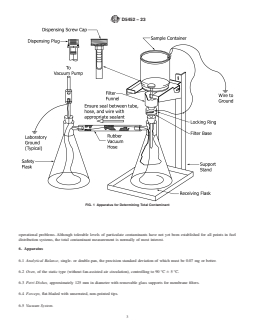
FIG. 1 Apparatus for Determining Total Contaminant
D5452 − 23
38 °C (refer to Test Method D56 or Test Methods D93 or
D3828) may be transferred by pouring the sample from the
sample container directly into the funnel. Bonding of a metallic
sample container to the funnel is required. (Warning—Volatile
fuels such as JP-4 and Jet B or mixtures having flash points
below 38 °C have been ignited by electrostatic discharges
when poured through membrane filters.)
4.3 Appendix X2 describes safety precautions to avoid
static discharge in filtering fuel through membranes.
5. Significance and Use
5.1 This test method provides a gravimetric measurement of
the particulate matter present in a sample of aviation turbine
fuel delivered to a laboratory for evaluation. The objective is to
minimize these contaminants to avoid filter plugging and other
operational problems. Although tolerable levels of particulate
contaminants have not yet been established for all points in fuel
distribution systems, the total contaminant measurement is
normally of most interest.
6. Apparatus
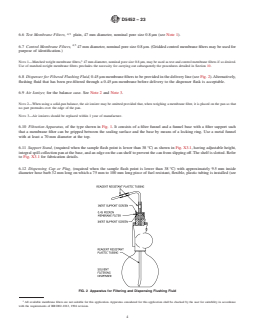
FIG. 2 Apparatus for Filtering and Dispensing Flushing Fluid
6.1 Analytical Balance, single- or double-pan, the precision
standard deviation of which must be 0.07 mg or better.
6.2 Oven, of the static type (without fan-assisted air
surface and the base by means of a locking ring. Use a metal
circulation), controlling to 90 °C 6 5 °C. funnel with at least a 70 mm diameter at the top.
6.3 Petri Dishes, approximately 125 mm in diameter with
6.11 Support Stand, (required when the sample flash point is
removable glass supports for membrane filters. lower than 38 °C) as shown in Fig. X3.1, having adjustable
height, integral spill collection pan at the base, and an edge on
6.4 Forceps, flat-bladed with unserrated, non-pointed tips.
the can shelf to prevent the can from slipping off. The shelf is
6.5 Vacuum System.
slotted. Refer to Fig. X3.1 for fabrication details.
4,5
6.6 Test Membrane Filters, plain, 47 mm diameter,
6.12 Dispensing Cap or Plug, (required when the sample
nominal pore size 0.8 μm (see Note 1).
flash point is lower than 38 °C) with approximately 9.5 mm
4,5
6.7 Control Membrane Filters, 47 mm diameter, nominal inside diameter hose barb 32 mm long on which a 75 mm to
pore size 0.8 μm. (Gridded control membrane filters may be 100 mm long piece of fuel resistant, flexible, plastic tubing is
used for purpose of identification.) installed (see Fig. 1). The plug is for sample containers having
⁄4 in. (19 mm) female pipe threads while the cap is for
NOTE 1—Matched weight membrane filters, 47 mm diameter, nominal
containers having 1.75 in. (44 mm) diameter sheet metal
pore size 0.8 μm, may be used as test and control membrane filters if so
threads. Dispensing spouts for other containers must be fabri-
desired. Use of matched-weight membrane filters precludes the necessity
for carrying out subsequently the procedures detailed in Section 10.
cated. The closure gasket shall be made of a fuel resistant
material. A paper composition material is not acceptable.
6.8 Dispenser for Filtered Flushing Fluid, 0.45 μm mem-
brane filters to be provided in the delivery line (see Fig. 2).
6.13 Sample Container, should be a 3.8 L to 5 L (1 gal)
Alternatively, flushing fluid that has been pre-filtered through a
epoxy lined sample can, preferably the same container in
0.45 μm membrane before delivery to the dispenser flask is
which the sample was collected and should conform to the
acceptable.
criteria set forth in Practice D4306. When samples are col-
lected in a smaller container than recommended here, select a
6.9 Air Ionizer, for the balance case. See Note 2 and Note 3.
container that does not trap particles when the contents are
NOTE 2—When using a solid-pan balance, the air ionizer may be
poured out.
omitted provided that, when weighing a membrane filter, it is placed on
the pan so that no part protrudes over the edge of the pan.
6.14 Receiving Flask, shall be glass or metal. A graduated
NOTE 3—Air ionizers should be replaced within 1 year of manufacture.
glass flask is preferred so that the space remaining for fuel can
6.10 Filtration Apparatus, of the type shown in Fig. 1. It be observed. The filtration apparatus is fitted to the top of the
consists of a filter funnel and a funnel base with a filter support flask. The flask shall be fitted with a side arm to connect the
such that a membrane filter can be gripped between the sealing vacuum system. The flask should be large enough to contain
the sample and flushing fluids.
6.15 Safety Flask, shall be glass containing a sidearm
All available membrane filters are not suitable for this application. Apparatus
attached to the receiving flask with a fuel and solvent resistant
considered for this application shall be checked by the user for suitability in
accordance with the requirements of RR:D02-1012, 1994 revision. rubber hose and shall be connected to the vacuum system.
D5452 − 23
6.16 Ground/Bond Wire, #10–#19 (0.912 mm to 2.59 mm) suitable for this test method because insufficient care may have
bare stranded flexible, stainless steel or copper installed in the been taken to avoid particulate contamination.
flasks and grounded as shown in Fig. 1. If a metallic flask(s) is
8.4 Where possible a 3.8 L to 5 L (1 gal) fuel sample should
used instead of glass, the flask(s) must be grounded.
be taken, preferably in the same container that will be used in
6.17 Plastic Film, polyethylene or any other clear film not
the test to avoid the need to transfer from one container to
adversely affected by flushing fluids. Refer to Appendix X4. another with increased possibility of contamination. Ideally, a
sample to be tested should be collected in a single container
6.18 Multimeter/VOM, used for determining whether elec-
and transferred to the laboratory for testing. If the sample is
trical continuity is 10 ohms or less between 2 points.
collected in small containers such as glass bottles and then
shipped to the laboratory, the collection containers shall be
7. Reagents
handled in a way to flush particulates into the transport
7.1 Purity of Reagents—Reagent grade chemicals shall be
container which should be UN/ICAO approved for public
used in all tests. Unless otherwise indicated, it is intended that
transport. Results obtained by taking other sample volumes can
all reagents shall conform to the specifications of the Commit-
have different precisions.
tee on Analytical Reagents of the American Chemical Society,
where such specifications are available. Other grades may be 8.5 The sample volume shall be quoted with the results. If
the sample was transferred from one container to another
used, provided it is first ascertained that the reagent is of
sufficiently high purity to permit its use without lessening the before the test was performed, this shall also be noted with the
test results.
accuracy of the determination.
7.2 Purity of Water—Unless otherwise indicated references
9. Preparation of Apparatus and Sample Containers
to water shall be understood to mean reagent water as defined
by Type III of Specification D1193. 9.1 Clean all components of the filtration apparatus, includ-
ing the funnels, filter base, forceps, petri dishes, dispensing cap
7.3 Isopropyl Alcohol, (Warning—Flammable.)
or plug and tubing (from 6.12) as described in 9.1.2 – 9.1.6.
7.4 Liquid Detergent, water-soluble.
9.1.1 Remove any labels, tags, and so forth.
7.5 Flushing Fluids—Petroleum spirit (also known as pe-
9.1.2 Wash with warm tap water containing detergent.
troleum ether or IP Petroleum Spirit 40/60), having boiling 9.1.3 Rinse thoroughly with warm tap water.
range from 35 °C to 60 °C. (Warning—Extremely flammable.
9.1.4 Rinse thoroughly with reagent water. Container caps
Harmful if inhaled. Vapors are easily ignited by electrostatic
should be handled only externally with clean laboratory
discharges, causing flash fire. See Appendix X2.)
crucible tongs during this and subsequent washing.
9.1.5 Rinse thoroughly with filtered isopropyl alcohol.
7.6 Filtered Flushing Fluids—Filtered fluids are fluids fil-
9.1.6 Rinse thoroughly with filtered flushing fluid.
tered through a nominal 0.45 μm membrane filter. Filtered
9.1.7 For special cleanliness procedures in facilities that can
flushing fluids are most conveniently obtained by means of the
have airborne dust, see Appendix X4.
dispenser described in Fig. 2.
8. Sampling 10. Preparation of Test and Control Membrane Filters
8.1 All containers and their closures shall be thoroughly
10.1 Two 47 mm membrane filters of nominal pore size
cleaned in accordance with Practice D4306.
0.8 μm are required: a test and a control membrane filter.
Matched-weight membrane filters may be used if so desired
8.2 To obtain a representative sample from a fuel stream and
(see Note 1). If matched-weight membrane filters are used, it is
to avoid external contamination, the sample may be drawn
unnecessary to carry out the procedures detailed in this section
from the flushing fitting of a field sampling kit (see Test
because they had been carried out previously by the membrane
Method D2276). Ensure that the line is first flushed with the
filter supplier. The two membrane filters used for each indi-
fuel to be sampled and that the line is externally clean.
vidual test should be identified by marking the petri dishes used
8.3 Whether or not a sampling kit is available, suitable
as containers. Clean glassware used in preparation of mem-
precautions shall be taken to avoid sample contamination by
brane filters must be cleaned as described in 9.1. Refer to
the use of a suitable sampling point in accordance with Test
Appendix X4.
Method D2276. If the quick-disconnect sampling connection is
10.1.1 Using forceps, place the test and control membrane
not used, a stainless steel ball or plug type valve should be
filters side by side in a clean petri dish. To facilitate handling,
selected as its internal design avoids the possibility of trapping
the membrane filters should rest on clean glass support rods in
or generating solid contaminant. Samples that are collected for
the petri dish.
general laboratory or chemical analysis are not necessarily
10.1.2 Place the petri dish with its lid slightly ajar, in an
oven at 90 °C 6 5 °C and leave it for 30 min.
10.1.3 Remove the petri dish from the oven and place it near
ACS Reagent Chemicals, Specifications and Procedures for Reagents and
Standard-Grade Reference Materials, American Chemical Society, Washington,
the balance. The petri dish cover should be ajar but still
DC. For suggestions on the testing of reagents not listed by the American Chemical
protecting the membrane filters from contamination from the
Society, see Analar Standards for Laboratory Chemicals, BDH Ltd., Poole, Dorset,
atmosphere. Allow 30 min for the membrane filters to come to
U.K., and the United States Pharmacopeia and National Formulary, U.S. Pharma-
copeial Convention, Inc. (USPC), Rockville, MD. equilibrium with the ambient air temperature and humidity.
D5452 − 23
NOTE 5—All of this apparatus should be mounted in an exhaust hood to
10.1.4 Remove the control membrane filter from the petri
minimize operator exposure to fumes.
dish with forceps, handling by the edge only, and place it
centrally on the weighing pan. Weigh it and return it to the petri
11.3.1 Connect the receiving flask and safety flask with
dish.
hose, and connect the grounding cable assembly as shown in
10.1.5 Repeat 10.1.4 for the test membrane filter. Record the
Fig. 1. Place the pre-assembled filter funnel and filter base
membrane filter masses.
assembly on the receiving flask. Ensure the adjustable shelf is
located approximately 25 mm to 50 mm above the top of the
11. Procedure
filter funnel. This filtration procedure will definitely result in
electrostatic charges that must be grounded for safety. Refer to
11.1 Prepare the Filter Funnel and Filter Base Assembly—
Appendix X2.
Using clean forceps, place the two test membrane filters
11.3.2 Secure a ground clip and wire to the container
centrally on the membrane filter support ring of the filtration
support and ground in series as shown in Fig. 1.
apparatus (see Fig. 1) with the test membrane on top of the
control membrane. Install the filter funnel. If using matched
11.3.3 Screw the dispensing closure from 6.12 firmly on the
weight membranes, either one can be on top. With the sample container. Slip a length of plastic tubing mentioned in
membrane filter in place, perform a continuity test using a
6.12 snugly over the hose barb of the above (dispensing plug or
multimeter between the filter funnel and the filter holder. The cap). If the closure will not fit the original sample container,
meter shall read 10 Ω or less.
shake the original sample container briefly, and quickly trans-
fer the sample, by use of a funnel, to another container that can
11.2 Prepare the Sample Container for the Filtration Test:
be equipped with a dispensing cap or plug. Ensure that the new
11.2.1 Visually inspect the sample container. If soiled,
container has been rinsed as described in Section 9. Preserve at
ensure the sample container is properly sealed then thoroughly
a clean location the now empty original container pending
clean the region of the closure by washing with detergent in
flushing at 11.4.8.
water and rinsing with tap water and filtered isopropyl alcohol.
If the sample container is not visibly soiled, wipe the outside of
11.4 Transfer the Fuel in the Sample Container to the Filter
the sample container in the region of the closure with a paper
Funnel:
towel damp with tap water or filtered isopropyl alcohol.
11.4.1 The length of the tubing on the dispensing plug or
Remove all labels from the container top. Shake the container
cap should be sufficient such that when the sample container is
vigorously for about ⁄2 min to flush particles from internal
resting on the shelf, the tubing will extend well into the filter
surfaces of the installed plug or cap into the fuel in the
funnel, approximately halfway down to where the cone tran-
container. Remove the closure. If it is a cap, remove any
sition is located.
external contaminant that may be present in the threads on the
NOTE 6—The reason for this is that the operator is instructed in this
sample container by washing with filtered flushing fluid,
procedure to shake the sample container every minute. A short tube can
ensuring that none of the washings enter the container.
accidentally come out of the funnel. if the outlet end of the tube is
submerged in the fuel as little as 5 mm, flow into the filter funnel will stop
NOTE 4—If the closure is a plug, preserve it in a clean petri dish for
to prevent overflow.
flushing at 11.2.5 or at 11.4.9. If it is a cap, it will not be flushed at 11.4.9,
because its internal threads can be contaminated with external dirt.
11.4.2 Fold down any container handle that is present, and
11.2.2 If it has been determined that the fuel sample has a
double over or cri
...
This document is not an ASTM standard and is intended only to provide the user of an ASTM standard an indication of what changes have been made to the previous version. Because
it may not be technically possible to adequately depict all changes accurately, ASTM recommends that users consult prior editions as appropriate. In all cases only the current version
of the standard as published by ASTM is to be considered the official document.
Designation: D5452 − 20 D5452 − 23
Designation: 423/97423/10
Standard Test Method for
Particulate Contamination in Aviation Fuels by Laboratory
1,2
Filtration
This standard is issued under the fixed designation D5452; the number immediately following the designation indicates the year of
original adoption or, in the case of revision, the year of last revision. A number in parentheses indicates the year of last reapproval. A
superscript epsilon (´) indicates an editorial change since the last revision or reapproval.
This standard has been approved for use by agencies of the U.S. Department of Defense.
1. Scope*
1.1 This test method covers the gravimetric determination by filtration of particulate contaminant in a sample of aviation turbine
fuel delivered to a laboratory.
1.1.1 The sample is filtered through a test membrane and a control membrane using vacuum. The mass change difference identifies
the contaminant level per unit volume.
1.2 The values stated in SI units are to be regarded as the standard. The values given in parentheses are for information only.
1.3 This standard does not purport to address all of the safety concerns, if any, associated with its use. It is the responsibility
of the user of this standard to establish appropriate safety, health, and environmental practices and determine the applicability of
regulatory limitations prior to use. For specific hazard statements, see 4.2, 7.3, 7.5, 11.2, and X1.7.2. Before using this standard,
refer to supplier’s safety labels, material safety data sheets, and technical literature.
1.4 This international standard was developed in accordance with internationally recognized principles on standardization
established in the Decision on Principles for the Development of International Standards, Guides and Recommendations issued
by the World Trade Organization Technical Barriers to Trade (TBT) Committee.
2. Referenced Documents
2.1 ASTM Standards:
D56 Test Method for Flash Point by Tag Closed Cup Tester
D93 Test Methods for Flash Point by Pensky-Martens Closed Cup Tester
D1193 Specification for Reagent Water
D1535 Practice for Specifying Color by the Munsell System
D2244 Practice for Calculation of Color Tolerances and Color Differences from Instrumentally Measured Color Coordinates
This test method is under the jurisdiction of ASTM International Committee D02 on Petroleum Products, Liquid Fuels, and Lubricants and is the direct responsibility
of ASTM Subcommittee D02.J0.05 on Fuel Cleanliness. The technically equivalent standard as referenced is under the jurisdiction of the Energy Institute Subcommittee
SC-B-11.
Current edition approved Sept. 1, 2020May 1, 2023. Published October 2020May 2023. Originally approved in 1993. Last previous edition approved in 20122020 as
D5452 – 12.D5452 – 20. DOI: 10.1520/D5452-20.10.1520/D5452-23.
This test method has been separated from D2276 and has been modified primarily to establish improved safety measures.
This test method has been developed through the cooperative effort between ASTM and the Energy Institute, London. ASTM and IP standards were approved by ASTM
and EI technical committees as being technically equivalent but that does not imply both standards are identical.
For referenced ASTM standards, visit the ASTM website, www.astm.org, or contact ASTM Customer Service at service@astm.org. For Annual Book of ASTM Standards
volume information, refer to the standard’s Document Summary page on the ASTM website.
*A Summary of Changes section appears at the end of this standard
Copyright © ASTM International, 100 Barr Harbor Drive, PO Box C700, West Conshohocken, PA 19428-2959. United States
D5452 − 23
D2276 Test Method for Particulate Contaminant in Aviation Fuel by Line Sampling
D3828 Test Methods for Flash Point by Small Scale Closed Cup Tester
D4306 Practice for Aviation Fuel Sample Containers for Tests Affected by Trace Contamination
D4865 Guide for Generation and Dissipation of Static Electricity in Petroleum Fuel Systems
D6615 Specification for Jet B Wide-Cut Aviation Turbine Fuel
D8194 Practice for Evaluation of Suitability of 37 mm Filter Monitors and 47 mm Filters Used to Determine Particulate
Contaminant in Aviation Turbine Fuels
3. Terminology
3.1 Definitions:
3.1.1 bond, v—to connect two parts of a system electrically by means of a bonding wire to eliminate voltage differences.
3.1.2 ground, vt—to connect electrically with ground (earth).
3.1.3 membrane filter, n—a porous article of closely controlled pore size through which a liquid is passed to separate matter in
suspension.
3.1.3.1 Discussion—
Research Report RR:D02-1012 contains information on membrane filters that have historically met the requirements of the
method and are still considered suitable. Practice D8194 contains the test methods and acceptance criteria for suitable membrane
filters.
3.1.4 particulate, adj—of or relating to minute separate particles.
3.1.4.1 Discussion—
Solids generally composed of oxides, silicates, and fuel insoluble salts.
3.1.5 volatile fuels, n—relatively wide boiling range volatile distillate.
3.1.5.1 Discussion—
These are identified as Jet B in Specification D6615 or the military grade known as JP-4. Any fuel or mixture having a flash point
less than 38 °C is considered to be volatile.
4. Summary of Test Method
4.1 A known volume of fuel is filtered through a pre-weighed test membrane filter and the increase in membrane filter mass is
weight determined after washing and drying. The change in weight of a control membrane located immediately below the test
membrane filter is also determined. The objective of using a control membrane is to assess whether the fuel itself influences the
weight of a membrane. The particulate contaminant is determined from the increase in mass of the test membrane relative to the
control membrane filter.
4.2 In order to ensure safety in handling, the test method requires that volatile fuels be transferred from the sample container to
the funnel without pouring using a support stand shown in Fig. 1. Fuels having a verified flash point greater than 38 °C (refer to
Test Method D56 or Test Methods D93 or D3828) may be transferred by pouring the sample from the sample container directly
into the funnel. Bonding of a metallic sample container to the funnel is required. (Warning—Volatile fuels such as JP-4 and Jet
B or mixtures having flash points below 38 °C have been ignited by electrostatic discharges when poured through membrane
filters.)
4.3 Appendix X2 describes safety precautions to avoid static discharge in filtering fuel through membranes.
5. Significance and Use
5.1 This test method provides a gravimetric measurement of the particulate matter present in a sample of aviation turbine fuel
delivered to a laboratory for evaluation. The objective is to minimize these contaminants to avoid filter plugging and other
Supporting data (including a list of suppliers who have provided data indicating their membranes, field monitors, and field monitor castings) have been filed at ASTM
International Headquarters and may be obtained by requesting Research Report RR:D02-1012. Contact ASTM Customer Service at service@astm.org.
D5452 − 23
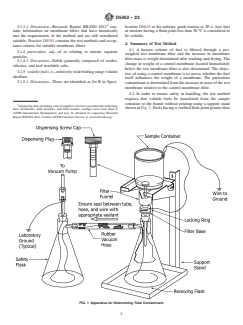
FIG. 1 Apparatus for Determining Total Contaminant
operational problems. Although tolerable levels of particulate contaminants have not yet been established for all points in fuel
distribution systems, the total contaminant measurement is normally of most interest.
6. Apparatus
6.1 Analytical Balance, single- or double-pan, the precision standard deviation of which must be 0.07 mg or better.
6.2 Oven, of the static type (without fan-assisted air circulation), controlling to 90 °C 6 5 °C.
6.3 Petri Dishes, approximately 125 mm in diameter with removable glass supports for membrane filters.
6.4 Forceps, flat-bladed with unserrated, non-pointed tips.
6.5 Vacuum System.
D5452 − 23
4,5
6.6 Test Membrane Filters, plain, 47 mm diameter, nominal pore size 0.8 μm (see Note 1).
4,5
6.7 Control Membrane Filters, 47 mm diameter, nominal pore size 0.8 μm. (Gridded control membrane filters may be used for
purpose of identification.)
NOTE 1—Matched weight membrane filters, 47 mm diameter, nominal pore size 0.8 μm, may be used as test and control membrane filters if so desired.
Use of matched-weight membrane filters precludes the necessity for carrying out subsequently the procedures detailed in Section 10.
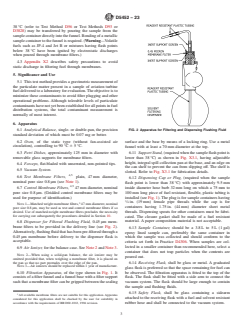
6.8 Dispenser for Filtered Flushing Fluid, 0.45 μm membrane filters to be provided in the delivery line (see Fig. 2). Alternatively,
flushing fluid that has been pre-filtered through a 0.45 μm membrane before delivery to the dispenser flask is acceptable.
6.9 Air Ionizer, for the balance case. See Note 2 and Note 3.
NOTE 2—When using a solid-pan balance, the air ionizer may be omitted provided that, when weighing a membrane filter, it is placed on the pan so that
no part protrudes over the edge of the pan.
NOTE 3—Air ionizers should be replaced within 1 year of manufacture.
6.10 Filtration Apparatus, of the type shown in Fig. 1. It consists of a filter funnel and a funnel base with a filter support such
that a membrane filter can be gripped between the sealing surface and the base by means of a locking ring. Use a metal funnel
with at least a 70 mm diameter at the top.
6.11 Support Stand, (required when the sample flash point is lower than 38 °C) as shown in Fig. X3.1, having adjustable height,
integral spill collection pan at the base, and an edge on the can shelf to prevent the can from slipping off. The shelf is slotted. Refer
to Fig. X3.1 for fabrication details.
6.12 Dispensing Cap or Plug, (required when the sample flash point is lower than 38 °C) with approximately 9.5 mm inside
diameter hose barb 32 mm long on which a 75 mm to 100 mm long piece of fuel resistant, flexible, plastic tubing is installed (see
FIG. 2 Apparatus for Filtering and Dispensing Flushing Fluid
All available membrane filters are not suitable for this application. Apparatus considered for this application shall be checked by the user for suitability in accordance
with the requirements of RR:D02-1012, 1994 revision.
D5452 − 23
Fig. 1). The plug is for sample containers having ⁄4 in. (19 mm) female pipe threads while the cap is for containers having 1.75 in.
(44 mm) diameter sheet metal threads. Dispensing spouts for other containers must be fabricated. The closure gasket shall be made
of a fuel resistant material. A paper composition material is not acceptable.
6.13 Sample Container, should be a 3.8 L to 5 L (1 gal) epoxy lined sample can, preferably the same container in which the sample
was collected and should conform to the criteria set forth in Practice D4306. When samples are collected in a smaller container
than recommended here, select a container that does not trap particles when the contents are poured out.
6.14 Receiving Flask, shall be glass or metal. A graduated glass flask is preferred so that the space remaining for fuel can be
observed. The filtration apparatus is fitted to the top of the flask. The flask shall be fitted with a side arm to connect the vacuum
system. The flask should be large enough to contain the sample and flushing fluids.
6.15 Safety Flask, shall be glass containing a sidearm attached to the receiving flask with a fuel and solvent resistant rubber hose
and shall be connected to the vacuum system.
6.16 Ground/Bond Wire, #10–#19 (0.912 mm to 2.59 mm) bare stranded flexible, stainless steel or copper installed in the flasks
and grounded as shown in Fig. 1. If a metallic flask(s) is used instead of glass, the flask(s) must be grounded.
6.17 Plastic Film, polyethylene or any other clear film not adversely affected by flushing fluids. Refer to Appendix X4.
6.18 Multimeter/VOM, used for determining whether electrical continuity is 10 ohms or less between 2 points.
7. Reagents
7.1 Purity of Reagents—Reagent grade chemicals shall be used in all tests. Unless otherwise indicated, it is intended that all
reagents shall conform to the specifications of the Committee on Analytical Reagents of the American Chemical Society, where
such specifications are available. Other grades may be used, provided it is first ascertained that the reagent is of sufficiently high
purity to permit its use without lessening the accuracy of the determination.
7.2 Purity of Water—Unless otherwise indicated references to water shall be understood to mean reagent water as defined by Type
III of Specification D1193.
7.3 Isopropyl Alcohol, (Warning—Flammable.)
7.4 Liquid Detergent, water-soluble.
7.5 Flushing Fluids—Petroleum spirit (also known as petroleum ether or IP Petroleum Spirit 40/60), having boiling range from
35 °C to 60 °C. (Warning—Extremely flammable. Harmful if inhaled. Vapors are easily ignited by electrostatic discharges,
causing flash fire. See Appendix X2.)
7.6 Filtered Flushing Fluids—Filtered fluids are fluids filtered through a nominal 0.45 μm membrane filter. Filtered flushing fluids
are most conveniently obtained by means of the dispenser described in Fig. 2.
8. Sampling
8.1 All containers and their closures shall be thoroughly cleaned in accordance with Practice D4306.
8.2 To obtain a representative sample from a fuel stream and to avoid external contamination, the sample may be drawn from the
flushing fitting of a field sampling kit (see Test Method D2276). Ensure that the line is first flushed with the fuel to be sampled
and that the line is externally clean.
ACS Reagent Chemicals, Specifications and Procedures for Reagents and Standard-Grade Reference Materials, American Chemical Society, Washington, DC. For
suggestions on the testing of reagents not listed by the American Chemical Society, see Analar Standards for Laboratory Chemicals, BDH Ltd., Poole, Dorset, U.K., and
the United States Pharmacopeia and National Formulary, U.S. Pharmacopeial Convention, Inc. (USPC), Rockville, MD.
D5452 − 23
8.3 Whether or not a sampling kit is available, suitable precautions shall be taken to avoid sample contamination by the use of
a suitable sampling point in accordance with Test Method D2276. If the quick-disconnect sampling connection is not used, a
stainless steel ball or plug type valve should be selected as its internal design avoids the possibility of trapping or generating solid
contaminant. Samples that are collected for general laboratory or chemical analysis are not necessarily suitable for this test method
because insufficient care may have been taken to avoid particulate contamination.
8.4 Where possible a 3.8 L to 5 L (1 gal) fuel sample should be taken, preferably in the same container that will be used in the
test to avoid the need to transfer from one container to another with increased possibility of contamination. Ideally, a sample to
be tested should be collected in a single container and transferred to the laboratory for testing. If the sample is collected in small
containers such as glass bottles and then shipped to the laboratory, the collection containers shall be handled in a way to flush
particulates into the transport container which should be UN/ICAO approved for public transport. Results obtained by taking other
sample volumes can have different precisions.
8.5 The sample volume shall be quoted with the results. If the sample was transferred from one container to another before the
test was performed, this shall also be noted with the test results.
9. Preparation of Apparatus and Sample Containers
9.1 Clean all components of the filtration apparatus, including the funnels, filter base, forceps, petri dishes, dispensing cap or plug
and tubing (from 6.12) as described in 9.1.2 – 9.1.6.
9.1.1 Remove any labels, tags, and so forth.
9.1.2 Wash with warm tap water containing detergent.
9.1.3 Rinse thoroughly with warm tap water.
9.1.4 Rinse thoroughly with reagent water. Container caps should be handled only externally with clean laboratory crucible tongs
during this and subsequent washing.
9.1.5 Rinse thoroughly with filtered isopropyl alcohol.
9.1.6 Rinse thoroughly with filtered flushing fluid.
9.1.7 For special cleanliness procedures in facilities that can have airborne dust, see Appendix X4.
10. Preparation of Test and Control Membrane Filters
10.1 Two 47 mm membrane filters of nominal pore size 0.8 μm are required: a test and a control membrane filter. Matched-weight
membrane filters may be used if so desired (see Note 1). If matched-weight membrane filters are used, it is unnecessary to carry
out the procedures detailed in this section because they had been carried out previously by the membrane filter supplier. The two
membrane filters used for each individual test should be identified by marking the petri dishes used as containers. Clean glassware
used in preparation of membrane filters must be cleaned as described in 9.1. Refer to Appendix X4.
10.1.1 Using forceps, place the test and control membrane filters side by side in a clean petri dish. To facilitate handling, the
membrane filters should rest on clean glass support rods in the petri dish.
10.1.2 Place the petri dish with its lid slightly ajar, in an oven at 90 °C 6 5 °C and leave it for 30 min.
10.1.3 Remove the petri dish from the oven and place it near the balance. The petri dish cover should be ajar but still protecting
the membrane filters from contamination from the atmosphere. Allow 30 min for the membrane filters to come to equilibrium with
the ambient air temperature and humidity.
10.1.4 Remove the control membrane filter from the petri dish with forceps, handling by the edge only, and place it centrally on
the weighing pan. Weigh it and return it to the petri dish.
10.1.5 Repeat 10.1.4 for the test membrane filter. Record the membrane filter masses.
D5452 − 23
11. Procedure
11.1 Prepare the Filter Funnel and Filter Base Assembly—Using clean forceps, place the two test membrane filters centrally on
the membrane filter support ring of the filtration apparatus (see Fig. 1) with the test membrane on top of the control membrane.
Install the filter funnel. If using matched weight membranes, either one can be on top. With the membrane filter in place, perform
a continuity test using a multimeter between the filter funnel and the filter holder. The meter shall read 10 Ω or less.
11.2 Prepare the Sample Container for the Filtration Test:
11.2.1 Thoroughly clean the outside of Visually inspect the sample container. If soiled, ensure the sample container in is properly
sealed then thoroughly clean the region of the closure by washing with detergent in water and rinsing with tap water and filtered
isopropyl alcohol. If the sample container is not visibly soiled, wipe the outside of the sample container in the region of the closure
with a paper towel damp with tap water or filtered isopropyl alcohol. Remove all labels from the container top. Shake the container
vigorously for about ⁄2 min to flush particles from internal surfaces of the installed plug or cap into the fuel in the container.
Remove the closure. If it is a cap, remove any external contaminant that may be present in the threads on the sample container
by washing with filtered flushing fluid, ensuring that none of the washings enter the container.
NOTE 4—If the closure is a plug, preserve it in a clean petri dish for flushing at 11.2.5 or at 11.4.9. If it is a cap, it will not be flushed at 11.4.9, because
its internal threads can be contaminated with external dirt.
11.2.2 If it has been determined that the fuel sample has a verified flash point greater than 38 °C and that the sample is therefore
to be poured into the filter funnel rather than to use the support stand, connect the receiving flask and safety flask with hose and
connect the grounding cable assembly as shown in Fig. 1. Place the pre-assembled filter funnel and filter base assembly on the
receiving flask. This filtration procedure will definitely result in electrostatic charges that shall be grounded for safety. Refer to
Appendix X2.
11.2.3 Commence pouring the sample into the filter funnel and switch on the vacuum source. Move (swirl) the sample container
about in order to carry particles into the funnel.
11.2.4 After the fuel has filtered completely, disconnect the vacuum, and record the volume of the filtered sample.
11.2.5 If the sample had been transferred from other containers, rinse them with four 50 mL quantities of filtered flushing fluid
directly into the filter funnel. The external threads of the sample container plug may now be rinsed with 30 mL of filtered flushing
fluid directly into the filter funnel. Then, proceed to 11.4.10.
11.3 If it was determined that the support stand should be used for filtering the fuel sample, prepare the apparatus.
NOTE 5—All of this apparatus should be mounted in an exhaust hood to minimize operator exposure to fumes.
11.3.1 Connect the receiving flask and safety flask with hose, and connect the grounding cable assembly as shown in Fig. 1. Place
the pre-assembled filter funnel and filter base assembly on the receiving flask. Ensure the adjustable shelf is located approximately
25 mm to 50 mm above the top of the filter funnel. This filtration procedure will definitely result in electrostatic charges that must
be grounded for safety. Refer to Appendix X2.
11.3.2 Secure a ground clip and wire to the container support and ground in series as shown in Fig. 1.
11.3.3 Screw the dispensing closure from 6.12 firmly on the sample container. Slip a length
...