

ASTM C1490-14(2023)
(Guide)Standard Guide for the Selection, Training and Qualification of Nondestructive Assay (NDA) Personnel
General Information
- Abstract
SIGNIFICANCE AND USE
4.1 The process of selection, training and qualification of personnel involved with NDA measurements is one of the quality assurance elements for an overall quality NDA measurement program.
4.2 This guide describes an approach to selection, qualification, and training of personnel that is to be used in conjunction with other NDA Quality Assurance (QA) program elements. The selection, qualification and training processes can vary and this guide provides one such approach.
4.3 The qualification activities described in this guide assume that NDA personnel are already proficient in general facility operations and safety procedures. The training and activities that developed this proficiency are not covered in this guide.
4.4 This guide describes a basic approach and principles for the qualification of NDA professionals and technical specialists and operators. A different approach may be adopted by the management organization based on its particular organization and facility specifics. However, if a variation of the approach of this guide is applied, the resulting selection, training, and qualification programs must meet the requirements of the facility quality assurance program and should provide all the applicable functions of Section 5.
4.5 This guide may be used as an aid in the preparation of a Training Implementation Plan (TIP) for the Transuranic Waste Characterization Program (TWCP).
4.6 This guide describes education and expertise guidance for NDA auditors due to the importance and complexity of proper oversight of NDA activities.
SCOPE
1.1 This guide contains good practices for the selection, training, qualification, and professional development of personnel performing analysis, calibration, physical measurements, or data review using nondestructive assay equipment, methods, results, or techniques. The guide also covers NDA personnel involved with NDA equipment setup, selection, diagnosis, troubleshooting, or repair. General guidelines for the selection, training, and qualification of NDA auditors are included as well, but at a lower level of detail due to the variability of the personnel’s responsibilities performing this functions. Selection, training, and qualification programs based on this guide are intended to provide assurance that NDA personnel are suitably qualified and experienced personnel (SQEP) to perform their jobs competently. This guide presents a series of options but does not recommend a specific course of action.
This standard guide does not address the qualifications per se of an NDA Manager. However, it is expected that the NDA Manager is familiar with NDA techniques, and can make informed decisions on the acceptability of the assay results. If an NDA Manager does not have adequate technical qualifications in the NDA field, they are recommended to undergo training to gain familiarity in this area.
An NDA Manager with no relevant NDA experience should have access to a Senior NDA Professional who will give guidance for all technical decisions such as applicability and limitation of methods, reasonableness of results, needed upgrades and advantageous development investments.
1.2 This international standard was developed in accordance with internationally recognized principles on standardization established in the Decision on Principles for the Development of International Standards, Guides and Recommendations issued by the World Trade Organization Technical Barriers to Trade (TBT) Committee.
- Status
- Published
- Publication Date
- 31-Dec-2022
- Technical Committee
- C26 - Nuclear Fuel Cycle
- Drafting Committee
- C26.10 - Non Destructive Assay
Overview
ASTM C1490-14(2023): Standard Guide for the Selection, Training and Qualification of Nondestructive Assay (NDA) Personnel provides a framework for organizations to systematically select, train, and qualify personnel involved in nondestructive assay (NDA) activities. NDA refers to analysis, calibration, physical measurements, and data review without altering the material being examined, primarily in the context of nuclear facilities. The standard supports quality assurance (QA) goals, helping ensure personnel performing NDA tasks are suitably qualified, competent, and meet regulatory requirements.
The guide addresses a broad range of NDA roles, from instrument operators and technical specialists to senior professionals and auditors. It emphasizes the importance of matching competence with responsibility, and suggests ways to structure training and qualification to suit unique facility needs. While it provides a recommended approach, the standard does not prescribe a single method, offering instead a flexible set of best practices.
Key Topics
- Personnel Selection: The guide highlights the careful evaluation of candidates’ education, experience, and suitability for NDA duties. Attributes such as technical skills, judgment, motivation, and communication ability are critical. Selection may involve interviews and practical tests.
- Training Programs: Training should combine classroom, laboratory, and on-the-job instruction. Core topics cover nuclear theory, instrument operation and calibration, NDA methods (e.g., gamma-ray, neutron counting), data analysis, regulatory requirements, and facility-specific processes.
- Qualification Process: Personnel must demonstrate competence through education, experience, and practical skills. Qualification is documented and auditable, ensuring a verifiable record of an individual’s ability and ongoing training requirements.
- Roles and Responsibilities: The guide outlines expectations and required knowledge for various NDA personnel categories, including:
- Senior NDA Professionals
- NDA Professionals
- Technical Specialists
- Qualified Instrument Operators
- NDA Auditors
- Professional Development: Ongoing training, mentoring, and participation in external courses or conferences are encouraged for continuous improvement in NDA skills.
Applications
Organizations implementing NDA techniques-particularly in nuclear material control, radioactive waste management, and safeguards-benefit from applying ASTM C1490-14(2023) by:
- Enhancing Quality Assurance: Structured training and qualification support reliable NDA measurements, calibration, and data analysis, reducing errors and ensuring regulatory compliance.
- Supporting Nuclear Facility Operations: With trained and qualified staff, facilities can maintain higher safety standards in handling special nuclear materials, complying with both internal policies and external regulations.
- Developing Customized Training Programs: Facilities can use this guide to create training implementation plans tailored to their specific equipment, processes, and regulatory landscape.
- Enabling Effective Oversight: By outlining auditor qualifications, the standard supports thorough and knowledgeable oversight of NDA activities, promoting accountability and continual improvement.
Related Standards
ASTM C1490-14(2023) references and aligns with several other ASTM standards relevant to nondestructive assay, including:
- ASTM C1030: Determination of plutonium isotopic composition by gamma-ray spectrometry
- ASTM C1133: NDA of special nuclear material in low-density scrap and waste by segmented passive gamma-ray scanning
- ASTM C1207, C1221, C1268, C1316, C1455, C1458, C1493, C1500, C1514, C1592, C1718, C1726: Various NDA methods for assay of nuclear materials and quality assurance practices
- ASTM C1673: Terminology for nondestructive assay methods
These related standards provide specific methods and terminology that complement the personnel qualification and training guidelines in C1490-14(2023).
Keywords: ASTM C1490-14(2023), nondestructive assay, NDA personnel, training, qualification, quality assurance, nuclear facility, NDA auditor, nuclear measurement, professional development, calibration, quality NDA measurement program.
Relations
- Effective Date
- 01-Oct-2023
- Effective Date
- 15-Mar-2019
- Effective Date
- 01-Feb-2019
- Effective Date
- 01-Apr-2018
- Effective Date
- 01-Apr-2018
- Effective Date
- 01-Apr-2018
- Effective Date
- 01-Apr-2018
- Effective Date
- 01-Jan-2017
- Effective Date
- 01-Jan-2017
- Effective Date
- 01-Mar-2016
- Effective Date
- 01-Jun-2015
- Effective Date
- 01-Jan-2014
- Effective Date
- 01-Nov-2010
- Effective Date
- 01-Nov-2010
- Effective Date
- 01-Jun-2010
Get Certified
Connect with accredited certification bodies for this standard

DNV
DNV is an independent assurance and risk management provider.

BSI Group
BSI (British Standards Institution) is the business standards company that helps organizations make excellence a habit.

Bureau Veritas
Bureau Veritas is a world leader in laboratory testing, inspection and certification services.
Sponsored listings
Frequently Asked Questions
ASTM C1490-14(2023) is a guide published by ASTM International. Its full title is "Standard Guide for the Selection, Training and Qualification of Nondestructive Assay (NDA) Personnel". This standard covers: SIGNIFICANCE AND USE 4.1 The process of selection, training and qualification of personnel involved with NDA measurements is one of the quality assurance elements for an overall quality NDA measurement program. 4.2 This guide describes an approach to selection, qualification, and training of personnel that is to be used in conjunction with other NDA Quality Assurance (QA) program elements. The selection, qualification and training processes can vary and this guide provides one such approach. 4.3 The qualification activities described in this guide assume that NDA personnel are already proficient in general facility operations and safety procedures. The training and activities that developed this proficiency are not covered in this guide. 4.4 This guide describes a basic approach and principles for the qualification of NDA professionals and technical specialists and operators. A different approach may be adopted by the management organization based on its particular organization and facility specifics. However, if a variation of the approach of this guide is applied, the resulting selection, training, and qualification programs must meet the requirements of the facility quality assurance program and should provide all the applicable functions of Section 5. 4.5 This guide may be used as an aid in the preparation of a Training Implementation Plan (TIP) for the Transuranic Waste Characterization Program (TWCP). 4.6 This guide describes education and expertise guidance for NDA auditors due to the importance and complexity of proper oversight of NDA activities. SCOPE 1.1 This guide contains good practices for the selection, training, qualification, and professional development of personnel performing analysis, calibration, physical measurements, or data review using nondestructive assay equipment, methods, results, or techniques. The guide also covers NDA personnel involved with NDA equipment setup, selection, diagnosis, troubleshooting, or repair. General guidelines for the selection, training, and qualification of NDA auditors are included as well, but at a lower level of detail due to the variability of the personnel’s responsibilities performing this functions. Selection, training, and qualification programs based on this guide are intended to provide assurance that NDA personnel are suitably qualified and experienced personnel (SQEP) to perform their jobs competently. This guide presents a series of options but does not recommend a specific course of action. This standard guide does not address the qualifications per se of an NDA Manager. However, it is expected that the NDA Manager is familiar with NDA techniques, and can make informed decisions on the acceptability of the assay results. If an NDA Manager does not have adequate technical qualifications in the NDA field, they are recommended to undergo training to gain familiarity in this area. An NDA Manager with no relevant NDA experience should have access to a Senior NDA Professional who will give guidance for all technical decisions such as applicability and limitation of methods, reasonableness of results, needed upgrades and advantageous development investments. 1.2 This international standard was developed in accordance with internationally recognized principles on standardization established in the Decision on Principles for the Development of International Standards, Guides and Recommendations issued by the World Trade Organization Technical Barriers to Trade (TBT) Committee.
SIGNIFICANCE AND USE 4.1 The process of selection, training and qualification of personnel involved with NDA measurements is one of the quality assurance elements for an overall quality NDA measurement program. 4.2 This guide describes an approach to selection, qualification, and training of personnel that is to be used in conjunction with other NDA Quality Assurance (QA) program elements. The selection, qualification and training processes can vary and this guide provides one such approach. 4.3 The qualification activities described in this guide assume that NDA personnel are already proficient in general facility operations and safety procedures. The training and activities that developed this proficiency are not covered in this guide. 4.4 This guide describes a basic approach and principles for the qualification of NDA professionals and technical specialists and operators. A different approach may be adopted by the management organization based on its particular organization and facility specifics. However, if a variation of the approach of this guide is applied, the resulting selection, training, and qualification programs must meet the requirements of the facility quality assurance program and should provide all the applicable functions of Section 5. 4.5 This guide may be used as an aid in the preparation of a Training Implementation Plan (TIP) for the Transuranic Waste Characterization Program (TWCP). 4.6 This guide describes education and expertise guidance for NDA auditors due to the importance and complexity of proper oversight of NDA activities. SCOPE 1.1 This guide contains good practices for the selection, training, qualification, and professional development of personnel performing analysis, calibration, physical measurements, or data review using nondestructive assay equipment, methods, results, or techniques. The guide also covers NDA personnel involved with NDA equipment setup, selection, diagnosis, troubleshooting, or repair. General guidelines for the selection, training, and qualification of NDA auditors are included as well, but at a lower level of detail due to the variability of the personnel’s responsibilities performing this functions. Selection, training, and qualification programs based on this guide are intended to provide assurance that NDA personnel are suitably qualified and experienced personnel (SQEP) to perform their jobs competently. This guide presents a series of options but does not recommend a specific course of action. This standard guide does not address the qualifications per se of an NDA Manager. However, it is expected that the NDA Manager is familiar with NDA techniques, and can make informed decisions on the acceptability of the assay results. If an NDA Manager does not have adequate technical qualifications in the NDA field, they are recommended to undergo training to gain familiarity in this area. An NDA Manager with no relevant NDA experience should have access to a Senior NDA Professional who will give guidance for all technical decisions such as applicability and limitation of methods, reasonableness of results, needed upgrades and advantageous development investments. 1.2 This international standard was developed in accordance with internationally recognized principles on standardization established in the Decision on Principles for the Development of International Standards, Guides and Recommendations issued by the World Trade Organization Technical Barriers to Trade (TBT) Committee.
ASTM C1490-14(2023) is classified under the following ICS (International Classification for Standards) categories: 03.100.30 - Management of human resources; 27.120.30 - Fissile materials and nuclear fuel technology. The ICS classification helps identify the subject area and facilitates finding related standards.
ASTM C1490-14(2023) has the following relationships with other standards: It is inter standard links to ASTM C1268-23, ASTM C1493-19, ASTM C1718-10(2019), ASTM C1030-10(2018), ASTM C1207-10(2018), ASTM C1221-10(2018), ASTM C1673-10a(2018), ASTM C1316-08(2017), ASTM C1514-08(2017), ASTM C1458-16, ASTM C1268-15, ASTM C1455-14, ASTM C1673-10ae1, ASTM C1673-10a, ASTM C1207-10. Understanding these relationships helps ensure you are using the most current and applicable version of the standard.
ASTM C1490-14(2023) is available in PDF format for immediate download after purchase. The document can be added to your cart and obtained through the secure checkout process. Digital delivery ensures instant access to the complete standard document.
Standards Content (Sample)
This international standard was developed in accordance with internationally recognized principles on standardization established in the Decision on Principles for the
Development of International Standards, Guides and Recommendations issued by the World Trade Organization Technical Barriers to Trade (TBT) Committee.
Designation: C1490 −14 (Reapproved 2023)
Standard Guide for
the Selection, Training and Qualification of Nondestructive
Assay (NDA) Personnel
This standard is issued under the fixed designation C1490; the number immediately following the designation indicates the year of
original adoption or, in the case of revision, the year of last revision. A number in parentheses indicates the year of last reapproval. A
superscript epsilon (´) indicates an editorial change since the last revision or reapproval.
1. Scope 2. Referenced Documents
1.1 This guide contains good practices for the selection, 2.1 ASTM Standards:
training, qualification, and professional development of per- C1030 TestMethodforDeterminationofPlutoniumIsotopic
sonnel performing analysis, calibration, physical Composition by Gamma-Ray Spectrometry
measurements, or data review using nondestructive assay C1133 Test Method for Nondestructive Assay of Special
equipment, methods, results, or techniques. The guide also Nuclear Material in Low-Density Scrap and Waste by
covers NDA personnel involved with NDA equipment setup, Segmented Passive Gamma-Ray Scanning
selection, diagnosis, troubleshooting, or repair. General guide- C1207 Test Method for Nondestructive Assay of Plutonium
lines for the selection, training, and qualification of NDA in Scrap and Waste by Passive Neutron Coincidence
auditors are included as well, but at a lower level of detail due Counting
to the variability of the personnel’s responsibilities performing C1221 Test Method for Nondestructive Analysis of Special
this functions. Selection, training, and qualification programs Nuclear Materials in Homogeneous Solutions by Gamma-
basedonthisguideareintendedtoprovideassurancethatNDA Ray Spectrometry
personnel are suitably qualified and experienced personnel C1268 Test Method for Quantitative Determination of
(SQEP) to perform their jobs competently. This guide presents Am in Plutonium by Gamma-Ray Spectrometry
a series of options but does not recommend a specific course of C1316 Test Method for Nondestructive Assay of Nuclear
action. Material in Scrap and Waste by Passive-Active Neutron
This standard guide does not address the qualifications per Counting Using Cf Shuffler
se of an NDAManager. However, it is expected that the NDA C1455 Test Method for Nondestructive Assay of Special
Manager is familiar with NDA techniques, and can make Nuclear Material Holdup Using Gamma-Ray Spectro-
scopic Methods
informed decisions on the acceptability of the assay results. If
an NDA Manager does not have adequate technical qualifica- C1458 Test Method for NondestructiveAssay of Plutonium,
Tritium and Am by Calorimetric Assay
tions in the NDA field, they are recommended to undergo
training to gain familiarity in this area. C1493 Test Method for Non-Destructive Assay of Nuclear
Material in Waste by Passive and Active Neutron Count-
An NDA Manager with no relevant NDA experience
shouldhaveaccesstoaSeniorNDAProfessionalwhowillgive ing Using a Differential Die-Away System
C1500 Test Method for Nondestructive Assay of Plutonium
guidance for all technical decisions such as applicability and
limitation of methods, reasonableness of results, needed up- by Passive Neutron Multiplicity Counting
grades and advantageous development investments. C1514 TestMethodforMeasurementof UFractionUsing
Enrichment Meter Principle
1.2 This international standard was developed in accor-
C1592 Guide for Making Quality Nondestructive Assay
dance with internationally recognized principles on standard-
Measurements
ization established in the Decision on Principles for the
C1673 Terminology of C26.10 Nondestructive Assay Meth-
Development of International Standards, Guides and Recom-
ods
mendations issued by the World Trade Organization Technical
C1718 Test Method for Nondestructive Assay of Radioac-
Barriers to Trade (TBT) Committee.
tive Material by Tomographic Gamma Scanning
C1726 Guide for Use of Modeling for Passive Gamma
Measurements
This guide is under the jurisdiction ofASTM Committee C26 on Nuclear Fuel
Cycle and is the direct responsibility of Subcommittee C26.10 on Non Destructive
Assay. For referenced ASTM standards, visit the ASTM website, www.astm.org, or
Current edition approved Jan. 1, 2023. Published January 2023. Originally contact ASTM Customer Service at service@astm.org. For Annual Book of ASTM
approved in 2001. Last previous edition approved in 2014 as C1490–14. DOI: Standardsvolume information, refer to the standard’s Document Summary page on
10.1520/C1490-14R23. the ASTM website.
Copyright © ASTM International, 100 Barr Harbor Drive, PO Box C700, West Conshohocken, PA 19428-2959. United States
C1490 − 14 (2023)
3. Terminology 5.2.1.1 Education—Advanced degree (M.S. or Ph.D.) in
physics, chemistry, or nuclear engineering and five years NDA
3.1 Refer to Terminology C1673 for definitions used in this
experience; or fifteen equivalent years of experience in the
test method.
NDA field.
5.2.1.2 Expertise—ExpertiseinmostorallNDAtechniques.
4. Significance and Use
Recognized nationally as an expert in one or more NDAfields
4.1 The process of selection, training and qualification of
through publications, peer reviewed by other subject matter
personnel involved with NDA measurements is one of the
experts (SMEs), active participation in national NDA confer-
quality assurance elements for an overall quality NDA mea-
ences or conducting NDA training courses. Knowledge areas
surement program.
cover most of those listed in 5.1. Core expertise in one or more
4.2 This guide describes an approach to selection,
of the following areas, and familiarity with the others: Test
qualification, and training of personnel that is to be used in
Methods C1030, C1133, C1207, C1221, C1268, C1316,
conjunction with other NDAQualityAssurance (QA) program
C1455, C1458, C1493, C1500, C1514, Guide C1592, Termi-
elements. The selection, qualification and training processes
nology C1673, Test Method C1718, and Guide C1726 are
can vary and this guide provides one such approach.
applicable. The senior professional must adhere to t good
practices for performing NDAmeasurements and data analysis
4.3 The qualification activities described in this guide as-
to achieve quality results, as described in Guide C1592
sume that NDA personnel are already proficient in general
(Standard Guide for Making Quality Nond-Destructive Assay
facility operations and safety procedures. The training and
Measurements). The senior professional must possess relevant
activities that developed this proficiency are not covered in this
technical knowledge of the physical and chemical properties of
guide.
the materials being assayed, when available. In-depth knowl-
4.4 This guide describes a basic approach and principles for
edge of analysis algorithm’s applicability to the assay condi-
thequalificationofNDAprofessionalsandtechnicalspecialists
tions (and limitations) for the NDA methods used is required.
and operators. A different approach may be adopted by the
Knowledge of computational codes used for modeling, for
management organization based on its particular organization
example MCNP and MCNPX, may be necessary.
and facility specifics. However, if a variation of the approach
5.2.1.3 Duties—Designs NDA measurement programs, in-
of this guide is applied, the resulting selection, training, and
cluding method selection and instrument performance specifi-
qualification programs must meet the requirements of the
cation. Performs NDA technical oversight over the entire
facility quality assurance program and should provide all the
program. Performs initial calibrations, qualifications and cer-
applicable functions of Section 5.
tifications for instruments and methods. Provides expert tech-
4.5 This guide may be used as an aid in the preparation of
nical data review. Provides consultation on NDA matters to
a Training Implementation Plan (TIP) for the Transuranic
various facility departments and organizations such as nuclear
Waste Characterization Program (TWCP).
safety,safeguards,nuclearmaterialscontrolandaccountability,
4.6 This guide describes education and expertise guidance waste characterization, waste disposal and production opera-
for NDA auditors due to the importance and complexity of tions. Provides mentoring to other job categories.
proper oversight of NDA activities.
5.2.2 NDA Professional:
5.2.2.1 Education—Undergraduate degree in physical sci-
5. NDA Roles, Responsibilities, and Duties
ence or engineering and five years NDA experience; or ten
5.1 The application and use of NDA techniques includes
equivalent years of experience in the NDA field.
such diverse activities as data review and analysis; measure-
5.2.2.2 Expertise—Expertise in one or more NDA tech-
ment control activities; equipment operation, troubleshooting
niques. Recognized in NDA field on a local or facility basis.
and repair; all require different levels of education, expertise,
Knowledge areas cover several of those listed in 5.1. Under-
and training. Therefore the implementation and continued
standing of the NDAmethods contained in one or more of the
successful application of an NDA measurement program re-
following: Test Methods C1030, C1133, C1207, C1221,
quires a complex mixture of theory, experience, and profes-
C1268, C1316, C1455, C1458, C1493, C1500, C1514, Guide
sional judgement. For NDA professionals, a wide variety of
C1592, Terminology C1673, Test Method C1718, and Guide
skills and knowledge areas is required. These knowledge areas
C1726, are essential. The professional must be a practitioner
include:physics,chemistry,statistics,NDAmodelingmethods,
of good practices for performing NDAmeasurements and data
electronics, engineering, health physics, quality assurance,
analysis to achieve quality results, as described in Guide
nuclear safety, and appropriate regulatory requirements. For
C1592 (Standard Guide for Making Quality Nondestructive
technical specialists and operators, less emphasis can be put on
Assay Measurements).
formal education, but would be compensated for by higher
5.2.2.3 Duties—Provides expert technical data review, and
levels of job specific training.
NDA measurement oversight. Performs routine instrument
5.2 Based on roles and responsibilities, NDApersonnel can qualification, calibration, and validation. Reviews and ap-
be broken into the following categories. These are not neces- provesmeasurementcontroldata.ProvidesconsultingonNDA
sarily job titles and some facilities may combine one or more matters within his or her area of expertise to various facility
levels. The activities exist in a broader organizational context. departments and organizations such as nuclear safety,
5.2.1 Senior NDA Professional: safeguards, nuclear materials control and accountability, waste
C1490 − 14 (2023)
characterization, waste disposal, production operations. Men- described in Guide C1592 (Standard Guide for Making Non-
tors technical specialists and operators. destructive Assay Measurements) is necessary.
5.5.1.3 Duties—Audits of NDA measurement process,
5.2.3 NDA Technical Specialist:
application, results, and compliance typically related to, radio-
5.2.3.1 Education—Undergraduate degree or equivalent
active waste, safeguards or nuclear criticality.
with emphasis in the physical sciences and one year NDA
experience or a 12–year General Education (High School) and
6. Selection
two years NDA experience; or five equivalent years of expe-
6.1 The selection of NDApersonnel should be a careful and
rience in the NDA field.
thoughtful process that recognizes the responsibilities that are
5.2.3.2 Expertise—Knowledgeable in one or more NDA
unique to the NDA position. The selection process should
techniques. Knowledge areas may cover one or more of those
include an evaluation of the NDA candidate’s technical skills,
listed in 5.1.
as well as the individual’s experience and past performance
5.2.3.3 Duties—Independent technical data review; instru-
relative to the position requirements.
ment calibration, and validation. Performs measurement con-
6.2 The attributes, characteristics, and skills used as criteria
trol activities, instrument operation. Provides first response to
for selecting NDA candidates or trainees should include
instrument problems, upset conditions. Performs troubleshoot-
demonstrated qualities such as: judgment, motivation,
ing.
integrity, communication skills, teamwork skills, diagnostic
5.2.4 NDA Qualified Instrument Operator:
skills, analytical ability, and strong technical competence.
5.2.4.1 Education—a 12–year general education (high
6.3 The NDA organization should have a selection process
school) or equivalent technical training, or two years of
for initial hiring and promoting of personnel.This process may
experience in the nuclear facility field.
involve a selection test, in addition to interviews. Selection
5.2.4.2 Expertise—Trained and qualified in operation of one
should be based on the ability to meet position qualification
or more NDA instruments.
criteria with reasonable amounts of training.
5.2.4.3 Duties—Operation of NDA instrument. Recording
of NDA data and other duties as qualified and assigned.
7. Training
5.3 The hierarchy described above is only one set of 7.1 Atraining program should be established to develop and
possible tiers. Other tiered hierarchies providing equivalent enhance the skills, knowledge, and abilities of NDAtrainees to
perform their job assignments. The program should consist of
functions are equally valid. The important consideration is the
increasing level of required expertise and independence of a combination of classroom-type and on-the-job training (OJT)
and should include laboratory training (for those facilities that
actionwithincreasingjoblevelfunction.Basedonsite-specific
practices and policies, the four levels presented above may be have laboratory facilities), as it applies to the NDA position.
collapsed or expanded and the duties listed may move to other
7.2 Full implementation of an NDA training program re-
tiers in the hierarchy.
quires a long-term commitment from both the NDA personnel
and management. Training activities should be carefully man-
5.4 In addition to the NDA personnel described above, the
aged to produce effective results.
services of other specialists are often required. These include
statisticians to help establish measurement uncertainties, con-
7.3 Each NDAorganization should assess its training needs
trol limits, etc.Also, personnel trained in the maintenance and
to develop a facility-specific training program. It is important
repair of electronic and mechanical systems may be required.
to implement a systematic method to update training program
In all cases, the value of the services provided by these
content to incorporate facility modifications, operating
specialists is enhanced if they have a basic understanding of
experiences, procedure changes, and changes in job require-
NDA methods and instruments.
ments.
5.5 Roles, Responsibilities, and Duties of NDA Auditors:
7.4 The complete training program for NDApersonnel may
5.5.1 NDA Auditor: include courses offered by national laboratories, commercial
vendors, universities, and other centers of excellence. The
5.5.1.1 Education—Undergraduate degree or equivalent
necessity for this type of training will depend on the roles and
with emphasis in the physical sciences and two years experi-
responsibilities of the NDA personnel.
enceinthenuclearfacilityfield;oranundergraduatedegreein
an unrelated field and four years experience in the nuclear
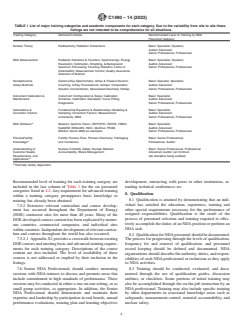
7.5 Table 1 contains a list of training categories that are
facility field.
necessary for effective NDA application. Each training cat-
5.5.1.2 Expertise—Trained and qualified nuclear facility egory includes a list of academic components for that training
auditor. Demonstrated basic physics knowledge relevant to area. Table 1 is not intended to be comprehensive for all
detection of neutrons and gamma rays. Familiarity with the situations. Site-specific training plans shall be evaluated
NDAmethods contained in those of the following that apply to against the training categories listed in Table 1 and any
personnel being audited: Test Methods C1030, C1133, C1207, academic content exclusion must be justified (for example, a
C1221, C1268, C1316, C1455, C1458, C1493, C1500, C1514, site only stores sealed items so holdup measurements are never
Guide C1592, Terminology C1673, Test Method C1718, and performed).
Guide C1726; and the good practices for performing NDA 7.5.1 Different job responsibilities require different levels of
measurements and data analysis to achieve quality results, as understanding and mastery of the contents listed in Table 1.
C1490 − 14 (2023)
TABLE 1 List of major training categories and academic components for each category. Due to the variability from site to site these
listings are not intended to be comprehensive for all situations.
Training Category Itemized Contents Recommended Level of Training by NDA
Personnel Category
Nuclear Theory Radioactivity; Radiation Interactions Basic: Specialist, Operator,
Auditor Advanced:
Senior Professional, Professional
NDA Measurement Radiation Detectors & Counters; Spectroscopy; Energy Basic: Specialist, Operator,
Resolution; Collimation, Shielding, & Background; Auditor Advanced:
Spectrum Processing; Counting Statistics; Limits of Senior Professional, Professional
Detectability; Measurement Control; Quality Assurance;
Selection of Method
Nondestructive Gamma-Ray Spectrometry; Active & Passive Neutron Basic: Operator, Specialist,
Assay Methods Counting; X-Ray Fluorescence; Isotopic Composition; Auditor Advanced:
Solution Concentration; Generalized Geometry Holdup Senior Professional, Professional
Instrument Calibration & Instrument Configuration & Setup; Calibration Basic: Specialist,
Maintenance Schemes; Calibration Standards; Curve Fitting; Auditor Advanced:
Diagnostics Senior Professional, Professional
Calculations & Fundamental Equations & Relationships; Modeling & Basic: Specialist,
Correction Factors Sampling; Correction Factors; Measurement Auditor Advanced:
Uncertainty; MDA Senior Professional, Professional
A
NDA Software Maestro; Gamma Vision; ISOTOPIC; ISOCS; HMS4; Basic: Specialist,
NaIGEM; WINU235, INCC, MultiCal, FRAM, Auditor Advanced:
MGA/U; Genie 2000 as examples Senior Professional, Professional
ProcessFacility Facility Process Flow; Process Chemistry; Packaging Basic: Senior Professional,
A
Knowledge and Containers Professional, Auditor
Understanding of Nuclear Criticality Safety, Nuclear Material Basic: Senior Professional, Professional
Customer Needs, Accountability, Waste Management Advanced: Auditor (at minimum
Requirements, and site discipline being audited)
A
Applications
A
Normally facility dependent.
Recommended level of training for each training category are development, interacting with peers in other institutions, at-
included in the last column of Table 1 for the six personnel tending technical conferences etc.
categories listed in 4.2.Any requirement for advanced training
8. Qualification
within a training category presupposes basic knowledge or
8.1 Qualification is attained by demonstrating that an indi-
training has already been obtained.
vidual has satisfied the education, experience, training and
7.5.2 Extensive relevant curriculum and course develop-
other special requirements necessary for the performance of
ment has occurred throughout the Department of Energy
assigned responsibilities. Qualification is the result of the
(DOE) contractor sites for more than 40 years. Many of the
process of personnel selection and training required to effec-
DOE developed courses content has been replicated by numer-
tively accomplish the duties of an NDAposition or perform an
ous countries, commercial companies, and individual sites
NDA task.
withincountries.Independentdevelopmentofrelevantcurricu-
lum and courses throughou
...