


ASTM F2412-18a
(Test Method)Standard Test Methods for Foot Protection
Standard Test Methods for Foot Protection
SIGNIFICANCE AND USE
4.1 These test methods contain requirements to evaluate the performance of footwear for the following:
4.1.1 Impact resistance for the toe area of footwear (I),
4.1.2 Compression resistance for the toe area of footwear (C),
4.1.3 Metatarsal protection that reduces the chance of injury to the metatarsal bones at the top of the foot (Mt),
4.1.4 Conductive properties which reduce hazards that may result from static electricity buildup, and reduce the possibility of ignition of explosives and volatile chemicals (Cd),
4.1.5 Electric hazard to protect the wearer when accidentally stepping on live electric wires (EH),
4.1.6 Static dissipative properties to reduce hazards that result from a build up of static charge where there is an underlying risk of accidental contact with live electrical circuits (SD), and
4.1.7 Puncture resistance footwear devices (PR).
4.2 Any changes to the original components of safety toe footwear such as replacing or adding after-market footbeds/inserts could cause non-compliance to any or all parts of this standard rendering the ASTM label invalid. Protective toe footwear specimens or samples shall be retested for any of the following changes.
4.2.1 Change in material used to make protective toe cap, change in protective cap manufacturer, change in the design of the toe cap.
4.2.2 Change in construction method used to make footwear or change in factory in which footwear is produced.
4.2.3 Change in the upper or insole material thickness greater than 25 %.
4.2.4 Change in the out sole or midsole, including its hardness.
4.2.5 Change in shape of last used in the manufacturing of footwear.
4.2.6 Change in material or supplier of protective insole.
4.2.7 Change in material or supplier of met guard.
SCOPE
1.1 These test methods measure the resistance of footwear to a variety of hazards that can potentially result in injury.
1.2 These test methods may be used to test for compliance to minimum performance requirements in established safety standards.
1.2.1 By agreement between the purchaser and the supplier, or as required by established safety standards, these test methods can be used to determine any one, or all of the following: (1) impact resistance (I), (2) compression resistance (C), (3) metatarsal impact resistance (Mt), (4) resistance to electrical conductivity (Cd), (5) resistance to electric hazard (EH), (6) static dissipative performance (SD), and (7) puncture resistance (PR).
1.3 The values stated in SI units are to be regarded as the standard. The values given in parentheses are for information only.
1.4 This standard does not purport to address all of the safety concerns, if any, associated with its use. It is the responsibility of the user of this standard to establish appropriate safety, health, and environmental practices and determine the applicability of regulatory limitations prior to use.
1.5 This international standard was developed in accordance with internationally recognized principles on standardization established in the Decision on Principles for the Development of International Standards, Guides and Recommendations issued by the World Trade Organization Technical Barriers to Trade (TBT) Committee.
General Information
- Status
- Published
- Publication Date
- 31-Jul-2018
- Technical Committee
- F13 - Pedestrian/Walkway Safety and Footwear
- Drafting Committee
- F13.30 - Footwear
Relations
- Effective Date
- 01-Aug-2018
- Effective Date
- 01-Oct-2011
- Effective Date
- 01-Jul-2009
- Effective Date
- 15-Dec-2007
- Effective Date
- 01-Mar-2007
- Effective Date
- 01-Oct-2003
- Effective Date
- 10-Oct-2002
- Effective Date
- 10-Apr-1997
- Effective Date
- 01-Aug-2018
- Effective Date
- 01-Aug-2018
- Effective Date
- 01-Aug-2018
- Effective Date
- 01-Aug-2018
- Effective Date
- 01-Aug-2018
Overview
ASTM F2412-18a specifies standard test methods for evaluating the protective performance of footwear against a variety of workplace hazards. Developed by ASTM International, this standard is integral to ensuring that safety footwear meets rigorous criteria for impact, compression, metatarsal, electrical, and puncture resistance. These test methods are used to assess compliance with safety requirements adopted by industries such as manufacturing, construction, utilities, and chemical processing, providing assurance that footwear will protect workers from injuries caused by physical, electrical, and puncture hazards.
Key Topics
ASTM F2412-18a covers the following critical areas for foot protection:
- Impact Resistance (I): Evaluates the ability of footwear to protect toes from falling or rolling objects by ensuring a protective toe cap is incorporated and effectively tested.
- Compression Resistance (C): Assesses the strength of the toe area to withstand compressive forces, preventing crush injuries.
- Metatarsal Protection (Mt): Tests the effectiveness of built-in metatarsal guards in reducing injury to the metatarsal bones at the top of the foot.
- Conductive Properties (Cd): Determines if footwear can safely conduct static electricity, a key requirement in environments with explosive or flammable materials.
- Electric Hazard Resistance (EH): Ensures footwear provides insulation against accidental contact with live electrical circuits.
- Static Dissipative Properties (SD): Verifies that footwear dissipates static charge safely, which is crucial where there is a possibility of accidental contact with electrical components.
- Puncture Resistance (PR): Tests the penetration resistance of footwear against sharp objects, an essential criterion for construction and waste handling sectors.
Additionally, the standard emphasizes that any modification to original materials, construction, or protective components (such as toe caps, insoles, or metatarsal guards) requires retesting to maintain compliance.
Applications
ASTM F2412-18a is widely implemented to ensure worker safety across multiple high-risk industries. Applications of this standard include:
- Footwear Manufacturers: Used as a guideline in the design and production of occupational safety footwear, enabling development of products that meet regulatory and client requirements.
- Purchasers and Suppliers: Forms the basis for procurement specifications, ensuring that only compliant protective footwear is supplied and used.
- Testing Laboratories: Provides standardized test procedures for certifying safety footwear, ensuring consistency in evaluation and reporting.
- Workplace Safety Compliance: Referenced in regulations such as OSHA workplace standards, facilitating compliance with national and international safety laws.
By adhering to ASTM F2412-18a, organizations can effectively mitigate workplace foot injury risks, support compliance efforts, and demonstrate a commitment to employee safety.
Related Standards
ASTM F2412-18a is frequently used alongside other standards to establish comprehensive foot protection protocols, including:
- ASTM F2413 - Standard Specification for Performance Requirements for Protective (Safety) Toe Cap Footwear: Details the minimum performance criteria products must meet, while F2412 describes the test methods.
- CSA Z195 - Protective Footwear (Canada): Canadian standard for protective footwear, referenced for cross-border compliance.
- B117 - Practice for Operating Salt Spray (Fog) Apparatus: Relevant for additional footwear material assessments.
Conclusion
ASTM F2412-18a plays a vital role in occupational health and safety by establishing standardized test methods for foot protection. Its broad applicability, focus on practical hazards, and alignment with regulatory requirements make it essential for safety footwear design, production, and testing worldwide. Adopting this standard supports safer work environments and enhances workforce protection.
Get Certified
Connect with accredited certification bodies for this standard

NSF International
Global independent organization facilitating standards development and certification.

CIS Institut d.o.o.
Personal Protective Equipment (PPE) certification body. Notified Body NB-2890 for EU Regulation 2016/425 PPE.

Kiwa BDA Testing
Building and construction product certification.
Sponsored listings
Frequently Asked Questions
ASTM F2412-18a is a standard published by ASTM International. Its full title is "Standard Test Methods for Foot Protection". This standard covers: SIGNIFICANCE AND USE 4.1 These test methods contain requirements to evaluate the performance of footwear for the following: 4.1.1 Impact resistance for the toe area of footwear (I), 4.1.2 Compression resistance for the toe area of footwear (C), 4.1.3 Metatarsal protection that reduces the chance of injury to the metatarsal bones at the top of the foot (Mt), 4.1.4 Conductive properties which reduce hazards that may result from static electricity buildup, and reduce the possibility of ignition of explosives and volatile chemicals (Cd), 4.1.5 Electric hazard to protect the wearer when accidentally stepping on live electric wires (EH), 4.1.6 Static dissipative properties to reduce hazards that result from a build up of static charge where there is an underlying risk of accidental contact with live electrical circuits (SD), and 4.1.7 Puncture resistance footwear devices (PR). 4.2 Any changes to the original components of safety toe footwear such as replacing or adding after-market footbeds/inserts could cause non-compliance to any or all parts of this standard rendering the ASTM label invalid. Protective toe footwear specimens or samples shall be retested for any of the following changes. 4.2.1 Change in material used to make protective toe cap, change in protective cap manufacturer, change in the design of the toe cap. 4.2.2 Change in construction method used to make footwear or change in factory in which footwear is produced. 4.2.3 Change in the upper or insole material thickness greater than 25 %. 4.2.4 Change in the out sole or midsole, including its hardness. 4.2.5 Change in shape of last used in the manufacturing of footwear. 4.2.6 Change in material or supplier of protective insole. 4.2.7 Change in material or supplier of met guard. SCOPE 1.1 These test methods measure the resistance of footwear to a variety of hazards that can potentially result in injury. 1.2 These test methods may be used to test for compliance to minimum performance requirements in established safety standards. 1.2.1 By agreement between the purchaser and the supplier, or as required by established safety standards, these test methods can be used to determine any one, or all of the following: (1) impact resistance (I), (2) compression resistance (C), (3) metatarsal impact resistance (Mt), (4) resistance to electrical conductivity (Cd), (5) resistance to electric hazard (EH), (6) static dissipative performance (SD), and (7) puncture resistance (PR). 1.3 The values stated in SI units are to be regarded as the standard. The values given in parentheses are for information only. 1.4 This standard does not purport to address all of the safety concerns, if any, associated with its use. It is the responsibility of the user of this standard to establish appropriate safety, health, and environmental practices and determine the applicability of regulatory limitations prior to use. 1.5 This international standard was developed in accordance with internationally recognized principles on standardization established in the Decision on Principles for the Development of International Standards, Guides and Recommendations issued by the World Trade Organization Technical Barriers to Trade (TBT) Committee.
SIGNIFICANCE AND USE 4.1 These test methods contain requirements to evaluate the performance of footwear for the following: 4.1.1 Impact resistance for the toe area of footwear (I), 4.1.2 Compression resistance for the toe area of footwear (C), 4.1.3 Metatarsal protection that reduces the chance of injury to the metatarsal bones at the top of the foot (Mt), 4.1.4 Conductive properties which reduce hazards that may result from static electricity buildup, and reduce the possibility of ignition of explosives and volatile chemicals (Cd), 4.1.5 Electric hazard to protect the wearer when accidentally stepping on live electric wires (EH), 4.1.6 Static dissipative properties to reduce hazards that result from a build up of static charge where there is an underlying risk of accidental contact with live electrical circuits (SD), and 4.1.7 Puncture resistance footwear devices (PR). 4.2 Any changes to the original components of safety toe footwear such as replacing or adding after-market footbeds/inserts could cause non-compliance to any or all parts of this standard rendering the ASTM label invalid. Protective toe footwear specimens or samples shall be retested for any of the following changes. 4.2.1 Change in material used to make protective toe cap, change in protective cap manufacturer, change in the design of the toe cap. 4.2.2 Change in construction method used to make footwear or change in factory in which footwear is produced. 4.2.3 Change in the upper or insole material thickness greater than 25 %. 4.2.4 Change in the out sole or midsole, including its hardness. 4.2.5 Change in shape of last used in the manufacturing of footwear. 4.2.6 Change in material or supplier of protective insole. 4.2.7 Change in material or supplier of met guard. SCOPE 1.1 These test methods measure the resistance of footwear to a variety of hazards that can potentially result in injury. 1.2 These test methods may be used to test for compliance to minimum performance requirements in established safety standards. 1.2.1 By agreement between the purchaser and the supplier, or as required by established safety standards, these test methods can be used to determine any one, or all of the following: (1) impact resistance (I), (2) compression resistance (C), (3) metatarsal impact resistance (Mt), (4) resistance to electrical conductivity (Cd), (5) resistance to electric hazard (EH), (6) static dissipative performance (SD), and (7) puncture resistance (PR). 1.3 The values stated in SI units are to be regarded as the standard. The values given in parentheses are for information only. 1.4 This standard does not purport to address all of the safety concerns, if any, associated with its use. It is the responsibility of the user of this standard to establish appropriate safety, health, and environmental practices and determine the applicability of regulatory limitations prior to use. 1.5 This international standard was developed in accordance with internationally recognized principles on standardization established in the Decision on Principles for the Development of International Standards, Guides and Recommendations issued by the World Trade Organization Technical Barriers to Trade (TBT) Committee.
ASTM F2412-18a is classified under the following ICS (International Classification for Standards) categories: 13.340.50 - Leg and foot protection. The ICS classification helps identify the subject area and facilitates finding related standards.
ASTM F2412-18a has the following relationships with other standards: It is inter standard links to ASTM F2412-18, ASTM B117-11, ASTM B117-09, ASTM B117-07a, ASTM B117-07, ASTM B117-03, ASTM B117-02, ASTM B117-97, ASTM F2413-18, ASTM F1646-16, ASTM E2770-17, ASTM F2892-18, ASTM E2458-17. Understanding these relationships helps ensure you are using the most current and applicable version of the standard.
ASTM F2412-18a is available in PDF format for immediate download after purchase. The document can be added to your cart and obtained through the secure checkout process. Digital delivery ensures instant access to the complete standard document.
Standards Content (Sample)
This international standard was developed in accordance with internationally recognized principles on standardization established in the Decision on Principles for the
Development of International Standards, Guides and Recommendations issued by the World Trade Organization Technical Barriers to Trade (TBT) Committee.
Designation: F2412 − 18a
Standard Test Methods for
Foot Protection
This standard is issued under the fixed designation F2412; the number immediately following the designation indicates the year of
original adoption or, in the case of revision, the year of last revision. A number in parentheses indicates the year of last reapproval. A
superscript epsilon (´) indicates an editorial change since the last revision or reapproval.
INTRODUCTION
For more than sixty years, the predecessor to these test methods, ANSI Z41, established the
performance criteria for a wide range of footwear to protect from the hazards that affect the personal
safetyofworkers.ThevalueofthesestandardswasrecognizedearlyinthehistoryoftheOccupational
Safety and Health Administration (OSHA) and incorporated as a reference standard in the Code of
Federal Regulation (CFR) Section 1910.
1. Scope 2. Referenced Documents
1.1 These test methods measure the resistance of footwear 2.1 ASTM Standards:
to a variety of hazards that can potentially result in injury. B117 Practice for Operating Salt Spray (Fog) Apparatus
2.2 CSA Standard:
1.2 These test methods may be used to test for compliance
CAN/CSA Z195 Protective Footwear
to minimum performance requirements in established safety
standards.
3. Terminology
1.2.1 By agreement between the purchaser and the supplier,
or as required by established safety standards, these test
3.1 Definitions:
methods can be used to determine any one, or all of the
3.1.1 footbed (removable), n—also known as ‘insock,’ a
following: (1) impact resistance (I), (2) compression resistance
component typically made of a foam material with a leather or
(C), (3) metatarsal impact resistance (Mt), (4) resistance to
fabric cover/sockliner and often shaped or contoured covering
electrical conductivity (Cd), (5) resistance to electric hazard
the entire insole board which can be inserted between the foot
(EH), (6) static dissipative performance (SD), and (7) puncture
and insole board.
resistance (PR).
3.1.2 insole, n—foundation of the shoe; the inner sole of the
1.3 The values stated in SI units are to be regarded as the
shoe which is next to the foot, under the sock liner or insert,
standard. The values given in parentheses are for information
onto which the upper is lasted.
only.
3.1.3 last, n—solid hinged form, in the general shape of a
1.4 This standard does not purport to address all of the
foot, around which footwear is constructed.
safety concerns, if any, associated with its use. It is the
3.1.4 lasting, v—building of footwear around a specific foot
responsibility of the user of this standard to establish appro-
form.
priate safety, health, and environmental practices and deter-
3.1.5 lining, n—term used to describe all components that
mine the applicability of regulatory limitations prior to use.
can be used to construct the interior of the upper portion of the
1.5 This international standard was developed in accor-
footwear.
dance with internationally recognized principles on standard-
3.1.6 outsole and heel, n—exterior bottom platform of the
ization established in the Decision on Principles for the
footwear; the bottom surface.
Development of International Standards, Guides and Recom-
mendations issued by the World Trade Organization Technical
3.1.7 product category, n—group of similar footwear items
Barriers to Trade (TBT) Committee.
manufactured for a specific hazard or hazards and that:
1 2
These test methods are under the jurisdiction of ASTM Committee F13 on For referenced ASTM standards, visit the ASTM website, www.astm.org, or
Pedestrian/Walkway Safety and Footwear and are the direct responsibility of contact ASTM Customer Service at service@astm.org. For Annual Book of ASTM
Subcommittee F13.30 on Footwear. Standards volume information, refer to the standard’s Document Summary page on
Current edition approved Aug. 1, 2018. Published August 2018. Originally the ASTM website.
approved in 2005. Last previous edition approved in 2018 as F2412 – 18. DOI: Available from Canadian Standards Association (CSA), 178 Rexdale Blvd.,
10.1520/F2412-18A. Toronto, ON Canada M9W1R3.
Copyright © ASTM International, 100 Barr Harbor Drive, PO Box C700, West Conshohocken, PA 19428-2959. United States
F2412 − 18a
• Have same protective toe cap, protective insole or met- standard rendering the ASTM label invalid. Protective toe
guard materials footwear specimens or samples shall be retested for any of the
• Have the same supplier for each of those components following changes.
• Have the same outsole design, compound and hardness 4.2.1 Change in material used to make protective toe cap,
(including midsole) change in protective cap manufacturer, change in the design of
• Have the same thickness (within a 612.5 % range) of the toe cap.
upper, lining, and insole 4.2.2 Change in construction method used to make footwear
• Are manufactured using the same method of construction; or change in factory in which footwear is produced.
cemented, welted, etc. 4.2.3 Change in the upper or insole material thickness
• Are manufactured in the same factory greater than 25 %.
• Are manufactured using the same last 4.2.4 Change in the out sole or midsole, including its
hardness.
3.1.8 product classification, n—footwear manufactured to
4.2.5 Change in shape of last used in the manufacturing of
meet a minimum performance requirement for a specific
footwear.
hazard or hazards.
4.2.6 Change in material or supplier of protective insole.
3.1.9 protective footwear, n—footwear that is designed,
4.2.7 Change in material or supplier of met guard.
constructed, and classified to protect the wearer from a
potential hazard or hazards.
5. Protective Toe Impact Resistance (I)
3.1.10 protective toe cap, n—component designed to pro-
5.1 Summary of Method:
vide toe protection that is an integral and permanent part of the
5.1.1 Footwear shall be constructed and manufactured so
footwear.
thataprotectivetoecapisanintegralandpermanentpartofthe
footwear.
3.1.11 quarter, n—entirebackportionofthefootwearupper.
5.1.2 Footwear with a protective toe cap is impacted with a
3.1.12 size, n—length and breadth measurements of foot-
specified force.
wear determined by using a specific grading; the American
5.1.3 After impact, the height of the modeling clay cylinder
system of footwear grading.
is measured.
3.1.13 socklining (non-removable), n—fabric material
5.2 Apparatus:
placed over the insole, footbed, or insert that may be imprinted
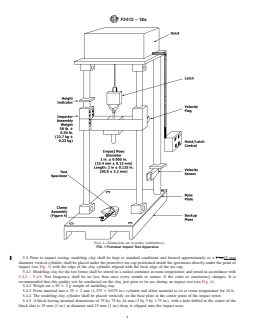
5.2.1 The apparatus as shown in Fig. 1 and Fig. 1(a)
with a brand name or other designation.
consists of a frame structure that permits the impactor to be
3.1.14 specimen, for protective footwear, n—may be a left
constrained to fall along a known and repeatable path. Provi-
foot, a right foot, or a matched pair.
sionshallbemadeforamechanismtocatchthestrikerafterthe
3.1.14.1 Discussion—The exact number and type of foot-
initial impact so that the test specimen is struck only once.
wear units is indicated by test method.
5.2.1.1 The impactor consists of a steel weight having a
massof22.7 60.23kg(50 60.5lb).Thenoseoftheimpactor
3.1.15 upper, n—parts of a shoe or boot that are above the
is a solid steel cylinder having a diameter of 25.4 6 0.13 mm
sole.
(1 6 0.03 in.) and protruding a length of 50.8 6 3.2 mm (2.0
6 0.13 in.) from the impact assembly. The impact side of the
4. Significance and Use
cylinder has a smooth spherical surface with a radius of 25.4 6
4.1 These test methods contain requirements to evaluate the
0.127mm(1.00 60.005in.).Thelongitudinalcenterlineofthe
performance of footwear for the following:
cylinder is parallel and coincident within 3.175 mm (0.125 in.)
4.1.1 Impact resistance for the toe area of footwear (I),
to the vertical axis of the impactor.
4.1.2 Compression resistance for the toe area of footwear
5.2.1.2 Apparatus incorporates a means of measuring the
(C),
velocity at impact with a tolerance of 62 %. The use of a
4.1.3 Metatarsal protection that reduces the chance of injury
velocity metering system allows for determining the time
to the metatarsal bones at the top of the foot (Mt),
required for a 25.4-mm (1-in.) wide blade to pass completely
4.1.4 Conductive properties which reduce hazards that may
through a beam of light immediately prior to the impactor
result from static electricity buildup, and reduce the possibility
striking the specimen. The result, referred to as gate time, is
of ignition of explosives and volatile chemicals (Cd),
measured in milliseconds (ms). The velocity in m/s can be
4.1.5 Electric hazard to protect the wearer when acciden-
calculated using the following formula:
tally stepping on live electric wires (EH),
V 5 (1)
4.1.6 Static dissipative properties to reduce hazards that
t
g
result from a build up of static charge where there is an
where:
underlying risk of accidental contact with live electrical
circuits (SD), and V = velocity in m/s, and
t = gate time in ms.
4.1.7 Puncture resistance footwear devices (PR).
g
4.2 Any changes to the original components of safety toe
footwear such as replacing or adding after-market footbeds/
Imagery as shown within Ells, W., Ed., Safety and Occupational Footwear,
inserts could cause non-compliance to any or all parts of this MNL71-EB, ASTM International, 2014.
F2412 − 18a
NOTE 1—Dimensions are in inches (millimeters).
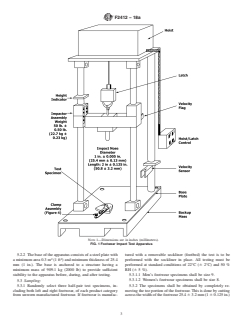
FIG. 1 Footwear Impact Test Apparatus
5.2.2 The base of the apparatus consists of a steel plate with tured with a removable sockliner (footbed) the test is to be
2 2
a minimum area 0.3 m (1 ft ) and minimum thickness of 25.4 performed with the sockliner in place. All testing must be
mm (1 in.). The base is anchored to a structure having a performed at standard conditions of 22°C (6 2°C) and 50 %
minimum mass of 909.1 kg (2000 lb) to provide sufficient RH (6 5 %).
stability to the apparatus before, during, and after testing.
5.3.1.1 Men’s footwear specimens shall be size 9.
5.3.1.2 Women’s footwear specimens shall be size 8.
5.3 Sampling:
5.3.1 Randomly select three half-pair test specimens, in- 5.3.2 The specimens shall be obtained by completely re-
cluding both left and right footwear, of each product category moving the toe portion of the footwear. This is done by cutting
from unworn manufactured footwear. If footwear is manufac- acrossthewidthofthefootwear25.4 63.2mm(1 60.125in.)
F2412 − 18a
FIG. 1 (a) Impact Testing (Left) and Compression Testing (Right) (continued)
behind the back edge of the protective toe cap and cutting the 5.4.6 The block/impactor assembly is carefully lowered
upper material back to the edge of the protective toe cap as
until the wooden block makes contact with the modeling clay
shown in Fig. 2.
cylinder.
5.4 Prior to impact testing, modeling clay shall be kept at 5.4.7 The impactor assembly is released allowing full
weight to compress the cylinder for 10 61s.
standard conditions and formed approximately as a 25 mm
diameter vertical cylinder, shall be placed under the protective
5.4.8 Immediately afterwards, the impactor assembly is
toecappositionedinsidethespecimensdirectlyunderthepoint
raised and the modeling clay cylinder if necessary cut in half to
ofimpact(seeFig.3)withtheedgeoftheclaycylinderaligned
measure.
with the back edge of the toe cap.
5.4.9 A modeling clay cylinder having a compressed thick-
5.4.1 Modeling clay for the test forms shall be stored in a
ness of 15 6 2 mm is acceptable to use in impact resistance.
sealed container at room temperature and tested in accordance
with 5.4.2 – 5.4.9. Test frequency shall be no less than once 5.5 Specimen Mounting:
every month or sooner, if the color or consistency changes. It
5.5.1 Specimens are to be placed on the test apparatus base
is recommended that this quality test be conducted on the clay
plate so that the sole is parallel with the base.
just prior to its use during an impact test (see Fig. 4).
5.5.1.1 The specimen is positioned so that the longitudinal
5.4.2 Weigh out a 50 6 2 g sample of modeling clay.
center of the nose of the impactor strikes the approximate
5.4.3 Form material into a 35 6 2 mm (1.375 6 0.075 in.)
center of the protective toe cap at a point that is 12.7 6 1.6 mm
cylinder and allow material to sit at room temperature for 24 h.
(0.50 60.0625in.)towardthefrontasmeasuredfromtheback
5.4.4 The modeling clay cylinder shall be placed vertically
edge of the protective toe cap (see Fig. 3).
on the base plate at the center point of the impact tester.
5.5.2 The specimen is held in position during test by use of
5.4.5 Ablock having nominal dimensions of 75 by 75 by 44
a clamping device as shown in Fig. 5.
mm (3 by 3 by 1.75 in.), with a hole drilled in the center of the
block that is 25 mm (1 in.) in diameter and 25 mm (1 in.) deep, 5.5.2.1 The stabilizing fork clamp device rests on the insert
is slipped onto the impact nose. and can be adjusted by means of a screw.
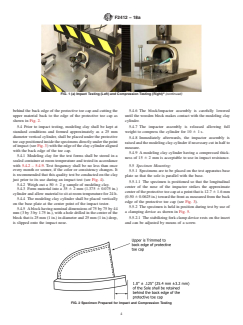
FIG. 2 Specimen Prepared for Impact and Compression Testing
F2412 − 18a
FIG. 3 Specimen Prepared for Impact and Compression Testing
FIG. 4 Apparatus for Modeling Clay Quality Test
5.5.2.2 The adjustment secures the specimen parallel to the 5.6.3 Release the impactor.
base plate and prevents movement when the impactor strikes 5.6.4 After impact raise and secure the impactor on test
the specimen. apparatus, carefully remove the clay cylinder from inside the
5.5.2.3 Clamping screw shall be tightened using a force of specimen and measure the height of the modeling clay cylinder
2.8 Nm (25 in. lbs). at its lowest point using a measuring device capable of
measuring to the nearest 0.1 mm (0.004 in.).
5.6 Procedure:
5.6.5 Thisvalue,tothenearest0.1mmwithoutroundingup,
5.6.1 When in place, the modeling clay cylinder shall be
is the impact interior height clearance for the specimen.
shaped having a diameter of approximately 25 mm (1 in.)
nominal and positioned so that the cylinder makes contact with
5.7 Test Report—Report the impact interior height clearance
the insert/sock liner/footbed of the footwear and the dome of results for each specimen.
the protective toe cap.
6. Protective Toe Compression Resistance (C)
NOTE 1—A small piece of release paper such as wax paper or
cellophane can be placed on either the bottom side or top side of the clay
6.1 Summary of Method:
cylinder to prevent the modeling clay from adhering to either the
6.1.1 Footwear shall be constructed and manufactured so
insert/sock liner or dome.
thataprotectivetoecapisanintegralandpermanentpartofthe
5.6.2 To measure impact resistance, the impactor is dropped
footwear.
from a height that results in an impact velocity of 2995 6 61
6.1.2 Footwear with a protective toe cap is exposed to a
mm/s (117.9 6 2.4 in./s), creating an energy of 101.75 J (75
compressive force.
lbf).
6.1.3 During application of the compressive force, the
interior space of the toe cap is measured using a modeling clay
NOTE 2—In a vacuum, the distance would be 457 mm (18 in.). Due to
friction and air resistance, the height used for the test is somewhat greater. cylinder.
F2412 − 18a
NOTE 1—Dimensions are in inches (millimetres).
FIG. 5 Position/Clamping/Impact Arrangement
6.2 Apparatus: 6.2.1.2 Pressure head has a minimum diameter of 76.2 mm
6.2.1 Compression testing equipment that is equipped with
(3 in.) and a bed plate with a minimum width of 152.4 mm (6
smooth steel compression test surfaces.
in.).
6.2.1.1 Test surfaces must remain parallel during applica-
tion of force up to 22 241 N (5000 lbf).
F2412 − 18a
6.2.1.3 Equipment must be graduated in increments so as to 6.6.4 This value, to the nearest 0.1 mm (0.004 in.) without
measure compressive force between 222.4 N (50 lbf) to 22 241 rounding up, is the compression interior height clearance for
N (5000 lbf). the specimen.
6.3 Sampling: 6.7 Test Report—Report the compression interior height
6.3.1 Randomly select three half-pair test specimens, in- clearance results for each specimen.
cluding both left and right footwear, of each product category
from unworn manufactured footwear. If footwear is manufac- 7. Metatarsal Impact Resistance (Mt)
tured with a removable sockliner (footbed) the test is to be
7.1 Summary of Method:
performed with the sockliner in place. All testing must be
7.1.1 Footwear shall be constructed and manufactured so
performed at standard conditions of 22°C (62°C) and 50 %
that a metatarsal impact guard is positioned partially over the
RH (65 %).
protective toe cap and extended to cover the metatarsal bone
6.3.1.1 Men’s footwear specimens shall be size 9.
area. The metatarsal protection shall be an integral and
6.3.1.2 Women’s footwear specimens shall be size 8.
permanent part of the footwear.
6.3.2 The specimens shall be prepared by completely re-
7.1.2 Footwear with a protective toe cap and metatarsal
moving the toe portion of the footwear. This is done by cutting
guard is impacted with the appropriate force.
acrossthewidthofthefootwear25.4 63.2mm(1 60.125in.)
7.1.3 After impact, carefully remove the wax form from
behind the back edge of the protective toe cap and cutting the
inside the footwear and measure.
upper material back to the edge of the protective toe cap as
7.2 Apparatus:
shown in Fig. 2.
7.2.1 The same apparatus as used in 5.2 (Fig. 1) for impact
6.4 Prior to compression testing, modeling clay, kept at
testing of protective footwear, with certain modifications, is
standard conditions and formed approximately as a 1 in.
used for metatarsal impact testing. The modifications to the
diameter vertical cylinder, shall be placed under the protective
apparatus are shown in Fig. 6 and Fig. 6(a) and Fig. 7.
toecappositionedinsidethespecimensdirectlyunderthepoint
7.2.1.1 The striking bar is a solid steel cylinder having a
of compression (see Fig. 3) with the edge of the clay cylinder
diameterof25.4 60.8mm(1 60.03in.)andalengthof152.4
aligned with the back edge of the toe cap.
6 3.2 mm (6.0 6 0.13 in.).
6.4.1 Modeling clay for the test forms shall be stored in a
7.2.1.2 The striking bar is positioned so that the impact is
sealed container at standard conditions and tested in accor-
perpendicular to the longitudinal plane of the heel/toe axis at
dance with 5.4.2 – 5.4.9. Test frequency shall be no less than
the appropriate impact point for men’s and women’s footwear
once every month. Or sooner, if the color or consistency
(see Fig. 8).
changes. It is recommended that this quality test be conducted
7.3 Sampling:
on the clay just prior to its use during a compression test (see
7.3.1 Randomly select three half-pair test specimens, in-
Fig. 4).
cluding both left and right footwear, of each product category
6.5 Specimen Mounting:
from unworn manufactured footwear. If footwear is manufac-
6.5.1 The specimen is positioned on the bed plate of the test
tured with a removable sockliner (footbed) the test is to be
apparatus so that the highest point of the protective toe cap is
performed with the sockliner in place. All testing must be
perpendicular to the direction of force.
performed at standard conditions of 22°C (62°C) and 50 %
6.5.2 The stabilizing fork clamp device rests on the insert
RH (65 %).
and can be adjusted by means of a screw (see Fig. 5).
7.3.1.1 Men’s footwear specimens shall be size 9.
6.5.2.1 This adjustment secures the specimen parallel to the
7.3.1.2 Women’s footwear specimens shall be size 8.
bed plate and prevents movement.
7.4 Specimen Mounting:
6.5.2.2 Clamping screw shall be tightened using a force of
2.8 Nm (25 in. lbs). 7.4.1 Mount specimen in a device, as shown in Fig. 7, that
retains footwear in place during testing.
6.6 Procedure:
7.4.2 Mount specimen so that outsole is resting on base of
6.6.1 When in place, the modeling clay cylinder shall be
apparatus and positioned so that the point of contact for the
shaped having a base diameter of approximately 25 mm (1 in.)
striking bar is appropriate for the specimen as shown in Fig. 8.
nominal and positioned so that the cylinder simultaneously
7.4.2.1 Men’s footwear requires that the point of contact for
makes contact with the insert/sock liner/footbed of the foot-
the striking bar is 89 mm (3.5 in.) when measured backwards
wear and the dome of the protective toe cap. (See Note 1 and
from the front point of the toe toward the heel. As shown in
Fig. 3.)
Fig. 8.
6.6.2 A compressive force is applied to the specimen at an
7.4.2.2 Women’s footwear requires that the point of contact
approximate rate of 222.4 N/s (50 lbf/s) until it reaches 11 121
for the striking bar is 86 mm (3.375 in.) when measured
N (2500 lbf) for compression.
backwards from the front part of the toe toward the heel.
6.6.3 After compression testing, carefully remove the mod-
7.5 Procedure:
eling clay cylinder from the specimen and, using a measuring
device capable of measuring to the nearest 0.1 mm (0.004 in.) 7.5.1 Insert a wax form, as described in AnnexA1, into the
measure the height of the modeling clay cylinder at its lowest specimen. The insert/sock lining/footbed of the
...
This document is not an ASTM standard and is intended only to provide the user of an ASTM standard an indication of what changes have been made to the previous version. Because
it may not be technically possible to adequately depict all changes accurately, ASTM recommends that users consult prior editions as appropriate. In all cases only the current version
of the standard as published by ASTM is to be considered the official document.
Designation: F2412 − 18 F2412 − 18a
Standard Test Methods for
Foot Protection
This standard is issued under the fixed designation F2412; the number immediately following the designation indicates the year of
original adoption or, in the case of revision, the year of last revision. A number in parentheses indicates the year of last reapproval. A
superscript epsilon (´) indicates an editorial change since the last revision or reapproval.
INTRODUCTION
For more than sixty years, the predecessor to these test methods, ANSI Z41, established the
performance criteria for a wide range of footwear to protect from the hazards that affect the personal
safety of workers. The value of these standards was recognized early in the history of the Occupational
Safety and Health Administration (OSHA) and incorporated as a reference standard in the Code of
Federal Regulation (CFR) Section 1910.
These test methods contains test protocols developed in conjunction with ANSI Z41 as well as other
ASTM standards that are used to evaluate the performance of footwear when exposed to a variety of
hazards: (1) impact resistance (I) for the toe area of footwear; (2) compression resistance (C) for the
toe area of footwear; (3) metatarsal impact protection (Mt) that reduces the chance of injury to the
metatarsal bones at the top of the foot; (4) conductive properties (Cd) that reduce hazards that may
result from static electricity buildup and reduce the possibility of ignition of explosives and volatile
chemicals; (5) electric hazard resistant (EH) non-conductive; (6) static dissipative (SD) properties to
reduce hazards due to excessively low footwear electrical resistance that may exist where SD footwear
is required; and (7) puncture resistance (PR) of foot devices.
1. Scope
1.1 These test methods measure the resistance of footwear to a variety of hazards that can potentially result in injury.
1.2 These test methods may be used to test for compliance to minimum performance requirements in established safety
standards.
1.2.1 By agreement between the purchaser and the supplier, or as required by established safety standards, these test methods
can be used to determine any one, or all of the following: (1) impact resistance (I), (2) compression resistance (C), (3) metatarsal
impact resistance (Mt), (4) resistance to electrical conductivity (Cd), (5) resistance to electric hazard (EH), (6) static dissipative
performance (SD), and (7) puncture resistance (PR).
1.3 The values stated in SI units are to be regarded as the standard. The values given in parentheses are for information only.
1.4 This standard does not purport to address all of the safety concerns, if any, associated with its use. It is the responsibility
of the user of this standard to establish appropriate safety, health, and environmental practices and determine the applicability of
regulatory limitations prior to use.
1.5 This international standard was developed in accordance with internationally recognized principles on standardization
established in the Decision on Principles for the Development of International Standards, Guides and Recommendations issued
by the World Trade Organization Technical Barriers to Trade (TBT) Committee.
2. Referenced Documents
2.1 ASTM Standards:
B117 Practice for Operating Salt Spray (Fog) Apparatus
These test methods are under the jurisdiction of ASTM Committee F13 on Pedestrian/Walkway Safety and Footwear and are the direct responsibility of Subcommittee
F13.30 on Footwear.
Current edition approved Feb. 1, 2018Aug. 1, 2018. Published March 2018August 2018. Originally approved in 2005. Last previous edition approved in 20112018 as
F2412 – 11.F2412 – 18. DOI: 10.1520/F2412-18.10.1520/F2412-18A.
For referenced ASTM standards, visit the ASTM website, www.astm.org, or contact ASTM Customer Service at service@astm.org. For Annual Book of ASTM Standards
volume information, refer to the standard’s Document Summary page on the ASTM website.
Copyright © ASTM International, 100 Barr Harbor Drive, PO Box C700, West Conshohocken, PA 19428-2959. United States
F2412 − 18a
2.2 CSA Standard:
CAN/CSA Z195 Protective Footwear
3. Terminology
3.1 Definitions:
3.1.1 footbed (removable), n—also known as ‘insock,’ a component typically made of a foam material with a leather or fabric
cover/sockliner and often shaped or contoured covering the entire insole board which can be inserted between the foot and insole
board.
3.1.2 insole, n—foundation of the shoe; the inner sole of the shoe which is next to the foot, under the sock liner or insert, onto
which the upper is lasted.
3.1.3 last, n—solid hinged form, in the general shape of a foot, around which footwear is constructed.
3.1.4 lasting, v—building of footwear around a specific foot form.
3.1.5 lining, n—term used to describe all components that can be used to construct the interior of the upper portion of the
footwear.
3.1.6 outsole and heel, n—exterior bottom platform of the footwear; the bottom surface.
3.1.7 product category, n—group of similar footwear items manufactured for a specific hazard or hazards and that:
• Have same protective toe cap, protective insole or metguard materials
• Have the same supplier for each of those components
• Have the same outsole design, compound and hardness (including midsole)
• Have the same thickness (within a 612.5 % range) of upper, lining, sole and insole
• Are manufactured using the same method of construction; cemented, welted, etc.
• Are manufactured in the same factory
• Are manufactured using the same last
3.1.8 product classification, n—footwear manufactured to meet a minimum performance requirement for a specific hazard or
hazards.
3.1.9 protective footwear, n—footwear that is designed, constructed, and classified to protect the wearer from a potential hazard
or hazards.
3.1.10 protective toe cap, n—component designed to provide toe protection that is an integral and permanent part of the
footwear.
3.1.11 quarter, n—entire back portion of the footwear upper.
3.1.12 size, n—length and breadth measurements of footwear determined by using a specific grading; the American system of
footwear grading.
3.1.13 socklining (non-removable), n—fabric material placed over the insole, footbed, or insert that may be imprinted with a
brand name or other designation.
3.1.14 specimen, for protective footwear, n—footwear units evaluated for various hazards.may be a left foot, a right foot, or a
matched pair.
3.1.14.1 Discussion—
Footwear units may be a left foot, a right foot, or a matched pair. The exact number and type of footwear units is indicated by test
method.
3.1.15 upper, n—parts of a shoe or boot that are above the sole.
4. Significance and Use
4.1 These test methods contain requirements to evaluate the performance of footwear for the following:
4.1.1 Impact resistance for the toe area of footwear (I/75),(I),
4.1.2 Compression resistance for the toe area of footwear (C/75),(C),
4.1.3 Metatarsal protection that reduces the chance of injury to the metatarsal bones at the top of the foot (Mt/75),(Mt),
4.1.4 Conductive properties which reduce hazards that may result from static electricity buildup, and reduce the possibility of
ignition of explosives and volatile chemicals (Cd),
4.1.5 Electric Hazard by hazard to protect the wearer when accidentally stepping on live wire electric wires (EH),
Available from Canadian Standards Association (CSA), 178 Rexdale Blvd., Toronto, ON Canada M9W1R3.
F2412 − 18a
4.1.6 Static dissipative (SD) properties to reduce hazards due to excessively low footwear electrical resistance that may exist
where SD footwear is required, that result from a build up of static charge where there is an underlying risk of accidental contact
with live electrical circuits (SD), and
4.1.7 Puncture resistance footwear devices (PR).
4.2 Any changes to the original components of safety toe footwear such as replacing or adding after-market footbeds/inserts
could cause non-compliance to any or all parts of this standard rendering the ASTM label invalid. Protective toe footwear
specimens or samples shall be retested for any of the following changes.
4.2.1 Change in material used to make protective toe cap, change in protective cap manufacturer, change in the design of the
toe cap.
4.2.2 Change in construction method used to make footwear or change in factory in which footwear is produced.
4.2.3 Change in the upper or insole material thickness greater than 25 %, change to the soling system or a change in the hardness
of the outsole.%.
4.2.4 Change in the out sole or midsole, including its hardness.
4.2.5 Change in shape of last used in the manufacturing of footwear.
4.2.6 Change in material or supplier of protective insole.
4.2.7 Change in material or supplier of met guard.
5. Protective Toe Impact Resistance (I)
5.1 Summary of Method:
5.1.1 Footwear shall be constructed and manufactured so that a protective toe cap is an integral and permanent part of the
footwear.
5.1.2 Footwear with a protective toe cap is impacted with a specified force.
5.1.3 After impact, the height of the modeling clay cylinder is measured.
5.2 Apparatus:
5.2.1 The apparatus as shown in Fig. 1 and Fig. 1(a) consists of a frame structure that permits the impactor to be constrained
to fall along a known and repeatable path. Provision shall be made for a mechanism to catch the striker after the initial impact so
that the test specimen is struck only once.
5.2.1.1 The impactor consists of a steel weight having a mass of 22.7 6 0.23 kg (50 6 0.5 lb). The nose of the impactor is a
solid steel cylinder having a diameter of 25.4 6 0.80.13 mm (1 6 0.03 in.) and protruding a length of 50.8 6 3.2 mm (2.0 6 0.13
in.) from the impact assembly. The impact side of the cylinder has a smooth spherical surface with a radius of 25.4 6 0.127 mm
(1.00 6 0.005 in.). The longitudinal centerline of the cylinder is parallel and coincident within 3.175 mm (0.125 in.) to the vertical
axis of the impactor.
5.2.1.2 Apparatus incorporates a means of measuring the velocity at impact with a tolerance of 62 %. The use of a velocity
metering system allows for determining the time required for a 25.4-mm (1-in.) wide blade to pass completely through a beam of
light immediately prior to the impactor striking the specimen. The result, referred to as gate time, is measured in milliseconds (ms).
The speedvelocity in in./sm/s can be calculated using the following formula:
V 5 (1)
t
g
where:
V = velocity in in./s, and
V = velocity in m/s, and
t = gate time in ms.
g
2 2
5.2.2 The base of the apparatus consists of a steel plate with a minimum area 0.3 m (1 ft ) and minimum thickness of 25.4 mm
(1 in.). The base is anchored to a structure having a minimum mass of 909.1 kg (2000 lb) to provide sufficient stability to the
apparatus before, during, and after testing.
5.3 Sampling:
5.3.1 Randomly select three half-pair test specimens, including both left and right footwear, of each product category from
unworn manufactured footwear. If footwear is manufactured with a removable sockliner (footbed) the test is to be performed with
the sockliner in place. All testing must be performed at standard conditions of 22°C (6 2°C) and 50 % RH (6 5 %).
5.3.1.1 Men’s footwear specimens shall be size 9.
5.3.1.2 Women’s footwear specimens shall be size 8.
5.3.2 The specimens shall be obtained by completely removing the toe portion of the footwear. This is done by cutting across
the width of the footwear 25.4 6 3.2 mm (1 6 0.125 in.) behind the back edge of the protective toe cap and cutting the upper
material back to the edge of the protective toe cap as shown in Fig. 2.
Imagery as shown within Ells, W., Ed., Safety and Occupational Footwear, MNL71-EB, ASTM International, 2014.
F2412 − 18a
NOTE 1—Dimensions are in inches (millimeters).
FIG. 1 Footwear Impact Test Apparatus
5.4 Prior to impact testing, modeling clay shall be kept at standard conditions and formed approximately as a 1 in.25 mm
diameter vertical cylinder, shall be placed under the protective toe cap positioned inside the specimens directly under the point of
impact (see Fig. 3) with the edge of the clay cylinder aligned with the back edge of the toe cap.
5.4.1 Modeling clay for the test forms shall be stored in a sealed container at room temperature and tested in accordance with
5.4.2 – 5.4.9. Test frequency shall be no less than once every month or sooner, if the color or consistency changes. It is
recommended that this quality test be conducted on the clay just prior to its use during an impact test (see Fig. 4).
5.4.2 Weigh out a 50 6 2 g sample of modeling clay.
5.4.3 Form material into a 35 6 2 mm (1.375 6 0.075 in.) cylinder and allow material to sit at room temperature for 24 h.
5.4.4 The modeling clay cylinder shall be placed vertically on the base plate at the center point of the impact tester.
5.4.5 A block having nominal dimensions of 75 by 75 by 44 mm (3 by 3 by 1.75 in.), with a hole drilled in the center of the
block that is 25 mm (1 in.) in diameter and 25 mm (1 in.) deep, is slipped onto the impact nose.
F2412 − 18a
FIG. 1 (a) Impact Testing (Left) and Compression Testing (Right) (continued)
FIG. 2 Specimen Prepared for Impact and Compression Testing
FIG. 3 Specimen Prepared for Impact and Compression Testing
5.4.6 The block/impactor assembly is carefully lowered until the wooden block makes contact with the modeling clay cylinder.
5.4.7 The impactor assembly is released allowing full weight to compress the cylinder for 61 s.10 6 1 s.
5.4.8 Immediately afterwards, the impactor assembly is raised and the modeling clay cylinder if necessary cut in half to
measure.
5.4.9 A modeling clay cylinder having a compressed thickness of 15 6 2 mm is acceptable to use in impact resistance.
F2412 − 18a
FIG. 4 Apparatus for Modeling Clay Quality Test
5.5 Specimen Mounting:
5.5.1 Specimens are to be placed on the test apparatus base plate so that the sole is parallel with the base.
5.5.1.1 The specimen is positioned so that the longitudinal center of the nose of the impactor strikes the approximate center of
the protective toe cap at a point that is 12.7 6 1.6 mm (0.50 6 0.0625 in.) toward the front as measured from the back edge of
the protective toe cap (see Fig. 3).
5.5.2 The specimen is held in position during test by use of a clamping device as shown in Fig. 5.
5.5.2.1 The stabilizing fork clamp device rests on the insert and can be adjusted by means of a screw.
5.5.2.2 The adjustment secures the specimen parallel to the base plate and prevents movement when the impactor strikes the
specimen.
5.5.2.3 Clamping screw shall be tightened using a force of 2.8 Nm (25 in. lbs).
5.6 Procedure:
5.6.1 When in place, the modeling clay cylinder shall be shaped having a diameter of approximately 25 mm (1 in.) nominal and
positioned so that the cylinder makes contact with the insert/sock liner/footbed of the footwear and the dome of the protective toe
cap.
NOTE 1—A small piece of release paper such as wax paper or cellophane can be placed on either the bottom side or top side of the clay cylinder to
prevent the modeling clay from adhering to either the insert/sock liner or dome.
5.6.2 To measure Impact 75 product footwear, impact resistance, the impactor is dropped from a height that results in an impact
velocity of 2995 6 61 mm/s (117.9 6 2.4 in./s), creating an energy of 101.75 J (75 lbf).
NOTE 2—In a vacuum, the distance would be 457 mm (18 in.). Due to friction and air resistance, the height used for the test is somewhat greater.
5.6.3 Release the impactor.
5.6.4 After impact raise and secure the impactor on test apparatus, carefully remove the clay cylinder from inside the specimen
and measure the height of the modeling clay cylinder at its lowest point using a measuring device capable of measuring to the
nearest 0.1 mm (0.004 in.).
5.6.5 This value is reported as the impact minimum value, to the nearest 0.1 mm without rounding up, is the impact interior
height clearance for the specimen.
5.7 Test Report—Report the minimum height of the modeling clay cylinder, without rounding up, to the nearest 0.1 mm (0.004
in.) as the clearance result for the product category for all three specimens.impact interior height clearance results for each
specimen.
6. Protective Toe Compression Resistance (C)
6.1 Summary of Method:
6.1.1 Footwear shall be constructed and manufactured so that a protective toe cap is an integral and permanent part of the
footwear.
6.1.2 Footwear with a protective toe cap is exposed to a compressive force.
6.1.3 During application of the compressive force, the interior space of the toe cap is measured using a modeling clay cylinder.
6.2 Apparatus:
6.2.1 Compression testing equipment that is equipped with smooth steel compression test surfaces.
6.2.1.1 Test surfaces must remain parallel during application of force up to 22 241 N (5000 lbf).
6.2.1.2 Pressure head has a minimum diameter of 76.2 mm (3 in.) and a bed plate with a minimum width of 152.4 mm (6 in.).
6.2.1.3 Equipment must be graduated in increments so as to measure compressive force between 222.4 N (50 lbf) to 22 241 N
(5000 lbf).
F2412 − 18a
NOTE 1—Dimensions are in inches (millimetres).
FIG. 5 Position/Clamping/Impact Arrangement
6.3 Sampling:
6.3.1 Randomly select three half-pair test specimens, including both left and right footwear, of each product category from
unworn manufactured footwear. If footwear is manufactured with a removable sockliner (footbed) the test is to be performed with
the sockliner in place. All testing must be performed at standard conditions of 22°C (62°C) and 50 % RH (65 %).
6.3.1.1 Men’s footwear specimens shall be size 9.
6.3.1.2 Women’s footwear specimens shall be size 8.
6.3.2 The specimens shall be prepared by completely removing the toe portion of the footwear. This is done by cutting across
the width of the footwear 25.4 6 3.2 mm (1 6 0.125 in.) behind the back edge of the protective toe cap and cutting the upper
material back to the edge of the protective toe cap as shown in Fig. 2.
F2412 − 18a
6.4 Prior to compression testing, modeling clay, kept at standard conditions and formed approximately as a 1 in. diameter
vertical cylinder, shall be placed under the protective toe cap positioned inside the specimens directly under the point of
compression (see Fig. 3) with the edge of the clay cylinder aligned with the back edge of the toe cap.
6.4.1 Modeling clay for the test forms shall be stored in a sealed container at standard conditions and tested in accordance with
5.4.2 – 5.4.9. Test frequency shall be no less than once every month. Or sooner, if the color or consistency changes. It is
recommended that this quality test be conducted on the clay just prior to its use during a compression test (see Fig. 4).
6.5 Specimen Mounting:
6.5.1 The specimen is positioned on the bed plate of the test apparatus so that the highest point of the protective toe cap is
perpendicular to the direction of force.
6.5.2 The stabilizing fork clamp device rests on the insert and can be adjusted by means of a screw (see Fig. 5).
6.5.2.1 This adjustment secures the specimen parallel to the bed plate and prevents movement.
6.5.2.2 Clamping screw shall be tightened using a force of 2.8 Nm (25 in. lbs).
6.6 Procedure:
6.6.1 When in place, the modeling clay cylinder shall be shaped having a base diameter of approximately 25 mm (1 in.) nominal
and positioned so that the cylinder simultaneously makes contact with the insert/sock liner/footbed of the footwear and the dome
of the protective toe cap. (See Note 1 and Fig. 3.)
6.6.2 A compressive force is applied to the specimen at an approximate rate of 222.4 N/s (50 lbf/s) until it reaches 11 121 N
(2500 lbf) for Compression 75.compression.
6.6.3 After compression testing, carefully remove the modeling clay cylinder from the specimen and, using a measuring device
capable of measuring to the nearest 0.1 mm (0.004 in.) measure the height of the modeling clay cylinder at its lowest point, without
rounding up.
6.6.4 This value, to the nearest 0.1 mm (0.004 in.) without rounding up, is the compression interior height clearance for the
specimen.
6.7 Test Report—Report the minimum height of the modeling clay cylinder without rounding up to the nearest 0.1 mm (0.004
in.) as the clearance result for the product category for all three specimens.compression interior height clearance results for each
specimen.
7. Metatarsal Impact Resistance (Mt)
7.1 Summary of Method:
7.1.1 Footwear shall be constructed and manufactured so that a metatarsal impact guard is positioned partially over the
protective toe cap and extended to cover the metatarsal bone area. The metatarsal protection shall be an integral and permanent
part of the footwear.
7.1.2 Footwear with a protective toe cap and metatarsal guard is impacted with the appropriate force.
7.1.3 After impact, carefully remove the wax form from inside the footwear and measure.
7.2 Apparatus:
7.2.1 The same apparatus as used in 5.2 (Fig. 1) for impact testing of protective footwear, with certain modifications, is used
for metatarsal impact testing. The modifications to the apparatus are shown in Fig. 6 and Fig. 6(a) and Fig. 7.
7.2.1.1 The striking bar is a solid steel cylinder having a diameter of 25.4 6 0.8 mm (1 6 0.03 in.) and a length of 152.4 6
3.2 mm (6.0 6 0.13 in.).
7.2.1.2 The striking bar is positioned so that the impact is perpendicular to the longitudinal plane of the heel/toe axis at the
appropriate impact point for men’s and women’s footwear (see Fig. 8).
7.3 Sampling:
7.3.1 Randomly select three half-pair test specimens, including both left and right footwear, of each product category from
unworn manufactured footwear. If footwear is manufactured with a removable sockliner (footbed) the test is to be performed with
the sockliner in place. All testing must be performed at standard conditions of 22°C (62°C) and 50 % RH (65 %).
7.3.1.1 Me
...
Questions, Comments and Discussion
Ask us and Technical Secretary will try to provide an answer. You can facilitate discussion about the standard in here.
Loading comments...