

ASTM F1818-15(2022)
(Specification)Standard Specification for Foot Protection for Chainsaw Users
General Information
- Abstract
ABSTRACT
This specification prescribes the minimum requirements for the design, performance, testing, and certification of footwear and foot protective devices that, when worn by operators of power chain saws, shall provide cut resistance protection to their feet, and thereby reducing foot injuries caused by close contact with the running saw chain. The footwear and foot protective devices shall be constructed with suitable fit and flexibility so as to provide sufficient foot comfort and normal maneuverability to perform intended tasks, while maintaining satisfactory functionality and efficacy for the duration of its regular use throughout seasonal climatic variations. Completed footwear shall be inspected and certified as specified, and maintained in accordance with the manufacturer's instructions.
SCOPE
1.1 This specification covers minimum requirements for the design, performance, testing, and certification of footwear and foot protective devices designed to provide cut resistance protection to the feet of operators of power chainsaws.
1.2 The objective of this specification is to prescribe fit, function, and performance criteria for footwear and foot protective devices worn by chainsaw operators, which are intended to reduce foot injuries caused by contact with a running power saw chain.
1.3 This specification is not intended to serve as a detailed manufacturing or purchasing specification, but can be referenced in purchase contracts to ensure that minimum performance requirements are met.
1.4 Controlled laboratory tests used to determine compliance with the performance requirements of this specification shall not be deemed as establishing performance levels for all situations to which chainsaw operators may be exposed.
1.5 Mandatory requirements are indicated by the use of the word shall; recommendations and advisory information is indicated by the use of the word should.
1.6 This international standard was developed in accordance with internationally recognized principles on standardization established in the Decision on Principles for the Development of International Standards, Guides and Recommendations issued by the World Trade Organization Technical Barriers to Trade (TBT) Committee.
- Status
- Published
- Publication Date
- 30-Nov-2022
- Technical Committee
- F23 - Personal Protective Clothing and Equipment
- Drafting Committee
- F23.20 - Physical
Overview
ASTM F1818-15(2022) - Standard Specification for Foot Protection for Chainsaw Users is an internationally recognized standard developed by ASTM International. It defines the minimum requirements for the design, performance, testing, and certification of footwear and foot protective devices intended specifically for chainsaw users. The primary goal of this standard is to ensure that chainsaw operators are provided with certified foot protection that significantly reduces the risk of injury from accidental contact with an operating saw chain. This standard addresses cut resistance, fit, flexibility, comfort, and durability under varying climatic conditions, ensuring reliable protection for professional and occasional chainsaw operators.
Key Topics
- Cut Resistance: Specifies minimum criteria for cut-resistant materials and construction in protective footwear for chainsaw users, including standards for upper and toe areas.
- Design and Performance Requirements: Outlines requirements for proper fit, comfort, flexibility, and normal maneuverability while maintaining effective protection throughout the product's lifecycle.
- Testing and Certification: Covers rigorous laboratory testing for cut-through resistance and mandates third-party certification, including labeling and follow-up inspection programs.
- Identification and Labeling: Ensures certified products carry visible, permanent labels with essential information such as manufacturer, lot identification, and certification statements.
- Care and Maintenance: Offers guidance for users regarding care, maintenance, repair, and retirement of foot protective devices as per manufacturer instructions.
- Scope of Application: Clarifies that this standard sets minimum requirements and can be referenced in purchase contracts, but is not a detailed manufacturing or purchasing specification.
Applications
ASTM F1818-15(2022) is highly relevant for various industries and professionals where chainsaw operation is part of the workflow, such as:
- Forestry and Logging: Essential for loggers, arborists, and forestry personnel, ensuring compliance with occupational safety standards.
- Tree Care and Landscaping: Provides tree surgeons, landscaping teams, and groundskeepers with robust protection to minimize foot injuries during chainsaw usage.
- Fire and Rescue Services: Used by emergency response teams during disaster recovery and wildfire operations where chainsaws are commonly deployed.
- Construction and Maintenance: Applied by personnel involved in construction, land clearing, and infrastructure maintenance.
Compliant foot protection not only helps employers meet regulatory and safety requirements but also fosters a culture of safety, reducing workplace injuries and related costs.
Related Standards
ASTM F1818-15(2022) references several complementary standards for protective clothing and equipment:
- ASTM F1414: Test Method for Measurement of Cut Resistance to Chainsaw in Lower Body (Legs) Protective Clothing.
- ASTM F1458: Test Method for Measurement of Cut Resistance to Chainsaw of Foot Protective Devices.
- ASTM F1897: Specification for Leg Protection for Chain Saw Users.
- ASTM F2413: Performance Requirements for Protective (Safety) Toe Cap Footwear.
- OSHA 29 CFR 1910.266: Logging Operations, which references ASTM F2413 for foot protection in logging environments.
These referenced standards further support comprehensive personal protective equipment (PPE) strategies, enhancing safety for chainsaw operators across multiple sectors.
Keywords: ASTM F1818, chainsaw user foot protection, cut-resistant footwear, safety standards, personal protective equipment, chainsaw safety, occupational safety, certification, forestry PPE, cut resistance standards.
Relations
- Effective Date
- 01-Nov-2023
- Effective Date
- 01-Jan-2020
- Effective Date
- 01-Jun-2019
- Effective Date
- 01-Aug-2018
- Effective Date
- 01-Nov-2017
- Effective Date
- 01-Nov-2015
- Effective Date
- 01-Feb-2014
- Effective Date
- 01-Jan-2013
- Effective Date
- 01-Jul-2011
- Effective Date
- 15-Jun-2008
- Effective Date
- 15-Jun-2008
- Effective Date
- 01-Mar-2005
- Effective Date
- 01-Oct-2004
- Effective Date
- 01-Oct-2004
- Effective Date
- 01-Oct-2004
Get Certified
Connect with accredited certification bodies for this standard

CIS Institut d.o.o.
Personal Protective Equipment (PPE) certification body. Notified Body NB-2890 for EU Regulation 2016/425 PPE.

Kiwa BDA Testing
Building and construction product certification.
Kmetijski inštitut Slovenije
Agricultural Institute of Slovenia. Soil testing, plant health, agricultural product analysis.
Sponsored listings
Frequently Asked Questions
ASTM F1818-15(2022) is a technical specification published by ASTM International. Its full title is "Standard Specification for Foot Protection for Chainsaw Users". This standard covers: ABSTRACT This specification prescribes the minimum requirements for the design, performance, testing, and certification of footwear and foot protective devices that, when worn by operators of power chain saws, shall provide cut resistance protection to their feet, and thereby reducing foot injuries caused by close contact with the running saw chain. The footwear and foot protective devices shall be constructed with suitable fit and flexibility so as to provide sufficient foot comfort and normal maneuverability to perform intended tasks, while maintaining satisfactory functionality and efficacy for the duration of its regular use throughout seasonal climatic variations. Completed footwear shall be inspected and certified as specified, and maintained in accordance with the manufacturer's instructions. SCOPE 1.1 This specification covers minimum requirements for the design, performance, testing, and certification of footwear and foot protective devices designed to provide cut resistance protection to the feet of operators of power chainsaws. 1.2 The objective of this specification is to prescribe fit, function, and performance criteria for footwear and foot protective devices worn by chainsaw operators, which are intended to reduce foot injuries caused by contact with a running power saw chain. 1.3 This specification is not intended to serve as a detailed manufacturing or purchasing specification, but can be referenced in purchase contracts to ensure that minimum performance requirements are met. 1.4 Controlled laboratory tests used to determine compliance with the performance requirements of this specification shall not be deemed as establishing performance levels for all situations to which chainsaw operators may be exposed. 1.5 Mandatory requirements are indicated by the use of the word shall; recommendations and advisory information is indicated by the use of the word should. 1.6 This international standard was developed in accordance with internationally recognized principles on standardization established in the Decision on Principles for the Development of International Standards, Guides and Recommendations issued by the World Trade Organization Technical Barriers to Trade (TBT) Committee.
ABSTRACT This specification prescribes the minimum requirements for the design, performance, testing, and certification of footwear and foot protective devices that, when worn by operators of power chain saws, shall provide cut resistance protection to their feet, and thereby reducing foot injuries caused by close contact with the running saw chain. The footwear and foot protective devices shall be constructed with suitable fit and flexibility so as to provide sufficient foot comfort and normal maneuverability to perform intended tasks, while maintaining satisfactory functionality and efficacy for the duration of its regular use throughout seasonal climatic variations. Completed footwear shall be inspected and certified as specified, and maintained in accordance with the manufacturer's instructions. SCOPE 1.1 This specification covers minimum requirements for the design, performance, testing, and certification of footwear and foot protective devices designed to provide cut resistance protection to the feet of operators of power chainsaws. 1.2 The objective of this specification is to prescribe fit, function, and performance criteria for footwear and foot protective devices worn by chainsaw operators, which are intended to reduce foot injuries caused by contact with a running power saw chain. 1.3 This specification is not intended to serve as a detailed manufacturing or purchasing specification, but can be referenced in purchase contracts to ensure that minimum performance requirements are met. 1.4 Controlled laboratory tests used to determine compliance with the performance requirements of this specification shall not be deemed as establishing performance levels for all situations to which chainsaw operators may be exposed. 1.5 Mandatory requirements are indicated by the use of the word shall; recommendations and advisory information is indicated by the use of the word should. 1.6 This international standard was developed in accordance with internationally recognized principles on standardization established in the Decision on Principles for the Development of International Standards, Guides and Recommendations issued by the World Trade Organization Technical Barriers to Trade (TBT) Committee.
ASTM F1818-15(2022) is classified under the following ICS (International Classification for Standards) categories: 13.340.50 - Leg and foot protection. The ICS classification helps identify the subject area and facilitates finding related standards.
ASTM F1818-15(2022) has the following relationships with other standards: It is inter standard links to ASTM F1414-19(2023), ASTM F1897-20, ASTM F1414-19, ASTM F2413-18, ASTM F2413-17, ASTM F1414-15, ASTM F1897-14, ASTM F1414-13, ASTM F2413-11, ASTM F1897-08, ASTM F1458-04(2008), ASTM F2413-05, ASTM F1897-04, ASTM F1458-04, ASTM F1414-04. Understanding these relationships helps ensure you are using the most current and applicable version of the standard.
ASTM F1818-15(2022) is available in PDF format for immediate download after purchase. The document can be added to your cart and obtained through the secure checkout process. Digital delivery ensures instant access to the complete standard document.
Standards Content (Sample)
This international standard was developed in accordance with internationally recognized principles on standardization established in the Decision on Principles for the
Development of International Standards, Guides and Recommendations issued by the World Trade Organization Technical Barriers to Trade (TBT) Committee.
Designation: F1818 −15 (Reapproved 2022)
Standard Specification for
Foot Protection for Chainsaw Users
This standard is issued under the fixed designation F1818; the number immediately following the designation indicates the year of
original adoption or, in the case of revision, the year of last revision. A number in parentheses indicates the year of last reapproval. A
superscript epsilon (´) indicates an editorial change since the last revision or reapproval.
1. Scope F1458 Test Method for Measurement of Cut Resistance to
Chainsaw of Foot Protective Devices
1.1 This specification covers minimum requirements for the
F1897 Specification for Leg Protection for Chain Saw Users
design, performance, testing, and certification of footwear and
F2413 Specification for Performance Requirements for Pro-
foot protective devices designed to provide cut resistance
tective (Safety) Toe Cap Footwear
protection to the feet of operators of power chainsaws.
2.2 OSHA Standard:
1.2 The objective of this specification is to prescribe fit,
29 CFR 1910.266 Logging Operations
function, and performance criteria for footwear and foot
protective devices worn by chainsaw operators, which are
3. Terminology
intended to reduce foot injuries caused by contact with a
3.1 Definitions:
running power saw chain.
3.1.1 approve, v—to be acceptable to the authority having
1.3 This specification is not intended to serve as a detailed
jurisdiction.
manufacturing or purchasing specification, but can be refer-
3.1.2 authority having jurisdiction, n—the organization,
enced in purchase contracts to ensure that minimum perfor-
office, or individual responsible for approving any equipment,
mance requirements are met.
installation, or procedure.
1.4 Controlled laboratory tests used to determine compli-
3.1.2.1 Discussion—The term authority having jurisdiction
ance with the performance requirements of this specification
is used in this document in a broad manner since jurisdictions
shall not be deemed as establishing performance levels for all
and the responsibilities of approval agencies vary.
situations to which chainsaw operators may be exposed.
3.1.3 certification, n—a system whereby an organization
1.5 Mandatory requirements are indicated by the use of the determines that a manufacturer has demonstrated the ability to
word shall; recommendations and advisory information is
make a product that complies with the requirements of the
indicated by the use of the word should. specification, authorizes the manufacturer to use a label on
products that comply with the requirements of the
1.6 This international standard was developed in accor-
specification, and conducts a follow-up program to verify the
dance with internationally recognized principles on standard-
methods the manufacturer uses to determine compliance with
ization established in the Decision on Principles for the
the requirements of this specification.
Development of International Standards, Guides and Recom-
mendations issued by the World Trade Organization Technical 3.1.4 certification organization, n—an independent, third-
Barriers to Trade (TBT) Committee.
partyorganizationthatdeterminesproductcompliancewiththe
requirements of the specification with a labeling and listing
2. Referenced Documents
follow-up program.
2.1 ASTM Standards: 3.1.5 chainsaw, n—a portable power-operated tool used for
F1414 Test Method for Measurement of Cut Resistance to
cutting wood which has cutters linked in a chain.
Chainsaw in Lower Body (Legs) Protective Clothing
3.1.6 chain speed, n—the speed of synchronized movement
of linked cutters around a guide bar and sprocket.
3.1.7 chainspeed 50 (CS50), n—forchainsawprotection,the
This specification is under the jurisdiction of ASTM Committee F23 on
mean speed at which cut-through occurs.
Personal Protective Clothing and Equipment and is under the direct responsibility of
Subcommittee F23.20 on Physical. 3.1.7.1 Discussion—This value establishes the relationship
Current edition approved Dec. 1, 2022. Published December 2022. Originally
between the probability of cutting through the chainsaw leg
approved in 1997. Last previous edition approved in 2015 as F1818 – 15. DOI:
protective clothing (or foot protective device) and the speed of
10.1520/F1818-15R22.
For referenced ASTM standards, visit the ASTM website, www.astm.org, or
contact ASTM Customer Service at service@astm.org. For Annual Book of ASTM
Standards volume information, refer to the standard’s Document Summary page on Available from Occupational Safety and Health Administration (OSHA), 200
the ASTM website. Constitution Ave., Washington, DC 20210, http://www.osha.gov.
Copyright © ASTM International, 100 Barr Harbor Drive, PO Box C700, West Conshohocken, PA 19428-2959. United States
F1818 − 15 (2022)
the saw chain. For lower chain speeds, the probability of frontmost part of the footwear, to a vertical plane 15 mm 6
cut-throughapproacheszero,whileforhigherchainspeeds,the 0.25 mm (0.60 in. 6 0.01 in.) behind the toe box.
probability of cut-through approaches one. 3.1.20.1 Discussion—In the absence of a toe box, the toe
area cut zone extends to a vertical plane 65 mm 6 0.25 mm
3.1.8 chain stop, n—for chainsaw cut resistance, the result-
(2.60 in. 6 0.01 in.) from the front of the footwear.
ing action when a material clogs (jams) the drive sprocket or
slows the speed sufficiently to prevent advancement of the saw 3.1.21 toe box, n—in the testing of foot protective devices,a
chain. component inserted into the toe area of footwear.
3.1.9 cut resistance, n—in chainsaw testing, the ability of a 3.1.22 upper, n—in footwear, that area of the footwear
above the sole.
material, while in contact with the linked cutters, to resist
cut-through of the cutters of a moving saw chain, independent
3.1.23 upper cut zone, n—in the testing of foot protective
of either jamming or chain stop.
devices, that area which starts near the top of the footwear and
3.1.10 cut-through, n—for chainsaw cut resistance, the extends downward, but excludes the toe area cut zone.
action of a running chainsaw after complete breakthrough of
4. Materials and Workmanship
either protective garment or protective device.
4.1 Footwear and foot protective devices shall be con-
3.1.11 follow-up program, n—the sampling, inspection,
structed of materials which should remain functional and
tests, or other measures conducted by the certification organi-
effective throughout seasonal climatic variations.
zation on a periodic basis to determine the continued compli-
anceofproductsthatarebeingmadebythemanufacturertothe
4.2 Footwear and foot protective devices shall not impede
requirements of the standard specification.
normal movement or the capability to perform the intended
tasks.
3.1.12 foot protective device, n—for chainsaw cut
resistance, an article of personal equipment which covers the
4.3 The workmanship in the production and assembly of the
foot and ankle for the purpose of providing limited protection
footwear or foot protective device shall be such that the
from injury due to contact with a moving saw chain.
protective material is securely attached.
3.1.13 footwear, n—for chainsaw cut resistance, a boot or
4.4 Footwear and foot protective devices shall be free of
shoe of any construction.
defects or imperfections which could detract from their func-
3.1.14 gaiter, n—for chainsaw cut resistance, a foot protec-
tion or performance. All hardware should be free of rough
tivedevicepermanentlyattachedtotheoutsideofthefootwear. spots, burrs, or sharp edges.
3.1.15 jamming, n—for chainsaw cut resistance, the clog-
5. Areas of Protection
ging action manifested by a protective garment which can
produce a chain stop. 5.1 Footwear and foot protective devices shall have a
minimum area of protection as described in 5.1.1 – 5.1.3.
3.1.16 label, v—for protective clothing, to attach a symbol
5.1.1 Height of Protection—The chainsaw cut resistance
or other identifying mark, the use of which has been authorized
area of the upper test cut zone shall extend downward from a
by a certification organization.
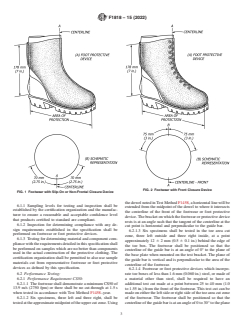
minimum height of 178 mm (7 in.). (See Fig. 1.)
3.1.17 list, v—for protective clothing,topublisharegisterof
NOTE 1—This height can be measured by using a dowel having 64 mm
equipment or materials which has been verified by a certifica-
(2 ⁄2 in.) diameter and 178 mm (7 in.) length placed at the inside back of
tion organization as being acceptable and meeting the require-
the heel of the footwear.
ments of standard specifications.
5.1.2 Width of Protection:
3.1.17.1 Discussion—The means for identifying listed
5.1.2.1 Slip-On or Non-Frontal Closure Device—Thechain-
equipment may vary for each organization concerned with
saw cut resistance area shall extend from Point A, at the front
product evaluation, some of which do not recognize equipment
centerline to vertical lines on both sides of the footwear or the
as listed unless it is also labeled. The authority having
foot protective device. The top of the vertical lines are 70 mm
jurisdiction should utilize the system employed by the certifi-
(2.75 in.) from PointAwhen measured circumferentially along
cation organization to identify a listed product.
the top of the minimum protective area as shown in Fig. 1.
3.1.18 protective clothing, n—an item of clothing that is
5.1.2.2 Front Closure Device—The chainsaw cut resistance
specifically designed and constructed for the intended purpose
area shall extend from Point A, at the front centerline to
of isolating all or part of the body from a potential hazard or
vertical lines on both sides of the footwear or foot protective
isolating the external environment from contamination by the
device. The top of the vertical lines are 75 mm (3.0 in.) from
wearer of the clothing.
Point B when measured circumferentially along the top of the
3.1.18.1 Discussion—For chainsaw cut-resistant protective
minimum protective area as shown in Fig. 2.
clothing, the potential hazard is exposure to a running power
5.1.3 Toe Area Protection—Toe boxes at least 1.6 mm
saw chain.
(0.60 in.) thickness steel shall be considered to be part of the
3.1.19 saw chain, n—aclosedloopofcutterslinkedtogether
protective area.
for use in a portable power-operated tool.
6. Inspection and Performance Testing
3.1.20 toe area cut zone—in the testing of foot protective
devices, that area, excluding the sole, that extends from the 6.1 Inspection:
F1818 − 15 (2022)
FIG. 2 Footwear with Front Closure Device
FIG. 1 Footwear with Slip-On or Non-Frontal Closure Device
thedowelnotedinTestMethodF1458,ahorizontallinewillbe
6.1.1 Sampling levels for testing and inspection shall be
extended from the midpoint of the dowel to where it intersects
established by the certification organization and the manufac-
the centerline of the front of the footwear or foot protective
turer to ensure a reasonable and acceptable confidence level
device.The bracket on which the footwear or protective device
that products certified to standard are compliant.
rests is at an angle such that the tangent of the centerline at the
6.1.2 Inspection for determining compliance with any de-
cut point is horizontal and perpendicular to the guide bar.
sign requirements established in the specification shall be
6.2.1.3 Six specimens shall be tested in the toe area cut
performed on footwear or foot protective devices.
zone, three left outside and
...