

ASTM D5664-17
(Test Method)Standard Test Method for Evaluating the Effects of Fire-Retardant Treatments and Elevated Temperatures on Strength Properties of Fire-Retardant Treated Lumber
General Information
- Abstract
SIGNIFICANCE AND USE
5.1 The mechanical properties evaluated by this test method provide the following:
5.1.1 Data for use in developing modification factors for the allowable design properties of fire-retardant treated lumber when used at or near room temperatures (see 6.3).
5.1.2 Data for use in developing modification factors for allowable design properties of fire-retardant treated lumber when exposed to elevated temperatures and humidity (see 6.4).
5.1.3 Data (optional) for use in modifying these factors for size effects when fire-retardant treated lumber is used at or near room temperature and when exposed to elevated temperatures and humidity (see 6.5).
5.2 Data from the first two procedures in this test method of evaluation are indicative only for that species.
Note 1: The results of the three listed species (Southern pine, Douglas fir, and either white spruce or a Spruce/Fir mixture) are allowed to be used together to make inference on untested wood species because the three tested species represent the full spectrum of expected treatability.
5.3 Data from the optional third part of this three-part method of evaluation are indicative for all species because it is primarily used to assess size effects.
SCOPE
1.1 This test method covers procedures for obtaining data to assess the initial adjustments to allowable design stresses for lumber treated with candidate commercial fire-retardant (FR) formulations and further procedures for obtaining data to assess the effect of extended exposure to elevated temperature of 66 ± 2°C (150 ± 4°F).
1.2 This standard does not purport to address all of the safety concerns, if any, associated with its use. It is the responsibility of the user of this standard to establish appropriate safety and health practices and determine the applicability of regulatory limitations prior to use.
1.3 This international standard was developed in accordance with internationally recognized principles on standardization established in the Decision on Principles for the Development of International Standards, Guides and Recommendations issued by the World Trade Organization Technical Barriers to Trade (TBT) Committee.
- Status
- Published
- Publication Date
- 14-Apr-2017
- Technical Committee
- D07 - Wood
- Drafting Committee
- D07.07 - Fire Performance of Wood
Buy Documents
ASTM D5664-17 - Standard Test Method for Evaluating the Effects of Fire-Retardant Treatments and Elevated Temperatures on Strength Properties of Fire-Retardant Treated Lumber
REDLINE ASTM D5664-17 - Standard Test Method for Evaluating the Effects of Fire-Retardant Treatments and Elevated Temperatures on Strength Properties of Fire-Retardant Treated Lumber
Overview
ASTM D5664-17 is the Standard Test Method developed by ASTM International for evaluating the effects of fire-retardant treatments and elevated temperatures on the strength properties of fire-retardant treated lumber. This standard provides a structured approach to generate data supporting the development of modification factors for the allowable design properties of lumber treated with fire-retardant chemicals, particularly when exposed to elevated temperatures and humidity.
The standard is widely utilized in the construction and wood products industries to ensure that fire-retardant treated (FRT) lumber maintains structural integrity under both typical and fire-risk environmental conditions. The procedures are aligned with internationally recognized principles, making ASTM D5664-17 relevant for both national and international applications.
Key Topics
- Mechanical Property Evaluation: The standard details methods for assessing changes in key mechanical properties such as bending, tension parallel, compression parallel, and shear in FRT lumber.
- Adjustment Factors: It provides data necessary for developing modification factors to adjust allowable design stresses for FRT lumber used at room temperature or after exposure to increased temperature and humidity.
- Test Methods: Evaluations include both small clear specimens and full-sized lumber to address initial effects of fire-retardant treatment and to study impacts after prolonged exposure.
- Species Coverage: The standard primarily references Southern pine, Douglas fir, and either white spruce or a Spruce/Fir mixture to represent a broad spectrum of treatability, with provisions for inferring results onto other species.
- Treatment and Conditioning Requirements: Step-by-step guidance is provided for pressure treatment, chemical retention measurement, kiln drying, and conditioning.
Applications
- Structural Engineering: Design professionals use data derived from ASTM D5664-17 to calculate safe allowable stress values for structural lumber in building projects utilizing fire-retardant treatments.
- Building Code Compliance: This test method supports compliance with building codes and insurance requirements that mandate the use of FRT lumber in fire-sensitive applications, such as wall assemblies, roof trusses, and egress routes.
- Product Certification: Manufacturers of commercial fire-retardant chemicals and FRT lumber depend on this standard to objectively demonstrate the performance and stability of their products under thermal stress.
- Quality Assurance: Third-party certification and inspection bodies use ASTM D5664-17 to verify that treated lumber products meet specified strength requirements after fire-retardant application and exposure to adverse conditions.
- Research and Development: Laboratories and R&D teams employ this methodology to study the effects of new fire-retardant formulations or processes on wood strength.
Related Standards
For comprehensive evaluation and to ensure cross-compliance, the following related standards and references are frequently used in conjunction with ASTM D5664-17:
- ASTM D5516 - Test Method for Evaluating Flexural Properties of FRT Softwood Plywood Exposed to Elevated Temperatures
- ASTM D4761 - Test Methods for Mechanical Properties of Lumber and Wood-Base Structural Material
- ASTM E84 - Test Method for Surface Burning Characteristics of Building Materials
- ASTM D6841 - Practice for Calculating Design Value Treatment Adjustment Factors for FRT Lumber
- AWPA C20 - Lumber-Fire Retardant Treatment by Pressure Processes
- NFPA 703 - Standard for Fire Retardant Impregnated Wood and Fire Retardant Coatings for Building Materials
- U.S. Product Standards PS 20 - American Softwood Lumber Standard
By adhering to ASTM D5664-17 and relevant associated standards, industry professionals can ensure fire-retardant treated wood products are both safe and structurally reliable for use in building applications exposed to elevated temperatures.
Keywords: fire-retardant treated lumber, strength properties, ASTM D5664-17, fire-retardant treatments, elevated temperatures, structural wood, design modification factors, building fire safety, treated wood testing, mechanical testing of lumber.
Relations
- Effective Date
- 15-Apr-2017
- Effective Date
- 01-Jan-2024
- Effective Date
- 01-Dec-2023
- Effective Date
- 15-Nov-2023
- Effective Date
- 01-Sep-2023
- Effective Date
- 01-Jul-2019
- Effective Date
- 15-Apr-2019
- Effective Date
- 01-Apr-2019
- Effective Date
- 01-Mar-2019
- Effective Date
- 15-Dec-2018
- Effective Date
- 01-Nov-2018
- Effective Date
- 01-Oct-2018
- Effective Date
- 01-Jul-2018
- Effective Date
- 01-Jun-2018
- Effective Date
- 01-Mar-2018
Buy Documents
ASTM D5664-17 - Standard Test Method for Evaluating the Effects of Fire-Retardant Treatments and Elevated Temperatures on Strength Properties of Fire-Retardant Treated Lumber
REDLINE ASTM D5664-17 - Standard Test Method for Evaluating the Effects of Fire-Retardant Treatments and Elevated Temperatures on Strength Properties of Fire-Retardant Treated Lumber
Get Certified
Connect with accredited certification bodies for this standard

CIS Institut d.o.o.
Personal Protective Equipment (PPE) certification body. Notified Body NB-2890 for EU Regulation 2016/425 PPE.
Gozdarski inštitut Slovenije
Slovenian Forestry Institute. Forest management certification support, timber testing.

Kiwa BDA Testing
Building and construction product certification.
Sponsored listings
Frequently Asked Questions
ASTM D5664-17 is a standard published by ASTM International. Its full title is "Standard Test Method for Evaluating the Effects of Fire-Retardant Treatments and Elevated Temperatures on Strength Properties of Fire-Retardant Treated Lumber". This standard covers: SIGNIFICANCE AND USE 5.1 The mechanical properties evaluated by this test method provide the following: 5.1.1 Data for use in developing modification factors for the allowable design properties of fire-retardant treated lumber when used at or near room temperatures (see 6.3). 5.1.2 Data for use in developing modification factors for allowable design properties of fire-retardant treated lumber when exposed to elevated temperatures and humidity (see 6.4). 5.1.3 Data (optional) for use in modifying these factors for size effects when fire-retardant treated lumber is used at or near room temperature and when exposed to elevated temperatures and humidity (see 6.5). 5.2 Data from the first two procedures in this test method of evaluation are indicative only for that species. Note 1: The results of the three listed species (Southern pine, Douglas fir, and either white spruce or a Spruce/Fir mixture) are allowed to be used together to make inference on untested wood species because the three tested species represent the full spectrum of expected treatability. 5.3 Data from the optional third part of this three-part method of evaluation are indicative for all species because it is primarily used to assess size effects. SCOPE 1.1 This test method covers procedures for obtaining data to assess the initial adjustments to allowable design stresses for lumber treated with candidate commercial fire-retardant (FR) formulations and further procedures for obtaining data to assess the effect of extended exposure to elevated temperature of 66 ± 2°C (150 ± 4°F). 1.2 This standard does not purport to address all of the safety concerns, if any, associated with its use. It is the responsibility of the user of this standard to establish appropriate safety and health practices and determine the applicability of regulatory limitations prior to use. 1.3 This international standard was developed in accordance with internationally recognized principles on standardization established in the Decision on Principles for the Development of International Standards, Guides and Recommendations issued by the World Trade Organization Technical Barriers to Trade (TBT) Committee.
SIGNIFICANCE AND USE 5.1 The mechanical properties evaluated by this test method provide the following: 5.1.1 Data for use in developing modification factors for the allowable design properties of fire-retardant treated lumber when used at or near room temperatures (see 6.3). 5.1.2 Data for use in developing modification factors for allowable design properties of fire-retardant treated lumber when exposed to elevated temperatures and humidity (see 6.4). 5.1.3 Data (optional) for use in modifying these factors for size effects when fire-retardant treated lumber is used at or near room temperature and when exposed to elevated temperatures and humidity (see 6.5). 5.2 Data from the first two procedures in this test method of evaluation are indicative only for that species. Note 1: The results of the three listed species (Southern pine, Douglas fir, and either white spruce or a Spruce/Fir mixture) are allowed to be used together to make inference on untested wood species because the three tested species represent the full spectrum of expected treatability. 5.3 Data from the optional third part of this three-part method of evaluation are indicative for all species because it is primarily used to assess size effects. SCOPE 1.1 This test method covers procedures for obtaining data to assess the initial adjustments to allowable design stresses for lumber treated with candidate commercial fire-retardant (FR) formulations and further procedures for obtaining data to assess the effect of extended exposure to elevated temperature of 66 ± 2°C (150 ± 4°F). 1.2 This standard does not purport to address all of the safety concerns, if any, associated with its use. It is the responsibility of the user of this standard to establish appropriate safety and health practices and determine the applicability of regulatory limitations prior to use. 1.3 This international standard was developed in accordance with internationally recognized principles on standardization established in the Decision on Principles for the Development of International Standards, Guides and Recommendations issued by the World Trade Organization Technical Barriers to Trade (TBT) Committee.
ASTM D5664-17 is classified under the following ICS (International Classification for Standards) categories: 13.220.50 - Fire-resistance of building materials and elements; 79.040 - Wood, sawlogs and sawn timber. The ICS classification helps identify the subject area and facilitates finding related standards.
ASTM D5664-17 has the following relationships with other standards: It is inter standard links to ASTM D5664-10, ASTM E176-24, ASTM E84-23d, ASTM D143-23, ASTM E84-23c, ASTM E84-19b, ASTM E84-19a, ASTM D4761-19, ASTM E84-19, ASTM E176-18a, ASTM D4761-18, ASTM E84-18b, ASTM E84-18a, ASTM D5516-18, ASTM E84-18. Understanding these relationships helps ensure you are using the most current and applicable version of the standard.
ASTM D5664-17 is available in PDF format for immediate download after purchase. The document can be added to your cart and obtained through the secure checkout process. Digital delivery ensures instant access to the complete standard document.
Standards Content (Sample)
This international standard was developed in accordance with internationally recognized principles on standardization established in the Decision on Principles for the
Development of International Standards, Guides and Recommendations issued by the World Trade Organization Technical Barriers to Trade (TBT) Committee.
Designation:D5664 −17
Standard Test Method for
Evaluating the Effects of Fire-Retardant Treatments and
Elevated Temperatures on Strength Properties of Fire-
Retardant Treated Lumber
This standard is issued under the fixed designation D5664; the number immediately following the designation indicates the year of
original adoption or, in the case of revision, the year of last revision. A number in parentheses indicates the year of last reapproval. A
superscript epsilon (´) indicates an editorial change since the last revision or reapproval.
1. Scope Elevated Temperatures
D6841 Practice for Calculating Design Value Treatment
1.1 This test method covers procedures for obtaining data to
Adjustment Factors for Fire-Retardant-Treated Lumber
assess the initial adjustments to allowable design stresses for
E84 Test Method for Surface Burning Characteristics of
lumber treated with candidate commercial fire-retardant (FR)
Building Materials
formulations and further procedures for obtaining data to
E176 Terminology of Fire Standards
assess the effect of extended exposure to elevated temperature
2.2 Other Standards:
of 66 6 2°C (150 6 4°F).
AWPA C20 Lumber—FireRetardantTreatmentbyPressure
1.2 This standard does not purport to address all of the
Processes
safety concerns, if any, associated with its use. It is the
NFPA 703 Standard for Fire Retardant Impregnated Wood
responsibility of the user of this standard to establish appro-
and Fire Retardant Coatings for Building Materials
priate safety and health practices and determine the applica-
U.S. Product Standards PS 20 American Softwood Lumber
bility of regulatory limitations prior to use.
Standard
1.3 This international standard was developed in accor-
dance with internationally recognized principles on standard-
3. Terminology
ization established in the Decision on Principles for the
3.1 Definitions—Definitions used in this test method are in
Development of International Standards, Guides and Recom-
accordance with Terminologies D9 and E176 and Nomencla-
mendations issued by the World Trade Organization Technical
ture D1165.
Barriers to Trade (TBT) Committee.
4. Summary of Test Method
2. Referenced Documents
4.1 Thegeneralobjectivesofthistestmethodaretodevelop
2.1 ASTM Standards:
data to adjust allowable design stresses of FR-treated lumber
D9 Terminology Relating to Wood and Wood-Based Prod-
for the initial effects for the tested FR-formulation(s) and to
ucts
develop data on in-service thermal stability after extended
D143 Test Methods for Small Clear Specimens of Timber
exposure to environmental conditions up to 66 6 2°C (150 6
D1165 Nomenclature of Commercial Hardwoods and Soft-
4°F) and ≥50 % relative humidity.
woods
4.2 Procedure 1—This procedure uses small clear speci-
D3500 Test Methods for Structural Panels in Tension
mens cut from end-matched nominal 2 by 4 (38 by 89-mm)
D4761 Test Methods for Mechanical Properties of Lumber
dimension lumber (see Fig. 1) to compare the initial effects of
and Wood-Base Structural Material
fire-retardant treatments to untreated controls for bending,
D5516 TestMethodforEvaluatingtheFlexuralPropertiesof
tension parallel, compression parallel, and horizontal shear
Fire-Retardant Treated Softwood Plywood Exposed to
properties.
4.3 Procedure 2—This procedure uses small clear speci-
This test method is under the jurisdiction of ASTM Committee D07 on Wood
mens cut from end matched nominal 2 by 4 (38 by 89-mm)
and is the direct responsibility of Subcommittee D07.07 on Fire Performance of
Wood.
Current edition approved April 15, 2017. Published June 2017. Originally
approved in 1995. Last previous edition approved in 2010 as D5664 – 10. DOI: Available from American Wood Protection Association (AWPA), P.O. Box
10.1520/D5664-17. 361784, Birmingham, AL 35236-1784, http://www.awpa.com.
2 4
For referenced ASTM standards, visit the ASTM website, www.astm.org, or Available from National Fire Protection Association (NFPA), 1 Batterymarch
contact ASTM Customer Service at service@astm.org. For Annual Book of ASTM Park, Quincy, MA 02169-7471, http://www.nfpa.org.
Standards volume information, refer to the standard’s Document Summary page on Available from American Lumber Standard Committee, Incorporated (ALSC),
the ASTM website. P.O. Box 210, Germantown, MD 20875-0210, http://www.alsc.org.
Copyright © ASTM International, 100 Barr Harbor Drive, PO Box C700, West Conshohocken, PA 19428-2959. United States
D5664−17
tested species represent the full spectrum of expected treatability.
5.3 Data from the optional third part of this three-part
method of evaluation are indicative for all species because it is
primarily used to assess size effects.
6. Procedures
6.1 Treatment:
6.1.1 Pressure treat those pieces designated for treatment
with the fire-retardant formulation being evaluated. The gage
retention level of each charge shall not be less than the
midpoint of the retention range as specified for the species by
the agency certifying the flame spread index of the treated
lumber. The retention range specified by the certifying agency
shall provide a flame-spread index of 25 or less when tested in
accordance with Test Method E84 for 10 min, show no
evidenceofsignificantprogressioncombustionwhenthetestis
continued for an additional 20-min period and not allow
progression of the flame front beyond a distance of 3.2 m (10.5
ft) beyond the centerline of the burners anytime during the
30-min extended test.
6.1.1.1 The provisions of 6.1.1 are not intended to prevent
use of this test standard when the fire-retardant treatments
being certified are for applications other than those requiring
conformance to AWPA C20, NFPA 703, or similar building
code requirements for “fire-retardant-treated wood” that re-
FIG. 1Hypothetical Cutting Patterns to Obtain One Bending, Two
quire the Test Method E84 test extended to 30 min. When
Tension Parallel, One Compression Parallel, One Block Shear,
alternative performance criteria for the treatment are being
and One Specific Gravity Block from Each 1.2-m (4-ft) Lumber
certified, the test report on specimens of that treatment shall
Specimen
state clearly the alternative performance criteria and that the
treatment retention was limited to that required for the alter-
dimension lumber. This second set of specimens is used to
native performance criteria.
assess the differential trends between end-matched fire-
6.1.2 Weigh all treated pieces before and immediately after
retardant treated and untreated specimens on bending and
treatment to determine the chemical retention based on the
tension parallel properties over the course of a prolonged
solution retained and the concentration of chemicals in the
exposure to elevated temperature.
solution. Complete a treating report for each charge of material
4.4 Procedure 3—The optional third procedure uses full-
todocumentthetreatingcycle,times,pressures,gageretention,
sized nominal 2 by 4 (38 by 89-mm) dimension lumber to
and piece retentions.
modify the small clear specimen results from 4.2 and 4.3 for
6.2 Post-Treatment Drying:
size effects.
6.2.1 After pressure treatment, kiln dry the treated pieces to
5. Significance and Use
a maximum moisture content of 19 % following the standard
redrying procedures established for the treatment and species
5.1 The mechanical properties evaluated by this test method
by the manufacturer. Redry the treated pieces at the manufac-
provide the following:
turer’s maximum specified dry bulb temperature with a minus
5.1.1 Data for use in developing modification factors for the
2°C (4°F) tolerance for 21 h of the first 24-h period. For the
allowable design properties of fire-retardant treated lumber
remainder of the drying period, the tolerance shall be minus
when used at or near room temperatures (see 6.3).
3°C (5°F).There is no upper limit on the redrying temperature.
5.1.2 Data for use in developing modification factors for
Sticker all test pieces to obtain proper air flow across both
allowable design properties of fire-retardant treated lumber
surfaces and to provide even drying.
when exposed to elevated temperatures and humidity (see 6.4).
5.1.3 Data (optional) for use in modifying these factors for
NOTE 2—Research has shown that high kiln drying temperatures can
sizeeffectswhenfire-retardanttreatedlumberisusedatornear adverselyaffectthestructuralpropertiesofwoodproducts.TheAWPAand
NFPAstandardsforfireretardanttreatedwoodproductslimitkilndrybulb
room temperature and when exposed to elevated temperatures
temperatures.AWPAC20requiresthatthedrybulbtemperatureofthekiln
and humidity (see 6.5).
not exceed 70°C (160°F) during any kiln drying of plywood treated with
5.2 Data from the first two procedures in this test method of fire retardants. In the case of exterior fire-retardants that require curing at
higher temperatures, curing after the moisture content is 19 % or less is
evaluation are indicative only for that species.
permitted. However, such elevated curing temperatures must not exceed
NOTE 1—The results of the three listed species (Southern pine, Douglas 99°C (210°F) and the total curing time must not exceed 48 h. In NFPA
fir,andeitherwhitespruceoraSpruce/Firmixture)areallowedtobeused 703, the dry bulb temperature must not exceed 70°C (160°F) until the
together to make inference on untested wood species because the three average moisture content of the wood has dropped to 25 % or less.
D5664−17
NOTE 3—To establish the worst-case strength properties of treated
with the same relative surfaces in tension and compression.
lumber, the laboratory must redry the test material within a small negative
Tension parallel specimens shall be machined as shown in Fig.
tolerance of the maximum temperature used by the manufacturer.
2. Horizontal shear specimens shall be machined as shown in
Therefore, there is no upper limit for the temperature used in the tests. If
Fig. 3.
a manufacturer desires to establish conservative property values or
6.3.3 After cutting, all specimens (treated and untreated)
provide a basis for evaluating production material that exceeds the limit,
the test material can be redried at that temperature.Amanufacturer then is
shall be equilibrated to constant weight at 22 + 5°C (72 + 9°F)
allowedtodeterminethenecessaryproductionschedulefortheirtreatment
and65+1% relative humidity.
and equipment or conditions. Thus, a stepped schedule (for example, 10 h
6.3.4 Appropriate treated and untreated specimens shall be
at 54°C (130°F), 10 h at 60°C (140°F); 10 h at 71°C (160°F), etc.) is
alternately tested in bending, compression parallel, and hori-
allowed by the standard, provided the maximum temperature tolerance
requirement is met. These provisions provide for air-drying production zontal shear using Test Methods D143 and tension parallel
material provided the redry conditions in the tests are within the tolerance
using Test Methods D3500, but with the exceptions listed in
of the maximum temperature specified by the manufacturer.
Table 1.
6.2.2 Monitor the moisture content of the test pieces during
6.4 Procedure 2—For each species (Southern pine, Douglas
the drying cycle by individually weighing representative
fir and white spruce, four sets of 25 end-matched treated and
pieces. Keep a well-documented kiln charge report and kiln
untreated small clear bending and tension parallel specimens
recorder chart showing dry and wet bulb temperatures during
shall be cut from at least 25 nominal 2 by 4 (38 by 89 mm)
the redrying period.
2.44-m (8-ft) long pieces. These specimens shall be used to
assess the differential effects of exposure to elevated tempera-
6.3 Procedure 1—The first procedure presents a methodol-
ogy using small clear wood specimens to assess the initial ture between untreated and FR-treated clear wood specimens.
6.4.1 One set of 25 FR-treated and untreated specimens of
effect of fire-retardant treatment on median mechanical prop-
erties. The results are used to adjust the allowable design each species shall be used as an unexposed control (that is, 0
stresses of lumber based on estimates of median reductions in days of exposure).
bending, tension parallel, compression parallel, and horizontal
shear properties using small clear specimens cut from larger
end-matched dimension lumber specimens.
6.3.1 For each species/species grouping (Southern pine,
Douglas fir, and either white spruce or a Spruce/Fir mixture),
twenty five (25) 2.44–m (8–ft) long, high-grade nominal 2 by
4s (38 by 89 mm) shall be obtained and cut into 1.22–m (4–ft)
halves. Each specimen shall be marked to identify it with its
matched-sister(s) specimen(s). For each specimen, one 1.22-m
(4–ft) half shall be randomly allotted to remain untreated and
the other half assigned to be treated with the candidate
fire-retardant treatment and each half shall be appropriately
marked.
NOTE 4—ASpruce/Fir mixture can be obtained by obtaining Canadian
Spruce-Pine-Fir and removing the Lodgepole pine and Jack pine, which
can be visually segregated from the remaining spruces and firs of this
specific species group. The Lodgepole pine and Jack pine have numerous
longitudinal resin canals that are generally quite evenly distributed in the
outerportionofeverygrowthring.Inthefourspruces(Black,Engelmann,
Red, and White), the longitudinal resin canals are generally sparse. In the
two firs (Alpine and Balsam), the longitudinal resin canals are normally
absent.
NOTE 5—High Grade is a relative term, but some latitude is required
because it is a common industry practice to group grades for some
species/species groupings into “and better” categories. If available, Select
Structural often is desirable because it provides an adequate yield of smal
...
This document is not an ASTM standard and is intended only to provide the user of an ASTM standard an indication of what changes have been made to the previous version. Because
it may not be technically possible to adequately depict all changes accurately, ASTM recommends that users consult prior editions as appropriate. In all cases only the current version
of the standard as published by ASTM is to be considered the official document.
Designation: D5664 − 10 D5664 − 17
Standard Test Method for
Evaluating the Effects of Fire-Retardant Treatments and
Elevated Temperatures on Strength Properties of Fire-
Retardant Treated Lumber
This standard is issued under the fixed designation D5664; the number immediately following the designation indicates the year of
original adoption or, in the case of revision, the year of last revision. A number in parentheses indicates the year of last reapproval. A
superscript epsilon (´) indicates an editorial change since the last revision or reapproval.
1. Scope
1.1 This test method covers procedures for obtaining data to assess the initial adjustments to allowable design stresses for
lumber treated with candidate commercial fire-retardant (FR) formulations and further procedures for obtaining data to assess the
effect of extended exposure to elevated temperature of 66 6 2°C (150 6 4°F).
1.2 This standard does not purport to address all of the safety concerns, if any, associated with its use. It is the responsibility
of the user of this standard to establish appropriate safety and health practices and determine the applicability of regulatory
limitations prior to use.
1.3 This international standard was developed in accordance with internationally recognized principles on standardization
established in the Decision on Principles for the Development of International Standards, Guides and Recommendations issued
by the World Trade Organization Technical Barriers to Trade (TBT) Committee.
2. Referenced Documents
2.1 ASTM Standards:
D9 Terminology Relating to Wood and Wood-Based Products
D143 Test Methods for Small Clear Specimens of Timber
D1165 Nomenclature of Commercial Hardwoods and Softwoods
D3500 Test Methods for Structural Panels in Tension
D4761 Test Methods for Mechanical Properties of Lumber and Wood-Base Structural Material
D5516 Test Method for Evaluating the Flexural Properties of Fire-Retardant Treated Softwood Plywood Exposed to Elevated
Temperatures
D6841 Practice for Calculating Design Value Treatment Adjustment Factors for Fire-Retardant-Treated Lumber
E84 Test Method for Surface Burning Characteristics of Building Materials
E176 Terminology of Fire Standards
2.2 Other Standards:
AWPA C20 Lumber—Fire Retardant Treatment by Pressure Processes
NFPA 703 Standard for Fire Retardant Impregnated Wood and Fire Retardant Coatings for Building Materials
U.S. Product Standards PS 20 American Softwood Lumber Standard
3. Terminology
3.1 Definitions—Definitions used in this test method are in accordance with Terminologies D9 and E176 and Nomenclature
D1165.
This test method is under the jurisdiction of ASTM Committee D07 on Wood and is the direct responsibility of Subcommittee D07.07 on Fire Performance of Wood.
Current edition approved June 1, 2010April 15, 2017. Published July 2010June 2017. Originally approved in 1995. Last previous edition approved in 20082010 as
D5664 – 08.D5664 – 10. DOI: 10.1520/D5664-10.10.1520/D5664-17.
For referenced ASTM standards, visit the ASTM website, www.astm.org, or contact ASTM Customer Service at service@astm.org. For Annual Book of ASTM Standards
volume information, refer to the standard’s Document Summary page on the ASTM website.
Available from American Wood Protection Association (AWPA), P.O. Box 361784, Birmingham, AL 35236-1784, http://www.awpa.com.
Available from National Fire Protection Association (NFPA), 1 Batterymarch Park, Quincy, MA 02169-7471, http://www.nfpa.org.
Available from American Lumber Standard Committee, Incorporated (ALSC), P.O. Box 210, Germantown, MD 20875-0210, http://www.alsc.org.
Copyright © ASTM International, 100 Barr Harbor Drive, PO Box C700, West Conshohocken, PA 19428-2959. United States
D5664 − 17
4. Summary of Test Method
4.1 The general objectives of this test method are to develop data to adjust allowable design stresses of FR-treated lumber for
the initial effects for the tested FR-formulation(s) and to develop data on in-service thermal stability after extended exposure to
environmental conditions up to 66 6 2°C (150 6 4°F) and ≥50 % relative humidity.
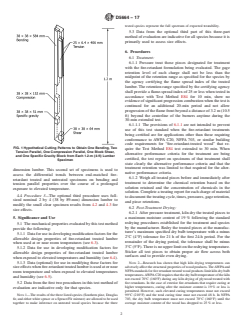
4.2 Procedure 1—This procedure uses small clear specimens cut from end-matched nominal 2 by 4 (38 by 89-mm) dimension
lumber (see Fig. 1) to compare the initial effects of fire-retardant treatments to untreated controls for bending, tension parallel,
compression parallel, and horizontal shear properties.
4.3 Procedure 2—This procedure uses small clear specimens cut from end matched nominal 2 by 4 (38 by 89-mm) dimension
lumber. This second set of specimens is used to assess the differential trends between end-matched fire-retardant treated and
untreated specimens on bending and tension parallel properties over the course of a prolonged exposure to elevated temperature.
4.4 Procedure 3—The optional third procedure uses full-sized nominal 2 by 4 (38 by 89-mm) dimension lumber to modify the
small clear specimen results from 4.2 and 4.3 for size effects.
5. Significance and Use
5.1 The mechanical properties evaluated by this test method provide the following:
5.1.1 Data for use in developing modification factors for the allowable design properties of fire-retardant treated lumber when
used at or near room temperatures (see 6.3).
5.1.2 Data for use in developing modification factors for allowable design properties of fire-retardant treated lumber when
exposed to elevated temperatures and humidity (see 6.4).
5.1.3 Data (optional) for use in modifying these factors for size effects when fire-retardant treated lumber is used at or near room
temperature and when exposed to elevated temperatures and humidity (see 6.5).
5.2 Data from the first two procedures in this test method of evaluation are indicative only for that species.
NOTE 1—The results of the three listed species (Southern pine, Douglas fir, and either white spruce or a Spruce/Fir mixture) may are allowed to be
used together to make inference on untested wood species because the three tested species represent the full spectrum of expected treatability.
5.3 Data from the optional third part of this three-part method of evaluation are indicative for all species because it is primarily
used to assess size effects.
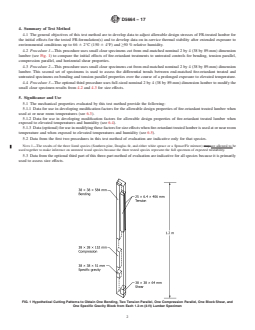
FIG. 1 Hypothetical Cutting Patterns to Obtain One Bending, Two Tension Parallel, One Compression Parallel, One Block Shear, and
One Specific Gravity Block from Each 1.2-m (4-ft) Lumber Specimen
D5664 − 17
6. Procedures
6.1 Treatment:
6.1.1 Pressure treat those pieces designated for treatment with the fire-retardant formulation being evaluated. The gage retention
level of each charge shall not be less than the midpoint of the retention range as specified for the species by the agency certifying
the flame spread index of the treated lumber. The retention range specified by the certifying agency shall provide a flame-spread
index of 25 or less when tested in accordance with Test Method E84 for 10 min, show no evidence of significant progression
combustion when the test is continued for an additional 20-min period and not allow progression of the flame front beyond a
distance of 3.2 m (10.5 ft) beyond the centerline of the burners anytime during the 30-min extended test.
6.1.1.1 The provisions of 6.1.1 are not intended to prevent use of this test standard when the fire-retardant treatments being
certified are for applications other than those requiring conformance to AWPA C20, NFPA 703, or similar building code
requirements for “fire-retardant-treated wood” that require the Test Method E84 test extended to 30 min. When alternative
performance criteria for the treatment are being certified, the test report on specimens of that treatment shall state clearly the
alternative performance criteria and that the treatment retention was limited to that required for the alternative performance criteria.
6.1.2 Weigh all treated pieces before and immediately after treatment to determine the chemical retention based on the solution
retained and the concentration of chemicals in the solution. Complete a treating report for each charge of material to document
the treating cycle, times, pressures, gage retention, and piece retentions.
6.2 Post-Treatment Drying:
6.2.1 After pressure treatment, kiln dry the treated pieces to a maximum moisture content of 19 % following the standard
redrying procedures established for the treatment and species by the manufacturer. Redry the treated pieces at the manufacturer’s
maximum specified dry bulb temperature with a minus 2°C (4°F) tolerance for 21 h of the first 24-h period. For the remainder of
the drying period, the tolerance shall be minus 3°C (5°F). There is no upper limit on the redrying temperature. Sticker all test pieces
to obtain proper air flow across both surfaces and to provide even drying.
NOTE 2—Research has shown that high kiln drying temperatures can adversely affect the structural properties of wood products. The AWPA and NFPA
standards for fire retardant treated wood products limit kiln dry bulb temperatures. AWPA C20 requires that the dry bulb temperature of the kiln not exceed
70°C (160°F) during any kiln drying of plywood treated with fire retardants. In the case of exterior fire-retardants that require curing at higher
temperatures, curing after the moisture content is 19 % or less is permitted. However, such elevated curing temperatures must not exceed 99°C (210°F)
and the total curing time must not exceed 48 h. In NFPA 703, the dry bulb temperature must not exceed 70°C (160°F) until the average moisture content
of the wood has dropped to 25 % or less.
NOTE 3—To establish the worst-case strength properties of treated lumber, the laboratory must redry the test material within a small negative tolerance
of the maximum temperature used by the manufacturer. Therefore, there is no upper limit for the temperature used in the tests. If a manufacturer desires
to establish conservative property values or provide a basis for evaluating production material that exceeds the limit, the test material can be redried at
that temperature. A manufacturer then is allowed to determine the necessary production schedule for their treatment and equipment or conditions. Thus,
a stepped schedule (for example, 10 h at 54°C (130°F), 10 h at 60°C (140°F); 10 h at 71°C (160°F), etc.) is allowed by the standard, provided the
maximum temperature tolerance requirement is met. These provisions provide for air-drying production material provided the redry conditions in the tests
are within the tolerance of the maximum temperature specified by the manufacturer.
6.2.2 Monitor the moisture content of the test pieces during the drying cycle by individually weighing representative pieces.
Keep a well-documented kiln charge report and kiln recorder chart showing dry and wet bulb temperatures during the redrying
period.
6.3 Procedure 1—The first procedure presents a methodology using small clear wood specimens to assess the initial effect of
fire-retardant treatment on median mechanical properties. The results may be are used to adjust the allowable design stresses of
lumber based on estimates of median reductions in bending, tension parallel, compression parallel, and horizontal shear properties
using small clear specimens cut from larger end-matched dimension lumber specimens.
6.3.1 For each species/species grouping (Southern pine, Douglas fir, and either white spruce or a Spruce/Fir mixture), twenty
five (25) 2.44–m (8–ft) long, high-grade nominal 2 by 4s (38 by 89 mm) shall be obtained and cut into 1.22–m (4–ft) halves. Each
specimen shall be marked to identify it with its matched-sister(s) specimen(s). For each specimen, one 1.22-m (4–ft) half shall be
randomly allotted to remain untreated and the other half assigned to be treated with the candidate fire-retardant treatment and each
half shall be appropriately marked.
NOTE 4—A Spruce/Fir mixture can be obtained by obtaining Canadian Spruce-Pine-Fir and removing the Lodgepole pine and Jack pine, which can
be visually segregated from the remaining spruces and firs of this specific species group. The Lodgepole pine and Jack pine have numerous longitudinal
resin canals that are generally quite evenly distributed in the outer portion of every growth ring. In the four spruces (Black, Engelmann, Red, and White),
the longitudinal resin canals are generally sparse. In the two firs (Alpine and Balsam), the longitudinal resin canals are normally absent.
NOTE 5—High Grade is a relative term, but some latitude is required because it is a common industry practice to group grades for some species/species
groupings into “and better” categories. If available, Select Structural often is desirable because it provides an adequate yield of small clear specimens.
It should also be noted that The initial use of ≥30 specimens will usually ensure 25 acceptable specimens when using lower grades which have lower
yields.
6.3.2 After treating and redrying are completed, each treated and untreated nominal 2 by 4 (38 by 89-mm) piece shall be cut
into small clear specimens as shown in Fig. 1. Care shall be taken to avoid cutting specimens containing strength-reducing
characteristics such as knots, cross-grain, or slope-of-grain in excess of 1 in 12. When cutting small test specimens, an original
wide surface shall remain unmachined and each specimen shall later be tested so that this surface is exposed to the greater stress
D5664 − 17
during that particular mechanical test. Each end-matched treated and untreated specimen shall be tested with the same relative
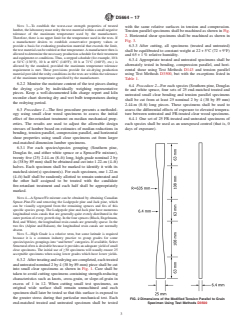
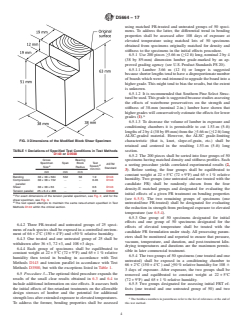
surfaces in tension and compression. Tension parallel specimens shall be machined as shown in Fig. 2. Horizontal shear specimens
shall be machined as shown in Fig. 3.
6.3.3 After cutting, all specimens (treated and untreated) s
...