

ASTM E2632/E2632M-20
(Test Method)Standard Test Method for Evaluating the Under-Deck Fire Test Response of Deck Materials
General Information
- Abstract
SIGNIFICANCE AND USE
5.1 This test method addresses the suitability of deck materials by assessing their response to fire hazards associated with sources of flame located beneath the deck material.
SCOPE
1.1 This standard prescribes a method to assess the fire-test response characteristics of deck materials when used as the walking surface of a deck. The prescribed fire exposure is intended, under test conditions, to determine the heat release rate and the thermal decomposition modes of decking materials when exposed to a burner flame simulating combustibles burning beneath a deck.2
1.2 The values stated in either SI units or inch-pound units are to be regarded separately as standard. The values stated in each system are not necessarily exact equivalents; therefore, each system shall be used independently of the other. Combining values from the two systems has the potential to result in non-conformance with the standard.
1.3 This standard is used to measure and describe the response of deck materials to heat and flame under controlled conditions, but does not by itself incorporate all factors required for fire hazard or fire risk assessment of the deck materials under actual fire conditions.
1.4 This standard does not purport to address all of the safety concerns, if any, associated with its use. It is the responsibility of the user of this standard to establish appropriate safety, health, and environmental practices and determine the applicability of regulatory limitations prior to use.
1.5 Fire testing is inherently hazardous. Adequate safeguards for personnel and property shall be employed in conducting these tests.
1.6 This international standard was developed in accordance with internationally recognized principles on standardization established in the Decision on Principles for the Development of International Standards, Guides and Recommendations issued by the World Trade Organization Technical Barriers to Trade (TBT) Committee.
- Status
- Published
- Publication Date
- 31-Jan-2020
- Technical Committee
- E05 - Fire Standards
- Drafting Committee
- E05.14 - External Fire Exposures
Buy Documents
ASTM E2632/E2632M-20 - Standard Test Method for Evaluating the Under-Deck Fire Test Response of Deck Materials
REDLINE ASTM E2632/E2632M-20 - Standard Test Method for Evaluating the Under-Deck Fire Test Response of Deck Materials
Overview
ASTM E2632/E2632M-20, titled "Standard Test Method for Evaluating the Under-Deck Fire Test Response of Deck Materials," provides a standardized procedure for assessing the fire-test response of deck materials when exposed to flame from beneath. Developed by ASTM International, this method is crucial for evaluating the fire performance of decking products, particularly for applications where wildfire or accidental under-deck ignition is a consideration. The standard empowers manufacturers, regulators, and safety professionals to objectively measure and compare how different deck materials react under specific simulated fire exposure conditions.
Key Topics
- Fire-Test Response Evaluation: The standard outlines a test to measure the heat release rate and the physical changes of deck materials due to a controlled flame exposure from below.
- Test Apparatus and Procedure: The test involves a diffusion flame from a burner situated beneath the test specimen, simulating realistic fire scenarios such as combustible material burning under a deck.
- Measurement Parameters: Heat release rate is quantified using oxygen depletion calorimetry, and physical changes such as structural failure and loss of material are documented.
- Pre-Test Conditioning: Deck materials must be conditioned to a specific moisture content to ensure consistency, with guidance for both wood-based and composite products.
- Safety Provisions: The standard underscores the hazardous nature of fire testing and requires comprehensive safeguards to protect personnel and property.
- Accelerated Aging/Weathering: Provisions exist for optional pre-test aging to simulate long-term environmental exposure if required by relevant authorities.
Applications
ASTM E2632/E2632M-20 is widely applicable in contexts where under-deck fire exposure is a concern:
- Deck Material Manufacturers: Provides a benchmark for product development and quality assurance, allowing manufacturers to demonstrate fire resistance performance to regulators and customers.
- Building Code Authorities & Inspectors: Offers an objective fire test method suitable for code compliance and public safety evaluations, especially in fire-prone regions.
- Architects and Builders: Informs material selection for projects requiring compliance with wildland-urban interface (WUI) regulations or similar fire safety standards.
- Insurance Assessors: Supports assessment of fire risk and helps inform insurance decisions regarding decks in wildfire-prone areas.
- Product Certifiers and Testing Labs: Enables standardized testing and reporting, facilitating product certification and market acceptance.
Related Standards
Several other standards are directly referenced or complement the testing and evaluation outlined in ASTM E2632/E2632M-20:
- ASTM D2898 - Practice for Accelerated Weathering of Fire-Retardant-Treated Wood for Fire Testing
- ASTM D4442 - Methods for Direct Moisture Content Measurement of Wood and Wood-Based Materials
- ASTM D4444 - Test Method for Laboratory Standardization and Calibration of Hand-Held Moisture Meters
- ASTM E176 - Terminology of Fire Standards
- ASTM E2067 - Practice for Full-Scale Oxygen Consumption Calorimetry Fire Tests
- ISO 13943 - Fire Safety - Vocabulary
These related standards provide terminology, complementary test methods, and additional practices relevant for conducting fire testing or preparing specimens in accordance with ASTM E2632/E2632M-20.
Keywords: deck materials, fire test response, under-deck fire test, heat release rate, ASTM E2632/E2632M-20, fire safety standard, decking fire resistance, building codes, fire risk assessment, wildfire safety.
Relations
- Effective Date
- 01-Feb-2020
- Effective Date
- 01-Jan-2024
- Effective Date
- 01-Nov-2023
- Effective Date
- 01-Mar-2020
- Effective Date
- 15-Dec-2018
- Effective Date
- 01-Jul-2018
- Effective Date
- 01-Mar-2018
- Effective Date
- 01-Feb-2017
- Effective Date
- 15-Nov-2016
- Effective Date
- 01-Nov-2015
- Effective Date
- 01-Aug-2015
- Effective Date
- 01-Aug-2015
- Effective Date
- 01-Jun-2015
- Effective Date
- 01-Feb-2015
- Effective Date
- 01-Oct-2014
Buy Documents
ASTM E2632/E2632M-20 - Standard Test Method for Evaluating the Under-Deck Fire Test Response of Deck Materials
REDLINE ASTM E2632/E2632M-20 - Standard Test Method for Evaluating the Under-Deck Fire Test Response of Deck Materials
Get Certified
Connect with accredited certification bodies for this standard

DNV
DNV is an independent assurance and risk management provider.

Lloyd's Register
Lloyd's Register is a global professional services organisation specialising in engineering and technology.

FSC International
Forest Stewardship Council certification.
Sponsored listings
Frequently Asked Questions
ASTM E2632/E2632M-20 is a standard published by ASTM International. Its full title is "Standard Test Method for Evaluating the Under-Deck Fire Test Response of Deck Materials". This standard covers: SIGNIFICANCE AND USE 5.1 This test method addresses the suitability of deck materials by assessing their response to fire hazards associated with sources of flame located beneath the deck material. SCOPE 1.1 This standard prescribes a method to assess the fire-test response characteristics of deck materials when used as the walking surface of a deck. The prescribed fire exposure is intended, under test conditions, to determine the heat release rate and the thermal decomposition modes of decking materials when exposed to a burner flame simulating combustibles burning beneath a deck.2 1.2 The values stated in either SI units or inch-pound units are to be regarded separately as standard. The values stated in each system are not necessarily exact equivalents; therefore, each system shall be used independently of the other. Combining values from the two systems has the potential to result in non-conformance with the standard. 1.3 This standard is used to measure and describe the response of deck materials to heat and flame under controlled conditions, but does not by itself incorporate all factors required for fire hazard or fire risk assessment of the deck materials under actual fire conditions. 1.4 This standard does not purport to address all of the safety concerns, if any, associated with its use. It is the responsibility of the user of this standard to establish appropriate safety, health, and environmental practices and determine the applicability of regulatory limitations prior to use. 1.5 Fire testing is inherently hazardous. Adequate safeguards for personnel and property shall be employed in conducting these tests. 1.6 This international standard was developed in accordance with internationally recognized principles on standardization established in the Decision on Principles for the Development of International Standards, Guides and Recommendations issued by the World Trade Organization Technical Barriers to Trade (TBT) Committee.
SIGNIFICANCE AND USE 5.1 This test method addresses the suitability of deck materials by assessing their response to fire hazards associated with sources of flame located beneath the deck material. SCOPE 1.1 This standard prescribes a method to assess the fire-test response characteristics of deck materials when used as the walking surface of a deck. The prescribed fire exposure is intended, under test conditions, to determine the heat release rate and the thermal decomposition modes of decking materials when exposed to a burner flame simulating combustibles burning beneath a deck.2 1.2 The values stated in either SI units or inch-pound units are to be regarded separately as standard. The values stated in each system are not necessarily exact equivalents; therefore, each system shall be used independently of the other. Combining values from the two systems has the potential to result in non-conformance with the standard. 1.3 This standard is used to measure and describe the response of deck materials to heat and flame under controlled conditions, but does not by itself incorporate all factors required for fire hazard or fire risk assessment of the deck materials under actual fire conditions. 1.4 This standard does not purport to address all of the safety concerns, if any, associated with its use. It is the responsibility of the user of this standard to establish appropriate safety, health, and environmental practices and determine the applicability of regulatory limitations prior to use. 1.5 Fire testing is inherently hazardous. Adequate safeguards for personnel and property shall be employed in conducting these tests. 1.6 This international standard was developed in accordance with internationally recognized principles on standardization established in the Decision on Principles for the Development of International Standards, Guides and Recommendations issued by the World Trade Organization Technical Barriers to Trade (TBT) Committee.
ASTM E2632/E2632M-20 is classified under the following ICS (International Classification for Standards) categories: 13.220.40 - Ignitability and burning behaviour of materials and products; 47.020.50 - Deck equipment and installations. The ICS classification helps identify the subject area and facilitates finding related standards.
ASTM E2632/E2632M-20 has the following relationships with other standards: It is inter standard links to ASTM E2632/E2632M-13e1, ASTM E176-24, ASTM E2067-23, ASTM D4442-20, ASTM E176-18a, ASTM D4444-13(2018), ASTM E176-18, ASTM D2898-10(2017), ASTM D4442-16, ASTM E2067-15, ASTM E176-15a, ASTM E176-15ae1, ASTM D4442-15, ASTM E176-15, ASTM E176-14c. Understanding these relationships helps ensure you are using the most current and applicable version of the standard.
ASTM E2632/E2632M-20 is available in PDF format for immediate download after purchase. The document can be added to your cart and obtained through the secure checkout process. Digital delivery ensures instant access to the complete standard document.
Standards Content (Sample)
This international standard was developed in accordance with internationally recognized principles on standardization established in the Decision on Principles for the
Development of International Standards, Guides and Recommendations issued by the World Trade Organization Technical Barriers to Trade (TBT) Committee.
Designation: E2632/E2632M − 20 An American National Standard
Standard Test Method for
Evaluating the Under-Deck Fire Test Response of Deck
Materials
ThisstandardisissuedunderthefixeddesignationE2632/E2632M;thenumberimmediatelyfollowingthedesignationindicatestheyear
of original adoption or, in the case of revision, the year of last revision. A number in parentheses indicates the year of last reapproval.
A superscript epsilon (´) indicates an editorial change since the last revision or reapproval.
1. Scope* 2. Referenced Documents
1.1 This standard prescribes a method to assess the fire-test 2.1 ASTM Standards:
response characteristics of deck materials when used as the D2898 Practice for Accelerated Weathering of Fire-
walking surface of a deck. The prescribed fire exposure is Retardant-Treated Wood for Fire Testing
intended, under test conditions, to determine the heat release D4442 Test Methods for Direct Moisture Content Measure-
rateandthethermaldecompositionmodesofdeckingmaterials ment of Wood and Wood-Based Materials
when exposed to a burner flame simulating combustibles D4444 Test Method for Laboratory Standardization and
burning beneath a deck. Calibration of Hand-Held Moisture Meters
E176 Terminology of Fire Standards
1.2 The values stated in either SI units or inch-pound units
E2067 Practice for Full-Scale Oxygen Consumption Calo-
are to be regarded separately as standard. The values stated in
rimetry Fire Tests
each system are not necessarily exact equivalents; therefore,
2.2 ISO Standards:
each system shall be used independently of the other. Combin-
ISO 13943 Fire Safety – Vocabulary
ing values from the two systems has the potential to result in
non-conformance with the standard.
3. Terminology
1.3 This standard is used to measure and describe the
3.1 Definitions—For definitions of terms used in this test
response of deck materials to heat and flame under controlled
method, refer to Terminology E176 or ISO 13943. When
conditions, but does not by itself incorporate all factors
discrepancies exist, the definition in Terminology E176 shall
required for fire hazard or fire risk assessment of the deck
prevail.
materials under actual fire conditions.
3.2 Definitions of Terms Specific to This Standard:
1.4 This standard does not purport to address all of the
3.2.1 deck surface area, n—the test specimen area defined
safety concerns, if any, associated with its use. It is the
by the overall specimen length and width after assembly.
responsibility of the user of this standard to establish appro-
priate safety, health, and environmental practices and deter-
4. Summary of Test Method
mine the applicability of regulatory limitations prior to use.
4.1 The test method described here measures the heat
1.5 Fire testing is inherently hazardous. Adequate safe-
release rate of deck materials subjected to a flame source
guards for personnel and property shall be employed in
located beneath a test specimen.
conducting these tests.
4.2 The test method employs a diffusion flame based fire
1.6 This international standard was developed in accor-
source from a nominal 305 mm [12 in.] square burner located
dance with internationally recognized principles on standard-
underneath the test specimen.
ization established in the Decision on Principles for the
4.3 An80kWfireexposureshallbeappliedtotheunderside
Development of International Standards, Guides and Recom-
of the test specimen for a period of 3 min after which the
mendations issued by the World Trade Organization Technical
burner is extinguished.
Barriers to Trade (TBT) Committee.
4.4 Fire test response characteristics monitored and re-
This test method is under the jurisdiction of ASTM Committee E05 on Fire
corded shall include heat release of the test specimen utilizing
Standards and is the direct responsibility of Subcommittee E05.14 on External Fire
Exposures.
Current edition approved Feb. 1, 2020. Published March 2020. Originally For referenced ASTM standards, visit the ASTM website, www.astm.org, or
ɛ1
approved in 2013. Last previous edition approved in 2013 as E2632/E2632M-13 . contact ASTM Customer Service at service@astm.org. For Annual Book of ASTM
DOI: 10.1520/E2632_E2632M-20. Standards volume information, refer to the standard’s Document Summary page on
Appendix X1 provides commentary on the background of this test method as the ASTM website.
well as its potential use for evaluation of coatings and surface treatments of deck Available from International Organization for Standardization (ISO), 1, ch. de
products. la Voie-Creuse, CP 56, CH-1211 Geneva 20, Switzerland, http://www.iso.org.
*A Summary of Changes section appears at the end of this standard
Copyright © ASTM International, 100 Barr Harbor Drive, PO Box C700, West Conshohocken, PA 19428-2959. United States
E2632/E2632M − 20
oxygen depletion methodologies as described in Practice moisture content of the test material shall be measured prior to
E2067. In addition, physical changes of the test specimen conducting the test. For lumber and other wood-based
during the test shall be recorded.
materials, use Test Methods D4442. Use of an appropriately
calibrated moisture meter, as described in Test Method D4444,
5. Significance and Use
to determine the moisture content of wood or wood products is
5.1 This test method addresses the suitability of deck
also permitted. For other hygroscopic materials, use test
materials by assessing their response to fire hazards associated
methods appropriate for those materials.
with sources of flame located beneath the deck material.
6.3 Test Specimen Size—The overall test specimen width
(i.e., direction of joists, see Fig. 1) shall be 710 6 51 mm [28
6. Deck Test Specimen
6 2.0 in.] to accommodate variations in individual deck board
6.1 Test material shall be representative of normal daily
width and spacing. The length of individual deck boards shall
production and shall be installed according to the manufactur-
be 610 6 6 mm [24 6 0.25 in.].The deck surface area shall be
er’s instructions. Test material for developmental products
theoveralltestspecimenlengthandwidthafterassemblyofthe
shall be so identified.
testspecimen.Thefrontdeckboardshallbeflushwiththeends
6.2 Pre-test Conditioning—Prior to testing, all materials
of the joists. The rear deck board shall overhang the end of the
(deck boards and joist material) shall be conditioned to a
joistsby25 66mm[1 60.25in.]andrestontheledgerboard
constant weight or for a minimum of 30 days at 21 62ºC[70
attached to the test apparatus. Deck board profiles shall not be
64ºF]and50 65%relativehumidity,whicheveroccursfirst.
changed from their manufactured dimensions.
Constant weight shall be defined as occurring when the change
6.4 Joists—When constructing the test specimen, the deck
in test material weight is less than or equal to 0.1 % in a 24-h
period. For those materials whose fire test response is poten- materials shall be attached to two nominal 2 by 6-in. Douglas-
tially affected by moisture resident within that material, the fir joists with a 406 6 5 mm [16 6 0.2 in.] center-to-center
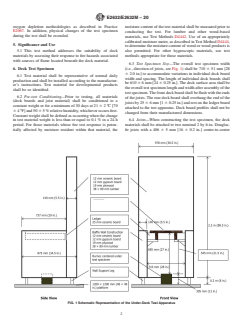
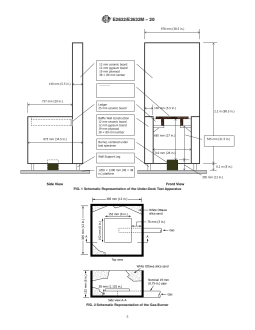
FIG. 1 Schematic Representation of the Under-Deck Test Apparatus
E2632/E2632M − 20
spacing, creating an approximate 90 mm [approx. 3.5 in.] 7.5 JoistSupport—Horizontalmetalplatesshallbeprovided
overhang on one side of each joist. to support the joists along their full length, and also to confine
burner flames to the underside of the deck boards located
7. Under-Deck Test Apparatus (See Fig. 1 and Fig. 2)
between the support joists. The support surface of the joist
support shall be 545 mm 6 6 mm [21.5 6 0.25 in.] above the
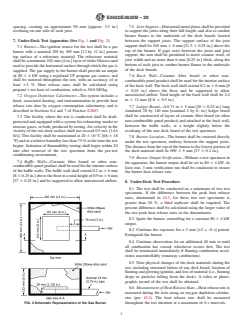
7.1 Burner—The ignition source for the test shall be a gas
top of the burner. If gaps exist between the joists and joist
burner with a nominal 305 by 305 mm [12 by 12 in.] porous
support, the user shall be permitted to insert ceramic wool, of
top surface of a refractory material. The refractory material
joist width and no more than 6 mm [0.25 in.] thick, along the
shallbeaminimum102-mm[4-in.]layerofwhiteOttawasand
bottom of each joist to confine burner flames to the underside
used to provide the horizontal surface through which the gas is
of the deck boards.
supplied. The gas supply to the burner shall provide an output
of 80 6 4 kW using a regulated CP propane gas source, and
7.6 Back Wall—Ceramic fiber board or other non-
shall be metered throughout the test, with an accuracy of at
combustible panel product shall be used for the interior surface
least 63 %. Heat release rates shall be calculated using
of the back wall. The back wall shall extend 0.2 m 66mm[8
propane’s net heat of combustion, which is 50.0 MJ/kg.
6 0.25 in.] above the floor and be supported to allow
unrestricted airflow. Total height of the back wall shall be 2.4
7.2 Oxygen Depletion Calorimeter—The system includes a
m 6 12 mm [8 ft 6 0.5 in.].
hood, associated ducting, and instrumentation to provide heat
release rate data by oxygen consumption calorimetry, and is
7.7 Ledger Board—A0.71 m 65mm[28 6 0.25 in.] long
described in Sections 6.4 and 7 of Practice E2067.
simulated 38 by 140 mm [nominal 2 by 6- in.] ledger board
shall be constructed of layers of ceramic fiber board (or other
7.3 The facility where the test is conducted shall be draft-
non-combustible panel product) and attached to the back wall,
protected and equipped with a system for exhausting smoke or
between the baffle walls, at a height slightly below the
noxious gases, or both, produced by testing.Air velocity in the
overhang of the rear deck board of the test specimen.
vicinity of the test deck surface shall not exceed 0.5 m/s [1.64
ft/s]. This facility shall be maintained at 20 6 10 °C [68 6 18
7.8 Burner Location—The burner shall be centered directly
°F]andatarelativehumiditylessthan75%atthetimethetest
under the test specimen, midway between the support joists.
begins. Initiation of flammability testing shall begin within 20
The distance from the top of the burner to the lowest portion of
min after removal of the test specimen from the pre-test
the deck material shall be 690 65mm[27 6 0.2 in.].
conditioning environment.
7.9 Burner Output Verification—Without a test specimen in
7.4 Baffle Walls—Ceramic fiber board or other non-
the apparatus, the burner output shall be set to 80 64kW.At
combustible panel product shall be used for the interior surface
least one, 3 min verification run shall be conducted to ensure
of the baffle walls. The baffle wall shall extend 0.2 m 66mm
the burner heat release rate.
[8 60.25in.]abovethefloortoatotalheightof0.9m 66mm
[37 6 0.25 in.] and be supported to allow unrestricted airflow.
8. Under-Deck Test Procedure
8.1 The test shall be conducted on a minimum of two test
specimens. If the difference between the peak heat release
rates, determined in 10.3, for these two test specimens is
greater than 20 %, a third replicate shall be required. The
percent difference shall be calculated using the larger value of
the two peak heat release rates in the denominator.
8.2 Ignite the burner, controlling for a constant 80 64kW
output.
8.3 Continue the exposure for a 3 min [+2 s, -0 s] period.
Extinguish the burner.
8.4 Continue observation for an additional 40 min or until
all combustion has ceased, whichever occurs first. The test
shall be terminated immediately if flaming combustion accel-
erates uncontrollably (runaway combustion).
8.5 Note physical changes of the deck materials during the
test, including structural failure of any deck board, location of
flamingandglowingignition,andlossofmaterial(i.e.,flaming
drops or particles falling from the deck). A video or photo-
graphic record of the test shall be obtained.
8.6 Measurement of Heat Release Rate—Heat release rate is
measured during the tests using an oxygen depletion calorim-
eter (per 10.3). The heat release rate shall be measured
FIG. 2 Schematic Representation of the Gas Burner throughout the test duration at a maximum of 6 s intervals.
E2632/E2632M − 20
9. Accelerated Aging/Weathering 10.3 Thereportshallincludecompletedataonthemeasured
heat release rate (kW) versus time(s). Because the burner is
9.1 When it is anticipated that a regulatory or other agency
ignited for the first three minutes of the test, the calculation of
will require pre-test accelerated aging/weathering of the
thepeakheatreleaserateduringthatperiodshallbereducedby
samples, the manufacturer shall have the option to conduct
the amount of heat provided by the burner. For the first three
suchweathering.Weatheringshallbeconductedasspecifiedby
minutes of the test, the peak heat release rate per unit area (Pk
the regulatory agency or applicable methods as specified for
HRR) shall be reported as: Pk HRR = [maximum HRR
th
...
This document is not an ASTM standard and is intended only to provide the user of an ASTM standard an indication of what changes have been made to the previous version. Because
it may not be technically possible to adequately depict all changes accurately, ASTM recommends that users consult prior editions as appropriate. In all cases only the current version
of the standard as published by ASTM is to be considered the official document.
´1
Designation: E2632/E2632M − 13 E2632/E2632M − 20 An American National Standard
Standard Test Method for
Evaluating the Under-Deck Fire Test Response of Deck
Materials
This standard is issued under the fixed designation E2632/E2632M; the number immediately following the designation indicates the year
of original adoption or, in the case of revision, the year of last revision. A number in parentheses indicates the year of last reapproval.
A superscript epsilon (´) indicates an editorial change since the last revision or reapproval.
ε NOTE—The units statement and captions for figures were updated editorially in February 2013.
1. Scope Scope*
1.1 This standard prescribes a method to assess the fire-test response characteristics of deck materials when used as the walking
surface of a deck. The prescribed fire exposure is intended, under test conditions, to determine the heat release rate and the thermal
decomposition modes of decking materials when exposed to a burner flame simulating combustibles burning beneath a deck.
1.2 The values stated in either SI units or inch-pound units are to be regarded separately as standard. The values stated in each
system are not necessarily exact equivalents; therefore, each system shall be used independently of the other. Combining values
from the two systems has the potential to result in non-conformance with the standard.
1.3 This standard is used to measure and describe the response of deck materials to heat and flame under controlled conditions,
but does not by itself incorporate all factors required for fire hazard or fire risk assessment of the deck materials under actual fire
conditions.
1.4 This standard does not purport to address all of the safety concerns, if any, associated with its use. It is the responsibility
of the user of this standard to establish appropriate safety, health, and environmental practices and determine the applicability of
regulatory limitations prior to use.
1.5 Fire testing is inherently hazardous. Adequate safeguards for personnel and property shall be employed in conducting these
tests.
1.6 This international standard was developed in accordance with internationally recognized principles on standardization
established in the Decision on Principles for the Development of International Standards, Guides and Recommendations issued
by the World Trade Organization Technical Barriers to Trade (TBT) Committee.
2. Referenced Documents
2.1 ASTM Standards:
D2898 Practice for Accelerated Weathering of Fire-Retardant-Treated Wood for Fire Testing
D4442 Test Methods for Direct Moisture Content Measurement of Wood and Wood-Based Materials
D4444 Test Method for Laboratory Standardization and Calibration of Hand-Held Moisture Meters
E176 Terminology of Fire Standards
E2067 Practice for Full-Scale Oxygen Consumption Calorimetry Fire Tests
2.2 ISO Standards:
ISO 13943 Fire Safety – Vocabulary
3. Terminology
3.1 Definitions—For definitions of terms used in this test method, refer to Terminology E176 or ISO 13943. When discrepancies
exist, the definition in Terminology E176 shall prevail.
3.2 Definitions of Terms Specific to This Standard:
This test method is under the jurisdiction of ASTM Committee E05 on Fire Standards and is the direct responsibility of Subcommittee E05.14 on External Fire Exposures.
Current edition approved Feb. 1, 2013Feb. 1, 2020. Published February 2013March 2020. Originally approved in 2013. Last previous edition approved in 2013 as
ɛ1
E2632/E2632M-13 . DOI: 10.1520/E2632_E2632M-13E01.10.1520/E2632_E2632M-20.
Appendix X1 provides commentary on the background of this test method as well as its potential use for evaluation of coatings and surface treatments of deck products.
For referenced ASTM standards, visit the ASTM website, www.astm.org, or contact ASTM Customer Service at service@astm.org. For Annual Book of ASTM Standards
volume information, refer to the standard’s Document Summary page on the ASTM website.
Available from International Organization for Standardization (ISO), 1, ch. de la Voie-Creuse, CP 56, CH-1211 Geneva 20, Switzerland, http://www.iso.org.
*A Summary of Changes section appears at the end of this standard
Copyright © ASTM International, 100 Barr Harbor Drive, PO Box C700, West Conshohocken, PA 19428-2959. United States
E2632/E2632M − 20
3.2.1 deck surface area, n—the test specimen area defined by the overall specimen length and width after assembly.
4. Summary of Test Method
4.1 The test method described here measures the heat release rate of deck materials subjected to a flame source located beneath
a test specimen.
4.2 The test method employs a diffusion flame based fire source from a nominal 305 mm [12 in.] square burner located
underneath the test specimen.
4.3 An 80 kW fire exposure shall be applied to the underside of the test specimen for a period of 3 min after which the burner
is extinguished.
4.4 Fire test response characteristics monitored and recorded shall include heat release of the test specimen utilizing oxygen
depletion methodologies as described in Practice E2067. In addition, physical changes of the test specimen during the test shall
be recorded.
5. Significance and Use
5.1 This test method addresses the suitability of deck materials by assessing their response to fire hazards associated with
sources of flame located beneath the deck material.
6. Deck Test Specimen
6.1 Test material shall be representative of normal daily production and shall be installed according to the manufacturer’s
instructions. Test material for developmental products shall be so identified.
6.2 Pre-test Conditioning—Prior to testing, all materials (deck boards and joist material) shall be conditioned to a constant
weight or for a minimum of 30 days at 21 6 2 ºC [70 6 4 ºF] and 50 6 5 % relative humidity, whichever occurs first. Constant
weight shall be defined as occurring when the change in test material weight is less than or equal to 0.1 % in a 24-h period. For
those materials whose fire test response is potentially affected by moisture resident within that material, the moisture content of
the test material shall be measured prior to conducting the test. For lumber and other wood-based materials, use Test Methods
D4442. Use of an appropriately calibrated moisture meter, as described in Test Method D4444, to determine the moisture content
of wood or wood products is also permitted. For other hygroscopic materials, use test methods appropriate for those materials.
6.3 Test Specimen Size—The overall test specimen width (i.e., direction of joists, see Fig. 1) shall be 710 6 51 mm [28 6 2.0
in.] to accommodate variations in individual deck board width and spacing. The length of individual deck boards shall be 610 6
6 mm [24 6 0.25 in.]. The deck surface area shall be the overall test specimen length and width after assembly of the test specimen.
The front deck board shall be flush with the ends of the joists. The rear deck board shall overhang the end of the joists by 25 6
6 mm [1 6 0.25 in.] and rest on the ledger board attached to the test apparatus. Deck board profiles shall not be changed from
their manufactured dimensions.
6.4 Joists—When constructing the test specimen, the deck materials shall be attached to two nominal 2 by 6-in. Douglas-fir
joists with a 406 6 5 mm [16 6 0.2 in.] center-to-center spacing, creating an approximate 90 mm [approx. 3.5 in.] overhang on
one side of each joist.
7. Under-Deck Test Apparatus (See Fig. 1 and Fig. 2)
7.1 Burner—The ignition source for the test shall be a gas burner with a nominal 305 by 305 mm [12 by 12 in.] porous top
surface of a refractory material. The refractory material shall be a minimum 102-mm [4-in.] layer of white Ottawa sand used to
provide the horizontal surface through which the gas is supplied. The gas supply to the burner shall provide an output of 80 6
4 kW using a regulated CP propane gas source, and shall be metered throughout the test, with an accuracy of at least 63 %. Heat
release rates shall be calculated using propane’s net heat of combustion, which is 50.0 MJ/kg.
7.2 Oxygen Depletion Calorimeter—The system includes a hood, associated ducting, and instrumentation to provide heat
release rate data by oxygen consumption calorimetry, and is described in Sections 6.4 and 7 of Practice E2067.
7.3 The facility where the test is conducted shall be draft-protected and equipped with a system for exhausting smoke or noxious
gases, or both, produced by testing. Air velocity in the vicinity of the test deck surface shall not exceed 0.5 m/s [1.64 ft/s]. This
facility shall be maintained at 20 6 10 °C [68 6 18 °F] and at a relative humidity less than 75 % at the time the test begins.
Initiation of flammability testing shall begin within 20 min after removal of the test specimen from the pre-test conditioning
environment.
7.4 Baffle Walls—Ceramic fiber board or other non-combustible panel product shall be used for the interior surface of the baffle
walls. The baffle wall shall extend 0.2 m 6 6 mm [8 6 0.25 in.] above the floor to a total height of 0.9 m 6 6 mm [37 6 0.25
in.] and be supported to allow unrestricted airflow.
7.5 Joist Support—Horizontal metal plates shall be provided to support the joists along their full length, and also to confine
burner flames to the underside of the deck boards located between the support joists. The support surface of the joist support shall
E2632/E2632M − 20
FIG. 1 Schematic Representation of the Under-Deck Test Apparatus
FIG. 2 Schematic Representation of the Gas Burner
E2632/E2632M − 20
be 545 mm 6 6 mm [21.5 6 0.25 in.] above the top of the burner. If gaps exist between the joists and joist support, the user shall
be permitted to insert ceramic wool, of joist width and no more than 6 mm [0.25 in.] thick, along the bottom of each joist to confine
burner flames to the underside of the deck boards.
7.6 Back Wall—Ceramic fiber board or other non-combustible panel product shall be used for the interior surface of the back
wall. The back wall shall extend 0.2 m 6 6 mm [8 6 0.25 in.] above the floor and be supported to allow unrestricted airflow. Total
height of the back wall shall be 2.4 m 6 12 mm [8 ft 6 0.5 in.].
7.7 Ledger Board—A 0.71 m 6 5 mm [28 6 0.25 in.] long simulated 38 by 140 mm [nominal 2 by 6- in.] ledger board shall
be constructed of layers of ceramic fiber board (or other non-combustible panel product) and attached to the back wall, between
the baffle walls, at a height slightly below the overhang of the rear deck board of the test specimen.
7.8 Burner Location—The burner shall be centered directly under the test specimen, midway between the support joists. The
distance from the top of the burner to the lowest portion of the deck material shall be 690 6 5 mm [27 6 0.2 in.].
7.9 Burner Output Verification—Without a test specimen in the apparatus, the burner output shall be set to 80 6 4 kW. At least
one, 3 min verification run shall be conducted to ensure the burner heat release rate.
8. Under-Deck Test Procedure
8.1 The test shall be conducted on a minimum of two test specimens. If the difference between the peak heat release rates,
determined in 10.3, for these two test specimens is greater than 20 %, a third replicate shall be required. The percent difference
shall be calculated using the larger value of the two peak heat release rates in the denominator.
8.2 Ignite the burner, controlling for a constant 80 6 4 kW output.
8.3 Continue the exposure for a 3 min [+2 s, -0 s] period. Extinguish the burner.
8.4 Continue observation for an additional 40 min or until all combustion has ceased, whichever occurs first. The test shall be
terminated immediately if flaming combustion accelerates uncontrollably (runaway combustion).
8.5 Note physical changes of the deck materials during the test, including structural failure of any deck board, location of
flaming and glowing ignition, and loss of material (i.e., flaming drops or particles falling from the deck). A video or photographic
record of the test shall be obtained.
8.6 Measurement of Heat Release Rate—Heat release rate is measured during the tests using an oxygen depletion calorimeter
(per 10.3). The heat release rate shall be measured throughout the test duration at a maximum of 6 s intervals.
9. Accelerated Aging/Weathering
9.1 When it is anticipated that a regulatory or other agency will require pre-test accelerated aging/weathering of the samples,
the manufacturer shall have the option to conduct such weathering. Weathering shall be conducted as specified by the regulatory
agency or applicable methods as specified for the product. The process shall evaluate the potential for the fire test response
characteristics as measured in this test method to deteriorate due to accelerated aging/weathering of the deck material. Details of
the accelerated aging/weathering method used, or a reference to a standard test method, shall be includ
...