


ASTM D6079-22
(Test Method)Standard Test Method for Evaluating Lubricity of Diesel Fuels by the High-Frequency Reciprocating Rig (HFRR)
Standard Test Method for Evaluating Lubricity of Diesel Fuels by the High-Frequency Reciprocating Rig (HFRR)
SIGNIFICANCE AND USE
5.1 Diesel fuel injection equipment has some reliance on lubricating properties of the diesel fuel. Shortened life of engine components, such as diesel fuel injection pumps and injectors, has sometimes been ascribed to lack of lubricity in a diesel fuel.
5.2 The trend of HFRR test results to diesel injection system pump component distress due to wear has been demonstrated in pump rig tests for some fuel/hardware combinations where boundary lubrication is believed to be a factor in the operation of the component.6
5.3 The wear scar generated in the HFRR test is sensitive to contamination of the fluids and test materials, the temperature of the test fuel, and the ambient relative humidity. Lubricity evaluations are also sensitive to trace contaminants acquired during test fuel sampling and storage.
5.4 The HFRR and Scuffing Load Ball on Cylinder Lubricity Evaluator (SLBOCLE, Test Method D6078) are two methods for evaluating diesel fuel lubricity. No absolute correlation has been developed between the two test methods.
5.5 The HFRR may be used to evaluate the relative effectiveness of diesel fuels for preventing wear under the prescribed test conditions. Correlation of HFRR test results with field performance of diesel fuel injection systems has not yet been determined.
5.6 This test method is designed to evaluate boundary lubrication properties. While viscosity effects on lubricity in this test method are not totally eliminated, they are minimized.
SCOPE
1.1 This test method covers the evaluation of the lubricity of diesel fuels using a high-frequency reciprocating rig (HFRR).
1.2 This test method is applicable to middle distillate fuels, such as Grades No. 1-D S15, S500, and S5000, and Grades No. 2-D S15, S500, and S5000 diesel fuels, in accordance with Specification D975; and other similar petroleum-based fuels which can be used in diesel engines. This test method is applicable to biodiesel blends. B5 was included in the round robin program that determined the precision statement.
Note 1: It is not known that this test method will predict the performance of all additive/fuel combinations. Additional work is underway to establish this correlation and future revisions of this test method may be necessary once this work is complete.
1.3 The values stated in SI units are to be regarded as standard. No other units of measurement are included in this standard.
1.4 This standard does not purport to address all of the safety concerns, if any, associated with its use. It is the responsibility of the user of this standard to establish appropriate safety, health, and environmental practices and determine the applicability of regulatory limitations prior to use. Specific warning statements are given in Section 7.
1.5 This international standard was developed in accordance with internationally recognized principles on standardization established in the Decision on Principles for the Development of International Standards, Guides and Recommendations issued by the World Trade Organization Technical Barriers to Trade (TBT) Committee.
General Information
- Status
- Published
- Publication Date
- 30-Nov-2022
- Technical Committee
- D02 - Petroleum Products, Liquid Fuels, and Lubricants
- Drafting Committee
- D02.E0 - Burner, Diesel and Non-Aviation Gas Turbine Fuels
Relations
- Refers
ASTM D4175-23a - Standard Terminology Relating to Petroleum Products, Liquid Fuels, and Lubricants - Effective Date
- 15-Dec-2023
- Effective Date
- 15-Dec-2023
- Refers
ASTM D4175-23e1 - Standard Terminology Relating to Petroleum Products, Liquid Fuels, and Lubricants - Effective Date
- 01-Jul-2023
- Effective Date
- 01-Feb-2019
- Effective Date
- 01-Dec-2018
- Effective Date
- 01-Jul-2018
- Effective Date
- 15-Dec-2017
- Effective Date
- 01-Jul-2017
- Effective Date
- 01-May-2017
- Effective Date
- 01-Oct-2016
- Effective Date
- 01-Sep-2016
- Effective Date
- 01-Oct-2015
- Effective Date
- 01-Oct-2015
- Effective Date
- 01-Jul-2015
- Effective Date
- 01-Jun-2015
Overview
ASTM D6079-22: Standard Test Method for Evaluating Lubricity of Diesel Fuels by the High-Frequency Reciprocating Rig (HFRR) specifies a laboratory method to determine the lubricity of middle distillate diesel fuels, including biodiesel blends. Using the HFRR, this test method measures how well diesel fuels prevent wear in high-pressure fuel injection systems by simulating metal-to-metal contact under controlled laboratory conditions. Proper diesel fuel lubricity is critical as insufficient lubrication can lead to premature wear or failure of engine components, such as fuel injection pumps and injectors.
ASTM D6079-22 provides test procedures to support fuel manufacturers, engine builders, and operators in assessing and benchmarking diesel fuel performance to ensure long-term equipment reliability.
Key Topics
Lubricity in Diesel Fuels:
- Lubricity refers to a fuel’s ability to reduce friction and wear between moving metal surfaces.
- Critical for the protection of diesel engine parts, particularly fuel injection components operating under boundary lubrication conditions.
High-Frequency Reciprocating Rig (HFRR) Method:
- Uses a steel ball oscillating against a stationary steel disk, both submerged in a diesel fuel test specimen.
- Measures the Wear Scar Diameter (WSD) produced on the ball after a controlled test cycle, providing a quantitative indicator of fuel lubricity.
- Test conditions, including fuel temperature and relative humidity, are tightly controlled for consistency.
- Susceptible to contamination; cleanliness of test components and sample containers is essential.
Scope and Applicability:
- Suitable for Grades No. 1-D and 2-D S15, S500, S5000 as per ASTM D975, other similar petroleum-based diesel fuels, and biodiesel blends (e.g., B5).
- Uses SI units as the standard measurement basis.
- Designed for boundary lubrication assessment, with minimized influence from fuel viscosity.
Test Limitations:
- The HFRR test correlates with component wear under specific conditions; however, direct prediction of field performance or additive/fuel combinations is not always possible.
- Ongoing work seeks to improve correlation between laboratory results and engine operation.
Applications
Quality Control for Fuel Producers:
- Evaluate incoming diesel fuel batches to verify compliance with lubricity requirements.
- Benchmark performance of additized and non-additized fuels.
Engine and Injector Manufacturers:
- Assess the impact of fuel formulations and lubricity additives on component life and warranty performance.
- Support compatibility studies for new engine designs or materials.
Fleet Operators and End-Users:
- Select fuels with adequate lubricity for extended injector and pump life.
- Troubleshoot issues related to increased engine wear or failures linked to fuel quality.
Biodiesel and Alternative Fuel Blending:
- Ensure that blends with varying biofuel content maintain lubricity to protect modern injection systems.
- Monitor changes in lubricity from sample storage and handling.
Related Standards
- ASTM D975: Specification for Diesel Fuel Oils - details fuel grades referenced in D6079.
- ASTM D6078: Lubricity Evaluation by the Scuffing Load Ball-on-Cylinder Lubricity Evaluator (SLBOCLE) - an alternative, withdrawn standard.
- ASTM D4057 & D4177: Practices for sampling petroleum products - ensure representative and contamination-free samples.
- ASTM D4306: Guidelines on sample containers for tests sensitive to trace contamination.
- ISO 12156: Covers similar HFRR lubricity methods on an international basis.
- ASTM D4175: Terminology relating to petroleum products.
- SAE-AMS 6440, ISO 3290, ASTM E18, E92: Specify materials and hardness for test balls and disks.
Practical Value
Implementing ASTM D6079-22 helps stakeholders in the diesel fuel and engine sectors to:
- Safeguard engine durability by certifying fuel lubricity.
- Ensure compliance with fuel specifications and international trade standards.
- Optimize maintenance schedules and reduce total cost of ownership through minimized wear-related breakdowns.
- Support ongoing industry and regulatory efforts for cleaner, more reliable fuel properties in a changing energy landscape.
Key Terms: diesel fuel lubricity, HFRR, ASTM D6079, fuel injection protection, wear scar diameter, diesel engine reliability, boundary lubrication.
Buy Documents
ASTM D6079-22 - Standard Test Method for Evaluating Lubricity of Diesel Fuels by the High-Frequency Reciprocating Rig (HFRR)
REDLINE ASTM D6079-22 - Standard Test Method for Evaluating Lubricity of Diesel Fuels by the High-Frequency Reciprocating Rig (HFRR)
Get Certified
Connect with accredited certification bodies for this standard

ABS Quality Evaluations Inc.
American Bureau of Shipping quality certification.

Element Materials Technology
Materials testing and product certification.

ABS Group Brazil
ABS Group certification services in Brazil.
Sponsored listings
Frequently Asked Questions
ASTM D6079-22 is a standard published by ASTM International. Its full title is "Standard Test Method for Evaluating Lubricity of Diesel Fuels by the High-Frequency Reciprocating Rig (HFRR)". This standard covers: SIGNIFICANCE AND USE 5.1 Diesel fuel injection equipment has some reliance on lubricating properties of the diesel fuel. Shortened life of engine components, such as diesel fuel injection pumps and injectors, has sometimes been ascribed to lack of lubricity in a diesel fuel. 5.2 The trend of HFRR test results to diesel injection system pump component distress due to wear has been demonstrated in pump rig tests for some fuel/hardware combinations where boundary lubrication is believed to be a factor in the operation of the component.6 5.3 The wear scar generated in the HFRR test is sensitive to contamination of the fluids and test materials, the temperature of the test fuel, and the ambient relative humidity. Lubricity evaluations are also sensitive to trace contaminants acquired during test fuel sampling and storage. 5.4 The HFRR and Scuffing Load Ball on Cylinder Lubricity Evaluator (SLBOCLE, Test Method D6078) are two methods for evaluating diesel fuel lubricity. No absolute correlation has been developed between the two test methods. 5.5 The HFRR may be used to evaluate the relative effectiveness of diesel fuels for preventing wear under the prescribed test conditions. Correlation of HFRR test results with field performance of diesel fuel injection systems has not yet been determined. 5.6 This test method is designed to evaluate boundary lubrication properties. While viscosity effects on lubricity in this test method are not totally eliminated, they are minimized. SCOPE 1.1 This test method covers the evaluation of the lubricity of diesel fuels using a high-frequency reciprocating rig (HFRR). 1.2 This test method is applicable to middle distillate fuels, such as Grades No. 1-D S15, S500, and S5000, and Grades No. 2-D S15, S500, and S5000 diesel fuels, in accordance with Specification D975; and other similar petroleum-based fuels which can be used in diesel engines. This test method is applicable to biodiesel blends. B5 was included in the round robin program that determined the precision statement. Note 1: It is not known that this test method will predict the performance of all additive/fuel combinations. Additional work is underway to establish this correlation and future revisions of this test method may be necessary once this work is complete. 1.3 The values stated in SI units are to be regarded as standard. No other units of measurement are included in this standard. 1.4 This standard does not purport to address all of the safety concerns, if any, associated with its use. It is the responsibility of the user of this standard to establish appropriate safety, health, and environmental practices and determine the applicability of regulatory limitations prior to use. Specific warning statements are given in Section 7. 1.5 This international standard was developed in accordance with internationally recognized principles on standardization established in the Decision on Principles for the Development of International Standards, Guides and Recommendations issued by the World Trade Organization Technical Barriers to Trade (TBT) Committee.
SIGNIFICANCE AND USE 5.1 Diesel fuel injection equipment has some reliance on lubricating properties of the diesel fuel. Shortened life of engine components, such as diesel fuel injection pumps and injectors, has sometimes been ascribed to lack of lubricity in a diesel fuel. 5.2 The trend of HFRR test results to diesel injection system pump component distress due to wear has been demonstrated in pump rig tests for some fuel/hardware combinations where boundary lubrication is believed to be a factor in the operation of the component.6 5.3 The wear scar generated in the HFRR test is sensitive to contamination of the fluids and test materials, the temperature of the test fuel, and the ambient relative humidity. Lubricity evaluations are also sensitive to trace contaminants acquired during test fuel sampling and storage. 5.4 The HFRR and Scuffing Load Ball on Cylinder Lubricity Evaluator (SLBOCLE, Test Method D6078) are two methods for evaluating diesel fuel lubricity. No absolute correlation has been developed between the two test methods. 5.5 The HFRR may be used to evaluate the relative effectiveness of diesel fuels for preventing wear under the prescribed test conditions. Correlation of HFRR test results with field performance of diesel fuel injection systems has not yet been determined. 5.6 This test method is designed to evaluate boundary lubrication properties. While viscosity effects on lubricity in this test method are not totally eliminated, they are minimized. SCOPE 1.1 This test method covers the evaluation of the lubricity of diesel fuels using a high-frequency reciprocating rig (HFRR). 1.2 This test method is applicable to middle distillate fuels, such as Grades No. 1-D S15, S500, and S5000, and Grades No. 2-D S15, S500, and S5000 diesel fuels, in accordance with Specification D975; and other similar petroleum-based fuels which can be used in diesel engines. This test method is applicable to biodiesel blends. B5 was included in the round robin program that determined the precision statement. Note 1: It is not known that this test method will predict the performance of all additive/fuel combinations. Additional work is underway to establish this correlation and future revisions of this test method may be necessary once this work is complete. 1.3 The values stated in SI units are to be regarded as standard. No other units of measurement are included in this standard. 1.4 This standard does not purport to address all of the safety concerns, if any, associated with its use. It is the responsibility of the user of this standard to establish appropriate safety, health, and environmental practices and determine the applicability of regulatory limitations prior to use. Specific warning statements are given in Section 7. 1.5 This international standard was developed in accordance with internationally recognized principles on standardization established in the Decision on Principles for the Development of International Standards, Guides and Recommendations issued by the World Trade Organization Technical Barriers to Trade (TBT) Committee.
ASTM D6079-22 is classified under the following ICS (International Classification for Standards) categories: 75.160.20 - Liquid fuels. The ICS classification helps identify the subject area and facilitates finding related standards.
ASTM D6079-22 has the following relationships with other standards: It is inter standard links to ASTM D4175-23a, ASTM D975-23a, ASTM D4175-23e1, ASTM D975-19, ASTM D975-18a, ASTM E18-18, ASTM D975-17a, ASTM E18-17, ASTM D975-17, ASTM D975-16a, ASTM D975-16, ASTM D975-15c, ASTM D4306-15, ASTM D975-15b, ASTM D975-15a. Understanding these relationships helps ensure you are using the most current and applicable version of the standard.
ASTM D6079-22 is available in PDF format for immediate download after purchase. The document can be added to your cart and obtained through the secure checkout process. Digital delivery ensures instant access to the complete standard document.
Standards Content (Sample)
This international standard was developed in accordance with internationally recognized principles on standardization established in the Decision on Principles for the
Development of International Standards, Guides and Recommendations issued by the World Trade Organization Technical Barriers to Trade (TBT) Committee.
Designation: D6079 − 22
Standard Test Method for
Evaluating Lubricity of Diesel Fuels by the High-Frequency
Reciprocating Rig (HFRR)
This standard is issued under the fixed designation D6079; the number immediately following the designation indicates the year of
original adoption or, in the case of revision, the year of last revision.Anumber in parentheses indicates the year of last reapproval.A
superscript epsilon (´) indicates an editorial change since the last revision or reapproval.
1. Scope* 2. Referenced Documents
1.1 Thistestmethodcoverstheevaluationofthelubricityof 2.1 ASTM Standards:
diesel fuels using a high-frequency reciprocating rig (HFRR). D975Specification for Diesel Fuel
D4057Practice for Manual Sampling of Petroleum and
1.2 This test method is applicable to middle distillate fuels,
Petroleum Products
suchasGradesNo.1-DS15,S500,andS5000,andGradesNo.
D4175Terminology Relating to Petroleum Products, Liquid
2-D S15, S500, and S5000 diesel fuels, in accordance with
Fuels, and Lubricants
Specification D975; and other similar petroleum-based fuels
D4177Practice for Automatic Sampling of Petroleum and
which can be used in diesel engines. This test method is
Petroleum Products
applicable to biodiesel blends. B5 was included in the round
D4306Practice for Aviation Fuel Sample Containers for
robin program that determined the precision statement.
Tests Affected by Trace Contamination
NOTE 1—It is not known that this test method will predict the
D6078TestMethodforEvaluatingLubricityofDieselFuels
performance of all additive/fuel combinations.Additional work is under-
by the Scuffing Load Ball-on-Cylinder Lubricity Evalua-
way to establish this correlation and future revisions of this test method
tor (SLBOCLE) (Withdrawn 2021)
may be necessary once this work is complete.
E18Test Methods for Rockwell Hardness of Metallic Ma-
1.3 The values stated in SI units are to be regarded as
terials
standard. No other units of measurement are included in this
E92Test Methods for Vickers Hardness and Knoop Hard-
standard.
ness of Metallic Materials
1.4 This standard does not purport to address all of the
2.2 SAE Standard:
safety concerns, if any, associated with its use. It is the
SAE-AMS 6440Steel, Bars, Forgings, and Tubing, 1.45 Cr
responsibility of the user of this standard to establish appro-
(0.93-1.05C) (SAE 52100), for Bearing Applications
priate safety, health, and environmental practices and deter-
2.3 ISO Standard:
mine the applicability of regulatory limitations prior to use.
ISO 3290Roller Bearings, Balls – Dimensions and toler-
Specific warning statements are given in Section 7.
ances
1.5 This international standard was developed in accor-
3. Terminology
dance with internationally recognized principles on standard-
ization established in the Decision on Principles for the
3.1 Definitions:
Development of International Standards, Guides and Recom-
3.1.1 For definitions of terms used in this test method, refer
mendations issued by the World Trade Organization Technical
to Terminology D4175.
Barriers to Trade (TBT) Committee.
For referenced ASTM standards, visit the ASTM website, www.astm.org, or
contact ASTM Customer Service at service@astm.org. For Annual Book of ASTM
This test method is under the jurisdiction of ASTM Committee D02 on Standards volume information, refer to the standard’s Document Summary page on
Petroleum Products, Liquid Fuels, and Lubricants and is the direct responsibility of the ASTM website.
Subcommittee D02.E0 on Burner, Diesel and Non-Aviation Gas Turbine Fuels. The last approved version of this historical standard is referenced on
Current edition approved Dec. 1, 2022. Published January 2023. Originally www.astm.org.
approved in 1999. Last previous edition approved in 2018 as D6079–18. DOI: AvailablefromSAEInternational(SAE),400CommonwealthDr.,Warrendale,
10.1520/D6079-22. PA 15096-0001, http://www.sae.org.
This test method was developed by ISO/TC22/SC7/WG6 and is a part of ISO Available fromAmerican National Standards Institute (ANSI), 25 W. 43rd St.,
12156. 4th Floor, New York, NY 10036, http://www.ansi.org.
*A Summary of Changes section appears at the end of this standard
Copyright © ASTM International, 100 Barr Harbor Drive, PO Box C700, West Conshohocken, PA 19428-2959. United States
D6079 − 22
3.1.2 boundary lubrication, n—a condition in which the
friction and wear between two surfaces in relative motion are
determined by the properties of the surfaces and the properties
of the contacting fluid, other than bulk viscosity.
3.1.2.1 Discussion—Metal to metal contact occurs and the
chemistry of the system is involved. Physically adsorbed or
chemically reacted soft films (usually very thin) support
contact loads. As a result, some wear is inevitable.
3.1.3 lubricity, n—a qualitative term describing the ability
of a fluid to affect friction between, and wear to, surfaces in
relative motion under load.
3.1.3.1 Discussion—In this test method, the lubricity of a
FIG. 1 Schematic Diagram of HFRR (not including instrumenta-
fluid is evaluated by the wear scar, in microns, produced on an
tion)
oscillatingballfromcontactwithastationarydiskimmersedin
the fluid operating under defined and controlled conditions.
5.4 The HFRR and Scuffing Load Ball on Cylinder Lubric-
3.2 Abbreviations:
ity Evaluator (SLBOCLE, Test Method D6078) are two meth-
3.2.1 HFRR—high frequency reciprocating rig
ods for evaluating diesel fuel lubricity. No absolute correlation
3.2.2 WSD—wear scar diameter
has been developed between the two test methods.
4. Summary of Test Method 5.5 The HFRR may be used to evaluate the relative effec-
tiveness of diesel fuels for preventing wear under the pre-
4.1 A 2mL test specimen of fuel is placed in the test
scribed test conditions. Correlation of HFRR test results with
reservoir of an HFRR.
field performance of diesel fuel injection systems has not yet
4.2 A vibrator arm holding a nonrotating steel ball and
been determined.
loadedwitha200gmassislowereduntilitcontactsatestdisk
5.6 This test method is designed to evaluate boundary
completely submerged in the fuel. When the fuel temperature
lubrication properties. While viscosity effects on lubricity in
has stabilized, the ball is caused to rub against the disk with a
this test method are not totally eliminated, they are minimized.
1mm stroke at a frequency of 50Hz for 75min.
4.3 The test fuel temperature is maintained at 60°C and the
6. Apparatus
ambient relative humidity is maintained between 30% and 7,8
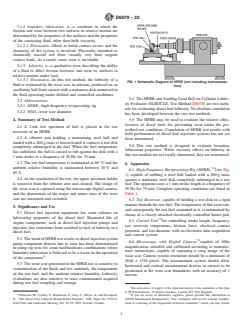
6.1 High-Frequency Reciprocating Rig (HFRR), (see Fig.
85%.
1) capable of rubbing a steel ball loaded with a 200g mass
4.4 At the conclusion of the test, the upper specimen holder against a stationary steel disk completely submerged in a test
is removed from the vibrator arm and cleaned. The image of fuel.Theapparatususesa1mmstrokelengthatafrequencyof
the wear scar is captured using the microscope digital camera,
50Hz for 75min. Complete operating conditions are listed in
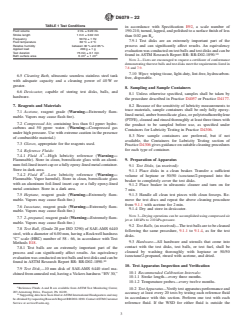
and the dimensions of the major and minor axes of the wear Table 1.
scar are measured and recorded.
6.2 Test Reservoir, capable of holding a test disk in a rigid
mannerbeneaththetestfuel.Thetemperatureofthisreservoir,
5. Significance and Use
and consequently the test fuel contained in it, is maintained by
5.1 Diesel fuel injection equipment has some reliance on
means of a closely attached electrically controlled heater pad.
lubricating properties of the diesel fuel. Shortened life of
7,8
6.3 Control Unit for controlling stroke length, frequency,
engine components, such as diesel fuel injection pumps and
test reservoir temperature, friction force, electrical contact
injectors, has sometimes been ascribed to lack of lubricity in a
potential, and test duration, with an electronic data acquisition
diesel fuel.
and control system.
5.2 ThetrendofHFRRtestresultstodieselinjectionsystem
7,8
6.4 Microscope, with Digital Camera capable of 100×
pump component distress due to wear has been demonstrated
magnification, installed and calibrated according to manufac-
in pump rig tests for some fuel/hardware combinations where
turer instructions, capable of capturing a crisp image of the
boundary lubrication is believed to be a factor in the operation
6 wear scar. Camera system resolution should be a minimum of
of the component.
2048 × 1536 pixels. The measurement system should allow
5.3 ThewearscargeneratedintheHFRRtestissensitiveto
horizontal and vertical measurement devices or cursors to be
contamination of the fluids and test materials, the temperature
positioned at the wear scar boundaries with an accuracy of 1
of the test fuel, and the ambient relative humidity. Lubricity
micron.
evaluations are also sensitive to trace contaminants acquired
during test fuel sampling and storage.
The sole source of supply of the apparatus known to the committee at this time
is PCS Instruments, 78 Stanley Gardens, London W3 7SZ, England.
6 8
Nikanjam, M., Crosby, T., Henderson, P., Gray, C., Meyer, K, and Davenport, If you are aware of alternative suppliers, please provide this information to
N., “ISO Diesel Fuel Lubricity Round Robin Program,” SAE, Paper No. 952372, ASTM International Headquarters. Your comments will receive careful consider-
SAE Fuels and Lubricants Meeting, Oct. 16-19, 1995, Toronto, Canada. ation at a meeting of the responsible technical committee, which you may attend.
D6079 − 22
TABLE 1 Test Conditions
in accordance with Specification E92, a scale number of
Fluid volume 2 mL ± 0.20 mL 190-210,turned,lapped,andpolishedtoasurfacefinishofless
Stroke length 1 mm ± 0.02 mm
than 0.02µm R .
a
Frequency 50 Hz±1Hz
7.9.1 Test disks are an extremely important part of the
Fluid temperature 60 °C ± 2 °C
Relative humidity between 30 % and 85 % process and can significantly affect results. An equivalency
Appliedload 200g±1g
evaluationwasconductedontestballsandtestdisksandcanbe
Test duration 75 min ± 0.1 min
2 2 found in ASTM Research Report RR: RR:D02-1890.
Bath surface area 6 cm ±1cm
NOTE 2—Users are encouraged to request a certificate of conformance
demonstrating that test balls and test disks meet the requirements listed in
7.8 and 7.9.
7.10 Wiper,wipingtissue,light-duty,lint-free,hydrocarbon-
6.5 Cleaning Bath, ultrasonic seamless stainless steel tank
free, disposable.
with adequate capacity and a cleaning power of 40W or
greater.
8. Sampling and Sample Containers
6.6 Desiccator, capable of storing test disks, balls, and
8.1 Unless otherwise specified, samples shall be taken by
hardware.
the procedure described in Practice D4057 or Practice D4177.
8.2 Because of the sensitivity of lubricity measurements to
7. Reagents and Materials
trace materials, sample containers shall be only fully epoxy-
7.1 Acetone, reagent grade (Warning—Extremely flam-
lined metal, amber borosilicate glass, or polytetrafluorethylene
mable. Vapors may cause flash fire).
(PTFE),cleanedandrinsedthoroughlyatleastthreetimeswith
7.2 Compressed Air, containing less than 0.1ppmv hydro-
the product to be sampled before use, as specified under
carbons and 50 ppmv water. (Warning—Compressed gas
Containers for Lubricity Testing in Practice
...
This document is not an ASTM standard and is intended only to provide the user of an ASTM standard an indication of what changes have been made to the previous version. Because
it may not be technically possible to adequately depict all changes accurately, ASTM recommends that users consult prior editions as appropriate. In all cases only the current version
of the standard as published by ASTM is to be considered the official document.
Designation: D6079 − 18 D6079 − 22
Standard Test Method for
Evaluating Lubricity of Diesel Fuels by the High-Frequency
Reciprocating Rig (HFRR)
This standard is issued under the fixed designation D6079; the number immediately following the designation indicates the year of
original adoption or, in the case of revision, the year of last revision. A number in parentheses indicates the year of last reapproval. A
superscript epsilon (´) indicates an editorial change since the last revision or reapproval.
1. Scope*
1.1 This test method covers the evaluation of the lubricity of diesel fuels using a high-frequency reciprocating rig (HFRR).
1.2 This test method is applicable to middle distillate fuels, such as Grades No. 1-D S15, S500, and S5000, and Grades No. 2-D
S15, S500, and S5000 diesel fuels, in accordance with Specification D975; and other similar petroleum-based fuels which can be
used in diesel engines. This test method is applicable to biodiesel blends. B5 was included in the round robin program that
determined the precision statement.
NOTE 1—It is not known that this test method will predict the performance of all additive/fuel combinations. Additional work is underway to establish
this correlation and future revisions of this test method may be necessary once this work is complete.
1.3 The values stated in SI units are to be regarded as standard. No other units of measurement are included in this standard.
1.4 This standard does not purport to address all of the safety concerns, if any, associated with its use. It is the responsibility
of the user of this standard to establish appropriate safety, health, and environmental practices and determine the applicability of
regulatory limitations prior to use. Specific warning statements are given in Section 7.
1.5 This international standard was developed in accordance with internationally recognized principles on standardization
established in the Decision on Principles for the Development of International Standards, Guides and Recommendations issued
by the World Trade Organization Technical Barriers to Trade (TBT) Committee.
2. Referenced Documents
2.1 ASTM Standards:
D975 Specification for Diesel Fuel
D4057 Practice for Manual Sampling of Petroleum and Petroleum Products
D4175 Terminology Relating to Petroleum Products, Liquid Fuels, and Lubricants
D4177 Practice for Automatic Sampling of Petroleum and Petroleum Products
D4306 Practice for Aviation Fuel Sample Containers for Tests Affected by Trace Contamination
This test method is under the jurisdiction of ASTM Committee D02 on Petroleum Products, Liquid Fuels, and Lubricants and is the direct responsibility of Subcommittee
D02.E0 on Burner, Diesel, Diesel and Non-Aviation Gas Turbine, and Marine Turbine Fuels.
Current edition approved Aug. 1, 2018Dec. 1, 2022. Published September 2018January 2023. Originally approved in 1999. Last previous edition approved in 20162018
as D6079 – 11 (2016).D6079 – 18. DOI: 10.1520/D6079-18.10.1520/D6079-22.
This test method was developed by ISO/TC22/SC7/WG6 and is a part of ISO 12156.
For referenced ASTM standards, visit the ASTM website, www.astm.org, or contact ASTM Customer Service at service@astm.org. For Annual Book of ASTM Standards
volume information, refer to the standard’s Document Summary page on the ASTM website.
*A Summary of Changes section appears at the end of this standard
Copyright © ASTM International, 100 Barr Harbor Drive, PO Box C700, West Conshohocken, PA 19428-2959. United States
D6079 − 22
D6078 Test Method for Evaluating Lubricity of Diesel Fuels by the Scuffing Load Ball-on-Cylinder Lubricity Evaluator
(SLBOCLE) (Withdrawn 2021)
E18 Test Methods for Rockwell Hardness of Metallic Materials
E92 Test Methods for Vickers Hardness and Knoop Hardness of Metallic Materials
2.2 SAE Standard:
SAE-AMS 6440 Steel, Bars, Forgings, and Tubing, 1.45 Cr (0.93-1.05C) (SAE 52100), for Bearing Applications
2.3 ISO Standard:
ISO 3290 Roller Bearings, Balls – Dimensions and tolerances
3. Terminology
3.1 Definitions:
3.1.1 For definitions of terms used in this test method, refer to Terminology D4175.
3.1.2 boundary lubrication, n—a condition in which the friction and wear between two surfaces in relative motion are determined
by the properties of the surfaces and the properties of the contacting fluid, other than bulk viscosity.
3.1.2.1 Discussion—
Metal to metal contact occurs and the chemistry of the system is involved. Physically adsorbed or chemically reacted soft films
(usually very thin) support contact loads. As a result, some wear is inevitable.
3.1.3 lubricity, n—a qualitative term describing the ability of a fluid to affect friction between, and wear to, surfaces in relative
motion under load.
3.1.3.1 Discussion—
In this test method, the lubricity of a fluid is evaluated by the wear scar, in microns, produced on an oscillating ball from contact
with a stationary disk immersed in the fluid operating under defined and controlled conditions.
3.2 Abbreviations:
3.2.1 HFRR—high frequency reciprocating rig
3.2.2 WSD—wear scar diameter
4. Summary of Test Method
4.1 A 2 mL test specimen of fuel is placed in the test reservoir of an HFRR.
4.2 A vibrator arm holding a nonrotating steel ball and loaded with a 200 g mass is lowered until it contacts a test disk completely
submerged in the fuel. When the fuel temperature has stabilized, the ball is caused to rub against the disk with a 1 mm stroke at
a frequency of 50 Hz for 75 min.
4.3 The test fuel temperature is maintained at 60 °C and the ambient relative humidity is maintained between 30 % and 85 %.
4.4 At the conclusion of the test, the upper specimen holder is removed from the vibrator arm and cleaned. The image of the wear
scar is captured using the microscope digital camera, and the dimensions of the major and minor axes of the wear scar are measured
and recorded.
5. Significance and Use
5.1 Diesel fuel injection equipment has some reliance on lubricating properties of the diesel fuel. Shortened life of engine
components, such as diesel fuel injection pumps and injectors, has sometimes been ascribed to lack of lubricity in a diesel fuel.
The last approved version of this historical standard is referenced on www.astm.org.
Available from SAE International (SAE), 400 Commonwealth Dr., Warrendale, PA 15096-0001, http://www.sae.org.
Available from American National Standards Institute (ANSI), 25 W. 43rd St., 4th Floor, New York, NY 10036, http://www.ansi.org.
D6079 − 22
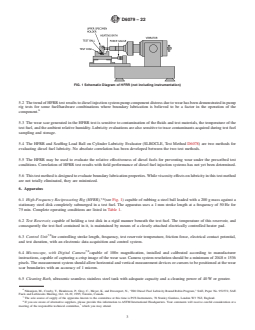
FIG. 1 Schematic Diagram of HFRR (not including instrumentation)
5.2 The trend of HFRR test results to diesel injection system pump component distress due to wear has been demonstrated in pump
rig tests for some fuel/hardware combinations where boundary lubrication is believed to be a factor in the operation of the
component.
5.3 The wear scar generated in the HFRR test is sensitive to contamination of the fluids and test materials, the temperature of the
test fuel, and the ambient relative humidity. Lubricity evaluations are also sensitive to trace contaminants acquired during test fuel
sampling and storage.
5.4 The HFRR and Scuffing Load Ball on Cylinder Lubricity Evaluator (SLBOCLE, Test Method D6078) are two methods for
evaluating diesel fuel lubricity. No absolute correlation has been developed between the two test methods.
5.5 The HFRR may be used to evaluate the relative effectiveness of diesel fuels for preventing wear under the prescribed test
conditions. Correlation of HFRR test results with field performance of diesel fuel injection systems has not yet been determined.
5.6 This test method is designed to evaluate boundary lubrication properties. While viscosity effects on lubricity in this test method
are not totally eliminated, they are minimized.
6. Apparatus
7,8
6.1 High-Frequency Reciprocating Rig (HFRR), (see Fig. 1) capable of rubbing a steel ball loaded with a 200 g mass against a
stationary steel disk completely submerged in a test fuel. The apparatus uses a 1 mm stroke length at a frequency of 50 Hz for
75 min. Complete operating conditions are listed in Table 1.
6.2 Test Reservoir, capable of holding a test disk in a rigid manner beneath the test fuel. The temperature of this reservoir, and
consequently the test fuel contained in it, is maintained by means of a closely attached electrically controlled heater pad.
7,8
6.3 Control Unit for controlling stroke length, frequency, test reservoir temperature, friction force, electrical contact potential,
and test duration, with an electronic data acquisition and control system.
7,8
6.4 Microscope, with Digital Camera capable of 100× magnification, installed and calibrated according to manufacturer
instructions, capable of capturing a crisp image of the wear scar. Camera system resolution should be a minimum of 2048 × 1536
pixels. The measurement system should allow horizontal and vertical measurement devices or cursors to be positioned at the wear
scar boundaries with an accuracy of 1 micron.
6.5 Cleaning Bath, ultrasonic seamless stainless steel tank with adequate capacity and a cleaning power of 40 W or greater.
Nikanjam, M., Crosby, T., Henderson, P., Gray, C., Meyer, K, and Davenport, N., “ISO Diesel Fuel Lubricity Round Robin Program,” SAE, Paper No. 952372, SAE
Fuels and Lubricants Meeting, Oct. 16-19, 1995, Toronto, Canada.
The sole source of supply of the apparatus known to the committee at this time is PCS Instruments, 78 Stanley Gardens, London W3 7SZ, England.
If you are aware of alternative suppliers, please provide this information to ASTM International Headquarters. Your comments will receive careful consideration at a
meeting of the responsible technical committee, which you may attend.
D6079 − 22
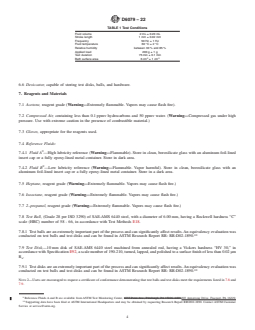
TABLE 1 Test Conditions
Fluid volume 2 mL ± 0.20 mL
Stroke length 1 mm ± 0.02 mm
Frequency 50 Hz ± 1 Hz
Fluid temperature 60 °C ± 2 °C
Relative humidity between 30 % and 85 %
Applied load 200 g ± 1 g
Test duration 75 min ± 0.1 min
2 2
Bath surface area 6 cm ± 1 cm
6.6 Desiccator, capable of storing test disks, balls, and hardware.
7. Reagents and Materials
7.1 Acetone, reagent grade (Warning—Extremely flammable. Vapors may cause flash fire).
7.2 Compressed Air, containing less than 0.1 ppmv hydrocarbons and 50 ppmv water. (Warning—Compressed gas under high
pressure. Use with extreme caution in the presence of combustible material.)
7.3 Gloves, appropriate for the reagents used.
7.4 Reference Fluids:
7.4.1 Fluid A —High lubricity reference (Warning—Flammable). Store in clean, borosilicate glass with an aluminum foil-lined
insert cap or a fully epoxy-lined metal container. Store in dark area.
7.4.2 Fluid B —Low lubricity reference (Warning—Flammable. Vapor harmful). Store in clean, borosilicate glass with an
aluminum foil-lined insert cap or a fully epoxy-lined metal container. Store in a dark area.
7.5 Heptane, reagent grade (Warning—Extremely flammable. Vapors may cause flash fire.)
7.6 Isooctane, reagent grade (Warning—Extremely flammable. Vapors may cause flash fire.)
7.7 2–propanol, reagent grade (Warning—Extremely flammable. Vapors may cause flash fire.)
7.8 Test Ball, (Grade 28 per ISO 3290) of SAE-AMS 6440 steel, with a diameter of 6.00 mm, having a Rockwell hardness “C”
scale (HRC) number of 58 - 66, in accordance with Test Methods E18.
7.8.1 Test balls are an extremely important part of the process and can significantly affect results. An equivalency evaluation was
conducted on test balls and test
...
Questions, Comments and Discussion
Ask us and Technical Secretary will try to provide an answer. You can facilitate discussion about the standard in here.
Loading comments...