

ASTM F1774-20
(Specification)Standard Specification for Climbing and Mountaineering Carabiners
General Information
- Abstract
ABSTRACT
This specification covers six mechanical tests and the corresponding minimum performance and design requirements for steel or aluminum alloy carabiners fabricated specifically for the sports of climbing and mountaineering. Two different types of carabiners are defined, namely, non-locking carabiners and locking carabiners. The mechanical tests to which the representative carabiners shall be evaluated on are gate function during body weight test, major axis gate closed 70 % force test, locking mechanism test, major axis gate closed ultimate strength test, major axis gate open ultimate strength test, and minor axis gate closed ultimate strength test. These tests are destructive in nature. Hence, carabiners subjected to any of these tests shall not be used in any way after testing, except in evaluating the results of such testing.
SCOPE
1.1 This specification covers six mechanical tests and the minimum performance requirements for carabiners designed specifically for the sports of climbing and mountaineering.
1.2 Two different types of carabiners are defined in this standard, non-locking carabiners and locking carabiners.
1.3 Tests contained herein are destructive in nature. Carabiners subjected to any of these tests shall not be used in any way after testing except in evaluating the results of such testing.
1.4 This specification does not imply approval of any method of use of climbing and mountaineering carabiners. In addition, the test load values contained herein are not to be interpreted as the forces which a climbing and mountaineering carabiner may be subjected to, or expected to sustain in actual field use.
1.5 This specification is limited to carabiners made of steel or aluminum alloys only.
1.6 The values stated in SI units are to be regarded as standard. The values given in parentheses after SI units are provided for information only and are not considered standard.
1.7 This international standard was developed in accordance with internationally recognized principles on standardization established in the Decision on Principles for the Development of International Standards, Guides and Recommendations issued by the World Trade Organization Technical Barriers to Trade (TBT) Committee.
- Status
- Published
- Publication Date
- 14-Mar-2020
- Technical Committee
- F32 - Search and Rescue
- Drafting Committee
- F32.01 - Equipment, Testing, and Maintenance
Buy Documents
ASTM F1774-20 - Standard Specification for Climbing and Mountaineering Carabiners
REDLINE ASTM F1774-20 - Standard Specification for Climbing and Mountaineering Carabiners
Overview
ASTM F1774-20 is the internationally recognized Standard Specification for Climbing and Mountaineering Carabiners, published by ASTM International. This standard establishes the minimum mechanical performance and design requirements for both steel and aluminum alloy carabiners designed specifically for rock climbing, ice climbing, and mountaineering activities. ASTM F1774-20 plays a critical role in ensuring that climbing and mountaineering carabiners meet consistent safety, functionality, and durability criteria through rigorous mechanical testing.
The specification distinguishes between two main types of carabiners:
- Non-locking carabiners
- Locking carabiners
It defines six destructive mechanical tests and outlines the information that must be affixed to each product. The aim is to promote climber safety and support product reliability through standardized evaluation.
Key Topics
ASTM F1774-20 sets out requirements for:
- Mechanical Testing: Six destructive tests are specified to determine a carabiner's strength, required force resistance, and operational reliability. Tests include:
- Gate function during body weight test
- Major axis gate closed at reduced force
- Locking mechanism function
- Major axis gate closed ultimate strength
- Major axis gate open ultimate strength
- Minor axis gate closed ultimate strength
- Carabiner Types:
- Non-locking carabiners: Standard gates without an additional locking mechanism.
- Locking carabiners: Gates equipped with a manual locking device requiring at least two distinct actions to open.
- Performance Marking: Mandatory clear and durable labeling of manufacturer details, lot number, and ultimate strength ratings on each carabiner.
- Material Specification: Applies only to carabiners manufactured from steel or aluminum alloys.
- Corrosion Resistance: Includes a corrosion test to assess performance after salt spray exposure.
- Reporting Requirements: Detailed results and test reports are to be provided, as needed, for product certification and traceability.
Applications
The primary application of ASTM F1774-20 is aiding manufacturers, suppliers, and regulatory bodies in:
- Climbing Equipment Certification: Providing a reliable method to certify carabiners for sport climbing, ice climbing, and mountaineering.
- Quality Assurance: Ensuring products consistently meet defined mechanical strength and performance thresholds, reducing product liability risk.
- Procurement and Inspection: Supporting procurement professionals and inspectors in verifying compliance for climbing organizations, rescue teams, and retail suppliers.
- Product Traceability: Ensuring each carabiner can be traced back to its manufacturing lot and meets labeling requirements for end-user confidence.
Complying with ASTM F1774-20 is essential for manufacturers looking to demonstrate product quality, gain market acceptance, and facilitate international trade.
Related Standards
Several other standards relate to or complement ASTM F1774-20, including:
- ASTM F1772: Specification for Harnesses for Rescue and Sport Activities
- ASTM B117: Practice for Operating Salt Spray (Fog) Apparatus
- ASTM E4: Practice for Force Verification of Testing Machines
- EN 566: Mountaineering Equipment - Slings - Safety Requirements and Test Methods
Compliance with ASTM F1774-20 and these related standards enhances the safety and reliability of climbing hardware within the broader outdoor, rescue, and adventure sports industries. This comprehensive approach to testing and specification supports climbers’ safety and the reputation of equipment manufacturers globally.
Relations
- Effective Date
- 15-Mar-2020
- Effective Date
- 01-Jun-2014
- Effective Date
- 01-Oct-2011
- Effective Date
- 01-Jun-2010
- Effective Date
- 01-Nov-2009
- Effective Date
- 01-Jul-2009
- Effective Date
- 01-Apr-2009
- Effective Date
- 01-Dec-2008
- Effective Date
- 15-Dec-2007
- Effective Date
- 01-Mar-2007
- Effective Date
- 01-Jan-2007
- Effective Date
- 01-Oct-2003
- Effective Date
- 10-Aug-2003
- Effective Date
- 10-Nov-2002
- Effective Date
- 10-Oct-2002
Buy Documents
ASTM F1774-20 - Standard Specification for Climbing and Mountaineering Carabiners
REDLINE ASTM F1774-20 - Standard Specification for Climbing and Mountaineering Carabiners
Frequently Asked Questions
ASTM F1774-20 is a technical specification published by ASTM International. Its full title is "Standard Specification for Climbing and Mountaineering Carabiners". This standard covers: ABSTRACT This specification covers six mechanical tests and the corresponding minimum performance and design requirements for steel or aluminum alloy carabiners fabricated specifically for the sports of climbing and mountaineering. Two different types of carabiners are defined, namely, non-locking carabiners and locking carabiners. The mechanical tests to which the representative carabiners shall be evaluated on are gate function during body weight test, major axis gate closed 70 % force test, locking mechanism test, major axis gate closed ultimate strength test, major axis gate open ultimate strength test, and minor axis gate closed ultimate strength test. These tests are destructive in nature. Hence, carabiners subjected to any of these tests shall not be used in any way after testing, except in evaluating the results of such testing. SCOPE 1.1 This specification covers six mechanical tests and the minimum performance requirements for carabiners designed specifically for the sports of climbing and mountaineering. 1.2 Two different types of carabiners are defined in this standard, non-locking carabiners and locking carabiners. 1.3 Tests contained herein are destructive in nature. Carabiners subjected to any of these tests shall not be used in any way after testing except in evaluating the results of such testing. 1.4 This specification does not imply approval of any method of use of climbing and mountaineering carabiners. In addition, the test load values contained herein are not to be interpreted as the forces which a climbing and mountaineering carabiner may be subjected to, or expected to sustain in actual field use. 1.5 This specification is limited to carabiners made of steel or aluminum alloys only. 1.6 The values stated in SI units are to be regarded as standard. The values given in parentheses after SI units are provided for information only and are not considered standard. 1.7 This international standard was developed in accordance with internationally recognized principles on standardization established in the Decision on Principles for the Development of International Standards, Guides and Recommendations issued by the World Trade Organization Technical Barriers to Trade (TBT) Committee.
ABSTRACT This specification covers six mechanical tests and the corresponding minimum performance and design requirements for steel or aluminum alloy carabiners fabricated specifically for the sports of climbing and mountaineering. Two different types of carabiners are defined, namely, non-locking carabiners and locking carabiners. The mechanical tests to which the representative carabiners shall be evaluated on are gate function during body weight test, major axis gate closed 70 % force test, locking mechanism test, major axis gate closed ultimate strength test, major axis gate open ultimate strength test, and minor axis gate closed ultimate strength test. These tests are destructive in nature. Hence, carabiners subjected to any of these tests shall not be used in any way after testing, except in evaluating the results of such testing. SCOPE 1.1 This specification covers six mechanical tests and the minimum performance requirements for carabiners designed specifically for the sports of climbing and mountaineering. 1.2 Two different types of carabiners are defined in this standard, non-locking carabiners and locking carabiners. 1.3 Tests contained herein are destructive in nature. Carabiners subjected to any of these tests shall not be used in any way after testing except in evaluating the results of such testing. 1.4 This specification does not imply approval of any method of use of climbing and mountaineering carabiners. In addition, the test load values contained herein are not to be interpreted as the forces which a climbing and mountaineering carabiner may be subjected to, or expected to sustain in actual field use. 1.5 This specification is limited to carabiners made of steel or aluminum alloys only. 1.6 The values stated in SI units are to be regarded as standard. The values given in parentheses after SI units are provided for information only and are not considered standard. 1.7 This international standard was developed in accordance with internationally recognized principles on standardization established in the Decision on Principles for the Development of International Standards, Guides and Recommendations issued by the World Trade Organization Technical Barriers to Trade (TBT) Committee.
ASTM F1774-20 is classified under the following ICS (International Classification for Standards) categories: 97.220.40 - Outdoor and water sports equipment. The ICS classification helps identify the subject area and facilitates finding related standards.
ASTM F1774-20 has the following relationships with other standards: It is inter standard links to ASTM F1774-13, ASTM E4-14, ASTM B117-11, ASTM E4-10, ASTM E4-09a, ASTM B117-09, ASTM E4-09, ASTM E4-08, ASTM B117-07a, ASTM B117-07, ASTM E4-07, ASTM B117-03, ASTM E4-03, ASTM E4-02, ASTM B117-02. Understanding these relationships helps ensure you are using the most current and applicable version of the standard.
ASTM F1774-20 is available in PDF format for immediate download after purchase. The document can be added to your cart and obtained through the secure checkout process. Digital delivery ensures instant access to the complete standard document.
Standards Content (Sample)
This international standard was developed in accordance with internationally recognized principles on standardization established in the Decision on Principles for the
Development of International Standards, Guides and Recommendations issued by the World Trade Organization Technical Barriers to Trade (TBT) Committee.
Designation:F1774 −20
Standard Specification for
Climbing and Mountaineering Carabiners
This standard is issued under the fixed designation F1774; the number immediately following the designation indicates the year of
original adoption or, in the case of revision, the year of last revision.Anumber in parentheses indicates the year of last reapproval.A
superscript epsilon (´) indicates an editorial change since the last revision or reapproval.
1. Scope 2.2 Other Standard:
EN566:1994Mountaineering equipment. Slings. Safety re-
1.1 This specification covers six mechanical tests and the
quirements and test methods
minimum performance requirements for carabiners designed
specifically for the sports of climbing and mountaineering.
3. Terminology
1.2 Two different types of carabiners are defined in this
3.1 Definitions:
standard, non-locking carabiners and locking carabiners.
3.1.1 carabiner, n—a self-closing gated, load-bearing, con-
1.3 Tests contained herein are destructive in nature. Cara-
nective device. Some carabiner models may have cocking or
biners subjected to any of these tests shall not be used in any
blockingdevices,thatwhenactivated,overridetheself-closing
way after testing except in evaluating the results of such
features.
testing.
3.1.2 durably affıxed, adj—themannerofattachinginforma-
1.4 This specification does not imply approval of any
tion directly to the product which endures for the life of the
method of use of climbing and mountaineering carabiners. In
product.
addition, the test load values contained herein are not to be
3.1.3 failure, n—an arbitrary point beyond which a material
interpreted as the forces which a climbing and mountaineering
orproductceasestobefunctionallycapableofitsintendeduse.
carabiner may be subjected to, or expected to sustain in actual
In this application, the point at which some part of the
field use.
carabiner physically breaks or distorts to an extent that the test
1.5 This specification is limited to carabiners made of steel
members are released.
or aluminum alloys only.
3.1.4 locking carabiner, n—a carabiner with a mechanism
1.6 The values stated in SI units are to be regarded as that reduces the possibility of a gate being opened inadver-
standard. The values given in parentheses after SI units are
tently. A locking mechanism requires at least two different
provided for informationonlyandarenotconsideredstandard.
consecutive manual actions to open the gate.
1.7 This international standard was developed in accor-
3.1.5 nonlocking carabiner, n—any carabiner that does not
dance with internationally recognized principles on standard-
have a mechanism that reduces the possibility of a gate being
ization established in the Decision on Principles for the
opened inadvertently.
Development of International Standards, Guides and Recom-
3.1.6 normal body weight, n—a standardized weight that
mendations issued by the World Trade Organization Technical
representsa typicalclimber,definedasFunctionTestForceNo.
Barriers to Trade (TBT) Committee.
1.
3.1.7 ultimate strength, n—themaximumforcesustainedby
2. Referenced Documents
a carabiner during an ultimate force test, prior to its failure.
2.1 ASTM Standards:
B117Practice for Operating Salt Spray (Fog) Apparatus
4. Requirements
E4Practices for Force Verification of Testing Machines
4.1 Product information shall include the following items:
4.1.1 Manufacturer’s or Distributor’s Name or Logo—A
This specification is under the jurisdiction ofASTM Committee F32 on Search
clear indication as to who is responsible for the primary
and Rescue and is the direct responsibility of Subcommittee F32.01 on Equipment,
manufacture or distribution, or both, of the product.
Testing, and Maintenance.
4.1.2 Major Axis Gate Closed Ultimate Strength—A clear
Current edition approved March 15, 2020. Published April 2020. Originally
indication as to the major axis gate closed strength by either
approved in 1997. Last previous edition approved in 2013 as F1774–13. DOI:
10.1520/F1774-20.
symbol or pictorial representation.
For referenced ASTM standards, visit the ASTM website, www.astm.org, or
4.1.3 Minor Axis Gate Closed Ultimate Strength—A clear
contact ASTM Customer Service at service@astm.org. For Annual Book of ASTM
indication as to the minor axis gate closed ultimate strength by
Standards volume information, refer to the standard’s Document Summary page on
the ASTM website. either symbol or pictorial representation.
Copyright © ASTM International, 100 Barr Harbor Drive, PO Box C700, West Conshohocken, PA 19428-2959. United States
F1774−20
4.1.4 Major Axis Gate Open Ultimate Strength—A clear 7. Hazards
indication as to the major axis gate open ultimate strength by
7.1 Carabiners may disengage or eject parts from the test
either symbol or pictorial representation.
fixture. Use a safety screen and wear safety glasses while
4.1.5 Lot Number—A manufacturer’s or distributor’s lot
testing. Do not perform this test alone.
number.
4.1.6 Either symbol or pictorial representation to read the
8. Sampling
manufacturer’s or distributor’s instructions.
8.1 Sample Selection—Randomlyselectthecarabinersfrom
4.2 Lettering,symbols,andpictorialrepresentationsshallbe
the same production lot in accordance with 8.2.2. Each user of
durably affixed to the carabiner.
this test method may specify the lot size from which the
carabiners are to be selected.
4.3 Lettering,symbols,andpictorialrepresentationsshallbe
a minimum of 2 mm ( ⁄64 in.) in height.
8.2 Number of Samples:
8.2.1 The same number of carabiners must be used for each
5. Significance and Use
of the tests in this specification.
8.2.2 A minimum of five will be used, in sequence, for the
5.1 Gate Function During Body Weight Test—This test
gatefunctionduringbodyweight,majoraxisgateclosed70%,
simulates a climber’s body weight of Function Test Force No.
and major axis gate closed ultimate strength tests.Aminimum
1 and verifies that the gate functions as intended under body
of five will be used for the major axis gate open ultimate
weight force.
strengthtest.Aminimumoffivewillbeusedfortheminoraxis
5.2 Major Axis Gate Closed 70 % Force Test—This test
gate closed ultimate strength test.
verifies that the gate functions as originally intended after
Function Test Force No. 2 has been applied and released.
9. Performance Specifications
5.3 Locking Mechanism Test—This test verifies that the
9.1 Gate Function During Body Weight Test:
locking mechanism keeps the gate in the locked position
9.1.1 Function Test Force No. 1 will be used for this test.
between forces of 0 kN and Function Force Test No. 3.
Each of the carabiners subjected to the body weight test shall
5.4 Major Axis Gate Closed Ultimate Strength Test—This
show no evidence of distortion that impairs the designed
testisintendedtoshowtheforcerequiredtophysicallyfailthe function.
carabiner.
9.1.2 While the body weight force is applied, the carabiner
gateshallopenandcloseasdesignedandwiththesamequality
5.5 Major Axis Gate Open Ultimate Strength Test—Thistest
and performance as before the test. (The use of tools or any
simulates a potential inadvertent use of a carabiner. It is
device other than finger pressure is not allowed.)
intended to show the force required to physically fail the
9.1.3 When a locking carabiner is locked while the body
carabiner.
weightforceisapplied,thelockingmechanismmustbeableto
5.6 Minor Axis Gate Closed Ultimate Strength Test—This
be rotated to its unlocked position by hand after the force is
test simulates a potential inadvertent use of a carabiner. It is
removed. (The use of tools or any device other than finger
intended to show the force required to fail physically the
pressure is not allowed.)
carabiner along the minor axis.
9.2 Major Axis Gate Closed 70 Force Test—Function Test
Force No. 2 will be used for this test. Each of the carabiners
6. Apparatus and Conditions
subjected to the 70% force test shall show no evidence of
6.1 Test Apparatus—The test apparatus shall be maintained
distortion that impairs the designed function after the test is
in good operation condition, used only in the proper loading
conducted.Thelockingmechanismofalockingcarabinershall
range, and calibrated periodically in accordance with the latest
openandcloseasoriginallyintendedandwiththesamequality
revision of Practices E4.
and performance as before the test. (The use of tools or any
device other than finger pressure is not allowed.)
6.2 Test Fixtures and Supplies:
6.2.1 There are four total test pins required, two pins with
9.3 Locking Mechanism Test—Function Test Force No. 3
6 60.05-mm radius and two pins with 5 60.05-mm radius.
will be used for this test. With the locking mechanism in the
Pins must be AISI SAE Type 01 Tool Steel (commonly
locked position and an inward force of 50 N applied to the
purchased as 01 Drill Rod) and heat-treated to minimum
center of the gate, the gate must not open as Function Test
Rockwell hardness, C scale 60. The mean surface roughness,
ForceNo.3isappliedtothemajoraxisofthecarabiner.When
R ,mustnotexceed0.8µmandthepeaktovalleyheight, R ,
the load is released, the gate and locking mechanism must be
a max
mustnotexceed6.3µm.Thefixtureshouldbedesignedinsuch
fully functional. (The use of tools or any device other than
a way that the pins do not rotate and that the carabiner is free
finger pressure is not allowed.)
to locate itself on the pins when the force is applied. See Figs.
9.4 Major Axis Gate Closed Ultimate Strength Test:
1 and 2.
9.4.1 Each of the non-locking carabiners subjected to this
6.2.2 Molybdenum-Based Grease.
test shall have an ultimate strength equal to or greater than the
6.3 Test Conditions—The ambient temperature shall be major axis gate closed minimum ultimate strength for non-
between 15 and 23°C (59 and 73°F). locking carabiners listed in Table 1.
F1774−20
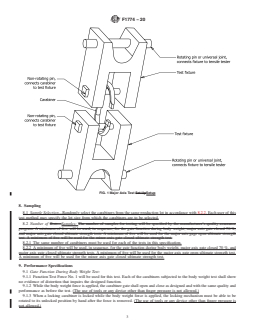
FIG. 1Major Axis Test Setup
9.4.2 Each of the locking carabiners subjected to this test minor axis gate closed minimum ultimate strength for locking
shall have an ultimate strength equal to or greater than the carabiners listed in Table 1.
major axis gate closed minimum ultimate strength for locking
9.6.3 Corrosion Test—Each of the carabiners subjected to
carabiners listed in Table 1.
the corrosion test shall not have more than light-surface
corrosion following the test. In addition, each carabiner gate
9.5 Major Axis Gate Open Ultimate Strength Test:
shall open and close with the same quality and performance as
9.5.1 Each of the nonlocking carabiners subjected to this
beforethetest.(Theuseoftoolsoranydeviceotherthanfinger
test shall have an ultimate strength equal to or greater than the
pressure is not allowed.) Furthermore, each gate locking
major axis gate open minimum ultimate strength for nonlock-
mechanism must be able to move through its full range of
ing carabiners listed in Table 1.
travelwiththesamequalityandperformanceasbeforethetest.
9.5.2 Each of the locking carabiners subjected to this test
(Theuseoftoolsoranydeviceotherthanfingerpressureisno
...
This document is not an ASTM standard and is intended only to provide the user of an ASTM standard an indication of what changes have been made to the previous version. Because
it may not be technically possible to adequately depict all changes accurately, ASTM recommends that users consult prior editions as appropriate. In all cases only the current version
of the standard as published by ASTM is to be considered the official document.
Designation: F1774 − 13 F1774 − 20
Standard Specification for
Climbing and Mountaineering Carabiners
This standard is issued under the fixed designation F1774; the number immediately following the designation indicates the year of
original adoption or, in the case of revision, the year of last revision. A number in parentheses indicates the year of last reapproval. A
superscript epsilon (´) indicates an editorial change since the last revision or reapproval.
1. Scope
1.1 This specification covers six mechanical tests and the minimum performance requirements for carabiners designed
specifically for the sports of climbing and mountaineering.
1.2 Two different types of carabiners are defined in this standard, non-locking carabiners and locking carabiners.
1.3 Tests contained herein are destructive in nature. Carabiners subjected to any of these tests shall not be used in any way after
testing except in evaluating the results of such testing.
1.4 This specification does not imply approval of any method of use of climbing and mountaineering carabiners. In addition,
the test load values contained herein are not to be interpreted as the forces which a climbing and mountaineering carabiner may
be subjected to, or expected to sustain in actual field use.
1.5 This specification is limited to carabiners made of steel or aluminum alloys only.
1.6 The values stated in SI units are to be regarded as the standard. standard. The values given in parentheses after SI units are
provided for information only and are not considered standard.
1.7 This international standard was developed in accordance with internationally recognized principles on standardization
established in the Decision on Principles for the Development of International Standards, Guides and Recommendations issued
by the World Trade Organization Technical Barriers to Trade (TBT) Committee.
2. Referenced Documents
2.1 ASTM Standards:
B117 Practice for Operating Salt Spray (Fog) Apparatus
E4 Practices for Force Verification of Testing Machines
F1772 Specification for Harnesses for Rescue and Sport Activities
2.2 Other Standard:
EN 566:1994 Slings [preliminary] Mountaineering equipment. Slings. Safety requirements and test methods
3. Terminology
3.1 Definitions—Terms defined in Terminology F1772 shall be applicable to this specification.
3.1 Definitions of Terms Specific to This Standard:Definitions:
3.1.1 carabiner, n—a self-closing gated, load-bearing, connective device. Some carabiner models may have cocking or blocking
devices, that when activated, override the self-closing features.
3.1.2 durably affıxed, adj—the manner of attaching information directly to the product which endures for the life of the product.
3.1.3 failure, n—an arbitrary point beyond which a material or product ceases to be functionally capable of its intended use. In
this application, the point at which some part of the carabiner physically breaks or distorts to an extent that the test members are
released.
3.1.4 locking carabiner, n—a carabiner with a mechanism that reduces the possibility of a gate being opened inadvertently. A
locking mechanism requires at least two different consecutive manual actions to open the gate.
This specification is under the jurisdiction of ASTM Committee F32 on Search and Rescue and is the direct responsibility of Subcommittee F32.01 on Equipment, Testing,
and Maintenance.
Current edition approved Dec. 15, 2013March 15, 2020. Published February 2014April 2020. Originally approved in 1997. Last previous edition approved in 20052013
as F1774 – 99 (2005).F1774 – 13. DOI: 10.1520/F1774-13.10.1520/F1774-20.
For referenced ASTM standards, visit the ASTM website, www.astm.org, or contact ASTM Customer Service at service@astm.org. For Annual Book of ASTM Standards
volume information, refer to the standard’s Document Summary page on the ASTM website.
Copyright © ASTM International, 100 Barr Harbor Drive, PO Box C700, West Conshohocken, PA 19428-2959. United States
F1774 − 20
3.1.5 nonlocking carabiner, n—any carabiner that does not have a mechanism that reduces the possibility of a gate being opened
inadvertently.
3.1.6 normal body weight, n—a standardized weight that represents a typical climber, defined as Function Test Force No. 1.
3.1.7 ultimate strength, n—the maximum force sustained by a carabiner during an ultimate force test, prior to its failure.
4. Requirements
4.1 Product information shall include the following items:
4.1.1 Manufacturer’s or Distributor’s Name or Logo—A clear indication as to who is responsible for the primary manufacture
or distribution, or both, of the product.
4.1.2 Major Axis Gate Closed Ultimate Strength—A clear indication as to the major axis gate closed strength by either symbol
or pictorial representation.
4.1.3 Minor Axis Gate Closed Ultimate Strength—A clear indication as to the minor axis gate closed ultimate strength by either
symbol or pictorial representation.
4.1.4 Major Axis Gate Open Ultimate Strength—A clear indication as to the major axis gate open ultimate strength by either
symbol or pictorial representation.
4.1.5 Lot Number—A manufacturer’s or distributor’s lot number.
4.1.6 Either symbol or pictorial representation to read the manufacturer’s or distributor’s instructions.
4.2 Lettering, symbols, and pictorial representations shall be durably affixed to the carabiner.
4.3 Lettering, symbols, and pictorial representations shall be a minimum of 2 mm ( ⁄64 in.) in height.
5. Significance and Use
5.1 Gate Function During Body Weight Test—This test simulates a climber’s body weight of Function Test Force No. 1 and
verifies that the gate functions as intended under body weight force.
5.2 Major Axis Gate Closed 70 % Force Test—This test verifies that the gate functions as originally intended after Function Test
Force No. 2 has been applied and released.
5.3 Locking Mechanism Test—This test verifies that the locking mechanism keeps the gate in the locked position between forces
of 0 kN and Function Force Test No. 3.
5.4 Major Axis Gate Closed Ultimate Strength Test—This test is intended to show the force required to physically fail the
carabiner.
5.5 Major Axis Gate Open Ultimate Strength Test—This test simulates a potential inadvertent use of a carabiner. It is intended
to show the force required to physically fail the carabiner.
5.6 Minor Axis Gate Closed Ultimate Strength Test—This test simulates a potential inadvertent use of a carabiner. It is intended
to show the force required to fail physically the carabiner along the minor axis.
6. Responsibility for Quality Assurance
6.1 Quality control is solely the responsibility of the manufacturer or purchaser, or both, and is not addressed by this
specification.
6. Apparatus and ConditionConditions
6.1 Tensile Tester, Test Apparatus— capable of calibration in accordance with PracticesThe test apparatus shall be maintained
in good operation condition, used only in the proper loading range, and calibrated periodically in accordance with the E4 to the
ultimatelatest revision of Practices E4strength of all carabiners tested. .
6.2 Test Fixtures and Supplies:
6.2.1 There are four total test pins required, two pins with 6 6 0.05-mm radius and two pins with 5 6 0.05-mm radius. Pins
must be alloy steel AISI SAE Type 01 Tool Steel (commonly purchased as 01 Drill Rod) and heat-treated to minimum Rockwell
hardness, C scale 60. The mean surface roughness, R , must not exceed 0.8 μm and the peak to valley height, R , must not exceed
a max
6.3 μm. The fixture should be designed in such a way that the pins do not rotate and that the carabiner is free to locate itself on
the pins when the force is applied. See Figs. 1 and 2.
6.2.2 Molybdenum-Based Grease.
6.3 Test Conditions—The ambient temperature shall be between 15 and 23°C. 23°C (59 and 73°F).
7. Hazards
7.1 Carabiners may disengage or eject parts from the test fixture. Use a safety screen and wear safety glasses while testing. Do
not perform this test alone.
F1774 − 20
FIG. 1 Major Axis Test Set-UpSetup
8. Sampling
8.1 Sample Selection—Randomly select the carabiners from the same production lot in accordance with 8.2.2. Each user of this
test method may specify the lot size from which the carabiners are to be selected.
8.2 Number of Tests—Samples: The number of samples for testing will be specified by the manufacturer’s quality assurance
program. A minimum of five will be used, in sequence, for the gate function during body weight, major axis gate closed 70 %,
and major axis gate closed ultimate strength tests. A minimum of five will be used for the major axis gage open ultimate strength
test. A minimum of five will be used for the minor axis gate closed ultimate strength test.
8.2.1 The same number of carabiners must be used for each of the tests in this specification.
8.2.2 A minimum of five will be used, in sequence, for the gate function during body weight, major axis gate closed 70 %, and
major axis gate closed ultimate strength tests. A minimum of five will be used for the major axis gate open ultimate strength test.
A minimum of five will be used for the minor axis gate closed ultimate strength test.
9. Performance Specifications
9.1 Gate Function During Body Weight Test:
9.1.1 Function Test Force No. 1 will be used for this test. Each of the carabiners subjected to the body weight test shall show
no evidence of distortion that impairs the designed function.
9.1.2 While the body weight force is applied, the carabiner gate shall open and close as designed and with the same quality and
performance as before the test. (The use of tools or any device other than finger pressure is not allowed.)
9.1.3 When a locking carabiner is locked while the body weight force is applied, the locking mechanism must be able to be
rotated to its unlocked position by hand after the force is removed. (The use of tools or any device other than finger pressure is
not allowed.)
F1774 − 20
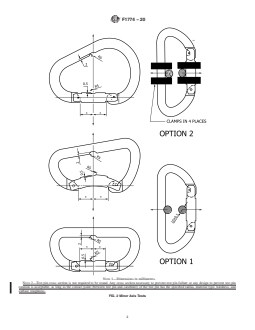
NOTE 1—Dimensions in millimetres.
NOTE 2—Test pin cross section is not required to be round. Any cross section necessary to prevent test pin failure or any design to prevent test pin
rotation is acceptable, as long as the contact point (between test pin and carabiner) of the test pin has the specified radius, material type, hardness, and
surface roughness.
FIG. 2 Minor Axis Tests
F1774 − 20
9.2 Major Axis Gate Closed 70 Force Test—Function Test Force No. 2 will be used for this test. Each of the carabiners subjected
to the 70 % force test shall show no evidence of distortion that impairs the designed function after the test is conducted. The locking
mechanism of a locking carabiner shall open and close as originally intended and with the same quality and performance as before
the test. (The use of tools or any device other than finger pressure is not allowed.)
9.3 Locking Mechanism Test—Function Test Force No. 3 will be used for this test. With the locking mechanism in the locked
position and an inward force of 50 N applied to the center of the gate, the gate must not open as Function Test Force No. 3 is
applied to the major axis of the carabiner. When the load is released, the gate and locking mechanism must be fully functional.
(The use of tools or any device other than finger pressure is not allowed.)
9.4 Major Axis Gate Closed Ultimate Strength Test:
9.4.1 Each of the nonlockingnon-locking carabiners subjected to this test shall have an ultimate strength equal to or greater than
the major axis gate closed minimum ultimate strength for nonlockingnon-locking carabiners listed in Table 1.
9.4.2 Each of the locking carabiners subjected to this test shall have an ultimate strength equal to or greater than the major axis
gate closed minimum ultimat
...