

ASTM D7016/D7016M-20
(Test Method)Standard Test Method to Evaluate Edge Binding Components Used in Mattresses After Exposure to An Open Flame
General Information
- Abstract
SIGNIFICANCE AND USE
5.1 This test method evaluates the edge binding assembly used to determine how well the two external elements along the mattress edge, essentially, the edge tape and FR sewing thread, behave after exposure to an open flame and a hot air oven. These data can be used to confirm that either the mattress or foundation, or both will pass when tested using 16 CFR1633. Evaluation of raw material components is a vital and ongoing part of any manufacturing operation, especially when each item can contribute to the technical performance of the final product.
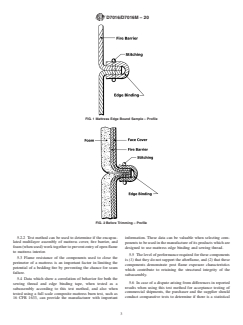
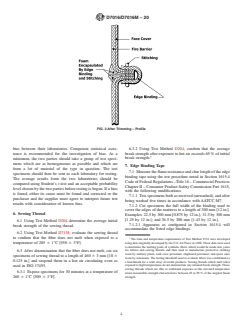
5.2 Inherently flame resistant (FR) sewing thread is used as shown in Fig. 1, Fig. 2, and Fig. 3 to secure and encapsulate the following elements:
FIG. 1 Mattress Edge Bound Sample – Profile
FIG. 2 Before Trimming – Profile
FIG. 3 After Trimming – Profile
5.2.1 Test method measures the behavior of mattress edge binding tape that joins and closes the assembly of either the mattress or the box spring foundation, or both, and sewing thread during and after exposure to an open flame ignition source.
5.2.2 Test method can be used to determine if the encapsulated multilayer assembly of mattress cover, fire barrier, and foam (when used) work together to prevent entry of open flame to mattress interior.
5.3 Flame resistance of the components used to close the perimeter of a mattress is an important factor in limiting the potential of a bedding fire by preventing the chance for seam failure.
5.4 Data which show a correlation of behavior for both the sewing thread and edge binding tape, when tested as a subassembly according to this test method, and also when tested using a full scale composite mattress burn test, such as 16 CFR 1633, can provide the manufacturer with important information. These data can be valuable when selecting components to be used in the manufacture of its products which are designed to use mattress edge binding and sewing thread.
5.5 The level of performance required for these comp...
SCOPE
1.1 This test method measures the flammability characteristics of mattress edge bindings and sewing threads during and after exposure to an open flame ignition source.
1.1.1 This test method is used to evaluate these components either independently or in combination for use in mattresses designed with a fire barrier fabric.
1.1.1.1 The test method is used to evaluate mattress edge binding and sewing thread when the design requires the use of these components.
1.1.2 This test method can be used as a screening test method to determine how sewing thread and mattress edge binding component combinations will perform.
1.2 This standard is used to measure and describe the response of materials, products, or assemblies to heat and flame under controlled conditions, but does not by itself incorporate all factors required for fire hazard or fire risk assessment of the materials, products, or assemblies under actual fire conditions.
1.3 Fire testing of products and materials is inherently hazardous, and adequate safeguards for personnel and property shall be employed in conducting these tests.
1.4 The values stated in either SI units or inch-pound units are to be regarded separately as standard. The values stated in each system are not necessarily exact equivalents; therefore, to ensure conformance with the standard, each system shall be used independently of the other, and values from the two systems shall not be combined.
1.5 This standard does not purport to address all of the safety concerns, if any, associated with its use. It is the responsibility of the user of this standard to establish appropriate safety, health, and environmental practices and determine the applicability of regulatory limitations prior to use.
1.6 This international standard was developed in accordance with internationally recognized principles on standardization established in the Decision on Principles for the Development of Inter...
- Status
- Published
- Publication Date
- 31-Jul-2020
- Technical Committee
- D13 - Textiles
- Drafting Committee
- D13.52 - Flammability
Buy Documents
ASTM D7016/D7016M-20 - Standard Test Method to Evaluate Edge Binding Components Used in Mattresses After Exposure to An Open Flame
REDLINE ASTM D7016/D7016M-20 - Standard Test Method to Evaluate Edge Binding Components Used in Mattresses After Exposure to An Open Flame
Overview
ASTM D7016/D7016M-20 is a standard test method developed by ASTM International for evaluating the performance of edge binding components-specifically, edge tape and flame-resistant (FR) sewing thread-used in mattresses after exposure to an open flame. The method provides manufacturers, regulators, and quality assurance professionals with a way to measure how well these external textile components perform under fire conditions, contributing to both the fire safety and structural integrity of mattresses.
This flammability assessment is critical for confirming that mattress constructions can meet regulatory requirements, such as those set by 16 CFR 1633, which addresses the flammability (open flame) of mattress sets. The standard supports routine quality evaluations of raw materials and finished subassemblies, making it a vital tool in product development, supplier quality assurance, and regulatory compliance.
Key Topics
- Evaluation Scope: The standard focuses on mattress edge bindings (tape) and sewing threads, either independently or as part of a multilayer subassembly that may include fire barrier fabrics and foam.
- Test Procedures: ASTM D7016/D7016M-20 details the exposure of materials to open flame and hot air ovens, measuring factors such as char length, afterflame time, and seam break strength before and after exposure.
- Flame Resistance and Integrity: The main criteria assessed are the ability of edge binding tape and sewing thread to resist supporting afterflame and their contribution to maintaining mattress seam integrity post-exposure.
- Support for Regulatory Testing: Results from this method correlate with full-scale burn tests (such as 16 CFR 1633), helping manufacturers screen and select components that will contribute to regulatory compliance.
- Use of Inherently FR Thread: The method requires and assesses the use of inherently flame-resistant thread in the construction of mattress seams, supporting best practices in fire-safe mattress design.
Applications
- Mattress Manufacturing: Supports manufacturers in selecting and validating edge binding and sewing thread combinations that enhance product safety and durability.
- Quality Assurance: Useful as a screening test within supplier quality assurance programs to ensure consistency and compliance of incoming materials.
- Product Development: Guides R&D teams in optimizing the selection of edge tapes and FR threads that perform reliably under fire exposure, contributing to safer final products.
- Regulatory Compliance: Aids companies in demonstrating conformity with US federal regulations (such as 16 CFR 1633) governing the flammability of mattress sets.
- Component Performance Assessment: Helps stakeholders understand how raw material choices impact mattress performance in fire scenarios, thus influencing procurement and design decisions.
Related Standards
- 16 CFR 1633 - Standard for the Flammability (Open Flame) of Mattress Sets
- ASTM D204 - Test Methods for Sewing Threads
- ASTM D1683 - Test Method for Failure in Sewn Seams of Woven Fabrics
- ASTM D7140 - Test Method to Measure Heat Transfer Through Textile Thermal Barrier Materials
- AATCC M7 - Standard Laboratory Practice for Home Laundering Fabrics Prior to Flammability Testing
- NFPA 701 - Standard Methods of Fire Tests for Flame Propagation of Textiles and Films
- ISO 17493 - Test Method for Convective Heat Resistance Using a Hot Air Circulating Oven
Practical Value
By implementing ASTM D7016/D7016M-20, manufacturers and supply chains in the mattress industry can ensure that critical edge binding components do not contribute to fire spread and that seam integrity is maintained even under demanding fire exposures. Regular application of this standard helps improve consumer safety, reduce product liability, and ensure continued compliance with flammability regulations, thereby supporting robust quality management and safer sleep products for end users.
Relations
- Effective Date
- 01-May-2018
- Effective Date
- 01-Mar-2017
- Effective Date
- 15-Feb-2016
- Effective Date
- 15-Feb-2016
- Effective Date
- 01-Jan-2016
- Effective Date
- 15-Sep-2015
- Effective Date
- 01-Sep-2015
- Effective Date
- 01-Apr-2015
- Effective Date
- 15-Jun-2013
- Effective Date
- 15-Jun-2013
- Effective Date
- 15-May-2013
- Effective Date
- 01-Jan-2013
- Effective Date
- 01-Jan-2013
- Effective Date
- 01-Jan-2013
- Effective Date
- 01-Feb-2012
Buy Documents
ASTM D7016/D7016M-20 - Standard Test Method to Evaluate Edge Binding Components Used in Mattresses After Exposure to An Open Flame
REDLINE ASTM D7016/D7016M-20 - Standard Test Method to Evaluate Edge Binding Components Used in Mattresses After Exposure to An Open Flame
Frequently Asked Questions
ASTM D7016/D7016M-20 is a standard published by ASTM International. Its full title is "Standard Test Method to Evaluate Edge Binding Components Used in Mattresses After Exposure to An Open Flame". This standard covers: SIGNIFICANCE AND USE 5.1 This test method evaluates the edge binding assembly used to determine how well the two external elements along the mattress edge, essentially, the edge tape and FR sewing thread, behave after exposure to an open flame and a hot air oven. These data can be used to confirm that either the mattress or foundation, or both will pass when tested using 16 CFR1633. Evaluation of raw material components is a vital and ongoing part of any manufacturing operation, especially when each item can contribute to the technical performance of the final product. 5.2 Inherently flame resistant (FR) sewing thread is used as shown in Fig. 1, Fig. 2, and Fig. 3 to secure and encapsulate the following elements: FIG. 1 Mattress Edge Bound Sample – Profile FIG. 2 Before Trimming – Profile FIG. 3 After Trimming – Profile 5.2.1 Test method measures the behavior of mattress edge binding tape that joins and closes the assembly of either the mattress or the box spring foundation, or both, and sewing thread during and after exposure to an open flame ignition source. 5.2.2 Test method can be used to determine if the encapsulated multilayer assembly of mattress cover, fire barrier, and foam (when used) work together to prevent entry of open flame to mattress interior. 5.3 Flame resistance of the components used to close the perimeter of a mattress is an important factor in limiting the potential of a bedding fire by preventing the chance for seam failure. 5.4 Data which show a correlation of behavior for both the sewing thread and edge binding tape, when tested as a subassembly according to this test method, and also when tested using a full scale composite mattress burn test, such as 16 CFR 1633, can provide the manufacturer with important information. These data can be valuable when selecting components to be used in the manufacture of its products which are designed to use mattress edge binding and sewing thread. 5.5 The level of performance required for these comp... SCOPE 1.1 This test method measures the flammability characteristics of mattress edge bindings and sewing threads during and after exposure to an open flame ignition source. 1.1.1 This test method is used to evaluate these components either independently or in combination for use in mattresses designed with a fire barrier fabric. 1.1.1.1 The test method is used to evaluate mattress edge binding and sewing thread when the design requires the use of these components. 1.1.2 This test method can be used as a screening test method to determine how sewing thread and mattress edge binding component combinations will perform. 1.2 This standard is used to measure and describe the response of materials, products, or assemblies to heat and flame under controlled conditions, but does not by itself incorporate all factors required for fire hazard or fire risk assessment of the materials, products, or assemblies under actual fire conditions. 1.3 Fire testing of products and materials is inherently hazardous, and adequate safeguards for personnel and property shall be employed in conducting these tests. 1.4 The values stated in either SI units or inch-pound units are to be regarded separately as standard. The values stated in each system are not necessarily exact equivalents; therefore, to ensure conformance with the standard, each system shall be used independently of the other, and values from the two systems shall not be combined. 1.5 This standard does not purport to address all of the safety concerns, if any, associated with its use. It is the responsibility of the user of this standard to establish appropriate safety, health, and environmental practices and determine the applicability of regulatory limitations prior to use. 1.6 This international standard was developed in accordance with internationally recognized principles on standardization established in the Decision on Principles for the Development of Inter...
SIGNIFICANCE AND USE 5.1 This test method evaluates the edge binding assembly used to determine how well the two external elements along the mattress edge, essentially, the edge tape and FR sewing thread, behave after exposure to an open flame and a hot air oven. These data can be used to confirm that either the mattress or foundation, or both will pass when tested using 16 CFR1633. Evaluation of raw material components is a vital and ongoing part of any manufacturing operation, especially when each item can contribute to the technical performance of the final product. 5.2 Inherently flame resistant (FR) sewing thread is used as shown in Fig. 1, Fig. 2, and Fig. 3 to secure and encapsulate the following elements: FIG. 1 Mattress Edge Bound Sample – Profile FIG. 2 Before Trimming – Profile FIG. 3 After Trimming – Profile 5.2.1 Test method measures the behavior of mattress edge binding tape that joins and closes the assembly of either the mattress or the box spring foundation, or both, and sewing thread during and after exposure to an open flame ignition source. 5.2.2 Test method can be used to determine if the encapsulated multilayer assembly of mattress cover, fire barrier, and foam (when used) work together to prevent entry of open flame to mattress interior. 5.3 Flame resistance of the components used to close the perimeter of a mattress is an important factor in limiting the potential of a bedding fire by preventing the chance for seam failure. 5.4 Data which show a correlation of behavior for both the sewing thread and edge binding tape, when tested as a subassembly according to this test method, and also when tested using a full scale composite mattress burn test, such as 16 CFR 1633, can provide the manufacturer with important information. These data can be valuable when selecting components to be used in the manufacture of its products which are designed to use mattress edge binding and sewing thread. 5.5 The level of performance required for these comp... SCOPE 1.1 This test method measures the flammability characteristics of mattress edge bindings and sewing threads during and after exposure to an open flame ignition source. 1.1.1 This test method is used to evaluate these components either independently or in combination for use in mattresses designed with a fire barrier fabric. 1.1.1.1 The test method is used to evaluate mattress edge binding and sewing thread when the design requires the use of these components. 1.1.2 This test method can be used as a screening test method to determine how sewing thread and mattress edge binding component combinations will perform. 1.2 This standard is used to measure and describe the response of materials, products, or assemblies to heat and flame under controlled conditions, but does not by itself incorporate all factors required for fire hazard or fire risk assessment of the materials, products, or assemblies under actual fire conditions. 1.3 Fire testing of products and materials is inherently hazardous, and adequate safeguards for personnel and property shall be employed in conducting these tests. 1.4 The values stated in either SI units or inch-pound units are to be regarded separately as standard. The values stated in each system are not necessarily exact equivalents; therefore, to ensure conformance with the standard, each system shall be used independently of the other, and values from the two systems shall not be combined. 1.5 This standard does not purport to address all of the safety concerns, if any, associated with its use. It is the responsibility of the user of this standard to establish appropriate safety, health, and environmental practices and determine the applicability of regulatory limitations prior to use. 1.6 This international standard was developed in accordance with internationally recognized principles on standardization established in the Decision on Principles for the Development of Inter...
ASTM D7016/D7016M-20 is classified under the following ICS (International Classification for Standards) categories: 97.140 - Furniture. The ICS classification helps identify the subject area and facilitates finding related standards.
ASTM D7016/D7016M-20 has the following relationships with other standards: It is inter standard links to ASTM D4391-18, ASTM D123-17, ASTM D4391-16, ASTM D4391-16e1, ASTM D7138-16, ASTM D123-15b, ASTM D123-15a, ASTM D123-15, ASTM D123-13a, ASTM D123-13ae1, ASTM D123-13, ASTM D4391-93A(2013)e1, ASTM D4391-93a(2013), ASTM D4391-93a(2013)e2, ASTM D123-12e1. Understanding these relationships helps ensure you are using the most current and applicable version of the standard.
ASTM D7016/D7016M-20 is available in PDF format for immediate download after purchase. The document can be added to your cart and obtained through the secure checkout process. Digital delivery ensures instant access to the complete standard document.
Standards Content (Sample)
This international standard was developed in accordance with internationally recognized principles on standardization established in the Decision on Principles for the
Development of International Standards, Guides and Recommendations issued by the World Trade Organization Technical Barriers to Trade (TBT) Committee.
Designation: D7016/D7016M − 20
Standard Test Method to
Evaluate Edge Binding Components Used in Mattresses
After Exposure to An Open Flame
This standard is issued under the fixed designation D7016/D7016M; the number immediately following the designation indicates the
year of original adoption or, in the case of revision, the year of last revision. A number in parentheses indicates the year of last
reapproval. A superscript epsilon (´) indicates an editorial change since the last revision or reapproval.
INTRODUCTION
Evaluation of raw material components is a vital and ongoing part of any manufacturing operation,
especially when each item can contribute to the technical performance of the final product.
Components used in a mattress construction govern the ultimate product performance, its comfort and
durability, and also affect its flammability behavior.
The textile components used on the exterior of the mattress—mattress tape and sewing thread—are
critical for holding the structure together. These components contribute to the aesthetics of the
structure, and they are also susceptible to ignition when exposed to an open flame hazard. Data which
indicate that these two components are able to meet minimum performance criteria when exposed to
an open flame provides the mattress manufacturers with valuable information.
The value of these data increases when the behavior of components in a small scale test correlate
to the behavior of these components in a full scale mattress burn test.The performance criteria require
that: (1) the components do not support the combustion of the afterflame and, (2) that these
components demonstrate post flame exposure characteristics which contribute to the retention of
structural integrity and prevent seam rupture. This test method can be used as a quality control
technique in a supplier quality assurance program.
1. Scope assessment of the materials, products, or assemblies under
actual fire conditions.
1.1 This test method measures the flammability character-
istics of mattress edge bindings and sewing threads during and 1.3 Fire testing of products and materials is inherently
after exposure to an open flame ignition source.
hazardous, and adequate safeguards for personnel and property
1.1.1 This test method is used to evaluate these components shall be employed in conducting these tests.
either independently or in combination for use in mattresses
1.4 The values stated in either SI units or inch-pound units
designed with a fire barrier fabric.
are to be regarded separately as standard. The values stated in
1.1.1.1 The test method is used to evaluate mattress edge
each system are not necessarily exact equivalents; therefore, to
binding and sewing thread when the design requires the use of
ensure conformance with the standard, each system shall be
these components.
used independently of the other, and values from the two
1.1.2 This test method can be used as a screening test
systems shall not be combined.
method to determine how sewing thread and mattress edge
1.5 This standard does not purport to address all of the
binding component combinations will perform.
safety concerns, if any, associated with its use. It is the
1.2 This standard is used to measure and describe the
responsibility of the user of this standard to establish appro-
response of materials, products, or assemblies to heat and
priate safety, health, and environmental practices and deter-
flame under controlled conditions, but does not by itself
mine the applicability of regulatory limitations prior to use.
incorporate all factors required for fire hazard or fire risk
1.6 This international standard was developed in accor-
dance with internationally recognized principles on standard-
This test method is under the jurisdiction ofASTM Committee D13 on Textiles
ization established in the Decision on Principles for the
and is the direct responsibility of Subcommittee D13.52 on Flammability.
Development of International Standards, Guides and Recom-
Current edition approved Aug. 1, 2020. Published September 2020. Originally
mendations issued by the World Trade Organization Technical
approved in 2004. Last previous edition approved in 2018 as D7016–18. DOI:
10.1520/D7016_D7016M-20. Barriers to Trade (TBT) Committee.
Copyright © ASTM International, 100 Barr Harbor Drive, PO Box C700, West Conshohocken, PA 19428-2959. United States
D7016/D7016M − 20
2. Referenced Documents 3.1.2 afterflame time, n—the length of time for which a
2 material continues to flame after the ignition source has been
2.1 ASTM Standards:
removed.
D123 Terminology Relating to Textiles
3.1.3 char length, n—in measuring flame resistance of
D204 Test Methods for Sewing Threads
textiles, the distance from the fabric edge, which is directly
D1683 Test Method for Failure in Sewn Seams of Woven
exposed to the flame to the furthest point of visible fabric
Fabrics
damage.
D4391 Terminology Relating to The Burning Behavior of
3.1.3.1 Discussion—Char length represents the maximum
Textiles
length of a fabric specimen which can be consumed by a
D7138 Test Method to Determine Melting Temperature of
vertical flame.
Synthetic Fibers
D7140 Test Method to Measure Heat Transfer Through
3.1.4 fire barrier composite, n—amultilayerstructurewhich
Textile Thermal Barrier Materials
consists of a non-flame resistant fabric that is secured to a
flame resistant fabric.
2.2 AATCC Method
AATCC M7 Standard Laboratory Practice for Home Laun-
3.1.5 fire barrier fabric, n—a single layer structure made of
dering Fabrics Prior to Flammability Testing to Differen-
fibers which are either inherently flame resistant or chemically
tiate Between Durable and Non-Durable Finishes
treated to be flame retardant.
2.3 Federal Standards:
3.1.6 flame resistance, n—the property of a material
Code of Federal Regulations – Title 16 – Commercial
whereby flaming combustion is prevented, terminated, or
Practices Chapter II—Consumer Product Safety Commis-
inhibited following application of a flaming or non-flaming
sion Part 1615 Standard for The Flammability of Chil-
source of ignition, with or without subsequent removal of the
dren’s Sleepwear: Sizes 0 through 6X – Revision of
ignition source.
January 1, 2001
3.1.7 ignition, n—the initiation of combustion.
Code of Federal Regulations – Title 16 – Commercial
3.2 For other terms related to burning behavior of textiles
Practices Chapter II – Consumer Product Safety Commis-
see Terminology D4391.
sion Part 1633 Standard for the Flammability (Open
Flame) of Mattress SetsStandard for the Flammability
3.3 For other terms related to textiles see Terminology
(Open Flame) of Mattress Sets (16 CFR 1633) D123.
2.4 NFPA Standards:
4. Summary of Test Method
NFPA701 Standard Methods of Fire Tests for Flame Propa-
4.1 Sewingthreadisevaluatedforbreakstrengthbeforeand
gation of Textiles and Films (1999 Edition)
after exposure to air at an elevated temperature.
2.5 ISO Standard:
4.2 Flame resistance of edge binding tape is determined by
ISO 17493 Test Method for Convective Heat Resistance
char length measurements.
Using a Hot Air Circulating Oven
4.3 Specimens of fire barrier fabrics which are secured
2.6 Military Standards, Commercial Item Description
using inherently flame resistant sewing thread and edge bind-
(CID):
ing tape are exposed to an open flame to determine if seam
A-A55195 Thread Para-Aramid, Spun, Intermediate Modu-
integrity is maintained.
lus; Type I – Normal Performance; Type II – High
Performance
5. Significance and Use
A-A 55220 Thread, Para-Aramid, Intermediate Modulus
5.1 This test method evaluates the edge binding assembly
usedtodeterminehowwellthetwoexternalelementsalongthe
3. Terminology
mattress edge, essentially, the edge tape and FR sewing thread,
3.1 Definitions:
behave after exposure to an open flame and a hot air oven.
3.1.1 afterflame,n—persistentflamingofamaterialafterthe
These data can be used to confirm that either the mattress or
ignition source has been removed.
foundation, or both will pass when tested using 16 CFR1633.
Evaluation of raw material components is a vital and ongoing
part of any manufacturing operation, especially when each
For referenced ASTM standards, visit the ASTM website, www.astm.org, or
item can contribute to the technical performance of the final
contact ASTM Customer Service at service@astm.org. For Annual Book of ASTM
product.
Standards volume information, refer to the standard’s Document Summary page on
the ASTM website.
5.2 Inherently flame resistant (FR) sewing thread is used as
Available from American Association of Textile Chemists and Colorists
showninFig.1,Fig.2,andFig.3tosecureandencapsulatethe
(AATCC), P.O. Box 12215, Research Triangle Park, NC 27709-2215, http://
following elements:
www.aatcc.org.
5.2.1 Test method measures the behavior of mattress edge
Government Printing Office, 732 N. Capital Street N.W., Washington, DC
20401.
binding tape that joins and closes the assembly of either the
Available from National Fire Protection Association (NFPA), 1 Batterymarch
mattress or the box spring foundation, or both, and sewing
Park, Quincy, MA 02169-7471, http://www.nfpa.org
thread during and after exposure to an open flame ignition
Available fromAmerican National Standards Institute (ANSI), 25 W. 43rd St.,
4th Floor, New York, NY 10036, http://www.ansi.org. source.
D7016/D7016M − 20
FIG. 1 Mattress Edge Bound Sample – Profile
FIG. 2 Before Trimming – Profile
5.2.2 Test method can be used to determine if the encapsu- information. These data can be valuable when selecting com-
lated multilayer assembly of mattress cover, fire barrier, and
ponents to be used in the manufacture of its products which are
foam(whenused)worktogethertoprevententryofopenflame
designed to use mattress edge binding and sewing thread.
to mattress interior.
5.5 The level of performance required for these components
5.3 Flame resistance of the components used to close the
is (1) that they do not support the afterflame, and (2) that these
perimeter of a mattress is an important factor in limiting the
components demonstrate post flame exposure characteristics
potential of a bedding fire by preventing the chance for seam
which contribute to retaining the structural integrity of the
failure.
subassembly.
5.4 Data which show a correlation of behavior for both the
5.6 In case of a dispute arising from differences in reported
sewing thread and edge binding tape, when tested as a
results when using this test method for acceptance testing of
subassembly according to this test method, and also when
commercial shipments, the purchaser and the supplier should
tested using a full scale composite mattress burn test, such as
conduct comparative tests to determine if there is a statistical
16 CFR 1633, can provide the manufacturer with important
D7016/D7016M − 20
FIG. 3 After Trimming – Profile
bias between their laboratories. Competent statistical assis- 6.3.2 Using Test Method D204, confirm that the average
break strength after exposure to hot air exceeds 65 % of initial
tance is recommended for the investigation of bias. As a
break strength.
minimum, the two parties should take a group of test speci-
mens which are as homogeneous as possible and which are
7. Edge Binding Tape
from a lot of material of the type in question. The test
7.1 Measuretheflameresistanceandcharlengthoftheedge
specimens should then be sent to each laboratory for testing.
binding tape using the test procedure noted in Section 1615.4
The average results from the two laboratories should be
Code of Federal Regulations –Title 16 – Commercial Practices
compared using Student’s t-test and an acceptable probability
Chapter II – Consumer Product Safety Commission Part 1615,
levelchosenbythetwopartiesbeforetestingisbegun.Ifabias
with the following modifications:
is found, either its cause must be found and corrected or the
7.1.1 Test specimens both as received (unwashed), and after
purchaser and the supplier must agree to interpret future test
being washed five times in accordance with AATCC M7.
results with consideration of known bias.
7.1.2 Cut specimens the full width of the binding used to
cover the edges of the mattress to a length of 300 mm [12 in.].
6. Sewing Thread
Examples: 22.5 by 300 mm [0.875 by 12 in.]; 31.5 by 300 mm
[1.25 by 12 in.]; and 36.5 by 300 mm [1.43 by 12 in.].
6.1 Using Test Method D204 determine the average initial
7.1.2.1 Apparatus as configured in Section 1615.4 will
break strength of the sewing thread.
accommodate the listed edge bindings.
6.2 Using Test Method D7138, evaluate the sewing thread
to confirm that the fiber does not melt when exposed to a 7
The time and temperature requirements of Test Method 1534 were developed
using data originally developed by the U.S.Air Force in 1968.These data were used
temperature of 285 6 1°C [550 6 3°F].
to determine the melting point of synthetic fibers which would be made into yarns
for fabrics and sewing threads and then used to manufacture protective clothing
6.3 After determination that the fiber does not melt, cut six
worn by military pilots, tank crew personnel, shipboard personnel, and space suits
specimens of sewing thread to a length of 460 63mm[18 6
worn by astronauts. The testing threshold used to evaluate fibers was established as
0.125 in.] and suspend them in a hot air circulating oven as
a benchmark for a wide array of textile products. Sewing threads which melt when
exposed to high temperatures do not demonstrate any retained break strength.Those
used in ISO 17493.
sewing threads which are able to withstand exposure at this elevated temperature
6.3.1 Expose specimens for 30 minutes at a temperature of
retain measurable strength characteristics between 65 to 85 % of the original break
260 6 1°C [500 6 3°F]. strength.
D7016/D7016M − 20
7.1.3 Test ten unwashed specimens and ten washed speci- 8.2.1.1 Test five specimens and determine average seam
mens. break strength.
7.1.3.1 Expose each of ten unwashed specimens to a 12 s 8.2.2 For open flame resistance testing, cut seven specimens
vertical flame impingement. Specimens shall exhibit a char with a vertical dimension of 500 66mm[20 6 0.25 in] and
length no greater than 100 mm [4 in.]. ahorizontaldimensionof200 66mm[8 60.25in.]asshown
7.1.3.2 Expose each of ten washed specimens to a 12 s in Figs. 1 and 5. The seam with the mattress edge binding
vertical flame impingement. Specimens shall exhibit a char should be horizontal and approximately midway between the
length no greater than 125 mm [5 in.]. top and bottom edge.
8.2.3 When evaluating specimens which are made using a
8. Subassembly
fire barrier fabric, dress cover fabric, and foam, remove the
foam layer except for that foam which is encapsulated by the
8.1 Select a fire barrier fabric which has been tested using
Test Method D7140. edge binding and sewing thread. (See Fig. 2, Fig. 3, and Fig.
6)
8.1.1 Make samples using the sewing thread shown to
comply to Section 5 and edge binding tape shown to comply to 8.2.3.1 The perimeter of cut specimens which have an
Section 6. unfinished raw edge shall be finished using the same sewing
thread as evaluated in Section 5. The edge finish of the
8.1.1.1 Select the edge binding tape having the appropriate
width to enclose the edge of the two sections. specimencanbecompletedasnotedinChapter5ofNFPA701,
Standard Methods of Fire Tests for Flame Propagation of
8.1.2 Join two fire barrier sections. One section shall repre-
sent the fire barrier fabric used on the top panel of the mattress; Textiles and Films (1999 Edition), with exception of vertical
(fifth) stitch line.
one section shall represent the fire barrier fabric used on the
side panel of the mattress.
8.3 Measure the open flame resistance of the subassembly
8.1.2.1 Sew the fabric sections together using the same
using the 45 6 1 s open flame exposure, of Test Method 1,
seam closing techniques used to manufacture mattresses.
NFPA 701, Standard Methods of Fire Tests for Flame Propa-
8.1.3 Samples measure a minimum of 208 6 0.50 cm [80 6
gation of Textiles and Films (1999 Edition) with following
0.75 in.] in width and 50 6 0.50 cm [20 6 0.75 in.] in length
modifications:
as shown in Fig. 1 and Fig. 4.
8.2 Cut the samples into specimens for seam testing and
Inthemanufactureofamattress,thetapeedgebindingandstitchingoperations,
when properly done by an experienced operator, performs three functions: (1) it
open flame resistance testing.
secures the top or bottom perimeter of the mattress by joining th
...
This document is not an ASTM standard and is intended only to provide the user of an ASTM standard an indication of what changes have been made to the previous version. Because
it may not be technically possible to adequately depict all changes accurately, ASTM recommends that users consult prior editions as appropriate. In all cases only the current version
of the standard as published by ASTM is to be considered the official document.
Designation: D7016/D7016M − 18 D7016/D7016M − 20
Standard Test Method to
Evaluate Edge Binding Components Used in Mattresses
After Exposure to An Open Flame
This standard is issued under the fixed designation D7016/D7016M; the number immediately following the designation indicates the
year of original adoption or, in the case of revision, the year of last revision. A number in parentheses indicates the year of last
reapproval. A superscript epsilon (´) indicates an editorial change since the last revision or reapproval.
INTRODUCTION
Evaluation of raw material components is a vital and ongoing part of any manufacturing operation,
especially when each item can contribute to the technical performance of the final product.
Components used in a mattress construction govern the ultimate product performance, its comfort and
durability, and also affect its flammability behavior.
The textile components used on the exterior of the mattress—mattress tape and sewing thread—are
critical for holding the structure together. These components contribute to the aesthetics of the
structure, and they are also susceptible to ignition when exposed to an open flame hazard. Data which
indicate that these two components are able to meet minimum performance criteria when exposed to
an open flame provides the mattress manufacturers with valuable information.
The value of these data increases when the behavior of components in a small scale test correlate
to the behavior of these components in a full scale mattress burn test. The performance criteria require
that: (1) the components do not support the combustion of the afterflame and, (2) that these
components demonstrate post flame exposure characteristics which contribute to the retention of
structural integrity and prevent seam rupture. This test method can be used as a quality control
technique in a supplier quality assurance program.
1. Scope
1.1 This test method measures the flammability characteristics of mattress edge bindings and sewing threads during and after
exposure to an open flame ignition source.
1.1.1 This test method is used to evaluate these components either independently or in combination for use in mattresses designed
with a fire barrier fabric.
1.1.1.1 The test method is used to evaluate mattress edge binding and sewing thread when the design requires the use of these
components.
1.1.2 This test method can be used as a screening test method to determine how sewing thread and mattress edge binding
component combinations will perform.
1.2 This standard is used to measure and describe the response of materials, products, or assemblies to heat and flame under
This test method is under the jurisdiction of ASTM Committee D13 on Textiles and is the direct responsibility of Subcommittee D13.52 on Flammability.
Current edition approved Aug. 1, 2018Aug. 1, 2020. Published August 2018September 2020. Originally approved in 2004. Last previous edition approved in 20142018
as D7016–14.–18. DOI: 10.1520/D7016_D7016M-18.10.1520/D7016_D7016M-20.
Copyright © ASTM International, 100 Barr Harbor Drive, PO Box C700, West Conshohocken, PA 19428-2959. United States
D7016/D7016M − 20
controlled conditions, but does not by itself incorporate all factors required for fire hazard or fire risk assessment of the materials,
products, or assemblies under actual fire conditions.
1.3 Fire testing of products and materials is inherently hazardous, and adequate safeguards for personnel and property shall be
employed in conducting these tests.
1.4 The values stated in either SI units or inch-pound units are to be regarded separately as standard. The values stated in each
system mayare not benecessarily exact equivalents; therefore, to ensure conformance with the standard, each system shall be used
independently of the other. Combiningother, and values from the two systems may result in non-conformance with the
standard.shall not be combined.
1.5 This standard does not purport to address all of the safety concerns, if any, associated with its use. It is the responsibility
of the user of this standard to establish appropriate safety, health, and environmental practices and determine the applicability of
regulatory limitations prior to use.
1.6 This international standard was developed in accordance with internationally recognized principles on standardization
established in the Decision on Principles for the Development of International Standards, Guides and Recommendations issued
by the World Trade Organization Technical Barriers to Trade (TBT) Committee.
2. Referenced Documents
2.1 ASTM Standards:
D123 Terminology Relating to Textiles
D204 Test Methods for Sewing Threads
D1683 Test Method for Failure in Sewn Seams of Woven Fabrics
D4391 Terminology Relating to The Burning Behavior of Textiles
D7138 Test Method to Determine Melting Temperature of Synthetic Fibers
D7140 Test Method to Measure Heat Transfer Through Textile Thermal Barrier Materials
2.2 AATCC Method:Method
Standard Laboratory Practice for Home Laundering Fabrics Prior to Flammability Testing to Differentiate Between Durable and
Non-Durable FinishesAATCC M7 Standard Laboratory Practice for Home Laundering Fabrics Prior to Flammability Testing
to Differentiate Between Durable and Non-Durable Finishes
2.3 Federal Standards:
Code of Federal Regulations—Title 16—Commercial Regulations – Title 16 – Commercial Practices Chapter II—Consumer
Product Safety Commission Part 1615 Standard for theThe Flammability of Children’s Sleepwear;Sleepwear: Sizes 0 through
6X, 6X – Revision of January 1, 2001
Code of Federal Regulations, 16 CFR Regulations – Title 16 – Commercial Practices Chapter II – Consumer Product Safety
Commission Part 1633 Standard for the Flammability (Open Flame) of Mattress SetsSetsStandard for the Flammability (Open
Flame) of Mattress Sets (16 CFR 1633)
2.4 NFPA Standards:
NFPA 701 Standard Methods of Fire Tests for Flame Propagation of Textiles and Films (1999 Edition)
2.5 ISO Standard:
ISO 17493 Test Method for Convective Heat Resistance Using a Hot Air Circulating Oven
2.6 Military Standards, Commercial Item Description (CID):
A-A 55195 Thread Para-Aramid, Spun, Intermediate Modulus; Type I – Normal Performance; Type II – High Performance
A-A 55220 Thread, Para-Aramid, Intermediate Modulus
3. Terminology
3.1 Definitions:
3.1.1 afterflame, n—persistent flaming of a material after the ignition source has been removed.
For referenced ASTM standards, visit the ASTM website, www.astm.org, or contact ASTM Customer Service at service@astm.org. For Annual Book of ASTM Standards
volume information, refer to the standard’s Document Summary page on the ASTM website.
American Association of Textile Colorists and Chemists, PO Box 12215, Research Triangle Park, NC 27709.Available Available from American Association of Textile
Chemists and Colorists (AATCC), P.O. Box 12215, Research Triangle Park, NC 27709,27709-2215, http://www.aatcc.org.
Government Printing Office, 732 N. Capital Street N.W., Washington, DC 20401.
Available from National Fire Protection Association (NFPA), 1 Batterymarch Park, Quincy, MA 02169-7471, http://www.nfpa.org
Available from American National Standards Institute (ANSI), 25 W. 43rd St., 4th Floor, New York, NY 10036, http://www.ansi.org.
D7016/D7016M − 20
3.1.2 afterflame time, n—the length of time for which a material continues to flame after the ignition source has been removed.
3.1.3 char length, n—in measuring flame resistance of textiles, the distance from the fabric edge, which is directly exposed to the
flame to the furthest point of visible fabric damage.
3.1.3.1 Discussion—
Char length represents the maximum length of a fabric specimen which can be consumed by a vertical flame.
3.1.4 fire barrier composite, n—a multilayer structure which consists of a non-flame resistant fabric that is secured to a flame
resistant fabric.
3.1.5 fire barrier fabric, n—a single layer structure made of fibers which are either inherently flame resistant or chemically treated
to be flame retardant.
3.1.6 flame resistance, n—the property of a material whereby flaming combustion is prevented, terminated, or inhibited following
application of a flaming or non-flaming source of ignition, with or without subsequent removal of the ignition source.
3.1.7 ignition, n—the initiation of combustion.
3.2 For other terms used in this test method related to textiles refer to related to burning behavior of textiles see Terminology
D123D4391.
3.3 For other terms related to textiles see Terminology D123.
4. Summary of Test Method
4.1 Sewing thread is evaluated for break strength before and after exposure to air at an elevated temperature.
4.2 Flame resistance of edge binding tape is determined by char length measurements.
4.3 Specimens of fire barrier fabrics which are secured using inherently flame resistant sewing thread and edge binding tape are
exposed to an open flame to determine if seam integrity is maintained.
5. Significance and Use
5.1 This test method evaluates the edge binding assembly used to determine how well the two external elements along the mattress
edge, essentially, the edge tape and FR sewing thread, behave after exposure to an open flame and a hot air oven. These data can
be used to confirm that either the mattress or foundation, or both will pass when tested using 16 CFR1633. Evaluation of raw
material components is a vital and ongoing part of any manufacturing operation, especially when each item can contribute to the
technical performance of the final product.
5.2 This test method measures the behavior of mattress edge binding and sewing thread during Inherently flame resistant (FR)
sewing thread is used as shown in Fig. 1, Fig. 2, and afterFig. 3 exposure to an open flame ignition source.to secure and encapsulate
the following elements:
5.2.1 Test method measures the behavior of mattress edge binding tape that joins and closes the assembly of either the mattress
or the box spring foundation, or both, and sewing thread during and after exposure to an open flame ignition source.
5.2.2 Test method can be used to determine if the encapsulated multilayer assembly of mattress cover, fire barrier, and foam (when
used) work together to prevent entry of open flame to mattress interior.
5.3 Flame resistance of the components used to close the perimeter of a mattress is an important factor in limiting the potential
of a bedding fire by preventing the chance for seam failure.
5.4 Data which show a correlation of behavior for both the sewing thread and edge binding tape, when tested as a subassembly
D7016/D7016M − 20
FIG. 21 Mattress Edge Bound Sample—ProfileSample – Profile
FIG. 52 Before Trimming—ProfileTrimming – Profile
according to this test method, and also when tested using a full scale composite mattress burn test, such as 16 CFR 1633, can
provide the manufacturer with important information. These data can be valuable when selecting components to be used in the
manufacture of its products which are designed to use mattress edge binding and sewing thread.
5.5 The level of performance required for these components is (1) that they do not support the afterflame, and (2) that these
components demonstrate post flame exposure characteristics which contribute to retaining the structural integrity of the
subassembly.
5.6 In case of a dispute arising from differences in reported results when using this test method for acceptance testing of
commercial shipments, the purchaser and the supplier should conduct comparative tests to determine if there is a statistical bias
between their laboratories. Competent statistical assistance is recommended for the investigation of bias. As a minimum, the two
parties should take a group of test specimens which are as homogeneous as possible and which are from a lot of material of the
type in question. The test specimens should then be sent to each laboratory for testing. The average results from the two
laboratories should be compared using Student’s t-test and an acceptable probability level chosen by the two parties before testing
D7016/D7016M − 20
FIG. 63 After Trimming—ProfileTrimming – Profile
is begun. If a bias is found, either its cause must be found and corrected or the purchaser and the supplier must agree to interpret
future test results with consideration to the of known bias.
6. Sewing Thread
6.1 Using Test Method D204 determine the average initial break strength of the sewing thread.
6.2 Using Test Method D7138, evaluate the sewing thread to confirm that the fiber does not melt when exposed to a temperature
of 285 6 1°C [550 6 3°F].
6.3 After determination that the fiber does not melt, cut six specimens of sewing thread to a length of 460 6 3 mm [18 6 0.125
in.] and suspend them in a hot air circulating oven as used in ISO 17493.
6.3.1 Expose specimens for 30 minutes at a temperature of 260 6 1°C [500 6 3°F].
6.3.2 Using Test Method D204, confirm that the average break strength after exposure to hot air exceeds 65 % of initial break
strength.
7. Edge Binding Tape
7.1 Measure the flame resistance and char length of the edge binding tape using the test procedure noted in Section 1615.4 Code
of Federal Regulations—Title 16—Commercial Practices Chapter II—Consumer Regulations –Title 16 – Commercial Practices
Chapter II – Consumer Product Safety Commission Part 1615, Standard for The Flammability of Children’s Sleepwear; sizes 0
through 6X Revision of January 1, 2001 with the following modifications:
7.1.1 Test specimens both as received (unwashed), and after being washed five times in accordance with AATCC Standard
Laboratory Practice for Home Laundering Fabrics Prior to Flammability Testing to Differentiate Between Durable and
Non-Durable Finishes.M7.
The time and temperature requirements of Test Method 1534 were developed using data originally developed by the U.S. Air Force in 1968. These data were used to
determine the melting point of synthetic fibers which would be made into yarns for fabrics and sewing threads and then used to manufacture protective clothing worn by
military pilots, tank crew personnel, shipboard personnel, and space suits worn by astronauts. The testing threshold used to evaluate fibers was established as a benchmark
for a wide array of textile products. Sewing threads which melt when exposed to high temperatures do not demonstrate any retained break strength. Those sewing threads
which are able to withstand exposure at this elevated temperature retain measurable strength characteristics between 65 to 85 % of the original break strength.
D7016/D7016M − 20
7.1.2 Cut specimens the full width of the binding used to cover the edges of the mattress to a length of 300 mm [12 in.]. Examples:
22.5 by 300 mm [0.875 by 12 in.]; 31.5 by 300 mm [1.25 by 12 in.]; and 36.5 by 300 mm [1.43 by 12 in.].
7.1.2.1 Apparatus as configured in Section 1615.4 will accommodate the listed edge bindings.
7.1.3 Test ten unwashed specimens and ten washed specimens.
7.1.3.1 Expose each of ten unwashed specimens to a 12 s vertical flame impingement. Specimens shall exhibit a char length no
greater than 100 mm [4 in.].
7.1.3.2 Expose each of ten washed specimens to a 12 s vertical flame impingement. Specimens shall exhibit a char length no
greater than 125 mm [5 in.].
8. Subassembly
8.1 Select a fire barrier fabric which has been tested using Test Method D7140.
8.1.1 Make samples using the sewing thread shown to comply to Section 5 and edge binding tape shown to comply to Section
6.
8.1.1.1 Select the edge binding tape having the appropriate width to enclose the edge of the two sections.
8.1.2 Join two fire barrier sections. One section shall represent the fire barrier fabric used on the top panel of the mattress; one
section shall represent the fire barrier fabric used on the side panel of the mattress.
8.1.2.1 Sew the fabric sections together using the same seam closing techniques used to manufacture mattresses.
8.1.3 Samples measure a minimum of 208 6 0.50 cm [80 6 0.75 in.] in width and 50 6 0.50 cm [20 6 0.75 in.] in length as
shown in Figs. 1 and 2Fig. 1 and Fig. 4.
8.2 Cut the samples into specimens for seam testing and open flame resistance testing.
FIG. 14 Mattress Edge Bound Sample—Front Sample – Front View
Fire barrier fabrics are made using a variety of technologies. In addition to fabrics made of inherently flame resistant fibers, these structures can be made of multifiber
hybrids and also treated fabrics. The fabrics are manufactured as both woven and nonwoven structures. The synergy of the sewing thread and edge binding tape is intended
to work in conjunction with every type of fire barrier fabric which can be used to successfully pass the requirements of an open flame test, such as 16 CFR 1633.
D7016/D7016M − 20
8.2.1 For seam strength testing, before exposure to open flame test, cut five specimens in accordance with the requirements of Test
Method D1683.
8.2.1.1 Test five specimens and determine average seam break strength.
8.2.2 For open flame resistance testing, cut seven specimens with a vertical
...