

ASTM G194-08(2018)
(Test Method)Standard Test Method for Measuring Rolling Friction Characteristics of a Spherical Shape on a Flat Horizontal Plane
General Information
- Abstract
SIGNIFICANCE AND USE
5.1 Rolling friction like sliding friction depends upon many factors. It is a system effect that involves the nature of the rolling surface and the counterface. The sliding friction force (F) is usually considered to be the sum of forces arising from deformations of surface features (Fs), from attractive forces (atomic, molecular, etc.) at contact points (Fa) and force from interaction of films and particulates on the rubbing surfaces (Ff):
The rolling friction force includes these force contributions plus effects from the relative stiffness of the contacting surfaces, the diameter (curvature) of the spherical shape (ball, orange, etc.) and other factors. Because there are so many factors involved in a rolling tribosystem, rolling resistance can best be quantified by an actual test of the sphere of interest on the intended counterface, as in this test method.
5.2 There are countless applications where it is important to quantify the rolling characteristics of a particular spherical shape on a particular surface. The interlaboratory tests conducted for this test method were performed on hardened steel balls like those used in ball bearings. This test method could be used to assess the effect of different counterface surfaces on the rolling characteristics of balls for ball bearings. Conversely, it could be used as a quality control test on balls. Surface imperfections/defects/films, etc. on the balls can affect how they roll: the distance traveled on a common counterface.
5.3 Industrial applications of this test method can include assessing conveying surfaces for spherical or nearly special parts: check valve balls, cabinet knobs, Christmas ornaments, toilet floats, etc. Many medical devices use special shapes where rolling characteristics are a consideration. Similarly, many pharmaceutical products (pills) are spherical or nearly spherical in shape, and this test method can be used to assess rolling characteristics for conveying or other reasons such ...
SCOPE
1.1 This test method covers the use of an angled launch ramp to initiate rolling of a sphere or nearly spherical shape on a flat horizontal surface to determine the rolling friction characteristics of a given spherical shape on a given surface.
1.1.1 Steel balls on a surface plate were used in interlaboratory tests (see Appendix X1). Golf balls on a green, soccer and lacrosse balls on playing surfaces, bowling balls on an a lane, basketballs on hardwood, and marbles on composite surface were tested in the development of this test method, but the test applies to any sphere rolling on any flat horizontal surface.
1.1.2 The rolling friction of spheres on horizontal surfaces is affected by the spherical shape’s stiffness, radius of curvature, surface texture, films on the surface, the nature of the counterface surface; there are many factors to consider. This test method takes all of these factors into consideration. The spherical shape of interest is rolled on the surface of interest using a standard ramp to initiate rolling and standard techniques to measure and treat the rolled distance after leaving the ramp.
1.1.3 This test method produces a rolling resistance number on a specific spherical shape on a specific surface. It is intended for comparing similar tribosystems. For example, the rolling resistances of marbles on a particular surface are not to be compared with the rolling resistance of soccer balls on grass, because their masses and diameters are very different as are the counterface surfaces on which they roll.
1.1.4 Different launch ramps are appropriate for different types of spherical shapes. If a sphere of interest cannot be accommodated with using one of the launch ramps discussed in Appendix X1 and Appendix X2, a different launch ramp can be developed and added with future revisions to this test method.
1.2 The values stated in SI units are to be regarded as standard. No other units of measu...
- Status
- Published
- Publication Date
- 31-May-2018
- Technical Committee
- G02 - Wear and Erosion
- Drafting Committee
- G02.50 - Friction
Overview
ASTM G194-08(2018), Standard Test Method for Measuring Rolling Friction Characteristics of a Spherical Shape on a Flat Horizontal Plane, provides an internationally recognized procedure to quantify the rolling friction or rolling resistance of spherical objects-such as balls-on flat horizontal surfaces. Developed by ASTM International, this test method is widely applicable to the evaluation and comparison of rolling characteristics in various tribological systems, from industrial components to consumer products and sports equipment.
Quantifying rolling friction is crucial in many engineering, manufacturing, scientific, and quality control contexts where accurate measurement of the ease or resistance of rolling is necessary. The standard details a reproducible approach using an angled launch ramp and standardized measurement protocols, ensuring objectivity and repeatability in findings.
Key Topics
- Rolling Friction and Resistance: Defines and details the concept of rolling friction for spherical shapes, summarizing the system-dependent factors including contact surface properties, object curvature and stiffness, and surface texture.
- Test Methodology: Describes the use of an angled launch ramp to initiate rolling. The sphere or nearly spherical shape is released down the ramp onto the test surface, and the rolling distance is measured. The coefficient of rolling resistance (CORR) is calculated as the ratio of ramp height to rolling distance.
- System Effects: Covers the significant factors influencing rolling resistance, including the mechanical properties of both the sphere and counterface, as well as high sensitivity to surface cleanliness, defects, and the testing environment.
- Application and Comparison: Provides guidance on assessing the rolling characteristics of various spheres/surfaces and the limitations of direct comparison between dissimilar systems (e.g., different ball types or surfaces).
- Reporting and Repeatability: Offers recommendations for test replication, data collection, and reporting to ensure precision and transparency.
Applications
This ASTM test method has broad practical value in industries and research areas where rolling friction influences product performance, safety, or processing efficiency:
- Ball Bearings and Mechanical Components: Used to assess the rolling characteristics of bearing balls or rollers on various surfaces, supporting effective quality control and comparative analysis of material and manufacturing variations.
- Sporting Goods: Evaluates the roll of sports balls (e.g., golf, soccer, basketball, marbles) on different surfaces to inform product development, performance testing, and equipment selection.
- Industrial Conveyance: Assesses surfaces or conveying equipment for spherical and near-spherical objects such as valve balls, knobs, ornaments, and floats, advancing flow and sorting system efficiency.
- Medical and Pharmaceutical: Applies to medical devices or pharmaceutical products shaped as spheres or near-spheres (e.g., pills), enabling the study of rolling during fabrication, transport, or packaging.
- Food Industry: Helps classify and handle spherical food products (e.g., apples, nuts, candies) by analyzing how they roll on various surfaces for sorting or packaging processes.
- Education: Serves as an accessible teaching tool for physics and engineering students, demonstrating fundamental tribological concepts.
Related Standards
Users of ASTM G194-08(2018) may also encounter the following related ASTM standards that complement or support rolling friction measurement:
- ASTM G40: Terminology Relating to Wear and Erosion
- ASTM G115: Guide for Measuring and Reporting Friction Coefficients
- ASTM G143: Test Method for Measurement of Web/Roller Friction Characteristics
These standards provide essential definitions, best practices in friction measurement, and related procedures in tribology.
Keywords: ASTM G194, rolling friction, rolling resistance, coefficient of rolling resistance, tribology, spherical shape rolling, ball bearings, friction measurement, industrial quality control, sports equipment testing
Relations
- Effective Date
- 01-Jun-2018
- Effective Date
- 01-Nov-2023
- Refers
ASTM G143-03(2018) - Standard Test Method for Measurement of Web/Roller Friction Characteristics - Effective Date
- 01-Jun-2018
- Effective Date
- 01-Jun-2018
- Effective Date
- 01-Nov-2015
- Effective Date
- 15-Nov-2013
- Refers
ASTM G143-03(2013) - Standard Test Method for Measurement of Web/Roller Friction Characteristics - Effective Date
- 15-Nov-2013
- Effective Date
- 01-Jun-2013
- Effective Date
- 01-May-2012
- Effective Date
- 01-Dec-2010
- Effective Date
- 01-Jul-2010
- Effective Date
- 15-Jun-2010
- Effective Date
- 01-Jan-2010
- Effective Date
- 15-Nov-2009
- Refers
ASTM G143-03(2009) - Standard Test Method for Measurement of Web/Roller Friction Characteristics - Effective Date
- 01-May-2009
Get Certified
Connect with accredited certification bodies for this standard

BSMI (Bureau of Standards, Metrology and Inspection)
Taiwan's standards and inspection authority.
Sponsored listings
Frequently Asked Questions
ASTM G194-08(2018) is a standard published by ASTM International. Its full title is "Standard Test Method for Measuring Rolling Friction Characteristics of a Spherical Shape on a Flat Horizontal Plane". This standard covers: SIGNIFICANCE AND USE 5.1 Rolling friction like sliding friction depends upon many factors. It is a system effect that involves the nature of the rolling surface and the counterface. The sliding friction force (F) is usually considered to be the sum of forces arising from deformations of surface features (Fs), from attractive forces (atomic, molecular, etc.) at contact points (Fa) and force from interaction of films and particulates on the rubbing surfaces (Ff): The rolling friction force includes these force contributions plus effects from the relative stiffness of the contacting surfaces, the diameter (curvature) of the spherical shape (ball, orange, etc.) and other factors. Because there are so many factors involved in a rolling tribosystem, rolling resistance can best be quantified by an actual test of the sphere of interest on the intended counterface, as in this test method. 5.2 There are countless applications where it is important to quantify the rolling characteristics of a particular spherical shape on a particular surface. The interlaboratory tests conducted for this test method were performed on hardened steel balls like those used in ball bearings. This test method could be used to assess the effect of different counterface surfaces on the rolling characteristics of balls for ball bearings. Conversely, it could be used as a quality control test on balls. Surface imperfections/defects/films, etc. on the balls can affect how they roll: the distance traveled on a common counterface. 5.3 Industrial applications of this test method can include assessing conveying surfaces for spherical or nearly special parts: check valve balls, cabinet knobs, Christmas ornaments, toilet floats, etc. Many medical devices use special shapes where rolling characteristics are a consideration. Similarly, many pharmaceutical products (pills) are spherical or nearly spherical in shape, and this test method can be used to assess rolling characteristics for conveying or other reasons such ... SCOPE 1.1 This test method covers the use of an angled launch ramp to initiate rolling of a sphere or nearly spherical shape on a flat horizontal surface to determine the rolling friction characteristics of a given spherical shape on a given surface. 1.1.1 Steel balls on a surface plate were used in interlaboratory tests (see Appendix X1). Golf balls on a green, soccer and lacrosse balls on playing surfaces, bowling balls on an a lane, basketballs on hardwood, and marbles on composite surface were tested in the development of this test method, but the test applies to any sphere rolling on any flat horizontal surface. 1.1.2 The rolling friction of spheres on horizontal surfaces is affected by the spherical shape’s stiffness, radius of curvature, surface texture, films on the surface, the nature of the counterface surface; there are many factors to consider. This test method takes all of these factors into consideration. The spherical shape of interest is rolled on the surface of interest using a standard ramp to initiate rolling and standard techniques to measure and treat the rolled distance after leaving the ramp. 1.1.3 This test method produces a rolling resistance number on a specific spherical shape on a specific surface. It is intended for comparing similar tribosystems. For example, the rolling resistances of marbles on a particular surface are not to be compared with the rolling resistance of soccer balls on grass, because their masses and diameters are very different as are the counterface surfaces on which they roll. 1.1.4 Different launch ramps are appropriate for different types of spherical shapes. If a sphere of interest cannot be accommodated with using one of the launch ramps discussed in Appendix X1 and Appendix X2, a different launch ramp can be developed and added with future revisions to this test method. 1.2 The values stated in SI units are to be regarded as standard. No other units of measu...
SIGNIFICANCE AND USE 5.1 Rolling friction like sliding friction depends upon many factors. It is a system effect that involves the nature of the rolling surface and the counterface. The sliding friction force (F) is usually considered to be the sum of forces arising from deformations of surface features (Fs), from attractive forces (atomic, molecular, etc.) at contact points (Fa) and force from interaction of films and particulates on the rubbing surfaces (Ff): The rolling friction force includes these force contributions plus effects from the relative stiffness of the contacting surfaces, the diameter (curvature) of the spherical shape (ball, orange, etc.) and other factors. Because there are so many factors involved in a rolling tribosystem, rolling resistance can best be quantified by an actual test of the sphere of interest on the intended counterface, as in this test method. 5.2 There are countless applications where it is important to quantify the rolling characteristics of a particular spherical shape on a particular surface. The interlaboratory tests conducted for this test method were performed on hardened steel balls like those used in ball bearings. This test method could be used to assess the effect of different counterface surfaces on the rolling characteristics of balls for ball bearings. Conversely, it could be used as a quality control test on balls. Surface imperfections/defects/films, etc. on the balls can affect how they roll: the distance traveled on a common counterface. 5.3 Industrial applications of this test method can include assessing conveying surfaces for spherical or nearly special parts: check valve balls, cabinet knobs, Christmas ornaments, toilet floats, etc. Many medical devices use special shapes where rolling characteristics are a consideration. Similarly, many pharmaceutical products (pills) are spherical or nearly spherical in shape, and this test method can be used to assess rolling characteristics for conveying or other reasons such ... SCOPE 1.1 This test method covers the use of an angled launch ramp to initiate rolling of a sphere or nearly spherical shape on a flat horizontal surface to determine the rolling friction characteristics of a given spherical shape on a given surface. 1.1.1 Steel balls on a surface plate were used in interlaboratory tests (see Appendix X1). Golf balls on a green, soccer and lacrosse balls on playing surfaces, bowling balls on an a lane, basketballs on hardwood, and marbles on composite surface were tested in the development of this test method, but the test applies to any sphere rolling on any flat horizontal surface. 1.1.2 The rolling friction of spheres on horizontal surfaces is affected by the spherical shape’s stiffness, radius of curvature, surface texture, films on the surface, the nature of the counterface surface; there are many factors to consider. This test method takes all of these factors into consideration. The spherical shape of interest is rolled on the surface of interest using a standard ramp to initiate rolling and standard techniques to measure and treat the rolled distance after leaving the ramp. 1.1.3 This test method produces a rolling resistance number on a specific spherical shape on a specific surface. It is intended for comparing similar tribosystems. For example, the rolling resistances of marbles on a particular surface are not to be compared with the rolling resistance of soccer balls on grass, because their masses and diameters are very different as are the counterface surfaces on which they roll. 1.1.4 Different launch ramps are appropriate for different types of spherical shapes. If a sphere of interest cannot be accommodated with using one of the launch ramps discussed in Appendix X1 and Appendix X2, a different launch ramp can be developed and added with future revisions to this test method. 1.2 The values stated in SI units are to be regarded as standard. No other units of measu...
ASTM G194-08(2018) is classified under the following ICS (International Classification for Standards) categories: 17.040.20 - Properties of surfaces. The ICS classification helps identify the subject area and facilitates finding related standards.
ASTM G194-08(2018) has the following relationships with other standards: It is inter standard links to ASTM G194-08(2013), ASTM G143-23, ASTM G143-03(2018), ASTM G115-10(2018), ASTM G40-15, ASTM G115-10(2013), ASTM G143-03(2013), ASTM G40-13, ASTM G40-12, ASTM G40-10b, ASTM G40-10a, ASTM G115-10, ASTM G40-10, ASTM G40-09, ASTM G143-03(2009). Understanding these relationships helps ensure you are using the most current and applicable version of the standard.
ASTM G194-08(2018) is available in PDF format for immediate download after purchase. The document can be added to your cart and obtained through the secure checkout process. Digital delivery ensures instant access to the complete standard document.
Standards Content (Sample)
This international standard was developed in accordance with internationally recognized principles on standardization established in the Decision on Principles for the
Development of International Standards, Guides and Recommendations issued by the World Trade Organization Technical Barriers to Trade (TBT) Committee.
Designation: G194 − 08 (Reapproved 2018)
Standard Test Method for
Measuring Rolling Friction Characteristics of a Spherical
Shape on a Flat Horizontal Plane
This standard is issued under the fixed designation G194; the number immediately following the designation indicates the year of
original adoption or, in the case of revision, the year of last revision.Anumber in parentheses indicates the year of last reapproval.A
superscript epsilon (´) indicates an editorial change since the last revision or reapproval.
1. Scope 1.3 This standard does not purport to address all of the
safety concerns, if any, associated with its use. It is the
1.1 This test method covers the use of an angled launch
responsibility of the user of this standard to establish appro-
ramptoinitiaterollingofasphereornearlysphericalshapeon
priate safety, health, and environmental practices and deter-
a flat horizontal surface to determine the rolling friction
mine the applicability of regulatory limitations prior to use.
characteristics of a given spherical shape on a given surface.
1.4 This international standard was developed in accor-
1.1.1 Steel balls on a surface plate were used in interlabo-
dance with internationally recognized principles on standard-
ratory tests (see Appendix X1). Golf balls on a green, soccer
ization established in the Decision on Principles for the
and lacrosse balls on playing surfaces, bowling balls on an a
Development of International Standards, Guides and Recom-
lane, basketballs on hardwood, and marbles on composite
mendations issued by the World Trade Organization Technical
surface were tested in the development of this test method, but
Barriers to Trade (TBT) Committee.
the test applies to any sphere rolling on any flat horizontal
surface.
2. Referenced Documents
1.1.2 Therollingfrictionofspheresonhorizontalsurfacesis
affected by the spherical shape’s stiffness, radius of curvature, 2.1 ASTM Standards:
surface texture, films on the surface, the nature of the counter- G40Terminology Relating to Wear and Erosion
face surface; there are many factors to consider. This test G115Guide for Measuring and Reporting Friction Coeffi-
method takes all of these factors into consideration. The cients
spherical shape of interest is rolled on the surface of interest G143Test Method for Measurement of Web/Roller Friction
using a standard ramp to initiate rolling and standard tech- Characteristics
niquestomeasureandtreattherolleddistanceafterleavingthe
ramp. 3. Terminology
1.1.3 This test method produces a rolling resistance number
3.1 Definitions:
onaspecificsphericalshapeonaspecificsurface.Itisintended
3.1.1 rolling friction force, n—in tribology,aforce,opposite
for comparing similar tribosystems. For example, the rolling
tothedirectionofrolling,resistingrollingofasphericalshape,
resistances of marbles on a particular surface are not to be
ball, roller, wheel, etc. forced against and rolling in a direction
compared with the rolling resistance of soccer balls on grass,
on another surface. G40
becausetheirmassesanddiametersareverydifferentasarethe
3.2 Definitions of Terms Specific to This Standard:
counterface surfaces on which they roll.
3.2.1 coeffıcient of rolling resistance (CORR)—
1.1.4 Different launch ramps are appropriate for different
dimensionless measure of rolling retardation experienced by a
types of spherical shapes. If a sphere of interest cannot be
spherical shape (sphere and the like) on a flat horizontal plane
accommodatedwithusingoneofthelaunchrampsdiscussedin
of interest; it is the ratio of the vertical distance between the
AppendixX1andAppendixX2,adifferentlaunchrampcanbe
sphere’s point of contact with the launch ramp and the
developed and added with future revisions to this test method.
horizontal plane divided by the distance rolled on the horizon-
1.2 The values stated in SI units are to be regarded as
tal plane after leaving the launch ramp.
standard. No other units of measurement are included in this
3.2.2 rolling resistance number (RR), n—dimensionless
standard.
measure of the retardation produced on a spherical shape
This test method is under the jurisdiction of ASTM Committee G02 on Wear
and Erosion and is the direct responsibility of Subcommittee G02.50 on Friction. For referenced ASTM standards, visit the ASTM website, www.astm.org, or
CurrenteditionapprovedJune1,2018.PublishedJuly2018.Originallyapproved contact ASTM Customer Service at service@astm.org. For Annual Book of ASTM
in 2008. Last previous edition approved in 2013 as G194 – 08 (2013). DOI: Standardsvolume information, refer to the standard’s Document Summary page on
10.1520/G0194-08R18. the ASTM website.
Copyright © ASTM International, 100 Barr Harbor Drive, PO Box C700, West Conshohocken, PA 19428-2959. United States
G194 − 08 (2018)
rolling on a flat horizontal surface: the higher the number, the parts: check valve balls, cabinet knobs, Christmas ornaments,
higher the retardation. This number is obtained by multiplying toilet floats, etc. Many medical devices use special shapes
the CORR by 100. where rolling characteristics are a consideration. Similarly,
many pharmaceutical products (pills) are spherical or nearly
4. Summary of Test Method
spherical in shape, and this test method can be used to assess
4.1 A vee-shaped launch ramp with known height, length
rolling characteristics for conveying or other reasons such as
and vee angle is placed on a flat and level (most flat and level size (mass) check.
portion) of a surface of interest and a sphere (ball bearing,
5.4 Rolling friction of spherical shapes can be a consider-
orange, golf ball, etc.) is rolled down the ramp onto the test
ation in countless sports (soccer, golf, lacrosse, etc.) and game
surface. The distance traveled after exiting the ramp is mea-
applications (billiards, bocce, toys, etc.). This test method can
sured. The ratio of the height of the spherical shape’s outside
be used to rank the rolling resistance of different ball
diameter above the test surface (plane) to the distance rolled
compositions, masses, shapes, surface textures, design,
after leaving the ramp is the coefficient of rolling resistance.
stiffness, etc. Similarly, the test method can be used to assess
Thetestconceptisthatthepotentialenergyofthesphereraised
the ease of rolling of balls on different playing or game
to a height (mass × height) is equated to the rolling energy of
surfaces.
the released sphere (mass × distance rolled). The energy is
5.5 This test method is very applicable to spherical or
manifested in distance traveled after leaving the launch ramp.
mostly spherical food products. For example, it is common to
The distance traveled is the test metric, and this distance is
use rolling distance of apples, citrus, nuts, etc. to classify them
affected by the nature of the spherical shape and rolling
by size for marketing. They are rolled down an angled surface
surface. The test method can be used to compare the rolling
and the rolling distance becomes a function of size (mass/
characteristics of different spherical shapes/surface textures on
diameter).Thistestmethodcanbeusedtoassessthesuitability
a constant rolling surface or a constant spherical shape on
of various rolling surfaces (carpet, metal, wood, etc.) for
different rolling surfaces to compare ease of rolling. Different
suitability in classification equipment. It could also be used for
shapedrampsandangleshavebeenusedfordifferentspherical
food conveyance on spherical-shaped processed foods
objects (Appendix X2). Data developed with one procedure
(gumballs, hard candy, meatballs, etc.)
cannot be readily compared with data developed using one of
the other procedures since the spherical shapes, launch ramps,
5.6 Finally, this test method can be a valuable teaching tool
and rolling surfaces are different.
for physics and tribology students. The equipment is simple,
low cost and student proof. It can be used to demonstrate the
5. Significance and Use
concept of rolling friction and the factors that affect it.
5.1 Rolling friction like sliding friction depends upon many
factors. It is a system effect that involves the nature of the 6. Apparatus
rolling surface and the counterface. The sliding friction force
6.1 Atypical launch ramp for small-diameter balls is shown
(F) is usually considered to be the sum of forces arising from
in Fig. X2.1. The ramp can be made from any metal with a
deformations of surface features (F ), from attractive forces
s
cold-finished surface roughness in the range of 0.1 and 0.3-µm
(atomic, molecular, etc.) at contact points (F ) and force from
a
roughness average. Corrosion-resistant materials (aluminum,
interaction of films and particulates on the rubbing surfaces
stainless steel) are preferred as the material of construction of
(F):
f
the launch ramp since the rolling surface can be subject to
F 5 F 1F 1F (1) corrosion from rain, dew, handling, etc.
a s f
The rolling friction force includes these force contributions
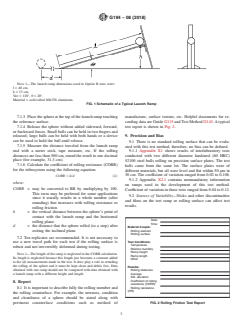
6.2 Fig. 1 shows a launch ramp schematic that includes the
plus effects from the relative stiffness of the contacting
necessary design elements of a suitable launch ramp. The
surfaces, the diameter (curvature) of the spherical shape
distance rolled after the spherical shape leaves the ramp (d) is
(ball, orange, etc.) and other factors. Because there are so
many factors involved in a rolling tribosystem, rolling resis- the test metric. These design elements are:
tance can best be quantified by an actual test of the sphere
(1)A vee shape to cradle the sphere.
of interest on the intended counterface, as in this test
(2)Areference surface that locates the sphere at the top of
method.
the ramp.
5.2 There are countless applications where it is important to
(3)Arampheight(h),length(l),andangles(veeandramp)
quantify the rolling characteristics of a particular spherical
(°) suitable for the size and mass of the sphere (Appendix
shape on a particular surface. The interlaboratory tests con-
X2.1).
ducted for this test method were performed on hardened steel
(4)The delivery end of the ramp must be tapered to
ballslikethoseusedinballbearings.Thistestmethodcouldbe
minimize “drop-off” as the sphere exit
...