


ASTM E213-22
(Practice)Standard Practice for Ultrasonic Testing of Metal Pipe and Tubing
Standard Practice for Ultrasonic Testing of Metal Pipe and Tubing
SIGNIFICANCE AND USE
5.1 The purpose of this practice is to outline a procedure for detecting and locating significant discontinuities such as pits, voids, inclusions, cracks, splits, etc., by the ultrasonic pulse-reflection method.
SCOPE
1.1 This practice2 covers a procedure for detecting discontinuities in metal pipe and tubing during a volumetric examination using ultrasonic methods. Specific techniques of the ultrasonic method to which this practice applies include pulse-reflection techniques, both contact and non-contact (for example, as described in Guide E1774 and Practice E1816), and angle beam immersion techniques, both conventional and phased array. Artificial reflectors consisting of longitudinal, and, when specified by the using party or parties, transverse reference notches placed on the surfaces of a reference standard are employed as the primary means of standardizing the ultrasonic system.
1.2 This practice is intended for use with tubular products having outside diameters approximately 1/2 in. (12.7 mm) and larger, provided that the examination parameters comply with and satisfy the requirements of Section 11. These procedures have been successful with smaller sizes. These may be specified upon contractual agreement between the using parties. These procedures are intended to ensure that proper beam angles and beam shapes are used to provide full volume coverage of pipes and tubes, including those with low ratios of outside diameter-to-wall thickness, and to avoid spurious signal responses when examining small-diameter, thin-wall tubes.
1.3 The procedure in Annex A1 is applicable to pipe and tubing used in nuclear and other special and safety applications. The procedure in Annex A2 may be used to determine the helical scan pitch.
1.4 This practice does not establish acceptance criteria; they must be specified by the using party or parties.
1.5 Units—The values stated in inch-pound units are to be regarded as standard. The values given in parentheses are mathematical conversions to SI units that are provided for information only and are not considered standard.
1.6 This standard does not purport to address all of the safety concerns, if any, associated with its use. It is the responsibility of the user of this standard to establish appropriate safety, health, and environmental practices and determine the applicability of regulatory limitations prior to use.
1.7 This international standard was developed in accordance with internationally recognized principles on standardization established in the Decision on Principles for the Development of International Standards, Guides and Recommendations issued by the World Trade Organization Technical Barriers to Trade (TBT) Committee.
General Information
- Status
- Published
- Publication Date
- 31-Jan-2022
- Technical Committee
- E07 - Nondestructive Testing
- Drafting Committee
- E07.06 - Ultrasonic Method
Relations
- Effective Date
- 01-Feb-2024
- Effective Date
- 01-Dec-2019
- Effective Date
- 01-Mar-2019
- Effective Date
- 01-Jan-2018
- Effective Date
- 15-Jun-2017
- Effective Date
- 01-Feb-2017
- Effective Date
- 01-Aug-2016
- Effective Date
- 01-Feb-2016
- Effective Date
- 01-Dec-2015
- Effective Date
- 01-Sep-2015
- Effective Date
- 01-Jun-2014
- Effective Date
- 01-Jun-2014
- Effective Date
- 01-Dec-2013
- Effective Date
- 15-Jun-2013
- Effective Date
- 01-Jun-2013
Overview
ASTM E213-22: Standard Practice for Ultrasonic Testing of Metal Pipe and Tubing establishes procedures for detecting discontinuities in metal pipe and tubing through ultrasonic testing using the pulse-reflection technique. Developed by ASTM Committee E07 on Nondestructive Testing, this international standard is widely adopted for ensuring the quality and integrity of metallic tubular products across a range of critical industries. The standard outlines best practices for volumetric examinations to identify significant defects, such as pits, cracks, inclusions, and splits, thereby helping manufacturers and inspectors maintain product safety and reliability.
Key Topics
- Scope of Application: Covers ultrasonic testing methods for metal pipe and tubing, typically with outside diameters of 1/2 inch (12.7 mm) and larger, but also applicable for smaller diameters by agreement.
- Ultrasonic Techniques: Includes pulse-reflection, both contact and non-contact (such as electromagnetic acoustic transducers [EMATs]), and angle beam immersion methods-conventional and phased array.
- Reference Standards: Utilizes artificial reflectors (longitudinal and, when specified, transverse notches) placed on reference standards to standardize equipment sensitivity and detection capabilities.
- Examination Procedures: Emphasizes full-volume coverage using appropriate beam angles and shapes to reduce false indications, particularly for small-diameter, thin-wall tubes. Scanning is recommended in circumferential directions for longitudinal defects and in axial directions for transverse defects.
- Personnel and Agency Qualifications: References internationally recognized qualification standards for nondestructive testing (NDT) personnel, such as SNT-TC-1A, ANSI/ASNT CP-189, ISO 9712, and NAS 410.
- Surface Preparation and Equipment Checks: Requires clean, prepared surfaces free of contaminants. Mandates periodic standardization and documentation of test equipment to ensure consistent and reliable results.
- Criteria and Reporting: Acceptance criteria and reporting requirements are to be defined by the using parties. The document specifies what examination data and system details should be archived for compliance and traceability.
Applications
ASTM E213-22 is critical for industries where pipe and tubing integrity is essential for safety, performance, and regulatory compliance, including:
- Oil and Gas: Supports the detection of hidden flaws in transportation pipelines and process tubing to prevent leaks and failures.
- Power Generation and Nuclear: Required for examining pipes and tubes in boilers, heat exchangers, and nuclear facilities where strict quality and safety standards apply.
- Aerospace and Defense: Used to inspect critical tubular components for structural integrity in both manufacturing and maintenance.
- Construction and Infrastructure: Ensures metal piping in water, gas, and HVAC systems is free from critical defects.
- Manufacturing: Integral to quality assurance protocols for suppliers and fabricators of metal tubular products.
By standardizing ultrasonic testing procedures, ASTM E213-22 helps organizations reduce the risk of in-service failures, improve product performance, and meet regulatory and customer requirements.
Related Standards
- ASTM E543 – Specification for Agencies Performing Nondestructive Testing
- ASTM E1065 – Practice for Evaluating Characteristics of Ultrasonic Search Units
- ASTM E1774 – Guide for Electromagnetic Acoustic Transducers (EMATs)
- ASTM E1816 – Practice for Measuring Thickness by Pulse-Echo EMAT Methods
- ASTM E1316 – Terminology for Nondestructive Examinations
- ASNT SNT-TC-1A – Recommended Practice for NDT Personnel Qualification
- ANSI/ASNT CP-189 – Standard for Qualification of NDT Personnel
- ISO 9712 – Non-destructive Testing - Qualification and Certification of NDT Personnel
- NAS 410 – Certification and Qualification of NDT Personnel
Keywords: ASTM E213-22, ultrasonic testing, nondestructive testing, NDT, pipe inspection, tubing inspection, pulse-reflection, phased array, reference standard, ultrasonic examination, metal pipe quality, defect detection.
For those seeking effective, internationally recognized ultrasonic testing of metal pipes and tubes, adoption of ASTM E213-22 ensures comprehensive inspection, traceability, and compliance with industry best practices.
Buy Documents
ASTM E213-22 - Standard Practice for Ultrasonic Testing of Metal Pipe and Tubing
REDLINE ASTM E213-22 - Standard Practice for Ultrasonic Testing of Metal Pipe and Tubing
Get Certified
Connect with accredited certification bodies for this standard

Institut za varilstvo d.o.o. (Welding Institute)
Slovenia's leading welding institute since 1952. ISO 3834, EN 1090, pressure equipment certification, NDT personnel, welder qualification. Only IIW Au
Sponsored listings
Frequently Asked Questions
ASTM E213-22 is a standard published by ASTM International. Its full title is "Standard Practice for Ultrasonic Testing of Metal Pipe and Tubing". This standard covers: SIGNIFICANCE AND USE 5.1 The purpose of this practice is to outline a procedure for detecting and locating significant discontinuities such as pits, voids, inclusions, cracks, splits, etc., by the ultrasonic pulse-reflection method. SCOPE 1.1 This practice2 covers a procedure for detecting discontinuities in metal pipe and tubing during a volumetric examination using ultrasonic methods. Specific techniques of the ultrasonic method to which this practice applies include pulse-reflection techniques, both contact and non-contact (for example, as described in Guide E1774 and Practice E1816), and angle beam immersion techniques, both conventional and phased array. Artificial reflectors consisting of longitudinal, and, when specified by the using party or parties, transverse reference notches placed on the surfaces of a reference standard are employed as the primary means of standardizing the ultrasonic system. 1.2 This practice is intended for use with tubular products having outside diameters approximately 1/2 in. (12.7 mm) and larger, provided that the examination parameters comply with and satisfy the requirements of Section 11. These procedures have been successful with smaller sizes. These may be specified upon contractual agreement between the using parties. These procedures are intended to ensure that proper beam angles and beam shapes are used to provide full volume coverage of pipes and tubes, including those with low ratios of outside diameter-to-wall thickness, and to avoid spurious signal responses when examining small-diameter, thin-wall tubes. 1.3 The procedure in Annex A1 is applicable to pipe and tubing used in nuclear and other special and safety applications. The procedure in Annex A2 may be used to determine the helical scan pitch. 1.4 This practice does not establish acceptance criteria; they must be specified by the using party or parties. 1.5 Units—The values stated in inch-pound units are to be regarded as standard. The values given in parentheses are mathematical conversions to SI units that are provided for information only and are not considered standard. 1.6 This standard does not purport to address all of the safety concerns, if any, associated with its use. It is the responsibility of the user of this standard to establish appropriate safety, health, and environmental practices and determine the applicability of regulatory limitations prior to use. 1.7 This international standard was developed in accordance with internationally recognized principles on standardization established in the Decision on Principles for the Development of International Standards, Guides and Recommendations issued by the World Trade Organization Technical Barriers to Trade (TBT) Committee.
SIGNIFICANCE AND USE 5.1 The purpose of this practice is to outline a procedure for detecting and locating significant discontinuities such as pits, voids, inclusions, cracks, splits, etc., by the ultrasonic pulse-reflection method. SCOPE 1.1 This practice2 covers a procedure for detecting discontinuities in metal pipe and tubing during a volumetric examination using ultrasonic methods. Specific techniques of the ultrasonic method to which this practice applies include pulse-reflection techniques, both contact and non-contact (for example, as described in Guide E1774 and Practice E1816), and angle beam immersion techniques, both conventional and phased array. Artificial reflectors consisting of longitudinal, and, when specified by the using party or parties, transverse reference notches placed on the surfaces of a reference standard are employed as the primary means of standardizing the ultrasonic system. 1.2 This practice is intended for use with tubular products having outside diameters approximately 1/2 in. (12.7 mm) and larger, provided that the examination parameters comply with and satisfy the requirements of Section 11. These procedures have been successful with smaller sizes. These may be specified upon contractual agreement between the using parties. These procedures are intended to ensure that proper beam angles and beam shapes are used to provide full volume coverage of pipes and tubes, including those with low ratios of outside diameter-to-wall thickness, and to avoid spurious signal responses when examining small-diameter, thin-wall tubes. 1.3 The procedure in Annex A1 is applicable to pipe and tubing used in nuclear and other special and safety applications. The procedure in Annex A2 may be used to determine the helical scan pitch. 1.4 This practice does not establish acceptance criteria; they must be specified by the using party or parties. 1.5 Units—The values stated in inch-pound units are to be regarded as standard. The values given in parentheses are mathematical conversions to SI units that are provided for information only and are not considered standard. 1.6 This standard does not purport to address all of the safety concerns, if any, associated with its use. It is the responsibility of the user of this standard to establish appropriate safety, health, and environmental practices and determine the applicability of regulatory limitations prior to use. 1.7 This international standard was developed in accordance with internationally recognized principles on standardization established in the Decision on Principles for the Development of International Standards, Guides and Recommendations issued by the World Trade Organization Technical Barriers to Trade (TBT) Committee.
ASTM E213-22 is classified under the following ICS (International Classification for Standards) categories: 23.040.10 - Iron and steel pipes. The ICS classification helps identify the subject area and facilitates finding related standards.
ASTM E213-22 has the following relationships with other standards: It is inter standard links to ASTM E1316-24, ASTM E1316-19b, ASTM E1316-19, ASTM E1316-18, ASTM E1316-17a, ASTM E1316-17, ASTM E1316-16a, ASTM E1316-16, ASTM E1316-15a, ASTM E1316-15, ASTM E1316-14, ASTM E1316-14e1, ASTM E1316-13d, ASTM E1316-13c, ASTM E1316-13b. Understanding these relationships helps ensure you are using the most current and applicable version of the standard.
ASTM E213-22 is available in PDF format for immediate download after purchase. The document can be added to your cart and obtained through the secure checkout process. Digital delivery ensures instant access to the complete standard document.
Standards Content (Sample)
This international standard was developed in accordance with internationally recognized principles on standardization established in the Decision on Principles for the
Development of International Standards, Guides and Recommendations issued by the World Trade Organization Technical Barriers to Trade (TBT) Committee.
Designation: E213 − 22
Standard Practice for
Ultrasonic Testing of Metal Pipe and Tubing
This standard is issued under the fixed designation E213; the number immediately following the designation indicates the year of
original adoption or, in the case of revision, the year of last revision.Anumber in parentheses indicates the year of last reapproval.A
superscript epsilon (´) indicates an editorial change since the last revision or reapproval.
1. Scope* 1.6 This standard does not purport to address all of the
safety concerns, if any, associated with its use. It is the
1.1 This practice covers a procedure for detecting discon-
responsibility of the user of this standard to establish appro-
tinuities in metal pipe and tubing during a volumetric exami-
priate safety, health, and environmental practices and deter-
nation using ultrasonic methods. Specific techniques of the
mine the applicability of regulatory limitations prior to use.
ultrasonic method to which this practice applies include
1.7 This international standard was developed in accor-
pulse-reflection techniques, both contact and non-contact (for
dance with internationally recognized principles on standard-
example, as described in Guide E1774 and Practice E1816),
ization established in the Decision on Principles for the
and angle beam immersion techniques, both conventional and
Development of International Standards, Guides and Recom-
phased array. Artificial reflectors consisting of longitudinal,
mendations issued by the World Trade Organization Technical
and, when specified by the using party or parties, transverse
Barriers to Trade (TBT) Committee.
reference notches placed on the surfaces of a reference
standard are employed as the primary means of standardizing
2. Referenced Documents
the ultrasonic system.
2.1 ASTM Standards:
1.2 This practice is intended for use with tubular products
E543Specification forAgencies Performing Nondestructive
having outside diameters approximately ⁄2 in. (12.7 mm) and
Testing
larger, provided that the examination parameters comply with
E1065Practice for Evaluating Characteristics of Ultrasonic
and satisfy the requirements of Section 11. These procedures
Search Units
have been successful with smaller sizes. These may be speci-
E1316Terminology for Nondestructive Examinations
fied upon contractual agreement between the using parties.
E1774Guide for Electromagnetic Acoustic Transducers
These procedures are intended to ensure that proper beam
(EMATs)
angles and beam shapes are used to provide full volume
E1816PracticeforMeasuringthicknessbyPulse-EchoElec-
coverage of pipes and tubes, including those with low ratios of
tromagnetic Acoustic Transducer (EMAT) Methods
outside diameter-to-wall thickness, and to avoid spurious 4
2.2 ASNT Documents:
signal responses when examining small-diameter, thin-wall
Recommended Practice SNT-TC-1A for Nondestructive
tubes.
Testing Personnel Qualification and Certification
1.3 The procedure in Annex A1 is applicable to pipe and ANSI/ASNT CP-189Standard for Qualification and Certifi-
tubing used in nuclear and other special and safety applica-
cation of Nondestructive Testing Personnel
tions. The procedure in Annex A2 may be used to determine 2.3 ISO Standard:
the helical scan pitch.
ISO 9712Non-destructive Testing— Qualification and Cer-
tification of NDT Personnel
1.4 Thispracticedoesnotestablishacceptancecriteria;they
2.4 AIA Document:
must be specified by the using party or parties.
NAS 410Certification and Qualification of Nondestructive
1.5 Units—The values stated in inch-pound units are to be
Testing Personnel
regarded as standard. The values given in parentheses are
mathematical conversions to SI units that are provided for
For referenced ASTM standards, visit the ASTM website, www.astm.org, or
information only and are not considered standard.
contact ASTM Customer Service at service@astm.org. For Annual Book of ASTM
Standards volume information, refer to the standard’s Document Summary page on
This practice is under the jurisdiction of ASTM Committee E07 on Nonde- the ASTM website.
structive Testing and is the direct responsibility of Subcommittee E07.06 on AvailablefromAmericanSocietyforNondestructiveTesting(ASNT),P.O.Box
Ultrasonic Method. 28518, 1711 Arlingate Ln., Columbus, OH 43228-0518, http://www.asnt.org.
Current edition approved Feb. 1, 2022. Published February 2022. Originally Available from International Organization for Standardization (ISO), ISO
approved in 1963. Last previous edition approved in 2020 as E213–20. DOI: Central Secretariat, BIBC II, Chemin de Blandonnet 8, CP 401, 1214 Vernier,
10.1520/E0213-22. Geneva, Switzerland, http://www.iso.org.
For ASME Boiler and Pressure Vessel Code applications, see related Practice Available from Aerospace Industries Association (AIA), 1000 Wilson Blvd.,
SE-213 in the Code. Suite 1700, Arlington, VA 22209, http://www.aia-aerospace.org.
*A Summary of Changes section appears at the end of this standard
Copyright © ASTM International, 100 Barr Harbor Drive, PO Box C700, West Conshohocken, PA 19428-2959. United States
E213 − 22
3. Terminology 5. Significance and Use
3.1 Definitions—For definitions of terms used in this
5.1 Thepurposeofthispracticeistooutlineaprocedurefor
practice, see Terminology E1316.
detecting and locating significant discontinuities such as pits,
voids, inclusions, cracks, splits, etc., by the ultrasonic pulse-
4. Summary of Practice reflection method.
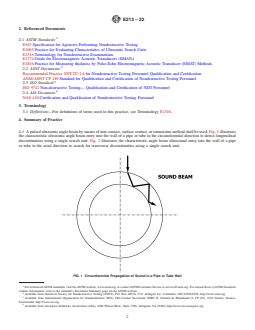
4.1 A pulsed ultrasonic angle beam by means of non-
6. Basis of Application
contact, surface contact, or immersion method shall be used.
Fig. 1 illustrates the characteristic ultrasonic angle beam entry
6.1 The following items are subject to contractual agree-
into the wall of a pipe or tube in the circumferential direction
ment between the parties using or referencing this practice.
todetectlongitudinaldiscontinuitiesusingasinglesearchunit.
6.2 If specified in the contractual agreement, personnel
Fig.2illustratesthecharacteristicanglebeamultrasoundentry
performing examinations to this practice shall be qualified in
into the wall of a pipe or tube in the axial direction to search
accordance with a nationally recognized NDTpersonnel quali-
for transverse discontinuities using a single search unit.
fication practice or standard such as ANSI/ASNT-CP-189,
NOTE1—Theimmersionmethodmayincludetanks,wheelsearchunits,
SNT-TC-1A, ISO 9712, NAS 410, or a similar document and
or systems that use streams or columns of liquid to couple the ultrasonic
certified by the employer or certifying agency, as applicable.
energy from the search unit to the material.
The practice or standard used and its applicable revision shall
4.2 To ensure detection of discontinuities that may not
be identified in the contractual agreement between the using
provide a favorable response from one side, scanning shall be
parties.
performed in both circumferential directions for longitudinal
6.3 Qualification of Nondestructive Agencies—If specified
discontinuitiesandwhenanaxialscanisspecifiedbytheusing
in the contractual agreement, NDT agencies shall be qualified
party or parties, in both axial directions for transverse discon-
and evaluated as described in Specification E543. The appli-
tinuities.
cable edition of Specification E543 shall be specified in the
4.3 For efficient examination of large quantities of material,
contractual agreement.
multiple search units and instruments may be used simultane-
6.4 Size and type of pipe or tubing to be examined.
ously to perform scanning in the required directions. Multiple
search units may be employed for “interlaced” scanning in 6.5 Procedures and Techniques—The procedures and tech-
eachrequireddirectiontoenablehigherexaminationratestobe niques to be utilized shall be as specified in the contractual
achieved through higher allowable scan index or “pitch.” agreement and should include:
FIG. 1 Circumferential Propagation of Sound in a Pipe or Tube Wall
E213 − 22
FIG. 2 Axial Propagation of Sound in a Pipe or Tube Wall
6.5.1 Type, dimension, location, and number of reference 8. Apparatus
reflectors to be placed in the reference standard,
8.1 Instruments shall be of the pulse echo type and shall be
6.5.2 Method(s) for measuring side versus side acoustic
capable of detecting the reference notches of the types de-
response of reference notches and tolerance limits,
scribed in Section 10 to the extent required in the standardiza-
6.5.3 Items that affect examination coverage may also be
tion procedure described in Section 11. An independent chan-
specified such as scan overlap, examination frequency, pulse
nel (or channels) of instrumentation shall be employed to
density, and maximum search unit size,
individually monitor the responses from the longitudinal and,
6.5.4 Sound beam orientation and number of beams used,
whenrequired,transverseorientedsearchunits.Theinstrument
6.5.5 Numberofdeadelementswithinaphasedarrayvirtual
pulse repetition rate per channel shall be capable of being
probe,
adjustedtoasufficientlyhighvaluetoensurenotchdetectionat
6.5.6 Procedure and use of distance amplitude
thescanningrateemployed.Theinstrumentshallbecapableof
compensation, and
this pulse repetition rate without false indications due to
6.5.7 Maximum time interval between equipment standard-
spurious reflections or interference from other instruments and
ization checks, if different from that described in 12.2, and the
searchunitsbeingusedforsimultaneousexaminationsinother
tolerance to be applied to a standardization check,
directions or along other scan paths.
6.6 The stage(s) in the manufacturing process at which the
8.1.1 The frequency and bandwidth of the instrument and
material will be examined.
search unit shall be capable of being selected to produce a
6.7 Surface Preparation—The pre-examination surface
satisfactory signal-to-noise ratio for the detection of the re-
preparation if additional requirements are necessary beyond quired notches as compared to background “noise” response
what is specified in Section 7.
fromirregularitiessuchasgrainboundariesandsurfacerough-
ness.
6.8 Reporting
6.8.1 Criteria for reportable and rejectable indications (ac-
8.2 Search unit frequency shall be selected to produce a
ceptance criteria), and
desirable “signal-to-noise” ratio (S/N), from the material to be
6.8.2 Requirements for permanent records of the response
examined, at the specified sensitivity.AS/N value of at least 3
from each tube, if applicable.
to 1 is usually considered to be minimum.Ahigher minimum
value is desirable and may be specified by the contracting
6.9 Reexamination of Repaired/Reworked Items—
agency.
Reexamination of repaired/reworked items is not addressed in
thispracticeandifrequiredshallbespecifiedinthecontractual 8.2.1 Select a search unit size, frequency, and refracted
agreement.
angle (or corresponding parameters for non-contact tech-
niques) to produce an approximate 45 degrees beam-center
7. Surface Condition
shear wave in the tube or pipe wall. For material with an
outside diameter-to-thickness ratio less than 7, a lower re-
7.1 Allsurfacesshallbecleanandfreeofscale,dirt,grease,
fracted angle (or corresponding parameters for non-contact
paint, or other foreign material that could interfere with
techniques) must be used to ensure intersection with the inside
interpretation of examination results. The methods used for
cleaning and preparing the surfaces for ultrasonic examination
shall not be detrimental to the base metal or the surface finish.
Excessive surface roughness or scratches can produce signals
that interfere with the examination.
E213 − 22
ultrasonic transmission when the tubing is precoated several hours before
surface. This does not ensure detection of midwall disconti-
the examination.
nuities (See Ref (1)).
8.2.2 Phased Array Transducers: Linear or Non-Linear
10. Reference Standards
Arrays—Each virtual probe in the array shall meet the appli-
cable requirements of a search unit as defined in 8.2.1. Virtual
10.1 Areference standard of a convenient length (see A1.4)
probe responses within an array shall be normalized to each
shall be prepared from a length of pipe or tube of the same
other for a defined beam profile.
nominal diameter, wall thickness, material, surface finish, and
8.2.3 For contact systems, the curvature of the contact
acoustical properties as the material to be examined. The
mechanism should match the tube outside diameter.
reference pipe or tube shall be free of discontinuities or other
conditions producing indications that can interfere with detec-
8.3 The positions of all conveyor and drive mechanisms
tion of the reference notches.
must be set to support and feed the material to be examined in
a stable manner and at the desired scan “pitch” (helix). For
10.2 Longitudinal and, when required by the contracting
small tubes, support mechanisms must be used in the exami-
agency, transverse reference notches shall be placed on both
nation station to prevent any transverse motion with respect to
the outside and inside surfaces of the reference standard to
the search unit beam during scanning. If larger material that is
ensure satisfactory examination sensitivity near each of these
not straight is to be examined, the search units may have to be
boundaries.
supported in a “follower” mechanism to compensate for this.
10.3 Reference notches shall be separated sufficiently (cir-
cumferentially or axially, or both) to preclude interference and
9. Couplant
interpretation difficulties.
9.1 For piezoelectric-based search units (non-contact tech-
10.4 All upset metal, burrs, etc., adjacent to the reference
niques do not require couplant), a couplant such as water, oil,
notches shall be removed.
or glycerin, capable of conducting ultrasonic vibrations be-
tweenthesearchunitandthepipeortubebeingexaminedshall
10.5 The notch dimensions and tolerances, which are
be used. Rust inhibitors, softeners, and wetting agents may be
length, depth, and width (and for V-notches, the included
added to the couplant. The couplant liquid with all the
angle) must be decided upon by the using party or parties,
additivesshallnotbedetrimentaltothesurfaceconditionofthe
unless specified otherwise by the product specification. Fig. 3
pipe or tube, and shall wet the surface of the material to
illustrates the common notch configurations and the dimen-
provide adequate coupling efficiency. To prevent spurious
sions to be measured (Note 3). Reflection amplitudes from V-,
signals or loss of sensitivity, or both, care must be taken to
square-, and U-shaped notches of comparable dimensions may
avoid the presence of air bubbles in the couplant. For contact,
varywidelydependingontheangle,frequency,andvibrational
squirter, or wheel-type systems, the equipment may use ultra-
mode of the interrogating sound beam.
sonic or other means/techniques to monitor the coupling to
NOTE 3—In Fig. 3 (a), ( b), and (d), the sharp corners are for ease of
ensure uninterrupted examination.
illustration. It is recognized that in normal machining practice, a radius
NOTE 2—In the contact method, some couplants result in better will be generated.
10.5.1 The notch depth shall be an average measured from
the circular tubing surface to the maximum and minimum
Theboldfacenumbersinparenthesesrefertothelistofreferencesattheendof
penetration of the notch. Measurements may be made by
this standard.
FIG. 3 Common Notch Shapes
E213 − 22
optical, replicating, or other agreed upon techniques. Unless 11.3 The pitch of the feed helix shall be small enough to
specified otherwise by the using party or parties, the notch ensureatleast100%coverageattheexaminationdistanceand
depth shall be within 60.0005 in. (0.013 mm) of the specified sensitivity established during standardization. Coverage shall
value for notches 0.005 in. (0.13 mm) or less in depth, and be based upon the maximum effective size of the search unit,
within+10,−15% of the specified value for notches over the pulse density for each instrument channel, and the helix.
0.005 in. in depth. At the option of the testing agency,
12. Procedure
shallower notches may be used to provide a more stringent
12.1 Examine the pipe or tubing with the ultrasound trans-
examination.
mitted in both circumferential directions for longitudinal dis-
NOTE 4—For as-rolled or scaly pipe or tube surfaces, it may be
continuities and, when specified, in both axial directions for
necessary to modify 10.5.1. Two acceptable modifications are listed
transverse discontinuities, under identical conditions used for
below. Modification (a) is preferred; however, modification (b) may be
equipment standardization (see Note 7).
used unless otherwise specified.
(a) The circular pipe or tube surface may be smoothed or prepared in the
NOTE 7—Identical conditions include all instrument settings, mechani-
notch area, or
calmotions,searchunitpositionandalignmentrelativetothepipeortube,
(b) The notch depth shall be within ±0.002 in. (0.051 mm), or + 10, − 15 %
liquid couplant, and any other factors that affect the performance of the
of the specified depth, whichever is greater.
examination.
10.5.2 When notch tolerances are specified by the using
12.2 Standardization Checks—Periodically check the dy-
party or parties, tolerances may often include only negative
namic standardization of the equipment by passing the refer-
values with zero positive deviation allowed so that sensitivity
ence standard through the examination system in accordance
is never reduced below a specified minimum value.The use of
with 11.2. Make these checks prior to any examination run,
smaller notches by the examination agency is permissible,
prior to equipment shutdown after an examination run, and at
provided that concurrence is obtained from the contracting
least every four hours during continuous equipment operation.
agency.
Restandardize the equipment in accordance with 11.1 and 11.2
any time the equipment fails to produce the signal amplitudes
NOTE5—Theamplitudeofindicationsobtainedfromreferencenotches
may not be linearly proportional to notch depth. This depends upon the
or other conditions for rejection within the tolerances agreed
transducer beam profile as well as the intercepting beam width to notch
upon with the contracting agency or the product manufactur-
length.
er’s procedure. In the event that the equipment does not meet
10.5.3 The width of the notches shall be as small as
this requirement, reexamine all pipe or tubing examined since
practical, but should not exceed twice the depth.
the last acceptable standardization after restandardization has
been accomplished.
10.6 Other types and orientations of reference reflectors
12.2.1 When required by the purchaser, more specific re-
may be specified by the using party or parties.
standardization criteria may be specified.
11. Standardization of Apparatus
12.3 For many tubular sizes and examination arrangements,
there will be a reflection from the entry surface of the pipe or
11.1 Static Standardization—Using the reference standard
tube.Thissignalmaybeobserved,butnotgatedforevaluation
specifiedinSection10,adjusttheequipmenttoproduceclearly
purposes, as a supplement to the required checking of the
identifiable indications from both the inner and outer surface
reference standard to provide increased assurance that the
notches.Theresponsefromtheinnerandoutersurfacenotches
equipment is functioning properly. If such a signal does not
shouldbeasnearlyequalaspossible.Usethelesserofthetwo
exist, make more frequent equipment standardization checks.
responses to establish the rejection level. On large diameter or
heavywallpipeandtubing,iftheinnerandoutersurfacenotch 12.4 Do not make any equipment adjustments, during
amplitudecannotbemadeequalbecauseofmaterialsoundpath examination, unless the complete standardization procedure
distance and inside diameter curvature, a separate rejection describedinSection11isperformedafteranysuchadjustment.
levelorgainmaybeestablishedfortheinnerandoutersurface
12.5 The examination shall be applied to 100% of the pipe
notches.
or tubing unless otherwise specified.
NOTE 6—Distance-Amplitude Correction—Amethod of compensating
NOTE 8—Some traversing mechanisms do not allow examination of
for the reduction in ultrasonic signal amplitude as a function of material
pipe or tube ends. When this condition exists, clearly indicate the extent
sound-path distance may be employed. Details of the procedures used to
of this effect, per tube, in the examination report.
establish and apply the distance-amplitude correction (DAC) curve shall
be established by the using party or parties. 13. Interpretation of Results
11.2 Dynamic Standardization—Standardize the equipment 13.1 All indications that are equal to or greater than the
under dynamic conditions that simulate the production exami- rejection level established during standardization as described
nation. The pipe or tubing to be examined and the search unit in Section 11, using the agreed upon reference indicators
assembly shall have a rotating translating motion relative to described in 10.5, shall be considered as representing defects
eachothersuchthatahelicalscanpathwillbedescribedonthe and may be cause for rejection of the pipe or tube.
outersurfaceofthepipeortube.Maintainthespeedofrotation Alternatively, the using party or parties may specify specific
and translation constant within 610%. Axial scanning with acceptance criteria or other means (manual or semi-automated
circumferential indexing may be used to provide equivalent techniques) to further evaluate the indication to determine its
coverage. acceptability.
E213 − 22
13.2 If, upon further examination of the pipe or tube, no contain recordings of all standardizations and standardization
rejectable indications are detected, the material shall be con- checks and should be annotated to provide a positive correla-
sidered as having passed the ultrasonic examination, except as tion between examination record for each reject pipe or tube
noted in 12.2. andthecorrespondingpipeortube.Thesuppliershallmaintain
a report of the examination on file. When requested by the
NOTE 9—Rejected pipe or tubes may be reworked in a manner
customer, a report of the examination shall be submitted to the
acceptable to the purchaser. If, upon ultrasonic reexamination of the
customer. The report shall include at least the following
reworked pipe or tube, no rejectable indications are detected, the material
should be considered as having passed the ultrasonic examination.
information:
NOTE 10—Care should be exercised to ensure that reworking a pipe or
14.2.1 Identification of the material by type, size, lot, heat
tube does not change its acceptability with respect to other requirements
treatment, and any other pertinent information.
ofthematerialspecificationsuchaswallthickness,ovality,surfacefinish,
14.2.2 Identification of the examination equipment and
length, and the like.
accessories.
14.2.3 Details of the examination technique, including ex-
14. Documentation
aminationspeed,examinationfrequency,andendeffectsifany.
14.1 When a report is required, it shall contain such
14.2.4 Description of the reference standard, including the
information as is mutually considered adequate to document
actual (measured) dimensions of the artificial reference reflec-
that the examination of the pipe or tubes supplied meets the
tors.
requirements of this practice, and any modifications specified
14.2.5 Description of the distance-amplitude correction
in the contractual agreement.
procedure, if used.
14.2 Whena“thirdparty”examinationisrequired,asmight 14.2.6 Examination results.
be performed by an independent examination facility, and to
15. Keywords
the extent specified in the contractual agreement, a permanent
recordcontainingobjectiveevidenceoftheexaminationresults 15.1 angle beam; nondestructive examination; pipe; tubing;
shall be obtained for each pipe or tube examined. It shall ultrasonic examination
ANNEXES
(Mandatory Information)
A1. EXAMINATION OF PIPE AND TUBING FOR SPECIAL AND SAFETY APPLICATIONS
A1.1 Introduction—When the end use of pipe or tubing generated by a cylindrically focused immersion search unit. In
depends critically upon freedom from discontinuities over a pipes and tubes with diameters several times larger than the
certain maximum size, certain additional ultrasonic examina- length of a con
...
This document is not an ASTM standard and is intended only to provide the user of an ASTM standard an indication of what changes have been made to the previous version. Because
it may not be technically possible to adequately depict all changes accurately, ASTM recommends that users consult prior editions as appropriate. In all cases only the current version
of the standard as published by ASTM is to be considered the official document.
Designation: E213 − 20 E213 − 22
Standard Practice for
Ultrasonic Testing of Metal Pipe and Tubing
This standard is issued under the fixed designation E213; the number immediately following the designation indicates the year of
original adoption or, in the case of revision, the year of last revision. A number in parentheses indicates the year of last reapproval. A
superscript epsilon (´) indicates an editorial change since the last revision or reapproval.
1. Scope*
1.1 This practice covers a procedure for detecting discontinuities in metal pipe and tubing during a volumetric examination using
ultrasonic methods. Specific techniques of the ultrasonic method to which this practice applies include pulse-reflection techniques,
both contact and non-contact (for example, as described in Guide E1774 and Practice E1816), and angle beam immersion
techniques, both conventional and phased array. Artificial reflectors consisting of longitudinal, and, when specified by the using
party or parties, transverse reference notches placed on the surfaces of a reference standard are employed as the primary means
of standardizing the ultrasonic system.
1.2 This practice is intended for use with tubular products having outside diameters approximately ⁄2 in. (12.7 mm) and larger,
provided that the examination parameters comply with and satisfy the requirements of Section 1211. These procedures have been
successful with smaller sizes. These may be specified upon contractual agreement between the using parties. These procedures are
intended to ensure that proper beam angles and beam shapes are used to provide full volume coverage of pipes and tubes, including
those with low ratios of outside diameter-to-wall thickness, and to avoid spurious signal responses when examining small-diameter,
thin-wall tubes.
1.3 The procedure in Annex A1 is applicable to pipe and tubing used in nuclear and other special and safety applications. The
procedure in Annex A2 may be used to determine the helical scan pitch.
1.4 This practice does not establish acceptance criteria; they must be specified by the using party or parties.
1.5 Units—The values stated in inch-pound units are to be regarded as standard. The values given in parentheses are mathematical
conversions to SI units that are provided for information only and are not considered standard.
1.6 This standard does not purport to address all of the safety concerns, if any, associated with its use. It is the responsibility
of the user of this standard to establish appropriate safety, health, and environmental practices and determine the applicability of
regulatory limitations prior to use.
1.7 This international standard was developed in accordance with internationally recognized principles on standardization
established in the Decision on Principles for the Development of International Standards, Guides and Recommendations issued
by the World Trade Organization Technical Barriers to Trade (TBT) Committee.
This practice is under the jurisdiction of ASTM Committee E07 on Nondestructive Testing and is the direct responsibility of Subcommittee E07.06 on Ultrasonic Method.
Current edition approved Jan. 15, 2020Feb. 1, 2022. Published January 2020February 2022. Originally approved in 1963. Last previous edition approved in 20142020
ε1
as E213 – 14E213 – 20. . DOI: 10.1520/E0213-20.10.1520/E0213-22.
For ASME Boiler and Pressure Vessel Code applications, see related Practice SE-213 in the Code.
*A Summary of Changes section appears at the end of this standard
Copyright © ASTM International, 100 Barr Harbor Drive, PO Box C700, West Conshohocken, PA 19428-2959. United States
E213 − 22
2. Referenced Documents
2.1 ASTM Standards:
E543 Specification for Agencies Performing Nondestructive Testing
E1065 Practice for Evaluating Characteristics of Ultrasonic Search Units
E1316 Terminology for Nondestructive Examinations
E1774 Guide for Electromagnetic Acoustic Transducers (EMATs)
E1816 Practice for Measuring thickness by Pulse-Echo Electromagnetic Acoustic Transducer (EMAT) Methods
2.2 ASNT Documents:
Recommended Practice SNT-TC-1A for Nondestructive Testing Personnel Qualification and Certification
ANSI/ASNT CP-189 Standard for Qualification and Certification of Nondestructive Testing Personnel
2.3 ISO Standard:
ISO 9712 Non-destructive Testing— Qualification and Certification of NDT Personnel
2.4 AIA Document:
NAS 410 Certification and Qualification of Nondestructive Testing Personnel
3. Terminology
3.1 Definitions—For definitions of terms used in this practice, see Terminology E1316.
4. Summary of Practice
4.1 A pulsed ultrasonic angle beam by means of non-contact, surface contact, or immersion method shall be used. Fig. 1 illustrates
the characteristic ultrasonic angle beam entry into the wall of a pipe or tube in the circumferential direction to detect longitudinal
discontinuities using a single search unit. Fig. 2 illustrates the characteristic angle beam ultrasound entry into the wall of a pipe
or tube in the axial direction to search for transverse discontinuities using a single search unit.
FIG. 1 Circumferential Propagation of Sound in a Pipe or Tube Wall
For referenced ASTM standards, visit the ASTM website, www.astm.org, or contact ASTM Customer Service at service@astm.org. For Annual Book of ASTM Standards
volume information, refer to the standard’s Document Summary page on the ASTM website.
Available from American Society for Nondestructive Testing (ASNT), P.O. Box 28518, 1711 Arlingate Ln., Columbus, OH 43228-0518, http://www.asnt.org.
Available from International Organization for Standardization (ISO), ISO Central Secretariat, BIBC II, Chemin de Blandonnet 8, CP 401, 1214 Vernier, Geneva,
Switzerland, http://www.iso.org.
Available from Aerospace Industries Association (AIA), 1000 Wilson Blvd., Suite 1700, Arlington, VA 22209, http://www.aia-aerospace.org.
E213 − 22
FIG. 2 Axial Propagation of Sound in a Pipe or Tube Wall
NOTE 1—The immersion method may include tanks, wheel search units, or systems that use streams or columns of liquid to couple the ultrasonic energy
from the search unit to the material.
4.2 To ensure detection of discontinuities that may not provide a favorable response from one side, scanning shall be performed
in both circumferential directions for longitudinal discontinuities and when an axial scan is specified by the using party or parties,
in both axial directions for transverse discontinuities.
4.3 For efficient examination of large quantities of material, multiple search units and instruments may be used simultaneously to
perform scanning in the required directions. Multiple search units may be employed for “interlaced” scanning in each required
direction to enable higher examination rates to be achieved through higher allowable scan index or “pitch.”
5. Significance and Use
5.1 The purpose of this practice is to outline a procedure for detecting and locating significant discontinuities such as pits, voids,
inclusions, cracks, splits, etc., by the ultrasonic pulse-reflection method.
6. Basis of Application
6.1 The following items are subject to contractual agreement between the parties using or referencing this practice.
6.2 If specified in the contractual agreement, personnel performing examinations to this practice shall be qualified in accordance
with a nationally recognized NDT personnel qualification practice or standard such as ANSI/ASNT-CP-189, SNT-TC-1A, ISO
9712, NAS 410, or a similar document and certified by the employer or certifying agency, as applicable. The practice or standard
used and its applicable revision shall be identified in the contractual agreement between the using parties.
6.3 Qualification of Nondestructive Agencies—If specified in the contractual agreement, NDT agencies shall be qualified and
evaluated as described in Specification E543. The applicable edition of Specification E543 shall be specified in the contractual
agreement.
6.4 Size and type of pipe or tubing to be examined.
6.5 Procedures and Techniques—The following are items that must be decided upon by the using party or parties.procedures and
techniques to be utilized shall be as specified in the contractual agreement and should include:
6.5.1 Size and type of pipe or tubing to be examined.Type, dimension, location, and number of reference reflectors to be placed
in the reference standard,
E213 − 22
6.5.2 Additional scanning for transverse discontinuities.Method(s) for measuring side versus side acoustic response of reference
notches and tolerance limits,
6.5.3 Items that affect examination coverage may also be specified such as scan overlap, examination frequency, pulse density, and
maximum search unit size.size,
6.5.4 The stage(s) in the manufacturing process at which the material will be examined.Sound beam orientation and number of
beams used,
6.5.5 Surface condition.Number of dead elements within a phased array virtual probe,
6.5.6 Procedure and use of distance amplitude compensation, and
6.5.7 Maximum time interval between equipment standardization checks, if different from that described in 13.212.2, and the
tolerance to be applied to a standardization check.check,
6.1.7 Type, dimensions, location, method of manufacture, and number of artificial reflectors to be placed on the reference standard.
6.1.8 Method(s) for measuring dimensions of artificial reflectors and tolerance limits if different than specified in Section 11.
6.1.9 Method(s) for measuring side versus side acoustic response of reference notches and tolerance limits.
6.1.10 Criteria for reportable and rejectable indications (acceptance criteria).
6.1.11 Reexamination of repaired/reworked items, if required or permitted, shall be specified in the contractual agreement.
6.1.12 Requirements for permanent records of the response from each tube, if applicable.
6.1.13 Contents of examination report.
6.1.14 Operator qualifications and certification, if required.
6.1.15 Qualification of Nondestructive Agencies. If specified in the contractual agreement, NDT agencies shall be qualified and
evaluated as described in Specification E543. The applicable edition of Specification E543 shall be specified in the contractual
agreement.
6.1.16 Level of personnel qualification. (See 7.1.)
6.6 The stage(s) in the manufacturing process at which the material will be examined.
6.7 Surface Preparation—The pre-examination surface preparation if additional requirements are necessary beyond what is
specified in Section 7.
6.8 Reporting
6.8.1 Criteria for reportable and rejectable indications (acceptance criteria), and
6.8.2 Requirements for permanent records of the response from each tube, if applicable.
6.9 Reexamination of Repaired/Reworked Items—Reexamination of repaired/reworked items is not addressed in this practice and
if required shall be specified in the contractual agreement.
7. Personnel Qualification
7.1 If specified in the contractual agreement, personnel performing examinations to this standard shall be qualified in accordance
with a nationally recognized NDT personnel qualification practice or standard such as ANSI/ASNT CP-189, SNT-TC-1A, ISO
E213 − 22
9712, NAS 410, or a similar document and certified by the employer or certifying agency, as applicable. The practice or standard
used and its applicable revision shall be identified in the contractual agreement between the using parties.
7. Surface Condition
7.1 All surfaces shall be clean and free of scale, dirt, grease, paint, or other foreign material that could interfere with interpretation
of examination results. The methods used for cleaning and preparing the surfaces for ultrasonic examination shall not be
detrimental to the base metal or the surface finish. Excessive surface roughness or scratches can produce signals that interfere with
the examination.
8. Apparatus
8.1 Instruments shall be of the pulse echo type and shall be capable of detecting the reference notches of the types described in
Section 1110 to the extent required in the standardization procedure described in Section 1211. An independent channel (or
channels) of instrumentation shall be employed to individually monitor the responses from the longitudinal and, when required,
transverse oriented search units. The instrument pulse repetition rate per channel shall be capable of being adjusted to a sufficiently
high value to ensure notch detection at the scanning rate employed. The instrument shall be capable of this pulse repetition rate
without false indications due to spurious reflections or interference from other instruments and search units being used for
simultaneous examinations in other directions or along other scan paths.
8.1.1 The frequency and bandwidth of the instrument and search unit shall be capable of being selected to produce a satisfactory
signal-to-noise ratio for the detection of the required notches as compared to background “noise” response from irregularities such
as grain boundaries and surface roughness.
8.2 Search unit frequency shall be selected to produce a desirable “signal-to-noise” ratio (S/N), from the material to be examined,
at the specified sensitivity. A S/N value of at least 3 to 1 is usually considered to be minimum. A higher minimum value is desirable
and may be specified by the contracting agency.
8.2.1 Select a search unit size, frequency, and refracted angle (or corresponding parameters for non-contact techniques) to produce
an approximate 45 degrees beam-center shear wave in the tube or pipe wall. For material with an outside diameter-to-thickness
ratio less than 7, a lower refracted angle (or corresponding parameters for non-contact techniques) must be used to ensure
intersection with the inside surface. This does not ensure detection of midwall discontinuities (See Ref (1)).
8.2.2 Phased Array Transducers: Linear or Non-Linear Arrays—Each virtual probe in the array shall meet the applicable
requirements of a search unit as defined in 8.2.1. Virtual probe responses within an array shall be normalized to each other for a
defined beam profile.
8.2.3 For contact systems, the curvature of the contact mechanism should match the tube outside diameter.
8.3 The positions of all conveyor and drive mechanisms must be set to support and feed the material to be examined in a stable
manner and at the desired scan “pitch” (helix). For small tubes, support mechanisms must be used in the examination station to
prevent any transverse motion with respect to the search unit beam during scanning. If larger material that is not straight is to be
examined, the search units may have to be supported in a “follower” mechanism to compensate for this.
9. Couplant
9.1 For piezoelectric-based search units (non-contact techniques do not require couplant), a couplant such as water, oil, or
glycerin, capable of conducting ultrasonic vibrations between the search unit and the pipe or tube being examined shall be used.
Rust inhibitors, softeners, and wetting agents may be added to the couplant. The couplant liquid with all the additives shall not
be detrimental to the surface condition of the pipe or tube, and shall wet the surface of the material to provide adequate coupling
efficiency. To prevent spurious signals or loss of sensitivity, or both, care must be taken to avoid the presence of air bubbles in the
couplant. For contact, squirter, or wheel-type systems, the equipment may use ultrasonic or other means/techniques to monitor the
coupling to ensure uninterrupted examination.
NOTE 2—In the contact method, some couplants result in better ultrasonic transmission when the tubing is precoated several hours before the examination.
The boldface numbers in parentheses refer to the list of references at the end of this standard.
E213 − 22
10. Reference Standards
10.1 A reference standard of a convenient length (see A1.4) shall be prepared from a length of pipe or tube of the same nominal
diameter, wall thickness, material, surface finish, and acoustical properties as the material to be examined. The reference pipe or
tube shall be free of discontinuities or other conditions producing indications that can interfere with detection of the reference
notches.
10.2 Longitudinal and, when required by the contracting agency, transverse reference notches shall be placed on both the outside
and inside surfaces of the reference standard to ensure satisfactory examination sensitivity near each of these boundaries.
10.3 Reference notches shall be separated sufficiently (circumferentially or axially, or both) to preclude interference and
interpretation difficulties.
10.4 All upset metal, burrs, etc., adjacent to the reference notches shall be removed.
10.5 The notch dimensions and tolerances, which are length, depth, and width (and for V-notches, the included angle) must be
decided upon by the using party or parties, unless specified otherwise by the product specification. Fig. 3 illustrates the common
notch configurations and the dimensions to be measured (Note 3). Reflection amplitudes from V-, square-, and U-shaped notches
of comparable dimensions may vary widely depending on the angle, frequency, and vibrational mode of the interrogating sound
beam.
NOTE 3—In Fig. 3 (a), ( b), and (d), the sharp corners are for ease of illustration. It is recognized that in normal machining practice, a radius will be
generated.
10.5.1 The notch depth shall be an average measured from the circular tubing surface to the maximum and minimum penetration
of the notch. Measurements may be made by optical, replicating, or other agreed upon techniques. Unless specified otherwise by
the using party or parties, the notch depth shall be within 60.0005 in. (0.013 mm) of the specified value for notches 0.005 in. (0.13
mm) or less in depth, and within + 10, − 15 % of the specified value for notches over 0.005 in. in depth. At the option of the testing
agency, shallower notches may be used to provide a more stringent examination.
NOTE 4—For as-rolled or scaly pipe or tube surfaces, it may be necessary to modify 11.5.110.5.1. Two acceptable modifications are listed below.
Modification (a) is preferred; however, modification (b) may be used unless otherwise specified.
(a) The circular pipe or tube surface may be smoothed or prepared in the
notch area, or
(b) The notch depth shall be within ±0.002 in. (0.051 mm), or + 10, − 15 %
of the specified depth, whichever is greater.
FIG. 3 Common Notch Shapes
E213 − 22
10.5.2 When notch tolerances are specified by the using party or parties, tolerances may often include only negative values with
zero positive deviation allowed so that sensitivity is never reduced below a specified minimum value. The use of smaller notches
by the examination agency is permissible, provided that concurrence is obtained from the contracting agency.
NOTE 5—The amplitude of indications obtained from reference notches may not be linearly proportional to notch depth. This depends upon the transducer
beam profile as well as the intercepting beam width to notch length.
10.5.3 The width of the notches shall be as small as practical, but should not exceed twice the depth.
10.6 Other types and orientations of reference reflectors may be specified by the using party or parties.
11. Standardization of Apparatus
11.1 Static Standardization—Using the reference standard specified in Section 1110, adjust the equipment to produce clearly
identifiable indications from both the inner and outer surface notches. The response from the inner and outer surface notches should
be as nearly equal as possible. Use the lesser of the two responses to establish the rejection level. On large diameter or heavy wall
pipe and tubing, if the inner and outer surface notch amplitude cannot be made equal because of material soundpath distance and
inside diameter curvature, a separate rejection level or gain may be established for the inner and outer surface notches.
NOTE 6—Distance-Amplitude Correction— A method of compensating for the reduction in ultrasonic signal amplitude as a function of material sound-path
distance may be employed. Details of the procedures used to establish and apply the distance-amplitude correction (DAC) curve shall be established by
the using party or parties.
11.2 Dynamic Standardization—Standardize the equipment under dynamic conditions that simulate the production examination.
The pipe or tubing to be examined and the search unit assembly shall have a rotating translating motion relative to each other such
that a helical scan path will be described on the outer surface of the pipe or tube. Maintain the speed of rotation and translation
constant within 610 %. Axial scanning with circumferential indexing may be used to provide equivalent coverage.
11.3 The pitch of the feed helix shall be small enough to ensure at least 100 % coverage at the examination distance and sensitivity
established during standardization. Coverage shall be based upon the maximum effective size of the search unit, the pulse density
for each instrument channel, and the helix.
12. Procedure
12.1 Examine the pipe or tubing with the ultrasound transmitted in both circumferential directions for longitudinal discontinuities
and, when specified, in both axial directions for transverse discontinuities, under identical conditions used for equipment
standardization (see Note 7).
NOTE 7—Identical conditions include all instrument settings, mechanical motions, search unit position and alignment relative to the pipe or tube, liquid
couplant, and any other factors that affect the performance of the examination.
12.2 Standardization Checks—Periodically check the dynamic standardization of the equipment by passing the reference standard
through the examination system in accordance with 12.211.2. Make these checks prior to any examination run, prior to equipment
shutdown after an examination run, and at least every four hours during continuous equipment operation. Restandardize the
equipment in accordance with 12.111.1 and 12.211.2 any time the equipment fails to produce the signal amplitudes or other
conditions for rejection within the tolerances agreed upon with the contracting agency or the product manufacturer’s procedure.
In the event that the equipment does not meet this requirement, reexamine all pipe or tubing examined since the last acceptable
standardization after restandardization has been accomplished.
12.2.1 When required by the purchaser, more specific restandardization criteria may be specified.
12.3 For many tubular sizes and examination arrangements, there will be a reflection from the entry surface of the pipe or tube.
This signal may be observed, but not gated for evaluation purposes, as a supplement to the required checking of the reference
standard to provide increased assurance that the equipment is functioning properly. If such a signal does not exist, make more
frequent equipment standardization checks.
E213 − 22
12.4 Do not make any equipment adjustments, during examination, unless the complete standardization procedure described in
Section 1211 is performed after any such adjustment.
12.5 The examination shall be applied to 100 % of the pipe or tubing unless otherwise specified.
NOTE 8—Some traversing mechanisms do not allow examination of pipe or tube ends. When this condition exists, clearly indicate the extent of this effect,
per tube, in the examination report.
13. Interpretation of Results
13.1 All indications that are equal to or greater than the rejection level established during standardization as described in Section
1211, using the agreed upon reference indicators described in 11.510.5, shall be considered as representing defects and may be
cause for rejection of the pipe or tube. Alternatively, the using party or parties may specify specific acceptance criteria or other
means (manual or semi-automated techniques) to further evaluate the indication to determine its acceptability.
13.2 If, upon further examination of the pipe or tube, no rejectable indications are detected, the material shall be considered as
having passed the ultrasonic examination, except as noted in 13.212.2.
NOTE 9—Rejected pipe or tubes may be reworked in a manner acceptable to the purchaser. If, upon ultrasonic reexamination of the reworked pipe or tube,
no rejectable indications are detected, the material should be considered as having passed the ultrasonic examination.
NOTE 10—Care should be exercised to ensure that reworking a pipe or tube does not change its acceptability with respect to other requirements of the
material specification such as wall thickness, ovality, surface finish, length, and the like.
14. Documentation
14.1 When a report is required, it shall contain such information as is mutually considered adequate to document that the
examination of the pipe or tubes supplied meets the requirements of this practice, and any modifications specified in the contractual
agreement.
14.2 When a “third party” examination is required, as might be performed by an independent examination facility, and to the
extent specified in the contractual agreement, a permanent record containing objective evidence of the examination results shall
be obtained for each pipe or tube examined. This may be in the form of a strip chart recording or computerized data of the
ultrasonic instrument output during the examination. It shall contain recordings of all standardizations and standardization checks
and should be annotated to provide a positive correlation between examination record for each reject pipe or tube and the
corresponding pipe or tube. The supplier shall maintain a report of the examination on file. When requested by the customer, a
report of the examination shall be submitted to the customer. The report shall include at least the following information:
14.2.1 Identification of the material by type, size, lot, heat treatment, and any other pertinent information.
14.2.2 Identification of the examination equipment and accessories.
14.2.3 Details of the examination technique, including examination speed, examination frequency, and end effects if any.
14.2.4 Description of the reference standard, including the actual (measured) dimensions of the artificial reference reflectors.
14.2.5 Description of the distance-
...
Questions, Comments and Discussion
Ask us and Technical Secretary will try to provide an answer. You can facilitate discussion about the standard in here.
Loading comments...