

ASTM D1282-18
(Test Method)Standard Test Method for Resistance to Airflow as an Indication of Average Fiber Diameter of Wool Top, Card Sliver, and Scoured Wool
General Information
- Abstract
SIGNIFICANCE AND USE
5.1 This test method is not recommended for the acceptance testing of commercial shipments of wool top, card sliver, or scoured wool since the referee method, Test Method D2130, is recommended for that purpose. Although this test method is not recommended for acceptance testing, it is useful for fast quality control checks.
5.1.1 If there are differences of practical significance between reported test results for two laboratories (or more), comparative test should be performed to determine if there is a statistical bias between them, using competent statistical assistance. As a minimum, use the samples for such a comparative test that are as homogenous as possible, drawn from the same lot of material as the samples that resulted in disparate results during initial testing and randomly assigned in equal numbers to each laboratory. The test results from the laboratories involved should be compared using a statistical test for unpaired data, a probability level chosen prior to the testing series. If bias is found, either its cause must be found and corrected, or future test results for that material must be adjusted in consideration of the known bias.
5.2 The specific area of the wool fibers is measured by the resistance in air flow. The resistance to air flow has been related to average fiber diameter measured by the microprojection method. The instruments have been calibrated to read average diameter in micrometres. Although the reading is affected by the average fiber diameter distribution of the specimen, the results secured by the instruments give no indication of this distribution. However, in converting the micrometres reading to millitex units (Annex A1), low, medium, and high standard deviations were used in the calculations to arrive at the range of millitex units which accordingly reflect the distribution of fiber diameters.
SCOPE
1.1 This test method covers the estimation of the average fiber diameter of wool fibers by use of the Port-Ar and the WIRA Fiber Fineness Meter instrument, which operate on the air-flow principle. Other air-flow instruments have not been tested with this method. The method is directly applicable to non-medullated, carded wool and wool top.
1.2 This test method is applicable to grease wool and scoured wool after the samples of such materials have been prepared as directed in Test Method D2130.
Note 1: The use of the Micronaire instrument for measuring the fineness of cotton fibers is covered in Test Method D1448.
The assignment of grade for wool and mohair is covered in Specifications D3991 and D3992.
1.3 This standard does not purport to address all of the safety concerns, if any, associated with its use. It is the responsibility of the user of this standard to establish appropriate safety, health, and environmental practices and determine the applicability of regulatory limitations prior to use.
1.4 This international standard was developed in accordance with internationally recognized principles on standardization established in the Decision on Principles for the Development of International Standards, Guides and Recommendations issued by the World Trade Organization Technical Barriers to Trade (TBT) Committee.
- Status
- Published
- Publication Date
- 30-Jun-2018
- Technical Committee
- D13 - Textiles
- Drafting Committee
- D13.13 - Wool and Felt
Overview
ASTM D1282-18 is the international standard test method established by ASTM International for determining the resistance to airflow as an indication of average fiber diameter in wool top, card sliver, and scoured wool. This standard is directly applicable to non-medullated, carded wool and wool top and utilizes specific instruments, namely the Port-Ar and WIRA Fiber Fineness Meter, that operate on the air-flow principle.
The primary purpose of this method is to provide a rapid quality control check for the average fiber diameter in wool processing facilities. While it is not recommended for acceptance testing of commercial shipments-where Test Method ASTM D2130 is preferred-it is valuable for routine monitoring of fiber characteristics during production.
Key Topics
- Airflow Principle: The method measures resistance to airflow through a prepared wool specimen and correlates this resistance with average fiber diameter, as calibrated by the microprojection method.
- Applicable Instruments: Only the Port-Ar and WIRA Fiber Fineness Meter are covered, as these have been specifically tested and calibrated for this standard.
- Sample Preparation & Calibration: Proper sample conditioning, instrument calibration, and solvent use (such as trichloroethane) are essential for accurate results.
- Statistical Consideration: Comparative testing and statistical analysis are recommended if significant differences arise between laboratory results.
- Distribution Awareness: While the method reports average fiber diameter, it does not provide direct information about fiber diameter distribution; this is reflected in conversion to millitex units using various standard deviations.
Applications
ASTM D1282-18 has broad applicability in the wool and textile industry, particularly for:
- Quality Control: Enabling mill and laboratory technicians to quickly monitor average wool fiber diameter during carding, combing, and scouring processes.
- In-Process Checks: Supporting operational decisions by providing rapid feedback, facilitating adjustments to ensure product consistency.
- Wool Grading: Assisting in preliminary assessment of wool fineness before more detailed or referee testing.
- Research and Development: Providing reliable, repeatable test data for studies related to wool processing, fiber fineness, and product development.
While not recommended for commercial acceptance testing, ASTM D1282-18 allows organizations to maintain quality standards, minimize variability, and optimize processing conditions in a production environment.
Related Standards
ASTM D1282-18 references several related standards and industry documents critical to wool testing and terminology:
- ASTM D2130: Referee test method for wool fiber diameter determination by microprojection.
- ASTM D3991 & D3992: Specifications for fineness and grade assignment of wool, mohair, and wool top.
- ASTM D4845: Terminology relating to wool.
- ASTM D1060: Practice for core sampling of raw wool in packages.
- ASTM D1448: Test method for cotton fiber fineness using the Micronaire instrument.
- IWTO-6-92(E) & IWTO-28-82(E): Air-flow methods developed by the International Wool Textile Organization for mean fiber diameter determination.
These referenced standards ensure a common language and procedural framework for fiber diameter testing across global textile laboratories.
Keywords: ASTM D1282-18, wool fiber diameter, resistance to airflow, Port-Ar, WIRA Fiber Fineness Meter, wool quality control, scoured wool, card sliver, fiber fineness testing, textile standards, wool grading.
Relations
- Effective Date
- 01-Jul-2018
- Effective Date
- 01-Jul-2018
- Effective Date
- 01-Jul-2018
- Effective Date
- 01-Mar-2017
- Effective Date
- 15-Sep-2015
- Effective Date
- 01-Sep-2015
- Effective Date
- 01-Apr-2015
- Effective Date
- 15-Jun-2013
- Effective Date
- 15-Jun-2013
- Effective Date
- 15-May-2013
- Effective Date
- 01-Feb-2012
- Effective Date
- 01-Feb-2012
- Effective Date
- 01-Jan-2011
- Effective Date
- 01-Jun-2010
- Effective Date
- 01-Jun-2010
Get Certified
Connect with accredited certification bodies for this standard

Control Union Certifications
Global certification for agriculture and sustainability.

Hohenstein Institut
Textile testing and certification.

Bureau Veritas Bangladesh
Bureau Veritas certification services in Bangladesh.
Sponsored listings
Frequently Asked Questions
ASTM D1282-18 is a standard published by ASTM International. Its full title is "Standard Test Method for Resistance to Airflow as an Indication of Average Fiber Diameter of Wool Top, Card Sliver, and Scoured Wool". This standard covers: SIGNIFICANCE AND USE 5.1 This test method is not recommended for the acceptance testing of commercial shipments of wool top, card sliver, or scoured wool since the referee method, Test Method D2130, is recommended for that purpose. Although this test method is not recommended for acceptance testing, it is useful for fast quality control checks. 5.1.1 If there are differences of practical significance between reported test results for two laboratories (or more), comparative test should be performed to determine if there is a statistical bias between them, using competent statistical assistance. As a minimum, use the samples for such a comparative test that are as homogenous as possible, drawn from the same lot of material as the samples that resulted in disparate results during initial testing and randomly assigned in equal numbers to each laboratory. The test results from the laboratories involved should be compared using a statistical test for unpaired data, a probability level chosen prior to the testing series. If bias is found, either its cause must be found and corrected, or future test results for that material must be adjusted in consideration of the known bias. 5.2 The specific area of the wool fibers is measured by the resistance in air flow. The resistance to air flow has been related to average fiber diameter measured by the microprojection method. The instruments have been calibrated to read average diameter in micrometres. Although the reading is affected by the average fiber diameter distribution of the specimen, the results secured by the instruments give no indication of this distribution. However, in converting the micrometres reading to millitex units (Annex A1), low, medium, and high standard deviations were used in the calculations to arrive at the range of millitex units which accordingly reflect the distribution of fiber diameters. SCOPE 1.1 This test method covers the estimation of the average fiber diameter of wool fibers by use of the Port-Ar and the WIRA Fiber Fineness Meter instrument, which operate on the air-flow principle. Other air-flow instruments have not been tested with this method. The method is directly applicable to non-medullated, carded wool and wool top. 1.2 This test method is applicable to grease wool and scoured wool after the samples of such materials have been prepared as directed in Test Method D2130. Note 1: The use of the Micronaire instrument for measuring the fineness of cotton fibers is covered in Test Method D1448. The assignment of grade for wool and mohair is covered in Specifications D3991 and D3992. 1.3 This standard does not purport to address all of the safety concerns, if any, associated with its use. It is the responsibility of the user of this standard to establish appropriate safety, health, and environmental practices and determine the applicability of regulatory limitations prior to use. 1.4 This international standard was developed in accordance with internationally recognized principles on standardization established in the Decision on Principles for the Development of International Standards, Guides and Recommendations issued by the World Trade Organization Technical Barriers to Trade (TBT) Committee.
SIGNIFICANCE AND USE 5.1 This test method is not recommended for the acceptance testing of commercial shipments of wool top, card sliver, or scoured wool since the referee method, Test Method D2130, is recommended for that purpose. Although this test method is not recommended for acceptance testing, it is useful for fast quality control checks. 5.1.1 If there are differences of practical significance between reported test results for two laboratories (or more), comparative test should be performed to determine if there is a statistical bias between them, using competent statistical assistance. As a minimum, use the samples for such a comparative test that are as homogenous as possible, drawn from the same lot of material as the samples that resulted in disparate results during initial testing and randomly assigned in equal numbers to each laboratory. The test results from the laboratories involved should be compared using a statistical test for unpaired data, a probability level chosen prior to the testing series. If bias is found, either its cause must be found and corrected, or future test results for that material must be adjusted in consideration of the known bias. 5.2 The specific area of the wool fibers is measured by the resistance in air flow. The resistance to air flow has been related to average fiber diameter measured by the microprojection method. The instruments have been calibrated to read average diameter in micrometres. Although the reading is affected by the average fiber diameter distribution of the specimen, the results secured by the instruments give no indication of this distribution. However, in converting the micrometres reading to millitex units (Annex A1), low, medium, and high standard deviations were used in the calculations to arrive at the range of millitex units which accordingly reflect the distribution of fiber diameters. SCOPE 1.1 This test method covers the estimation of the average fiber diameter of wool fibers by use of the Port-Ar and the WIRA Fiber Fineness Meter instrument, which operate on the air-flow principle. Other air-flow instruments have not been tested with this method. The method is directly applicable to non-medullated, carded wool and wool top. 1.2 This test method is applicable to grease wool and scoured wool after the samples of such materials have been prepared as directed in Test Method D2130. Note 1: The use of the Micronaire instrument for measuring the fineness of cotton fibers is covered in Test Method D1448. The assignment of grade for wool and mohair is covered in Specifications D3991 and D3992. 1.3 This standard does not purport to address all of the safety concerns, if any, associated with its use. It is the responsibility of the user of this standard to establish appropriate safety, health, and environmental practices and determine the applicability of regulatory limitations prior to use. 1.4 This international standard was developed in accordance with internationally recognized principles on standardization established in the Decision on Principles for the Development of International Standards, Guides and Recommendations issued by the World Trade Organization Technical Barriers to Trade (TBT) Committee.
ASTM D1282-18 is classified under the following ICS (International Classification for Standards) categories: 59.060.10 - Natural fibres. The ICS classification helps identify the subject area and facilitates finding related standards.
ASTM D1282-18 has the following relationships with other standards: It is inter standard links to ASTM D1282-05(2009), ASTM D4845-10(2018), ASTM D1060-10(2018), ASTM D123-17, ASTM D123-15b, ASTM D123-15a, ASTM D123-15, ASTM D123-13ae1, ASTM D123-13a, ASTM D123-13, ASTM D123-12e1, ASTM D123-12, ASTM D1448-11, ASTM D1060-10, ASTM D4845-10e1. Understanding these relationships helps ensure you are using the most current and applicable version of the standard.
ASTM D1282-18 is available in PDF format for immediate download after purchase. The document can be added to your cart and obtained through the secure checkout process. Digital delivery ensures instant access to the complete standard document.
Standards Content (Sample)
This international standard was developed in accordance with internationally recognized principles on standardization established in the Decision on Principles for the
Development of International Standards, Guides and Recommendations issued by the World Trade Organization Technical Barriers to Trade (TBT) Committee.
Designation:D1282 −18
Standard Test Method for
Resistance to Airflow as an Indication of Average Fiber
Diameter of Wool Top, Card Sliver, and Scoured Wool
This standard is issued under the fixed designation D1282; the number immediately following the designation indicates the year of
original adoption or, in the case of revision, the year of last revision.Anumber in parentheses indicates the year of last reapproval.A
superscript epsilon (´) indicates an editorial change since the last revision or reapproval.
1. Scope D2130TestMethodforDiameterofWoolandOtherAnimal
Fibers by Microprojection
1.1 This test method covers the estimation of the average
D3991Specifications for Fineness of Wool or Mohair and
fiber diameter of wool fibers by use of the Port-Ar and the
Assignment of Grade
WIRAFiber Fineness Meter instrument, which operate on the
D3992Specifications for Fineness of Wool Top or Mohair
air-flow principle. Other air-flow instruments have not been
Top and Assignment of Grade
tested with this method. The method is directly applicable to
D4845Terminology Relating to Wool
non-medullated, carded wool and wool top.
2.2 Other Standard:
1.2 This test method is applicable to grease wool and
IWTO-6-92(E) MethodofTestfortheDeterminationofThe
scoured wool after the samples of such materials have been
Mean Diameter of Wool Fibers in Combed Sliver Using
prepared as directed in Test Method D2130.
the Air-Flow Apparatus
NOTE 1—The use of the Micronaire instrument for measuring the IWTO-28-82(E)Determination By The Airflow Method of
fineness of cotton fibers is covered in Test Method D1448.
the Mean Fibre Diameter of Core Samples of Raw Wool
The assignment of grade for wool and mohair is covered in Specifica-
tions D3991 and D3992.
3. Terminology
1.3 This standard does not purport to address all of the
3.1 For all terminology related to wool and wool felt, refer
safety concerns, if any, associated with its use. It is the
to Terminology D4845.
responsibility of the user of this standard to establish appro-
3.1.1 The following terms are relevant to this standard:
priate safety, health, and environmental practices and deter-
sliver, specific area, top, and wool.
mine the applicability of regulatory limitations prior to use.
3.2 For all other terminology related to textiles, see Termi-
1.4 This international standard was developed in accor-
nology D123.
dance with internationally recognized principles on standard-
ization established in the Decision on Principles for the
4. Summary of Test Method
Development of International Standards, Guides and Recom-
mendations issued by the World Trade Organization Technical 4.1 The resistance to air flow of predetermined mass of
Barriers to Trade (TBT) Committee. wool compressed to a fixed volume is measured. The instru-
ments approved for use have been calibrated to read average
2. Referenced Documents
diameterinmicrometres.Specimensofwooltopareratedwith
2.1 ASTM Standards:
a Wool Top Scale and specimens of carded, scoured wool and
D123Terminology Relating to Textiles
scoured ⁄2-in. (13.0-mm) cores are rated with a Scoured Wool
D1060PracticeforCoreSamplingofRawWoolinPackages
Scale. If instruments are properly calibrated, results are inter-
for Determination of Percentage of Clean Wool Fiber
changeable.
Present
5. Significance and Use
D1448Test Method for Micronaire Reading of Cotton Fi-
bers
5.1 Thistestmethodisnotrecommendedfortheacceptance
testing of commercial shipments of wool top, card sliver, or
ThistestmethodisunderthejurisdictionofASTMCommitteeD13onTextiles
scoured wool since the referee method,Test Method D2130,is
and is the direct responsibility of Subcommittee D13.13 on Wool and Felt.
recommended for that purpose. Although this test method is
CurrenteditionapprovedJuly1,2018.PublishedJuly2018.Originallyapproved
not recommended for acceptance testing, it is useful for fast
in 1953. Last previous edition approved in 2005 as D1282–05 (2009) which was
withdrawn January 2018 and reinstated in July 2018. DOI: 10.1520/D1282-18.
quality control checks.
For referenced ASTM standards, visit the ASTM website, www.astm.org, or
5.1.1 If there are differences of practical significance be-
contact ASTM Customer Service at service@astm.org. For Annual Book of ASTM
tween reported test results for two laboratories (or more),
Standards volume information, refer to the standard’s Document Summary page on
the ASTM website. comparative test should be performed to determine if there is a
Copyright © ASTM International, 100 Barr Harbor Drive, PO Box C700, West Conshohocken, PA 19428-2959. United States
D1282−18
1) Balance Adjustment Knob 8) Porosity Calibration Control
2) Balance Pan 9) Compression Lever
3) Air Reservoir 10) Calibrator Plug Plunger
4) Meter Zero Adjustment Screw 11) Porosity Calibrator Plug
5) Porosity Test Chamber Lid 12) Calibration Weight
6) Differential Pressure Gage 13) Weighing Balance Mechanism
7) Porosity Zero Control 14) Atomizer Bulb
FIG. 1 Port-Ar Apparatus
statistical bias between them, using competent statistical assis-
tance.As a minimum, use the samples for such a comparative
test that are as homogenous as possible, drawn from the same
lot of material as the samples that resulted in disparate results
during initial testing and randomly assigned in equal numbers
to each laboratory. The test results from the laboratories
involved should be compared using a statistical test for
unpaired data, a probability level chosen prior to the testing
series. If bias is found, either its cause must be found and
corrected, or future test results for that material must be
adjusted in consideration of the known bias.
5.2 The specific area of the wool fibers is measured by the
resistanceinairflow.Theresistancetoairflowhasbeenrelated
to average fiber diameter measured by the microprojection
method. The instruments have been calibrated to read average
diameter in micrometres. Although the reading is affected by
the average fiber diameter distribution of the specimen, the
1) Metal specimen container 6) Gage tube
results secured by the instruments give no indication of this
2) Packing rod 7) Millimetre scale
distribution. However, in converting the micrometres reading
3) Plunger 8) Vacuum supply
4) Retaining collar 9) Upper gage tube mark
to millitex units (AnnexA1), low, medium, and high standard
5) Control knob 10) Lower gage tube mark
deviations were used in the calculations to arrive at the range
of millitex units which accordingly reflect the distribution of
FIG. 2 WIRA Fiber Fineness Meter
fiber diameters.
D1282−18
between shipping containers, between laboratory samples within a ship-
6. Apparatus, Materials, and Reagent
pingcontainer,andbetweenspecimenswithinalaboratorysamplesoasto
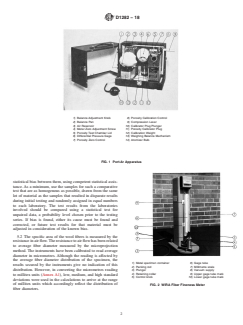
6.1 Port-Ar , described in this method and shown in Fig. 1.
provide a sampling plan which at the specified level of the property of
interest has a meaningful producer’s risk, consumer’s risk, acceptable
6.2 WIRA Fiber Fineness Meter , described in this method
quality level, and limiting quality level.
and shown in Fig. 2.
9.2 Laboratory Sample—As a laboratory sample for ac-
6.2.1 Scale graduated in millimetres.
ceptance testing, take the number of subsamples from each
6.2.2 Calibrationchartconvertingfloatheightinmillimetres
package in the lot sample as directed in an applicable material
to diameter in micrometres.
specificationorotheragreementbetweenthepurchaserandthe
6.2.3 Air pump capable of furnishing a constant vacuum of
supplier, such as an agreement to use Practice D1060 if baled
609.6 mm (24 in.) of mercury.
or bagged wool is to be tested.
6.2.4 Tables of correction values to correct observed results
in micrometres to deviations from standard conditions, 20°C
9.3 Test Specimens:
(68°F) and 65% relative humidity, as shown in Annex A2.
9.3.1 Port-Ar Procedure—Take one specimen per labora-
tory sampling unit.
6.3 Trichloroethane or equivalent solvent.
9.3.2 Wira Procedure—Take one specimen per laboratory
6.4 Working Reference Samples, three, prepared by each
sampling unit.
laboratory for use in checking the instruments. One working
referencesampleshouldbeselectedfromeachofthefollowing
10. Specimen Preparation
ranges of grade: (1) up to and including 48’s, (2) 50’s to 60’s
10.1 Prepare test specimens of wool top, card sliver,
inclusive, and (3) 62’s or finer. These samples of uniform
scoured, or grease wool as directed in Test Method D2130.
fineness with a low standard deviation, as explained inAppen-
10.2 Ifnomechanicalcardisavailable,taketwosubsamples
dix A1.1, must be thoroughly tested both by the air-flow
of scoured wool, each weighing approximately 4g more than
instrument being used and by the microprojection method.
the mass of wool required for measurement in the air-flow
6.5 StandardReferenceSamples —Threesamplesareavail-
instrument being used; hand card these subsamples at least 30
able with the following average fiber diameters: 20.7 µm, 27.3
strokes each and prepare a test specimen from each of them.
µm and 37.4 µm.
10.3 Rinsealltestspecimensintherecommendedsolventto
7. Hazards
reduce the extractable matter to less than 1% of the specimen
mass. Condition the test specimens as prescribed in 11.1 or
7.1 Refer to the manufacturer’s material safety data sheet
11.2.Fromtheconditionedtestspecimen,weightheamountof
for information on handling, use, storage, and disposal of
wool required for measurement in the air-flow instrument
trichloroethane or equivalent solvent.
being used.
7.2 Use trichloroethane or equivalent solvent in well-
10.3.1 Port-Ar—Place approximately 12.5g of the condi-
ventilated hood due to the associated health hazards.
tioned wool specimen in the balance basket. One pump of the
atomizerbulbwillindicatewhetherthespecimenistoolightor
8. Calibration of Apparatus
too heavy: If the meter reads above the red triangle, the
8.1 Calibrate the instrument on arrival in accordance with
specimen is too heavy; if below, the specimen is too light.
instructions in Annex A2.
Adjust the specimen to 12.5g by adding or removing small
amountsofwool.Themeterindicatesthemassofthespecimen
8.2 Recalibrate the instrument each day. Verify calibration
to within6 0.5% if the pointer is on scale, so the mass needs
after each 4h of use or whenever an operational problem is
to be adjusted only until the pointer reads within the red
noted.
triangle.
9. Sampling
NOTE 3—The accuracy of the balance should be thoroughly checked
9.1 Lot Sample—For acceptance testing, take at random the before and while using the Port-Ar. The specimen may be weighed on a
separate balance.
number of shipping containers directed in an applicable mate-
rialspecificationorotheragreementbetweenthepurchaserand
10.3.2 WIRA Fiber Fineness Meter—Weigh a 2.500 6
the supplier, such as an agreement to use Practice D1060.
0.005 g test specimen. Remove pieces of vegetable matter and
Considershippingcontainerstobetheprimarysamplingunits.
other impurities before weighing.
NOTE 2—A realistic specification or other agreement between the
11. Conditioning
purchaser and the supplier requires taking into account the variability
11.1 For tests made on the Port-Ar as directed in 11.2,
reasonable results may be obtained even if the standard
The Port-Ar instrument, trademark for a product manufactured by Zellweger
atmosphere for testing is not available since the instrument
Uster, 456 Troy Circle, P.O. Box 51720, Knoxville, TN 37950, has been found
uses low-pressure ambient air. Keep the instrument in a
satisfactory for this purpose.
draft-free room, away from radiators, sunlight, and other
The WIRA Fiber Fineness Meter, trademark for a product manufactured by
Reynolds and Branson Ltd., for Thorn Bendix Ltd., Beech Ave., New Barford,
elements which disturb temperature or air. Allow the instru-
Nottingham NG7 7JJ England.This instrument is available from Lawson-Hemphill
ment and the well-opened wool to be tested to remain in the
Sales, Inc., P.O. Drawer 6388, Spartanburg, SC 29304.
same atmospheric conditions for approximately 4h before the
May be obtained from Agricultural Marketing Service, Livestock and Seed
Division, 711 “O” Street, Greeley, CO 80631. specimens are tested.
D1282−18
11.2 For tests made on the WIRA Fiber Fineness meter as 12.2.6 For wool above 30 micrometres make four readings
directed in 12.2, bring the test specimen to moisture equilib- on each of four weighings and for wool of 30 micrometres or
riumwiththestandardatmosphere.A4hconditioningperiodis less make four readings on each of three weighings.
usually sufficient.
13. Calculation
12. Procedure
13.1 Calculate the average fiber diameter of the lot from all
12.1 Procedure with the Port-Ar:
the readings, to the nearest 0.05 µm.
12.1.1 WoolTop,CardSliver,ScouredWool,GreaseWool—
Usingtheweighedtestspecimen,(see10.3.1)placeoneendof
14. Report
the sliver in the chamber and tamp in the remainder. Do not
fold the wool top before placing in the chamber. When all of
14.1 State that the specimens were tested as directed inTest
the specimen has been forced into the chamber, close the Method D1282. Describe the material or product sampled and
compression chamber lid, 5, in place. Pull forward on the
the method of sampling used.
compression lever, 9, until it locks in place.Apply air pressure
14.2 Report the following information:
either by the atomizer bulb or by the electric pump to fill the
14.2.1 The average fiber diameter to the nearest 0.05 µm.
pressure tank (Note 3). Read the diameter in micrometres on
14.2.2 The number of test specimens used and the number
the scale as the piston settles. Record the reading and remove
of readings made on each specimen.
thespecimen,carefullyreopenitbyhandtoeliminatecompact
areas, replace the specimen in the chamber and make a second
14.2.3 The solvent used if not trichloroethane.
reading.
14.2.4 For the Port-Ar, the conditions under which the
testing was carried out, if the standard atmosphere for testing
NOTE 4—In using the electric pump, some operators find continuous
operation advantageous. Satisfactory results will be obtained in this case was not used, and if the instrument was calibrated using the
if calibration adjustments are also made with the pump running continu-
standardcalibrationswitchplunger,10,orwell-measuredwool
ously.Asmall reservoir tank or “bladder” mounted in the air line between
samples.
the pump and the instrument will reduce needle vibration.
NOTE 5—Port-Ar instrument described in Fig. 1 is calibrated for wool
15. Precision and Bias
grade (Top and wool). Port-Ar instrument is also available for measuring
mohair fibers.
15.1 Summary—In comparing two averages, the differences
12.2 Procedure with the WIRA Fiber Fineness Meter:
shouldnotexceedthefollowingcriticaldifferencesin95cases
12.2.1 Feed the weighed specimen into the metal container,
out of 100 when all of the observations are taken by the same
meanwhile pushing the wool down evenly into the container
well-trained operator using the same piece of test equipment
with the short end of the rod provided. It is important to use
and specimens randomly drawn from the same sample of
this rod and nothing else for packing since it prevents tight
material.
packingofthefibers.Thenpushinthemetalplunger(avoiding
Fiber Diameter, 0.40
trapping any fibers) until it rests on the lip of the container and
Port-Ar Procedure
screw down the retaining collar to the furthest extent, mean- Fiber Diameter, 0.45
WIRA Procedure
whileholdingtheplateattachedtothemetalplungertoprevent
Micrometres 2
it rotating.
For Averages Of
Micrometres 2
12.2.2 With the control knob in the OFF position switch on
For Averages Of
the pump then turn the knob slowly until the liquid level in the
gage tube fall
...