


ASTM E2263-12(2018)
(Test Method)Standard Test Method for Paired Preference Test
Standard Test Method for Paired Preference Test
SIGNIFICANCE AND USE
5.1 The paired preference test determines whether or not there is a preference for one product over another product among a specific target population. Knowledge of consumer segments, brand loyalties, the range of product offerings in the marketplace, and the decision risk must be understood when planning a paired preference test.
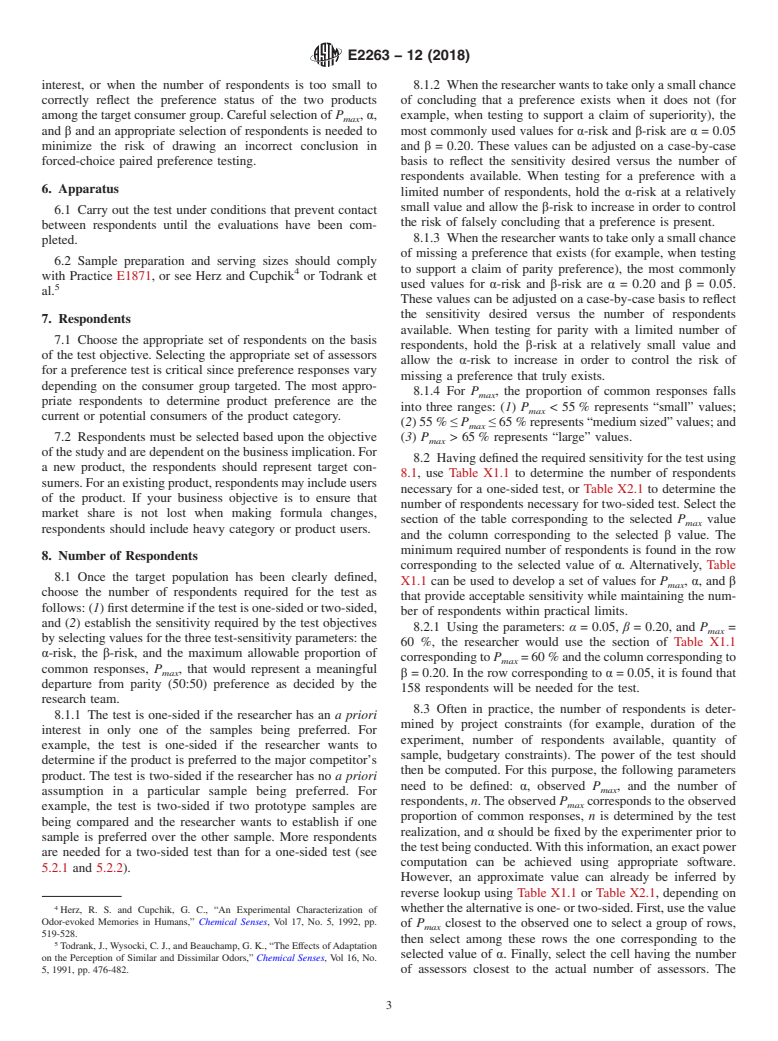
5.2 The paired preference method is commonly used in tests with one or more of the following objectives: (1) to establish superiority in preference versus the competition for advertising claims support; (2) to establish the preference of a new product for launch versus a competitor's product; (3) to establish the preference of a reformulated product in a product improvement or product modification project (for example, process change or ingredient change); and (4) to establish the preference of a cost improved product versus the current formulation in a cost savings project. Selected values of Pmax, α, and β will change with all four types of test objectives. These should be selected prior to determination of N.
5.2.1 Preference versus Competition or Launching a New Product versus Competition—Select a Pmax to represent what you expect a reasonable preference split to be. The main risk to avoid is to wrongly claim your product is preferred over the competitors. Thus, low values of α are selected, for example, 0.05, 0.01, or 0.001. The desired outcome of this test is to reject the null hypothesis. The alternative hypothesis is one sided: A new or improved product (A) is preferred over the competitor’s product (B). The test is one-sided. The value of β will be determined by the sample size chosen and the size of the preference in the consumer segment selected for the test. Selection of the appropriate number of respondents is determined by Pmax, α, and β, as well as the market segment that must be included in the test (for issues specific to conducting a paired preference test for an advertising claim, refer to Guide E1958).
5.2.2 C...
SCOPE
1.1 This document covers a procedure for determining preference between two products using either a two-alternative forced-choice task, or with the option of choosing no preference. Preference testing is a type of hedonic testing.
1.2 A paired preference test determines whether there is a statistically significant preference between two products for a given population of respondents. The target population must be carefully considered.
1.3 This method establishes preference in a single evaluation context. Replicated tests will not be covered within the scope of this document.
1.4 Paired preference testing can address overall preference or preference for a specified sensory attribute.
1.5 The method does not directly determine the magnitude of preference.
1.6 This method does not address whether or not two samples are perceived as different. Refer to Test Method E2164 for directional difference test.
1.7 A paired preference test is a simple task for respondents, and can be used with populations that have minimal reading or comprehension skills, or both.
1.8 Preference is not an intrinsic attribute of the product, such as hue is, but is a subjective measure relating to respondents' affective or hedonic response. It differs from paired comparison testing which measures objective characteristics of the product. Preference results are always dependent on the population sampled.
1.9 This standard does not purport to address all of the safety problems associated with its use, when testing includes hazardous materials, operations, or equipment. It is the responsibility of the user of this standard to establish appropriate safety, health, and environmental practices and to determine the applicability of regulatory limitations prior to use.
1.10 This international standard was developed in accordance with internationally recognized principles on standardization established in the Decision on Principles fo...
General Information
Relations
Standards Content (Sample)
This international standard was developed in accordance with internationally recognized principles on standardization established in the Decision on Principles for the
Development of International Standards, Guides and Recommendations issued by the World Trade Organization Technical Barriers to Trade (TBT) Committee.
Designation: E2263 − 12 (Reapproved 2018)
Standard Test Method for
1
Paired Preference Test
This standard is issued under the fixed designation E2263; the number immediately following the designation indicates the year of
original adoption or, in the case of revision, the year of last revision. A number in parentheses indicates the year of last reapproval. A
superscript epsilon (´) indicates an editorial change since the last revision or reapproval.
1. Scope 1.10 This international standard was developed in accor-
dance with internationally recognized principles on standard-
1.1 This document covers a procedure for determining
ization established in the Decision on Principles for the
preference between two products using either a two-alternative
Development of International Standards, Guides and Recom-
forced-choice task, or with the option of choosing no prefer-
mendations issued by the World Trade Organization Technical
ence. Preference testing is a type of hedonic testing.
Barriers to Trade (TBT) Committee.
1.2 A paired preference test determines whether there is a
2. Referenced Documents
statistically significant preference between two products for a
givenpopulationofrespondents.Thetargetpopulationmustbe 2
2.1 ASTM Standards:
carefully considered.
E253 Terminology Relating to Sensory Evaluation of Mate-
1.3 This method establishes preference in a single evalua- rials and Products
E456 Terminology Relating to Quality and Statistics
tion context. Replicated tests will not be covered within the
scope of this document. E1871 Guide for Serving Protocol for Sensory Evaluation of
Foods and Beverages
1.4 Paired preference testing can address overall preference
E1958 Guide for Sensory Claim Substantiation
or preference for a specified sensory attribute.
E2164 Test Method for Directional Difference Test
1.5 The method does not directly determine the magnitude
2.2 ISO Standard:
of preference.
ISO 5495 Sensory Analysis—Methodology—Paired Com-
3
parison
1.6 This method does not address whether or not two
samplesareperceivedasdifferent.RefertoTestMethodE2164
3. Terminology
for directional difference test.
3.1 For definition of terms relating to sensory analysis, see
1.7 Apairedpreferencetestisasimpletaskforrespondents,
Terminology E253, and for terms relating to statistics, see
and can be used with populations that have minimal reading or
Terminology E456.
comprehension skills, or both.
3.2 Definitions of Terms Specific to This Standard:
1.8 Preference is not an intrinsic attribute of the product,
3.2.1 α (alpha) risk—the probability of concluding that a
such as hue is, but is a subjective measure relating to
preference exists when, in reality, one does not. (Also known
respondents’ affective or hedonic response. It differs from
as Type I Error or significance level.)
paired comparison testing which measures objective character-
3.2.2 β (beta) risk—the probability of concluding that no
istics of the product. Preference results are always dependent
preference exists when, in reality, one does. (Also known as
on the population sampled.
Type II Error.)
1.9 This standard does not purport to address all of the
3.2.3 common responses—for a one-sided test, the number
safety problems associated with its use, when testing includes
of respondents selecting the product that is expected to be
hazardous materials, operations, or equipment. It is the re-
preferred. For a two-sided test, the largest number of respon-
sponsibility of the user of this standard to establish appropriate
dents selecting either product.
safety, health, and environmental practices and to determine
the applicability of regulatory limitations prior to use.
3.2.4 one-sided test—a test in which the researcher has an a
priori assumption concerning the direction of the preference.
1 2
This test method is under the jurisdiction ofASTM Committee E18 on Sensory For referenced ASTM standards, visit the ASTM website, www.astm.org, or
Evaluation and is the direct responsibility of Subcommittee E18.04 on Fundamen- contactASTM Customer Service at service@astm.org. ForAnnual Book ofASTM
tals of Sensory. Standards volume information, refer to the standard’s Document Summary page on
Current edition approved Aug. 1, 2018. Published August 2018. Originally theASTM website.
3
approved in 2004. Last previous edition approved in 2012 as E2263 – 12. DOI: Available fromAmerican National Standards Institute (ANSI), 25 W. 43rd St.,
10.1520/E2263-12R18. 4th Floor, New York, NY 10036.
Copyright © ASTM International, 100 Barr Harbor Drive, PO Box C700, West Conshohocken, PA 19428-2959. United States
1
---------------------- Page: 1 ----------------------
E2263 − 12 (2018)
...
Questions, Comments and Discussion
Ask us and Technical Secretary will try to provide an answer. You can facilitate discussion about the standard in here.