

ASTM D2628-91(2016)
(Specification)Standard Specification for Preformed Polychloroprene Elastomeric Joint Seals for Concrete Pavements
General Information
- Abstract
ABSTRACT
This specification covers the material requirements for preformed polychloroprene elastomeric joint seals for concrete pavements. The seal consists of a multiple web design and is installed with a lubricant. The seal functions by compression of the seal between the faces of the joint with the seal folding inward at the top to facilitate compression. The seals shall be preformed, and the material shall be vulcanized elastomeric compound using polychloroprene as the only base polymer. The materials shall also comply with the physical properties prescribed herein such as tensile strength, elongation, hardness, oil swell, ozone resistance, low-temperature stiffening, low-temperature recovery, and compression deflection.
SCOPE
1.1 This specification covers the material requirements for preformed polychloroprene elastomeric joint seals for concrete pavements. The seal consists of a multiple web design and functions only by compression of the seal between the faces of the joint with the seal folding inward at the top to facilitate compression. The seal is installed with a lubricant and is designed to seal the joint and reject incompressibles.
1.2 The values stated in inch-pound units are to be regarded as standard. The values given in parentheses are mathematical conversions to SI units that are provided for information only and are not considered standard.
1.3 This standard does not purport to address the safety concerns, if any, associated with its use. It is the responsibility of the user of this standard to establish appropriate safety and health practices and determine the applicability of regulatory limitations prior to use.
Note 1: This specification is a manufacturing and purchasing specification only and does not include requirements or considerations for selection of size, or the installation of the joint seals. However, experience has shown that successful performance of this product depends upon the proper selection of size and cross-sectional design of the joint seal, joint size, and joint spacing for the ambient conditions the pavement will be exposed to, and care in the installation of the joint seals.
- Status
- Published
- Publication Date
- 30-Sep-2016
- Technical Committee
- D04 - Road and Paving Materials
- Drafting Committee
- D04.34 - Preformed Joint Fillers, Sealers and Sealing Systems


Overview
ASTM D2628-91(2016), Standard Specification for Preformed Polychloroprene Elastomeric Joint Seals for Concrete Pavements, developed by ASTM International, defines the material and physical requirements for preformed elastomeric joint seals used in concrete pavements. The standard outlines criteria for polychloroprene-based seals, emphasizing performance characteristics essential for roadway durability and effective joint sealing under varying environmental conditions. This specification is primarily intended for manufacturers and purchasers engaged in producing, supplying, and selecting joint seal materials for new and rehabilitated concrete pavements.
Key Topics
- Material Composition: Specifies use of vulcanized elastomeric compound where polychloroprene is the only base polymer.
- Design Features: Requires a multiple web, inward-folding design to operate under joint compression and facilitate proper sealing.
- Physical Properties: Details essential performance metrics including:
- Minimum tensile strength and elongation at break
- Shore A durometer hardness
- Resistance to oven aging and ozone exposure
- Limits on oil swell and low-temperature stiffening
- Recovery characteristics after low and high temperature exposure
- Compression-deflection performance for sealing effectiveness
- Quality Assurance: Covers methods for sampling, testing, product marking, and acceptance, helping ensure consistent quality and traceability.
- Testing Methods: References ASTM test methods such as D412 (tensile), D2240 (hardness), D471 (oil resistance), D1149 (ozone resistance), and D573 (oven aging).
Applications
- Concrete Pavements: The principal use is in highway, airfield, and other concrete pavement joints where reliable elastomeric sealing is vital for preventing ingress of water, debris, and incompressibles.
- Infrastructure Longevity: Use of compliant joint seals contributes to extended pavement life by protecting against freeze-thaw cycles and mechanical stress.
- Purchasing and Specification: Provides a basis for procurement specifications, ensuring that only materials meeting defined physical and chemical properties are used.
- Quality Control: Assists manufacturers and contractors in evaluating and verifying joint seal performance prior to and during installation.
Note: The standard addresses manufacturing and purchasing specifications, but does not prescribe installation requirements or selection of size. Proper selection and installation remain critical for optimal field performance.
Related Standards
- ASTM D395 - Rubber Property-Compression Set
- ASTM D412 - Vulcanized Rubber and Thermoplastic Elastomers-Tension
- ASTM D2240 - Rubber Property-Durometer Hardness
- ASTM D471 - Rubber Property-Effect of Liquids
- ASTM D1149 - Rubber Deterioration-Cracking in an Ozone Controlled Environment
- ASTM D573 - Rubber-Deterioration in an Air Oven
- ASTM D3183 - Rubber-Preparation of Pieces for Test Purposes from Products
These related ASTM standards support the testing and evaluation protocols specified in ASTM D2628-91(2016).
Practical Value
Adopting ASTM D2628-91(2016) assures practitioners of dependable material performance, proven through robust physical property testing and aligned with internationally recognized practices. Selecting joint seals according to this standard enables pavement engineers, suppliers, and construction authorities to balance durability, reliability, and regulatory compliance, resulting in increased joint longevity and reduced maintenance needs for concrete infrastructure projects.
For manufacturers and purchasers, adherence to this specification enhances confidence in product quality, facilitates transparent communication, and supports efficient project planning and execution.
Keywords: ASTM D2628-91(2016), polychloroprene elastomeric joint seals, concrete pavement seals, preformed joint seals, elastomeric seals standard, pavement joint materials, ASTM pavement standards, quality assurance in concrete joints.
Relations
- Effective Date
- 01-Oct-2016
- Effective Date
- 01-Oct-2016
- Effective Date
- 01-Oct-2016
Get Certified
Connect with accredited certification bodies for this standard

Zavod za gradbeništvo Slovenije (ZAG) - Inšpekcija
ZAG inspection body for construction products, structures, and materials.
Sponsored listings
Frequently Asked Questions
ASTM D2628-91(2016) is a technical specification published by ASTM International. Its full title is "Standard Specification for Preformed Polychloroprene Elastomeric Joint Seals for Concrete Pavements". This standard covers: ABSTRACT This specification covers the material requirements for preformed polychloroprene elastomeric joint seals for concrete pavements. The seal consists of a multiple web design and is installed with a lubricant. The seal functions by compression of the seal between the faces of the joint with the seal folding inward at the top to facilitate compression. The seals shall be preformed, and the material shall be vulcanized elastomeric compound using polychloroprene as the only base polymer. The materials shall also comply with the physical properties prescribed herein such as tensile strength, elongation, hardness, oil swell, ozone resistance, low-temperature stiffening, low-temperature recovery, and compression deflection. SCOPE 1.1 This specification covers the material requirements for preformed polychloroprene elastomeric joint seals for concrete pavements. The seal consists of a multiple web design and functions only by compression of the seal between the faces of the joint with the seal folding inward at the top to facilitate compression. The seal is installed with a lubricant and is designed to seal the joint and reject incompressibles. 1.2 The values stated in inch-pound units are to be regarded as standard. The values given in parentheses are mathematical conversions to SI units that are provided for information only and are not considered standard. 1.3 This standard does not purport to address the safety concerns, if any, associated with its use. It is the responsibility of the user of this standard to establish appropriate safety and health practices and determine the applicability of regulatory limitations prior to use. Note 1: This specification is a manufacturing and purchasing specification only and does not include requirements or considerations for selection of size, or the installation of the joint seals. However, experience has shown that successful performance of this product depends upon the proper selection of size and cross-sectional design of the joint seal, joint size, and joint spacing for the ambient conditions the pavement will be exposed to, and care in the installation of the joint seals.
ABSTRACT This specification covers the material requirements for preformed polychloroprene elastomeric joint seals for concrete pavements. The seal consists of a multiple web design and is installed with a lubricant. The seal functions by compression of the seal between the faces of the joint with the seal folding inward at the top to facilitate compression. The seals shall be preformed, and the material shall be vulcanized elastomeric compound using polychloroprene as the only base polymer. The materials shall also comply with the physical properties prescribed herein such as tensile strength, elongation, hardness, oil swell, ozone resistance, low-temperature stiffening, low-temperature recovery, and compression deflection. SCOPE 1.1 This specification covers the material requirements for preformed polychloroprene elastomeric joint seals for concrete pavements. The seal consists of a multiple web design and functions only by compression of the seal between the faces of the joint with the seal folding inward at the top to facilitate compression. The seal is installed with a lubricant and is designed to seal the joint and reject incompressibles. 1.2 The values stated in inch-pound units are to be regarded as standard. The values given in parentheses are mathematical conversions to SI units that are provided for information only and are not considered standard. 1.3 This standard does not purport to address the safety concerns, if any, associated with its use. It is the responsibility of the user of this standard to establish appropriate safety and health practices and determine the applicability of regulatory limitations prior to use. Note 1: This specification is a manufacturing and purchasing specification only and does not include requirements or considerations for selection of size, or the installation of the joint seals. However, experience has shown that successful performance of this product depends upon the proper selection of size and cross-sectional design of the joint seal, joint size, and joint spacing for the ambient conditions the pavement will be exposed to, and care in the installation of the joint seals.
ASTM D2628-91(2016) is classified under the following ICS (International Classification for Standards) categories: 93.080.10 - Road construction. The ICS classification helps identify the subject area and facilitates finding related standards.
ASTM D2628-91(2016) has the following relationships with other standards: It is inter standard links to ASTM D2628-91(2011), ASTM D5973-97(2017), ASTM C1127/C1127M-15(2023). Understanding these relationships helps ensure you are using the most current and applicable version of the standard.
ASTM D2628-91(2016) is available in PDF format for immediate download after purchase. The document can be added to your cart and obtained through the secure checkout process. Digital delivery ensures instant access to the complete standard document.
Standards Content (Sample)
This international standard was developed in accordance with internationally recognized principles on standardization established in the Decision on Principles for the
Development of International Standards, Guides and Recommendations issued by the World Trade Organization Technical Barriers to Trade (TBT) Committee.
Designation:D2628 −91 (Reapproved 2016)
Standard Specification for
Preformed Polychloroprene Elastomeric Joint Seals for
Concrete Pavements
This standard is issued under the fixed designation D2628; the number immediately following the designation indicates the year of
original adoption or, in the case of revision, the year of last revision.Anumber in parentheses indicates the year of last reapproval.A
superscript epsilon (´) indicates an editorial change since the last revision or reapproval.
This standard has been approved for use by agencies of the U.S. Department of Defense.
1. Scope D518 Test Method for Rubber Deterioration—Surface
Cracking (Withdrawn 2007)
1.1 This specification covers the material requirements for
D573Test Method for Rubber—Deterioration in an Air
preformed polychloroprene elastomeric joint seals for concrete
Oven
pavements. The seal consists of a multiple web design and
D575Test Methods for Rubber Properties in Compression
functions only by compression of the seal between the faces of
D1149TestMethodsfor RubberDeterioration—Crackingin
the joint with the seal folding inward at the top to facilitate
an Ozone Controlled Environment
compression. The seal is installed with a lubricant and is
D2240Test Method for Rubber Property—Durometer Hard-
designed to seal the joint and reject incompressibles.
ness
1.2 The values stated in inch-pound units are to be regarded
D3183Practice for Rubber—Preparation of Pieces for Test
as standard. The values given in parentheses are mathematical
Purposes from Products
conversions to SI units that are provided for information only
and are not considered standard. 3. Materials and Manufacture
1.3 This standard does not purport to address the safety 3.1 The seals shall be preformed, and the material shall be
concerns, if any, associated with its use. It is the responsibility
vulcanized elastomeric compound using polychloroprene as
of the user of this standard to establish appropriate safety and the only base polymer.
health practices and determine the applicability of regulatory
4. Physical Requirements
limitations prior to use.
4.1 The materials shall conform to the physical properties
NOTE 1—This specification is a manufacturing and purchasing specifi-
prescribed in Table 1.
cation only and does not include requirements or considerations for
selectionofsize,ortheinstallationofthejointseals.However,experience
4.2 In the applicable requirements of Table 1 and the test
has shown that successful performance of this product depends upon the
methods,alldeflectionsshallbebasedonthenominalwidthof
proper selection of size and cross-sectional design of the joint seal, joint
the seal.
size, and joint spacing for the ambient conditions the pavement will be
exposed to, and care in the installation of the joint seals.
5. Dimensions and Permissible Variations
2. Referenced Documents
5.1 The size, shape, and dimensional variations shall be as
agreed upon by the purchaser and the producer or supplier.
2.1 ASTM Standards:
D395Test Methods for Rubber Property—Compression Set
6. Workmanship
D412TestMethodsforVulcanizedRubberandThermoplas-
6.1 Seals shall be free of defects in workmanship and
tic Elastomers—Tension
materials that may affect its serviceability.
D471Test Method for Rubber Property—Effect of Liquids
7. Sampling
7.1 Alot shall consist of the quantity for each cross section
This specification is under the jurisdiction ofASTM Committee D04 on Road
agreed upon by the purchaser and the producer or supplier.
and Paving Materials and is the direct responsibility of Subcommittee D04.34 on
Preformed Joint Fillers, Sealers and Sealing Systems.
7.2 Samplesshallbetakenatrandomfromeachshipmentof
Current edition approved Oct. 1, 2016. Published October 2016. Originally
material.Iftheshipmentconsistsofmorethanonelot,eachlot
approved in 1967. Last previous edition approved in 2011 as D2628–91(2011).
DOI: 10.1520/D2628-91R16.
shall be sampled.
For referenced ASTM standards, visit the ASTM website, www.astm.org, or
contact ASTM Customer Service at service@astm.org. For Annual Book of ASTM
Standards volume information, refer to the standard’s Document Summary page on The last approved version of this historical standard is referenced on
the ASTM website. www.astm.org.
Copyright © ASTM International, 100 Barr Harbor Drive, PO Box C700, West Conshohocken, PA 19428-2959. United States
D2628−91 (2016)
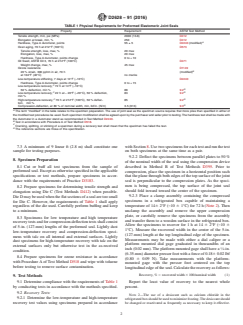
TABLE 1 Physical Requirements for Preformed Elastomeric Joint Seals
Property Requirement ASTM Test Method
Tensile strength, min, psi (MPa) 2000 (13.8) D412
Elongaton at break, min, % 250 D412
A
Hardness, Type A durometer, points 55 ± 5 D2240 (modified)
Oven aging, 70 h at 212°F (100°C) D573
Tensile strength, loss, max, % 20 max
Elongation, loss, max, % 20 max
Hardness, Type A durometer, points change 0 to + 10
Oil Swell, ASTM Oil 3, 70 h at 212°F (100°C) D471
Weight change, max, % 45 max
Ozone resistance D1149
B
20 % strain, 300 pphm in air, 70 h (modified)
at 104°F (40°C) no cracks
Low-temperature stiffening, 7 days at 14°F (−10°C) D2240
Hardness, Type A durometer, points change 0 to + 15
C
Low-temperature recovery, 72 h at 14°F (−10°C)
D
50 % deflection, min % 88 9.2
C D
Low-temperature recovery, 22 h at − 20°F (−29°C), 50 % deflection, 83 9.2
min %
C D
High-temperature recovery, 70 h at 212°F (100°C), 50 % deflec- 85 9.2
tion, min %
D
Compression-deflection, at 80 % of nominal width, min, lbf/in. (N/m) 3.5 (613) 9.3
A
The term “modified” in the table relates to the specimen preparation. The use of joint seal as the specimen source requires that more plies than specified in either of
themodifiedtestproceduresbeused.Suchspecimenmodificationshallbeagreeduponbythepurchaserandsellerpriortotesting.Thehardnesstestshallbemadewith
the durometer in a durometer stand as recommended in Test Method D2240.
B
Test in accordance with Procedure A of Test Method D518.
C
Cracking, splitting, or sticking of a specimen during a recovery test shall mean that the specimen has failed the test.
D
The reference sections are those of this specification.
7.3 A minimum of 9 linear ft (2.8 m) shall constitute one withSection8.Usetwospecimensforeachtestandrunthetest
sample for testing purposes. on both specimens at the same time as a pair.
9.2.2 Deflect the specimens between parallel plates to 50%
8. Specimen Preparation
of the nominal width of the seal using the compression device
8.1 Cut or buff all test specimens from the sample of
described in Method B of Test Methods D395. Prior to
preformed seal. Except as otherwise specified in the applicable
compression, place the specimen in a horizontal position such
specifications or test methods, prepare specimens in accor-
thattheplanethroughbothedgesofthetopsurfaceofthejoint
dance with the requirements of Practice D3183.
seal is perpendicular to the compression plates. As the speci-
men is being compressed, the top surface of the joint seal
8.2 Prepare specimens for determining tensile strength and
should fold inward toward the center of the specimen.
elongation using Die C (Test Methods D412) when possible.
9.2.3 Place a clamp assembly containing the compressed
...