

ASTM D5101-23
(Test Method)Standard Test Method for Measuring the Filtration Compatibility of Soil-Geotextile Systems
General Information
- Abstract
SIGNIFICANCE AND USE
5.1 This test method is recommended for the evaluation of the performance of water-saturated soil-geotextile systems under unidirectional flow conditions. The results obtained may be used as an indication of the compatibility of the soil-geotextile system with respect to both particle retention and flow capacity.
5.2 This test method is intended to evaluate the performance of specific on-site soils and geotextiles at the design stage of a project, or to provide qualitative data that may help identify causes of failure (for example, clogging, particle loss). It is not appropriate for acceptance testing of geotextiles. It is also improper to utilize the results from this test for job specifications or manufacturers' certifications.
5.3 This test method is intended for site-specific investigation therefore is not an index property of the geotextile, and thus is not intended to be requested of the manufacturer or supplier of the geotextile.
SCOPE
1.1 This test method covers performance tests applicable for determining the compatibility of geotextiles with various types of water-saturated soils under unidirectional flow conditions.
1.2 Two evaluation methods may be used to investigate soil-geotextile filtration behavior, depending on the soil type:
1.2.1 For soils with a plasticity index lower than 5, the systems compatibility shall be evaluated per this standard.
1.2.2 For soils with a plasticity index of 5 or more, it is recommended to use Test Method D5567 (‘HCR,’ Hydraulic Conductivity Ratio) instead of this test method.
1.2.3 If the plasticity index of the soil is close to 5, the involved parties shall agree on the selection of the appropriate method prior to conducting the test. This task may require comparison of the permeability of the soil-geotextile system to the detection limits of the HCR and Gradient Ratio Test (GRT) test apparatus being used.
1.3 The values stated in SI units are to be regarded as standard. The values in parentheses are for information only.
1.4 This standard does not purport to address all of the safety concerns, if any, associated with its use. It is the responsibility of the user of this standard to establish appropriate safety, health, and environmental practices and determine the applicability of regulatory limitations prior to use.
1.5 This international standard was developed in accordance with internationally recognized principles on standardization established in the Decision on Principles for the Development of International Standards, Guides and Recommendations issued by the World Trade Organization Technical Barriers to Trade (TBT) Committee.
- Status
- Published
- Publication Date
- 31-Oct-2023
- Technical Committee
- D35 - Geosynthetics
- Drafting Committee
- D35.03 - Permeability and Filtration
Buy Documents
ASTM D5101-23 - Standard Test Method for Measuring the Filtration Compatibility of Soil-Geotextile Systems
REDLINE ASTM D5101-23 - Standard Test Method for Measuring the Filtration Compatibility of Soil-Geotextile Systems
Overview
ASTM D5101-23: Standard Test Method for Measuring the Filtration Compatibility of Soil-Geotextile Systems is a widely recognized international standard published by ASTM International. This test method is used to evaluate the filtration performance of soil-geotextile systems subjected to unidirectional flow conditions under full water saturation. Its primary purpose is to assess the compatibility between specific site soils and selected geotextiles to ensure both effective particle retention and adequate flow capacity.
This standard is commonly applied during the design phase of civil engineering projects to identify potential issues such as clogging or particle loss, which could compromise system performance. ASTM D5101-23 is not intended for acceptance testing or for supplier certification of geotextile products.
Key Topics
- Filtration Compatibility: The method evaluates how well a geotextile filters soil under unidirectional flow, considering both particle retention and water permeability.
- Gradient Ratio Test: Observes hydraulic gradients and flow rates across the soil-geotextile interface to detect potential clogging or piping.
- Soil Type Considerations:
- Suitable for soils with a plasticity index less than 5.
- For soils with a plasticity index of 5 or greater, ASTM D5567 (Hydraulic Conductivity Ratio) is recommended.
- Test Apparatus: Utilizes a specialized soil-geotextile permeameter equipped for maintaining constant water head, pressure measurement, and controlled specimen conditions.
- Data Collection: Monitors key parameters such as flow rate, water head, temperature, and the mass of soil passing through the geotextile.
- Result Interpretation: Focuses on assessing equilibrium conditions, gradient ratios, and permeability to inform design decisions.
Applications
ASTM D5101-23 supports engineers and designers in the geotechnical and civil engineering fields by providing a means to evaluate soil-geotextile filter compatibility for a range of practical applications:
- Design Optimization: Assists in selecting geotextile filters for retaining fine soil particles while maintaining necessary drainage.
- Failure Investigation: Provides qualitative data to diagnose causes of filtration failure, such as clogging or excessive particle loss.
- Site-Specific Assessments: Ensures that soil and geotextile combinations will function effectively for the unique conditions of each project site.
- Infrastructure Projects: Especially relevant for the design and construction of roadways, embankments, retaining walls, drainage systems, and landfill liners where geotextile filters are employed.
This standard is critical for safeguarding against filter failure in demanding environments, supporting the long-term durability and performance of infrastructure.
Related Standards
For comprehensive filtration system evaluation, the following ASTM standards are often referenced alongside ASTM D5101-23:
- ASTM D5567 - Standard Test Method for Hydraulic Conductivity Ratio (HCR) Testing of Soil/Geotextile Systems (for soils with higher plasticity).
- ASTM D4318 - Test Methods for Liquid Limit, Plastic Limit, and Plasticity Index of Soils.
- ASTM D4751 - Test Methods for Determining Apparent Opening Size of a Geotextile.
- ASTM D4491 - Test Methods for Water Permeability of Geotextiles by Permittivity.
- ASTM D653 - Terminology Relating to Soil, Rock, and Contained Fluids.
- ASTM D2487 / D2488 - Soil Classification and Identification Practices.
- ASTM D5084 - Test Methods for Hydraulic Conductivity of Saturated Porous Materials.
Consult these standards for additional guidance on soil classification, geotextile selection, and advanced filtration testing.
Keywords: ASTM D5101-23, soil-geotextile system, filtration compatibility, gradient ratio, clogging potential, permeability, unidirectional flow, civil engineering, geotextile filter design, infrastructure durability
Relations
- Effective Date
- 01-Nov-2023
- Effective Date
- 01-Feb-2024
- Effective Date
- 01-Nov-2023
- Effective Date
- 01-Nov-2023
- Effective Date
- 01-Nov-2023
- Effective Date
- 01-Nov-2023
- Effective Date
- 01-Nov-2023
- Effective Date
- 01-Nov-2023
- Effective Date
- 01-Nov-2023
Buy Documents
ASTM D5101-23 - Standard Test Method for Measuring the Filtration Compatibility of Soil-Geotextile Systems
REDLINE ASTM D5101-23 - Standard Test Method for Measuring the Filtration Compatibility of Soil-Geotextile Systems
Get Certified
Connect with accredited certification bodies for this standard

Control Union Certifications
Global certification for agriculture and sustainability.

Hohenstein Institut
Textile testing and certification.

Bureau Veritas Bangladesh
Bureau Veritas certification services in Bangladesh.
Sponsored listings
Frequently Asked Questions
ASTM D5101-23 is a standard published by ASTM International. Its full title is "Standard Test Method for Measuring the Filtration Compatibility of Soil-Geotextile Systems". This standard covers: SIGNIFICANCE AND USE 5.1 This test method is recommended for the evaluation of the performance of water-saturated soil-geotextile systems under unidirectional flow conditions. The results obtained may be used as an indication of the compatibility of the soil-geotextile system with respect to both particle retention and flow capacity. 5.2 This test method is intended to evaluate the performance of specific on-site soils and geotextiles at the design stage of a project, or to provide qualitative data that may help identify causes of failure (for example, clogging, particle loss). It is not appropriate for acceptance testing of geotextiles. It is also improper to utilize the results from this test for job specifications or manufacturers' certifications. 5.3 This test method is intended for site-specific investigation therefore is not an index property of the geotextile, and thus is not intended to be requested of the manufacturer or supplier of the geotextile. SCOPE 1.1 This test method covers performance tests applicable for determining the compatibility of geotextiles with various types of water-saturated soils under unidirectional flow conditions. 1.2 Two evaluation methods may be used to investigate soil-geotextile filtration behavior, depending on the soil type: 1.2.1 For soils with a plasticity index lower than 5, the systems compatibility shall be evaluated per this standard. 1.2.2 For soils with a plasticity index of 5 or more, it is recommended to use Test Method D5567 (‘HCR,’ Hydraulic Conductivity Ratio) instead of this test method. 1.2.3 If the plasticity index of the soil is close to 5, the involved parties shall agree on the selection of the appropriate method prior to conducting the test. This task may require comparison of the permeability of the soil-geotextile system to the detection limits of the HCR and Gradient Ratio Test (GRT) test apparatus being used. 1.3 The values stated in SI units are to be regarded as standard. The values in parentheses are for information only. 1.4 This standard does not purport to address all of the safety concerns, if any, associated with its use. It is the responsibility of the user of this standard to establish appropriate safety, health, and environmental practices and determine the applicability of regulatory limitations prior to use. 1.5 This international standard was developed in accordance with internationally recognized principles on standardization established in the Decision on Principles for the Development of International Standards, Guides and Recommendations issued by the World Trade Organization Technical Barriers to Trade (TBT) Committee.
SIGNIFICANCE AND USE 5.1 This test method is recommended for the evaluation of the performance of water-saturated soil-geotextile systems under unidirectional flow conditions. The results obtained may be used as an indication of the compatibility of the soil-geotextile system with respect to both particle retention and flow capacity. 5.2 This test method is intended to evaluate the performance of specific on-site soils and geotextiles at the design stage of a project, or to provide qualitative data that may help identify causes of failure (for example, clogging, particle loss). It is not appropriate for acceptance testing of geotextiles. It is also improper to utilize the results from this test for job specifications or manufacturers' certifications. 5.3 This test method is intended for site-specific investigation therefore is not an index property of the geotextile, and thus is not intended to be requested of the manufacturer or supplier of the geotextile. SCOPE 1.1 This test method covers performance tests applicable for determining the compatibility of geotextiles with various types of water-saturated soils under unidirectional flow conditions. 1.2 Two evaluation methods may be used to investigate soil-geotextile filtration behavior, depending on the soil type: 1.2.1 For soils with a plasticity index lower than 5, the systems compatibility shall be evaluated per this standard. 1.2.2 For soils with a plasticity index of 5 or more, it is recommended to use Test Method D5567 (‘HCR,’ Hydraulic Conductivity Ratio) instead of this test method. 1.2.3 If the plasticity index of the soil is close to 5, the involved parties shall agree on the selection of the appropriate method prior to conducting the test. This task may require comparison of the permeability of the soil-geotextile system to the detection limits of the HCR and Gradient Ratio Test (GRT) test apparatus being used. 1.3 The values stated in SI units are to be regarded as standard. The values in parentheses are for information only. 1.4 This standard does not purport to address all of the safety concerns, if any, associated with its use. It is the responsibility of the user of this standard to establish appropriate safety, health, and environmental practices and determine the applicability of regulatory limitations prior to use. 1.5 This international standard was developed in accordance with internationally recognized principles on standardization established in the Decision on Principles for the Development of International Standards, Guides and Recommendations issued by the World Trade Organization Technical Barriers to Trade (TBT) Committee.
ASTM D5101-23 is classified under the following ICS (International Classification for Standards) categories: 59.080.70 - Geotextiles. The ICS classification helps identify the subject area and facilitates finding related standards.
ASTM D5101-23 has the following relationships with other standards: It is inter standard links to ASTM D5101-12(2017), ASTM D4439-24, ASTM D6917-16(2022), ASTM D5567-94(2018), ASTM D7664-10(2018)e1, ASTM D5819-22, ASTM D4439-23b, ASTM D1987-22, ASTM D2434-22. Understanding these relationships helps ensure you are using the most current and applicable version of the standard.
ASTM D5101-23 is available in PDF format for immediate download after purchase. The document can be added to your cart and obtained through the secure checkout process. Digital delivery ensures instant access to the complete standard document.
Standards Content (Sample)
This international standard was developed in accordance with internationally recognized principles on standardization established in the Decision on Principles for the
Development of International Standards, Guides and Recommendations issued by the World Trade Organization Technical Barriers to Trade (TBT) Committee.
Designation: D5101 − 23
Standard Test Method for
Measuring the Filtration Compatibility of Soil-Geotextile
Systems
This standard is issued under the fixed designation D5101; the number immediately following the designation indicates the year of
original adoption or, in the case of revision, the year of last revision. A number in parentheses indicates the year of last reapproval. A
superscript epsilon (´) indicates an editorial change since the last revision or reapproval.
1. Scope 2. Referenced Documents
1.1 This test method covers performance tests applicable for 2.1 ASTM Standards:
determining the compatibility of geotextiles with various types D123 Terminology Relating to Textiles
of water-saturated soils under unidirectional flow conditions. D422 Test Method for Particle-Size Analysis of Soils (With-
drawn 2016)
1.2 Two evaluation methods may be used to investigate
D653 Terminology Relating to Soil, Rock, and Contained
soil-geotextile filtration behavior, depending on the soil type:
Fluids
1.2.1 For soils with a plasticity index lower than 5, the
D4318 Test Methods for Liquid Limit, Plastic Limit, and
systems compatibility shall be evaluated per this standard.
Plasticity Index of Soils
1.2.2 For soils with a plasticity index of 5 or more, it is
D4354 Practice for Sampling of Geosynthetics and Rolled
recommended to use Test Method D5567 (‘HCR,’ Hydraulic
Erosion Control Products (RECPs) for Testing
Conductivity Ratio) instead of this test method.
D4439 Terminology for Geosynthetics
1.2.3 If the plasticity index of the soil is close to 5, the
D5567 Test Method for Hydraulic Conductivity Ratio
involved parties shall agree on the selection of the appropriate
(HCR) Testing of Soil/Geotextile Systems
method prior to conducting the test. This task may require
comparison of the permeability of the soil-geotextile system to
3. Terminology
the detection limits of the HCR and Gradient Ratio Test (GRT)
3.1 Definitions:
test apparatus being used.
3.1.1 clogging, n—in geotextiles, the tendency for a given
1.3 The values stated in SI units are to be regarded as
geotextile to lose permeability due to soil particles that have
standard. The values in parentheses are for information only.
either become embedded in the fabric openings or have built up
on the geotextile surface to form a layer with lower permeabil-
1.4 This standard does not purport to address all of the
safety concerns, if any, associated with its use. It is the ity than that of the bulk soil specimen.
responsibility of the user of this standard to establish appro-
3.1.2 gradient ratio, n—in geotextiles, ratio of the hydraulic
priate safety, health, and environmental practices and deter-
gradient across a soil-geotextile interface to the hydraulic
mine the applicability of regulatory limitations prior to use.
gradient through the soil alone.
1.5 This international standard was developed in accor-
3.1.3 hydraulic gradient, i, s (D)—the loss of hydraulic head
dance with internationally recognized principles on standard-
per unit distance of flow, dH/dL.
ization established in the Decision on Principles for the
3.1.4 piping, n—the tendency of the geotextile to let a
Development of International Standards, Guides and Recom-
quantity of soil pass through its plane that may potentially lead
mendations issued by the World Trade Organization Technical
to stability concerns in the soil or internal clogging of the
Barriers to Trade (TBT) Committee.
geotextile.
1 2
This test method is under the jurisdiction of ASTM Committee D35 on For referenced ASTM standards, visit the ASTM website, www.astm.org, or
Geosynthetics and is the direct responsibility of Subcommittee D35.03 on Perme- contact ASTM Customer Service at service@astm.org. For Annual Book of ASTM
ability and Filtration. Standards volume information, refer to the standard’s Document Summary page on
Current edition approved Nov. 1, 2023. Published November 2023. Originally the ASTM website.
approved in 1990. Last previous edition approved in 2017 as D5101 – 12 (2017). The last approved version of this historical standard is referenced on
DOI: 10.1520/D5101-23. www.astm.org.
Copyright © ASTM International, 100 Barr Harbor Drive, PO Box C700, West Conshohocken, PA 19428-2959. United States
D5101 − 23
3.1.5 For definitions of other textile terms, refer to Termi-
nology D123. For definitions of other terms related to
geotextiles, refer to Terminology D4439 and Terminology
D653.
3.2 Acronyms:
3.2.1 CHD—the acronym for constant head device
3.2.2 GRT—the acronym for gradient ratio test
3.2.3 HCR—the acronym for hydraulic conductivity ratio
4. Summary of Test Method
4.1 This method is intended for use in the observation of
change in the permeability of a soil-geotextile interface over
time under a range of applied hydraulic gradients. At the end of
the test, the weight of soil passing through the geotextile is
measured. The distribution of hydraulic gradients in the vicin-
ity of the soil-geotextile interface is also observed.
5. Significance and Use
5.1 This test method is recommended for the evaluation of
the performance of water-saturated soil-geotextile systems
under unidirectional flow conditions. The results obtained may
be used as an indication of the compatibility of the soil-
geotextile system with respect to both particle retention and
FIG. 1 Gradient Ratio Test Setup
flow capacity.
5.2 This test method is intended to evaluate the performance
NOTE 2—Some permeameters allow application of a normal load on the
of specific on-site soils and geotextiles at the design stage of a
soil-geotextile interface. If so, the loading system shall be designed in
project, or to provide qualitative data that may help identify such a way that it will not influence the system’s hydraulic behavior.
causes of failure (for example, clogging, particle loss). It is not
6.2 Two Constant Water Head Devices, one mounted on a
appropriate for acceptance testing of geotextiles. It is also
jack stand (adjustable) and one stationary (Fig. 3).
improper to utilize the results from this test for job specifica-
6.3 Soil Leveling Device (Fig. 4).
tions or manufacturers’ certifications.
6.4 Manometer Board, of parallel glass tubes and measuring
5.3 This test method is intended for site-specific investiga-
rulers.
tion therefore is not an index property of the geotextile, and
thus is not intended to be requested of the manufacturer or 6.5 Two Soil Support Screens, of approximately 5 mm
supplier of the geotextile. (No. 4) mesh.
6.6 Soil Support Cloth, of 150 μm (No. 100) mesh, or
6. Apparatus and Supplies
equivalent geotextile.
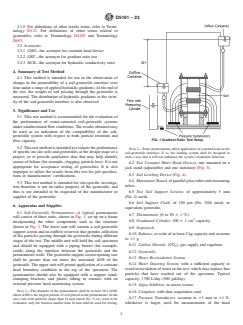
6.1 Soil-Geotextile Permeameter—A typical permeameter
6.7 Thermometer (0 to 50 6 1 °C).
will consist of three units, shown in Fig. 1, set up on a frame
6.8 Graduated Cylinder, 100 6 1 cm capacity.
incorporating the other components such as the structure
shown in Fig. 2. The lower unit will contain a soil-geotextile
6.9 Stopwatch.
support screen and an outflow reservoir that permits collection
6.10 Balance, or scale of at least 2 kg capacity and accurate
of the particles passing through the geotextile during different
to 61 g.
stages of the test. The middle unit will hold the soil specimen
6.11 Carbon Dioxide, (CO ), gas supply and regulator.
and should be equipped with a piping barrier (for example,
caulk) along the interface between the geotextile and the
6.12 Geotextile.
permeameter walls. The geotextile support screen opening size
6.13 Water Recirculation System.
shall be greater than ten times the measured AOS of the
6.14 Water Deairing System, with a sufficient capacity to
geotextile. The upper unit will permit application of a constant
avoid recirculation of water in the test, which may replace fine
head boundary condition to the top of the specimen. The
particles that have washed out of the specimen. Typical
permeameter should also be equipped with a support stand,
capacity: 1700 L/day (500 gal/day).
clamping brackets, and plastic tubing to connect with an
external pressure head monitoring system.
6.15 Algae Inhibitor, or micro screen.
NOTE 1—The diameter of the permeameter shall be at least 10 × d100,
6.16 Computer, with data acquisition card.
where d100 is the largest particle of soil placed in the permeameter. In the
6.17 Pressure Transducers, accurate to 61 mm or 61 %,
case soils with particles larger than 16 mm (mesh No. ⁄8 in.) were to be
evaluated, only the fraction smaller than 16 mm shall be used for testing. whichever is larger, used for measurements of the head
D5101 − 23
FIG. 2 Permeameter Section
FIG. 3 Individual Setup of Calibration System for Each Pressure Transducer
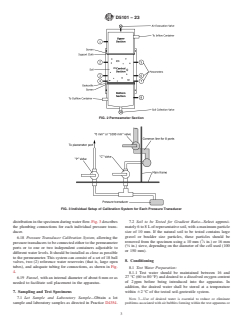
distribution in the specimen during water flow. Fig. 3 describes 7.2 Soil to be Tested for Gradient Ratio—Select approxi-
the plumbing connections for each individual pressure trans- mately 6 to 8 L of representative soil, with a maximum particle
ducer. size of 10 mm. If the natural soil to be tested contains large
gravel or boulder size particles, these particles should be
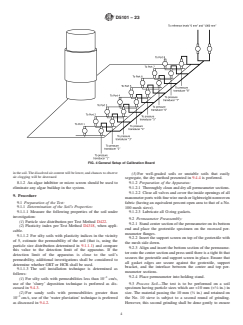
6.18 Pressure Transducer Calibration System, allowing the
removed from the specimen using a 10 mm ( ⁄8 in.) or 16 mm
pressure transducers to be connected either to the permeameter
( ⁄8 in.) sieve, depending on the diameter of the cell used (100
ports or to one or two independent containers adjustable to
or 150 mm).
different water levels. It should be installed as close as possible
to the permeameter. This system can consist of a set of 18 ball
8. Conditioning
valves, two (2) reference water reservoirs (that is, large open
tubes), and adequate tubing for connections, as shown in Fig.
8.1 Test Water Preparation:
4.
8.1.1 Test water should be maintained between 16 and
27 °C (60 to 80 °F) and deaired to a dissolved oxygen content
6.19 Funnel, with an internal diameter of about 6 mm or as
of 2 ppm before being introduced into the apparatus. In
needed to facilitate soil placement in the apparatus.
addition, the deaired water shall be stored at a temperature
7. Sampling and Test Specimens within 62 °C of the tested soil-geotextile system.
7.1 Lot Sample and Laboratory Sample—Obtain a lot
NOTE 3—Use of deaired water is essential to reduce or eliminate
sample and laboratory samples as directed in Practice D4354. problems associated with air bubbles forming within the test apparatus or
D5101 − 23
FIG. 4 General Setup of Calibration Board
in the soil. The dissolved air content will be lower, and chances to observe
(3) For well-graded soils or unstable soils that easily
air clogging will be decreased
segregate, the dry method presented in 9.4.4 is preferred.
8.1.2 An algae inhibitor or micro screen should be used to
9.1.2 Preparation of the Apparatus:
eliminate any algae buildup in the system.
9.1.2.1 Thoroughly clean and dry all permeameter sections.
9.1.2.2 Close all valves and cover the inside openings of all
9. Procedure
manometer ports with fine wire mesh or lightweight nonwoven
9.1 Preparation of the Test: fabric (having an equivalent percent open area to that of a No.
9.1.1 Determination of the Soil’s Properties: 100 mesh sieve).
9.1.1.1 Measure the following properties of the soil under
9.1.2.3 Lubricate all O-ring gaskets.
investigation:
9.2 Permeameter Preassembly:
(1) Particle size distribution per Test Method D422.
9.2.1 Stand center section of the permeameter on its bottom
(2) Plasticity index per Test Method D4318, when appli-
end and place the geotextile specimen on the recessed per-
cable.
meameter flanges.
9.1.1.2 For silty soils with plasticity indices in the vicinity
9.2.2 Insert the support screen on top of the geotextile with
of 5, estimate the permeability of the soil (that is, using the
the mesh side down.
particle size distribution determined in 9.1.1.1) and compare
9.2.3 Align and insert the bottom section of the permeame-
this value to the detection limit of the apparatus. If the
ter onto the center section and press until there is a tight fit that
detection limit of the apparatus is close to the soil’s
secures the geotextile and support screen in place. Ensure that
permeability, additional investigations shall be considered to
all gasket edges are secure against the geotextile, support
determine whether GRT or HCR shall be used.
bracket, and the interface between the center and top per-
9.1.1.3 The soil installation technique is determined as
meameter sections.
follows:
–3 9.2.4 Place permeameter into holding stand.
(1) For silty soils with permeabilities less than 10 cm/s,
use of the ‘slurry’ deposition technique is preferred as dis- 9.3 Process Soil—The test is to be performed on a soil
cussed in 9.4.3. specimen having particle sizes which are <10 mm (< ⁄8 in.) in
(2) For sandy soils with permeabilities greater than size. The material passing the 10 mm ( ⁄8 in.) and retained on
–3
10 cm ⁄s, use of the ‘water pluviation’ technique is preferred the No. 10 sieve is subject to a second round of grinding.
as discussed in 9.4.2. However, this second grinding shall be done gently to ensure
D5101 − 23
that agglomerates of particles will be maintained, as they 9.4.2.2 Use the funnel described in 6.19 to pour the soil in
reflect the field condition. the permeameter, in 25 mm thick lifts. The water level shall be
Select a representative sample of the amount required, periodically verified to ensure that the soil particles will always
approximately 1500 g, to perform the test by the method of fall into 5 to 10 mm of water. The bottom of the funnel should
quartering or by the use of a soil splitter. remain close to the water surface during soil deposition to
avoid air segregation of the soil (see Fig. 5).
9.4 Soil Placement—Soil placement shall be conducted
9.4.2.3 When the soil level is about 2 mm below a piezom-
keeping in mind that the following goals have to be achieved:
eter port, use this port to add some water in the permeameter.
(1) Uniformity of the soil from the top to the bottom of the
Stop filling with this port when the water has reached a level of
test specimen at the beginning of the test. Particular attention
5 to 10 mm over the port itself.
shall be given to the soil located at the interface.
9.4.2.4 After each lift of 25 mm of soil poured into the
(2) Saturation of the system at the beginning of the test.
permeameter, gently tap on the permeameter wall with a pestle
9.4.1 The placement procedure is a critical aspect of the test
to level the soil until reaching the desired lift thickness.
and may significantly influence the test results. Judgment shall
9.4.2.5 When the soil level has exceeded the support cloth
be used to determine the appropriate placement technique
level after the last soil lift, gently use a vacuum to remove the
given the field conditions to be reproduced. The following
excessive soil until the upper surface is even with the upper
procedures are proposed for informational purposes only. The
flange. During this task, the water level shall be increased so
first two procedures are wet methods and the third procedure is
that the soil always remains submerged.
a dry method. Saturation of the device is related to the specific
9.4.3 Soil Placement by Slurry Deposition Technique—This
method as detailed in the procedures. Any other procedure can
method is to be used for silty or low permeability soils (that is,
be considered, although it shall be detailed in the test report.
–3
nonplastic with permeability up to 10 cm/s). As with 9.4.2,
9.4.2 Soil Placement by Water Pluviation Technique—This
the apparatus is flooded to the level shown in Fig. 6 before
method is to be used for soils having permeability values
–3 placing the soil on top of the geotextile.
greater than 10 cm/s (that is, sandy soils, easily wetted). For
9.4.3.1 Place approximately 1500 g of soil in a pan. Add the
finer soils, use the slurry deposition technique described in
minimum quantity of water required to reach a slurry-like
9.4.3.
consistency (see Note 4). Let the soil rest in a large plate
In this method, the piezometer lines are plugged before soil
covered with plastic for 24 h to permit settling and hydration of
placement, and the apparatus is flooded as sho
...
This document is not an ASTM standard and is intended only to provide the user of an ASTM standard an indication of what changes have been made to the previous version. Because
it may not be technically possible to adequately depict all changes accurately, ASTM recommends that users consult prior editions as appropriate. In all cases only the current version
of the standard as published by ASTM is to be considered the official document.
Designation: D5101 − 12 (Reapproved 2017) D5101 − 23
Standard Test Method for
Measuring the Filtration Compatibility of Soil-Geotextile
Systems
This standard is issued under the fixed designation D5101; the number immediately following the designation indicates the year of
original adoption or, in the case of revision, the year of last revision. A number in parentheses indicates the year of last reapproval. A
superscript epsilon (´) indicates an editorial change since the last revision or reapproval.
1. Scope
1.1 This test method covers performance tests applicable for determining the compatibility of geotextiles with various types of
water-saturated soils under unidirectional flow conditions.
1.2 Two evaluation methods may be used to investigate soil-geotextile filtration behavior, depending on the soil type:
1.2.1 For soils with a plasticity index lower than 5, the systems compatibility shall be evaluated per this standard.
1.2.2 For soils with a plasticity index of 5 or more, it is recommended to use Test Method D5567 (‘HCR,’ Hydraulic Conductivity
Ratio) instead of this test method.
1.2.3 If the plasticity index of the soil is close to 5, the involved parties shall agree on the selection of the appropriate method prior
to conducting the test. This task may require comparison of the permeability of the soil-geotextile system to the detection limits
of the HCR and Gradient Ratio Test (GRT) test apparatus being used.
1.3 The values stated in SI units are to be regarded as standard. The values in parentheses are for information only.
1.4 This standard does not purport to address all of the safety concerns, if any, associated with its use. It is the responsibility
of the user of this standard to establish appropriate safety and healthsafety, health, and environmental practices and determine
the applicability of regulatory limitations prior to use.
1.5 This international standard was developed in accordance with internationally recognized principles on standardization
established in the Decision on Principles for the Development of International Standards, Guides and Recommendations issued
by the World Trade Organization Technical Barriers to Trade (TBT) Committee.
2. Referenced Documents
2.1 ASTM Standards:
D123 Terminology Relating to Textiles
D422 Test Method for Particle-Size Analysis of Soils (Withdrawn 2016)
D653 Terminology Relating to Soil, Rock, and Contained Fluids
This test method is under the jurisdiction of ASTM Committee D35 on Geosynthetics and is the direct responsibility of Subcommittee D35.03 on Permeability and
Filtration.
Current edition approved Feb. 15, 2017Nov. 1, 2023. Published February 2017November 2023. Originally approved in 1990. Last previous edition approved in 20122017
as D5101 – 12.D5101 – 12 (2017). DOI: 10.1520/D5101-12R17.10.1520/D5101-23.
For referenced ASTM standards, visit the ASTM website, www.astm.org, or contact ASTM Customer Service at service@astm.org. For Annual Book of ASTM Standards
volume information, refer to the standard’s Document Summary page on the ASTM website.
The last approved version of this historical standard is referenced on www.astm.org.
Copyright © ASTM International, 100 Barr Harbor Drive, PO Box C700, West Conshohocken, PA 19428-2959. United States
D5101 − 23
3 3
D698 Test Methods for Laboratory Compaction Characteristics of Soil Using Standard Effort (12,400 ft-lbf/ft (600 kN-m/m ))
D737 Test Method for Air Permeability of Textile Fabrics
D854 Test Methods for Specific Gravity of Soil Solids by Water Pycnometer (Withdrawn 2023)
D1587 Practice for Thin-Walled Tube Sampling of Fine-Grained Soils for Geotechnical Purposes
D2216 Test Methods for Laboratory Determination of Water (Moisture) Content of Soil and Rock by Mass
D2487 Practice for Classification of Soils for Engineering Purposes (Unified Soil Classification System)
D2488 Practice for Description and Identification of Soils (Visual-Manual Procedures)
D4220 Practices for Preserving and Transporting Soil Samples
D4318 Test Methods for Liquid Limit, Plastic Limit, and Plasticity Index of Soils
D4354 Practice for Sampling of Geosynthetics and Rolled Erosion Control Products (RECPs) for Testing
D4439 Terminology for Geosynthetics
D4491 Test Methods for Water Permeability of Geotextiles by Permittivity
D4647 Test Methods for Identification and Classification of Dispersive Clay Soils by the Pinhole Test
D4751 Test Methods for Determining Apparent Opening Size of a Geotextile
D5084 Test Methods for Measurement of Hydraulic Conductivity of Saturated Porous Materials Using a Flexible Wall
Permeameter
D5101 Test Method for Measuring the Filtration Compatibility of Soil-Geotextile Systems
D5567 Test Method for Hydraulic Conductivity Ratio (HCR) Testing of Soil/Geotextile Systems
3. Terminology
3.1 Definitions:
3.1.1 clogging, n—in geotextiles, the tendency for a given geotextile to lose permeability due to soil particles that have either
become embedded in the fabric openings or have built up on the geotextile surface to form a layer with lower permeability than
that of the bulk soil specimen.
3.1.2 piping, n—the tendency of the geotextile to let a quantity of soil pass through its plane that may potentially lead to stability
concerns in the soil or internal clogging of the geotextile.
3.1.2 gradient ratio, n—in geotextiles, ratio of the hydraulic gradient across a soil-geotextile interface to the hydraulic gradient
through the soil alone.
3.1.3 hydraulic gradient, i, s (D)—the loss of hydraulic head per unit distance of flow, dH/dL.
3.1.4 piping, n—the tendency of the geotextile to let a quantity of soil pass through its plane that may potentially lead to stability
concerns in the soil or internal clogging of the geotextile.
3.1.5 For definitions of other textile terms, refer to Terminology D123. For definitions of other terms related to geotextiles, refer
to Terminology D4439 and Terminology D653.
3.2 Symbols and Acronyms:
3.2.1 CHD—the acronym for constant head device
3.2.2 GRT—the acronym for gradient ratio test
3.2.3 HCR—the acronym for hydraulic conductivity ratio
4. Summary of Test Method
4.1 This method is intended for use in the observation of change in the permeability of a soil-geotextile interface over time under
a range of applied hydraulic gradients. At the end of the test, the weight of soil passing through the geotextile is measured. The
distribution of hydraulic gradients in the vicinity of the soil-geotextile interface is also observed.
5. Significance and Use
5.1 This test method is recommended for the evaluation of the performance of water-saturated soil-geotextile systems under
D5101 − 23
unidirectional flow conditions. The results obtained may be used as an indication of the compatibility of the soil-geotextile system
with respect to both particle retention and flow capacity.
5.2 This test method is intended to evaluate the performance of specific on-site soils and geotextiles at the design stage of a project,
or to provide qualitative data that may help identify causes of failure (for example, clogging, particle loss). It is not appropriate
for acceptance testing of geotextiles. It is also improper to utilize the results from this test for job specifications or manufacturers’
certifications.
5.3 This test method is intended for site-specific investigation therefore is not an index property of the geotextile, and thus is not
intended to be requested of the manufacturer or supplier of the geotextile.
6. Apparatus and Supplies
6.1 Soil-Geotextile Permeameter—A typical permeameter will consist of three units, shown in Fig. 1, set-up set up on a frame
incorporating the other components such as the structure shown in Fig. 2. The lower unit will contain a soil-geotextile support
screen and an outflow reservoir that permits collection of the particles passing through the geotextile during different stages of the
test. The middle unit will hold the soil specimen and should be equipped with a piping barrier (for example, caulk) along the
interface between the geotextile and the permeameter walls. The geotextile support screen opening size shall be greater than ten
times the measured AOS of the geotextile. The upper unit will permit application of a constant head boundary condition to the top
of the specimen. The permeameter should also be equipped with a support stand, clamping brackets, and plastic tubing to connect
with an external pressure head monitoring system.
NOTE 1—theThe diameter of the permeameter shall be at least 10 x× d100, where d100 is the largest particle of soil placed in the permeameter. In the
case soils with particles larger than 16 mm (mesh #No. ⁄8 in.) were to be evaluated, only the fraction smaller than 16 mm shall be used for testing.
NOTE 2—Some permeameters allow application of a normal load on the soil-geotextile interface. If so, the loading system shall be designed in such a
way that it will not influence the system’s hydraulic behavior.
6.2 Two Constant Water Head Devices, one mounted on a jack stand (adjustable) and one stationary (Fig. 3).
6.3 Soil Leveling Device (Fig. 4).
FIG. 1 Gradient Ratio Test Setup
D5101 − 23
FIG. 2 Permeameter Section
FIG. 3 Individual Setup of Calibration System for Each Pressure Transducer
6.4 Manometer Board, of parallel glass tubes and measuring rulers.
6.5 Two Soil Support Screens, of approximately 5 mm (No. 4) mesh.
6.6 Soil Support Cloth, of 150 μm (No. 100) mesh, or equivalent geotextile.
6.7 Thermometer (0 to 50 6 1 °C).
6.8 Graduated Cylinder, 100 6 1-cm1 cm capacity.
6.9 Stopwatch.
6.10 Balance, or scale of at least 2-kg 2 kg capacity and accurate to 61 g.
D5101 − 23
FIG. 4 General Setup of Calibration Board
6.11 Carbon Dioxide, (CO ), gas supply and regulator.
6.12 Geotextile.
6.13 Water Recirculation System.
6.14 Water Deairing System, with a sufficient capacity to avoid recirculation of water in the test, which may replace fine particles
that have washed out of the specimen. Typical capacity: 1700 L/day (500 gal/day).
6.15 Algae Inhibitor, or micro screen.
6.16 Computer, with data acquisition card.
6.17 Pressure Transducers, with a precision of at least 1 mm of water head, accurate to 61 mm or 61 %, whichever is larger,
used for measurements of the head distribution in the specimen during water flow. Fig. 3 describes the plumbing connections for
each individual pressure transducer.
6.18 Pressure Transducer Calibration System, allowing the pressure transducers to be connected either to the permeameter ports
or to one or two independent containers adjustable to different water levels. It should be installed as close as possible to the
permeameter. This system can consist of a set of 18 ball valves, two (2) reference water reservoirs (that is, large open tubes), and
adequate tubing for connections, as shown in Fig. 4.
6.19 Funnel, with aan internal diameter of about 6 mm or as needed to facilitate soil placement in the apparatus.
D5101 − 23
7. Sampling and Test Specimens
7.1 Lot Sample and Laboratory Sample—Obtain a lot sample and laboratory samples as directed in Practice D4354.
7.2 Soil to be Tested for Gradient Ratio—Select approximately 6 to 8 litersL of representative soil, with a maximum particle size
of 10 mm. If the natural soil to be tested contains large gravel- or boulder-size gravel or boulder size particles, these particles
3 5
should be removed from the specimen using a 10-mm 10 mm ( ⁄8-in.) or 16-mm in.) or 16 mm ( ⁄8-in.) in.) sieve, depending on
the diameter of the cell used (100 or 150 mm).
8. Conditioning
8.1 Test Water Preparation:
8.1.1 Test water should be maintained between 16 and 27 °C (60 to 80 °F) and deaired to a dissolved oxygen content of 2 ppm
before being introduced into the apparatus. In addition, the deaired water shall be stored at a temperature within 6 2 °C 62 °C
of the tested soil-geotextile system.
NOTE 3—Use of deaired water is essential to reduce or eliminate problems associated with air bubbles forming within the test apparatus or in the soil.
The dissolved air content will be lower, and chances to observe air clogging will be decreased
8.1.2 An algae inhibitor or micro screen should be used to eliminate any algae buildup in the system.
9. Procedure
9.1 Preparation of the Test:
9.1.1 Determination of the Soil’s Properties:
9.1.1.1 Measure the following properties of the soil under investigation:
(1) Particle size distribution per Test Method D422.
(2) Plasticity index per Test Method D4318, when applicable.
9.1.1.2 For silty soils with plasticity indices in the vicinity of 5, estimate the permeability of the soil (that is, using the particle
size distribution determined in 9.1.1.1) and compare this value to the detection limit of the apparatus. If the detection limit of the
apparatus is close to the soil’s permeability, additional investigations shall be considered to determine whether GRT or HCR shall
be used.
9.1.1.3 The soil installation technique is determined as follows:
–3
(1) For silty soils,soils with permeabilities less than 10 cm/s, use of the ‘slurry’ deposition technique is preferred as discussed
in 9.4.3.
–3
(2) For sandy soils,soils with permeabilities greater than 10 cm ⁄s, use of the ‘water pluviation’ technique is preferred as
discussed in 9.4.2.
(3) For well-graded soils or unstable soils that easily segregate, the dry method presented in 9.4.4 is preferred.
9.1.2 Preparation of the Apparatus:
9.1.2.1 Thoroughly clean and dry all permeameter sections.
9.1.2.2 Close all valves and cover the inside openings of all manometer ports with fine wire mesh or lightweight nonwoven fabric
(having an equivalent percent open area to that of a No. 100 mesh sieve).
9.1.2.3 Lubricate all O-ring gaskets.
9.2 Permeameter Preassembly:
9.2.1 Stand center section of the permeameter on its bottom end and place the geotextile specimen on the recessed permeameter
flanges.
D5101 − 23
9.2.2 Insert the support screen on top of the geotextile with the mesh side down.
9.2.3 Align and insert the bottom section of the permeameter onto the center section and press until there is a tight fit that secures
the geotextile and support screen in place. Ensure that all gasket edges are secure against the geotextile, support bracket, and the
interface between the center and top permeameter sections.
9.2.4 Place permeameter into holding stand.
9.3 Process Soil—The test is to be performed on a soil specimen having particle sizes which are <10 mm (< ⁄8 in.) in size. The
material passing the 10 mm ( ⁄8 in.) and retained on the No. 10 sieve is subject to a second round of grinding. However, this second
grinding shall be done gently to ensure that agglomerates of particles will be maintained, as they reflect the field condition.
Select a representative sample of the amount required, approximately 1500 g, to perform the test by the method of quartering
or by the use of a soil splitter.
9.4 Soil Placement—Soil placement shall be conducted keeping in mind that the following goals have to be achieved:
(1) Uniformity of the soil from the top to the bottom of the test specimen at the beginning of the test. Particular attention shall
be given to the soil located at the interface.
(2) Saturation of the system at the beginning of the test.
9.4.1 The placement procedure is a critical aspect of the test and may significantly influence the test results. Judgment shall be
used to determine the appropriate placement technique given the field conditions to be reproduced. The following procedures are
proposed for informational purposes only. The first two procedures are wet methods and the third procedure is a dry method.
Saturation of the device is related to the specific method as detailed in the procedures. Any other procedure can be considered,
although it shall be detailed in the test report.
9.4.2 Soil Placement by Water Pluviation Technique—This method is to be used for soils having permeability values greater than
–3
10 cm/s (that is, sandy soils, easily wetted). For finer soils, use the slurry deposition technique described in 9.4.3.
In this method, the piezometer lines are plugged before soil placement, and the apparatus is flooded as shown in Fig. 5. See
comments on Fig. 5. Also, the geotextile to be tested is installed first and the soil is poured on top of it.
9.4.2.1 Weigh out approximately 1500 g of oven-dried processed soil in a pan.
FIG. 5 Water Pluviation Technique
D5101 − 23
9.4.2.2 Use the funnel described in 6.19 to pour the soil in the permeameter, in 25 mm-thick mm thick lifts. The water level shall
be periodically verified to ensure that the soil particles will always fall into 5 to 10 mm of water. The bottom of the funnel should
remain close to the water surface during soil deposition,deposition to avoid air segregation of the soil (see Fig. 5).
9.4.2.3 When the soil level is about 2 mm below a piezometer port, use this port to add some water in the permeameter. Stop filling
with this port when the water has reached a level of 5 to 10 mm over the port i
...