

ASTM D1987-22
(Test Method)Standard Test Method for Biological Clogging of Geotextile, Drainage Geocomposites, or Soil/Geotextile Filters
General Information
- Abstract
SIGNIFICANCE AND USE
5.1 This test method is performance oriented for determining if, and to what degree, different liquids create biological activity on geotextile filters thereby reducing their flow capability. The use of the method is primarily oriented toward landfill leachates but can be performed with any liquid coming from a particular site or synthesized from a predetermined mixture of biological microorganisms.
5.2 The test can be used to compare the flow capability of different types of geotextiles, drainage geocomposite, or soil/geotextile combinations.
5.3 This test will usually take considerable time, for example, up to 1000 h, for the biological activity to initiate, grow, and reach an equilibrium condition. The curves resulting from the test are intended to indicate the in-situ behavior of a geotextile or soil/geotextile filter.
5.4 The test specimen can be incubated under unsaturated drained conditions between readings, or kept saturated at all times. The first case allows for air penetration into the flow column and thus aerobic conditions. The second case can result in the absence of air; thus it may simulate anaerobic conditions.
5.5 The flow rate can be determined using either a constant head test procedure or on the basis of a falling head test procedure. In either case, the flow column containing the geotextile or soil/geotextile is the same; only the head control devices change.
Note 1: It has been found that once biological clogging initiates, constant head tests often pass inadequate quantities of liquid to accurately measure. It thus becomes necessary to use falling head tests, which can be measured based on time of movement of a relatively small quantity of liquid between two designated points on a clear plastic standpipe.
5.6 If the establishment of an unacceptably high degree of clogging is seen in the flow rate curves, the device allows for back flushing with water or with water containing a biocide.
5.7 The resulting flow rate curves ar...
SCOPE
1.1 This test method is used to determine the potential for, and relative degree of, biological growth which can accumulate on geotextile, drainage geocomposites, or geotextile/soil filters.
1.2 This test method uses the measurement of flow rates over an extended period of time to determine the amount of clogging.
1.3 This test method can be adapted for unsaturated as well as saturated conditions.
1.4 This test method can use constant head or falling head measurement techniques.
1.5 This test method can also be used to give an indication as to the possibility of back flushing, biocide treatment, or both, for remediation purposes if biological clogging does occur.
1.6 The values in SI units are to be regarded as the standard. The values provided in inch-pound units are for information only.
1.7 This standard does not purport to address all of the safety concerns, if any, associated with its use. It is the responsibility of the user of this standard to establish appropriate safety, health, and environmental practices and determine the applicability of regulatory limitations prior to use.
1.8 This international standard was developed in accordance with internationally recognized principles on standardization established in the Decision on Principles for the Development of International Standards, Guides and Recommendations issued by the World Trade Organization Technical Barriers to Trade (TBT) Committee.
- Status
- Published
- Publication Date
- 30-Apr-2022
- Technical Committee
- D35 - Geosynthetics
- Drafting Committee
- D35.02 - Endurance Properties
Buy Documents
ASTM D1987-22 - Standard Test Method for Biological Clogging of Geotextile, Drainage Geocomposites, or Soil/Geotextile Filters
REDLINE ASTM D1987-22 - Standard Test Method for Biological Clogging of Geotextile, Drainage Geocomposites, or Soil/Geotextile Filters
Overview
ASTM D1987-22: Standard Test Method for Biological Clogging of Geotextile, Drainage Geocomposites, or Soil/Geotextile Filters provides a rigorous laboratory protocol to assess the potential for, and extent of, biological clogging in geotextiles, drainage geocomposites, or soil/geotextile filter systems. Biological clogging occurs when microorganisms, often present in landfill leachates or site-specific liquids, form biofilms or accumulate within filter materials, thereby reducing their permeability and flow capacity. This standard is especially relevant for environmental engineering, landfill operations, and civil infrastructure projects where long-term filter performance is critical.
Key Topics
- Test Objectives: The method evaluates the potential and degree of biological activity that may impair filter effectiveness by measuring changes in flow rate over time as biological growth develops.
- Applicability: Suitable for various liquids, including landfill leachates and engineered solutions containing selected microorganisms, to simulate site-specific conditions.
- Test Duration and Conditions: Typically, the test requires extended periods (up to 1000 hours) to allow for biological processes to reach equilibrium. Both saturated (anaerobic) and unsaturated (aerobic) conditions are considered to replicate field scenarios.
- Flow Measurement Techniques:
- Constant Head Test: For regular flow measurement until reduced accuracy prompts a switch.
- Falling Head Test: Utilized when biological clogging restricts flow, permitting precise assessment with small liquid volumes.
- Remediation Assessment: Evaluates the effectiveness of remedial techniques such as back flushing or biocide treatments if excessive clogging is observed.
- Reporting: Includes data on specimen preparation, test conditions, flow rate changes, and potential remediation strategies.
Applications
ASTM D1987-22 is vital for professionals in geotechnical, environmental, and civil engineering who design and manage systems requiring long-term filtration under challenging biological conditions. Key uses include:
- Landfill Leachate Collection: Determines geotextile filter suitability for sustained flow in leachate collection and removal systems.
- Environmental Remediation: Assesses filter performance in bioswales, wetlands, and bioretention systems where microbial activity is inherent.
- Drainage Design: Supports product selection for drainage geocomposites in infrastructure projects, helping compare materials for susceptibility to biological clogging.
- Quality Control: Beneficial for manufacturers and quality assurance labs evaluating product endurance and performance under prolonged exposure to contaminated liquids.
- Remediation Planning: The method's allowance for testing back flushing and biocides aids in forecasting maintenance needs and operational costs for filter systems.
Related Standards
Several ASTM standards complement or are referenced in ASTM D1987-22. Understanding these documents helps ensure comprehensive evaluation and compatibility in geosynthetic and filtration system design:
- ASTM D123 - Terminology Relating to Textiles
- ASTM D1776/D1776M - Practice for Conditioning and Testing Textiles
- ASTM D4354 - Practice for Sampling of Geosynthetics and Rolled Erosion Control Products (RECPs) for Testing
- ASTM D4439 - Terminology for Geosynthetics
- ASTM D4491/D4491M - Test Methods for Water Permeability of Geotextiles by Permittivity
- ASTM D5101 - Test Method for Measuring the Filtration Compatibility of Soil-Geotextile Systems
- ASTM E691 - Practice for Conducting an Interlaboratory Study to Determine the Precision of a Test Method
Practical Value
Implementing ASTM D1987-22 allows stakeholders to proactively identify geotextile and drainage composite materials most resistant to biological clogging, ensuring reliable filtration and drainage performance. Its systematic approach aids in optimizing landfill systems, designing robust environmental infrastructure, and establishing best practices for long-term maintenance and remediation protocols. By following this standard, practitioners gain assurance in product selection, design reliability, and compliance with international best practices for geosynthetics in challenging, biologically active environments.
Relations
- Effective Date
- 01-Feb-2024
- Effective Date
- 01-Nov-2023
- Effective Date
- 01-May-2020
- Effective Date
- 01-Feb-2020
- Effective Date
- 15-Apr-2018
- Effective Date
- 01-Aug-2017
- Effective Date
- 15-Feb-2017
- Refers
ASTM D4491/D4491M-17 - Standard Test Methods for Water Permeability of Geotextiles by Permittivity - Effective Date
- 01-Jan-2017
- Refers
ASTM D4491/D4491M-16 - Standard Test Methods for Water Permeability of Geotextiles by Permittivity - Effective Date
- 01-Jul-2016
- Effective Date
- 01-Jan-2016
- Effective Date
- 01-Sep-2015
- Refers
ASTM D4491/D4491M-15 - Standard Test Methods for Water Permeability of Geotextiles by Permittivity - Effective Date
- 01-Jul-2015
- Effective Date
- 01-Jul-2015
- Effective Date
- 01-Feb-2015
- Effective Date
- 01-Mar-2014
Buy Documents
ASTM D1987-22 - Standard Test Method for Biological Clogging of Geotextile, Drainage Geocomposites, or Soil/Geotextile Filters
REDLINE ASTM D1987-22 - Standard Test Method for Biological Clogging of Geotextile, Drainage Geocomposites, or Soil/Geotextile Filters
Get Certified
Connect with accredited certification bodies for this standard

Control Union Certifications
Global certification for agriculture and sustainability.

Hohenstein Institut
Textile testing and certification.

Bureau Veritas Bangladesh
Bureau Veritas certification services in Bangladesh.
Sponsored listings
Frequently Asked Questions
ASTM D1987-22 is a standard published by ASTM International. Its full title is "Standard Test Method for Biological Clogging of Geotextile, Drainage Geocomposites, or Soil/Geotextile Filters". This standard covers: SIGNIFICANCE AND USE 5.1 This test method is performance oriented for determining if, and to what degree, different liquids create biological activity on geotextile filters thereby reducing their flow capability. The use of the method is primarily oriented toward landfill leachates but can be performed with any liquid coming from a particular site or synthesized from a predetermined mixture of biological microorganisms. 5.2 The test can be used to compare the flow capability of different types of geotextiles, drainage geocomposite, or soil/geotextile combinations. 5.3 This test will usually take considerable time, for example, up to 1000 h, for the biological activity to initiate, grow, and reach an equilibrium condition. The curves resulting from the test are intended to indicate the in-situ behavior of a geotextile or soil/geotextile filter. 5.4 The test specimen can be incubated under unsaturated drained conditions between readings, or kept saturated at all times. The first case allows for air penetration into the flow column and thus aerobic conditions. The second case can result in the absence of air; thus it may simulate anaerobic conditions. 5.5 The flow rate can be determined using either a constant head test procedure or on the basis of a falling head test procedure. In either case, the flow column containing the geotextile or soil/geotextile is the same; only the head control devices change. Note 1: It has been found that once biological clogging initiates, constant head tests often pass inadequate quantities of liquid to accurately measure. It thus becomes necessary to use falling head tests, which can be measured based on time of movement of a relatively small quantity of liquid between two designated points on a clear plastic standpipe. 5.6 If the establishment of an unacceptably high degree of clogging is seen in the flow rate curves, the device allows for back flushing with water or with water containing a biocide. 5.7 The resulting flow rate curves ar... SCOPE 1.1 This test method is used to determine the potential for, and relative degree of, biological growth which can accumulate on geotextile, drainage geocomposites, or geotextile/soil filters. 1.2 This test method uses the measurement of flow rates over an extended period of time to determine the amount of clogging. 1.3 This test method can be adapted for unsaturated as well as saturated conditions. 1.4 This test method can use constant head or falling head measurement techniques. 1.5 This test method can also be used to give an indication as to the possibility of back flushing, biocide treatment, or both, for remediation purposes if biological clogging does occur. 1.6 The values in SI units are to be regarded as the standard. The values provided in inch-pound units are for information only. 1.7 This standard does not purport to address all of the safety concerns, if any, associated with its use. It is the responsibility of the user of this standard to establish appropriate safety, health, and environmental practices and determine the applicability of regulatory limitations prior to use. 1.8 This international standard was developed in accordance with internationally recognized principles on standardization established in the Decision on Principles for the Development of International Standards, Guides and Recommendations issued by the World Trade Organization Technical Barriers to Trade (TBT) Committee.
SIGNIFICANCE AND USE 5.1 This test method is performance oriented for determining if, and to what degree, different liquids create biological activity on geotextile filters thereby reducing their flow capability. The use of the method is primarily oriented toward landfill leachates but can be performed with any liquid coming from a particular site or synthesized from a predetermined mixture of biological microorganisms. 5.2 The test can be used to compare the flow capability of different types of geotextiles, drainage geocomposite, or soil/geotextile combinations. 5.3 This test will usually take considerable time, for example, up to 1000 h, for the biological activity to initiate, grow, and reach an equilibrium condition. The curves resulting from the test are intended to indicate the in-situ behavior of a geotextile or soil/geotextile filter. 5.4 The test specimen can be incubated under unsaturated drained conditions between readings, or kept saturated at all times. The first case allows for air penetration into the flow column and thus aerobic conditions. The second case can result in the absence of air; thus it may simulate anaerobic conditions. 5.5 The flow rate can be determined using either a constant head test procedure or on the basis of a falling head test procedure. In either case, the flow column containing the geotextile or soil/geotextile is the same; only the head control devices change. Note 1: It has been found that once biological clogging initiates, constant head tests often pass inadequate quantities of liquid to accurately measure. It thus becomes necessary to use falling head tests, which can be measured based on time of movement of a relatively small quantity of liquid between two designated points on a clear plastic standpipe. 5.6 If the establishment of an unacceptably high degree of clogging is seen in the flow rate curves, the device allows for back flushing with water or with water containing a biocide. 5.7 The resulting flow rate curves ar... SCOPE 1.1 This test method is used to determine the potential for, and relative degree of, biological growth which can accumulate on geotextile, drainage geocomposites, or geotextile/soil filters. 1.2 This test method uses the measurement of flow rates over an extended period of time to determine the amount of clogging. 1.3 This test method can be adapted for unsaturated as well as saturated conditions. 1.4 This test method can use constant head or falling head measurement techniques. 1.5 This test method can also be used to give an indication as to the possibility of back flushing, biocide treatment, or both, for remediation purposes if biological clogging does occur. 1.6 The values in SI units are to be regarded as the standard. The values provided in inch-pound units are for information only. 1.7 This standard does not purport to address all of the safety concerns, if any, associated with its use. It is the responsibility of the user of this standard to establish appropriate safety, health, and environmental practices and determine the applicability of regulatory limitations prior to use. 1.8 This international standard was developed in accordance with internationally recognized principles on standardization established in the Decision on Principles for the Development of International Standards, Guides and Recommendations issued by the World Trade Organization Technical Barriers to Trade (TBT) Committee.
ASTM D1987-22 is classified under the following ICS (International Classification for Standards) categories: 59.080.70 - Geotextiles. The ICS classification helps identify the subject area and facilitates finding related standards.
ASTM D1987-22 has the following relationships with other standards: It is inter standard links to ASTM D4439-24, ASTM D5101-23, ASTM D4354-12(2020), ASTM D1776/D1776M-20, ASTM D4439-18, ASTM D4439-17, ASTM D5101-12(2017), ASTM D4491/D4491M-17, ASTM D4491/D4491M-16, ASTM D1776/D1776M-16, ASTM D4439-15a, ASTM D4491/D4491M-15, ASTM D4439-15, ASTM D1776/D1776M-15, ASTM D4439-14. Understanding these relationships helps ensure you are using the most current and applicable version of the standard.
ASTM D1987-22 is available in PDF format for immediate download after purchase. The document can be added to your cart and obtained through the secure checkout process. Digital delivery ensures instant access to the complete standard document.
Standards Content (Sample)
This international standard was developed in accordance with internationally recognized principles on standardization established in the Decision on Principles for the
Development of International Standards, Guides and Recommendations issued by the World Trade Organization Technical Barriers to Trade (TBT) Committee.
Designation: D1987 − 22
Standard Test Method for
Biological Clogging of Geotextile, Drainage Geocomposites,
or Soil/Geotextile Filters
This standard is issued under the fixed designation D1987; the number immediately following the designation indicates the year of
original adoption or, in the case of revision, the year of last revision.Anumber in parentheses indicates the year of last reapproval.A
superscript epsilon (´) indicates an editorial change since the last revision or reapproval.
1. Scope 2. Referenced Documents
2.1 ASTM Standards:
1.1 This test method is used to determine the potential for,
D1776/D1776MPractice for Conditioning and Testing Tex-
andrelativedegreeof,biologicalgrowthwhichcanaccumulate
tiles
ongeotextile,drainagegeocomposites,orgeotextile/soilfilters.
D4354Practice for Sampling of Geosynthetics and Rolled
1.2 This test method uses the measurement of flow rates
Erosion Control Products (RECPs) for Testing
over an extended period of time to determine the amount of
D4439Terminology for Geosynthetics
clogging.
D4491/D4491MTest Methods for Water Permeability of
1.3 This test method can be adapted for unsaturated as well Geotextiles by Permittivity
D5101Test Method for Measuring the Filtration Compat-
as saturated conditions.
ibility of Soil-Geotextile Systems
1.4 This test method can use constant head or falling head
E691Practice for Conducting an Interlaboratory Study to
measurement techniques.
Determine the Precision of a Test Method
1.5 This test method can also be used to give an indication G22Practice for Determining Resistance of Plastics to
as to the possibility of back flushing, biocide treatment, or
Bacteria (Withdrawn 2002)
both, for remediation purposes if biological clogging does
occur.
3. Terminology
3.1 Please consult Terminology D4439 for definitions re-
1.6 ThevaluesinSIunitsaretoberegardedasthestandard.
lated to this test method.
The values provided in inch-pound units are for information
only.
4. Summary of Test Method
1.7 This standard does not purport to address all of the
4.1 Ageotextilefilter,drainagegeocomposite,orgeotextile/
safety concerns, if any, associated with its use. It is the
soilfiltercompositespecimenispositionedinaflowcolumnso
responsibility of the user of this standard to establish appro-
that a designated liquid flows through it under either constant
priate safety, health, and environmental practices and deter-
or falling head conditions.
mine the applicability of regulatory limitations prior to use.
4.1.1 The designated liquid might contain microorganisms
1.8 This international standard was developed in accor-
from which biological growth can occur.
dance with internationally recognized principles on standard-
ization established in the Decision on Principles for the
4.2 Flow rate is measured over time, converted to either
Development of International Standards, Guides and Recom-
permittivity or permeability, and reported accordingly.
mendations issued by the World Trade Organization Technical
4.2.1 Betweenreadings,thetestspecimencanbeallowedto
Barriers to Trade (TBT) Committee.
be in either unsaturated or saturated conditions.
1 2
This test method is under the jurisdiction of ASTM Committee D35 on For referenced ASTM standards, visit the ASTM website, www.astm.org, or
Geosynthetics and is the direct responsibility of Subcommittee D35.02 on Endur- contact ASTM Customer Service at service@astm.org. For Annual Book of ASTM
ance Properties. Standards volume information, refer to the standard’s Document Summary page on
Current edition approved May 1, 2022. Published June 2022. Originally the ASTM website.
approved in 1991. Last previous edition approved in 2018 as D1987–18. DOI: The last approved version of this historical standard is referenced on
10.1520/D1987-22. www.astm.org.
Copyright © ASTM International, 100 Barr Harbor Drive, PO Box C700, West Conshohocken, PA 19428-2959. United States
D1987 − 22
4.2.2 Back flushing can be introduced from the direction
opposite to the intended flow direction and evaluated accord-
ingly.
4.2.3 Biocide can be introduced with the back flushing
liquid, or introduced within the test specimen, and evaluated
accordingly.
5. Significance and Use
5.1 This test method is performance oriented for determin-
ing if, and to what degree, different liquids create biological
activity on geotextile filters thereby reducing their flow capa-
bility. The use of the method is primarily oriented toward
landfill leachates but can be performed with any liquid coming
from a particular site or synthesized from a predetermined
mixture of biological microorganisms.
5.2 The test can be used to compare the flow capability of
different types of geotextiles, drainage geocomposite, or soil/
geotextile combinations.
5.3 This test will usually take considerable time, for
example, up to 1000 h, for the biological activity to initiate,
grow,andreachanequilibriumcondition.Thecurvesresulting
from the test are intended to indicate the in-situ behavior of a
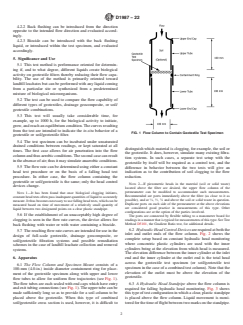
FIG. 1 Flow Column to Contain Geotextile Test Specimen
geotextile or soil/geotextile filter.
5.4 The test specimen can be incubated under unsaturated
drained conditions between readings, or kept saturated at all
distinguish which material is clogging, for example, the soil or
times. The first case allows for air penetration into the flow
the geotextile. It does, however, simulate many existing filtra-
columnandthusaerobicconditions.Thesecondcasecanresult
tion systems. In such cases, a separate test setup with the
intheabsenceofair;thusitmaysimulateanaerobicconditions.
geotextile by itself will be required as a control test, and the
5.5 The flow rate can be determined using either a constant
difference in behavior between the two tests will give an
head test procedure or on the basis of a falling head test
indication as to the contribution of soil clogging to the flow
procedure. In either case, the flow column containing the
reduction.
geotextile or soil/geotextile is the same; only the head control
NOTE 2—If piezometric heads in the material (soil or solid waste)
devices change.
located above the filter are desired, the upper flow column of the
permeameter can be modified to accommodate such measurements.
NOTE 1—It has been found that once biological clogging initiates,
Recommended are ports immediately above the filter (as close to it as
constantheadtestsoftenpassinadequatequantitiesofliquidtoaccurately
1 1 3
possible), and at ⁄4, ⁄2, ⁄4 and above the soil or solid waste in question.
measure.Itthusbecomesnecessarytousefallingheadtests,whichcanbe
Duplicate ports on each side of the permeameter at the above elevations
measured based on time of movement of a relatively small quantity of
are considered good practice in measurements of this type. Other
liquid between two designated points on a clear plastic standpipe.
configurations are at the option of the parties involved.
5.6 If the establishment of an unacceptably high degree of
The ports are connected by flexible tubing to a manometer board for
clogging is seen in the flow rate curves, the device allows for readingsinamannerthatistypicalformeasurementsofthistype.SeeTest
Method D5101, the Gradient Ratio test, for additional details.
back flushing with water or with water containing a biocide.
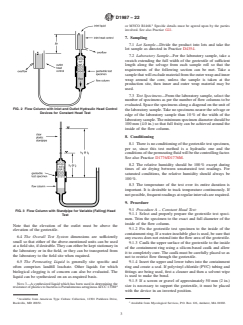
6.2 HydraulicHeadControlDevicesarerequiredatboththe
5.7 Theresultingflowratecurvesareintendedforuseinthe
inlet and outlet ends of the flow column. Fig. 2 shows the
design of full-scale geotextile, drainage geocomposite, or
complete setup based on constant hydraulic head monitoring
soil/geotextile filtration systems and possible remediation
where concentric plastic cylinders are used with the inner
schemes in the case of landfill leachate collection and removal
cylinders being at the elevation from which head is measured.
systems.
The elevation difference between the inner cylinder at the inlet
6. Apparatus end and the inner cylinder at the outlet end is the total head
across the geotextile test specimen (or soil/geotextile test
6.1 The Flow Column and Specimen Mount consists of a
specimeninthecaseofacombinedtestcolumn).Notethatthe
100-mm (4.0-in.) inside diameter containment ring for place-
elevation of the outlet must be above the elevation of the
ment of the geotextile specimen along with upper and lower
geotextile.
flow tubes to allow for uniform flow trajectories (see Fig. 1).
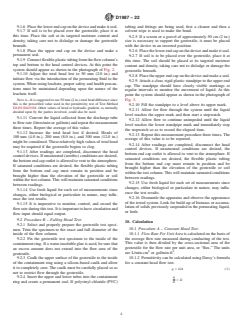
Theflowtubesareeachsealedwithendcapswhichhaveentry 6.3 A Hydraulic Head Standpipe above the flow column is
andexittubingconnections(seeFig.1).Theuppertubecanbe required for falling hydraulic head monitoring. Fig. 3 shows
made sufficiently long so as to provide for a soil column to be thistypeoftestconfigurationinwhichaclear,plasticstandpipe
placed above the geotextile. When this type of combined is placed above the flow column. Liquid movement is moni-
soil/geotextile cross section is used, however, it is difficult to toredforthetimeofflightbetweentwomarksonthestandpipe.
D1987 − 22
or MYCO B1468. Specific details must be agreed upon by the parties
involved. See also Practice G22.
7. Sampling
7.1 Lot Sample—Divide the product into lots and take the
lot sample as directed in Practice D4354.
7.2 Laboratory Sample—For the laboratory sample, take a
swatch extending the full width of the geotextile of sufficient
length along the selvage from each sample roll so that the
requirements of the following section can be met. Take a
samplethatwillexcludematerialfromtheouterwrapandinner
wrap around the core, unless the sample is taken at the
production site, then inner and outer wrap material may be
used.
7.3 Test Specimens—From the laboratory sample, select the
number of specimens as per the number of flow columns to be
evaluated. Space the specimens along a diagonal on the unit of
FIG. 2 Flow Column with Inlet and Outlet Hydraulic Head Control
thelaboratorysample.Takenospecimensnearertheselvageor
Devices for Constant Head Test
edge of the laboratory sample than 10% of the width of the
laboratorysample.Theminimumspecimendiametershouldbe
100 mm (4.0 in.) so that full fixity can be achieved around the
inside of the flow column.
8. Conditioning
8.1 Thereisnoconditioningofthegeotextiletestspecimen,
per se, since this test method is a hydraulic one and the
conditionsofthepermeatingfluidwillbethecontrollingfactor.
See also Practice D1776/D1776M.
8.2 The relative humidity should be 100% except during
times of air drying between unsaturated test readings. For
saturated conditions, the relative humidity should always be
100%.
8.3 The temperature of the test over its entire duration is
important. It is desirable to track temperature continuously. If
notpossible,frequentreadingsatregularintervalsarerequired.
9. Procedure
9.1 Procedure A – Constant Head Test:
FIG. 3 Flow Column with Standpipe for Variable (Falling) Head
Test 9.1.1 Select and properly prepare the geotextile test speci-
men. Trim the specimen to the exact and full diameter of the
inside of the flow column.
Note that the elevation of the outlet must be above the
9.1.2 Fix the geotextile test specimen to the inside of the
elevation of the geotextile.
containmentring.Ifawater-insolubleglueisused,besurethat
6.4 The Overall Test System dimensions are sufficiently
any excess does not extend into the flow area of the geotextile.
small so that either of the above-mentioned units can be used
9.1.3 Caulk the upper surface of the geotextile to the inside
atafieldsite,ifdesirable.Theycaneitherbekeptstationaryin
of the containment ring using a silicon-based caulk and allow
the laboratory or in the field, or they can be transported from
it to completely cure.The caulk must be carefully placed so as
the laboratory to the field site when required.
not to restrict flow throug
...
This document is not an ASTM standard and is intended only to provide the user of an ASTM standard an indication of what changes have been made to the previous version. Because
it may not be technically possible to adequately depict all changes accurately, ASTM recommends that users consult prior editions as appropriate. In all cases only the current version
of the standard as published by ASTM is to be considered the official document.
Designation: D1987 − 18 D1987 − 22
Standard Test Method for
Biological Clogging of Geotextile Geotextile, Drainage
Geocomposites, or Soil/Geotextile Filters
This standard is issued under the fixed designation D1987; the number immediately following the designation indicates the year of
original adoption or, in the case of revision, the year of last revision. A number in parentheses indicates the year of last reapproval. A
superscript epsilon (´) indicates an editorial change since the last revision or reapproval.
1. Scope
1.1 This test method is used to determine the potential for, and relative degree of, biological growth which can accumulate on
geotextile geotextile, drainage geocomposites, or geotextile/soil filters.
1.2 This test method uses the measurement of flow rates over an extended period of time to determine the amount of clogging.
1.3 This test method can be adapted for nonsaturatedunsaturated as well as saturated conditions.
1.4 This test method can use constant head or falling head measurement techniques.
1.5 This test method can also be used to give an indication as to the possibility of backflushing, back flushing, biocide treatment,
or both, for remediation purposes if biological clogging does occur.
1.6 The values in SI units are to be regarded as the standard. The values provided in inch-pound units are for information only.
1.7 This standard does not purport to address all of the safety concerns, if any, associated with its use. It is the responsibility
of the user of this standard to establish appropriate safety, health, and environmental practices and determine the applicability of
regulatory limitations prior to use.
1.8 This international standard was developed in accordance with internationally recognized principles on standardization
established in the Decision on Principles for the Development of International Standards, Guides and Recommendations issued
by the World Trade Organization Technical Barriers to Trade (TBT) Committee.
2. Referenced Documents
2.1 ASTM Standards:
D123 Terminology Relating to Textiles
D1776D1776/D1776M Practice for Conditioning and Testing Textiles
D4354 Practice for Sampling of Geosynthetics and Rolled Erosion Control Products (RECPs) for Testing
D4439 Terminology for Geosynthetics
D4491D4491/D4491M Test Methods for Water Permeability of Geotextiles by Permittivity
D5101 Test Method for Measuring the Filtration Compatibility of Soil-Geotextile Systems
This test method is under the jurisdiction of ASTM Committee D35 on Geosynthetics and is the direct responsibility of Subcommittee D35.02 on Endurance Properties.
Current edition approved Feb. 1, 2018May 1, 2022. Published February 2018June 2022. Originally approved in 1991. Last previous edition approved in 20162018 as
D1987 – 07 (2016).D1987 – 18. DOI: 10.1520/D1987-18.10.1520/D1987-22.
For referenced ASTM standards, visit the ASTM website, www.astm.org, or contact ASTM Customer Service at service@astm.org. For Annual Book of ASTM Standards
volume information, refer to the standard’s Document Summary page on the ASTM website.
Copyright © ASTM International, 100 Barr Harbor Drive, PO Box C700, West Conshohocken, PA 19428-2959. United States
D1987 − 22
E691 Practice for Conducting an Interlaboratory Study to Determine the Precision of a Test Method
G22 Practice for Determining Resistance of Plastics to Bacteria (Withdrawn 2002)
3. Terminology
3.1 Definitions:
3.1.1 aerobic, n—a condition in which a measurable volume of air is present in the incubation chamber or system.
3.1.1.1 Discussion—
In geotextiles, this condition can potentially contribute to the growth of microorganisms.
3.1.2 anaerobic, n—a condition in which no measurable volume of air is present in the incubation chamber or system.
3.1.2.1 Discussion—
In geotextiles, this condition cannot contribute to the growth of microorganisms.
3.1.3 back flushing, n—a process by which liquid is forced in the reverse direction to the flow direction.
3.1.3.1 Discussion—
In other drainage application areas, this process is commonly used to free clogged drainage systems of materials that impede the
intended direction of flow.
3.1.4 biocide, n—a chemical used to kill bacteria and other microorganisms.
3.1.5 geotextile, n—a permeable geosynthetic comprised solely of textiles.
3.1.6 permeability, n—the rate of flow of a liquid under a differential pressure through a material.
3.1.6.1 Discussion—
In geotextiles, permeability refers to hydraulic conductivity.
−1
3.1.7 permittivity, (Ψ)(t ), n—of geotextiles, the volumetric flow rate of water per unit, in a cross-sectional area head under
laminar flow conditions.
3.1 For definitions of otherPlease consult Terminology D4439 terms used in this test method, refer to Terminologies for definitions
related to this test method.D123 and D4439.
4. Summary of Test Method
4.1 A geotextile filter specimen filter, drainage geocomposite, or geotextile/soil filter composite specimen is positioned in a flow
column so that a designated liquid flows through it under either constant or falling head conditions.
4.1.1 The designated liquid might contain microorganisms from which biological growth can occur.
4.2 Flow rate is measured over time, converted to either permittivity or permeability, and reported accordingly.
4.2.1 Between readings, the test specimen can be allowed to be in either nonsaturatedunsaturated or saturated conditions.
4.2.2 Back flushing can be introduced from the direction opposite to the intended flow direction and evaluated accordingly.
4.2.3 Biocide can be introduced with the back flushing liquid, or introduced within the test specimen, and evaluated accordingly.
5. Significance and Use
5.1 This test method is performance oriented for determining if, and to what degree, different liquids create biological activity on
geotextile filters thereby reducing their flow capability. The use of the method is primarily oriented toward landfill leachates but
can be performed with any liquid coming from a particular site or synthesized from a predetermined mixture of biological
microorganisms.
The last approved version of this historical standard is referenced on www.astm.org.
D1987 − 22
5.2 The test can be used to compare the flow capability of different types of geotextiles geotextiles, drainage geocomposite, or
soil/geotextile combinations.
5.3 This test will usually take considerable time, for example, up to 1000 h, for the biological activity to initiate, grow, and reach
an equilibrium condition. The curves resulting from the test are intended to indicate the in situin-situ behavior of a geotextile or
soil/geotextile filter.
5.4 The test specimen can be incubated under nonsaturatedunsaturated drained conditions between readings, or kept saturated at
all times. The first case allows for air penetration into the flow column and thus aerobic conditions. The second case can result
in the absence of air,air; thus it may simulate anaerobic conditions.
5.5 The flow rate can be determined using either a constant head test procedure or on the basis of a falling head test procedure.
In either case, the flow column containing the geotextile or soil/geotextile is the same; only the head control devices change.
NOTE 1—It has been found that once biological clogging initiates, constant head tests often pass inadequate quantities of liquid to accurately measure.
It thus becomes necessary to use falling head tests, which can be measured on the basis of based on time of movement of a relatively small quantity of
liquid between two designated points on a clear plastic standpipe.
5.6 If the establishment of an unacceptably high degree of clogging is seen in the flow rate curves, the device allows for
backflushing back flushing with water or with water containing a biocide.
5.7 The resulting flow rate curves are intended for use in the design of full scale geotextile full-scale geotextile, drainage
geocomposite, or soil/geotextile filtration systems and possible remediation schemes in the case of landfill lechateleachate
collection and removal systems.
6. Apparatus
6.1 The Flow Column and Specimen Mount consists of a 100-mm (4.0-in.) inside diameter containment ring for placement of the
geotextile specimen along with upper and lower flow tubes to allow for uniform flow trajectories (see Fig. 1). The flow tubes are
each sealed with end caps which have entry and exit tubing connections (see Fig. 1). The upper tube can be made sufficiently long
so as to provide for a soil column to be placed above the geotextile. When this type of combined soil/geotextile cross section is
FIG. 1 Flow Column to Contain Geotextile Test Specimen
D1987 − 22
used, however, it is difficult to distinguish which material is clogging, for example, the soil or the geotextile. It does, however,
simulate many existing filtration systems. In such cases, a separate test setup with the geotextile by itself will be required as a
control test, and the difference in behavior between the two tests will give an indication as to the contribution of soil clogging to
the flow reduction.
NOTE 2—If piezoemetricpiezometric heads in the material (soil or solid waste) located above the filter are desired, the upper flow column of the
permeameter can be modified to accommodate such measurements. Recommended are ports immediately above the filter (as close to it as possible), and
1 1 3
at ⁄4, ⁄2, ⁄4 and above the soil or solid waste in question. Duplicate ports on each side of the permeameter at the above elevations are considered good
practice in measurements of this type. Other configurations are at the option of the parties involved.
The ports are connected by flexible tubing to a manometer board for readings in a manner that is typical for measurements of this type. See Test Method
D5101, the Gradient Ratio test, for additional details.
6.2 Hydraulic Head Control Devices are required at both the inlet and outlet ends of the flow column. Fig. 2 shows the complete
setup based on constant hydraulic head monitoring where concentric plastic cylinders are used with the inner cylinders being at
the elevation from which head is measured. The elevation difference between the inner cylinder at the inlet end and the inner
cylinder at the outlet end is the total head across the geotextile test specimen (or soil/geotextile test specimen in the case of a
combined test column). Note that the elevation of the outlet must be above the elevation of the geotextile.
6.3 A Hydraulic Head Standpipe above the flow column is required for falling hydraulic head monitoring. Fig. 3 shows this type
of test configuration in which a clear, plastic standpipe is placed above the flow column. Liquid movement is monitored for the
time of flight between two marks on the standpipe. Note that the elevation of the outlet must be above the elevation of the
geotextile.
6.4 The Overall Test System dimensions are sufficiently small so that either of the above-mentioned units can be used at a field
site, if desirable. They can either be kept stationary in the laboratory or in the field, or they can be transported from the laboratory
to the field site when required.
6.5 The Permeating Liquid is generally site specific and often comprises landfill leachate. Other liquids for which biological
clogging is of concern can also be evaluated. The liquid can be synthesized on an as-required basis.
NOTE 3—A synthesized liquid which has been used in determining the resistance of plastics to bacteria is Pseudomonas aeruginosa ATCC 13388 or
MYCO B1468. Specific details must be agreed upon by the parties involved. See also Practice G22.
FIG. 2 Flow Column with Inlet and Outlet Hydraulic Head Control Devices for Constant Head Test
Available from American Type Culture Collection, 12301 Parklawn Drive, Rockville, MD 20852.
Available from Mycological Services, P.O. Box 126, Amherst, MA 01002.
D1987 − 22
FIG. 3 Flow Column with Standpipe for Variable (Falling) Head Test
7. Sampling
7.1 Lot Sample—Divide the product into lots and take the lot sample as directed in Practice D4354.
7.2 Laboratory Sample—For the laboratory sample, take a swatch extending the full width of the geotextile of sufficient length
along the selvage from each sample roll so that the requirements of the following section can be met. Take a sample that will
exclude material from the outer wrap and inner wrap around the core, unless the sample is taken at the production site, then inner
and outer wrap material may be used.
7.3 Test Specimens—From the laboratory sample, select the number of specimens as per the number of flow columns to be
evaluated. Space the specimens along a diagonal on the unit of the laboratory sample. Take no specimens nearer the selvage or
edge of the laboratory sample than 10 % of the width of the laboratory sample. The minimum specimen diameter should be 100
mm (4.0 in.) so that full fixity can be
...