

ASTM D6636-01(2023)
(Test Method)Standard Test Method for Determination of Ply Adhesion Strength of Reinforced Geomembranes
General Information
- Abstract
SIGNIFICANCE AND USE
5.1 This method is an index test and measures the force required to separate individual plies of a reinforced geomembrane. The acceptable value of adhesion will vary for different types of products. However, for a particular type of product, minimum values of ply adhesion can be determined and agreed to by producer and consumer, and both can monitor to ensure compliance with the agreed-upon value.
5.2 Disputes—In case of a dispute arising from differences in reported test results when using this test method for acceptance testing of commercial shipments, the purchaser and the supplier should conduct comparative tests to determine if there is a statistical difference between their laboratories. Competent statistical assistance is recommended for the investigation of this difference. At a minimum, the two parties should take a group of test specimens which are from the same lot of material as those type in question and which are as homogeneous as possible. The test specimens should then be randomly assigned in equal numbers to each laboratory for testing. The average results from the two laboratories should be compared using Student's t-test for unpaired data and an acceptable probability level chosen by the two parties before the testing began. If a difference is found, either its cause must be found and corrected, or the purchaser and the supplier must agree to interpret future test results in the light of the known difference.
SCOPE
1.1 This test method covers the measurement of the adhesion strength (180° peel) between plies of reinforced geomembranes such as internally reinforced geomembranes and coated fabrics.
1.2 This test method is not intended for determining the strength of geomembrane seams or for determining the ply adhesion strength of geocomposite components (such as nonwoven geotextile bonded to geomembrane, or geotextile bonded to drainage core).
1.3 The values stated in SI units are to be regarded as standard. The values given in parentheses are for information only.
1.4 This standard does not purport to address all of the safety concerns, if any, associated with its use. It is the responsibility of the user of this standard to establish appropriate safety, health, and environmental practices and determine the applicability of regulatory limitations prior to use.
1.5 This international standard was developed in accordance with internationally recognized principles on standardization established in the Decision on Principles for the Development of International Standards, Guides and Recommendations issued by the World Trade Organization Technical Barriers to Trade (TBT) Committee.
- Status
- Published
- Publication Date
- 30-Apr-2023
- Technical Committee
- D35 - Geosynthetics
- Drafting Committee
- D35.10 - Geomembranes


Overview
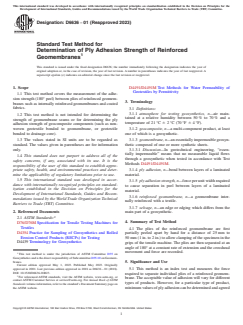
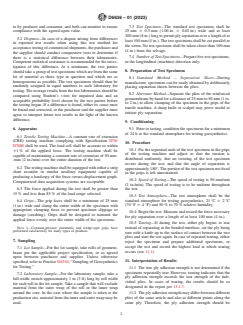
ASTM D6636-01(2023) - Standard Test Method for Determination of Ply Adhesion Strength of Reinforced Geomembranes sets forth a reliable procedure for measuring the adhesion strength (using a 180° peel test) between plies of reinforced geomembranes, including internally reinforced geomembranes and coated fabrics. This index test provides essential guidance for manufacturers, suppliers, and end users in quality assurance and product compliance within the geosynthetics industry.
The test method defines how the force required to separate individual plies of a reinforced geomembrane is to be measured and reported, supporting product development, performance specification, and contract verification in geotechnical and environmental applications.
Key Topics
- Scope and Use
- Provides a standardized approach to measure ply adhesion strength specific to reinforced geomembranes.
- Allows producers and consumers to establish and monitor minimum adhesion strength values for quality control.
- Test Applicability
- Focuses on ply separation within reinforced geomembranes and coated fabrics.
- Not intended for assessing seam strength or ply adhesion in geocomposites.
- Testing Procedure
- Uses a constant rate of extension (CRE) tensile testing machine.
- Measures the force necessary to peel apart plies at a 180° angle.
- Standard conditioning and specimen size ensure repeatability and reliability.
- Dispute Resolution
- Prescribes a structured approach for comparative testing in case of discrepancies between laboratories, including statistical comparison methods.
- Reporting
- Requires comprehensive documentation of test conditions, specimen preparation, equipment, maximum recorded forces, and any deviations.
Applications
Adhering to ASTM D6636-01(2023) provides practical benefits in diverse sectors that utilize geomembranes, such as:
- Construction and Civil Engineering
- Verifying the integrity of reinforced geomembrane liners used in containment, landfill, and environmental protection.
- Manufacturing
- Supporting ongoing production quality control of reinforced geomembranes and coated fabrics.
- Assisting in product development and process optimization.
- Procurement and Compliance
- Establishing acceptance criteria between suppliers and purchasers for minimum ply adhesion strength.
- Providing an objective basis for resolving disputes in commercial shipments via comparative laboratory testing.
- Research and Development
- Enabling comparative studies of new materials and bonding methods for geomembrane technologies.
Related Standards
Implementing ASTM D6636-01(2023) often involves referencing or aligning with other key ASTM standards related to geosynthetics, including:
- ASTM D76/D76M - Specification for Tensile Testing Machines for Textiles.
- ASTM D4354 - Practice for Sampling of Geosynthetics and Rolled Erosion Control Products.
- ASTM D4439 - Terminology for Geosynthetics.
- ASTM D4491/D4491M - Test Methods for Water Permeability of Geotextiles by Permittivity.
Users are advised to consult these standards for comprehensive guidance on equipment, terminology, and associated test methods closely related to ply adhesion strength determination.
By following ASTM D6636-01(2023), organizations can promote product reliability, demonstrate regulatory and contractual compliance, and achieve confidence in the adhesion characteristics of reinforced geomembranes for critical engineering applications.
Relations
- Effective Date
- 01-Feb-2024
- Effective Date
- 01-May-2020
- Effective Date
- 15-Apr-2018
- Effective Date
- 01-Aug-2017
- Refers
ASTM D4491/D4491M-17 - Standard Test Methods for Water Permeability of Geotextiles by Permittivity - Effective Date
- 01-Jan-2017
- Refers
ASTM D4491/D4491M-16 - Standard Test Methods for Water Permeability of Geotextiles by Permittivity - Effective Date
- 01-Jul-2016
- Effective Date
- 01-Sep-2015
- Effective Date
- 01-Jul-2015
- Refers
ASTM D4491/D4491M-15 - Standard Test Methods for Water Permeability of Geotextiles by Permittivity - Effective Date
- 01-Jul-2015
- Effective Date
- 01-Mar-2014
- Effective Date
- 01-Jul-2012
- Effective Date
- 01-Dec-2011
- Effective Date
- 01-Oct-2011
- Effective Date
- 15-Jan-2009
- Effective Date
- 01-Nov-2004
Get Certified
Connect with accredited certification bodies for this standard

DIBt (Deutsches Institut für Bautechnik)
German Institute for Building Technology.
DIN CERTCO
DIN Group product certification.

Aboma Certification B.V.
Specialized in construction, metal, and transport sectors.
Sponsored listings
Frequently Asked Questions
ASTM D6636-01(2023) is a standard published by ASTM International. Its full title is "Standard Test Method for Determination of Ply Adhesion Strength of Reinforced Geomembranes". This standard covers: SIGNIFICANCE AND USE 5.1 This method is an index test and measures the force required to separate individual plies of a reinforced geomembrane. The acceptable value of adhesion will vary for different types of products. However, for a particular type of product, minimum values of ply adhesion can be determined and agreed to by producer and consumer, and both can monitor to ensure compliance with the agreed-upon value. 5.2 Disputes—In case of a dispute arising from differences in reported test results when using this test method for acceptance testing of commercial shipments, the purchaser and the supplier should conduct comparative tests to determine if there is a statistical difference between their laboratories. Competent statistical assistance is recommended for the investigation of this difference. At a minimum, the two parties should take a group of test specimens which are from the same lot of material as those type in question and which are as homogeneous as possible. The test specimens should then be randomly assigned in equal numbers to each laboratory for testing. The average results from the two laboratories should be compared using Student's t-test for unpaired data and an acceptable probability level chosen by the two parties before the testing began. If a difference is found, either its cause must be found and corrected, or the purchaser and the supplier must agree to interpret future test results in the light of the known difference. SCOPE 1.1 This test method covers the measurement of the adhesion strength (180° peel) between plies of reinforced geomembranes such as internally reinforced geomembranes and coated fabrics. 1.2 This test method is not intended for determining the strength of geomembrane seams or for determining the ply adhesion strength of geocomposite components (such as nonwoven geotextile bonded to geomembrane, or geotextile bonded to drainage core). 1.3 The values stated in SI units are to be regarded as standard. The values given in parentheses are for information only. 1.4 This standard does not purport to address all of the safety concerns, if any, associated with its use. It is the responsibility of the user of this standard to establish appropriate safety, health, and environmental practices and determine the applicability of regulatory limitations prior to use. 1.5 This international standard was developed in accordance with internationally recognized principles on standardization established in the Decision on Principles for the Development of International Standards, Guides and Recommendations issued by the World Trade Organization Technical Barriers to Trade (TBT) Committee.
SIGNIFICANCE AND USE 5.1 This method is an index test and measures the force required to separate individual plies of a reinforced geomembrane. The acceptable value of adhesion will vary for different types of products. However, for a particular type of product, minimum values of ply adhesion can be determined and agreed to by producer and consumer, and both can monitor to ensure compliance with the agreed-upon value. 5.2 Disputes—In case of a dispute arising from differences in reported test results when using this test method for acceptance testing of commercial shipments, the purchaser and the supplier should conduct comparative tests to determine if there is a statistical difference between their laboratories. Competent statistical assistance is recommended for the investigation of this difference. At a minimum, the two parties should take a group of test specimens which are from the same lot of material as those type in question and which are as homogeneous as possible. The test specimens should then be randomly assigned in equal numbers to each laboratory for testing. The average results from the two laboratories should be compared using Student's t-test for unpaired data and an acceptable probability level chosen by the two parties before the testing began. If a difference is found, either its cause must be found and corrected, or the purchaser and the supplier must agree to interpret future test results in the light of the known difference. SCOPE 1.1 This test method covers the measurement of the adhesion strength (180° peel) between plies of reinforced geomembranes such as internally reinforced geomembranes and coated fabrics. 1.2 This test method is not intended for determining the strength of geomembrane seams or for determining the ply adhesion strength of geocomposite components (such as nonwoven geotextile bonded to geomembrane, or geotextile bonded to drainage core). 1.3 The values stated in SI units are to be regarded as standard. The values given in parentheses are for information only. 1.4 This standard does not purport to address all of the safety concerns, if any, associated with its use. It is the responsibility of the user of this standard to establish appropriate safety, health, and environmental practices and determine the applicability of regulatory limitations prior to use. 1.5 This international standard was developed in accordance with internationally recognized principles on standardization established in the Decision on Principles for the Development of International Standards, Guides and Recommendations issued by the World Trade Organization Technical Barriers to Trade (TBT) Committee.
ASTM D6636-01(2023) is classified under the following ICS (International Classification for Standards) categories: 91.100.50 - Binders. Sealing materials. The ICS classification helps identify the subject area and facilitates finding related standards.
ASTM D6636-01(2023) has the following relationships with other standards: It is inter standard links to ASTM D4439-24, ASTM D4354-12(2020), ASTM D4439-18, ASTM D4439-17, ASTM D4491/D4491M-17, ASTM D4491/D4491M-16, ASTM D4439-15a, ASTM D4439-15, ASTM D4491/D4491M-15, ASTM D4439-14, ASTM D4354-12, ASTM D76/D76M-11, ASTM D4439-11, ASTM D4354-99(2009), ASTM D4354-99(2004). Understanding these relationships helps ensure you are using the most current and applicable version of the standard.
ASTM D6636-01(2023) is available in PDF format for immediate download after purchase. The document can be added to your cart and obtained through the secure checkout process. Digital delivery ensures instant access to the complete standard document.
Standards Content (Sample)
This international standard was developed in accordance with internationally recognized principles on standardization established in the Decision on Principles for the
Development of International Standards, Guides and Recommendations issued by the World Trade Organization Technical Barriers to Trade (TBT) Committee.
Designation: D6636 − 01 (Reapproved 2023)
Standard Test Method for
Determination of Ply Adhesion Strength of Reinforced
Geomembranes
This standard is issued under the fixed designation D6636; the number immediately following the designation indicates the year of
original adoption or, in the case of revision, the year of last revision. A number in parentheses indicates the year of last reapproval. A
superscript epsilon (´) indicates an editorial change since the last revision or reapproval.
1. Scope D4491/D4491M Test Methods for Water Permeability of
Geotextiles by Permittivity
1.1 This test method covers the measurement of the adhe-
sion strength (180° peel) between plies of reinforced geomem-
3. Terminology
branes such as internally reinforced geomembranes and coated
fabrics. 3.1 Definitions:
3.1.1 atmosphere for testing geosynthetics, n—air main-
1.2 This test method is not intended for determining the
tained at a relative humidity between 50 % to 70 % and a
strength of geomembrane seams or for determining the ply
temperature of 21 °C 6 2 °C (70 °F 6 4 °F).
adhesion strength of geocomposite components (such as non-
woven geotextile bonded to geomembrane, or geotextile 3.1.2 geocomposite, n—a multi-component product, at least
bonded to drainage core). one of which is a geosynthetic.
3.1.3 geomembrane, n—an essentially impermeable geosyn-
1.3 The values stated in SI units are to be regarded as
thetic composed of one or more synthetic sheets.
standard. The values given in parentheses are for information
3.1.3.1 Discussion—In geotechnical engineering, “essen-
only.
tially impermeable” means that no measurable liquid flows
1.4 This standard does not purport to address all of the
through a geosynthetic when tested in accordance with Test
safety concerns, if any, associated with its use. It is the
Methods D4491/D4491M.
responsibility of the user of this standard to establish appro-
3.1.4 ply adhesion, n—bond between layers of a laminated
priate safety, health, and environmental practices and deter-
mine the applicability of regulatory limitations prior to use. material.
1.5 This international standard was developed in accor-
3.1.5 ply adhesion strength, n—force per unit width required
dance with internationally recognized principles on standard-
to cause separation in peel between layers of a laminated
ization established in the Decision on Principles for the
material.
Development of International Standards, Guides and Recom-
3.1.6 reinforced geomembrane, n—a geomembrane inter-
mendations issued by the World Trade Organization Technical
nally reinforced with a textile.
Barriers to Trade (TBT) Committee.
3.1.7 selvage, n—an edge or edging which differs from the
2. Referenced Documents
main part of a geosynthetic.
2.1 ASTM Standards:
4. Summary of Test Method
D76/D76M Specification for Tensile Testing Machines for
Textiles
4.1 The plies of the reinforced geomembrane are first
D4354 Practice for Sampling of Geosynthetics and Rolled
partially peeled apart by hand for a distance of 25 mm to
Erosion Control Products (RECPs) for Testing
50 mm (1 in. to 2 in.) to allow clamping of the specimen in the
D4439 Terminology for Geosynthetics
grips of the tensile machine. The plies are then separated at an
angle of 180° at a constant rate of extension and the crosshead
movement and force are recorded.
This test method is under the jurisdiction of ASTM Committee D35 on
Geosynthetics and is the direct responsibility of Subcommittee D35.10 on Geomem-
branes.
5. Significance and Use
Current edition approved May 1, 2023. Published May 2023. Originally
5.1 This method is an index test and measures the force
approved in 2001. Last previous edition approved in 2018 as D6636 – 01 (2018).
DOI: 10.1520/D6636-01R23.
required to separate individual plies of a reinforced geomem-
For referenced ASTM standards, visit the ASTM website, www.astm.org, or
brane. The acceptable value of adhesion will vary for different
contact ASTM Customer Service at service@astm.org. For Annual Book of ASTM
types of products. However, for a particular type of product,
Standards volume information, refer to the standard’s Document Summary page on
the ASTM website. minimum values of ply adhesion can be determined and agreed
Copyright © ASTM International, 100 Barr Harbor Drive, PO Box C700, West Conshohocken, PA 19428-2959. United States
D6636 − 01 (2023)
to by producer and consumer, and both can monitor to ensure 7.3 Test Specimen—The standard test specimens shall be
compliance with the agreed-upon value. 25 mm 6 0.5 mm (1.00 in. 6 0.02 in.) wide and at least
200 mm (8 in.) long to permit ply separation over a length of at
5.2 Disputes—In case of a dispute arising from differences
least 100 mm (4 in.). The test specimens shall be cut parallel to
in reported test results when using this test method for
the scrim. No test specimen shall be taken closer than 100 mm
acceptance testing of commercial shipments, the purchaser and
(4 in.) from the selvage.
the supplier should conduct comparative tests to determine if
7.4 Number of Test Specimens—Prepare five test specimens,
there is a statistical difference between their laboratories.
in the longitudinal (machine) direction only.
Competent statistical assistance is recommended for the inves-
tigation of this difference. At a minimum, the two parties
8. Preparation of Test Specimens
should take a group of test specimens which are from the same
lot of material as those type in question and which are as
8.1 Standard Method – Separation Sheet—During
homogeneous as possible. The test specimens should then be
manufacture, specimens can be easily obtained by deliberately
randomly assigned in equal numbers to each laboratory for
placing separation sheets between the plies.
testing. The average results from the two laboratories should be
8.2 Alternate Method—Separate the plies of the reinforced
compared using Student’s t-test for unpaired data and an
geomembrane by hand for a distance of 25 mm to 50 mm (1 in.
acceptable probability level chosen by the two parties before
to 2 in.) to allow clamping of the specimen in the grips of the
the testing began. If a difference is found, either its cause must
tensile machine. A sharp knife or scalpel may prove useful to
be found and corrected, or the purchaser and the supplier must
initiate ply separation.
agree to interpret future test results in the light of the known
difference.
9. Conditioning
9.1 Prior to testing, condition the specimens for a minimum
6. Apparatus
of 24 h at the standard atmosphere for testing geosynthetics.
6.1 Tensile Testing Machine—A constant rate of extensio
...