

ASTM C1222-23
(Practice)Standard Practice for Evaluation of Laboratories Testing Hydraulic Cement
General Information
- Abstract
SIGNIFICANCE AND USE
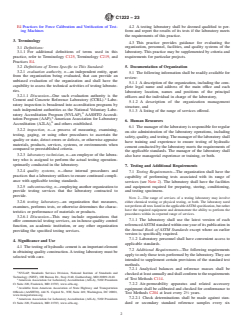
4.1 The testing of hydraulic cement is an important element in obtaining quality construction. A testing laboratory must be selected with care.
4.2 A testing laboratory shall be deemed qualified to perform and report the results of its tests if the laboratory meets the requirements of this practice.
4.3 This practice provides guidance for evaluating the organization, personnel, facilities, and quality systems of the laboratory. This practice may be supplemented by criteria and requirements for particular projects.
SCOPE
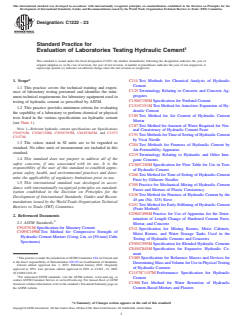
1.1 This practice covers the technical training and experience of laboratory testing personnel and identifies the minimum technical requirements for laboratory equipment used in testing of hydraulic cement as prescribed by ASTM.
1.2 This practice provides minimum criteria for evaluating the capability of a laboratory to perform chemical or physical tests listed in the various specifications on hydraulic cement (see Note 1).
Note 1: Relevant hydraulic cement specifications are Specifications C91/C91M, C150/C150M, C595/C595M, C845/C845M, and C1157/C1157M.
1.3 The values stated in SI units are to be regarded as standard. No other units of measurement are included in this standard.
1.4 This standard does not purport to address all of the safety concerns, if any, associated with its use. It is the responsibility of the user of this standard to establish appropriate safety, health, and environmental practices and determine the applicability of regulatory limitations prior to use.
1.5 This international standard was developed in accordance with internationally recognized principles on standardization established in the Decision on Principles for the Development of International Standards, Guides and Recommendations issued by the World Trade Organization Technical Barriers to Trade (TBT) Committee.
- Status
- Published
- Publication Date
- 31-Dec-2022
- Technical Committee
- C01 - Cement
- Drafting Committee
- C01.95 - Coordination of Standards
Overview
ASTM C1222-23: Standard Practice for Evaluation of Laboratories Testing Hydraulic Cement provides comprehensive requirements and guidance for evaluating the competence of laboratories that perform testing on hydraulic cement. The standard outlines procedures to assess the qualifications of laboratory organizations, personnel proficiency, adequacy of facilities and equipment, and the presence of robust quality management systems. Proper laboratory evaluation is crucial for ensuring accurate and reliable test results, which directly contribute to the quality of construction projects and compliance with multiple hydraulic cement specifications.
Key Topics
- Laboratory Qualification: Outlines the minimum criteria required for a laboratory to be deemed qualified to perform chemical and physical testing of hydraulic cement as prescribed by ASTM.
- Personnel Training and Experience: Specifies the necessary technical training, experience, and managerial competence for laboratory staff, especially those in supervisory positions.
- Testing Capabilities and Equipment: Details the technical requirements for laboratory equipment and facilities and the importance of using up-to-date standard test methods for hydraulic cement.
- Quality Systems: Requires laboratories to maintain documented procedures for sampling, testing, calibrations, personnel training, handling complaints, and internal quality reviews.
- Record Keeping and Reporting: Sets standards for the documentation of laboratory results, personnel qualifications, equipment inventory, and proficiency sample participation. Laboratories must retain these records for defined periods for traceability and quality verification.
- Subcontracting: Establishes protocols for subcontracting testing services, focusing on ensuring quality regardless of whether the subcontracting is permanent or temporary.
- External Evaluation and Accreditation: Mandates periodic inspection and evaluation by independent authorities to verify continued compliance with ASTM standards.
Applications
ASTM C1222-23 is widely used by:
- Construction quality control laboratories: To ensure that test results used in regulatory compliance and construction acceptance meet stringent accuracy standards.
- Accreditation and certification bodies: To evaluate laboratories for program participation or granting official recognition.
- Project owners and contractors: To vet laboratory testing partners and improve risk management by selecting organizations with proven testing qualifications.
- Academic and research laboratories: When conducting research or providing third-party verification for cement properties.
- Regulatory agencies: As a basis for oversight, inspection, and audit of materials testing laboratories.
The standard is referenced in conjunction with cement specifications such as ASTM C91/C91M (Masonry Cement), C150/C150M (Portland Cement), C595/C595M (Blended Hydraulic Cements), C845/C845M (Expansive Hydraulic Cement), and C1157/C1157M (Performance Specification for Hydraulic Cement).
Related Standards
For laboratories applying ASTM C1222-23, several other ASTM standards are crucial, including:
- ASTM C91/C91M: Specification for Masonry Cement
- ASTM C109/C109M: Test Method for Compressive Strength of Hydraulic Cement Mortars
- ASTM C114: Test Methods for Chemical Analysis of Hydraulic Cement
- ASTM C150/C150M: Specification for Portland Cement
- ASTM C204: Test Methods for Fineness of Hydraulic Cement by Air-Permeability Apparatus
- ASTM C511: Specification for Mixing Rooms and Water Storage for Testing Cements
- ASTM C595/C595M: Specification for Blended Hydraulic Cements
- ASTM C845/C845M: Specification for Expansive Hydraulic Cement
- ASTM C1157/C1157M: Performance Specification for Hydraulic Cement
ASTM C1222-23 aligns with internationally recognized standards development principles as set by the World Trade Organization TBT Committee, making it a trusted and credible tool for evaluating hydraulic cement testing laboratories worldwide. Adherence to ASTM C1222 enhances the reliability, traceability, and confidence in laboratory results across the construction and materials testing industries.
Relations
- Effective Date
- 01-Apr-2024
- Refers
ASTM C204-24 - Standard Test Methods for Fineness of Hydraulic Cement by Air-Permeability Apparatus - Effective Date
- 01-Jan-2024
- Effective Date
- 15-Dec-2023
- Effective Date
- 01-Dec-2023
- Effective Date
- 01-Oct-2023
- Effective Date
- 01-Aug-2020
- Effective Date
- 15-Jul-2020
- Effective Date
- 01-Apr-2020
- Effective Date
- 01-Apr-2020
- Effective Date
- 15-Dec-2019
- Effective Date
- 01-Dec-2019
- Effective Date
- 15-Nov-2019
- Effective Date
- 01-Jun-2019
- Effective Date
- 01-Apr-2019
- Effective Date
- 01-Jan-2019
Get Certified
Connect with accredited certification bodies for this standard

DIBt (Deutsches Institut für Bautechnik)
German Institute for Building Technology.
DIN CERTCO
DIN Group product certification.

ECOCERT
Organic and sustainability certification.
Sponsored listings
Frequently Asked Questions
ASTM C1222-23 is a standard published by ASTM International. Its full title is "Standard Practice for Evaluation of Laboratories Testing Hydraulic Cement". This standard covers: SIGNIFICANCE AND USE 4.1 The testing of hydraulic cement is an important element in obtaining quality construction. A testing laboratory must be selected with care. 4.2 A testing laboratory shall be deemed qualified to perform and report the results of its tests if the laboratory meets the requirements of this practice. 4.3 This practice provides guidance for evaluating the organization, personnel, facilities, and quality systems of the laboratory. This practice may be supplemented by criteria and requirements for particular projects. SCOPE 1.1 This practice covers the technical training and experience of laboratory testing personnel and identifies the minimum technical requirements for laboratory equipment used in testing of hydraulic cement as prescribed by ASTM. 1.2 This practice provides minimum criteria for evaluating the capability of a laboratory to perform chemical or physical tests listed in the various specifications on hydraulic cement (see Note 1). Note 1: Relevant hydraulic cement specifications are Specifications C91/C91M, C150/C150M, C595/C595M, C845/C845M, and C1157/C1157M. 1.3 The values stated in SI units are to be regarded as standard. No other units of measurement are included in this standard. 1.4 This standard does not purport to address all of the safety concerns, if any, associated with its use. It is the responsibility of the user of this standard to establish appropriate safety, health, and environmental practices and determine the applicability of regulatory limitations prior to use. 1.5 This international standard was developed in accordance with internationally recognized principles on standardization established in the Decision on Principles for the Development of International Standards, Guides and Recommendations issued by the World Trade Organization Technical Barriers to Trade (TBT) Committee.
SIGNIFICANCE AND USE 4.1 The testing of hydraulic cement is an important element in obtaining quality construction. A testing laboratory must be selected with care. 4.2 A testing laboratory shall be deemed qualified to perform and report the results of its tests if the laboratory meets the requirements of this practice. 4.3 This practice provides guidance for evaluating the organization, personnel, facilities, and quality systems of the laboratory. This practice may be supplemented by criteria and requirements for particular projects. SCOPE 1.1 This practice covers the technical training and experience of laboratory testing personnel and identifies the minimum technical requirements for laboratory equipment used in testing of hydraulic cement as prescribed by ASTM. 1.2 This practice provides minimum criteria for evaluating the capability of a laboratory to perform chemical or physical tests listed in the various specifications on hydraulic cement (see Note 1). Note 1: Relevant hydraulic cement specifications are Specifications C91/C91M, C150/C150M, C595/C595M, C845/C845M, and C1157/C1157M. 1.3 The values stated in SI units are to be regarded as standard. No other units of measurement are included in this standard. 1.4 This standard does not purport to address all of the safety concerns, if any, associated with its use. It is the responsibility of the user of this standard to establish appropriate safety, health, and environmental practices and determine the applicability of regulatory limitations prior to use. 1.5 This international standard was developed in accordance with internationally recognized principles on standardization established in the Decision on Principles for the Development of International Standards, Guides and Recommendations issued by the World Trade Organization Technical Barriers to Trade (TBT) Committee.
ASTM C1222-23 is classified under the following ICS (International Classification for Standards) categories: 71.040.10 - Chemical laboratories. Laboratory equipment; 91.100.10 - Cement. Gypsum. Lime. Mortar. The ICS classification helps identify the subject area and facilitates finding related standards.
ASTM C1222-23 has the following relationships with other standards: It is inter standard links to ASTM C219-24, ASTM C204-24, ASTM C109/C109M-23, ASTM C151/C151M-23, ASTM C114-23, ASTM C219-20a, ASTM C305-20, ASTM C219-20, ASTM C185-20, ASTM C125-19a, ASTM C185-19, ASTM C219-19a, ASTM C219-19, ASTM C150/C150M-19, ASTM C125-19. Understanding these relationships helps ensure you are using the most current and applicable version of the standard.
ASTM C1222-23 is available in PDF format for immediate download after purchase. The document can be added to your cart and obtained through the secure checkout process. Digital delivery ensures instant access to the complete standard document.
Standards Content (Sample)
This international standard was developed in accordance with internationally recognized principles on standardization established in the Decision on Principles for the
Development of International Standards, Guides and Recommendations issued by the World Trade Organization Technical Barriers to Trade (TBT) Committee.
Designation: C1222 − 23
Standard Practice for
Evaluation of Laboratories Testing Hydraulic Cement
This standard is issued under the fixed designation C1222; the number immediately following the designation indicates the year of
original adoption or, in the case of revision, the year of last revision. A number in parentheses indicates the year of last reapproval. A
superscript epsilon (´) indicates an editorial change since the last revision or reapproval.
1. Scope* C114 Test Methods for Chemical Analysis of Hydraulic
Cement
1.1 This practice covers the technical training and experi-
C125 Terminology Relating to Concrete and Concrete Ag-
ence of laboratory testing personnel and identifies the mini-
gregates
mum technical requirements for laboratory equipment used in
C150/C150M Specification for Portland Cement
testing of hydraulic cement as prescribed by ASTM.
C151/C151M Test Method for Autoclave Expansion of Hy-
1.2 This practice provides minimum criteria for evaluating
draulic Cement
the capability of a laboratory to perform chemical or physical
C185 Test Method for Air Content of Hydraulic Cement
tests listed in the various specifications on hydraulic cement
Mortar
(see Note 1).
C187 Test Method for Amount of Water Required for Nor-
NOTE 1—Relevant hydraulic cement specifications are Specifications
mal Consistency of Hydraulic Cement Paste
C91/C91M, C150/C150M, C595/C595M, C845/C845M, and C1157/
C191 TestMethodsforTimeofSettingofHydraulicCement
C1157M.
by Vicat Needle
1.3 The values stated in SI units are to be regarded as
C204 Test Methods for Fineness of Hydraulic Cement by
standard. No other units of measurement are included in this
Air-Permeability Apparatus
standard.
C219 Terminology Relating to Hydraulic and Other Inor-
1.4 This standard does not purport to address all of the
ganic Cements
safety concerns, if any, associated with its use. It is the
C230/C230M Specification for Flow Table for Use in Tests
responsibility of the user of this standard to establish appro-
of Hydraulic Cement
priate safety, health, and environmental practices and deter-
C266 Test Method for Time of Setting of Hydraulic-Cement
mine the applicability of regulatory limitations prior to use.
Paste by Gillmore Needles
1.5 This international standard was developed in accor-
C305 Practice for Mechanical Mixing of Hydraulic Cement
dance with internationally recognized principles on standard-
Pastes and Mortars of Plastic Consistency
ization established in the Decision on Principles for the
C430 Test Method for Fineness of Hydraulic Cement by the
Development of International Standards, Guides and Recom-
45-µm (No. 325) Sieve
mendations issued by the World Trade Organization Technical
C451 Test Method for Early Stiffening of Hydraulic Cement
Barriers to Trade (TBT) Committee.
(Paste Method)
C490/C490M Practice for Use of Apparatus for the Deter-
2. Referenced Documents
mination of Length Change of Hardened Cement Paste,
2.1 ASTM Standards:
Mortar, and Concrete
C91/C91M Specification for Masonry Cement
C511 Specification for Mixing Rooms, Moist Cabinets,
C109/C109M Test Method for Compressive Strength of
Moist Rooms, and Water Storage Tanks Used in the
Hydraulic Cement Mortars (Using 2-in. or [50 mm] Cube
Testing of Hydraulic Cements and Concretes
Specimens)
C595/C595M Specification for Blended Hydraulic Cements
C845/C845M Specification for Expansive Hydraulic Ce-
ment
This practice is under the jurisdiction ofASTM Committee C01 on Cement and
C1005 Specification for Reference Masses and Devices for
is the direct responsibility of Subcommittee C01.95 on Coordination of Standards.
DeterminingMassandVolumeforUseinPhysicalTesting
Current edition approved Jan. 1, 2023. Published January 2023. Originally
of Hydraulic Cements
approved in 1991. Last previous edition approved in 2021 as C1222 – 21. DOI:
10.1520/C1222-23.
C1157/C1157M Performance Specification for Hydraulic
For referenced ASTM standards, visit the ASTM website, www.astm.org, or
Cement
contact ASTM Customer Service at service@astm.org. For Annual Book of ASTM
C1506 Test Method for Water Retention of Hydraulic
Standards volume information, refer to the standard’s Document Summary page on
the ASTM website. Cement-Based Mortars and Plasters
*A Summary of Changes section appears at the end of this standard
Copyright © ASTM International, 100 Barr Harbor Drive, PO Box C700, West Conshohocken, PA 19428-2959. United States
C1222 − 23
E4 Practices for Force Calibration and Verification of Test- 4.2 A testing laboratory shall be deemed qualified to per-
ing Machines form and report the results of its tests if the laboratory meets
the requirements of this practice.
3. Terminology
4.3 This practice provides guidance for evaluating the
organization, personnel, facilities, and quality systems of the
3.1 Definitions:
3.1.1 For additional definitions of terms used in this laboratory. This practice may be supplemented by criteria and
requirements for particular projects.
practice, refer to Terminology C125, Terminology C219, and
Practices E4.
3.2 Definitions of Terms Specific to This Standard: 5. Documentation of Organization
3.2.1 evaluation authority, n—an independent entity, apart
5.1 The following information shall be readily available for
from the organization being evaluated, that can provide an
review:
unbiased evaluation of the organization and shall have the
5.1.1 A description of the organization, including the com-
capability to assess the technical activities of testing laborato-
plete legal name and address of the main office and each
ries.
laboratory location, names and positions of the principal
3.2.1.1 Discussion—One such evaluation authority is the
officers and the individual in charge of the laboratory,
Cement and Concrete Reference Laboratory (CCRL). Labo-
5.1.2 A description of the organization management
ratory inspection is broadened into accreditation programs by
structure, and
such independent authorities as the National Voluntary Labo-
5.1.3 A listing of the range of services offered.
ratory Accreditation Program (NVLAP), AASHTO Accredi-
tation Program (AAP), American Association for Laboratory
6. Human Resources
Accreditation (A2LA), and others established.
6.1 The manager of the laboratory is responsible for regular
3.2.2 inspection, n—a process of measuring, examining,
on-site administration of the laboratory operations, including
testing, gaging, or using other procedures to ascertain the
safety, quality, and testing. The manager of the laboratory shall
quality or state, detect errors or defects, or otherwise appraise
have training and experience to ensure testing of hydraulic
materials, products, services, systems, or environments when
cement conducted by the laboratory meets the requirements of
compared to preestablished criteria.
the applicable standards. The manager of the laboratory shall
3.2.3 laboratory technician, n—an employee of the labora-
also have managerial experience or training, or both.
tory who is assigned to perform the actual testing operation-
sprimarily conducted in the laboratory.
7. Testing and Additional Requirements
3.2.4 quality systems, n—those internal procedures and
7.1 Testing Requirements—The organization shall have the
practices that a laboratory utilizes to ensure continued compli-
capability of performing tests associated with its range of
ance with applicable testing standards.
services (see Note 2). The laboratory shall have the facilities
3.2.5 subcontracting, n—employing another organization to and equipment required for preparing, storing, conditioning,
provide testing services that the laboratory contracted to and testing specimens.
provide.
NOTE 2—The range of services of a testing laboratory may involve
3.2.6 testing laboratory—an organization that measures, either chemical testing or physical testing, or both. The laboratory need
notperformalltestslistedintheapplicableASTMspecification,butrather
examines, performs tests, or otherwise determines the charac-
have the required equipment and demonstrate the ability to perform the
teristics or performance of materials or products.
procedures within its reported range of services.
3.2.6.1 Discussion—This may include organizations that
7.1.1 The laboratory shall use the latest version of each
offer commercial testing services, an in-house quality control
referencedASTMstandardwithinoneyearofitspublicationin
function, an academic institution, or any other organization
the Annual Book of ASTM Standards except where an earlier
providing the specified testing services.
version is specifically required.
7.1.2 Laboratory personnel shall have convenient access to
4. Significance and Use
applicable standards.
4.1 The testing of hydraulic cement is an important element
7.2 Additional Requirements—The following requirements
in obtaining quality construction. A testing laboratory must be
apply to only those tests performed by the laboratory. They are
selected with care.
intended to supplement certain provisions of the standard test
methods.
7.2.1 Analytical balances and reference masses shall be
NVLAP, Standards Services Division, National Institute of Standards and
checkedatleastannuallyandshallconformtotherequirements
Technology (NIST), 100 Bureau Dr., Stop 2140, Gaithersburg, MD 20899-2140.
4 of Test Methods C114.
American Association for Laboratory Accreditation (A2LA), 5202 Presidents
7.2.2 Air-permeability apparatus and related accessory
Ct Suite 220, Frederick, MD 21703, www.a2la.org.
Available from American Association of State Highway and Transportation
equipment shall be calibrated and checked for conformance to
Officials (AASHTO), 444 N. Capitol St., NW, Suite 249, Washington, DC 20001,
Test Methods C204 at least every 2 ⁄2 years.
www.transportation.org.
7.2.2.1 Check determinations shall be made against stan-
American Association for Laboratory Accreditation (A2LA), 5202 Presidents
Ct Suite 220, Frederick, MD 21703, www.a2la.org. dard or secondary standard reference samples every six
...
This document is not an ASTM standard and is intended only to provide the user of an ASTM standard an indication of what changes have been made to the previous version. Because
it may not be technically possible to adequately depict all changes accurately, ASTM recommends that users consult prior editions as appropriate. In all cases only the current version
of the standard as published by ASTM is to be considered the official document.
Designation: C1222 − 21 C1222 − 23
Standard Practice for
Evaluation of Laboratories Testing Hydraulic Cement
This standard is issued under the fixed designation C1222; the number immediately following the designation indicates the year of
original adoption or, in the case of revision, the year of last revision. A number in parentheses indicates the year of last reapproval. A
superscript epsilon (´) indicates an editorial change since the last revision or reapproval.
1. Scope*
1.1 This practice covers the technical training and experience of laboratory testing personnel and identifies the minimum technical
requirements for laboratory equipment used in testing of hydraulic cement as prescribed by ASTM.
1.2 This practice provides minimum criteria for evaluating the capability of a laboratory to perform chemical or physical tests
listed in the various specifications on hydraulic cement (see Note 1).
NOTE 1—Relevant hydraulic cement specifications are Specifications C91/C91M, C150/C150M, C595/C595M, C845/C845M, and C1157/C1157M.
1.3 The values stated in SI units are to be regarded as standard. No other units of measurement are included in this standard.
1.4 This standard does not purport to address all of the safety concerns, if any, associated with its use. It is the responsibility
of the user of this standard to establish appropriate safety, health, and environmental practices and determine the applicability of
regulatory limitations prior to use.
1.5 This international standard was developed in accordance with internationally recognized principles on standardization
established in the Decision on Principles for the Development of International Standards, Guides and Recommendations issued
by the World Trade Organization Technical Barriers to Trade (TBT) Committee.
2. Referenced Documents
2.1 ASTM Standards:
C91/C91M Specification for Masonry Cement
C109/C109M Test Method for Compressive Strength of Hydraulic Cement Mortars (Using 2-in. or [50 mm] Cube Specimens)
C114 Test Methods for Chemical Analysis of Hydraulic Cement
C125 Terminology Relating to Concrete and Concrete Aggregates
C150/C150M Specification for Portland Cement
C151/C151M Test Method for Autoclave Expansion of Hydraulic Cement
C185 Test Method for Air Content of Hydraulic Cement Mortar
C187 Test Method for Amount of Water Required for Normal Consistency of Hydraulic Cement Paste
C191 Test Methods for Time of Setting of Hydraulic Cement by Vicat Needle
C204 Test Methods for Fineness of Hydraulic Cement by Air-Permeability Apparatus
C219 Terminology Relating to Hydraulic and Other Inorganic Cements
C230/C230M Specification for Flow Table for Use in Tests of Hydraulic Cement
This practice is under the jurisdiction of ASTM Committee C01 on Cement and is the direct responsibility of Subcommittee C01.95 on Coordination of Standards.
Current edition approved Jan. 1, 2021Jan. 1, 2023. Published February 2021January 2023. Originally approved in 1991. Last previous edition approved in 20192021 as
C1222 – 19a.C1222 – 21. DOI: 10.1520/C1222-21.10.1520/C1222-23.
For referenced ASTM standards, visit the ASTM website, www.astm.org, or contact ASTM Customer Service at service@astm.org. For Annual Book of ASTM Standards
volume information, refer to the standard’s Document Summary page on the ASTM website.
*A Summary of Changes section appears at the end of this standard
Copyright © ASTM International, 100 Barr Harbor Drive, PO Box C700, West Conshohocken, PA 19428-2959. United States
C1222 − 23
C266 Test Method for Time of Setting of Hydraulic-Cement Paste by Gillmore Needles
C305 Practice for Mechanical Mixing of Hydraulic Cement Pastes and Mortars of Plastic Consistency
C430 Test Method for Fineness of Hydraulic Cement by the 45-μm (No. 325) Sieve
C451 Test Method for Early Stiffening of Hydraulic Cement (Paste Method)
C490/C490M Practice for Use of Apparatus for the Determination of Length Change of Hardened Cement Paste, Mortar, and
Concrete
C511 Specification for Mixing Rooms, Moist Cabinets, Moist Rooms, and Water Storage Tanks Used in the Testing of Hydraulic
Cements and Concretes
C595/C595M Specification for Blended Hydraulic Cements
C845/C845M Specification for Expansive Hydraulic Cement
C1005 Specification for Reference Masses and Devices for Determining Mass and Volume for Use in Physical Testing of
Hydraulic Cements
C1157/C1157M Performance Specification for Hydraulic Cement
C1506 Test Method for Water Retention of Hydraulic Cement-Based Mortars and Plasters
E4 Practices for Force Calibration and Verification of Testing Machines
3. Terminology
3.1 Definitions:
3.1.1 For additional definitions of terms used in this practice, refer to Terminology C125, Terminology C219, and Practices E4.
3.2 Definitions of Terms Specific to This Standard:
3.2.1 evaluation authority, n—an independent entity, apart from the organization being evaluated, that can provide an unbiased
evaluation of the organization and shall have the capability to assess the technical activities of testing laboratories.
3.2.1.1 Discussion—
One such evaluation authority is the Cement and Concrete Reference Laboratory (CCRL). Laboratory inspection is broadened into
accreditation programs by such independent authorities as the National Voluntary Laboratory Accreditation Program (NVLAP),
5 6
AASHTO Accreditation Program (AAP), American Association for Laboratory Accreditation (A2LA), and others established.
3.2.2 inspection, n—a process of measuring, examining, testing, gaging, or using other procedures to ascertain the quality or state,
detect errors or defects, or otherwise appraise materials, products, services, systems, or environments when compared to
preestablished criteria.
3.2.3 laboratory technician, n—an employee of the laboratory who is assigned to perform the actual testing operationsprimarily
conducted in the laboratory.
3.2.4 quality systems, n—those internal procedures and practices that a laboratory utilizes to ensure continued compliance with
applicable testing standards.
3.2.5 subcontracting, n—employing another organization to provide testing services that the laboratory contracted to provide.
3.2.6 testing laboratory—an organization that measures, examines, performs tests, or otherwise determines the characteristics or
performance of materials or products.
3.2.6.1 Discussion—
This may include organizations that offer commercial testing services, an in-house quality control function, an academic institution,
or any other organization providing the specified testing services.
4. Significance and Use
4.1 The testing of hydraulic cement is an important element in obtaining quality construction. A testing laboratory must be selected
with care.
NVLAP, Standards Services Division, National Institute of Standards and Technology (NIST), 100 Bureau Dr., Stop 2140, Gaithersburg, MD 20899-2140.
American Association for Laboratory Accreditation (A2LA), 5202 Presidents Ct Suite 220, Frederick, MD 21703, www.a2la.org.
Available from American Association of State Highway and Transportation Officials (AASHTO), 444 N. Capitol St., NW, Suite 249, Washington, DC 20001,
www.transportation.org.
American Association for Laboratory Accreditation (A2LA), 5202 Presidents Ct Suite 220, Frederick, MD 21703, www.a2la.org.
C1222 − 23
4.2 A testing laboratory shall be deemed qualified to perform and report the results of its tests if the laboratory meets the
requirements of this practice.
4.3 This practice provides guidance for evaluating the organization, personnel, facilities, and quality systems of the laboratory.
This practice may be supplemented by criteria and requirements for particular projects.
5. Documentation of Organization
5.1 The following information shall be readily available for review:
5.1.1 A description of the organization, including the complete legal name and address of the main office and each laboratory
location, names and positions of the principal officers and the individual in charge of the laboratory,
5.1.2 A description of the organization management structure, and
5.1.3 A listing of the range of services offered.
6. Human Resources
6.1 The manager of the laboratory shall be a chemist, materials analyst, or an engineer and a full-time employee of the
organization having at least three years supervisory experience in theis responsible for regular on-site administration of the
laboratory operations, including safety, quality, and testing. The manager of the laboratory shall have training and experience to
ensure testing of hydraulic cement; however, a person with equivalent science-oriented education or experience having
satisfactorily directed testing of hydraulic cement is acceptable. cement conducted by the laboratory meets the requirements of the
applicable standards. The manager of the laboratory shall also have managerial experience or training, or both.
7. Testing and Additional Requirements
7.1 Testing Requirements—The organization shall have the capability of performing tests associated with its range of services (see
Note 2). The laboratory shall have the facilities and equipment required for preparing, storing, conditioning, and testing specimens.
NOTE 2—The range of services of a testing laboratory may involve either chemical testing or physical testing, or both. The laboratory need not perform
all tests listed in the applicable ASTM specification, but rather have the required equipment and demonstrate the ability to perform the procedures within
its reported range of services.
7.1.1 The laboratory shall use the latest version of each referenced ASTM standard within one year of its publication in the Annual
Book of ASTM Standards except where an earlier version is specifically required.
7.1.2 Laboratory personnel shall have convenient access to applicable standards.
7.2 Additional Requirements—The following requirements apply to only those tests performed by the laboratory. They are
intended to supplement certain provisions of the standard test methods.
7.2.1 Analytical balances and reference masses shall be checked at least annually and shall conform to the requirements of Test
Methods C114.
7.2.2 Air-permeability apparatus and related accessory equipment shall be calibrated and checked for conformance to Test
Methods C204 at least every 2 ⁄2 years.
7.2.2.1 Check determinations shall be made against standard
...