

ASTM B551/B551M-12(2021)
(Specification)Standard Specification for Zirconium and Zirconium Alloy Strip, Sheet, and Plate
General Information
- Abstract
ABSTRACT
This specification covers five grades of zirconium strip, sheet, and plate. These are low oxygen zirconium (Grade R60700), unalloyed zirconium (Grade R60702), zirconium-tin (Grade R60704), zirconium-niobium (Grade R60705), and zirconium-niobium (Grade R60706). The materials shall be made from ingots that are produced by vacuum or plasma arc melting, vacuum electron-beam melting, a combination of these three methods or other melting processes conventionally used for reactive metals. All processes to be done in furnaces usually used for reactive metals. The various mill products covered by this specification are formed with the conventional extrusion, forging, or rolling equipment normally found in primary ferrous and nonferrous plants. The strip, sheet, and plate shall be supplied in the recrystallized annealed condition unless otherwise specified in the purchase order. The materials shall be subjected to chemical analysis and tensile strength, yield strength, elongation, bend, and flatness tests.
SCOPE
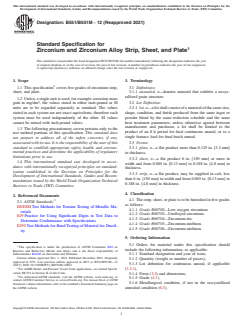
1.1 This specification2 covers five grades of zirconium strip, sheet, and plate.
1.2 Unless a single unit is used, for example corrosion mass gain in mg/dm2, the values stated in either inch-pound or SI units are to be regarded separately as standard. The values stated in each system are not exact equivalents; therefore each system must be used independently of the other. SI values cannot be mixed with inch-pound values.
1.3 The following precautionary caveat pertains only to the test method portions of this specification: This standard does not purport to address all of the safety concerns, if any, associated with its use. It is the responsibility of the user of this standard to establish appropriate safety, health, and environmental practices and determine the applicability of regulatory limitations prior to use.
1.4 This international standard was developed in accordance with internationally recognized principles on standardization established in the Decision on Principles for the Development of International Standards, Guides and Recommendations issued by the World Trade Organization Technical Barriers to Trade (TBT) Committee.
- Status
- Published
- Publication Date
- 31-Oct-2021
- Technical Committee
- B10 - Reactive and Refractory Metals and Alloys
- Drafting Committee
- B10.02 - Zirconium and Hafnium
Overview
ASTM B551/B551M-12(2021) is the internationally recognized standard specification developed by ASTM International for zirconium and zirconium alloy strip, sheet, and plate. It covers five distinct grades: low oxygen zirconium (Grade R60700), unalloyed zirconium (Grade R60702), zirconium-tin (Grade R60704), and zirconium-niobium (Grades R60705 and R60706). This standard defines requirements for materials produced through vacuum or plasma arc melting, vacuum electron-beam melting, or other conventional reactive metals processes, ensuring reliable quality for downstream fabrication and use. Products are typically supplied in the recrystallized annealed condition, unless otherwise specified.
Key Topics
- Product Forms and Grades: Defines strip, sheet, and plate forms, and details five grades according to composition and alloying elements.
- Manufacturing Quality: Ensures materials are made from high purity ingots using advanced melting processes suitable for reactive metals.
- Chemical and Mechanical Properties: Specifies allowable chemical compositions and mechanical properties such as tensile strength, yield strength, elongation, and bend performance.
- Dimensional Tolerances: Prescribes permissible variations in thickness, width, length, flatness, crown, and camber for different product forms.
- Testing and Inspection: Outlines requirements for chemical analysis and mechanical testing, and establishes procedures for retests, inspections, and referee testing in case of disputes.
- Workmanship and Appearance: Requires finished products to be free from defects and foreign materials, with acceptable removal of surface imperfections.
- Marking and Packaging: Details product marking, packaging requirements, and identification to ensure material traceability and safe transport.
Applications
ASTM B551/B551M-12(2021) is widely referenced in industries where zirconium and its alloys are essential for their excellent corrosion resistance, high strength, and stability in aggressive environments. Typical application areas include:
- Nuclear Power Generation: Fabrication of reactor components and fuel assemblies where resistance to corrosion and low neutron absorption are critical.
- Chemical Processing: Manufacture of equipment such as heat exchangers, vessels, and piping systems exposed to strong acids and alkalis.
- Explosion Cladding: As a clad layer for pressure vessels and heat exchangers, especially grades R60700 and R60702, thanks to their superior chemical durability and workability.
- Medical Devices and Electronics: Utilization in applications demanding biocompatibility and non-reactivity.
By defining rigorous manufacturing, testing, and documentation practices, this standard helps ensure safe, reliable, and consistent quality zirconium products for critical applications worldwide.
Related Standards
For comprehensive material selection and testing, the following standards are often used in conjunction with ASTM B551/B551M-12(2021):
- ASTM E8/E8M: Test Methods for Tension Testing of Metallic Materials
- ASTM E29: Practice for Using Significant Digits in Test Data
- ASTM E290: Test Methods for Bend Testing of Material for Ductility
- ASME SB-551: Equivalent specification adopted for boiler and pressure vessel applications
These related standards support precise testing and evaluation, ensuring conformity and compatibility within the global materials supply chain.
Keywords: zirconium strip, zirconium sheet, zirconium plate, zirconium alloy, ASTM B551, mechanical properties, chemical composition, dimensional tolerances, material standard, reactive metals, explosion cladding, corrosion resistance
Relations
- Effective Date
- 01-Jan-2024
- Effective Date
- 15-Jul-2016
- Effective Date
- 01-Feb-2015
- Effective Date
- 01-Jun-2013
- Effective Date
- 01-Apr-2013
- Effective Date
- 01-Dec-2011
- Effective Date
- 01-Oct-2008
- Effective Date
- 15-Nov-2006
- Effective Date
- 15-Sep-2006
- Effective Date
- 01-May-2006
- Effective Date
- 01-Dec-2004
- Effective Date
- 01-Oct-2004
- Effective Date
- 10-May-2002
- Effective Date
- 10-May-1999
- Effective Date
- 01-Jan-1997
Get Certified
Connect with accredited certification bodies for this standard

Element Materials Technology
Materials testing and product certification.

Inštitut za kovinske materiale in tehnologije
Institute of Metals and Technology. Materials testing, metallurgical analysis, NDT.
Sponsored listings
Frequently Asked Questions
ASTM B551/B551M-12(2021) is a technical specification published by ASTM International. Its full title is "Standard Specification for Zirconium and Zirconium Alloy Strip, Sheet, and Plate". This standard covers: ABSTRACT This specification covers five grades of zirconium strip, sheet, and plate. These are low oxygen zirconium (Grade R60700), unalloyed zirconium (Grade R60702), zirconium-tin (Grade R60704), zirconium-niobium (Grade R60705), and zirconium-niobium (Grade R60706). The materials shall be made from ingots that are produced by vacuum or plasma arc melting, vacuum electron-beam melting, a combination of these three methods or other melting processes conventionally used for reactive metals. All processes to be done in furnaces usually used for reactive metals. The various mill products covered by this specification are formed with the conventional extrusion, forging, or rolling equipment normally found in primary ferrous and nonferrous plants. The strip, sheet, and plate shall be supplied in the recrystallized annealed condition unless otherwise specified in the purchase order. The materials shall be subjected to chemical analysis and tensile strength, yield strength, elongation, bend, and flatness tests. SCOPE 1.1 This specification2 covers five grades of zirconium strip, sheet, and plate. 1.2 Unless a single unit is used, for example corrosion mass gain in mg/dm2, the values stated in either inch-pound or SI units are to be regarded separately as standard. The values stated in each system are not exact equivalents; therefore each system must be used independently of the other. SI values cannot be mixed with inch-pound values. 1.3 The following precautionary caveat pertains only to the test method portions of this specification: This standard does not purport to address all of the safety concerns, if any, associated with its use. It is the responsibility of the user of this standard to establish appropriate safety, health, and environmental practices and determine the applicability of regulatory limitations prior to use. 1.4 This international standard was developed in accordance with internationally recognized principles on standardization established in the Decision on Principles for the Development of International Standards, Guides and Recommendations issued by the World Trade Organization Technical Barriers to Trade (TBT) Committee.
ABSTRACT This specification covers five grades of zirconium strip, sheet, and plate. These are low oxygen zirconium (Grade R60700), unalloyed zirconium (Grade R60702), zirconium-tin (Grade R60704), zirconium-niobium (Grade R60705), and zirconium-niobium (Grade R60706). The materials shall be made from ingots that are produced by vacuum or plasma arc melting, vacuum electron-beam melting, a combination of these three methods or other melting processes conventionally used for reactive metals. All processes to be done in furnaces usually used for reactive metals. The various mill products covered by this specification are formed with the conventional extrusion, forging, or rolling equipment normally found in primary ferrous and nonferrous plants. The strip, sheet, and plate shall be supplied in the recrystallized annealed condition unless otherwise specified in the purchase order. The materials shall be subjected to chemical analysis and tensile strength, yield strength, elongation, bend, and flatness tests. SCOPE 1.1 This specification2 covers five grades of zirconium strip, sheet, and plate. 1.2 Unless a single unit is used, for example corrosion mass gain in mg/dm2, the values stated in either inch-pound or SI units are to be regarded separately as standard. The values stated in each system are not exact equivalents; therefore each system must be used independently of the other. SI values cannot be mixed with inch-pound values. 1.3 The following precautionary caveat pertains only to the test method portions of this specification: This standard does not purport to address all of the safety concerns, if any, associated with its use. It is the responsibility of the user of this standard to establish appropriate safety, health, and environmental practices and determine the applicability of regulatory limitations prior to use. 1.4 This international standard was developed in accordance with internationally recognized principles on standardization established in the Decision on Principles for the Development of International Standards, Guides and Recommendations issued by the World Trade Organization Technical Barriers to Trade (TBT) Committee.
ASTM B551/B551M-12(2021) is classified under the following ICS (International Classification for Standards) categories: 77.150.99 - Other products of non-ferrous metals. The ICS classification helps identify the subject area and facilitates finding related standards.
ASTM B551/B551M-12(2021) has the following relationships with other standards: It is inter standard links to ASTM E8/E8M-24, ASTM E8/E8M-16, ASTM E8/E8M-15, ASTM E8/E8M-13, ASTM E290-13, ASTM E8/E8M-11, ASTM E29-08, ASTM E29-06b, ASTM E29-06a, ASTM E29-06, ASTM E29-04, ASTM E290-97a(2004), ASTM E29-02e1, ASTM E29-93a(1999), ASTM E290-97a. Understanding these relationships helps ensure you are using the most current and applicable version of the standard.
ASTM B551/B551M-12(2021) is available in PDF format for immediate download after purchase. The document can be added to your cart and obtained through the secure checkout process. Digital delivery ensures instant access to the complete standard document.
Standards Content (Sample)
This international standard was developed in accordance with internationally recognized principles on standardization established in the Decision on Principles for the
Development of International Standards, Guides and Recommendations issued by the World Trade Organization Technical Barriers to Trade (TBT) Committee.
Designation: B551/B551M −12 (Reapproved 2021)
Standard Specification for
Zirconium and Zirconium Alloy Strip, Sheet, and Plate
This standard is issued under the fixed designation B551/B551M; the number immediately following the designation indicates the year
of original adoption or, in the case of revision, the year of last revision. A number in parentheses indicates the year of last reapproval.
A superscript epsilon (´) indicates an editorial change since the last revision or reapproval.
1. Scope 3. Terminology
1.1 Thisspecification coversfivegradesofzirconiumstrip, 3.1 Definitions:
sheet, and plate. 3.1.1 annealed, n—denotes material that exhibits a recrys-
tallized grain structure.
1.2 Unless a single unit is used, for example corrosion mass
gain in mg/dm , the values stated in either inch-pound or SI 3.2 Lot Definition:
units are to be regarded separately as standard. The values 3.2.1 lot,n—alotshallconsistofamaterialofthesamesize,
stated in each system are not exact equivalents; therefore each shape, condition, and finish produced from the same ingot or
system must be used independently of the other. SI values powder blend by the same reduction schedule and the same
cannot be mixed with inch-pound values. heat treatment parameters; unless otherwise agreed between
manufacturer and purchaser, a lot shall be limited to the
1.3 The following precautionary caveat pertains only to the
product of an 8 h period for final continuous anneal, or to a
test method portions of this specification: This standard does
single furnace load for final batch anneal.
not purport to address all of the safety concerns, if any,
associated with its use. It is the responsibility of the user of this
3.3 Forms:
standard to establish appropriate safety, health, and environ-
3.3.1 plate, n—a flat product more than 0.125 in. [3.2 mm]
mental practices and determine the applicability of regulatory
in thickness.
limitations prior to use.
3.3.2 sheet, n—a flat product 6 in. [150 mm] or more in
1.4 This international standard was developed in accor-
width and from 0.005 in. [0.13 mm] to 0.188 in. [4.8 mm] in
dance with internationally recognized principles on standard-
thickness.
ization established in the Decision on Principles for the
3.3.3 strip, n—a flat product, may be supplied in coil, less
Development of International Standards, Guides and Recom-
than 6 in. [150 mm] in width and from 0.005 in. [0.13 mm] to
mendations issued by the World Trade Organization Technical
0.188 in. [4.8 mm] in thickness.
Barriers to Trade (TBT) Committee.
4. Classification
2. Referenced Documents
4.1 The strip, sheet, or plate is to be furnished in five grades
2.1 ASTM Standards:
as follows:
E8/E8M Test Methods for Tension Testing of Metallic Ma-
4.1.1 Grade R60700—Low oxygen zirconium.
terials
4.1.2 Grade R60702—Unalloyed zirconium.
E29 Practice for Using Significant Digits in Test Data to
4.1.3 Grade R60704—Zirconium-tin.
Determine Conformance with Specifications
4.1.4 Grade R60705—Zirconium-niobium.
E290 Test Methods for Bend Testing of Material for Ductil-
4.1.5 Grade R60706—Zirconium-niobium.
ity
5. Ordering Information
5.1 Orders for material under this specification should
This specification is under the jurisdiction of ASTM Committee B10 on
include the following information, as applicable:
Reactive and Refractory Metals and Alloys and is the direct responsibility of
Subcommittee B10.02 on Zirconium and Hafnium.
5.1.1 Standard designation and year of issue,
Current edition approved Nov. 1, 2021. Published December 2021. Originally
5.1.2 Quantity (weight or number of pieces),
approved in 1971. Last previous edition approved in 2017 as B551/B551M – 12
5.1.3 Lot definition for continuous anneal, if applicable
(2017). DOI: 10.1520/B0551_B0551M-12R21.
(3.2.1),
For ASME Boiler and Pressure Vessel Code applications, see related Specifi-
cation SB-551 in Section II of that Code.
5.1.4 Form (3.3) and dimensions,
For referenced ASTM standards, visit the ASTM website, www.astm.org, or
5.1.5 Grade (4.1),
contact ASTM Customer Service at service@astm.org. For Annual Book of ASTM
5.1.6 Metallurgical condition, if not in the recrystallized
Standards volume information, refer to the standard’s Document Summary page on
the ASTM website. annealed condition (6.3),
Copyright © ASTM International, 100 Barr Harbor Drive, PO Box C700, West Conshohocken, PA 19428-2959. United States
B551/B551M − 12 (2021)
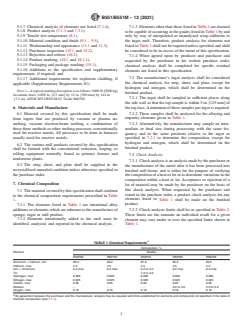
5.1.7 Chemical analysis of elements not listed (7.1.4), 7.1.3 Elements other than those listed in Table 1 are deemed
5.1.8 Product analysis (7.1.3 and 7.3.1), tobecapableofoccurringinthegradeslistedinTable1byand
5.1.9 Tensile test temperature (8.1), only by way of unregulated or unanalyzed scrap additions to
5.1.10 Material condition and finish (9.1 – 9.5), the ingot melt. Therefore, product analysis for elements not
5.1.11 Workmanship and appearance (11.1 and 11.3),
listed in Table 1 shall not be required unless specified and shall
5.1.12 Purchaser inspection (15.1 and 15.2), be considered to be in excess of the intent of this specification.
5.1.13 Rejection and referee (16.2),
7.1.4 When agreed upon by producer and purchaser and
5.1.14 Product marking, (18.1 and 18.1.1),
requested by the purchaser in his written purchase order,
5.1.15 Packaging and package marking (19.1),
chemical analysis shall be completed for specific residual
5.1.16 Additions to the specification and supplementary
elements not listed in this specification.
requirements, if required, and
7.2 The manufacturer’s ingot analysis shall be considered
5.1.17 Additional requirements for explosion cladding, if
the chemical analysis for strip, sheet, and plate, except for
applicable (Supplementary Requirements S1).
hydrogen and nitrogen, which shall be determined on the
NOTE1—Atypicalorderingdescriptionisasfollows:9000-lb[5000kg]
finished product.
zirconium sheet, 0.098 in. [2.5 mm] by 12 in. [300 mm] by 144 in.
7.2.1 The ingot shall be sampled in sufficient places along
[3.5 m], ASTM B551/B551M-07, Grade R60705.
the side wall so that the top sample is within 5 in. [125 mm] of
6. Materials and Manufacture the top face.Aminimum of three samples per ingot is required.
7.2.2 These samples shall be analyzed for the alloying and
6.1 Material covered by this specification shall be made
impurity elements given in Table 1.
from ingots that are produced by vacuum or plasma arc
melting, vacuum electron-beam melting, a combination of 7.2.3 Alternatively, the manufacturer may sample an inter-
these three methods or other melting processes conventionally
mediate or final size during processing with the same fre-
used for reactive metals. All processes to be done in furnaces quency and in the same positions relative to the ingot as
usually used for reactive metals.
specified in 7.2.1 to determine the composition, except for
hydrogen and nitrogen, which shall be determined on the
6.2 The various mill products covered by this specification
finished product.
shall be formed with the conventional extrusion, forging, or
rolling equipment normally found in primary ferrous and
7.3 Check Analysis:
nonferrous plants.
7.3.1 Checkanalysisisananalysismadebythepurchaseror
6.3 The strip, sheet, and plate shall be supplied in the
the manufacturer of the metal after it has been processed into
recrystallized annealed condition unless otherwise specified in
finished mill forms, and is either for the purpose of verifying
the purchase order.
thecompositionofaheatorlotortodeterminevariationsinthe
composition within a heat or lot. Acceptance or rejection of a
7. Chemical Composition
lot of material may be made by the purchaser on the basis of
this check analysis. When requested by the purchaser and
7.1 The material covered by this specification shall conform
stated in the purchase order, a product check analysis for any
to the chemical composition requirements prescribed in Table
elements listed in Table 1 shall be made on the finished
1.
product.
7.1.1 The elements listed in Table 1 are intentional alloy
additions or elements which are inherent to the manufacture of 7.3.2 Check analysis limits shall be as specified in Table 2.
sponge, ingot or mill product. These limits are the amounts an individual result for a given
7.1.2 Elements intentionally added to the melt must be element may vary under or over the specified limits shown in
identified, analyzed, and reported in the chemical analysis. Table 1.
A
TABLE 1 Chemical Requirements
Composition, %
Element Grades
R60700 R60702 R60704 R60705 R60706
Zirconium + hafnium, min 99.2 99.2 97.5 95.5 95.5
Hafnium, max 4.5 4.5 4.5 4.5 4.5
Iron + chromium 0.2 max 0.2 max 0.2 to 0.4 0.2 max 0.2 max
Tin . . 1.0to2.0 . .
Hydrogen, max 0.005 0.005 0.005 0.005 0.005
Nitrogen, max 0.025 0.025 0.025 0.025 0.025
Carbon, max 0.05 0.05 0.05 0.05 0.05
Niobium . . . . . . . 2.0 to 3.0 2.0 to 3.0
Oxygen, max 0.10 0.16 0.18 0.18 0.16
A
By agreement between the purchaser and the manufacturer, analysis may be required and limits established for elements and compounds not specified in the table of
chemical composition (see 7.1.1).
B551/B551M − 12 (2021)
TABLE 2 Permissible Variation in Check Analysis Between
9.2 Hot-rolled sheet, strip, or plate shall be furnished with
Different Laboratories
one of the following finishes as designated in the purchase
Permissible Variation in
order:
Element
Product Analysis, %
9.2.1 Not descaled,
Hydrogen 0.002
9.2.2 Mechanically descaled,
Nitrogen 0.01
Carbon 0.01 9.2.3 Mechanically descaled and pickled,
Hafnium 0.1
9.2.4 As-ground.
Iron + chromium 0.025
Tin 0.05
9.3 Cold-rolled sheet or strip shall be furnished with one of
Niobium 0.05
the following finishes as designated in the purchase order:
Oxygen 0.02
9.3.1 Bright cold-rolled,
9.3.2 Ground 32 µin. [0.8 µm] rms or better, or
7.3.3 Check analysis tolerances do not broaden the speci-
9.3.3 Pickled.
fied heat analysis requirements but cover variations between
9.4 Hot-Rolled Strip—The following types of edges can be
laboratories in the measurement of chemical content.
furnished on hot-rolled strip when specified in the purchase
7.3.4 The manufacturer shall not ship material that is
order:
outside the limits specified in Table 1 for the applicable grade.
9.4.1 Mill edge,
9.4.2 Split edge, or
8. Mechanical Properties
9.4.3 Sheared edge.
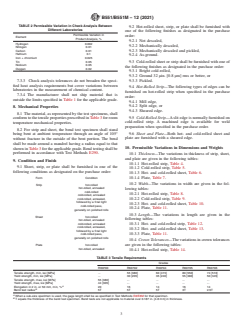
8.1 The material, as represented by the test specimens, shall
9.5 Cold-Rolled Strip—Aslit edge is normally furnished on
conformtothetensilepropertiesprescribedinTable3forroom
cold-rolled strip. A machined edge is available for weld
temperature mechanical properties.
preparation when specified in the purchase order.
8.2 For strip and sheet, the bend test specimen shall stand
9.6 Sheet and Plate—Both hot- and cold-rolled sheet and
being bent at ambient temperature through an angle of 105°
plate are furnished with a sheared edge.
without fracture in the outside of the bent portion. The bend
shall be made around a mandrel having a radius equal to that
10. Permissible Variations in Dimensions and Weights
showninTable3fortheapplicablegrade.Bendtestingshallbe
performed in accordance with Test Methods E290.
10.1 Thickness—The variations in thickness of strip, sheet,
and plate are given in the following tables:
9. Condition and Finish
10.1.1 Hot-rolled strip, Table 4.
9.1 Sheet, strip, or plate shall be furnished in one of the
10.1.2 Cold-rolled strip, Table 5.
following conditions as designated on the purchase order:
10.1.3 Hot- and cold-rolled sheet, Table 6.
Form Condition
10.1.4 Plate, Table 7.
10.2 Width—The variations in width are given in the fol-
Strip hot-rolled
hot-rolled, annealed
lowing tables:
cold-rolled
10.2.1 Hot-rolled strip, Table 8.
cold-rolled, annealed
cold-rolled, annealed, 10.2.2 Cold-rolled strip, Table 9.
followed by a final light
10.2.3 Hot- and cold-rolled sheet, Table 10.
cold-rolled pass,
10.2.4 Plate, Table 11.
generally on polished rolls
10.3 Length—The variations in length are given in the
Sheet hot-rolled
following tables:
hot-rolled, annealed
cold-rolled, annealed
10.3.1 Hot- and cold-rolled strip, Table 12.
cold-rolled, annealed,
10.3.2 Hot- and cold-rolled sheet, Table 13.
followed by a final light
10.3.3 Plate, Table 11.
cold-rolled pass,
generally on polished rolls
10.4 Crown Tolerances—The variations in crown tolerances
Plate hot-rolled are given in the following tables:
hot-rolled, annealed
10.4.1 Hot-rolled strip, Table 14.
TABLE 3 Tensile Requirements
Grades
R60700 R60702 R60704 R60705 R60706
Tensile strength, min, ksi [MPa] . 55 [380] 60 [415] 80 [550] 74 [510]
Yield strength, min, ksi [MPa] . 30 [205] 35 [240] 55 [380] 50 [345]
Tensile strength, max, ksi [MPa] 55 [380] . . . .
Yield strength, max, ksi [MPa] 44 [305] . . . .
A
Elongation in 2 in. or 50 mm, min, % 20 16 14 16 14
B
Bend test radius 5T 5T 5T 3T 2.5T
A
When a sub-size specimen is used, the gage length shall be as specified in Test Methods E8/E8M for that specimen.
B
T equals the thickness of the bend test specimen. Bend tests are not applicable to material over 0.187 in. [4.8 mm] in thickness.
B551/B551M − 12 (2021)
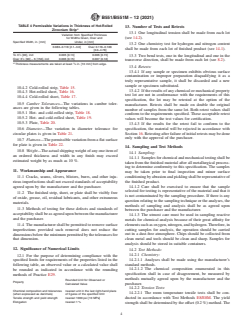
TABLE 4 Permissible Variations in Thickness of Hot-Rolled
13. Number of Tests and Retests
A
Zirconium Strip
13.1 One longitudinal tension shall be made from each lot
Variation from Specified Thickness
(see 14.2).
for Widths Given, Over and
Under, in [mm]
Specified Width, in. [mm]
13.2 One chemistry test for hydrogen and nitrogen content
0.083–0.118 [2.1–3.0] Over 0.118–0.188
shall be made from each lot of finished product (see 14.1).
[3.0–4.78]
To 3 ⁄2 [90], incl 0.005 [0.13] 0.006 [0.15]
13.3 Two bend tests, one in the longitudinal and one in the
Over 3 ⁄2 [90] – 6 [150], incl 0.006 [0.15] 0.007 [0.18]
transverse direction, shall be made from each lot (see 8.2).
A
Thickness measurements are taken at least ⁄8 in. [10 mm] from edge.
13.4 Retests:
13.4.1 If any sample or specimen exhibits obvious surface
contamination or improper preparation disqualifying it as a
truly representative sample, it shall be discarded and a new
sample or specimen substituted.
10.4.2 Cold-rolled strip, Table 15.
13.4.2 If the results of any chemical or mechanical property
10.4.3 Hot-rolled sheet, Table 16.
test lot are not in conformance with the requirements of this
10.4.4 Cold-rolled sheet, Table 17.
specification, the lot may be retested at the option of the
10.5 Camber Tolerances—The variations in camber toler-
manufacturer. Retests shall be made on double the original
ances are given in the following tables.
number of samples from the same lot. Both retest values shall
10.5.1 Hot- and cold-rolled strip, Table 18.
conform to the requirements specified. These acceptable retest
10.5.2 Hot- and cold-rolled sheet, Table 19.
values will become the test values for certification.
10.5.3 Plate, Table 20.
13.4.3 If the results for the retest fail to conform to the
10.6 Diameter—The variation in diameter tolerance for specification, the material will be rejected in accordance with
Section 16. Retesting after failure of initial retests may be done
circular plates is given in Table 21.
only with the approval of the purchaser.
10.7 Flatness—The permissible variation from a flat surface
for plate is given in Table 22.
14. Sampling and Test Methods
10.8 Weight—The actual shipping weight of any one item of
14.1 Sampling:
an ordered thickness and width in any finish may exceed
14.1.1 Samplesforchemicalandmechanicaltestingshallbe
estimated weight by as much as 10 %.
taken from the finished material after all metallurgical process-
ing to determine conformity to this specification. The samples
11. Workmanship and Appearance
may be taken prior to final inspection and minor surface
11.1 Cracks, seams, slivers, blisters, burrs, and other inju- conditioningbyabrasionandpicklingshallberepresentativeof
rious imperfections shall not exceed standards of acceptability the finished product.
agreed upon by the manufacturer and the purchaser. 14.1.2 Care shall be exercised to ensure that the sample
selected for testing is representative of the material and that it
11.2 The finished strip, sheet, or plate shall be visibly free
is not contaminated by the sampling procedure. If there is any
of oxide, grease, oil, residual lubricants, and other extraneous
question relating to the sampling technique or the analyses, the
materials.
methods of sampling and analysis shall be as agreed upon
11.3 Methods of testing for these defects and standards of
between the purchaser and the manufacturer.
acceptabilityshallbeasagreeduponbetweenthemanufacturer
14.1.3 The utmost care must be used in sampling reactive
and the purchaser.
metals for chemical analysis because of their great affinity for
elementssuchasoxygen,nitrogen,andhydrogen.Therefore,in
11.4 The manufacturer shall be permitted to remove surface
cutting samples for analysis, the operation should be carried
imperfections provided such removal does not reduce the
out in a dust-free atmosphere. Chips should be collected from
dimensionsbelowtheminimumpermittedbythetolerancesfor
clean metal and tools should be clean and sharp. Samples for
that dimension.
analysis should be stored in suitable containers.
12. Significance of Numerical Limits
14.2 Test Methods:
14.2.1 Chemistry:
12.1 For the purpose of determining compliance with the
14.2.1.1 Analyses shall be made using the manufacturer’s
specified limits for requirements of the properties listed in the
standard methods.
following table, an observed value or a calculated value shall
14.2.1.2 The chemical composition enumerated in this
be rounded as indicated in accordance with the rounding
specification shall in case of disagreement, be measured by
methods of Practice E29.
methods mutually agreed upon by the manufacturer and the
Rounded Unit for Observed or
Property
Calculated Value purchaser.
14.2.2 Tension Tests:
Chemical composition and tolerances nearest unit in the last right-hand place
14.2.2.1 The room temperature tensile tests shall be con-
(when expressed as decimals) of figures of the specified limit
Tensile strength and yield strength nearest 1000 psi [10 MPa]
ducted in accordance with Test Methods E8/E8M. The yield
Elongation nearest 1 %
strength shall be determined by the offset (0.2 %) method. The
B551/B551M − 12 (2021)
TABLE 5 Permissible Variations in Thickness of Cold-Rolled Zirconium Strip
NOTE 1—For thickness under 0.010 in. [0.25 mm] in width to 6 in. [150 mm] a tolerance of ±10 % of the thickness shall apply.
NOTE2—Thicknessmeasurementsshallbetaken ⁄8in.[10mm]infromedgeofthestrip,exceptonwidthslessthan1in.[2.5mm]wherethetolerances
are applicable for measurements at all locations.
Permissible Variations in Thickness, for Widths Given, ± in. [mm]
Specified Thickness, in. [mm] 3
⁄16 [4.8] to 1 [25], 1 [25] to 3 [75], 3[75]to6in.
excl excl [150], excl
0.188–0.160 [4.78–4.06], incl 0.002 [0.05] 0.003 [0.08] 0.004 [0.10]
0.160–0.100 [4.05–2.52], incl 0.002 [0.05] 0.002 [0.05] 0.003 [0.08]
0.099–0.069 [2.51–1.75], incl 0.002 [0.05] 0.002 [0.05] 0.003 [0.08]
0.068–0.050 [1.74–1.27], incl 0.002 [0.05] 0.002 [0.05] 0.003 [0.08]
0.049–0.040 [1.26–1.01], incl 0.002 [0.05] 0.002 [0.05] 0.0025 [0.07]
0.039–0.035 [0.99–0.90], incl 0.002 [0.05] 0.002 [0.05] 0.0025 [0.06]
0.034–0.029 [0.87–0.73], incl 0.0015 [0.04] 0.0015 [0.04] 0.002 [0.05]
0.028–0.026 [0.72–0.66], incl 0.001 [0.025] 0.0015 [0.04] 0.0015 [0.04]
0.025–0.020 [0.65–0.51], incl 0.001 [0.025] 0.001 [0.025] 0.0015 [0.04]
0.019 [0.50] and under 0.001 [0.025] 0.001 [0.025] 0.001 [0.025]
TABLE 6 Permissible Variations in Thickness of Hot- and
A
Cold-Rolled Zirconium Sheet
Hot-Rolled Cold-Rolled
Specified Thickness, in. [mm] Permissible Variations in Permissible Variations in
Thickness, ± in. [mm] Thickness, ± in. [mm]
0.1
...