

ASTM B352/B352M-17(2021)
(Specification)Standard Specification for Zirconium and Zirconium Alloy Sheet, Strip, and Plate for Nuclear Application
General Information
- Abstract
ABSTRACT
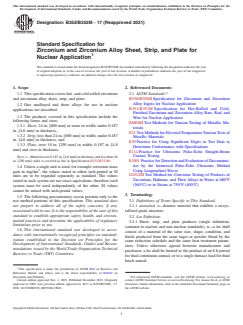
This specification covers hot- and cold-rolled zirconium and zirconium alloy sheet, strip, and plate.
SCOPE
1.1 This specification covers hot- and cold-rolled zirconium and zirconium alloy sheet, strip, and plate.
1.2 One unalloyed and three alloys for use in nuclear applications are described.
1.3 The products covered in this specification include the following forms and sizes:
1.3.1 Sheet, 24 in. [600 mm] or more in width; under 0.187 in. [4.8 mm] in thickness,
1.3.2 Strip, less than 24 in. [600 mm] in width; under 0.187 in. [4.8 mm] in thickness, and
1.3.3 Plate, over 10 in. [250 mm] in width; 0.187 in. [4.8 mm] and over in thickness.
Note 1: Material over 0.187 in. [4.8 mm] in thickness and less than 10 in. [250 mm] wide is covered as bar in Specification B351/B351M.
1.4 Unless a single unit is used, for example corrosion mass gain in mg/dm2, the values stated in either inch-pound or SI units are to be regarded separately as standard. The values stated in each system are not exact equivalents; therefore each system must be used independently of the other. SI values cannot be mixed with inch-pound values.
1.5 The following precautionary caveat pertains only to the test method portions of this specification. This standard does not purport to address all of the safety concerns, if any, associated with its use. It is the responsibility of the user of this standard to establish appropriate safety, health, and environmental practices and determine the applicability of regulatory limitations prior to use.
1.6 This international standard was developed in accordance with internationally recognized principles on standardization established in the Decision on Principles for the Development of International Standards, Guides and Recommendations issued by the World Trade Organization Technical Barriers to Trade (TBT) Committee.
- Status
- Published
- Publication Date
- 31-Oct-2021
- Technical Committee
- B10 - Reactive and Refractory Metals and Alloys
- Drafting Committee
- B10.02 - Zirconium and Hafnium
Overview
ASTM B352/B352M-17(2021) is the standard specification developed by ASTM International for zirconium and zirconium alloy sheet, strip, and plate used in nuclear applications. This standard outlines the requirements for both hot-rolled and cold-rolled products and covers dimensions, chemical composition, and mechanical properties to support the safe and reliable use of these materials in nuclear technologies. The specification applies to one unalloyed and three alloy grades, setting quality control benchmarks essential for the nuclear industry.
Key Topics
Product Forms and Sizes:
- Sheet: 24 in. (600 mm) or wider, under 0.187 in. (4.8 mm) thick
- Strip: Less than 24 in. (600 mm) wide, under 0.187 in. (4.8 mm) thick
- Plate: Over 10 in. (250 mm) wide, 0.187 in. (4.8 mm) or thicker
Material Grades:
- One unalloyed grade
- Three alloy grades tailored for nuclear service
Manufacturing Requirements:
- Produced in accordance with ASTM B350/B350M
- Conditions include hot-rolled, annealed, and cold-rolled variants, with optional final light cold-rolling
Chemical Composition:
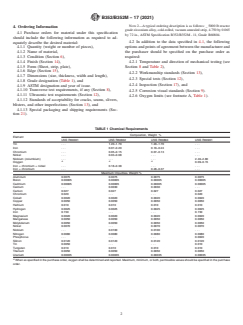
- Strict controls on alloying constituents and impurities per detailed tables
- Separate standards for hydrogen, oxygen, and nitrogen analysis
Mechanical Properties:
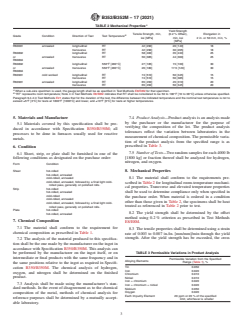
- Requirements for tensile strength, yield strength (0.2% offset), and elongation, both at room and elevated temperatures
Testing and Inspection:
- Regular mechanical and chemical testing per lot
- Ultrasonic and corrosion testing protocols
- Provisions for retests and referee analysis in case of disputes
Quality and Appearance:
- Free from cracks, seams, slivers, blisters, and other imperfections
- Several finishing and edge options based on specific application needs
Dimensional Tolerances:
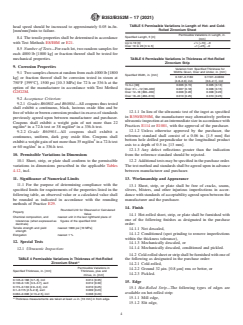
- Clear guidelines for variation in length, width, thickness, camber, and flatness
Applications
The standard is specifically tailored for nuclear applications where zirconium and zirconium alloy materials are critical for their:
- Corrosion resistance in high-temperature and high-pressure environments
- Low neutron absorption cross-section, essential for nuclear reactor components
- Structural integrity in fabricated fuel cladding, reactor internals, and other essential nuclear hardware
Key uses include:
- Fuel cladding and tubes in nuclear reactors
- Structural and support elements within reactor cores
- Heat exchanger plates and similar high-specification components
By adhering to ASTM B352/B352M-17(2021), manufacturers, suppliers, and end users ensure compliance with international best practices, enhancing nuclear plant safety and efficiency.
Related Standards
ASTM B352/B352M references and aligns with several other standards to provide a comprehensive approach to zirconium and its alloys in nuclear service:
- ASTM B350/B350M: Zirconium and Zirconium Alloy Ingots for Nuclear Application
- ASTM B351/B351M: Zirconium and Zirconium Alloy Bars, Rod, and Wire for Nuclear Application
- ASTM E8/E8M: Tension Testing of Metallic Materials
- ASTM E21: Elevated Temperature Tension Testing of Metallic Materials
- ASTM E114, E1001: Ultrasonic Testing Methods
- ASTM G2/G2M: Corrosion Testing of Zirconium and Hafnium Products
Each standard provides protocols supporting quality assurance and regulatory compliance, forming part of a rigorous framework vital for nuclear material supply chains.
Keywords: ASTM B352, zirconium alloy sheet, zirconium nuclear plate, nuclear material standards, zirconium strip specification, nuclear reactor materials, ASTM zirconium standards, zirconium alloy mechanical properties, corrosion resistance, nuclear industry compliance
Relations
- Effective Date
- 01-Apr-2011
- Effective Date
- 15-Sep-2006
- Effective Date
- 10-Jun-2002
- Effective Date
- 01-Jan-2024
- Effective Date
- 01-Jan-2019
- Effective Date
- 01-Oct-2016
- Effective Date
- 15-Jul-2016
- Effective Date
- 01-Feb-2015
- Effective Date
- 01-Oct-2013
- Effective Date
- 01-Jun-2013
- Effective Date
- 01-Dec-2011
- Effective Date
- 01-Sep-2011
- Effective Date
- 01-Sep-2011
- Effective Date
- 01-Aug-2011
- Effective Date
- 01-Apr-2011
Get Certified
Connect with accredited certification bodies for this standard

Element Materials Technology
Materials testing and product certification.

Inštitut za kovinske materiale in tehnologije
Institute of Metals and Technology. Materials testing, metallurgical analysis, NDT.
Sponsored listings
Frequently Asked Questions
ASTM B352/B352M-17(2021) is a technical specification published by ASTM International. Its full title is "Standard Specification for Zirconium and Zirconium Alloy Sheet, Strip, and Plate for Nuclear Application". This standard covers: ABSTRACT This specification covers hot- and cold-rolled zirconium and zirconium alloy sheet, strip, and plate. SCOPE 1.1 This specification covers hot- and cold-rolled zirconium and zirconium alloy sheet, strip, and plate. 1.2 One unalloyed and three alloys for use in nuclear applications are described. 1.3 The products covered in this specification include the following forms and sizes: 1.3.1 Sheet, 24 in. [600 mm] or more in width; under 0.187 in. [4.8 mm] in thickness, 1.3.2 Strip, less than 24 in. [600 mm] in width; under 0.187 in. [4.8 mm] in thickness, and 1.3.3 Plate, over 10 in. [250 mm] in width; 0.187 in. [4.8 mm] and over in thickness. Note 1: Material over 0.187 in. [4.8 mm] in thickness and less than 10 in. [250 mm] wide is covered as bar in Specification B351/B351M. 1.4 Unless a single unit is used, for example corrosion mass gain in mg/dm2, the values stated in either inch-pound or SI units are to be regarded separately as standard. The values stated in each system are not exact equivalents; therefore each system must be used independently of the other. SI values cannot be mixed with inch-pound values. 1.5 The following precautionary caveat pertains only to the test method portions of this specification. This standard does not purport to address all of the safety concerns, if any, associated with its use. It is the responsibility of the user of this standard to establish appropriate safety, health, and environmental practices and determine the applicability of regulatory limitations prior to use. 1.6 This international standard was developed in accordance with internationally recognized principles on standardization established in the Decision on Principles for the Development of International Standards, Guides and Recommendations issued by the World Trade Organization Technical Barriers to Trade (TBT) Committee.
ABSTRACT This specification covers hot- and cold-rolled zirconium and zirconium alloy sheet, strip, and plate. SCOPE 1.1 This specification covers hot- and cold-rolled zirconium and zirconium alloy sheet, strip, and plate. 1.2 One unalloyed and three alloys for use in nuclear applications are described. 1.3 The products covered in this specification include the following forms and sizes: 1.3.1 Sheet, 24 in. [600 mm] or more in width; under 0.187 in. [4.8 mm] in thickness, 1.3.2 Strip, less than 24 in. [600 mm] in width; under 0.187 in. [4.8 mm] in thickness, and 1.3.3 Plate, over 10 in. [250 mm] in width; 0.187 in. [4.8 mm] and over in thickness. Note 1: Material over 0.187 in. [4.8 mm] in thickness and less than 10 in. [250 mm] wide is covered as bar in Specification B351/B351M. 1.4 Unless a single unit is used, for example corrosion mass gain in mg/dm2, the values stated in either inch-pound or SI units are to be regarded separately as standard. The values stated in each system are not exact equivalents; therefore each system must be used independently of the other. SI values cannot be mixed with inch-pound values. 1.5 The following precautionary caveat pertains only to the test method portions of this specification. This standard does not purport to address all of the safety concerns, if any, associated with its use. It is the responsibility of the user of this standard to establish appropriate safety, health, and environmental practices and determine the applicability of regulatory limitations prior to use. 1.6 This international standard was developed in accordance with internationally recognized principles on standardization established in the Decision on Principles for the Development of International Standards, Guides and Recommendations issued by the World Trade Organization Technical Barriers to Trade (TBT) Committee.
ASTM B352/B352M-17(2021) is classified under the following ICS (International Classification for Standards) categories: 77.150.99 - Other products of non-ferrous metals. The ICS classification helps identify the subject area and facilitates finding related standards.
ASTM B352/B352M-17(2021) has the following relationships with other standards: It is inter standard links to ASTM B352/B352M-11, ASTM B352/B352M-02(2006), ASTM B352/B352M-02, ASTM E8/E8M-24, ASTM G2/G2M-19, ASTM B350/B350M-11(2016), ASTM E8/E8M-16, ASTM E8/E8M-15, ASTM B351/B351M-13, ASTM E8/E8M-13, ASTM E8/E8M-11, ASTM G2/G2M-06(2011), ASTM G2/G2M-06(2011)e1, ASTM E1001-11, ASTM B350/B350M-11. Understanding these relationships helps ensure you are using the most current and applicable version of the standard.
ASTM B352/B352M-17(2021) is available in PDF format for immediate download after purchase. The document can be added to your cart and obtained through the secure checkout process. Digital delivery ensures instant access to the complete standard document.
Standards Content (Sample)
This international standard was developed in accordance with internationally recognized principles on standardization established in the Decision on Principles for the
Development of International Standards, Guides and Recommendations issued by the World Trade Organization Technical Barriers to Trade (TBT) Committee.
Designation:B352/B352M −17 (Reapproved 2021)
Standard Specification for
Zirconium and Zirconium Alloy Sheet, Strip, and Plate for
Nuclear Application
This standard is issued under the fixed designation B352/B352M; the number immediately following the designation indicates the year
of original adoption or, in the case of revision, the year of last revision. A number in parentheses indicates the year of last reapproval.
A superscript epsilon (´) indicates an editorial change since the last revision or reapproval.
1. Scope 2. Referenced Documents
1.1 This specification covers hot- and cold-rolled zirconium
2.1 ASTM Standards:
and zirconium alloy sheet, strip, and plate. B350/B350M Specification for Zirconium and Zirconium
Alloy Ingots for Nuclear Application
1.2 One unalloyed and three alloys for use in nuclear
B351/B351M Specification for Hot-Rolled and Cold-
applications are described.
Finished Zirconium and Zirconium Alloy Bars, Rod, and
1.3 The products covered in this specification include the
Wire for Nuclear Application
following forms and sizes:
E8/E8M Test Methods for Tension Testing of Metallic Ma-
1.3.1 Sheet, 24 in. [600 mm] or more in width; under 0.187
terials
in. [4.8 mm] in thickness,
E21 TestMethodsforElevatedTemperatureTensionTestsof
1.3.2 Strip, less than 24 in. [600 mm] in width; under 0.187
Metallic Materials
in. [4.8 mm] in thickness, and
E29 Practice for Using Significant Digits in Test Data to
1.3.3 Plate, over 10 in. [250 mm] in width; 0.187 in. [4.8
Determine Conformance with Specifications
mm] and over in thickness.
E114 Practice for Ultrasonic Pulse-Echo Straight-Beam
Contact Testing
NOTE 1—Material over 0.187 in. [4.8 mm] in thickness and less than 10
in. [250 mm] wide is covered as bar in Specification B351/B351M.
E1001 Practice for Detection and Evaluation of Discontinui-
ties by the Immersed Pulse-Echo Ultrasonic Method
1.4 Unless a single unit is used, for example corrosion mass
Using Longitudinal Waves
gain in mg/dm , the values stated in either inch-pound or SI
G2/G2M Test Method for Corrosion Testing of Products of
units are to be regarded separately as standard. The values
Zirconium, Hafnium, and Their Alloys in Water at 680°F
stated in each system are not exact equivalents; therefore each
(360°C) or in Steam at 750°F (400°C)
system must be used independently of the other. SI values
cannot be mixed with inch-pound values.
3. Terminology
1.5 The following precautionary caveat pertains only to the
test method portions of this specification. This standard does 3.1 Definitions of Terms Specific to This Standard:
not purport to address all of the safety concerns, if any, 3.1.1 annealed, n—denotes material that exhibits a recrys-
associated with its use. It is the responsibility of the user of this tallized grain structure.
standard to establish appropriate safety, health, and environ-
3.2 Lot Definition:
mental practices and determine the applicability of regulatory
3.2.1 Sheet, strip, and plate products (single definition,
limitations prior to use.
common to nuclear and non-nuclear standards), n—a lot shall
1.6 This international standard was developed in accor-
consist of a material of the same size, shape, condition, and
dance with internationally recognized principles on standard-
finish produced from the same ingot or powder blend by the
ization established in the Decision on Principles for the
same reduction schedule and the same heat treatment param-
Development of International Standards, Guides and Recom-
eters. Unless otherwise agreed between manufacturer and
mendations issued by the World Trade Organization Technical
purchaser, a lot shall be limited to the product of an 8 h period
Barriers to Trade (TBT) Committee.
for final continuous anneal, or to a single furnace load for final
batch anneal.
This specification is under the jurisdiction of ASTM B10 on Reactive and
Refractory Metals and Alloys and is the direct responsibility of B10.02 on
Zirconium and Hafnium. For referenced ASTM standards, visit the ASTM website, www.astm.org, or
Current edition approved Nov. 1, 2021. Published December 2021. Originally contact ASTM Customer Service at service@astm.org. For Annual Book of ASTM
approved in 1960. Last previous edition approved in 2017 as B352/B352M – 17. Standards volume information, refer to the standard’s Document Summary page on
DOI: 10.1520/B0352_B0352M-17R21. the ASTM website.
Copyright © ASTM International, 100 Barr Harbor Drive, PO Box C700, West Conshohocken, PA 19428-2959. United States
B352/B352M−17 (2021)
NOTE 2—Atypical ordering description is as follows: _ 5000 lb reactor
4. Ordering Information
grade zirconium alloy, cold-rolled, vacuum annealed strip, 4.750 by 0.065
4.1 Purchase orders for material under this specification
by 72 in., ASTM Specification B352/B352M - 11, Grade R60804.
should include the following information as required to ad-
4.2 In addition to the data specified in 4.1, the following
equately describe the desired material:
options and points of agreement between the manufacturer and
4.1.1 Quantity (weight or number of pieces),
the purchaser should be specified on the purchase order as
4.1.2 Name of material,
required:
4.1.3 Condition (Section 6),
4.1.4 Finish (Section 14),
4.2.1 Temperature and direction of mechanical testing (see
4.1.5 Form (Sheet, strip, plate),
Section 8 and Table 2),
4.1.6 Edge (Section 15),
4.2.2 Workmanship standards (Section 13),
4.1.7 Dimensions (size, thickness, width and length),
4.2.3 Special tests (Section 12),
4.1.8 Grade designation (Table 1), and
4.2.4 Inspection (Section 17), and
4.1.9 ASTM designation and year of issue.
4.1.10 Transverse test requirements, if any (Section 8), 4.2.5 Corrosion visual standards (Section 9).
4.1.11 Ultrasonic test requirements (Section 12),
4.2.6 Oxygen limits (see footnote A, Table 1).
4.1.12 Standards of acceptability for cracks, seams, slivers,
blisters, and other imperfections (Section 13), and
4.1.13 Special packaging and shipping requirements (Sec-
tion 21).
TABLE 1 Chemical Requirements
Composition, Weight %
Element
UNS R60001 UNS R60802 UNS R60804 UNS R60901
Tin . . . 1.20–1.70 1.20–1.70 . . .
Iron . . . 0.07–0.20 0.18–0.24 . . .
Chromium . . . 0.05–0.15 0.07–0.13 . . .
Nickel . . . 0.03–0.08 . . . . . .
Niobium (columbium) . . . . . . . . . 2.40–2.80
AA A
Oxygen 0.09–0.15
Iron + chromium + nickel . . . 0.18–0.38 . . . . . .
Iron + chromium . . . . . . 0.28–0.37 . . .
Maximum Impurities, Weight %
Aluminum 0.0075 0.0075 0.0075 0.0075
Boron 0.00005 0.00005 0.00005 0.00005
Cadmium 0.00005 0.00005 0.00005 0.00005
Calcium . . . 0.0030 0.0030 . . .
Carbon 0.027 0.027 0.027 0.027
Chromium 0.020 . . . . . . 0.020
Cobalt 0.0020 0.0020 0.0020 0.0020
Copper 0.0050 0.0050 0.0050 0.0050
Hafnium 0.010 0.010 0.010 0.010
Hydrogen 0.0025 0.0025 0.0025 0.0025
Iron 0.150 . . . . . . 0.150
Magnesium 0.0020 0.0020 0.0020 0.0020
Manganese 0.0050 0.0050 0.0050 0.0050
Molybdenum 0.0050 0.0050 0.0050 0.0050
Nickel 0.0070 . . . 0.0070 0.0070
Niobium . . . 0.0100 0.0100 . . .
Nitrogen 0.0080 0.0080 0.0080 0.0080
Phosphorus . . . . . . . . . 0.0020
Silicon 0.0120 0.0120 0.0120 0.0120
Tin 0.0050 . . . . . . 0.010
Tungsten 0.010 0.010 0.010 0.010
Titanium 0.0050 0.0050 0.0050 0.0050
Uranium 0.00035 0.00035 0.00035 0.00035
A
When so specified in the purchase order, oxygen shall be determined and reported. Maximum, minimum, or both, permissible values should be specified in the purchase
order.
B352/B352M−17 (2021)
A
TABLE 2 Mechanical Properties
Yield Strength
Tensile Strength, min, (0.2 % Offset), Elongation in
B
Grade Condition Direction of Test Test Temperature
ksi [MPa] min, ksi 2 in. or 50 mm, min, %
[MPa]
R60001 annealed longitudinal RT 42 [290] 20 [140] 18
transverse RT 42 [290] 30 [205] 18
R60802 longitudinal RT 58 [400] 35 [240] 25
or annealed transverse RT 56 [385] 44 [300] 25
R60804
R60802 longitudinal 550°F [290°C] 27 [185] 15 [100] 30
or annealed transverse 550°F [290°C] 26 [180] 17.5 [120] 30
R60804
R60901 cold worked longitudinal RT 74 [510] 50 [345] 15
transverse RT 74 [510] 56 [385] 15
R60901 annealed longitudinal RT 65 [450] 45 [310] 20
transverse RT 65 [450] 50 [345] 20
A
When a sub-size specimen is used, the gauge length shall be as specified in Test Methods E8/E8M for that specimen.
B
“RT” represents room temperature; Note 4 in Test Methods E8/E8M indicates that RT shall be considered to be 50 to 100°F [10 to 38°C] unless otherwise specified.
Paragraph 9.4.4 in Test Methods E21 states that for the duration of the test, the difference between the indicated temperature and the nominal test temperature is not to
exceed ±5°F [3°C] for tests at 1800°F [1000°C] and lower, and ±10°F [6°C] for tests at higher temperatures.
5. Materials and Manufacture 7.4 Product Analysis—Product analysis is an analysis made
by the purchaser or the manufacturer for the purpose of
5.1 Materials covered by this specification shall be pro-
verifying the composition of the lot. The product analysis
duced in accordance with Specification B350/B350M; all
tolerances reflect the variation between laboratories in the
processes to be done in furnaces usually used for reactive
measurement of chemical composition. The permissible varia-
metals.
tion of the product analysis from the specified range is as
prescribed in Table 3.
6. Condition
7.5 Number of Tests—Tworandomsamplesforeach4000lb
6.1 Sheet, strip, or plate shall be furnished in one of the
[1800 kg] or fraction thereof shall be analyzed for hydrogen,
following conditions as designated on the purchase order:
nitrogen, and oxygen.
Form Condition
Sheet hot-rolled
8. Mechanical Properties
hot-rolled, annealed
cold-rolled, annealed 8.1 The material shall conform to the requirements pre-
cold-rolled, annealed, followed by a final light cold-
scribed in Table 2 for longitudinal room-temperature mechani-
rolled pass, generally on polished rolls.
cal properties. Transverse and elevated temperature properties
Strip hot-rolled
shall be used to determine compliance only when specified in
hot-rolled, annealed
cold-rolled
the purchase order. When material is ordered in a condition
cold-rolled, annealed
other than those given in Table 2, the specimens shall be heat
cold-rolled, annealed, followed by a final light cold-
treated as referenced in Table 2 prior to test.
rolled pass, generally on polished rolls.
Plate hot-rolled
8.2 The yield strength shall be determined by the offset
hot-rolled, annealed
method using 0.2 % criterion as prescribed in Test Methods
7. Chemical Composition
E8/E8M.
7.1 The material shall conform to the requirement for
8.3 The tensile properties shall be determined using a strain
chemical composition as prescribed in Table 1.
rate of 0.003 to 0.007 in./in. [mm/mm]/min through the yield
strength. After the yield strength has be exceeded, the cross
7.2 The analysis of the material produced to this specifica-
tion shall be the one made by the manufacturer on the ingot in
accordance with Specification B350/B350M. This analysis can
be performed by the manufacturer on the ingot itself, or on TABLE 3 Permissible Variations in Product Analysis
intermediate or final products with the same frequency and in
Permissible Variation from the Specified
Alloying Elements
Range (Table 1), %
the same positions relative to the ingot as required in Specifi-
Tin 0.050
cation B350/B350M. The chemical analysis of hydrogen,
Iron 0.020
oxygen, and nitrogen shall be determined on the finished
Chromium 0.010
product.
Nickel 0.010
Iron + chromium 0.020
7.3 Analysis shall be made using the manufacturer’s stan-
Iron + chromium + nickel 0.020
dard methods. In the event of disagreement as to the chemical Niobium 0.050
Oxygen 0.020
composition of the metal, methods of chemical analysis for
Each Impurity Element 20 ppm or 20 % of the specified
reference purposes shall be determined by a mutually accept-
limit, whichever is smaller
able laboratory.
B352/B352M−17 (2021)
TABLE 5 Permissible Variations in Length of Hot- and Cold-
head speed should be increased to approximately 0.05 in./in.
Rolled Zirconium Sheet
[mm/mm]/min to failure.
Permissible Variations in Length, in.
Specified Length, ft [m]
8.4 The tensile properties shall be determined in accordance
[mm]
Up to 10 [3] + ⁄2 [+13], –0
with Test Methods E8/E8M or E21.
Over 10 to 20 [3 to 6] +1 [+25], –0
8.5 Number of Tests—For each lot, two random samples for
each 4000 lb [1800 kg] or fraction thereof shall be tested for
mechanical properties.
TABLE 6 Permissible Variations in Thickness of Hot-Rolled
Zirconium Strip
9. Corrosion Properties
Variation from Specified Thickness for
Widths Given, Over and Under, in. [mm]
9.1 Twosampleschosenatrandomfromeach4000lb[1800
Specified Width, in. [mm]
0.187–0.1180 0.1197–0.0830
kg] or fraction thereof shall be corrosion tested in steam at
[4.8–3.0], incl. [3.0–2.1], incl
750°F [399°C], 1500 psi [10.3 MPa] for 72 h or 336 h at the
To 3 ⁄2 [90] 0.006 [0.15] 0.005 [0.13]
option of the manufacturer in accordance with Test Method
Over 3 ⁄2 –12 [90–300] 0.007 [0.18] 0.006 [0.15]
G2/G2M. Over 12–18 [300–460] 0.008 [0.20] 0.008 [0.20]
Over 18–24 [460–610] 0.010 [0.25] 0.010 [0.25]
9.2 Accepta
...