


ASTM D4045-19
(Test Method)Standard Test Method for Sulfur in Petroleum Products by Hydrogenolysis and Rateometric Colorimetry
Standard Test Method for Sulfur in Petroleum Products by Hydrogenolysis and Rateometric Colorimetry
SIGNIFICANCE AND USE
4.1 In many petroleum refining processes, low levels of sulfur in feed stocks may poison expensive catalysts. This test method can be used to monitor the amount of sulfur in such petroleum fractions.
4.2 This test method may also be used as a quality-control tool for sulfur determination in finished products.
SCOPE
1.1 This test method covers the determination of sulfur in petroleum products in the range from 0.02 mg/kg to 10.00 mg/kg.
1.2 This test method may be extended to higher concentration by dilution.
1.3 This test method is applicable to liquids whose boiling points are between 30 °C and 371 °C (86 °F and 700 °F). Materials that can be analyzed include naphtha, kerosine, alcohol, steam condensate, various distillates, jet fuel, benzene, and toluene.
1.4 The values stated in SI units are to be regarded as standard. The values given in parentheses are for information only.
1.4.1 Certain specifications for the recorder (see 5.5) are excepted.
1.5 This standard does not purport to address all of the safety concerns, if any, associated with its use. It is the responsibility of the user of this standard to establish appropriate safety, health, and environmental practices and determine the applicability of regulatory limitations prior to use.
1.6 This international standard was developed in accordance with internationally recognized principles on standardization established in the Decision on Principles for the Development of International Standards, Guides and Recommendations issued by the World Trade Organization Technical Barriers to Trade (TBT) Committee.
General Information
- Status
- Published
- Publication Date
- 30-Nov-2019
- Technical Committee
- D02 - Petroleum Products, Liquid Fuels, and Lubricants
- Drafting Committee
- D02.03 - Elemental Analysis
Relations
- Effective Date
- 01-Dec-2023
- Effective Date
- 15-Dec-2017
- Effective Date
- 15-Nov-2017
- Effective Date
- 01-Jan-2017
- Effective Date
- 01-Oct-2013
- Effective Date
- 01-Mar-2010
- Effective Date
- 01-Mar-2010
- Effective Date
- 01-Nov-2009
- Effective Date
- 15-Oct-2008
- Effective Date
- 01-Nov-2007
- Effective Date
- 01-Nov-2007
- Effective Date
- 01-Mar-2006
- Effective Date
- 10-Jun-2002
- Effective Date
- 10-Jun-2002
- Effective Date
- 10-Dec-2000
Overview
ASTM D4045-19, "Standard Test Method for Sulfur in Petroleum Products by Hydrogenolysis and Rateometric Colorimetry," published by ASTM International, provides an analytical method for quantifying sulfur content in petroleum products. This standard is critical for ensuring low levels of sulfur in petroleum fractions, which is essential to protect catalysts used in refining processes from degradation. The method is applicable to a wide range of liquid petroleum products with boiling points between 30 °C and 371 °C, including fuels such as naphtha, kerosene, jet fuel, alcohol, and aromatic hydrocarbons like benzene and toluene.
Key Topics
Scope and Applicability
- Determines sulfur in petroleum products within the range of 0.02 mg/kg to 10.00 mg/kg. Higher concentrations can be measured using dilution.
- Suitable for liquid samples with boiling points from 30 °C up to 371 °C.
Test Method Summary
- Samples are injected into a hydrogen stream and pyrolyzed at high temperatures to convert sulfur compounds to hydrogen sulfide (H₂S).
- The presence of H₂S is determined through rateometric colorimetry, relying on the color change when H₂S reacts with lead acetate.
Precision and Quality Control
- Repeatability and reproducibility have been statistically evaluated to ensure reliable results.
- Incorporates quality control guidelines (ASTM D6299) to maintain measurement integrity.
Safety and Compliance
- Addresses the importance of proper safety, health, and environmental practices, particularly due to the use of flammable gases such as hydrogen and toxic reagents.
Applications
Sulfur analysis in petroleum products is crucial in industrial and laboratory settings for the following reasons:
- Catalyst Protection: Low sulfur content is essential in feedstocks to prevent catalyst poisoning during processes such as cracking, reforming, and hydroprocessing.
- Quality Control in Production: The method is used to verify that finished fuels, such as diesel, jet fuel, and gasoline, meet regulatory and specification limits for sulfur content.
- Environmental Compliance: Supports industry efforts to produce fuels with reduced sulfur emissions, aligning with global air quality standards.
- Research and Development: Used in petrochemical laboratories to evaluate new refining techniques, product formulations, or alternative fuels.
- Contract Verification: Provides reliable data for contractual agreements involving sulfur specifications in petroleum product trading.
Related Standards
For comprehensive sulfur determination in petroleum products and quality assurance, the following ASTM standards are frequently referenced:
- ASTM D1193: Specification for Reagent Water, ensuring the purity of water used in analyses.
- ASTM D6299: Practice for Applying Statistical Quality Assurance and Control Charting Techniques, supporting analytical measurement system performance.
- Additional test methods for sulfur analysis, such as ASTM D2622 (X-ray fluorescence spectrometry) and ASTM D4294, may be used for cross-validation or alternative procedures.
Keywords: ASTM D4045-19, sulfur in petroleum products, hydrogenolysis, rateometric colorimetry, catalyst protection, quality control, petroleum analysis, refinery testing, fuel sulfur limits, ASTM standards.
Buy Documents
ASTM D4045-19 - Standard Test Method for Sulfur in Petroleum Products by Hydrogenolysis and Rateometric Colorimetry
REDLINE ASTM D4045-19 - Standard Test Method for Sulfur in Petroleum Products by Hydrogenolysis and Rateometric Colorimetry
Get Certified
Connect with accredited certification bodies for this standard

ABS Quality Evaluations Inc.
American Bureau of Shipping quality certification.

Element Materials Technology
Materials testing and product certification.

ABS Group Brazil
ABS Group certification services in Brazil.
Sponsored listings
Frequently Asked Questions
ASTM D4045-19 is a standard published by ASTM International. Its full title is "Standard Test Method for Sulfur in Petroleum Products by Hydrogenolysis and Rateometric Colorimetry". This standard covers: SIGNIFICANCE AND USE 4.1 In many petroleum refining processes, low levels of sulfur in feed stocks may poison expensive catalysts. This test method can be used to monitor the amount of sulfur in such petroleum fractions. 4.2 This test method may also be used as a quality-control tool for sulfur determination in finished products. SCOPE 1.1 This test method covers the determination of sulfur in petroleum products in the range from 0.02 mg/kg to 10.00 mg/kg. 1.2 This test method may be extended to higher concentration by dilution. 1.3 This test method is applicable to liquids whose boiling points are between 30 °C and 371 °C (86 °F and 700 °F). Materials that can be analyzed include naphtha, kerosine, alcohol, steam condensate, various distillates, jet fuel, benzene, and toluene. 1.4 The values stated in SI units are to be regarded as standard. The values given in parentheses are for information only. 1.4.1 Certain specifications for the recorder (see 5.5) are excepted. 1.5 This standard does not purport to address all of the safety concerns, if any, associated with its use. It is the responsibility of the user of this standard to establish appropriate safety, health, and environmental practices and determine the applicability of regulatory limitations prior to use. 1.6 This international standard was developed in accordance with internationally recognized principles on standardization established in the Decision on Principles for the Development of International Standards, Guides and Recommendations issued by the World Trade Organization Technical Barriers to Trade (TBT) Committee.
SIGNIFICANCE AND USE 4.1 In many petroleum refining processes, low levels of sulfur in feed stocks may poison expensive catalysts. This test method can be used to monitor the amount of sulfur in such petroleum fractions. 4.2 This test method may also be used as a quality-control tool for sulfur determination in finished products. SCOPE 1.1 This test method covers the determination of sulfur in petroleum products in the range from 0.02 mg/kg to 10.00 mg/kg. 1.2 This test method may be extended to higher concentration by dilution. 1.3 This test method is applicable to liquids whose boiling points are between 30 °C and 371 °C (86 °F and 700 °F). Materials that can be analyzed include naphtha, kerosine, alcohol, steam condensate, various distillates, jet fuel, benzene, and toluene. 1.4 The values stated in SI units are to be regarded as standard. The values given in parentheses are for information only. 1.4.1 Certain specifications for the recorder (see 5.5) are excepted. 1.5 This standard does not purport to address all of the safety concerns, if any, associated with its use. It is the responsibility of the user of this standard to establish appropriate safety, health, and environmental practices and determine the applicability of regulatory limitations prior to use. 1.6 This international standard was developed in accordance with internationally recognized principles on standardization established in the Decision on Principles for the Development of International Standards, Guides and Recommendations issued by the World Trade Organization Technical Barriers to Trade (TBT) Committee.
ASTM D4045-19 is classified under the following ICS (International Classification for Standards) categories: 75.080 - Petroleum products in general. The ICS classification helps identify the subject area and facilitates finding related standards.
ASTM D4045-19 has the following relationships with other standards: It is inter standard links to ASTM D6299-23a, ASTM D6299-17b, ASTM D6299-17a, ASTM D6299-17, ASTM D6299-13e1, ASTM D6299-10, ASTM D6299-10e2, ASTM D6299-09, ASTM D6299-08, ASTM D6299-07, ASTM D6299-07e1, ASTM D1193-06, ASTM D6299-02e1, ASTM D6299-02, ASTM D6299-00. Understanding these relationships helps ensure you are using the most current and applicable version of the standard.
ASTM D4045-19 is available in PDF format for immediate download after purchase. The document can be added to your cart and obtained through the secure checkout process. Digital delivery ensures instant access to the complete standard document.
Standards Content (Sample)
This international standard was developed in accordance with internationally recognized principles on standardization established in the Decision on Principles for the
Development of International Standards, Guides and Recommendations issued by the World Trade Organization Technical Barriers to Trade (TBT) Committee.
Designation: D4045 − 19
Standard Test Method for
Sulfur in Petroleum Products by Hydrogenolysis and
Rateometric Colorimetry
This standard is issued under the fixed designation D4045; the number immediately following the designation indicates the year of
original adoption or, in the case of revision, the year of last revision. A number in parentheses indicates the year of last reapproval. A
superscript epsilon (´) indicates an editorial change since the last revision or reapproval.
1. Scope* D6299 Practice for Applying Statistical Quality Assurance
and Control Charting Techniques to Evaluate Analytical
1.1 This test method covers the determination of sulfur in
Measurement System Performance
petroleum products in the range from 0.02 mg⁄kg to
10.00 mg⁄kg.
3. Summary of Test Method
1.2 This test method may be extended to higher concentra-
3.1 The sample is injected at a constant rate into a flowing
tion by dilution.
hydrogen stream in a hydrogenolysis apparatus. The sample
and hydrogen are pyrolyzed at a temperature of 1300 °C, or
1.3 This test method is applicable to liquids whose boiling
above, to convert sulfur compounds to hydrogen sulfide (H S).
points are between 30 °C and 371 °C (86 °F and 700 °F).
Readout is by the rateometric detection of the colorimetric
Materials that can be analyzed include naphtha, kerosine,
reactionofH Swithleadacetate.Condensablecomponentsare
alcohol,steamcondensate,variousdistillates,jetfuel,benzene,
converted to gaseous products, such as methane, during hy-
and toluene.
drogenolysis.
1.4 The values stated in SI units are to be regarded as
standard. The values given in parentheses are for information
4. Significance and Use
only.
4.1 In many petroleum refining processes, low levels of
1.4.1 Certain specifications for the recorder (see 5.5) are
sulfur in feed stocks may poison expensive catalysts. This test
excepted.
method can be used to monitor the amount of sulfur in such
1.5 This standard does not purport to address all of the
petroleum fractions.
safety concerns, if any, associated with its use. It is the
4.2 This test method may also be used as a quality-control
responsibility of the user of this standard to establish appro-
tool for sulfur determination in finished products.
priate safety, health, and environmental practices and deter-
mine the applicability of regulatory limitations prior to use.
5. Apparatus
1.6 This international standard was developed in accor-
5.1 Pyrolysis Furnace—A furnace that can provide an
dance with internationally recognized principles on standard-
adjustable temperature from 900 °C to 1400 °C in a 5 mm
ization established in the Decision on Principles for the
inside diameter or larger tube is required to pyrolyze the
Development of International Standards, Guides and Recom-
sample. The furnace entry temperature shall allow insertion of
mendations issued by the World Trade Organization Technical
the hypodermic tip to a depth at which the temperature is
Barriers to Trade (TBT) Committee.
550 °C to provide sample vaporization at the injection syringe
tip. This temperature shall be above the boiling point of the
2. Referenced Documents
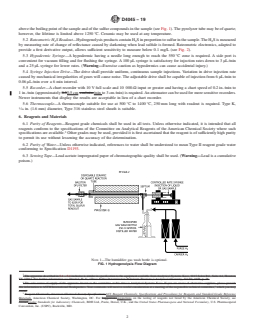
sample and of the sulfur compounds in the sample (see Fig. 1).
2.1 ASTM Standards:
The pyrolyzer tube may be of quartz; however, the lifetime is
D1193 Specification for Reagent Water
limited above 1250 °C. Ceramic may be used at any tempera-
ture.
5.2 Rateometric H S Readout—Hydrogenolysis products
This test method is under the jurisdiction of ASTM Committee D02 on
contain H S in proportion to sulfur in the sample. The HSis
Petroleum Products, Liquid Fuels, and Lubricants and is the direct responsibility of
2 2
Subcommittee D02.03 on Elemental Analysis.
measuredbymeasuringrateofchangeofreflectancecausedby
Current edition approved Dec. 1, 2019. Published December 2019. Originally
darkening when lead sulfide is formed. Rateometric
approved in 1987. Last previous edition approved in 2015 as D4045 – 15. DOI:
electronics, adapted to provide a first derivative output, allows
10.1520/D4045-19.
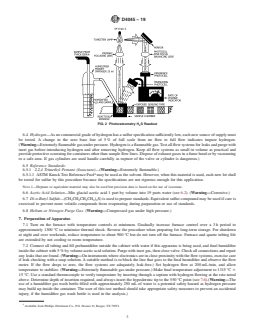
For referenced ASTM standards, visit the ASTM website, www.astm.org, or sufficient sensitivity to measure below 0.1 mg/L (see Fig. 2).
contact ASTM Customer Service at service@astm.org. For Annual Book of ASTM
5.3 Hypodermic Syringe—A hypodermic having a needle
Standards volume information, refer to the standard’s Document Summary page on
the ASTM website. long enough to reach the 550 °C zone is required. A side port
*A Summary of Changes section appears at the end of this standard
Copyright © ASTM International, 100 Barr Harbor Drive, PO Box C700, West Conshohocken, PA 19428-2959. United States
D4045 − 19
NOTE 1—The humidifier gas wash bottle is optional.
FIG. 1 Hydrogenolysis Flow Diagram
recorders. Newer instruments that display the results are
acceptable in lieu of a chart recorder.
5.6 Thermocouple—A thermocouple suitable for use at
500 °C to 1400 °C, 250 mm long with readout is required.
Type K, ⁄16 in. (1.6 mm) diameter, Type 316 stainless steel
sheath is suitable.
6. Reagents and Materials
6.1 Purity of Reagents—Reagent grade chemicals shall be
used in all tests. Unless otherwise indicated, it is intended that
all reagents conform to the specifications of the Committee on
Analytical Reagents of the American Chemical Society where
such specifications are available. Other grades may be used,
provided it is first ascertained that the reagent is of sufficiently
high purity to permit its use without lessening the accuracy of
the determination.
6.2 Purity of Water—Unless otherwise indicated, references
to water shall be understood to mean Type II reagent grade
water conforming to Specification D1193.
FIG. 2 Photorateometry H S Readout
6.3 Sensing Tape—Lead acetate impregnated paper of chro-
matographic quality shall be used. (Warning—Lead is a
cumulative poison.)
6.4 Hydrogen—As no commercial grade of hydrogen has a
is convenient for vacuum filling and for flushing the syringe.A
sulfur specification sufficiently low, each new source of supply
100 µL syringe is satisfactory for injection rates down to
must be tested. A change in the zero base line of 5 % of full
3 µL⁄min and a 25 µL syringe for lower rates. (Warning—
scale from no flow to full flow indicates impure hydrogen.
Exercise caution as hypodermics can cause accidental injury.)
(Warning—Extremely flammable gas under pressure. Hydro-
5.4 Syringe Injection Drive—The drive shall provide
gen is a flammable gas. Test all flow systems for leaks and
uniform, continuous sample injections. Variation in drive
purge with inert gas before introducing hydrogen and after
injection rate caused by mechanical irregularities of gears will
cause noise. The adjustable drive shall be capable of injection
from 6 µL⁄min to 0.06 µL⁄min over a 6 min interval.
ACS Reagent Chemicals, Specifications and Procedures for Reagents and
Standard-Grade Reference Materials, American Chemical Society, Washington,
5.5 Recorder—A chart recorder with 10 V full scale and
DC. For suggestions on the testing of reagents not listed by theAmerican Chemical
10 000-Ω input or greater and having a chart speed of
Society, see Analar Standards for Laboratory Chemicals, BDH Ltd., Poole, Dorset,
0.2 in.⁄min to 1 in.⁄min (approximately 0.5 cm⁄min to 3 cm-
U.K., and the United States Pharmacopeia and National Formulary, U.S. Pharma-
⁄min) is required.An attenuator can be used for more sensitive copeial Convention, Inc. (USPC), Rockville, MD.
D4045 − 19
removing hydrogen. Keep all flow systems as small in volume measures to prevent an accidental injury, if the humidifier gas
as practical and provide protective screening for containers wash bottle is used in the analysis.)
other than sample flow lines. Dispose of exhaust gases in a
7.3 Prepare the sample injection drive. Check to be sure
fume hood or by vacuuming to a safe area. If gas cylinders are
desired injection rate is obtained at various settings.Verify that
used handle carefully as rupture of the valve or cylinder is
erratic pulses of fast drive do not occur when the drive range
dangerous.)
is switched. Pulses of high sample flow above 15 µL⁄min will
6.5 Reference Standards: cause carboning and spurious readings.
6.5.1 2,2,4 Trimethyl Pentane (Isooctane)—(Warning—
7.4 Install sensing tape, and turn H S readout analyzer on.
Extremely flammable.)
7.5 Connect the recorder and adjust the zero to desired
6.5.1.1 ASTM Knock Test Reference Fuel may be used as
position with hydrogen flowing.
the solvent. However, when this material is used, each new lot
shall be tested for sulfur by this procedure because the 7.6 Fill syringe with blank reference standard solution,
specifications are not rigorous enough for this application.
typically isooctane, insert the needle through the septum to the
550 °C temperature zone, and clamp to the syringe drive. At
NOTE1—Heptaneorequivalentmaterialmayalsobeusedbutprecision
hightemperaturethehotneedlemayabsorbsulfurandatlower
data is based on the use of isooctane.
temperature heavy compounds may not evaporate. Set the
6.6 Acetic Acid Solution—Mix glacial acetic acid 1 part by
syringe drive rate desired, normally 6 µL⁄min, maximum with
volume into 19 parts water (see 6.2). (Warning—Corrosive.)
200 mL⁄min hydrogen flow. Drive rate may be increased for
6.7 Di-n-Butyl Sulfide—(CH CH CH CH ) S) is used to
increased sensitivity up to the point at which carbon is formed.
3 2 2 2 2
prepare standards. Equivalent sulfur compound may be used if
(Hydrogen flow at 500 mL⁄min allows injection of 15 µL⁄min;
care is exercised to prevent more volatile compounds from
however, dibenzothiophene conversion will be low.)
evaporating during preparation or use of standards.
8. Calibration Standard
6.8 Helium or Nitrogen Purge Gas. (Warning—
8.1 Prepare a reference standard-solution or solutions of
Compressed gas under high pressure.)
strength near that expected in the unknown. Measurements can
be made by weight or by volume for carrier liquid.
7. Preparation of Apparatus
8.2 Units of sulfur in milligrams per litre of sample are
7.1 Turn on the furnace with temperature controls at mini-
preferred as this is independent of the density of the carrier
mum. Gradually increase furnace control over a 3 h period to
liquid. The following equation is used to calculate the volume
approximately 1300 °C to minimize thermal shock. Reverse
of solvent required to dissolve a precise weight of sulfur
the procedure when preparing for long-term storage. For
compound, of known composition and purity to prepare a
shutdown at night and over weekends, reduce temperature to
liquid standard:
about 900 °C but do not turn off the furnace. Furnace and
quartz tubing life are extended by not cooling to room
b
z 5 3 d 3 e 310 /~a! or alternatively: (1)
temperature. S D
c
7.2 Connect all tubing and fill prehumidifier outside the
b
a 5 3 d 3 e 310 /~z! (2)
S D
cabinet with water if this apparatus is being used, and final
c
humidifier inside the cabinet wi
...
This document is not an ASTM standard and is intended only to provide the user of an ASTM standard an indication of what changes have been made to the previous version. Because
it may not be technically possible to adequately depict all changes accurately, ASTM recommends that users consult prior editions as appropriate. In all cases only the current version
of the standard as published by ASTM is to be considered the official document.
Designation: D4045 − 15 D4045 − 19
Standard Test Method for
Sulfur in Petroleum Products by Hydrogenolysis and
Rateometric Colorimetry
This standard is issued under the fixed designation D4045; the number immediately following the designation indicates the year of
original adoption or, in the case of revision, the year of last revision. A number in parentheses indicates the year of last reapproval. A
superscript epsilon (´) indicates an editorial change since the last revision or reapproval.
1. Scope*
1.1 This test method covers the determination of sulfur in petroleum products in the range from 0.02 mg ⁄kg to 10.00 mg ⁄kg.
1.2 This test method may be extended to higher concentration by dilution.
1.3 This test method is applicable to liquids whose boiling points are between 30 °C and 371 °C (86 °F and 700 °F). Materials
that can be analyzed include naphtha, kerosine, alcohol, steam condensate, various distillates, jet fuel, benzene, and toluene.
1.4 The values stated in SI units are to be regarded as standard. The values given in parentheses are for information only.
1.4.1 Certain specifications for the recorder (see 5.5) are excepted.
1.5 This standard does not purport to address all of the safety concerns, if any, associated with its use. It is the responsibility
of the user of this standard to establish appropriate safety safety, health, and healthenvironmental practices and determine the
applicability of regulatory limitations prior to use.
1.6 This international standard was developed in accordance with internationally recognized principles on standardization
established in the Decision on Principles for the Development of International Standards, Guides and Recommendations issued
by the World Trade Organization Technical Barriers to Trade (TBT) Committee.
2. Referenced Documents
2.1 ASTM Standards:
D1193 Specification for Reagent Water
D6299 Practice for Applying Statistical Quality Assurance and Control Charting Techniques to Evaluate Analytical Measure-
ment System Performance
3. Summary of Test Method
3.1 The sample is injected at a constant rate into a flowing hydrogen stream in a hydrogenolysis apparatus. The sample and
hydrogen are pyrolyzed at a temperature of 1300 °C, or above, to convert sulfur compounds to hydrogen sulfide (H S). Readout
is by the rateometric detection of the colorimetric reaction of H S with lead acetate. Condensable components are converted to
gaseous products, such as methane, during hydrogenolysis.
4. Significance and Use
4.1 In many petroleum refining processes, low levels of sulfur in feed stocks may poison expensive catalysts. This test method
can be used to monitor the amount of sulfur in such petroleum fractions.
4.2 This test method may also be used as a quality-control tool for sulfur determination in finished products.
,
5. Apparatus
5.1 Pyrolysis Furnace—A furnace that can provide an adjustable temperature from 900 °C to 1400 °C in a 5 mm inside diameter
or larger tube is required to pyrolyze the sample. The furnace entry temperature shall allow insertion of the hypodermic tip to a
depth at which the temperature is 550 °C to provide sample vaporization at the injection syringe tip. This temperature shall be
This test method is under the jurisdiction of ASTM Committee D02 on Petroleum Products, Liquid Fuels, and Lubricants and is the direct responsibility of Subcommittee
D02.03 on Elemental Analysis.
Current edition approved April 1, 2015Dec. 1, 2019. Published April 2015December 2019. Originally approved in 1987. Last previous edition approved in 20102015 as
D4045 – 04 (2010).D4045 – 15. DOI: 10.1520/D4045-15.10.1520/D4045-19.
For referenced ASTM standards, visit the ASTM website, www.astm.org, or contact ASTM Customer Service at service@astm.org. For Annual Book of ASTM Standards
volume information, refer to the standard’s Document Summary page on the ASTM website.
*A Summary of Changes section appears at the end of this standard
Copyright © ASTM International, 100 Barr Harbor Drive, PO Box C700, West Conshohocken, PA 19428-2959. United States
D4045 − 19
above the boiling point of the sample and of the sulfur compounds in the sample (see Fig. 1). The pyrolyzer tube may be of quartz;
however, the lifetime is limited above 1250 °C. Ceramic may be used at any temperature.
5.2 Rateometric H S Readout—Hydrogenolysis products contain H S in proportion to sulfur in the sample. The H S is measured
2 2 2
by measuring rate of change of reflectance caused by darkening when lead sulfide is formed. Rateometric electronics, adapted to
provide a first derivative output, allows sufficient sensitivity to measure below 0.1 mg/L (see Fig. 2).
5.3 Hypodermic Syringe—A hypodermic having a needle long enough to reach the 550 °C zone is required. A side port is
convenient for vacuum filling and for flushing the syringe. A 100 μL syringe is satisfactory for injection rates down to 3 μL ⁄min
and a 25 μL syringe for lower rates. (Warning—Exercise caution as hypodermics can cause accidental injury.)
5.4 Syringe Injection Drive—The drive shall provide uniform, continuous sample injections. Variation in drive injection rate
caused by mechanical irregularities of gears will cause noise. The adjustable drive shall be capable of injection from 6 μL ⁄min to
0.06 μL ⁄min over a 6 min interval.
5.5 Recorder—A chart recorder with 10 V full scale and 10 000-Ω input or greater and having a chart speed of 0.2 in. ⁄min to
1 in. ⁄min (approximately 0.50.5 cm cm/min ⁄min to 3 cm ⁄min) is required. An attenuator can be used for more sensitive recorders.
Newer instruments that display the results are acceptable in lieu of a chart recorder.
5.6 Thermocouple—A thermocouple suitable for use at 500 °C to 1400 °C, 250 mm long with readout is required. Type K,
⁄16 in. (1.6 mm) diameter, Type 316 stainless steel sheath is suitable.
6. Reagents and Materials
6.1 Purity of Reagents—Reagent grade chemicals shall be used in all tests. Unless otherwise indicated, it is intended that all
reagents conform to the specifications of the Committee on Analytical Reagents of the American Chemical Society where such
specifications are available. Other grades may be used, provided it is first ascertained that the reagent is of sufficiently high purity
to permit its use without lessening the accuracy of the determination.
6.2 Purity of Water—Unless otherwise indicated, references to water shall be understood to mean Type II reagent grade water
conforming to Specification D1193.
6.3 Sensing Tape—Lead acetate impregnated paper of chromatographic quality shall be used. (Warning—Lead is a cumulative
poison.)
NOTE 1—The humidifier gas wash bottle is optional.
FIG. 1 Hydrogenolysis Flow Diagram
The apparatus described in 5.1 – 5.4 inclusive is similar in specification to the equipment available from Analytical Systems Keco, 9215 Solon Rd., Suite A4, Houston,
TX 77064. For further information see Drushel, H. V., “Trace Sulfur Determination Petroleum Fractions,” Analytical Chemistry, Vol 50, 1978, p. 76.
The sole source of supply of the apparatus known to the committee at this time is Analytical Systems Keco. If you are aware of alternative suppliers, please provide
this information to ASTM International Headquarters. Your comments will receive careful consideration at a meeting of the responsible technical committee, which you may
attend.
Reagent Chemicals, American Chemical Society Specifications,ACS Reagent Chemicals, Specifications and Procedures for Reagents and Standard-Grade Reference
Materials, American Chemical Society, Washington, DC. For Suggestionssuggestions on the testing of reagents not listed by the American Chemical Society, see
AnnualAnalar Standards for Laboratory Chemicals, BDH Ltd., Poole, Dorset, U.K., and the United States Pharmacopeia and National Formulary, U.S. Pharmacopeial
Convention, Inc. (USPC), Rockville, MD.
D4045 − 19
FIG. 2 Photorateometry H S Readout
6.4 Hydrogen—As no commercial grade of hydrogen has a sulfur specification sufficiently low, each new source of supply must
be tested. A change in the zero base line of 5 % of full scale from no flow to full flow indicates impure hydrogen.
(Warning—Extremely flammable gas under pressure. Hydrogen is a flammable gas. Test all flow systems for leaks and purge with
inert gas before introducing hydrogen and after removing hydrogen. Keep all flow systems as small in volume as practical and
provide protective screening for containers other than sample flow lines. Dispose of exhaust gases in a fume hood or by vacuuming
to a safe area. If gas cylinders are used handle carefully as rupture of the valve or cylinder is dangerous.)
6.5 Reference Standards:
6.5.1 2,2,4 Trimethyl Pentane (Isooctane)—(Warning—Extremely flammable.)
6.5.1.1 ASTM Knock Test Reference Fuel may be used as the solvent. However, when this material is used, each new lot shall
be tested for sulfur by this procedure because the specifications are not rigorous enough for this application.
NOTE 1—Heptane or equivalent material may also be used but precision data is based on the use of isooctane.
6.6 Acetic Acid Solution—Mix glacial acetic acid 1 part by volume into 19 parts water (see 6.2). (Warning—Corrosive.)
6.7 Di-n-Butyl Sulfide—(CH CH CH CH ) S) is used to prepare standards. Equivalent sulfur compound may be used if care is
3 2 2 2 2
exercised to prevent more volatile compounds from evaporating during preparation or use of standards.
6.8 Helium or Nitrogen Purge Gas. (Warning—Compressed gas under high pressure.)
7. Preparation of Apparatus
7.1 Turn on the furnace with temperature controls at minimum. Gradually increase furnace control over a 3 h period to
approximately 1300 °C to minimize thermal shock. Reverse the procedure when preparing for long-term storage. For shutdown
at night and over weekends, reduce temperature to about 900 °C but do not turn off the furnace. Furnace and quartz tubing life
are extended by not cooling to room temperature.
7.2 Connect all tubing and fill prehumidifier outside the cabinet with water if this apparatus is being used, and final humidifier
inside the cabinet with 5 % by volume acetic acid solution. Purge with inert gas, then close valve. Check all connections and repair
any leaks that are found. (Warning—On instruments where electronics are in close proximity with the flow systems, exercise care
if leak checking with a soap solution. A suitable method is to block the line that goes to the final humidifier and observe the flow
meter. If the flow drops to zero, the flow systems are adequately leak-free.) Set hydrogen flow at 200 mL ⁄min, and allow
temperature to stabilize. (Warning—Extremely flammable gas under pressure.) Make final temperature adjustment to 1315 °C 6
15 °C. Use a standard thermocouple to verify temperature by inserting through a septum with hydrogen flowing at the rate noted
above. Determine depth of insertion required, and always insert the hypodermic tip to the 550 °C point (see 7.6).(Warning—The
use of a humidifier gas wash bottle filled with approximately 250 mL of water is a potential safety hazard as hydrogen pressure
may build up inside the container. The user of this test method should take appropriate safety measures to prevent an accidental
injury, if the humidifier gas wash bottle is used in the analysis.)
Available from Phillips Petroleum Co., P.O. Drawer O, Borger, TX 79071.
D4045 − 19
7.3 Prepare the sample injection drive. Check to be sure de
...
Questions, Comments and Discussion
Ask us and Technical Secretary will try to provide an answer. You can facilitate discussion about the standard in here.
Loading comments...