

ASTM D6455-11(2018)
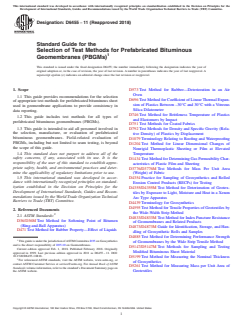
(Guide)Standard Guide for the Selection of Test Methods for Prefabricated Bituminous Geomembranes (PBGMs)
General Information
- Abstract
SIGNIFICANCE AND USE
4.1 To properly evaluate PBGMs, tests must be performed according to specific test methods and procedures. Failure to follow this practice can result in data not representative of the material's characteristics and performance.
SCOPE
1.1 This guide provides recommendations for the selection of appropriate test methods for prefabricated bituminous sheet used in geomembrane applications to provide consistency in data reporting.
1.2 This guide includes test methods for all types of prefabricated bituminous geomembranes (PBGMs).
1.3 This guide is intended to aid all personnel involved in the selection, manufacture, or evaluation of prefabricated bituminous geomembranes. Field-related evaluation of PBGMs, including but not limited to seam testing, is beyond the scope of this guide.
1.4 This standard does not purport to address all of the safety concerns, if any, associated with its use. It is the responsibility of the user of this standard to establish appropriate safety, health, and environmental practices and determine the applicability of regulatory limitations prior to use.
1.5 This international standard was developed in accordance with internationally recognized principles on standardization established in the Decision on Principles for the Development of International Standards, Guides and Recommendations issued by the World Trade Organization Technical Barriers to Trade (TBT) Committee.
- Status
- Published
- Publication Date
- 31-Jan-2018
- Technical Committee
- D35 - Geosynthetics
- Drafting Committee
- D35.10 - Geomembranes


Overview
ASTM D6455-11(2018) - Standard Guide for the Selection of Test Methods for Prefabricated Bituminous Geomembranes (PBGMs) provides essential recommendations for selecting appropriate test methods to evaluate prefabricated bituminous geomembranes. By standardizing the testing process, this guide ensures consistency and reliability in data reporting for various PBGM products used in geomembrane applications. This standard applies to all types of prefabricated bituminous geomembranes and is an indispensable resource for professionals involved in their selection, manufacturing, or evaluation.
Key Topics
- Selection of Test Methods: Offers guidance on the specific ASTM test methods suitable for evaluating the properties and performance of PBGMs.
- Scope and Limitations: Covers laboratory testing and is not intended for field-based evaluations, such as seam testing.
- Material Properties: Identifies key properties to be evaluated, ranging from basic properties to performance-related characteristics and component properties.
- Terminology Reference: Refers to established ASTM terminology for consistency (e.g., ASTM D4439 for geosynthetics and D1079 for bituminous materials).
Key Properties Addressed
- Basic properties: Identification, sampling, thickness, specific gravity, tensile properties, puncture resistance, and mass per unit area.
- Performance-related properties: Dimensional stability, water absorption, gas permeability, cold bending, UV and chemical resistance, and more.
- Component properties: Softening point of bitumen, mineral stabilizer content, reinforcement characteristics.
Importance of Standardization
- Ensures test data represents the true characteristics and performance of PBGM materials.
- Promotes reliability and comparability across different products and manufacturers.
- Assists users in complying with global testing and reporting requirements.
Applications
This guide is crucial for a wide range of applications involving the use of prefabricated bituminous geomembranes, including:
- Design and Specification: Engineers and designers rely on standardized test data when specifying PBGMs for containment, waterproofing, and environmental protection systems.
- Quality Control: Manufacturers use the guide to ensure that their products meet rigorous industry specifications by applying consistent test methods.
- Procurement and Evaluation: Purchasers and inspectors benefit from reliable testing protocols that support fair product comparisons and informed decisions.
- Research and Development: R&D teams utilize these recommendations to benchmark new PBGM materials and formulations.
Prefabricated bituminous geomembranes are commonly employed in applications such as landfill liners, canal linings, reservoirs, and roofing systems where durability, impermeability, and longevity are critical.
Related Standards
Professionals implementing ASTM D6455-11(2018) should be aware of related ASTM standards referenced throughout this guide. Key related standards include:
- ASTM D4439: Terminology for geosynthetics
- ASTM D1079: Terminology relating to roofing and waterproofing
- ASTM D5199: Test method for thickness of geosynthetics
- ASTM D5261: Measuring mass per unit area of geotextiles
- ASTM D5147: Sampling and testing modified bituminous sheet material
- ASTM D4885: Performance strength of geomembranes by the wide strip tensile method
For a full list of referenced documents and details on test methods, consult the ASTM website or the original standard documentation.
Keywords: prefabricated bituminous geomembranes, PBGMs, ASTM D6455, test methods, geosynthetics, modified bitumen, geomembrane testing, quality control, standardization, ASTM standards.
Relations
- Effective Date
- 01-Feb-2018
- Effective Date
- 01-Mar-2024
- Effective Date
- 01-Feb-2024
- Effective Date
- 15-Nov-2023
- Effective Date
- 01-Nov-2023
- Effective Date
- 01-Nov-2023
- Effective Date
- 01-Sep-2023
- Effective Date
- 01-Jun-2020
- Effective Date
- 01-May-2020
- Effective Date
- 01-May-2020
- Effective Date
- 01-May-2020
- Effective Date
- 01-Apr-2020
- Effective Date
- 01-Jul-2019
- Effective Date
- 01-Jul-2019
- Refers
ASTM D5199-12(2019) - Standard Test Method for Measuring the Nominal Thickness of Geosynthetics - Effective Date
- 15-Jun-2019
Get Certified
Connect with accredited certification bodies for this standard

DIBt (Deutsches Institut für Bautechnik)
German Institute for Building Technology.
DIN CERTCO
DIN Group product certification.

Aboma Certification B.V.
Specialized in construction, metal, and transport sectors.
Sponsored listings
Frequently Asked Questions
ASTM D6455-11(2018) is a guide published by ASTM International. Its full title is "Standard Guide for the Selection of Test Methods for Prefabricated Bituminous Geomembranes (PBGMs)". This standard covers: SIGNIFICANCE AND USE 4.1 To properly evaluate PBGMs, tests must be performed according to specific test methods and procedures. Failure to follow this practice can result in data not representative of the material's characteristics and performance. SCOPE 1.1 This guide provides recommendations for the selection of appropriate test methods for prefabricated bituminous sheet used in geomembrane applications to provide consistency in data reporting. 1.2 This guide includes test methods for all types of prefabricated bituminous geomembranes (PBGMs). 1.3 This guide is intended to aid all personnel involved in the selection, manufacture, or evaluation of prefabricated bituminous geomembranes. Field-related evaluation of PBGMs, including but not limited to seam testing, is beyond the scope of this guide. 1.4 This standard does not purport to address all of the safety concerns, if any, associated with its use. It is the responsibility of the user of this standard to establish appropriate safety, health, and environmental practices and determine the applicability of regulatory limitations prior to use. 1.5 This international standard was developed in accordance with internationally recognized principles on standardization established in the Decision on Principles for the Development of International Standards, Guides and Recommendations issued by the World Trade Organization Technical Barriers to Trade (TBT) Committee.
SIGNIFICANCE AND USE 4.1 To properly evaluate PBGMs, tests must be performed according to specific test methods and procedures. Failure to follow this practice can result in data not representative of the material's characteristics and performance. SCOPE 1.1 This guide provides recommendations for the selection of appropriate test methods for prefabricated bituminous sheet used in geomembrane applications to provide consistency in data reporting. 1.2 This guide includes test methods for all types of prefabricated bituminous geomembranes (PBGMs). 1.3 This guide is intended to aid all personnel involved in the selection, manufacture, or evaluation of prefabricated bituminous geomembranes. Field-related evaluation of PBGMs, including but not limited to seam testing, is beyond the scope of this guide. 1.4 This standard does not purport to address all of the safety concerns, if any, associated with its use. It is the responsibility of the user of this standard to establish appropriate safety, health, and environmental practices and determine the applicability of regulatory limitations prior to use. 1.5 This international standard was developed in accordance with internationally recognized principles on standardization established in the Decision on Principles for the Development of International Standards, Guides and Recommendations issued by the World Trade Organization Technical Barriers to Trade (TBT) Committee.
ASTM D6455-11(2018) is classified under the following ICS (International Classification for Standards) categories: 91.100.50 - Binders. Sealing materials. The ICS classification helps identify the subject area and facilitates finding related standards.
ASTM D6455-11(2018) has the following relationships with other standards: It is inter standard links to ASTM D6455-11, ASTM E96/E96M-24, ASTM D4439-24, ASTM E96/E96M-23, ASTM D5617-23, ASTM D5884/D5884M-23, ASTM D5322-23, ASTM D4833/D4833M-07(2020), ASTM D4354-12(2020), ASTM D1079-20, ASTM D36/D36M-14(2020), ASTM D1204-14(2020), ASTM E154/E154M-08a(2019), ASTM D5321/D5321M-19, ASTM D5199-12(2019). Understanding these relationships helps ensure you are using the most current and applicable version of the standard.
ASTM D6455-11(2018) is available in PDF format for immediate download after purchase. The document can be added to your cart and obtained through the secure checkout process. Digital delivery ensures instant access to the complete standard document.
Standards Content (Sample)
This international standard was developed in accordance with internationally recognized principles on standardization established in the Decision on Principles for the
Development of International Standards, Guides and Recommendations issued by the World Trade Organization Technical Barriers to Trade (TBT) Committee.
Designation: D6455 − 11 (Reapproved 2018)
Standard Guide for the
Selection of Test Methods for Prefabricated Bituminous
Geomembranes (PBGMs)
This standard is issued under the fixed designation D6455; the number immediately following the designation indicates the year of
original adoption or, in the case of revision, the year of last revision. A number in parentheses indicates the year of last reapproval. A
superscript epsilon (´) indicates an editorial change since the last revision or reapproval.
1. Scope D573 Test Method for Rubber—Deterioration in an Air
Oven
1.1 This guide provides recommendations for the selection
D696 Test Method for Coefficient of LinearThermal Expan-
of appropriate test methods for prefabricated bituminous sheet
sion of Plastics Between –30°C and 30°C with a Vitreous
used in geomembrane applications to provide consistency in
Silica Dilatometer
data reporting.
D746 Test Method for Brittleness Temperature of Plastics
1.2 This guide includes test methods for all types of
and Elastomers by Impact
prefabricated bituminous geomembranes (PBGMs).
D751 Test Methods for Coated Fabrics
1.3 This guide is intended to aid all personnel involved in
D792 Test Methods for Density and Specific Gravity (Rela-
the selection, manufacture, or evaluation of prefabricated
tive Density) of Plastics by Displacement
bituminous geomembranes. Field-related evaluation of
D1079 Terminology Relating to Roofing and Waterproofing
PBGMs, including but not limited to seam testing, is beyond
D1204 Test Method for Linear Dimensional Changes of
the scope of this guide.
Nonrigid Thermoplastic Sheeting or Film at Elevated
1.4 This standard does not purport to address all of the Temperature
safety concerns, if any, associated with its use. It is the
D1434 TestMethodforDeterminingGasPermeabilityChar-
responsibility of the user of this standard to establish appro-
acteristics of Plastic Film and Sheeting
priate safety, health, and environmental practices and deter-
D3776/D3776M Test Methods for Mass Per Unit Area
mine the applicability of regulatory limitations prior to use.
(Weight) of Fabric
1.5 This international standard was developed in accor-
D4354 Practice for Sampling of Geosynthetics and Rolled
dance with internationally recognized principles on standard-
Erosion Control Products (RECPs) for Testing
ization established in the Decision on Principles for the
D4355/D4355M Test Method for Deterioration of Geotex-
Development of International Standards, Guides and Recom-
tiles by Exposure to Light, Moisture and Heat in a Xenon
mendations issued by the World Trade Organization Technical
Arc Type Apparatus
Barriers to Trade (TBT) Committee.
D4439 Terminology for Geosynthetics
D4595 Test Method for Tensile Properties of Geotextiles by
2. Referenced Documents
the Wide-Width Strip Method
2.1 ASTM Standards:
D4833/D4833M Test Method for Index Puncture Resistance
D36/D36M Test Method for Softening Point of Bitumen
of Geomembranes and Related Products
(Ring-and-Ball Apparatus)
D4873/D4873M Guide for Identification, Storage, and Han-
D471 Test Method for Rubber Property—Effect of Liquids
dling of Geosynthetic Rolls and Samples
D4885 Test Method for Determining Performance Strength
This guide is under the jurisdiction ofASTM Committee D35 on Geosynthetics
of Geomembranes by the Wide Strip Tensile Method
and is the direct responsibility of D35.10 on Geomembranes.
D5147/D5147M Test Methods for Sampling and Testing
Current edition approved Feb. 1, 2018. Published February 2018. Originally
Modified Bituminous Sheet Material
approved in 1999. Last previous edition approved in 2011 as D6455 – 11. DOI:
10.1520/D6455-11R18. D5199 Test Method for Measuring the Nominal Thickness
For referenced ASTM standards, visit the ASTM website, www.astm.org, or
of Geosynthetics
contact ASTM Customer Service at service@astm.org. For Annual Book of ASTM
D5261 Test Method for Measuring Mass per Unit Area of
Standards volume information, refer to the standard’s Document Summary page on
Geotextiles
the ASTM website.
Copyright © ASTM International, 100 Barr Harbor Drive, PO Box C700, West Conshohocken, PA 19428-2959. United States
D6455 − 11 (2018)
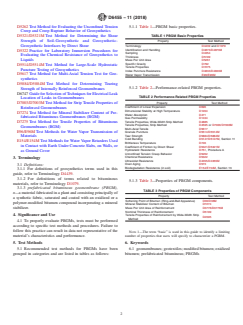
D5262 Test Method for Evaluating the Unconfined Tension 5.1.1 Table 1—PBGM basic properties.
Creep and Creep Rupture Behavior of Geosynthetics
TABLE 1 PBGM Basic Properties
D5321/D5321M Test Method for Determining the Shear
Strength of Soil-Geosynthetic and Geosynthetic- Property Test Method
Geosynthetic Interfaces by Direct Shear
Terminology D4439 and D1079
Identification and Handling D
...