

ASTM D1084-16(2021)
(Test Method)Standard Test Methods for Viscosity of Adhesives
General Information
- Abstract
SIGNIFICANCE AND USE
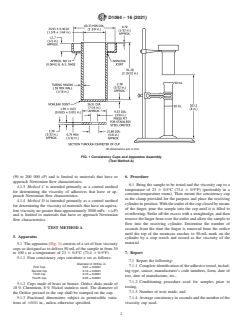
4.1 Several test methods are noted for viscosity determination of Newtonian and near Newtonian flow characteristics. (For adhesives not fitting into this category, Test Method D2556 should be considered.) Four test methods are covered as follows:
4.1.1 Method A is applicable only to adhesives that will deliver 50 mL in a steady uninterrupted stream from one of the cups described in Section 5.
4.1.2 Method B is intended for measuring the viscosity of adhesives covering a range from 0.05 Pa · s to 200 Pa · s (50 to 200 000 cP) and is limited to materials that have or approach Newtonian flow characteristics.
4.1.3 Method C is intended primarily as a control method for determining the viscosity of adhesives that have or approach Newtonian flow characteristics.
4.1.4 Method D is intended primarily as a control method for determining the viscosity of materials that have an equivalent viscosity no greater than approximately 3000 mPa · s (cP) and is limited to materials that have or approach Newtonian flow characteristics.
SCOPE
1.1 These test methods cover the determination of the viscosity of free-flowing adhesives.
1.1.1 The limitation of this test method to self-leveling adhesives eliminates thixotropic and plastic materials whose viscosity is a function of the rate of stirring and previous history of the adhesive.
1.2 The values stated in SI units are to be regarded as the standard. The values in parentheses are for information only.
1.3 This standard does not purport to address all of the safety concerns, if any, associated with its use. It is the responsibility of the user of this standard to establish appropriate safety, health, and environmental practices and determine the applicability of regulatory limitations prior to use.
1.4 This international standard was developed in accordance with internationally recognized principles on standardization established in the Decision on Principles for the Development of International Standards, Guides and Recommendations issued by the World Trade Organization Technical Barriers to Trade (TBT) Committee.
- Status
- Published
- Publication Date
- 31-Mar-2021
- Technical Committee
- D14 - Adhesives
- Drafting Committee
- D14.10 - Working Properties
Overview
ASTM D1084-16(2021) - Standard Test Methods for Viscosity of Adhesives provides internationally recognized procedures for determining the viscosity of free-flowing, self-leveling adhesives. This standard is vital for quality control and product comparison in the adhesives industry, as it ensures consistency and reliability in testing adhesive viscosity, especially for materials displaying Newtonian or near-Newtonian flow behavior. It is not intended for thixotropic or plastic materials with viscosity strongly influenced by stirring or handling history.
Key Topics
- Test Methods
Four different test methods are outlined, each targeting specific types of adhesives and viscosity measurement needs:- Method A: For adhesives deliverable in a steady, uninterrupted stream using standard viscosity cups.
- Method B: Measures viscosity in the range of 0.05 Pa·s to 200 Pa·s (50 to 200,000 cP) for Newtonian and near-Newtonian adhesives.
- Method C: Primarily a control method for adhesives with Newtonian flow properties.
- Method D: Control method for adhesives with viscosities up to 3,000 mPa·s (cP), suitable for quick checks using Zahn cups.
- Applicability
- Focused on free-flowing adhesives; not recommended for materials with significant thixotropy or plasticity.
- Uses standardized SI units; values in parentheses are informational.
- Standardization
- Developed according to internationally recognized WTO principles for creating standards, ensuring broad acceptance and regulatory consistency.
Applications
ASTM D1084-16(2021) is critical for manufacturers, quality assurance professionals, and laboratories in the adhesives and sealants supply chain. Its practical applications include:
- Product Quality Control
Assures consistency in adhesive viscosity, helping maintain product performance and batch-to-batch uniformity. - Material Comparison
Enables accurate comparisons of different adhesive formulations and brands by using standardized testing conditions. - Process Optimization
Viscosity data helps optimize adhesive application methods, improving end-use performance-especially in industries such as automotive, construction, packaging, and electronics. - Compliance and Certification
Demonstrates adherence to ASTM and international viscosity testing standards required by clients or regulatory bodies. - Research and Development
Supports the formulation and evaluation of new adhesives, ensuring that products meet specified flow and application criteria.
Related Standards
For laboratories and businesses seeking complementary test methods or broader context, the following related standards are recommended:
- ASTM D907: Terminology of Adhesives
- ASTM D562: Consistency of Paints Measuring Krebs Unit Viscosity Using a Stormer-Type Viscometer
- ASTM D1200: Viscosity by Ford Viscosity Cup
- ASTM D1545: Viscosity of Transparent Liquids by Bubble Time Method
- ASTM D2556: Apparent Viscosity of Adhesives Having Shear-Rate-Dependent Flow Properties Using Rotational Viscometry (for non-Newtonian materials)
- ISO 2555: Plastics-Resins in Liquid State-Determination of Apparent Viscosity by Brookfield Method
By following ASTM D1084-16(2021) for adhesive viscosity testing, users benefit from robust, repeatable, and industry-approved procedures that enhance both product performance and customer confidence. Ensuring accurate adhesive viscosity measurement supports innovation, quality, and regulatory compliance across multiple sectors.
Relations
- Effective Date
- 01-Mar-2024
- Effective Date
- 01-Nov-2018
- Effective Date
- 01-May-2018
- Effective Date
- 01-Nov-2017
- Effective Date
- 01-Dec-2014
- Effective Date
- 01-Dec-2014
- Effective Date
- 01-Nov-2014
- Effective Date
- 01-Mar-2014
- Effective Date
- 01-May-2013
- Refers
ASTM D1545-13 - Standard Test Method for Viscosity of Transparent Liquids by Bubble Time Method - Effective Date
- 01-Feb-2013
- Effective Date
- 01-Aug-2012
- Effective Date
- 01-Jul-2012
- Effective Date
- 01-May-2012
- Effective Date
- 01-Apr-2012
- Effective Date
- 01-Feb-2012
Get Certified
Connect with accredited certification bodies for this standard

DIN CERTCO
DIN Group product certification.

Smithers Quality Assessments
US management systems and product certification.
Sponsored listings
Frequently Asked Questions
ASTM D1084-16(2021) is a standard published by ASTM International. Its full title is "Standard Test Methods for Viscosity of Adhesives". This standard covers: SIGNIFICANCE AND USE 4.1 Several test methods are noted for viscosity determination of Newtonian and near Newtonian flow characteristics. (For adhesives not fitting into this category, Test Method D2556 should be considered.) Four test methods are covered as follows: 4.1.1 Method A is applicable only to adhesives that will deliver 50 mL in a steady uninterrupted stream from one of the cups described in Section 5. 4.1.2 Method B is intended for measuring the viscosity of adhesives covering a range from 0.05 Pa · s to 200 Pa · s (50 to 200 000 cP) and is limited to materials that have or approach Newtonian flow characteristics. 4.1.3 Method C is intended primarily as a control method for determining the viscosity of adhesives that have or approach Newtonian flow characteristics. 4.1.4 Method D is intended primarily as a control method for determining the viscosity of materials that have an equivalent viscosity no greater than approximately 3000 mPa · s (cP) and is limited to materials that have or approach Newtonian flow characteristics. SCOPE 1.1 These test methods cover the determination of the viscosity of free-flowing adhesives. 1.1.1 The limitation of this test method to self-leveling adhesives eliminates thixotropic and plastic materials whose viscosity is a function of the rate of stirring and previous history of the adhesive. 1.2 The values stated in SI units are to be regarded as the standard. The values in parentheses are for information only. 1.3 This standard does not purport to address all of the safety concerns, if any, associated with its use. It is the responsibility of the user of this standard to establish appropriate safety, health, and environmental practices and determine the applicability of regulatory limitations prior to use. 1.4 This international standard was developed in accordance with internationally recognized principles on standardization established in the Decision on Principles for the Development of International Standards, Guides and Recommendations issued by the World Trade Organization Technical Barriers to Trade (TBT) Committee.
SIGNIFICANCE AND USE 4.1 Several test methods are noted for viscosity determination of Newtonian and near Newtonian flow characteristics. (For adhesives not fitting into this category, Test Method D2556 should be considered.) Four test methods are covered as follows: 4.1.1 Method A is applicable only to adhesives that will deliver 50 mL in a steady uninterrupted stream from one of the cups described in Section 5. 4.1.2 Method B is intended for measuring the viscosity of adhesives covering a range from 0.05 Pa · s to 200 Pa · s (50 to 200 000 cP) and is limited to materials that have or approach Newtonian flow characteristics. 4.1.3 Method C is intended primarily as a control method for determining the viscosity of adhesives that have or approach Newtonian flow characteristics. 4.1.4 Method D is intended primarily as a control method for determining the viscosity of materials that have an equivalent viscosity no greater than approximately 3000 mPa · s (cP) and is limited to materials that have or approach Newtonian flow characteristics. SCOPE 1.1 These test methods cover the determination of the viscosity of free-flowing adhesives. 1.1.1 The limitation of this test method to self-leveling adhesives eliminates thixotropic and plastic materials whose viscosity is a function of the rate of stirring and previous history of the adhesive. 1.2 The values stated in SI units are to be regarded as the standard. The values in parentheses are for information only. 1.3 This standard does not purport to address all of the safety concerns, if any, associated with its use. It is the responsibility of the user of this standard to establish appropriate safety, health, and environmental practices and determine the applicability of regulatory limitations prior to use. 1.4 This international standard was developed in accordance with internationally recognized principles on standardization established in the Decision on Principles for the Development of International Standards, Guides and Recommendations issued by the World Trade Organization Technical Barriers to Trade (TBT) Committee.
ASTM D1084-16(2021) is classified under the following ICS (International Classification for Standards) categories: 83.180 - Adhesives. The ICS classification helps identify the subject area and facilitates finding related standards.
ASTM D1084-16(2021) has the following relationships with other standards: It is inter standard links to ASTM D115-17(2024), ASTM D2556-14(2018), ASTM D1601-18, ASTM D115-17, ASTM D562-10(2014), ASTM D1200-10(2014), ASTM D115-14, ASTM D2556-14, ASTM D88-07(2013), ASTM D1545-13, ASTM D1601-12, ASTM D907-12a, ASTM D907-12, ASTM D115-07(2012), ASTM D1545-07(2012). Understanding these relationships helps ensure you are using the most current and applicable version of the standard.
ASTM D1084-16(2021) is available in PDF format for immediate download after purchase. The document can be added to your cart and obtained through the secure checkout process. Digital delivery ensures instant access to the complete standard document.
Standards Content (Sample)
This international standard was developed in accordance with internationally recognized principles on standardization established in the Decision on Principles for the
Development of International Standards, Guides and Recommendations issued by the World Trade Organization Technical Barriers to Trade (TBT) Committee.
Designation: D1084 − 16 (Reapproved 2021)
Standard Test Methods for
Viscosity of Adhesives
This standard is issued under the fixed designation D1084; the number immediately following the designation indicates the year of
original adoption or, in the case of revision, the year of last revision. A number in parentheses indicates the year of last reapproval. A
superscript epsilon (´) indicates an editorial change since the last revision or reapproval.
This standard has been approved for use by agencies of the U.S. Department of Defense.
1. Scope Bubble Time Method
D1601 Test Method for Dilute Solution Viscosity of Ethyl-
1.1 These test methods cover the determination of the
ene Polymers
viscosity of free-flowing adhesives.
D2556 Test Method for Apparent Viscosity of Adhesives
1.1.1 The limitation of this test method to self-leveling
Having Shear-Rate-Dependent Flow Properties Using Ro-
adhesives eliminates thixotropic and plastic materials whose
tational Viscometry
viscosity is a function of the rate of stirring and previous
2.2 ISO Document:
history of the adhesive.
ISO 2555 Plastics — Resins in the Liquid State or as
1.2 The values stated in SI units are to be regarded as the
Emulsions or Dispersions — Determination of Apparent
standard. The values in parentheses are for information only.
Viscosity by the Brookfield Test Method
1.3 This standard does not purport to address all of the
3. Terminology
safety concerns, if any, associated with its use. It is the
responsibility of the user of this standard to establish appro-
3.1 Definitions:
priate safety, health, and environmental practices and deter-
3.1.1 Many terms in these test methods are defined in
mine the applicability of regulatory limitations prior to use.
Terminology D907.
1.4 This international standard was developed in accor-
3.1.2 viscosity, n—of a liquid, the resistance to flow ex-
dance with internationally recognized principles on standard-
pressed as the ratio of the applied stress to the resulting rate of
ization established in the Decision on Principles for the
shearing strain (see Newtonian behavior and thixotropy).
Development of International Standards, Guides and Recom-
(Compare consistency.)
mendations issued by the World Trade Organization Technical
3.2 Definitions of Terms Specific to This Standard:
Barriers to Trade (TBT) Committee.
3.2.1 viscosity, n—the ratio of shear stress to shear rate. The
viscosity of a liquid is a measure of the internal friction of the
2. Referenced Documents
liquid in motion. The unit of dynamic viscosity is the Pascal
2.1 ASTM Standards:
(poise), which is expressed as dyne-seconds per square centi-
D88 Test Method for Saybolt Viscosity
metre. For a Newtonian liquid, the viscosity is constant at all
D115 Test Methods for Testing Solvent Containing Var-
shear rates. For a non-Newtonian liquid, viscosity will vary
nishes Used for Electrical Insulation
depending on shear rate.
D562 Test Method for Consistency of Paints Measuring
KrebsUnit(KU)ViscosityUsingaStormer-TypeViscom-
4. Significance and Use
eter
4.1 Several test methods are noted for viscosity determina-
D907 Terminology of Adhesives
tion of Newtonian and near Newtonian flow characteristics.
D1200 Test Method for Viscosity by Ford Viscosity Cup
(For adhesives not fitting into this category, Test Method
D1545 Test Method for Viscosity of Transparent Liquids by
D2556shouldbeconsidered.)Fourtestmethodsarecoveredas
follows:
4.1.1 Method A is applicable only to adhesives that will
These test methods are under the jurisdiction of ASTM Committee D14 on
deliver 50 mLin a steady uninterrupted stream from one of the
Adhesives and are the direct responsibility of Subcommittee D14.10 on Working
Properties.
cups described in Section 5.
Current edition approved April 1, 2021. Published April 2021. Originally
4.1.2 Method B is intended for measuring the viscosity of
approved in 1950. Last previous edition approved in 2016 as D1084 – 16. DOI:
adhesives covering a range from 0.05 Pa·sto200Pa·s
10.1520/D1084-16R21.
For referenced ASTM standards, visit the ASTM website, www.astm.org, or
contact ASTM Customer Service at service@astm.org. For Annual Book of ASTM
Standards volume information, refer to the standard’s Document Summary page on Available fromAmerican National Standards Institute (ANSI), 25 W. 43rd St.,
the ASTM website. 4th Floor, New York, NY 10036, http://www.ansi.org.
Copyright © ASTM International, 100 Barr Harbor Drive, PO Box C700, West Conshohocken, PA 19428-2959. United States
D1084 − 16 (2021)
All dimensions are in mm.
FIG. 1 Consistency Cups and Apparatus Assembly
(Test Method A)
(50 to 200 000 cP) and is limited to materials that have or 6. Procedure
approach Newtonian flow characteristics.
6.1 Bring the sample to be tested and the viscosity cup to a
4.1.3 Method C is intended primarily as a control method
temperature of 23 6 0.5°C (73.4 6 0.9°F) (preferably in a
for determining the viscosity of adhesives that have or ap-
constant-temperature room). Then mount the consistency cup
proach Newtonian flow characteristics.
in the clamp provided for the purpose and place the receiving
4.1.4 Method D is intended primarily as a control method
cylinderinposition.Withtheoutletofthecupclosedbymeans
for determining the viscosity of materials that have an equiva-
of the finger, pour the sample into the cup until it is filled to
lent viscosity no greater than approximately 3000 mPa · s (cP)
overflowing. Strike off the excess with a straightedge, and then
and is limited to materials that have or approach Newtonian
remove the finger from over the outlet and allow the sample to
flow characteristics.
flow into the receiving cylinder. Determine the number of
TEST METHOD A
seconds from the time the finger is removed from the orifice
until the top of the meniscus reaches to 50-mL mark on the
5. Apparatus
cylinder by a stop watch and record as the viscosity of the
material.
5.1 The apparatus (Fig. 1) consists of a set of four viscosity
cups so designed as to deliver 50 mLof the sample in from 30
to 100 s at a temperature of 23 6 0.5°C (73.4 6 0.9°F). 7. Report
5.1.1 Four consistency cups constitute a set as follows:
7.1 Report the following:
Diameter of Orifice, in.
7.1.1 Complete identification of the adhesive tested, includ-
First Cup 0.07 ± 0.0001
Second cup 0.10 ± 0.0001
ing type, source, manufacturer’s code numbers, form, date of
Third cup 0.15 ± 0.0001
test, date of manufacture, etc.,
Fourth cup 0.25 ± 0.0001
7.1.2 Conditioning procedure used for samples prior to
5.1.2 Cups made of brass or bronze. Orifice disks made of
testing,
18 % Chromium, 8 % Nickel stainless steel. The diameter of
7.1.3 Number of tests made, and
the Orifice pressed in the cup shall be stamped on the cup.
7.1.4 Average consistency in seconds and the number of the
5.1.3 Fractional dimensions subject to permissible varia-
tions of 60.01 in., unless otherwise specified. viscosity cup used.
D1084 − 16 (2021)
TEST METHOD B 11.1.4 Temperature of the sample at the conclusion of the
test,
8. Procedure
11.1.5 Weight used,
11.1.6 Number of tests made, and
8.1 Refer to ISO 2555 for this test method.
11.1.7 Average viscosit
...