

ASTM D6641/D6641M-23
(Test Method)Standard Test Method for Compressive Properties of Polymer Matrix Composite Materials Using a Combined Loading Compression (CLC) Test Fixture
General Information
- Abstract
SIGNIFICANCE AND USE
5.1 This test method is designed to produce compressive property data for material specifications, research and development, quality assurance, and structural design and analysis. When tabbed (Procedure B) specimens, typically unidirectional composites, are tested, the CLC test method (combined shear end loading) has similarities to Test Methods D3410/D3410M (shear loading) and D695 (end loading). When testing lower strength materials such that untabbed CLC specimens can be used (Procedure A), the benefits of combined loading become particularly prominent. It may not be possible to successfully test untabbed specimens of these same materials using either of the other two methods. When specific laminates are tested (primarily of the [90/0]ns family, although other laminates containing at least one 0° ply can be used), the CLC data are frequently used to “back out” 0° ply strength, using lamination theory to calculate a 0° unidirectional lamina strength (1, 2). Factors that influence the compressive response include: type of material, methods of material preparation and lay-up, specimen stacking sequence, specimen preparation, specimen conditioning, environment of testing, speed of testing, time at temperature, void content, and volume percent reinforcement. Composite properties in the test direction that may be obtained from this test method include:
5.1.1 Ultimate compressive strength,
5.1.2 Ultimate compressive strain,
5.1.3 Compressive (linear or chord) modulus of elasticity, and
5.1.4 Poisson's ratio in compression.
SCOPE
1.1 This test method determines the compressive strength and stiffness properties of polymer matrix composite materials using a combined loading compression (CLC) (1)2 test fixture. This test method is applicable to general composites that are balanced and symmetric. The specimen may be untabbed (Procedure A) or tabbed (Procedure B), as required. One requirement for a successful test is that the specimen ends do not crush during the test. Untabbed specimens are usually suitable for use with materials of low orthotropy, for example, fabrics, chopped fiber composites, and laminates with a maximum of 50 % 0° plies, or equivalent (see 6.4). Materials of higher orthotropy, including unidirectional composites, typically require tabs.
1.2 The compressive force is introduced into the specimen by combined end- and shear-loading. In comparison, Test Method D3410/D3410M is a pure shear-loading compression test method and Test Method D695 is a pure end-loading test method.
1.3 Unidirectional (0° ply orientation) composites as well as multi-directional composite laminates, fabric composites, chopped fiber composites, and similar materials can be tested.
1.4 The values stated in either SI units or inch-pound units are to be regarded separately as standard. Within the test the inch-pound units are shown in brackets. The values stated in each system are not exact equivalents; therefore, each system must be used independently of the other. Combining values from the two systems may result in nonconformance with the standard.
Note 1: Additional procedures for determining the compressive properties of polymer matrix composites may be found in Test Methods D3410/D3410M, D5467/D5467M, and D695.
1.5 This standard does not purport to address all of the safety concerns, if any, associated with its use. It is the responsibility of the user of this standard to establish appropriate safety, health, and environmental practices and determine the applicability of regulatory limitations prior to use.
1.6 This international standard was developed in accordance with internationally recognized principles on standardization established in the Decision on Principles for the Development of International Standards, Guides and Recommendations issued by the World Trade Organization Technical Barriers to Trade (TBT) Committee.
- Status
- Published
- Publication Date
- 14-Nov-2023
- Technical Committee
- D30 - Composite Materials
- Drafting Committee
- D30.04 - Lamina and Laminate Test Methods
Buy Documents
ASTM D6641/D6641M-23 - Standard Test Method for Compressive Properties of Polymer Matrix Composite Materials Using a Combined Loading Compression (CLC) Test Fixture
REDLINE ASTM D6641/D6641M-23 - Standard Test Method for Compressive Properties of Polymer Matrix Composite Materials Using a Combined Loading Compression (CLC) Test Fixture
Overview
ASTM D6641/D6641M-23: Standard Test Method for Compressive Properties of Polymer Matrix Composite Materials Using a Combined Loading Compression (CLC) Test Fixture is a critical standard developed by ASTM International. It provides a unified methodology for determining the compressive strength and stiffness properties of polymer matrix composite materials using a combined loading compression (CLC) test fixture. This test is essential for material specifications, quality assurance, research and development, and structural design and analysis within industries utilizing composite materials.
The CLC test method is designed for both untabbed (Procedure A) and tabbed (Procedure B) specimens, making it applicable across materials with varying degrees of orthotropy, including unidirectional, multidirectional laminates, fabric composites, and chopped fiber composites.
Key Topics
- Testing Procedures: The method outlines two specimen preparation procedures:
- Procedure A (Untabbed): Suitable for materials with low orthotropy, such as fabrics and chopped fiber composites.
- Procedure B (Tabbed): Favored for high orthotropy materials, such as unidirectional composite laminates, to prevent end crushing and allow accurate loading.
- Load Introduction: Compressive force is applied via combined end- and shear-loading, unlike other methods which use pure shear or end-loading.
- Measured Properties: Key compressive properties obtainable using this test method include:
- Ultimate compressive strength
- Ultimate compressive strain
- Compressive modulus of elasticity (linear or chord)
- Poisson’s ratio in compression
- Specimen Preparation: Emphasizes the importance of proper machining and alignment (flat, parallel ends perpendicular to the longitudinal axis) to prevent invalid results due to end crushing or buckling.
- Environmental Conditioning: The method supports both standard and controlled environment testing, including temperature and moisture effects.
- Data Acquisition: Continuous or frequent recording of force and strain data is required, ensuring accurate stress-strain analysis.
Applications
ASTM D6641/D6641M-23 is widely utilized in industries where polymer matrix composites are integral to product performance and safety, such as aerospace, automotive, sporting goods, marine, and civil engineering. Practical applications include:
- Material Qualification: Assessing compressive properties for acceptance in material supply and procurement.
- Structural Design: Generating design data for finite element analysis or other structural assessment methods.
- Quality Control: Ensuring consistent compressive performance of manufactured composite components.
- Research & Development: Comparing new composite formulations, reinforcement architectures, or processing techniques.
- Data for Standards Compliance: Providing compressive property data required for certification and regulatory purposes.
This method is particularly valuable when conventional test methods (such as pure end or shear-loading) are inadequate for certain composite configurations-especially lower strength, untabbed specimens.
Related Standards
Users of ASTM D6641/D6641M-23 often reference and integrate additional ASTM standards for comprehensive composite material testing, including:
- ASTM D3410/D3410M: Test Method for Compressive Properties by Shear Loading
- ASTM D695: Test Method for Compressive Properties of Rigid Plastics
- ASTM D5467/D5467M: Compression Tests for Unidirectional Polymer Matrix Composite Materials
- ASTM D3878: Terminology for Composite Materials
- ASTM D5229/D5229M: Moisture Absorption Properties and Conditioning of Polymer Matrix Composites
Together, these standards ensure a robust, reliable framework for measuring and comparing the mechanical properties of advanced composite materials.
Keywords: ASTM D6641, compressive properties, polymer matrix composites, combined loading compression, CLC test fixture, composite material testing, ultimate compressive strength, modulus of elasticity, Poisson's ratio, material qualification, quality assurance, structural design, test standards for composites.
Relations
- Effective Date
- 15-Nov-2023
- Effective Date
- 01-Feb-2024
- Effective Date
- 01-Nov-2023
- Effective Date
- 01-Apr-2022
- Effective Date
- 01-Apr-2022
- Effective Date
- 15-Nov-2023
- Effective Date
- 15-Nov-2023
- Effective Date
- 15-Nov-2023
- Effective Date
- 15-Nov-2023
- Effective Date
- 15-Nov-2023
- Effective Date
- 15-Nov-2023
- Effective Date
- 15-Nov-2023
- Referred By
ASTM D6856/D6856M-23 - Standard Guide for Testing Fabric-Reinforced “Textile” Composite Materials - Effective Date
- 15-Nov-2023
- Effective Date
- 15-Nov-2023
- Effective Date
- 15-Nov-2023
Buy Documents
ASTM D6641/D6641M-23 - Standard Test Method for Compressive Properties of Polymer Matrix Composite Materials Using a Combined Loading Compression (CLC) Test Fixture
REDLINE ASTM D6641/D6641M-23 - Standard Test Method for Compressive Properties of Polymer Matrix Composite Materials Using a Combined Loading Compression (CLC) Test Fixture
Get Certified
Connect with accredited certification bodies for this standard

DIN CERTCO
DIN Group product certification.

Smithers Quality Assessments
US management systems and product certification.
Sponsored listings
Frequently Asked Questions
ASTM D6641/D6641M-23 is a standard published by ASTM International. Its full title is "Standard Test Method for Compressive Properties of Polymer Matrix Composite Materials Using a Combined Loading Compression (CLC) Test Fixture". This standard covers: SIGNIFICANCE AND USE 5.1 This test method is designed to produce compressive property data for material specifications, research and development, quality assurance, and structural design and analysis. When tabbed (Procedure B) specimens, typically unidirectional composites, are tested, the CLC test method (combined shear end loading) has similarities to Test Methods D3410/D3410M (shear loading) and D695 (end loading). When testing lower strength materials such that untabbed CLC specimens can be used (Procedure A), the benefits of combined loading become particularly prominent. It may not be possible to successfully test untabbed specimens of these same materials using either of the other two methods. When specific laminates are tested (primarily of the [90/0]ns family, although other laminates containing at least one 0° ply can be used), the CLC data are frequently used to “back out” 0° ply strength, using lamination theory to calculate a 0° unidirectional lamina strength (1, 2). Factors that influence the compressive response include: type of material, methods of material preparation and lay-up, specimen stacking sequence, specimen preparation, specimen conditioning, environment of testing, speed of testing, time at temperature, void content, and volume percent reinforcement. Composite properties in the test direction that may be obtained from this test method include: 5.1.1 Ultimate compressive strength, 5.1.2 Ultimate compressive strain, 5.1.3 Compressive (linear or chord) modulus of elasticity, and 5.1.4 Poisson's ratio in compression. SCOPE 1.1 This test method determines the compressive strength and stiffness properties of polymer matrix composite materials using a combined loading compression (CLC) (1)2 test fixture. This test method is applicable to general composites that are balanced and symmetric. The specimen may be untabbed (Procedure A) or tabbed (Procedure B), as required. One requirement for a successful test is that the specimen ends do not crush during the test. Untabbed specimens are usually suitable for use with materials of low orthotropy, for example, fabrics, chopped fiber composites, and laminates with a maximum of 50 % 0° plies, or equivalent (see 6.4). Materials of higher orthotropy, including unidirectional composites, typically require tabs. 1.2 The compressive force is introduced into the specimen by combined end- and shear-loading. In comparison, Test Method D3410/D3410M is a pure shear-loading compression test method and Test Method D695 is a pure end-loading test method. 1.3 Unidirectional (0° ply orientation) composites as well as multi-directional composite laminates, fabric composites, chopped fiber composites, and similar materials can be tested. 1.4 The values stated in either SI units or inch-pound units are to be regarded separately as standard. Within the test the inch-pound units are shown in brackets. The values stated in each system are not exact equivalents; therefore, each system must be used independently of the other. Combining values from the two systems may result in nonconformance with the standard. Note 1: Additional procedures for determining the compressive properties of polymer matrix composites may be found in Test Methods D3410/D3410M, D5467/D5467M, and D695. 1.5 This standard does not purport to address all of the safety concerns, if any, associated with its use. It is the responsibility of the user of this standard to establish appropriate safety, health, and environmental practices and determine the applicability of regulatory limitations prior to use. 1.6 This international standard was developed in accordance with internationally recognized principles on standardization established in the Decision on Principles for the Development of International Standards, Guides and Recommendations issued by the World Trade Organization Technical Barriers to Trade (TBT) Committee.
SIGNIFICANCE AND USE 5.1 This test method is designed to produce compressive property data for material specifications, research and development, quality assurance, and structural design and analysis. When tabbed (Procedure B) specimens, typically unidirectional composites, are tested, the CLC test method (combined shear end loading) has similarities to Test Methods D3410/D3410M (shear loading) and D695 (end loading). When testing lower strength materials such that untabbed CLC specimens can be used (Procedure A), the benefits of combined loading become particularly prominent. It may not be possible to successfully test untabbed specimens of these same materials using either of the other two methods. When specific laminates are tested (primarily of the [90/0]ns family, although other laminates containing at least one 0° ply can be used), the CLC data are frequently used to “back out” 0° ply strength, using lamination theory to calculate a 0° unidirectional lamina strength (1, 2). Factors that influence the compressive response include: type of material, methods of material preparation and lay-up, specimen stacking sequence, specimen preparation, specimen conditioning, environment of testing, speed of testing, time at temperature, void content, and volume percent reinforcement. Composite properties in the test direction that may be obtained from this test method include: 5.1.1 Ultimate compressive strength, 5.1.2 Ultimate compressive strain, 5.1.3 Compressive (linear or chord) modulus of elasticity, and 5.1.4 Poisson's ratio in compression. SCOPE 1.1 This test method determines the compressive strength and stiffness properties of polymer matrix composite materials using a combined loading compression (CLC) (1)2 test fixture. This test method is applicable to general composites that are balanced and symmetric. The specimen may be untabbed (Procedure A) or tabbed (Procedure B), as required. One requirement for a successful test is that the specimen ends do not crush during the test. Untabbed specimens are usually suitable for use with materials of low orthotropy, for example, fabrics, chopped fiber composites, and laminates with a maximum of 50 % 0° plies, or equivalent (see 6.4). Materials of higher orthotropy, including unidirectional composites, typically require tabs. 1.2 The compressive force is introduced into the specimen by combined end- and shear-loading. In comparison, Test Method D3410/D3410M is a pure shear-loading compression test method and Test Method D695 is a pure end-loading test method. 1.3 Unidirectional (0° ply orientation) composites as well as multi-directional composite laminates, fabric composites, chopped fiber composites, and similar materials can be tested. 1.4 The values stated in either SI units or inch-pound units are to be regarded separately as standard. Within the test the inch-pound units are shown in brackets. The values stated in each system are not exact equivalents; therefore, each system must be used independently of the other. Combining values from the two systems may result in nonconformance with the standard. Note 1: Additional procedures for determining the compressive properties of polymer matrix composites may be found in Test Methods D3410/D3410M, D5467/D5467M, and D695. 1.5 This standard does not purport to address all of the safety concerns, if any, associated with its use. It is the responsibility of the user of this standard to establish appropriate safety, health, and environmental practices and determine the applicability of regulatory limitations prior to use. 1.6 This international standard was developed in accordance with internationally recognized principles on standardization established in the Decision on Principles for the Development of International Standards, Guides and Recommendations issued by the World Trade Organization Technical Barriers to Trade (TBT) Committee.
ASTM D6641/D6641M-23 is classified under the following ICS (International Classification for Standards) categories: 83.140.10 - Films and sheets. The ICS classification helps identify the subject area and facilitates finding related standards.
ASTM D6641/D6641M-23 has the following relationships with other standards: It is inter standard links to ASTM D6641/D6641M-16e2, ASTM D883-24, ASTM D883-23, ASTM E456-13a(2022), ASTM E456-13a(2022)e1, ASTM D7792/D7792M-15, ASTM D8509/D8509M-23, ASTM D7992/D7992M-15, ASTM D7745-19, ASTM D4762-23, ASTM D8066/D8066M-23, ASTM D7137/D7137M-23, ASTM D6856/D6856M-23, ASTM D3410/D3410M-16e1, ASTM D695-23. Understanding these relationships helps ensure you are using the most current and applicable version of the standard.
ASTM D6641/D6641M-23 is available in PDF format for immediate download after purchase. The document can be added to your cart and obtained through the secure checkout process. Digital delivery ensures instant access to the complete standard document.
Standards Content (Sample)
This international standard was developed in accordance with internationally recognized principles on standardization established in the Decision on Principles for the
Development of International Standards, Guides and Recommendations issued by the World Trade Organization Technical Barriers to Trade (TBT) Committee.
Designation: D6641/D6641M − 23
Standard Test Method for
Compressive Properties of Polymer Matrix Composite
Materials Using a Combined Loading Compression (CLC)
Test Fixture
This standard is issued under the fixed designation D6641/D6641M; the number immediately following the designation indicates the
year of original adoption or, in the case of revision, the year of last revision. A number in parentheses indicates the year of last
reapproval. A superscript epsilon (´) indicates an editorial change since the last revision or reapproval.
1. Scope 1.5 This standard does not purport to address all of the
safety concerns, if any, associated with its use. It is the
1.1 This test method determines the compressive strength
responsibility of the user of this standard to establish appro-
and stiffness properties of polymer matrix composite materials
2 priate safety, health, and environmental practices and deter-
using a combined loading compression (CLC) (1) test fixture.
mine the applicability of regulatory limitations prior to use.
This test method is applicable to general composites that are
1.6 This international standard was developed in accor-
balanced and symmetric. The specimen may be untabbed
dance with internationally recognized principles on standard-
(Procedure A) or tabbed (Procedure B), as required. One
ization established in the Decision on Principles for the
requirement for a successful test is that the specimen ends do
Development of International Standards, Guides and Recom-
not crush during the test. Untabbed specimens are usually
mendations issued by the World Trade Organization Technical
suitable for use with materials of low orthotropy, for example,
Barriers to Trade (TBT) Committee.
fabrics, chopped fiber composites, and laminates with a maxi-
mum of 50 % 0° plies, or equivalent (see 6.4). Materials of
2. Referenced Documents
higher orthotropy, including unidirectional composites, typi-
2.1 ASTM Standards:
cally require tabs.
D695 Test Method for Compressive Properties of Rigid
1.2 The compressive force is introduced into the specimen
Plastics
by combined end- and shear-loading. In comparison, Test
D883 Terminology Relating to Plastics
Method D3410/D3410M is a pure shear-loading compression
D3410/D3410M Test Method for Compressive Properties of
test method and Test Method D695 is a pure end-loading test
Polymer Matrix Composite Materials with Unsupported
method.
Gage Section by Shear Loading
1.3 Unidirectional (0° ply orientation) composites as well as
D3878 Terminology for Composite Materials
multi-directional composite laminates, fabric composites,
D5229/D5229M Test Method for Moisture Absorption Prop-
chopped fiber composites, and similar materials can be tested.
erties and Equilibrium Conditioning of Polymer Matrix
Composite Materials
1.4 The values stated in either SI units or inch-pound units
D5379/D5379M Test Method for Shear Properties of Com-
are to be regarded separately as standard. Within the test the
posite Materials by the V-Notched Beam Method
inch-pound units are shown in brackets. The values stated in
D5467/D5467M Test Method for Compressive Properties of
each system are not exact equivalents; therefore, each system
Unidirectional Polymer Matrix Composite Materials Us-
must be used independently of the other. Combining values
ing a Sandwich Beam
from the two systems may result in nonconformance with the
D5687/D5687M Guide for Preparation of Flat Composite
standard.
Panels with Processing Guidelines for Specimen Prepara-
NOTE 1—Additional procedures for determining the compressive prop-
tion
erties of polymer matrix composites may be found in Test Methods
E4 Practices for Force Calibration and Verification of Test-
D3410/D3410M, D5467/D5467M, and D695.
ing Machines
E6 Terminology Relating to Methods of Mechanical Testing
This test method is under the jurisdiction of ASTM Committee D30 on
E122 Practice for Calculating Sample Size to Estimate, With
Composite Materials and is the direct responsibility of Subcommittee D30.04 on
Lamina and Laminate Test Methods.
Current edition approved Nov. 15, 2023. Published December 2023. Originally
approved in 2001. Last previous edition approved in 2016 as D6641/ For referenced ASTM standards, visit the ASTM website, www.astm.org, or
ɛ2
D6641M – 16 . DOI: 10.1520/D6641_D6641M-23. contact ASTM Customer Service at service@astm.org. For Annual Book of ASTM
Boldface numbers in parentheses refer to the list of references at the end of this Standards volume information, refer to the standard’s Document Summary page on
test method. the ASTM website.
Copyright © ASTM International, 100 Barr Harbor Drive, PO Box C700, West Conshohocken, PA 19428-2959. United States
D6641/D6641M − 23
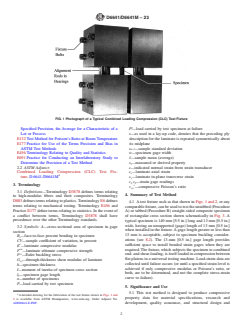
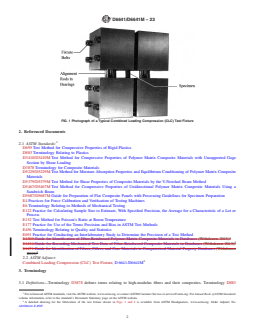
FIG. 1 Photograph of a Typical Combined Loading Compression (CLC) Test Fixture
f
Specified Precision, the Average for a Characteristic of a P —load carried by test specimen at failure
Lot or Process s—as used in a lay-up code, denotes that the preceding ply
E132 Test Method for Poisson’s Ratio at Room Temperature description for the laminate is repeated symmetrically about
E177 Practice for Use of the Terms Precision and Bias in its midplane
ASTM Test Methods s —sample standard deviation
n-1
E456 Terminology Relating to Quality and Statistics w—specimen gage width
E691 Practice for Conducting an Interlaboratory Study to x¯—sample mean (average)
Determine the Precision of a Test Method x —measured or derived property
i
2.2 ASTM Adjunct: ε—indicated normal strain from strain transducer
Combined Loading Compression (CLC) Test Fix- ε —laminate axial strain
x
ture, D 6641 ⁄D6641M ε —laminate in-plane transverse strain
y
ε ε —strain gage readings
1, 2
c
3. Terminology
v —compressive Poisson’s ratio
xy
3.1 Definitions—Terminology D3878 defines terms relating
4. Summary of Test Method
to high-modulus fibers and their composites. Terminology
D883 defines terms relating to plastics. Terminology E6 defines
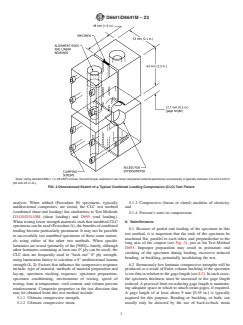
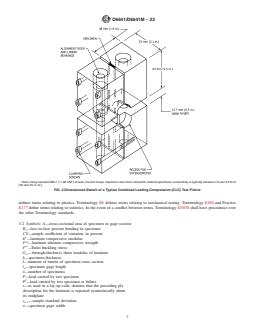
4.1 A test fixture such as that shown in Figs. 1 and 2, or any
terms relating to mechanical testing. Terminology E456 and
comparable fixture, can be used to test the untabbed (Procedure
Practice E177 define terms relating to statistics. In the event of
A) or tabbed (Procedure B) straight-sided composite specimen
a conflict between terms, Terminology D3878 shall have
of rectangular cross section shown schematically in Fig. 3. A
precedence over the other Terminology standards.
typical specimen is 140 mm [5.5 in.] long and 13 mm [0.5 in.]
wide, having an unsupported (gage) length of 13 mm [0.5 in.]
3.2 Symbols: A—cross-sectional area of specimen in gage
when installed in the fixture. A gage length greater or less than
section
13 mm is acceptable, subject to specimen buckling consider-
B —face-to-face percent bending in specimen
y
ations (see 8.2). The 13-mm [0.5 in.] gage length provides
CV—sample coefficient of variation, in percent
c
sufficient space to install bonded strain gages when they are
E —laminate compressive modulus
cu
required. The fixture, which subjects the specimen to combined
F —laminate ultimate compressive strength
cr
end- and shear-loading, is itself loaded in compression between
F —Euler buckling stress
flat platens in a universal testing machine. Load-strain data are
G —through-thickness shear modulus of laminate
xz
collected until failure occurs (or until a specified strain level is
h—specimen thickness
achieved if only compressive modulus or Poisson’s ratio, or
I—moment of inertia of specimen cross section
both, are to be determined, and not the complete stress-strain
l —specimen gage length
g
curve to failure).
n—number of specimens
P—load carried by test specimen
5. Significance and Use
5.1 This test method is designed to produce compressive
A detailed drawing for the fabrication of the test fixture shown in Figs. 1 and
property data for material specifications, research and
2 is available from ASTM Headquarters, www.astm.org. Order Adjunct No.
ADJD6641-E-PDF. development, quality assurance, and structural design and
D6641/D6641M − 23
Note: Using standard M6×1 ( ⁄4-28 UNF) screws, the bolt torque required to test most composite material specimens successfully is typically between 2.5 and 3.0 N-m
[20 and 25 in.-lb.].
FIG. 2 Dimensioned Sketch of a Typical Combined Loading Compression (CLC) Test Fixture
analysis. When tabbed (Procedure B) specimens, typically 5.1.3 Compressive (linear or chord) modulus of elasticity,
unidirectional composites, are tested, the CLC test method and
(combined shear end loading) has similarities to Test Methods
5.1.4 Poisson’s ratio in compression.
D3410/D3410M (shear loading) and D695 (end loading).
When testing lower strength materials such that untabbed CLC
6. Interferences
specimens can be used (Procedure A), the benefits of combined
6.1 Because of partial end loading of the specimen in this
loading become particularly prominent. It may not be possible
test method, it is important that the ends of the specimen be
to successfully test untabbed specimens of these same materi-
machined flat, parallel to each other, and perpendicular to the
als using either of the other two methods. When specific
long axis of the coupon (see Fig. 3), just as for Test Method
laminates are tested (primarily of the [90/0] family, although
ns
D695. Improper preparation may result in premature end
other laminates containing at least one 0° ply can be used), the
crushing of the specimen during loading, excessive induced
CLC data are frequently used to “back out” 0° ply strength,
bending, or buckling, potentially invalidating the test.
using lamination theory to calculate a 0° unidirectional lamina
strength (1, 2). Factors that influence the compressive response 6.2 Erroneously low laminate compressive strengths will be
include: type of material, methods of material preparation and produced as a result of Euler column buckling if the specimen
lay-up, specimen stacking sequence, specimen preparation, is too thin in relation to the gage length (see 8.2). In such cases,
specimen conditioning, environment of testing, speed of the specimen thickness must be increased or the gage length
testing, time at temperature, void content, and volume percent reduced. A practical limit on reducing gage length is maintain-
reinforcement. Composite properties in the test direction that ing adequate space in which to attach strain gages, if required.
may be obtained from this test method include: A gage length of at least about 9 mm [0.35 in.] is typically
5.1.1 Ultimate compressive strength, required for this purpose. Bending or buckling, or both, can
5.1.2 Ultimate compressive strain, usually only be detected by the use of back-to-back strain
D6641/D6641M − 23
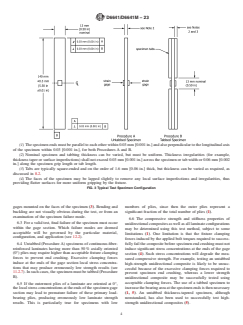
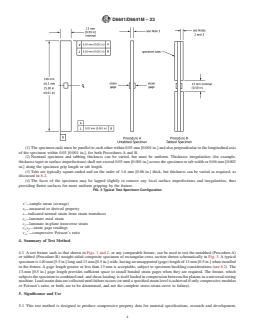
(1) The specimen ends must be parallel to each other within 0.03 mm [0.001 in.] and also perpendicular to the longitudinal axis
of the specimen within 0.03 [0.001 in.], for both Procedures A and B.
(2) Nominal specimen and tabbing thickness can be varied, but must be uniform. Thickness irregularities (for example,
thickness taper or surface imperfections) shall not exceed 0.03 mm [0.001 in.] across the specimen or tab width or 0.06 mm [0.002
in.] along the specimen grip length or tab length.
(3) Tabs are typically square-ended and on the order of 1.6 mm [0.06 in.] thick, but thickness can be varied as required, as
discussed in 8.2.
(4) The faces of the specimen may be lapped slightly to remove any local surface imperfections and irregularities, thus
providing flatter surfaces for more uniform gripping by the fixture.
FIG. 3 Typical Test Specimen Configuration
gages mounted on the faces of the specimen (3). Bending and numbers of plies, since then the outer plies represent a
buckling are not visually obvious during the test, or from an significant fraction of the total number of plies (1).
examination of the specimen failure mode.
6.6 The compressive strength and stiffness properties of
6.3 For a valid test, final failure of the specimen must occur
unidirectional composites as well as all laminate configurations
within the gage section. Which failure modes are deemed
may be determined using this test method, subject to some
acceptable will be governed by the particular material,
limitations (1). One limitation is that the fixture clamping
configuration, and application (see 12.2).
forces induced by the applied bolt torques required to success-
6.4 Untabbed (Procedure A) specimens of continuous-fiber-
fully fail the composite before specimen end crushing must not
reinforced laminates having more than 50 % axially oriented
induce significant stress concentrations at the ends of the gage
(0°) plies may require higher than acceptable fixture clamping
section (4). Such stress concentrations will degrade the mea-
forces to prevent end crushing. Excessive clamping forces
sured compressive strength. For example, testing an untabbed
induce at the ends of the gage section local stress concentra-
high-strength unidirectional composite is likely to be unsuc-
tions that may produce erroneously low strength results (see
cessful because of the excessive clamping forces required to
11.2.7). In such cases, the specimen must be tabbed (Procedure
prevent specimen end crushing, whereas a lower strength
B).
unidirectional composite may be successfully tested using
acceptable clamping forces. The use of a tabbed specimen to
6.5 If the outermost plies of a laminate are oriented at 0°,
increase the bearing area at the specimen ends is then necessary
the local stress concentrations at the ends of the specimen gage
section may lead to premature failure of these primary load- (1, 5). An untabbed thickness-tapered specimen, although
nonstandard, has also been used to successfully test high-
bearing plies, producing erroneously low laminate strength
results. This is particularly true for specimens with low strength unidirectional composites (5).
D6641/D6641M − 23
6.7 In multidirectional laminates, edge effects can affect the fixture shown introduces a controllable ratio of end loading to
measured strength and modulus of the laminate. shear loading into the specimen, by controlling the torque
applied to the clamping screws.
6.8 Strain anomalies may occur as the specimen approaches
ultimate force. These anomalies are likely to cause the apparent
7.7 Strain-Indicating Device—Longitudinal strain shall be
bending measurement of the specimen to deviate from the simultaneously measured on opposite faces of the specimen to
actual bending the specimen is experiencing. Examples of
allow for a correction as a result of any bending of the
strain anomalies are, but not limited to, strain gauge disbond, specimen, and to enable detection of Euler (column) buckling.
strain gauge lead separation and surface ply separation.
Back-to-back strain measurement shall be made for all five
specimens when the minimum number of specimens allowed
7. Apparatus and Supplies by this test method are tested. If more than five specimens are
to be tested, then a single strain-indicating device may be used
7.1 Micrometers and Calipers—A micrometer with a 4 mm
for the number of specimens greater than the five, provided the
to 8 mm [0.16 in. to 0.32 in.] nominal diameter ball-interface
total number of specimens are tested in a single test fixture and
or a flat anvil interface shall be used to measure the specimen
load frame throughout the tests, that no modifications to the
thickness. A ball interface is recommended for thickness
specimens or test procedure are made throughout the duration
measurements when at least one surface is irregular (for
of the tests, and provided the bending requirement (see 12.4
example, a course peel ply surface which is neither smooth nor
and 12.5) is met for the first five specimens. If these conditions
flat). A micrometer or caliper with a flat anvil interface shall be
are not met, then all specimens must be instrumented with
used for measuring length, width, and other machined surface
back-to-back devices. When Poisson’s ratio is to be
dimensions. The use of alternative measurement devices is
determined, the specimen shall be instrumented to measure
permitted if specified (or agreed to) by the test requestor and
strain in the lateral direction using the same type of transducer.
reported by the testing laboratory. The accuracy of the instru-
The same type of strain transducer shall be used for all strain
ment(s) shall be suitable for reading to within 1 % of the
measurements on any single coupon. Strain gages are recom-
specimen dimensions. For typical specimen geometries, an
mended because of the short gage length of the specimen.
instrument with an accuracy of 60.005 mm [60.0002 in.] is
Attachment of the strain-indicating device to the coupon shall
adequate for thickness and width measurements, while an
not cause damage to the specimen surface.
instrument with an accuracy of 60.025 mm [60.001 in.] is
adequate for measurement of length and other machined
7.8 Data Acquisition Equipment—Equipment capable of
surface dimensions.
recording force and strain data is required.
7.2 Torque Wrench—Calibrated within the torque range
8. Sampling and Test Specimens
required.
8.1 Sampling—Test at least five specimens per test condi-
7.3 Testing Machine—A calibrated testing machine shall be
tion unless valid results can be gained through the use of fewer
used which can be operated at constant crosshead speed over
specimens, such as in the case of a designed experiment. For
the specified range. The test machine mechanism shall be
statistically significant data, the procedures outlined in Practice
essentially free from inertial lag at the crosshead speeds
E122 should be consulted. The method of sampling shall be
specified. The machine shall be equipped with an appropriate
reported.
force-measuring device (for example, a load cell). The accu-
racy of the test machine shall be in accordance with Practices
8.2 Geometry—The test specimen is an untabbed (Proce-
E4.
dure A) or tabbed (Procedure B) rectangular strip of the
composite to be tested, as shown in Fig. 3. A guide to
7.4 Conditioning Chamber—When conditioning materials
preparation of flat composite panels, with processing guide-
at non-laboratory environments, a temperature-/vapor-level
lines for specimen preparation, is presented in Guide D5687/
controlled environmental conditioning chamber is required that
D5687M. Specimen dimensions and tolerances must be in
shall be capable of maintaining the required relative tempera-
compliance with the requirements of Fig. 3. As noted also in
ture to within 63 °C [65 °F] and the required relative humid-
6.6, for materials with a sufficiently high compressive strength
ity level to within 63 %. Chamber conditions shall be moni-
in the direction of loading, end crushing or an untabbed
tored either on an automated continuous basis or on a manual
specimen cannot be prevented by increasing fixture clamping
basis at regular intervals.
force alone. It then becomes necessary to use tabs, to increase
7.5 Environmental Chamber—An environmental test cham-
the load-bearing area at the specimen ends. While tapered tabs
ber is required for test environments other than ambient testing
would be potentially beneficial in reducing stress concentra-
laboratory conditions. This chamber shall be capable of main-
tions in the specimen at the tab ends, they increase the effective
taining the test specimen and fixture at the required test
unsupported length (gage length) of the specimen, increasing
environment during the mechanical test. The test temperature
the possibility of inducing specimen buckling. Thus, untapered
shall be maintained within 63 °C [65 °F] of the required
(square-ended) tabs are recommended. For many polymer-
temperature. The relative humidity level controlled within the
matrix composites, glass fabric/epoxy tabs have been found to
test chamber shall be defined by the test requestor.
perform well (1, 4). This material has a favorable combination
7.6 Compression Fixture—A test fixture such as that shown of compliance, shear strength and toughness. Note that tabs
in Figs. 1 and 2, or a comparable fixture, shall be used. The having a low stiffness, yet sufficiently strong to transmit the
D6641/D6641M − 23
induced forces, are desired. Thus, tabs of the same material as where:
the specimen are normally not desired, contrary to common
F = predicted Euler buckling stress, MPa [psi],
cr
2 2
beliefs (6). For specimen thicknesses on the order of 2.5 mm
A = specimen cross-sectional area, mm [in. ], and
[0.10 in.] thick or less, tabs on the order of 1.6 mm [0.06 in.] I = minimum moment of inertia of specimen cross section,
4 4
thick have been found to be adequate (1, 4). For thicker
mm [in. ].
specimens, thicker tabs may be required, a tab thickness limit
8.2.2.2 Eq 2 can be used to estimate the applied stress, F ,
cr
being reached when the tab adhesive is no longer able to
on the test specimen at which Euler buckling is predicted to
transfer the induced shear forces. In this case, the practical
occur for the specific specimen configuration of interest.
solution it to reduce the specimen thickness. If axial strain is to
Practical experience has shown that Eq 1 and Eq 2 are reliable
be measured (for example, to monitor specimen bending, to
for conventional fiber/polymer matrix composites, and that as
determine the axial compressive modulus, or to obtain a
a general guide, keeping the predicted value F of buckling
cr
stress-strain curve), two single-element axial strain gages or
stress at least 30 % above the expected compressive strength is
similar transducers are typically mounted back-to-back on the
usually sufficient (1, 4). Other composites may require differ-
faces of the specimen, in the center of the gage section, as
ent percentages.
shown in Fig. 3 (see also Section 12). If in-plane transverse
8.2.2.3 The through-the-thickness (interlaminar) shear
strain is also to be measured (for example, to calculate the
modulus, G , as required in Eq 1 and 2, can be measured, for
xz
in-plane compressive Poisson’s ratio), an additional single-
example, by using Test Method D5379/D5379M. If G is not
xz
element strain gage oriented in the transverse direction on one
available in the form of experimental data, assuming value of
face of the specimen may be used. Alternatively, one or more
G of approximately 4 GPa [0.60 Msi] is a reasonable estimate
xz
strain gage rosettes may be used.
for most polymer matrix composite materials tested at room
8.2.1 Specimen Width—The nominal specimen width shall
temperature (4). In any case, this is offered only as an estimate,
be 13 mm [0.50 in.]. However, other widths may be used. For
to serve as a starting point when designing a test specimen of
example, the fixture shown in Figs. 1 and 2 can accommodate
a material with an unknown G . Also, this assumed value may
xz
specimens up to a maximum width of 30 mm [1.2 in.]. In order
not be reasonable for configurations such as stitched laminates
to maintain a representative volume of material within the gage
or 3D woven composites, in which case it will be necessary to
section, specimens narrower than 13 mm [0.50 in.] are not
measure G directly. The absence of specimen buckling must
xz
typically used. It is sometimes desirable to use specimens
eventually be verified experimentally. The specimen can be
wider than nominal, for example, if the material architecture is
thinner if only modulus is being determined, as the required
coarse (as for a coarse-weave fabric), again to maintain a
applied force may then be significantly lower than the buckling
representative gage section volume of material being tested.
force. There is no specific upper limit on specimen thickness.
8.2.2 Specimen Thickness—Although no specific specimen
For Procedure A (untabbed specimens), one practical limitation
thickness is required, some limitations exist. The thickness
is the increasing difficulty of applying a uniform pressure over
must be sufficient to preclude Euler column buckling of the
the ends of a specimen of progressively larger cross-sectional
specimen. Eq 1 may be used to estimate the minimum
area. Another is the need to apply increasing clamping forces to
thickness to be used for strength determinations (see also Test
prevent end crushing as the specimen becomes thicker (by
Method D3410/D3410M). As indicated in Eq 1, the minimum
maintaining the desired ratio of end loading to shear loading).
specimen thickness required depends on a number of factors in
As discussed in 6.4, the induced stress concentrations in the
addition to gage length (1, 4).
specimen by the test fixture increase as the clamping force
l increases. Note that increasing the width of the specimen does
g
h $ (1)
cu f not alleviate this condition. For Procedure B (tabbed
1.2F E
0.9069Π1 2
S D S D specimens), the tab thickness must be increased as specimen
cu
G F
xz
thickness increases, to prevent end crushing. THe limit on
where:
specimen thickness is when the tab adhesive can no longer
h = specimen thickness, mm [in.], transmit the forces on the tab ends into the specimen via shear
l = length of gage section, mm [in.],
through the adhesive.
g
cu
F = expected ultimate compressive strength, MPa [psi],
8.3 Labeling—Label the specimens so that they will be
f
E = expected flexural modulus, MPa [psi], and
distinct from each other and traceable back to the raw material,
G = through-the-thickness (interlaminar) shear modulus,
xz
and will neither influence the test nor be affected by it.
MPa [psi].
NOTE 2—Eq 1 is derived from the following expression for the Euler
9. Calibration
buckling stress for a pin-ended column of length l (an assumption which
g
is strictly not valid for the specimen gage length l ), modified for shear
g
9.1 The accuracy of all measuring equipment shall have
f
deformation effects. The E in Eq 1 and Eq 2 is the flexural modulus of the
certified calibrations that are current at the time of use of the
specimen. For the intended purpose, the approximation of using the
c f
equipment.
compressive modulus E in place of the flexural modulus E may be valid.
8.2.2.1 Eq 1 may be rewritten in the form of Eq 2 (7).
2 f
π E
Supporting data have been filed at ASTM International Headquarters and may
F 5 (2)
2 f
cr
l A E
g be obtained by requesting Research Report RR:D30-1007. Contact ASTM Customer
11.2π
I G Service at service@astm.org.
xz
D6641/D6641M − 23
10. Conditioning specimen into the inverted upper half of the fixture. Make sure
the end of the specimen is flush with the end of the upper half
10.1 Standard Conditioning Procedure—The recommended
of the fixture and in contact with the flat surface plate. If the
pre-test condition is effective moisture equilibrium at a specific
upper half will not slide freely into the lower half, slightly
relative humidity as established by Test Method D5229/
loosen the two screws in the lower half that are closest to the
D5229M; however, if the test requestor does not explicitly
gage section, while restraining the upper half so that it does not
specify a pre-test conditioning environment, no conditioning is
slide down too far and damage the strain gages or other
required and the test specimens may be tested as prepared.
transducers, if present.
NOTE 3—The term moisture, as used in Test Method D5229/D5229M,
11.2.6 Slightly tighten the four screws in the upper half of
includes not only the vapor of a liquid and its condensate, but the liquid
the fixture (finger tight).
itself in large quantities, as for immersion.
11.2.7 Place the assembled fixture on its side with the
10.2 If no explicit conditioning process is performed, the
screws on top. Torque all eight of the 6-mm [0.25-in.] diameter
specimen conditioning process shall be reported as “uncondi-
screws to 2.5 N-m to 3.0 N-m [20 in.-lb to 25 in.-lb], in three
tioned” and the moisture content as “unknown.”
or four approximately equal increments, using a diagonal
tightening pattern at each end so the fixture surfaces are
11. Procedure
uniformly clamped against the surfaces of the test specimen.
11.1 Before Test:
NOTE 5—The required torque may vary depending on the type of
11.1.1 Following final specimen machining and before con-
material and the thickness of the specimen being tested. A torque of
ditioning and testing, measure the specimen width and thick-
2.5 N-m to 3.0 N-m [20 in.-lb to 25 in.-lb] has been found to be sufficient
for most materials of typical specimen thicknesses, for example, 2.0 mm
ness to a precision of 0.0025 mm [0.0001 in.], recording the
to 3.0 mm [0.080 in. to 0.120 in.] thick (1, 4). If the torque is too low for
average of three measurements. The width and thickness
a given configuration, the ends of the specimen may crush. If the torque
measurements shall be made in the gage section of the
is excessive, the high clamping force will induce detrimental stress
specimen, taking care not to measure directly over the strain
concentrations in the specimen at the ends of the gage section and lead to
gage or gage adhesive. Measure the specimen length to a premature failures. Thus, a torque just sufficient to prevent end crushing
should be used. This may require several trials when testing an unfamiliar
precision of 0.025 mm [0.001 in.].
material. However, it has been shown that the acceptable range of torque
11.1.2 Condition and store specimens in accordance with
is very broad (4).
applicable specifications or test instructions.
11.2.8 Place the assembled fixture between well-aligned,
11.1.3
...
This document is not an ASTM standard and is intended only to provide the user of an ASTM standard an indication of what changes have been made to the previous version. Because
it may not be technically possible to adequately depict all changes accurately, ASTM recommends that users consult prior editions as appropriate. In all cases only the current version
of the standard as published by ASTM is to be considered the official document.
´2
Designation: D6641/D6641M − 16 D6641/D6641M − 23
Standard Test Method for
Compressive Properties of Polymer Matrix Composite
Materials Using a Combined Loading Compression (CLC)
Test Fixture
This standard is issued under the fixed designation D6641/D6641M; the number immediately following the designation indicates the
year of original adoption or, in the case of revision, the year of last revision. A number in parentheses indicates the year of last
reapproval. A superscript epsilon (´) indicates an editorial change since the last revision or reapproval.
ε NOTE—A label in Figure 3 was corrected editorially in March 2017.
ε NOTE—Editorial corrections were made to the adjunct information in March 2021.
1. Scope
1.1 This test method determines the compressive strength and stiffness properties of polymer matrix composite materials using a
combined loading compression (CLC) (1) test fixture. This test method is applicable to general composites that are balanced and
symmetric. The specimen may be untabbed (Procedure A) or tabbed (Procedure B), as required. One requirement for a successful
test is that the specimen ends do not crush during the test. Untabbed specimens are usually suitable for use with materials of low
orthotropy, for example, fabrics, chopped fiber composites, and laminates with a maximum of 50 % 0° plies, or equivalent (see
6.4). Materials of higher orthotropy, including unidirectional composites, typically require tabs.
1.2 The compressive force is introduced into the specimen by combined end- and shear-loading. In comparison, Test Method
D3410/D3410M is a pure shear-loading compression test method and Test Method D695 is a pure end-loading test method.
1.3 Unidirectional (0° ply orientation) composites as well as multi-directional composite laminates, fabric composites, chopped
fiber composites, and similar materials can be tested.
1.4 The values stated in either SI units or inch-pound units are to be regarded separately as standard. Within the test the inch-pound
units are shown in brackets. The values stated in each system are not exact equivalents; therefore, each system must be used
independently of the other. Combining values from the two systems may result in nonconformance with the standard.
NOTE 1—Additional procedures for determining the compressive properties of polymer matrix composites may be found in Test Methods
D3410/D3410M, D5467/D5467M, and D695.
1.5 This standard does not purport to address all of the safety concerns, if any, associated with its use. It is the responsibility
of the user of this standard to establish appropriate safety, health, and environmental practices and determine the applicability of
regulatory limitations prior to use.
1.6 This international standard was developed in accordance with internationally recognized principles on standardization
established in the Decision on Principles for the Development of International Standards, Guides and Recommendations issued
by the World Trade Organization Technical Barriers to Trade (TBT) Committee.
This test method is under the jurisdiction of ASTM Committee D30 on Composite Materials and is the direct responsibility of Subcommittee D30.04 on Lamina and
Laminate Test Methods.
Current edition approved Nov. 1, 2016Nov. 15, 2023. Published November 2016December 2023. Originally approved in 2001. Last previous edition approved in 20142016
ɛ2
as D6641/D6641MD6641/D6641M – 16 -14. DOI: 10.1520/D6641_D6641M-16E02. DOI: 10.1520/D6641_D6641M-23.
Boldface numbers in parentheses refer to the list of references at the end of this test method.
Copyright © ASTM International, 100 Barr Harbor Drive, PO Box C700, West Conshohocken, PA 19428-2959. United States
D6641/D6641M − 23
FIG. 1 Photograph of a Typical Combined Loading Compression (CLC) Test Fixture
2. Referenced Documents
2.1 ASTM Standards:
D695 Test Method for Compressive Properties of Rigid Plastics
D883 Terminology Relating to Plastics
D3410/D3410M Test Method for Compressive Properties of Polymer Matrix Composite Materials with Unsupported Gage
Section by Shear Loading
D3878 Terminology for Composite Materials
D5229/D5229M Test Method for Moisture Absorption Properties and Equilibrium Conditioning of Polymer Matrix Composite
Materials
D5379/D5379M Test Method for Shear Properties of Composite Materials by the V-Notched Beam Method
D5467/D5467M Test Method for Compressive Properties of Unidirectional Polymer Matrix Composite Materials Using a
Sandwich Beam
D5687/D5687M Guide for Preparation of Flat Composite Panels with Processing Guidelines for Specimen Preparation
E4 Practices for Force Calibration and Verification of Testing Machines
E6 Terminology Relating to Methods of Mechanical Testing
E122 Practice for Calculating Sample Size to Estimate, With Specified Precision, the Average for a Characteristic of a Lot or
Process
E132 Test Method for Poisson’s Ratio at Room Temperature
E177 Practice for Use of the Terms Precision and Bias in ASTM Test Methods
E456 Terminology Relating to Quality and Statistics
E691 Practice for Conducting an Interlaboratory Study to Determine the Precision of a Test Method
E1309 Guide for Identification of Fiber-Reinforced Polymer-Matrix Composite Materials in Databases (Withdrawn 2015)
E1434 Guide for Recording Mechanical Test Data of Fiber-Reinforced Composite Materials in Databases (Withdrawn 2015)
E1471 Guide for Identification of Fibers, Fillers, and Core Materials in Computerized Material Property Databases (Withdrawn
2015)
2.2 ASTM Adjunct:
Combined Loading Compression (CLC) Test Fixture, D 6641 ⁄D6641M
3. Terminology
3.1 Definitions—Terminology D3878 defines terms relating to high-modulus fibers and their composites. Terminology D883
For referenced ASTM standards, visit the ASTM website, www.astm.org, or contact ASTM Customer Service at service@astm.org. For Annual Book of ASTM Standards
volume information, refer to the standard’s Document Summary page on the ASTM website.
A detailed drawing for the fabrication of the test fixture shown in Figs. 1 and 2 is available from ASTM Headquarters, www.astm.org. Order Adjunct No.
ADJD6641-E-PDF.
D6641/D6641M − 23
Note: Using standard M6×1 ( ⁄4-28 UNF) screws, the bolt torque required to test most composite material specimens successfully is typically between 2.5 and 3.0 N-m
[20 and 25 in.-lb.].
FIG. 2 Dimensioned Sketch of a Typical Combined Loading Compression (CLC) Test Fixture
defines terms relating to plastics. Terminology E6 defines terms relating to mechanical testing. Terminology E456 and Practice
E177 define terms relating to statistics. In the event of a conflict between terms, Terminology D3878 shall have precedence over
the other Terminology standards.
3.2 Symbols: A—cross-sectional area of specimen in gage section
B —face-to-face percent bending in specimen
y
CV—sample coefficient of variation, in percent
c
E —laminate compressive modulus
cu
F —laminate ultimate compressive strength
cr
F —Euler buckling stress
G —through-thickness shear modulus of laminate
xz
h—specimen thickness
I—moment of inertia of specimen cross section
l —specimen gage length
g
n—number of specimens
P—load carried by test specimen
f
P —load carried by test specimen at failure
s—as used in a lay-up code, denotes that the preceding ply
description for the laminate is repeated symmetrically about
its midplane
s —sample standard deviation
n-1
w—specimen gage width
D6641/D6641M − 23
(1) The specimen ends must be parallel to each other within 0.03 mm [0.001 in.] and also perpendicular to the longitudinal axis
of the specimen within 0.03 [0.001 in.], for both Procedures A and B.
(2) Nominal specimen and tabbing thickness can be varied, but must be uniform. Thickness irregularities (for example,
thickness taper or surface imperfections) shall not exceed 0.03 mm [0.001 in.] across the specimen or tab width or 0.06 mm [0.002
in.] along the specimen grip length or tab length.
(3) Tabs are typically square-ended and on the order of 1.6 mm [0.06 in.] thick, but thickness can be varied as required, as
discussed in 8.2.
(4) The faces of the specimen may be lapped slightly to remove any local surface imperfections and irregularities, thus
providing flatter surfaces for more uniform gripping by the fixture.
FIG. 3 Typical Test Specimen Configuration
x¯—sample mean (average)
x —measured or derived property
i
ε—indicated normal strain from strain transducer
ε —laminate axial strain
x
ε —laminate in-plane transverse strain
y
ε ε —strain gage readings
1, 2
c
v —compressive Poisson’s ratio
xy
4. Summary of Test Method
4.1 A test fixture such as that shown in Figs. 1 and 2, or any comparable fixture, can be used to test the untabbed (Procedure A)
or tabbed (Procedure B) straight-sided composite specimen of rectangular cross section shown schematically in Fig. 3. A typical
specimen is 140 mm [5.5 in.] long and 13 mm [0.5 in.] wide, having an unsupported (gage) length of 13 mm [0.5 in.] when installed
in the fixture. A gage length greater or less than 13 mm is acceptable, subject to specimen buckling considerations (see 8.2). The
13-mm [0.5 in.] gage length provides sufficient space to install bonded strain gages when they are required. The fixture, which
subjects the specimen to combined end- and shear-loading, is itself loaded in compression between flat platens in a universal testing
machine. Load-strain data are collected until failure occurs (or until a specified strain level is achieved if only compressive modulus
or Poisson’s ratio, or both, are to be determined, and not the complete stress-strain curve to failure).
5. Significance and Use
5.1 This test method is designed to produce compressive property data for material specifications, research and development,
D6641/D6641M − 23
quality assurance, and structural design and analysis. When tabbed (Procedure B) specimens, typically unidirectional composites,
are tested, the CLC test method (combined shear end loading) has similarities to Test Methods D3410/D3410M (shear loading)
and D695 (end loading). When testing lower strength materials such that untabbed CLC specimens can be used (Procedure A), the
benefits of combined loading become particularly prominent. It may not be possible to successfully test untabbed specimens of
these same materials using either of the other two methods. When specific laminates are tested (primarily of the [90/0] family,
ns
although other laminates containing at least one 0° ply can be used), the CLC data are frequently used to “back out” 0° ply strength,
using lamination theory to calculate a 0° unidirectional lamina strength (1, 2). Factors that influence the compressive response
include: type of material, methods of material preparation and lay-up, specimen stacking sequence, specimen preparation,
specimen conditioning, environment of testing, speed of testing, time at temperature, void content, and volume percent
reinforcement. Composite properties in the test direction that may be obtained from this test method include:
5.1.1 Ultimate compressive strength,
5.1.2 Ultimate compressive strain,
5.1.3 Compressive (linear or chord) modulus of elasticity, and
5.1.4 Poisson’s ratio in compression.
6. Interferences
6.1 Because of partial end loading of the specimen in this test method, it is important that the ends of the specimen be machined
flat, parallel to each other, and perpendicular to the long axis of the coupon (see Fig. 3), just as for Test Method D695. Improper
preparation may result in premature end crushing of the specimen during loading, excessive induced bending, or buckling,
potentially invalidating the test.
6.2 Erroneously low laminate compressive strengths will be produced as a result of Euler column buckling if the specimen is too
thin in relation to the gage length (see 8.2). In such cases, the specimen thickness must be increased or the gage length reduced.
A practical limit on reducing gage length is maintaining adequate space in which to attach strain gages, if required. A gage length
of at least about 9 mm [0.35 in.] is typically required for this purpose. Bending or buckling, or both, can usually only be detected
by the use of back-to-back strain gages mounted on the faces of the specimen (3). Bending and buckling are not visually obvious
during the test, or from an examination of the specimen failure mode.
6.3 For a valid test, final failure of the specimen must occur within the gage section. Which failure modes are deemed acceptable
will be governed by the particular material, configuration, and application (see 12.112.2).
6.4 Untabbed (Procedure A) specimens of continuous-fiber-reinforced laminates having more than 50 % axially oriented (0°) plies
may require higher than acceptable fixture clamping forces to prevent end crushing. Excessive clamping forces induce at the ends
of the gage section local stress concentrations that may produce erroneously low strength results (see 11.2.7). In such cases, the
specimen must be tabbed (Procedure B).
6.5 If the outermost plies of a laminate are oriented at 0°, the local stress concentrations at the ends of the specimen gage section
may lead to premature failure of these primary load-bearing plies, producing erroneously low laminate strength results. This is
particularly true for specimens with low numbers of plies, since then the outer plies represent a significant fraction of the total
number of plies (1).
6.6 The compressive strength and stiffness properties of unidirectional composites as well as all laminate configurations may be
determined using this test method, subject to some limitations (1). One limitation is that the fixture clamping forces induced by
the applied bolt torques required to successfully fail the composite before specimen end crushing must not induce significant stress
concentrations at the ends of the gage section (4). Such stress concentrations will degrade the measured compressive strength. For
example, testing an untabbed high-strength unidirectional composite is likely to be unsuccessful because of the excessive clamping
forces required to prevent specimen end crushing, whereas a lower strength unidirectional composite may be successfully tested
using acceptable clamping forces. The use of a tabbed specimen to increase the bearing area at the specimen ends is then
necesarynecessary (1, 5). An untabbed thickness-tapered specimen, although nonstandard, has also been used to successfully test
high-strength unidirectional composites (5).
D6641/D6641M − 23
6.7 In multidirectional laminates, edge effects can affect the measured strength and modulus of the laminate.
6.8 Strain anomalies may occur as the specimen approaches ultimate force. These anomalies are likely to cause the apparent
bending measurement of the specimen to deviate from the actual bending the specimen is experiencing. Examples of strain
anomalies are, but not limited to, strain gauge disbond, strain gauge lead separation and surface ply separation.
7. Apparatus and Supplies
7.1 Micrometers and Calipers—A micrometer having a suitable-size diameter ball-interface on irregular surfaces such as the
bag-side of a laminate, and with a 4 mm to 8 mm [0.16 in. to 0.32 in.] nominal diameter ball-interface or a flat anvil interface shall
be used to measure the specimen thickness. A ball interface is recommended for thickness measurements when at least one surface
is irregular (for example, a course peel ply surface which is neither smooth nor flat). A micrometer or caliper with a flat anvil
interface on machined edges or very smooth tooled surfaces, shall be used. A caliper of suitable size can also be used on machined
edges or very smooth tooled surfaces. shall be used for measuring length, width, and other machined surface dimensions. The use
of alternative measurement devices is permitted if specified (or agreed to) by the test requestor and reported by the testing
laboratory. The accuracy of these instrumentsthe instrument(s) shall be suitable for reading to within 1 % of the sample length,
width and thickness. specimen dimensions. For typical specimen geometries, an instrument with an accuracy of 62.5 μm [60.0001
in.] is desirable60.005 mm [60.0002 in.] is adequate for thickness and width measurement,measurements, while an instrument
with an accuracy of 625 μm [60.001 in.] is desirable for length measurements. 60.025 mm [60.001 in.] is adequate for
measurement of length and other machined surface dimensions.
7.2 Torque Wrench—Calibrated within the torque range required.
7.3 Testing Machine—A calibrated testing machine shall be used which can be operated at constant crosshead speed over the
specified range. The test machine mechanism shall be essentially free from inertial lag at the crosshead speeds specified. The
machine shall be equipped with an appropriate force-measuring device (for example, a load cell). The accuracy of the test machine
shall be in accordance with Practices E4.
7.4 Conditioning Chamber—When conditioning materials in other than ambient laboratory environments, a temperature-/
moisture-levelat non-laboratory environments, a temperature-/vapor-level controlled environmental conditioning chamber is
required that shall be capable of maintaining the required relative temperature to within 63°C [65°F]63 °C [65 °F] and the
required relative vaporhumidity level to within 65 %. 63 %. Chamber conditions shall be monitored either on an automated
continuous basis or on a manual basis at regular intervals.
7.5 Environmental Chamber—A chamber capable of enclosing the test fixture and specimen while they are mounted in the testing
machine, and capable of achieving the specified heating/cooling rates, test temperatures, and environments, shall be used when
nonambient conditions are required during testing. An environmental test chamber is required for test environments other than
ambient testing laboratory conditions. This chamber shall be capable of maintaining the gage section of the test specimen within
63°C [65°F] of test specimen and fixture at the required test temperatureenvironment during the mechanical test. In addition, the
chamber may have to be capable of maintaining environmental conditions such as fluid exposure or relative humidity during the
test.The test temperature shall be maintained within 63 °C [65 °F] of the required temperature. The relative humidity level
controlled within the test chamber shall be defined by the test requestor.
7.6 Compression Fixture—A test fixture such as that shown in Figs. 1 and 2, or a comparable fixture, shall be used. The fixture
shown introduces a controllable ratio of end loading to shear loading into the specimen, by controlling the torque applied to the
clamping screws.
7.7 Strain-Indicating Device—Longitudinal strain shall be simultaneously measured on opposite faces of the specimen to allow
for a correction as a result of any bending of the specimen, and to enable detection of Euler (column) buckling. Back-to-back strain
measurement shall be made for all five specimens when the minimum number of specimens allowed by this test method are tested.
If more than five specimens are to be tested, then a single strain-indicating device may be used for the number of specimens greater
than the five, provided the total number of specimens are tested in a single test fixture and load frame throughout the tests, that
no modifications to the specimens or test procedure are made throughout the duration of the tests, and provided the bending
requirement (see 12.312.4 and 12.412.5) is met for the first five specimens. If these conditions are not met, then all specimens must
be instrumented with back-to-back devices. When Poisson’s ratio is to be determined, the specimen shall be instrumented to
D6641/D6641M − 23
measure strain in the lateral direction using the same type of transducer. The same type of strain transducer shall be used for all
strain measurements on any single coupon. Strain gages are recommended because of the short gage length of the specimen.
Attachment of the strain-indicating device to the coupon shall not cause damage to the specimen surface.
7.8 Data Acquisition Equipment—Equipment capable of recording force and strain data is required.
8. Sampling and Test Specimens
8.1 Sampling—Test at least five specimens per test condition unless valid results can be gained through the use of fewer specimens,
such as in the case of a designed experiment. For statistically significant data, the procedures outlined in Practice E122 should be
consulted. The method of sampling shall be reported.
8.2 Geometry—The test specimen is an untabbed (Procedure A) or tabbed (Procedure B) rectangular strip of the composite to be
tested, as shown in Fig. 3. A guide to preparation of flat composite panels, with processing guidelines for specimen preparation,
is presented in Guide D5687/D5687M. Specimen dimensions and tolerances must be in compliance with the requirements of Fig.
3. As noted also in 6.6, for materials with a sufficiently high compressive strength in the direction of loading, end crushing or an
untabbed specimen cannot be prevented by increasing fixture clamping force alone. It then becomes necessary to use tabs, to
increase the load-bearing area at the specimen ends. While tapered tabs would be potentially beneficial in reducing stress
concentrations in the specimen at the tab ends, they increase the effective unsupported length (gage length) of the specimen,
increasing the possibility of inducing specimen buckling. Thus, untapered (square-ended) tabs are recommended. For many
polymer-matrix composites, glass fabric/epoxy tabs have been found to perform well (1, 4). This material has a favorable
combination of compliance, shear strength and toughness. Note that tabs having a low stiffness, yet sufficiently strong to transmit
the induced forces, are desired. Thus, tabs of the same material as the specimen are normally not desired, contrary to common
beliefs (6). For specimen thicknesses on the order of 2.5 mm [0.10 in.] thick or less, tabs on the order of 1.6 mm [0.06 in.] thick
have been found to be adequate (1, 4). For thicker specimens, thicker tabs may be required, a tab thickness limit being reached
when the tab adhesive is no longer able to transfer the induced shear forces. In this case, the practical solution it to reduce the
specimen thickness. If axial strain is to be measured (for example, to monitor specimen bending, to determine the axial
compressive modulus, or to obtain a stress-strain curve), two single-element axial strain gages or similar transducers are typically
mounted back-to-back on the faces of the specimen, in the center of the gage section, as shown in Fig. 3 (see also Section 12).
If in-plane transverse strain is also to be measured (for example, to calculate the in-plane compressive Poisson’s ratio), an
additional single-element strain gage oriented in the transverse direction on one face of the specimen may be used. Alternatively,
one or more strain gage rosettes may be used.
8.2.1 Specimen Width—The nominal specimen width shall be 13 mm [0.50 in.]. However, other widths may be used. For example,
the fixture shown in Figs. 1 and 2 can accommodate specimens up to a maximum width of 30 mm [1.2 in.]. In order to maintain
a representative volume of material within the gage section, specimens narrower than 13 mm [0.50 in.] are not typically used. It
is sometimes desirable to use specimens wider than nominal, for example, if the material architecture is coarse (as for a
coarse-weave fabric), again to maintain a representative gage section volume of material being tested.
8.2.2 Specimen Thickness—Although no specific specimen thickness is required, some limitations exist. The thickness must be
sufficient to preclude Euler column buckling of the specimen. Eq 1 may be used to estimate the minimum thickness to be used
for strength determinations (see also Test Method D3410/D3410M). As indicated in Eq 1, the minimum specimen thickness
required depends on a number of factors in addition to gage length (1, 4).
l
g
h $ (1)
cu f
1.2F E
0.9069 12
ŒS D S D
cu
G F
xz
where:
h = specimen thickness, mm [in.],
l = length of gage section, mm [in.],
g
cu
F = expected ultimate compressive strength, MPa [psi],
f
E = expected flexural modulus, MPa [psi], and
G = through-the-thickness (interlaminar) shear modulus, MPa [psi].
xz
NOTE 2—Eq 1 is derived from the following expression for the Euler buckling stress for a pin-ended column of length l (an assumption which is strictly
g
f
not valid for the specimen gage length l ), modified for shear deformation effects. The E in Eq 1 and Eq 2 is the flexural modulus of the specimen. For
g
c f
the intended purpose, the approximation of using the compressive modulus E in place of the flexural modulus E may be valid.
D6641/D6641M − 23
8.2.2.1 Eq 1 may be rewritten in the form of Eq 2 (7).
2 f
π E
F 5 (2)
cr 2 f
l A E
g
11.2π
I G
xz
where:
F = predicted Euler buckling stress, MPa [psi],
cr
2 2
A = specimen cross-sectional area, mm [in. ], and
4 4
I = minimum moment of inertia of specimen cross section, mm [in. ].
8.2.2.2 Eq 2 can be used to estimate the applied stress, F , on the test specimen at which Euler buckling is predicted to occur for
cr
the specific specimen configuration of interest. Practical experience has shown that Eq 1 and Eq 2 are reliable for conventional
fiber/polymer matrix composites, and that as a general guide, keeping the predicted value F of buckling stress at least 30 % above
cr
the expected compressive strength is usually sufficient (1, 4). Other composites may require different percentages.
8.2.2.3 The through-the-thickness (interlaminar) shear modulus, G , as required in Eq 1 and 2, can be measured, for example, by
xz
using Test Method D5379/D5379M. If G is not available in the form of experimental data, assuming value of G of
xz xz
approximately 4 GPa [0.60 Msi] is a reasonable estimate for most polymer matrix composite materials tested at room temperature
(4). In any case, this is offered only as an estimate, to serve as a starting point when designing a test specimen of a material with
an unknown G . Also, this assumed value may not be reasonable for configurations such as stitched laminates or 3D woven
xz
composites, in which case it will be necessary to measure G directly. The absence of specimen buckling must eventually be
xz
verified experimentally. The specimen can be thinner if only modulus is being determined, as the required applied force may then
be significantly lower than the buckling force. There is no specific upper limit on specimen thickness. For Procedure A (untabbed
specimens), one practical limitation is the increasing difficulty of applying a uniform pressure over the ends of a specimen of
progressively larger cross-sectional area. Another is the need to apply increasing clamping forces to prevent end crushing as the
specimen becomes thicker (by maintaining the desired ratio of end loading to shear loading). As discussed in 6.4, the induced stress
concentrations in the specimen by the test fixture increase as the clamping force increases. Note that increasing the width of the
specimen does not alleviate this condition. For Procedure B (tabbed specimens), the tab thickness must be increased as specimen
thickness increases, to prevent end crushing. THe limit on specimen thickness is when the tab adhesive can no longer transmit the
forces on the tab ends into the specimen via shear through the adhesive.
8.3 Labeling—Label the specimens so that they will be distinct from each other and traceable back to the raw material, and will
neither influence the test nor be affected by it.
9. Calibration
9.1 The accuracy of all measuring equipment shall have certified calibrations that are current at the time of use of the equipment.
10. Conditioning
10.1 Standard Conditioning Procedure—Unless a different environment is specified as part of the experiment, condition the test
specimens in accordance with Procedure C of The recommended pre-test condition is effective moisture equilibrium at a specific
relative humidity as established by Test Method D5229/D5229M, and store and test at standard laboratory atmosphere (23 6 3°C
[73 6 5°F] and 50 6 10 % relative humidity).; however, if the test requestor does not explicitly specify a pre-test conditioning
environment, no conditioning is required and the test specimens may be tested as prepared.
NOTE 3—The term moisture, as used in Test Method D5229/D5229M, includes not only the vapor of a liquid and its condensate, but the liquid itself in
large quantities, as for immersion.
10.2 If no explicit conditioning process is performed, the specimen conditioning process shall be reported as “unconditioned” and
the moisture content as “unknown.”
Supporting data have been filed at ASTM International Headquarters and may be obtained by requesting Research Report RR:D30-1007. Contact ASTM Customer
Service at service@astm.org.
D6641/D6641M − 23
11. Procedure
11.1 Before Test:
11.1.1 Following final specimen machining and before conditioning and testing, measure the specimen width and thickness to a
precision of 0.0025 mm [0.0001 in.], recording the average of three measurements. The width and thickness measurements shall
be made in the gage section of the specimen, taking care not to measure directly over the strain gage or gage adhesive. Measure
the specimen length to a precision of 0.025 mm [0.001 in.].
11.1.2 Condition and store specimens in accordance with applicable specifications or test instructions.
11.1.3 Inspect the test fixture to ensure that it is operating smoothly and that the gripping and loading surfaces are not damaged
and are free of foreign matter. Screw threads and fixture threads shall also be clean and lubricated. A powdered graphite lubricant
is suggested; oils can spread onto the surfaces of the fixture, promoting the accumulation of debris on them during subsequent
testing.
11.1.4 For nonambient temperature testing, preheat or precool the test chamber as required in the applicable specifications or test
instructions.
11.1.3 Condition and store specimens in accordance with applicable specifications or test instructions.
NOTE 4—The test requester may request that additional measurements be performed after the machined specimens have gone through any conditioning
or environmental exposure.
11.1.4 Measure the specimen width and thickness to a precision of 0.0025 mm [0.0001 in.], recording the average of three
measurements. The width and thickness measurements shall be made in the gage section of the specimen, taking care not to
measure directly over the strain gage or gage adhesive. Measure the specimen length to a precision of 0.025 mm [0.001 in.].
11.2 Specimen Installation When Using a Fixture of the Type Shown in Figs. 1 and 2:
11.2.1 Loosen the screws in both halves of the test fixture sufficiently to accommodate the specimen thickness to be tested.
11.2.2 Remove the upper half of the fixture from the lower half. Place the lower half of the fixture on a flat surface with the
alignment rods pointing upward. It is helpful to perform this operation on a granite surface plate or similar hard flat surface.
11.2.3 Place the test specimen in the test fixture. Ensure that the end of the specimen is flush with the bottom surface of the fixture
and in contact with the flat surface plate while slightly tightening the four screws in the lower half of the fixture (“finger tight”).
11.2.4 Turn the upper half of the fixture upside down and place it on the flat surface.
11.2.5 Turn the lower half of the fixture upside down and insert its alignment rods and the free end of the mounted specimen into
the inverted upper half of the fixture. Make sure the end of the s
...