

ASTM A1099/A1099M-20
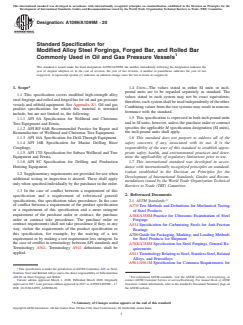
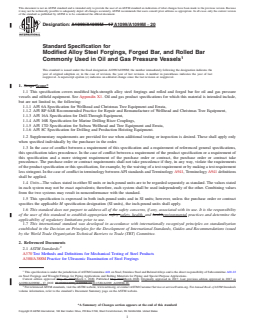
(Specification)Standard Specification for Modified Alloy Steel Forgings, Forged Bar, and Rolled Bar Commonly Used in Oil and Gas Pressure Vessels
General Information
- Abstract
ABSTRACT
This specification covers modified high-strength alloy steel forgings and rolled and forged bar commonly used in oil and gas pressure vessels and oilfield equipment. Oil and gas product specifications for which this material is intended include, but are not limited to, the following: specification for wellhead and Christmas tree equipment and errata, recommended practice for repair and remanufacture of wellhead and Christmas tree equipment, specification for drill-through equipment, specification for marine drilling riser couplings, specification for subsea wellhead and tree equipment and errata, and specification for drilling and production hoisting equipment.
This specification covers requirements for melting, hot working, heat treatment, chemical composition, mechanical properties and testing, rework and retreatment, inspection, certification, product marking, and workmanship, finish, and appearance, as well as metallurgical requirements and nondestructive examination (NDE) requirements.
SCOPE
1.1 This specification covers modified high-strength alloy steel forgings and rolled and forged bar for oil and gas pressure vessels and oilfield equipment. See Appendix X1. Oil and gas product specifications for which this material is intended include, but are not limited to, the following:
1.1.1 API 6A Specification for Wellhead and Christmas Tree Equipment and Errata,
1.1.2 API RP 6AR Recommended Practice for Repair and Remanufacture of Wellhead and Christmas Tree Equipment,
1.1.3 API 16A Specification for Drill-Through Equipment,
1.1.4 API 16R Specification for Marine Drilling Riser Couplings,
1.1.5 API 17D Specification for Subsea Wellhead and Tree Equipment and Errata,
1.1.6 API 8C Specification for Drilling and Production Hoisting Equipment.
1.2 Supplementary requirements are provided for use when additional testing or inspection is desired. These shall apply only when specified individually by the purchaser in the order.
1.3 In the case of conflict between a requirement of this specification and a requirement of referenced general specifications, this specification takes precedence. In the case of conflict between a requirement of the product specification or a requirement of this specification and a more stringent requirement of the purchase order or contract, the purchase order or contract take precedence. The purchase order or contract requirements shall not take precedence if they, in any way, violate the requirements of the product specification or this specification, for example, by the waiving of a test requirement or by making a test requirement less stringent. In the case of conflict in terminology between API standards and Terminology A941, Terminology A941 definitions shall be applied.
1.4 Units—The values stated in either SI units or inch-pound units are to be regarded separately as standard. The values stated in each system may not be exact equivalents; therefore, each system shall be used independently of the other. Combining values from the two systems may result in nonconformance with the standard.
1.5 This specification is expressed in both inch-pound units and in SI units; however, unless the purchase order or contract specifies the applicable M specification designation (SI units), the inch-pound units shall apply.
1.6 This standard does not purport to address all of the safety concerns, if any, associated with its use. It is the responsibility of the user of this standard to establish appropriate safety, health, and environmental practices and determine the applicability of regulatory limitations prior to use.
1.7 This international standard was developed in accordance with internationally recognized principles on standardization established in the Decision on Principles for the Development of International Standards, Guides and Recommendations issued by the World Trade Organization Technical Barriers to Trade (TBT) Committee.
- Status
- Published
- Publication Date
- 29-Feb-2020
- Technical Committee
- A01 - Steel, Stainless Steel and Related Alloys
- Drafting Committee
- A01.06 - Steel Forgings and Billets
Buy Documents
ASTM A1099/A1099M-20 - Standard Specification for Modified Alloy Steel Forgings, Forged Bar, and Rolled Bar Commonly Used in Oil and Gas Pressure Vessels
REDLINE ASTM A1099/A1099M-20 - Standard Specification for Modified Alloy Steel Forgings, Forged Bar, and Rolled Bar Commonly Used in Oil and Gas Pressure Vessels
Overview
ASTM A1099/A1099M-20 is the standard specification for modified alloy steel forgings, forged bar, and rolled bar commonly used in oil and gas pressure vessels and oilfield equipment. Developed by ASTM International, this standard establishes stringent requirements for high-strength alloy steel products to ensure their suitability for demanding oil and gas applications, including offshore and subsea projects. The specification encompasses materials intended for critical components such as wellhead equipment, Christmas tree assemblies, drilling risers, and hoisting equipment, addressing both the quality and reliability required by the industry.
Key Topics
Scope and Materials
The standard applies to modified high-strength alloy steel forgings, forged bars, and rolled bars, emphasizing their use in oil and gas pressure vessels and related equipment. The materials meet or exceed the requirements of various API specifications.Mechanical and Chemical Properties
Requirements are set for chemical composition, mechanical strength (tensile and yield), elongation, reduction of area, and hardness. These properties are established to guarantee performance under high-pressure and harsh environmental conditions.Manufacturing and Heat Treatment
Specifications include melting and hot working processes, with details on electric arc or induction melting, secondary refining, and minimum hot work reduction ratios. Heat treatment conditions, including normalizing, quenching, and tempering, are defined for product consistency and performance.Testing and Inspection
The specification requires rigorous mechanical testing, including Charpy V-notch impact testing and hardness measurements. Metallurgical evaluations, nondestructive examination (NDE) through ultrasonic testing, and other inspections ensure product quality and integrity.Certification and Product Marking
Requirements for traceability, certification, and marking are defined to facilitate supplier and purchaser confidence. Product marking includes heat numbers, grade, class, and manufacturer identification using low-stress stamping.
Applications
ASTM A1099/A1099M-20 is widely used in the fabrication and maintenance of oil and gas industry equipment, where material performance and safety are critical. Principal applications include:
Wellhead and Christmas Tree Equipment
Components such as valves, fittings, and connectors, where pressure containment and toughness are essential.Drill-Through and Hoisting Equipment
Structural elements subject to high mechanical loads, fatigue, and impact.Marine Drilling Riser Couplings and Subsea Equipment
Applications requiring corrosion resistance, strength, and integrity under subsea conditions.Repair and Remanufacture
Guidance is provided for repair and remanufacturing of critical equipment, supporting industry initiatives for sustainability and cost-effectiveness.
The standard is also referenced by specific American Petroleum Institute (API) documents, further affirming its role as a benchmark in oil and gas metallurgy.
Related Standards
ASTM A1099/A1099M-20 integrates best practices and harmonizes with several key industry standards, including:
- API 6A: Specification for Wellhead and Christmas Tree Equipment
- API 16A, 16R, 17D, 8C: Specifications covering drilling, marine risers, subsea equipment, and hoisting equipment
- ASTM A370, A788/A788M, A961/A961M: Mechanical and general forging requirements
- ASTM E10, E21, E45, E381, E1444/E1444M, E165/E165M: Hardness, tension, inclusion content, macroetch, and NDE practice standards
- SAE AMS 2750, ASNT SNT-TC-1A, ISO 6506, Norsok M-650, BS 7448-1: Additional standards for heat treatment, nondestructive testing, and material qualification
Practical Value
The specification assures buyers and manufacturers that alloy steel forgings and bars meet rigorous standards for use in oil, gas, and petroleum environments. Compliance with ASTM A1099/A1099M-20 helps mitigate risk, improve safety, and ensure performance in critical oilfield and subsea applications. The detailed requirements for mechanical properties, testing, traceability, and inspection facilitate global supply chain consistency and regulatory compliance across challenging environments.
Keywords: ASTM A1099/A1099M-20, modified alloy steel forgings, oil and gas pressure vessels, forged bar, rolled bar, wellhead equipment, Christmas tree equipment, oilfield equipment, mechanical properties, NDE, certification, API standards.
Relations
- Effective Date
- 01-Mar-2024
- Effective Date
- 01-Mar-2024
- Effective Date
- 01-Nov-2023
- Effective Date
- 01-Nov-2023
- Effective Date
- 01-Jan-2020
- Effective Date
- 01-Jan-2020
- Effective Date
- 01-Nov-2019
- Effective Date
- 01-Nov-2019
- Effective Date
- 01-Jul-2019
- Effective Date
- 01-May-2019
- Effective Date
- 01-Nov-2018
- Effective Date
- 01-Nov-2018
- Effective Date
- 01-Nov-2018
- Effective Date
- 01-Sep-2018
- Effective Date
- 01-May-2018
Buy Documents
ASTM A1099/A1099M-20 - Standard Specification for Modified Alloy Steel Forgings, Forged Bar, and Rolled Bar Commonly Used in Oil and Gas Pressure Vessels
REDLINE ASTM A1099/A1099M-20 - Standard Specification for Modified Alloy Steel Forgings, Forged Bar, and Rolled Bar Commonly Used in Oil and Gas Pressure Vessels
Get Certified
Connect with accredited certification bodies for this standard

Element Materials Technology
Materials testing and product certification.

ABS Group Brazil
ABS Group certification services in Brazil.

ABS Quality Evaluations Inc.
American Bureau of Shipping quality certification.
Sponsored listings
Frequently Asked Questions
ASTM A1099/A1099M-20 is a technical specification published by ASTM International. Its full title is "Standard Specification for Modified Alloy Steel Forgings, Forged Bar, and Rolled Bar Commonly Used in Oil and Gas Pressure Vessels". This standard covers: ABSTRACT This specification covers modified high-strength alloy steel forgings and rolled and forged bar commonly used in oil and gas pressure vessels and oilfield equipment. Oil and gas product specifications for which this material is intended include, but are not limited to, the following: specification for wellhead and Christmas tree equipment and errata, recommended practice for repair and remanufacture of wellhead and Christmas tree equipment, specification for drill-through equipment, specification for marine drilling riser couplings, specification for subsea wellhead and tree equipment and errata, and specification for drilling and production hoisting equipment. This specification covers requirements for melting, hot working, heat treatment, chemical composition, mechanical properties and testing, rework and retreatment, inspection, certification, product marking, and workmanship, finish, and appearance, as well as metallurgical requirements and nondestructive examination (NDE) requirements. SCOPE 1.1 This specification covers modified high-strength alloy steel forgings and rolled and forged bar for oil and gas pressure vessels and oilfield equipment. See Appendix X1. Oil and gas product specifications for which this material is intended include, but are not limited to, the following: 1.1.1 API 6A Specification for Wellhead and Christmas Tree Equipment and Errata, 1.1.2 API RP 6AR Recommended Practice for Repair and Remanufacture of Wellhead and Christmas Tree Equipment, 1.1.3 API 16A Specification for Drill-Through Equipment, 1.1.4 API 16R Specification for Marine Drilling Riser Couplings, 1.1.5 API 17D Specification for Subsea Wellhead and Tree Equipment and Errata, 1.1.6 API 8C Specification for Drilling and Production Hoisting Equipment. 1.2 Supplementary requirements are provided for use when additional testing or inspection is desired. These shall apply only when specified individually by the purchaser in the order. 1.3 In the case of conflict between a requirement of this specification and a requirement of referenced general specifications, this specification takes precedence. In the case of conflict between a requirement of the product specification or a requirement of this specification and a more stringent requirement of the purchase order or contract, the purchase order or contract take precedence. The purchase order or contract requirements shall not take precedence if they, in any way, violate the requirements of the product specification or this specification, for example, by the waiving of a test requirement or by making a test requirement less stringent. In the case of conflict in terminology between API standards and Terminology A941, Terminology A941 definitions shall be applied. 1.4 Units—The values stated in either SI units or inch-pound units are to be regarded separately as standard. The values stated in each system may not be exact equivalents; therefore, each system shall be used independently of the other. Combining values from the two systems may result in nonconformance with the standard. 1.5 This specification is expressed in both inch-pound units and in SI units; however, unless the purchase order or contract specifies the applicable M specification designation (SI units), the inch-pound units shall apply. 1.6 This standard does not purport to address all of the safety concerns, if any, associated with its use. It is the responsibility of the user of this standard to establish appropriate safety, health, and environmental practices and determine the applicability of regulatory limitations prior to use. 1.7 This international standard was developed in accordance with internationally recognized principles on standardization established in the Decision on Principles for the Development of International Standards, Guides and Recommendations issued by the World Trade Organization Technical Barriers to Trade (TBT) Committee.
ABSTRACT This specification covers modified high-strength alloy steel forgings and rolled and forged bar commonly used in oil and gas pressure vessels and oilfield equipment. Oil and gas product specifications for which this material is intended include, but are not limited to, the following: specification for wellhead and Christmas tree equipment and errata, recommended practice for repair and remanufacture of wellhead and Christmas tree equipment, specification for drill-through equipment, specification for marine drilling riser couplings, specification for subsea wellhead and tree equipment and errata, and specification for drilling and production hoisting equipment. This specification covers requirements for melting, hot working, heat treatment, chemical composition, mechanical properties and testing, rework and retreatment, inspection, certification, product marking, and workmanship, finish, and appearance, as well as metallurgical requirements and nondestructive examination (NDE) requirements. SCOPE 1.1 This specification covers modified high-strength alloy steel forgings and rolled and forged bar for oil and gas pressure vessels and oilfield equipment. See Appendix X1. Oil and gas product specifications for which this material is intended include, but are not limited to, the following: 1.1.1 API 6A Specification for Wellhead and Christmas Tree Equipment and Errata, 1.1.2 API RP 6AR Recommended Practice for Repair and Remanufacture of Wellhead and Christmas Tree Equipment, 1.1.3 API 16A Specification for Drill-Through Equipment, 1.1.4 API 16R Specification for Marine Drilling Riser Couplings, 1.1.5 API 17D Specification for Subsea Wellhead and Tree Equipment and Errata, 1.1.6 API 8C Specification for Drilling and Production Hoisting Equipment. 1.2 Supplementary requirements are provided for use when additional testing or inspection is desired. These shall apply only when specified individually by the purchaser in the order. 1.3 In the case of conflict between a requirement of this specification and a requirement of referenced general specifications, this specification takes precedence. In the case of conflict between a requirement of the product specification or a requirement of this specification and a more stringent requirement of the purchase order or contract, the purchase order or contract take precedence. The purchase order or contract requirements shall not take precedence if they, in any way, violate the requirements of the product specification or this specification, for example, by the waiving of a test requirement or by making a test requirement less stringent. In the case of conflict in terminology between API standards and Terminology A941, Terminology A941 definitions shall be applied. 1.4 Units—The values stated in either SI units or inch-pound units are to be regarded separately as standard. The values stated in each system may not be exact equivalents; therefore, each system shall be used independently of the other. Combining values from the two systems may result in nonconformance with the standard. 1.5 This specification is expressed in both inch-pound units and in SI units; however, unless the purchase order or contract specifies the applicable M specification designation (SI units), the inch-pound units shall apply. 1.6 This standard does not purport to address all of the safety concerns, if any, associated with its use. It is the responsibility of the user of this standard to establish appropriate safety, health, and environmental practices and determine the applicability of regulatory limitations prior to use. 1.7 This international standard was developed in accordance with internationally recognized principles on standardization established in the Decision on Principles for the Development of International Standards, Guides and Recommendations issued by the World Trade Organization Technical Barriers to Trade (TBT) Committee.
ASTM A1099/A1099M-20 is classified under the following ICS (International Classification for Standards) categories: 75.180.10 - Exploratory, drilling and extraction equipment; 77.140.30 - Steels for pressure purposes. The ICS classification helps identify the subject area and facilitates finding related standards.
ASTM A1099/A1099M-20 has the following relationships with other standards: It is inter standard links to ASTM A941-24, ASTM A370-24, ASTM A388/A388M-23, ASTM E45-18a(2023), ASTM E1820-20, ASTM E1820-20e1, ASTM A700-14(2019), ASTM A961/A961M-19a, ASTM A370-19, ASTM A788/A788M-19, ASTM E1820-18ae1, ASTM E1820-18a, ASTM A788/A788M-18b, ASTM A788/A788M-18a, ASTM E1820-18. Understanding these relationships helps ensure you are using the most current and applicable version of the standard.
ASTM A1099/A1099M-20 is available in PDF format for immediate download after purchase. The document can be added to your cart and obtained through the secure checkout process. Digital delivery ensures instant access to the complete standard document.
Standards Content (Sample)
This international standard was developed in accordance with internationally recognized principles on standardization established in the Decision on Principles for the
Development of International Standards, Guides and Recommendations issued by the World Trade Organization Technical Barriers to Trade (TBT) Committee.
Designation: A1099/A1099M − 20
Standard Specification for
Modified Alloy Steel Forgings, Forged Bar, and Rolled Bar
Commonly Used in Oil and Gas Pressure Vessels
This standard is issued under the fixed designation A1099/A1099M; the number immediately following the designation indicates the
year of original adoption or, in the case of revision, the year of last revision. A number in parentheses indicates the year of last
reapproval. A superscript epsilon (´) indicates an editorial change since the last revision or reapproval.
1. Scope* 1.4 Units—The values stated in either SI units or inch-
pound units are to be regarded separately as standard. The
1.1 This specification covers modified high-strength alloy
values stated in each system may not be exact equivalents;
steel forgings and rolled and forged bar for oil and gas pressure
therefore, each system shall be used independently of the other.
vessels and oilfield equipment. See Appendix X1. Oil and gas
Combining values from the two systems may result in noncon-
product specifications for which this material is intended
formance with the standard.
include, but are not limited to, the following:
1.5 This specification is expressed in both inch-pound units
1.1.1 API 6A Specification for Wellhead and Christmas
and in SI units; however, unless the purchase order or contract
Tree Equipment and Errata,
specifies the applicable M specification designation (SI units),
1.1.2 API RP 6AR Recommended Practice for Repair and
the inch-pound units shall apply.
Remanufacture of Wellhead and Christmas Tree Equipment,
1.1.3 API 16A Specification for Drill-Through Equipment, 1.6 This standard does not purport to address all of the
1.1.4 API 16R Specification for Marine Drilling Riser safety concerns, if any, associated with its use. It is the
Couplings,
responsibility of the user of this standard to establish appro-
1.1.5 API 17D Specification for Subsea Wellhead and Tree priate safety, health, and environmental practices and deter-
Equipment and Errata,
mine the applicability of regulatory limitations prior to use.
1.1.6 API 8C Specification for Drilling and Production 1.7 This international standard was developed in accor-
Hoisting Equipment.
dance with internationally recognized principles on standard-
ization established in the Decision on Principles for the
1.2 Supplementary requirements are provided for use when
Development of International Standards, Guides and Recom-
additional testing or inspection is desired. These shall apply
mendations issued by the World Trade Organization Technical
only when specified individually by the purchaser in the order.
Barriers to Trade (TBT) Committee.
1.3 In the case of conflict between a requirement of this
2. Referenced Documents
specification and a requirement of referenced general
specifications, this specification takes precedence. In the case
2.1 ASTM Standards:
of conflict between a requirement of the product specification
A370 Test Methods and Definitions for Mechanical Testing
or a requirement of this specification and a more stringent
of Steel Products
requirement of the purchase order or contract, the purchase
A388/A388M Practice for Ultrasonic Examination of Steel
order or contract take precedence. The purchase order or
Forgings
contract requirements shall not take precedence if they, in any
A534 Specification for Carburizing Steels for Anti-Friction
way, violate the requirements of the product specification or
Bearings
this specification, for example, by the waiving of a test
A700 Guide for Packaging, Marking, and Loading Methods
requirement or by making a test requirement less stringent. In
for Steel Products for Shipment
the case of conflict in terminology between API standards and
A788/A788M Specification for Steel Forgings, General Re-
Terminology A941, Terminology A941 definitions shall be
quirements
applied.
A941 Terminology Relating to Steel, Stainless Steel, Related
Alloys, and Ferroalloys
A961/A961M Specification for Common Requirements for
This specification is under the jurisdiction of ASTM Committee A01 on Steel,
Stainless Steel and Related Alloys and is the direct responsibility of Subcommittee
A01.06 on Steel Forgings and Billets. For referenced ASTM standards, visit the ASTM website, www.astm.org, or
Current edition approved March 1, 2020. Published March 2020. Originally contact ASTM Customer Service at service@astm.org. For Annual Book of ASTM
approved in 2017. Last previous edition approved in 2017 as A1099/A1099M – 17. Standards volume information, refer to the standard’s Document Summary page on
DOI: 10.1520/A1099_A1099M-20. the ASTM website.
*A Summary of Changes section appears at the end of this standard
Copyright © ASTM International, 100 Barr Harbor Drive, PO Box C700, West Conshohocken, PA 19428-2959. United States
A1099/A1099M − 20
Steel Flanges, Forged Fittings, Valves, and Parts for 2.7 British Standard:
Piping Applications BS 7448-1 Method for Determination of K , Critical CTOD
Ic
A991/A991M Test Method for Conducting Temperature and Critical J Values of Metallic Materials
Uniformity Surveys of Furnaces Used to Heat Treat Steel
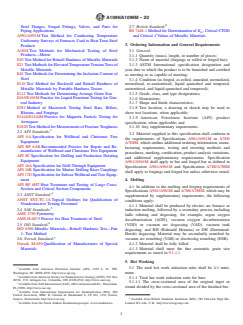
3. Ordering Information and General Requirements
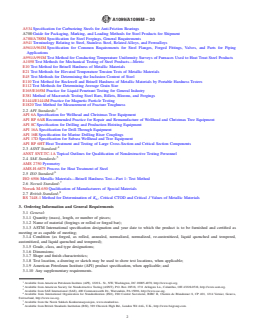
Products
A1058 Test Methods for Mechanical Testing of Steel
3.1 General:
Products—Metric
3.1.1 Quantity (mass), length, or number of pieces;
E10 Test Method for Brinell Hardness of Metallic Materials
3.1.2 Name of material (forgings or rolled or forged bar);
E21 Test Methods for Elevated Temperature Tension Tests of
3.1.3 ASTM International specification designation and
Metallic Materials
year date to which the product is to be furnished and certified
E45 Test Methods for Determining the Inclusion Content of
as meeting or as capable of meeting;
Steel 3.1.4 Condition (as forged, as rolled, annealed, normalized,
E110 Test Method for Rockwell and Brinell Hardness of
normalized, re-austenitized, liquid quenched and tempered,
Metallic Materials by Portable Hardness Testers austenitized, and liquid quenched and tempered);
E112 Test Methods for Determining Average Grain Size
3.1.5 Grade, class, and type designations;
E165/E165M Practice for Liquid Penetrant Testing for Gen-
3.1.6 Dimensions;
eral Industry
3.1.7 Shape and finish characteristics;
E381 Method of Macroetch Testing Steel Bars, Billets,
3.1.8 Test location, a drawing or sketch may be used to
Blooms, and Forgings
show test locations, when applicable;
E1444/E1444M Practice for Magnetic Particle Testing for
3.1.9 American Petroleum Institute (API) product
Aerospace
specification, when applicable; and
E1820 Test Method for Measurement of Fracture Toughness
3.1.10 Any supplementary requirements.
2.2 API Standards:
3.2 Material supplied to this specification shall conform to
API 6A Specification for Wellhead and Christmas Tree
the requirements of Specifications A961/A961M or A788/
Equipment
A788M, which outline additional ordering information, manu-
API RP 6AR Recommended Practice for Repair and Re-
facturing requirements, testing and retesting methods and
manufacture of Wellhead and Christmas Tree Equipment
procedures, marking, certification, product analysis variations,
API 8C Specification for Drilling and Production Hoisting
and additional supplementary requirements. Specification
Equipment
A961/A961M shall apply to bar and forged bar as defined in
API 16A Specification for Drill-Through Equipment
Specification A961/A961M and Specification A788/A788M
API 16R Specification for Marine Drilling Riser Couplings
shall apply to forgings and forged bar unless otherwise stated.
API 17D Specification for Subsea Wellhead and Tree Equip-
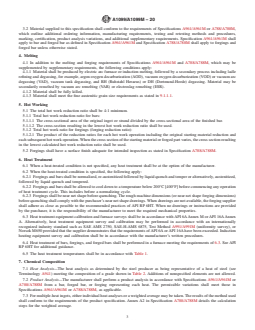
ment 4. Melting
API RP 6HT Heat Treatment and Testing of Large Cross-
4.1 In addition to the melting and forging requirements of
Section and Critical Section Components
Specifications A961/A961M and A788/A788M, which may be
2.3 ASNT Standard:
supplemented by supplementary requirements, the following
ANST SNT-TC-1A Topical Outlines for Qualification of
conditions apply:
Nondestructive Testing Personnel
4.1.1 Material shall be produced by electric arc furnace or
2.4 SAE Standards:
induction melting, followed by a secondary process including
AMS 2750 Pyrometry
ladle refining and degassing, for example, argon oxygen
AMS-H-6875 Process for Heat Treatment of Steel
decarburization (AOD), vacuum oxygen decarburization
2.5 ISO Standard:
(VOD) or vacuum arc degassing (VAD), vacuum tank
ISO 6506 Metallic Materials—Brinell Hardness Test—Part
degassing, and RH (Ruhstahl Heraeus) or DH (Dortmund-
1: Test Method
Horde) degassing. Material may be secondarily remelted by
vacuum arc remelting (VAR) or electroslag remelting (ESR).
2.6 Norsok Standard:
4.1.2 Material shall be fully killed.
Norsok M-650 Qualification of Manufacturers of Special
4.1.3 Material shall meet the fine austenitic grain size
Materials
requirements as stated in 9.1.1.1.
5. Hot Working
3 5.1 The total hot work reduction ratio shall be 4:1 mini-
Available from American Petroleum Institute (API), 1220 L. St., NW,
Washington, DC 20005-4070, http://www.api.org. mum.
Available from American Society for Nondestructive Testing (ASNT), P.O. Box
5.1.1 Total hot work reduction ratio for bars:
28518, 1711 Arlingate Ln., Columbus, OH 43228-0518, http://www.asnt.org.
5.1.1.1 The cross-sectional area of the original ingot or
Available from SAE International (SAE), 400 Commonwealth Dr., Warrendale,
strand divided by the cross-sectional area of the finished bar.
PA 15096, http://www.sae.org.
Available from International Organization for Standardization (ISO), ISO
Central Secretariat, BIBC II, Chemin de Blandonnet 8, CP 401, 1214 Vernier,
Geneva, Switzerland, http://www.iso.org. Available from British Standards Institution (BSI), 389 Chiswick High Rd.,
Available from the Norsk Sokkels Konkuranseposisjon, www.standard.no. London W4 4AL, U.K., http://www.bsigroup.com.
A1099/A1099M − 20
5.1.1.2 The cross-section resulting in the lowest hot work recommended practices of API RP 6HT. When no drawings or
reduction ratio shall be used. instructions are provided by the purchaser, it is the responsi-
5.1.2 Total hot work ratio for forgings (forging reduction bility of the manufacturer to meet the required mechanical
ratio): properties.
5.1.2.1 The product of the reduction ratios for each hot work
6.3 Heat treatment equipment calibration and furnace sur-
operation including the original starting material reduction and
veys shall be in accordance with API 6A Annex M or API 16A
each subsequent hot work operation. When the cross section of
Annex A. Alternatively, heat treatment equipment survey and
the starting material or forged part varies, the cross section
calibration may be performed in accordance with an interna-
resulting in the lowest calculated hot work reduction ratio shall
tionally recognized industry standard such as SAE AMS 2750,
be used.
SAE-H-AMS 6875, Test Method A991/A991M (uniformity
5.2 Forgings shall have a surface finish adequate for in- survey), or Norsok M650 provided that the supplier demon-
tended inspection as stated in Specification A788/A788M. strates that the requirements of API 6A or API 16A have been
exceeded. Induction heating equipment survey and calibration
6. Heat Treatment
shall be in accordance with the manufacturer’s written proce-
dures.
6.1 When a heat-treated condition is not specified, any heat
treatment shall be at the option of the manufacturer.
6.4 Heat treatment of bars, forgings, and forged bars shall be
performed in a furnace meeting the requirements of 6.3. See
6.2 When the heat-treated condition is specified, the follow-
API RP 6HT for additional guidance.
ing apply:
6.2.1 Forgings and bars shall be normalized, re-austenitized
6.5 The heat treatment temperatures shall be in accordance
followed by liquid quench and temper or alternatively,
with Table 1.
austenitized, followed by liquid quench and tempered.
6.2.2 Forgings and bars shall be allowed to cool down to a
7. Chemical Composition
temperature below 200°C [400°F] before commencing any
7.1 Heat Analysis—The heat analysis as determined by the
operation of heat treatment cycle. This includes before a
steel producer as being representative of a heat of steel (see
normalizing cycle.
Terminology A941) meeting the composition of a grade shown
6.2.3 Forgings shall be near net shape before quenching.
in Table 2. Additions of nonspecified elements are not allowed.
The rough machine dimensions (or near net shape forging
dimensions) before quenching shall comply with the purchas- 7.2 Product Analysis—The manufacturer shall perform a
er’s near net shape drawings. When drawings are not available, product analysis in accordance with Specifications A961/
the forging supplier shall adhere as close as possible to the A961M or A788/A788M from a bar, forged bar, or forging
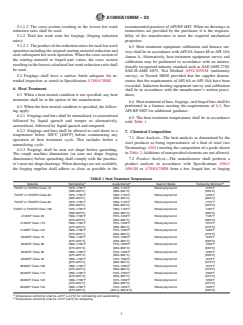
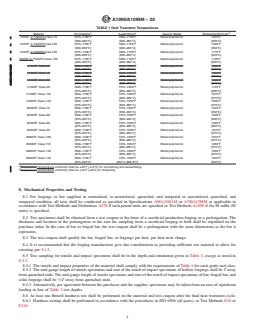
TABLE 1 Heat Treatment Temperatures
A A B
Material Normalizing Austenitizing Quench Media Tempering Minimum
F22OF or F22OFA Class 75 1675–1750°F 1650–1725°F Water/polymer/oil 1225°F
[900–950°C] [900–950°C] [650°C]
F22OF or F22OFA Class 80 1675–1750°F 1650–1725°F Water/polymer/oil 1200°F
[900–950°C] [900–950°C] [650°C]
F22OF or F22OFA Class 85 1675–1750°F 1650–1725°F Water/polymer/oil 1175°F
[900–950°C] [900–950°C] [625°C]
F22OF or F22OFA Class 105 1675–1750°F 1650–1725°F Water/polymer/oil 1100°F
[900–950°C] [900–950°C] [600°C]
4130OF Class 95 1600–1700°F 1575–1650°F Water/polymer/oil 1125°F
[875–925°C] [850–900°C] [600°C]
4130OF Class 110 1600–1700°F 1575–1650°F Water/polymer/oil 1075°F
[875–925°C] [850–900°C] [575°C]
4130OF Class 125 1600–1700°F 1575–1650°F Water/polymer/oil 1050°F
[875–925°C] [850–900°C] [575°C]
8630OF Class 75 1600–1700°F 1575–1650°F Water/polymer/oil 1225°F
[875–925°C] [850–900°C] [650°C]
8630OF Class 80 1600–1700°F 1575–1650°F Water/polymer/oil 1200°F
[875–925°C] [850–900°C] [650°C]
8630OF Class 85 1600–1700°F 1575–1650°F Water/polymer/oil 1200°F
[875–925°C] [850–900°C] [650°C]
8630OF Class 95 1600–1700°F 1575–1650°F Water/polymer/oil 1075°F
[875–925°C] [850–900°C] [575°C]
8630OF Class 100 1600–1700°F 1575–1650°F Water/polymer/oil 1075°F
[875–925°C] [850–900°C] [575°C]
8630OF Class 110 1600–1700°F 1575–1650°F Water/polymer/oil 1050°F
[875–925°C] [850–900°C] [575°C]
8630OF Class 120 1600–1700°F 1575–1650°F Water/polymer/oil 1050°F
[875–925°C] [850–900°C] [575°C]
8630OF Class 135 1600–1700°F 1575–1650°F Water/polymer/oil 1025°F
[875–925°C] [857.2–898.8°C] [550°C]
A
Temperature uniformity shall be ±25°F [±14°C] for normalizing and austenitizing.
B
Temperature uniformity shall be ±15°F [±8°C] for tempering.
A1099/A1099M − 20
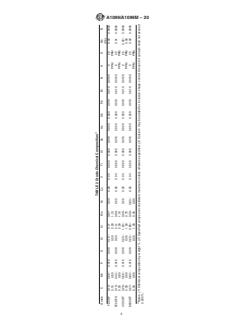
A
TABLE 2 Grade Chemical Composition
Grade C Mn P S Si Cr Mo Ni Cu V Ti Al Sn As Sb Pb Bi N H O Nb B
(Cb)
F22OF 0.10– 0.30– 0.015 0.010 0.15– 2.0– 0.87– 0.50 0.25 0.04 0.025 0.055 0.015 0.020 0.020 0.010 0.010 0.0120 2 25 0.02 0.0005
0.15 0.60 0.50 2.50 1.13 PPM PPM
F22OFA 0.15– 0.40– 0.015 0.010 0.50 2.0– 0.90– 0.50 0.25 0.04 0.025 0.055 0.015 0.020 0.020 0.010 0.010 0.0120 2 25 0.01 0.0005
0.20 0.80 2.50 1.10 PPM PPM
4130OF 0.25– 0.60– 0.015 0.010 0.20– 1.20– 0.65– 0.25 0.25 0.04 0.025 0.055 0.015 0.020 0.020 0.010 0.010 0.0120 2 25 0.02– 0.0005
0.33 0.90 0.35 1.50 0.75 PPM PPM 0.05
8630OF 0.27– 0.80– 0.015 0.010 0.20– 0.85– 0.35– 0.80– 0.25 0.04 0.025 0.055 0.015 0.020 0.020 0.010 0.010 0.0120 2 25 0.02 0.0005
0.33 0.95 0.35 1.00 0.45 0.90 PPM PPM
A
Notes: (1) Chemical composition by weight %. (2) Specified values are considered maximum unless otherwise specified. (3) Calcium may be added for inclusion shape control. Amount of calcium shall not exceed
0.005 %.
A1099/A1099M − 20
representing each heat. The permissible variations shall meet 8.5.3 Alternatively, per agreement between the purchaser
those in Specifications A961/A961M or A788/A788M, as and the supplier, specimens may be taken from an area of
applicable.
significant loading in lieu of Table 3 test depths.
7.3 For multiple-heat ingots, either individual heat analyses
8.6 At least one Brinell hardness test shall be performed on
or a weighted average may be taken. The results of the method
the material and test coupon after the final heat treatment cycle.
used shall conform to the requirements of the product specifi-
8.6.1 Hardness testing shall be performed in accordance
cation. Annex A2 in Specification A788/A788M details the
with the procedures in ISO 6506 (all parts), or Test Methods
calculation steps for the weighted average.
E10 or E110.
8. Mechanical Properties and Testing
8.6.2 The hardness of the material and test coupon shall
comply with the requirements of Table 4 for each grade and
8.1 For forgings or bar supplied in normalized, re-
class. A minimum of one hardness test shall be performed on
austenitized, quenched, and tempered or austenitized,
each test coupon and a minimum of one hardness test shall be
quenched, and tempered condition, all tests shall be conducted
performed on at least one production part.
as specified in Specifications A961/A961M or A788/A788M as
applicable in accordance with Test Methods and Definitions
8.7 If the results fail to meet any requirement in Table 4,
A370 if inch-pound units are specified or Test Methods A1058
then additional tests shall be performed on the test coupon with
if the M suffix (SI units) is specified.
no additional heat treatment as follows:
8.2 Test specimens shall be obtained from a test coupon in
8.7.1 Tensile—Two additional specimens for each failed
the form of a sacrificial production forging or a prolongation.
specimen, both of which shall meet the requirements;
The thickness and location of the prolongation or the area for
8.7.2 Charpy V-Notch—One additional set of three speci
...
This document is not an ASTM standard and is intended only to provide the user of an ASTM standard an indication of what changes have been made to the previous version. Because
it may not be technically possible to adequately depict all changes accurately, ASTM recommends that users consult prior editions as appropriate. In all cases only the current version
of the standard as published by ASTM is to be considered the official document.
Designation: A1099/A1099M − 17 A1099/A1099M − 20
Standard Specification for
Modified Alloy Steel Forgings, Forged Bar, and Rolled Bar
Commonly Used in Oil and Gas Pressure Vessels
This standard is issued under the fixed designation A1099/A1099M; the number immediately following the designation indicates the
year of original adoption or, in the case of revision, the year of last revision. A number in parentheses indicates the year of last
reapproval. A superscript epsilon (´) indicates an editorial change since the last revision or reapproval.
1. Scope Scope*
1.1 This specification covers modified high-strength alloy steel forgings and rolled and forged bar for oil and gas pressure
vessels and oilfield equipment. See Appendix X1. Oil and gas product specifications for which this material is intended include,
but are not limited to, the following:
1.1.1 API 6A Specification for Wellhead and Christmas Tree Equipment and Errata,
1.1.2 API RP 6AR Recommended Practice for Repair and Remanufacture of Wellhead and Christmas Tree Equipment,
1.1.3 API 16A Specification for Drill-Through Equipment,
1.1.4 API 16R Specification for Marine Drilling Riser Couplings,
1.1.5 API 17D Specification for Subsea Wellhead and Tree Equipment and Errata,
1.1.6 API 8C Specification for Drilling and Production Hoisting Equipment.
1.2 Supplementary requirements are provided for use when additional testing or inspection is desired. These shall apply only
when specified individually by the purchaser in the order.
1.3 In the case of conflict between a requirement of this specification and a requirement of referenced general specifications,
this specification takes precedence. In the case of conflict between a requirement of the product specification or a requirement of
this specification and a more stringent requirement of the purchase order or contract, the purchase order or contract take
precedence. The purchase order or contract requirements shall not take precedence if they, in any way, violate the requirements
of the product specification or this specification, for example, by the waiving of a test requirement or by making a test requirement
less stringent. In the case of conflict in terminology between API standards and Terminology A941, Terminology A941 definitions
shall be applied.
1.4 Units—The values stated in either SI units or inch-pound units are to be regarded separately as standard. The values stated
in each system may not be exact equivalents; therefore, each system shall be used independently of the other. Combining values
from the two systems may result in nonconformance with the standard.
1.5 This specification is expressed in both inch-pound units and in SI units; however, unless the purchase order or contract
specifies the applicable M specification designation (SI units), the inch-pound units shall apply.
1.6 This standard does not purport to address all of the safety concerns, if any, associated with its use. It is the responsibility
of the user of this standard to establish appropriate safety safety, health, and healthenvironmental practices and determine the
applicability of regulatory limitations prior to use.
1.7 This international standard was developed in accordance with internationally recognized principles on standardization
established in the Decision on Principles for the Development of International Standards, Guides and Recommendations issued
by the World Trade Organization Technical Barriers to Trade (TBT) Committee.
2. Referenced Documents
2.1 ASTM Standards:
A370 Test Methods and Definitions for Mechanical Testing of Steel Products
A388/A388M Practice for Ultrasonic Examination of Steel Forgings
This specification is under the jurisdiction of ASTM Committee A01 on Steel, Stainless Steel and Related Alloys and is the direct responsibility of Subcommittee A01.22
on Steel Forgings and Wrought Fittings for Piping Applications and Bolting Materials for Piping and Special Purpose Applications.
Current edition approved May 15, 2017March 1, 2020. Published May 2017March 2020. Originally approved in 2017. Last previous edition approved in 2017 as
A1099/A1099M – 17. DOI: 10.1520/A1099_A1099M-17.10.1520/A1099_A1099M-20.
For referenced ASTM standards, visit the ASTM website, www.astm.org, or contact ASTM Customer Service at service@astm.org. For Annual Book of ASTM Standards
volume information, refer to the standard’s Document Summary page on the ASTM website.
*A Summary of Changes section appears at the end of this standard
Copyright © ASTM International, 100 Barr Harbor Drive, PO Box C700, West Conshohocken, PA 19428-2959. United States
A1099/A1099M − 20
A534 Specification for Carburizing Steels for Anti-Friction Bearings
A700 Guide for Packaging, Marking, and Loading Methods for Steel Products for Shipment
A788/A788M Specification for Steel Forgings, General Requirements
A941 Terminology Relating to Steel, Stainless Steel, Related Alloys, and Ferroalloys
A961/A961M Specification for Common Requirements for Steel Flanges, Forged Fittings, Valves, and Parts for Piping
Applications
A991/A991M Test Method for Conducting Temperature Uniformity Surveys of Furnaces Used to Heat Treat Steel Products
A1058 Test Methods for Mechanical Testing of Steel Products—Metric
E10 Test Method for Brinell Hardness of Metallic Materials
E21 Test Methods for Elevated Temperature Tension Tests of Metallic Materials
E45 Test Methods for Determining the Inclusion Content of Steel
E110 Test Method for Rockwell and Brinell Hardness of Metallic Materials by Portable Hardness Testers
E112 Test Methods for Determining Average Grain Size
E165/E165M Practice for Liquid Penetrant Testing for General Industry
E381 Method of Macroetch Testing Steel Bars, Billets, Blooms, and Forgings
E1444/E1444M Practice for Magnetic Particle Testing
E1820 Test Method for Measurement of Fracture Toughness
2.2 API Standards:
API 6A Specification for Wellhead and Christmas Tree Equipment
API RP 6AR Recommended Practice for Repair and Remanufacture of Wellhead and Christmas Tree Equipment
API 8C Specification for Drilling and Production Hoisting Equipment
API 16A Specification for Drill-Through Equipment
API 16R Specification for Marine Drilling Riser Couplings
API 17D Specification for Subsea Wellhead and Tree Equipment
API RP 6HT Heat Treatment and Testing of Large Cross-Section and Critical Section Components
2.3 ASNT Standard:
ANST SNT-TC-1A Topical Outlines for Qualification of Nondestructive Testing Personnel
2.4 SAE Standards:
AMS 2750 Pyrometry
AMS-H-6875 Process for Heat Treatment of Steel
2.5 ISO Standard:
ISO 6506 Metallic Materials—Brinell Hardness Test—Part 1: Test Method
2.6 Norsok Standard:
Norsok M-650 Qualification of Manufacturers of Special Materials
2.7 British Standard:
BS 7448-1 Method for Determination of K , Critical CTOD and Critical J Values of Metallic Materials
Ic
3. Ordering Information and General Requirements
3.1 General:
3.1.1 Quantity (mass), length, or number of pieces;
3.1.2 Name of material (forgings or rolled or forged bar);
3.1.3 ASTM International specification designation and year date to which the product is to be furnished and certified as
meeting or as capable of meeting;
3.1.4 Condition (as forged, as rolled, annealed, normalized, normalized, re-austenitized, liquid quenched and tempered,
austenitized, and liquid quenched and tempered);
3.1.5 Grade, class, and type designations;
3.1.6 Dimensions;
3.1.7 Shape and finish characteristics;
3.1.8 Test location, a drawing or sketch may be used to show test locations, when applicable;
3.1.9 American Petroleum Institute (API) product specification, when applicable; and
3.1.10 Any supplementary requirements.
Available from American Petroleum Institute (API), 1220 L. St., NW, Washington, DC 20005-4070, http://www.api.org.
Available from American Society for Nondestructive Testing (ASNT), P.O. Box 28518, 1711 Arlingate Ln., Columbus, OH 43228-0518, http://www.asnt.org.
Available from SAE International (SAE), 400 Commonwealth Dr., Warrendale, PA 15096, http://www.sae.org.
Available from International Organization for Standardization (ISO), ISO Central Secretariat, BIBC II, Chemin de Blandonnet 8, CP 401, 1214 Vernier, Geneva,
Switzerland, http://www.iso.org.
Available from the Norsk Sokkels Konkuranseposisjon, www.standard.no.
Available from British Standards Institution (BSI), 389 Chiswick High Rd., London W4 4AL, U.K., http://www.bsigroup.com.
A1099/A1099M − 20
3.2 Material supplied to this specification shall conform to the requirements of Specifications A961/A961M or A788/A788M,
which outline additional ordering information, manufacturing requirements, testing and retesting methods and procedures,
marking, certification, product analysis variations, and additional supplementary requirements. Specification A961/A961M shall
apply to bar and forged bar as defined in Specification A961/A961M and Specification A788/A788M shall apply to forgings and
forged bar unless otherwise stated.
4. Melting
4.1 In addition to the melting and forging requirements of Specifications A961/A961M and A788/A788M, which may be
supplemented by supplementary requirements, the following conditions apply:
4.1.1 Material shall be produced by electric arc furnace or induction melting, followed by a secondary process including ladle
refining and degassing, for example, argon oxygen decarburization (AOD), vacuum oxygen decarburization (VOD) or vacuum arc
degassing (VAD), vacuum tank degassing, and RH (Ruhstahl Heraeus) or DH (Dortmund-Horde) degassing. Material may be
secondarily remelted by vacuum arc remelting (VAR) or electroslag remelting (ESR).
4.1.2 Material shall be fully killed.
4.1.3 Material shall meet the fine austenitic grain size requirements as stated in 9.1.1.1.
5. Hot Working
5.1 The total hot work reduction ratio shall be 4:1 minimum.
5.1.1 Total hot work reduction ratio for bars:
5.1.1.1 The cross-sectional area of the original ingot or strand divided by the cross-sectional area of the finished bar.
5.1.1.2 The cross-section resulting in the lowest hot work reduction ratio shall be used.
5.1.2 Total hot work ratio for forgings (forging reduction ratio):
5.1.2.1 The product of the reduction ratios for each hot work operation including the original starting material reduction and
each subsequent hot work operation. When the cross section of the starting material or forged part varies, the cross section resulting
in the lowest calculated hot work reduction ratio shall be used.
5.2 Forgings shall have a surface finish adequate for intended inspection as stated in Specification A788/A788M.
6. Heat Treatment
6.1 When a heat-treated condition is not specified, any heat treatment shall be at the option of the manufacturer.
6.2 When the heat-treated condition is specified, the following apply:
6.2.1 Forgings and bars shall be normalized, re-austenitized followed by liquid quench and temper or alternatively, austenitized,
followed by liquid quench and tempered.
6.2.2 Forgings and bars shall be allowed to cool down to a temperature below 200°C [400°F] before commencing any operation
of heat treatment cycle. This includes before a normalizing cycle.
6.2.3 Forgings shall be near net shape before quenching. The rough machine dimensions (or near net shape forging dimensions)
before quenching shall comply with the purchaser’s near net shape drawings. When drawings are not available, the forging supplier
shall adhere as close as possible to the recommended practices of API RP 6HT. When no drawings or instructions are provided
by the purchaser, it is the responsibility of the manufacturer to meet the required mechanical properties.
6.3 Heat treatment equipment calibration and furnace surveys shall be in accordance with API 6A Annex M or API 16A Annex
A. Alternatively, heat treatment equipment survey and calibration may be performed in accordance with an internationally
recognized industry standard such as SAE AMS 2750, SAE-H-AMS 6875, Test Method A991/A991M (uniformity survey), or
Norsok M650 provided that the supplier demonstrates that the requirements of API 6A or API 16A have been exceeded. Induction
heating equipment survey and calibration shall be in accordance with the manufacturer’s written procedures.
6.4 Heat treatment of bars, forgings, and forged bars shall be performed in a furnace meeting the requirements of 6.3. See API
RP 6HT for additional guidance.
6.5 The heat treatment temperatures shall be in accordance with Table 1.
7. Chemical Composition
7.1 Heat Analysis—The heat analysis as determined by the steel producer as being representative of a heat of steel (see
Terminology A941) meeting the composition of a grade shown in Table 2. Additions of nonspecified elements are not allowed.
7.2 Product Analysis—The manufacturer shall perform a product analysis in accordance with Specifications A961/A961M or
A788/A788M from a bar, forged bar, or forging representing each heat. The permissible variations shall meet those in
Specifications A961/A961M or A788/A788M, as applicable.
7.3 For multiple-heat ingots, either individual heat analyses or a weighted average may be taken. The results of the method used
shall conform to the requirements of the product specification. Annex A2 in Specification A788/A788M details the calculation
steps for the weighted average.
A1099/A1099M − 20
TABLE 1 Heat Treatment Temperatures
A A B
Material Normalizing Austenitizing Quench Media Tempering Minimum
F22OF or F22OFA Class 75 1675–1750°F 1650–1725°F Water/polymer/oil 1225°F
[900–950°C] [900–950°C] [650°C]
F22OF or F22OFA Class 80 1675–1750°F 1650–1725°F Water/polymer/oil 1200°F
[900–950°C] [900–950°C] [650°C]
F22OF or F22OFA Class 85 1675–1750°F 1650–1725°F Water/polymer/oil 1175°F
[900–950°C] [900–950°C] [625°C]
F22OF or F22OFA Class 105 1675–1750°F 1650–1725°F Water/polymer/oil 1100°F
[900–950°C] [900–950°C] [600°C]
4130OF Class 60 1600–1700°F 1575–1650°F Water/polymer/oil 1250°F
[875–925°C] [850–900°C] [675°C]
4130OF Class 75 1600–1700°F 1575–1650°F Water/polymer/oil 1200°F
[875–925°C] [850–900°C] [650°C]
4130OF Class 80 1600–1700°F 1575–1650°F Water/polymer/oil 1200°F
[875–925°C] [850–900°C] [650°C]
4130OF Class 95 1600–1700°F 1575–1650°F Water/polymer/oil 1125°F
[875–925°C] [850–900°C] [600°C]
4130OF Class 110 1600–1700°F 1575–1650°F Water/polymer/oil 1075°F
[875–925°C] [850–900°C] [575°C]
4130OF Class 125 1600–1700°F 1575–1650°F Water/polymer/oil 1050°F
[875–925°C] [850–900°C] [575°C]
8630OF Class 75 1600–1700°F 1575–1650°F Water/polymer/oil 1225°F
[875–925°C] [850–900°C] [650°C]
8630OF Class 80 1600–1700°F 1575–1650°F Water/polymer/oil 1200°F
[875–925°C] [850–900°C] [650°C]
8630OF Class 85 1600–1700°F 1575–1650°F Water/polymer/oil 1200°F
[875–925°C] [850–900°C] [650°C]
8630OF Class 95 1600–1700°F 1575–1650°F Water/polymer/oil 1075°F
[875–925°C] [850–900°C] [575°C]
8630OF Class 100 1600–1700°F 1575–1650°F Water/polymer/oil 1075°F
[875–925°C] [850–900°C] [575°C]
8630OF Class 110 1600–1700°F 1575–1650°F Water/polymer/oil 1050°F
[875–925°C] [850–900°C] [575°C]
8630OF Class 120 1600–1700°F 1575–1650°F Water/polymer/oil 1050°F
[875–925°C] [850–900°C] [575°C]
8630OF Class 135 1600–1700°F 1575–1650°F Water/polymer/oil 1025°F
[875–925°C] [857.2–898.8°C] [550°C]
A
Temperature Temperature uniformity shall be ±25°F [±14°C] for normalizing and austenitizing.
B
Temperature Temperature uniformity shall be ±15°F [±8°C] for tempering.
8. Mechanical Properties and Testing
8.1 For forgings or bar supplied in normalized, re-austenitized, quenched, and tempered or austenitized, quenched, and
tempered condition, all tests shall be conducted as specified in Specifications A961/A961M or A788/A788M as applicable in
accordance with Test Methods and Definitions A370 if inch-pound units are specified or Test Methods A1058 if the M suffix (SI
units) is specified.
8.2 Test specimens shall be obtained from a test coupon in the form of a sacrificial production forging or a prolongation. The
thickness and location of the prolongation or the area for sampling from a sacrificial forging or both shall be stipulated on the
purchase order. In the case of bar or forged bar, the test coupon shall be a prolongation with the same dimensions as the bar it
represents.
8.3 The test coupon shall qualify the bar, forged bar, or forgings per heat, per heat treat charge.
8.4 It is recommended that the forging manufacturer give due consideration to providing sufficient test material to allow for
retesting per 9.1.2.
8.5 Test sampling for tensile and impact specimens shall be in the depth and orientation given in Table 3, except as noted in
8.5.3.
8.5.1 The tensile and impact properties of the material shall comply with the requirements of Table 4 for each grade and class.
8.5.2 The mid-gauge length of tensile specimens and root of the notch of impact specimens of hollow forgings shall be T away
from quenched ends. The mid-gauge length of tensile specimens and root of the notch of impact specimens of bar, forged bar, and
solid forgings shall be ⁄2T away from quenched ends.
8.5.3 Alternatively, per agreement between the purchaser and the supplier, specimens may be taken from an area of significant
loading in lieu of Table 3 test depths.
8.6 At least one Brinell hardness test shall be performed on the material and test coupon after the final heat treatment cycle.
8.6.1 Hardness testing shall be performed in accordance with the procedures in ISO 6506 (all parts), or Test Methods E10 or
E110.
A1099/A1099M − 20
A
TABLE 2 Grade Chemical Composition
Grade C Mn P S Si Cr Mo Ni Cu V Ti Al Sn As Sb Pb Bi N H O Nb B
(Cb)
F22OF 0.10– 0.30– 0.015 0.010 0.15– 2.0– 0.87– 0.50 0.25 0.04 0.025 0.055 0.015 0.020 0.020 0.010 0.010 0.0120 2 25 0.02 0.0005
0.15 0.60 0.50 2.50 1.13 PPM PPM
F22OFA 0.15– 0.40– 0.015 0.010 0.50 2.0– 0.90– 0.50 0.25 0.04 0.025 0.055 0.015 0.020 0.020 0.010 0.010 0.0120 2 25 0.01 0.0005
0.20 0.80 2.50 1.10 PPM PPM
4130OF 0.25– 0.60– 0.015 0.010 0.20– 1.20– 0.65– 0.25 0.25 0.04 0.025 0.055 0.015 0.020 0.020 0.010 0.010 0.0120 2 25 0.02– 0.0005
0.33 0.90 0.35 1.50 0.75 PPM PPM 0.05
8630OF 0.27– 0.80– 0.015 0.010 0.20– 0.85– 0.35– 0.80– 0.25 0.04 0.025 0.055 0.015 0.020 0.020 0.010 0.0
...