

ASTM D381-22
(Test Method)Standard Test Method for Gum Content in Fuels by Jet Evaporation
General Information
- Abstract
SIGNIFICANCE AND USE
5.1 The true significance of this test method for determining gum in motor gasoline is not firmly established. It has been proved that high gum can cause induction-system deposits and sticking of intake valves, and in most instances, it can be assumed that low gum will ensure absence of induction-system difficulties. The user should, however, realize that the test method is not of itself correlative to induction-system deposits. The primary purpose of the test method, as applied to motor gasoline, is the measurement of the oxidation products formed in the sample prior to or during the comparatively mild conditions of the test procedure. Since many motor gasolines are purposely blended with nonvolatile oils or additives, the heptane extraction step is necessary to remove these from the evaporation residue so that the deleterious material, gum, may be determined. With respect to aviation turbine fuels, large quantities of gum are indicative of contamination of fuel by higher boiling oils or particulate matter and generally reflect poor handling practices in distribution downstream of the refinery.
SCOPE
1.1 This test method covers the determination of the existent gum content of aviation fuels, and the gum content of motor gasolines or other volatile distillates in their finished form, (including those containing alcohol and ether type oxygenates and deposit control additives—see Note 7 for additional information) at the time of test.
1.2 Provisions are made for the determination of the heptane insoluble portion of the residue of non-aviation fuels.
1.3 The values stated in SI units are to be regarded as standard. No other units of measurement are included in this standard.
1.3.1 The accepted SI unit of pressure is the Pascal (Pa); the accepted SI unit for temperature is degrees Celsius.
1.4 WARNING—Mercury has been designated by many regulatory agencies as a hazardous substance that can cause serious medical issues. Mercury, or its vapor, has been demonstrated to be hazardous to health and corrosive to materials. Use caution when handling mercury and mercury-containing products. See the applicable product Safety Data Sheet (SDS) for additional information. The potential exists that selling mercury or mercury-containing products, or both, is prohibited by local or national law. Users must determine legality of sales in their location.
1.5 This standard does not purport to address all of the safety concerns, if any, associated with its use. It is the responsibility of the user of this standard to establish appropriate safety, health, and environmental practices and determine the applicability of regulatory limitations prior to use. For specific warning statements, see 6.4, 7.4, and 9.1.
1.6 This international standard was developed in accordance with internationally recognized principles on standardization established in the Decision on Principles for the Development of International Standards, Guides and Recommendations issued by the World Trade Organization Technical Barriers to Trade (TBT) Committee.
- Status
- Published
- Publication Date
- 31-Mar-2022
- Technical Committee
- D02 - Petroleum Products, Liquid Fuels, and Lubricants
- Drafting Committee
- D02.14 - Stability, Cleanliness and Compatibility of Liquid Fuels
Overview
ASTM D381-22 outlines the Standard Test Method for Gum Content in Fuels by Jet Evaporation. Issued by ASTM International, this standard provides a procedure to determine the gum content present in aviation fuels, motor gasolines, and other volatile distillates. Gum content refers to the nonvolatile residue formed when fuels are evaporated under specific conditions, revealing potential contaminants, oxidation products, or degradation due to handling and storage.
Testing gum content is essential for quality control in fuel manufacturing and distribution. While the absolute correlation between gum content and engine deposits is not well established, high gum values can indicate contamination or improper fuel handling, potentially affecting engine performance or reliability.
Key Topics
Test Scope
- Applicable to finished aviation fuels, motor gasolines, and other volatile distillates, including those with alcohols, ethers, and deposit control additives.
- Provides a step for determination of heptane-insoluble residues in non-aviation fuels.
- All measurements are performed using SI units, with specific attention to safety regarding mercury-containing apparatus.
Significance of Results
- High gum levels can potentially cause fuel system deposits and operational problems, such as sticking intake valves in engines.
- The procedure measures oxidation products and contaminants formed prior to or during mild testing conditions.
Test Procedure
- A measured quantity of fuel is evaporated under controlled air or steam flow and temperature.
- Residue is weighed pre- and post-heptane extraction (for non-aviation fuels) to determine total and insoluble gum content.
- Results are reported in milligrams per 100 mL of fuel.
Precision and Reporting
- Repeatability and reproducibility guidelines are provided.
- Specific rounding and reporting practices are outlined based on gum content values.
Applications
The ASTM D381-22 test method is widely used for:
- Fuel Producers and Refineries: Assuring adherence to product specifications by monitoring gum content through production and blending operations.
- Quality Control Laboratories: Routine assessment of finished fuels to detect oxidation products, high boiling impurities, or improper storage conditions.
- Fuel Distributors and Airports: Monitoring aviation fuels for gum content that may indicate contamination from higher boiling oils or mishandling.
- Regulatory Compliance: Supporting requirements in procurement and safety regulations for both military and civil applications.
Low gum content is generally considered desirable, reducing risks related to induction system deposits and maintaining cleaner combustion.
Related Standards
For a comprehensive approach to fuel testing and quality, consider related ASTM standards:
- ASTM D1655 - Specification for Aviation Turbine Fuels
- ASTM D4057 - Practice for Manual Sampling of Petroleum and Petroleum Products
- ASTM D4175 - Terminology Relating to Petroleum Products, Liquid Fuels, and Lubricants
- ASTM E1 - Specification for ASTM Liquid-in-Glass Thermometers
Additionally, the Energy Institute’s IP 540 offers a comparable method for jet evaporation gum determination in aviation turbine fuel.
Keywords: ASTM D381, gum content, jet evaporation, fuel quality, aviation fuel testing, motor gasoline testing, fuel oxidation products, heptane insoluble residue, ASTM standards, petroleum product testing.
Relations
- Effective Date
- 15-Mar-2024
- Refers
ASTM D4175-23a - Standard Terminology Relating to Petroleum Products, Liquid Fuels, and Lubricants - Effective Date
- 15-Dec-2023
- Effective Date
- 01-Oct-2023
- Refers
ASTM D4175-23e1 - Standard Terminology Relating to Petroleum Products, Liquid Fuels, and Lubricants - Effective Date
- 01-Jul-2023
- Effective Date
- 01-Jan-2018
- Effective Date
- 01-Dec-2017
- Effective Date
- 01-Dec-2016
- Effective Date
- 01-Sep-2016
- Effective Date
- 01-Jun-2016
- Effective Date
- 01-Oct-2015
- Effective Date
- 15-Jul-2015
- Effective Date
- 01-Jan-2015
- Effective Date
- 15-Dec-2014
- Effective Date
- 01-Dec-2014
- Effective Date
- 01-Oct-2014
Get Certified
Connect with accredited certification bodies for this standard

Element Materials Technology
Materials testing and product certification.

ABS Group Brazil
ABS Group certification services in Brazil.

ABS Quality Evaluations Inc.
American Bureau of Shipping quality certification.
Sponsored listings
Frequently Asked Questions
ASTM D381-22 is a standard published by ASTM International. Its full title is "Standard Test Method for Gum Content in Fuels by Jet Evaporation". This standard covers: SIGNIFICANCE AND USE 5.1 The true significance of this test method for determining gum in motor gasoline is not firmly established. It has been proved that high gum can cause induction-system deposits and sticking of intake valves, and in most instances, it can be assumed that low gum will ensure absence of induction-system difficulties. The user should, however, realize that the test method is not of itself correlative to induction-system deposits. The primary purpose of the test method, as applied to motor gasoline, is the measurement of the oxidation products formed in the sample prior to or during the comparatively mild conditions of the test procedure. Since many motor gasolines are purposely blended with nonvolatile oils or additives, the heptane extraction step is necessary to remove these from the evaporation residue so that the deleterious material, gum, may be determined. With respect to aviation turbine fuels, large quantities of gum are indicative of contamination of fuel by higher boiling oils or particulate matter and generally reflect poor handling practices in distribution downstream of the refinery. SCOPE 1.1 This test method covers the determination of the existent gum content of aviation fuels, and the gum content of motor gasolines or other volatile distillates in their finished form, (including those containing alcohol and ether type oxygenates and deposit control additives—see Note 7 for additional information) at the time of test. 1.2 Provisions are made for the determination of the heptane insoluble portion of the residue of non-aviation fuels. 1.3 The values stated in SI units are to be regarded as standard. No other units of measurement are included in this standard. 1.3.1 The accepted SI unit of pressure is the Pascal (Pa); the accepted SI unit for temperature is degrees Celsius. 1.4 WARNING—Mercury has been designated by many regulatory agencies as a hazardous substance that can cause serious medical issues. Mercury, or its vapor, has been demonstrated to be hazardous to health and corrosive to materials. Use caution when handling mercury and mercury-containing products. See the applicable product Safety Data Sheet (SDS) for additional information. The potential exists that selling mercury or mercury-containing products, or both, is prohibited by local or national law. Users must determine legality of sales in their location. 1.5 This standard does not purport to address all of the safety concerns, if any, associated with its use. It is the responsibility of the user of this standard to establish appropriate safety, health, and environmental practices and determine the applicability of regulatory limitations prior to use. For specific warning statements, see 6.4, 7.4, and 9.1. 1.6 This international standard was developed in accordance with internationally recognized principles on standardization established in the Decision on Principles for the Development of International Standards, Guides and Recommendations issued by the World Trade Organization Technical Barriers to Trade (TBT) Committee.
SIGNIFICANCE AND USE 5.1 The true significance of this test method for determining gum in motor gasoline is not firmly established. It has been proved that high gum can cause induction-system deposits and sticking of intake valves, and in most instances, it can be assumed that low gum will ensure absence of induction-system difficulties. The user should, however, realize that the test method is not of itself correlative to induction-system deposits. The primary purpose of the test method, as applied to motor gasoline, is the measurement of the oxidation products formed in the sample prior to or during the comparatively mild conditions of the test procedure. Since many motor gasolines are purposely blended with nonvolatile oils or additives, the heptane extraction step is necessary to remove these from the evaporation residue so that the deleterious material, gum, may be determined. With respect to aviation turbine fuels, large quantities of gum are indicative of contamination of fuel by higher boiling oils or particulate matter and generally reflect poor handling practices in distribution downstream of the refinery. SCOPE 1.1 This test method covers the determination of the existent gum content of aviation fuels, and the gum content of motor gasolines or other volatile distillates in their finished form, (including those containing alcohol and ether type oxygenates and deposit control additives—see Note 7 for additional information) at the time of test. 1.2 Provisions are made for the determination of the heptane insoluble portion of the residue of non-aviation fuels. 1.3 The values stated in SI units are to be regarded as standard. No other units of measurement are included in this standard. 1.3.1 The accepted SI unit of pressure is the Pascal (Pa); the accepted SI unit for temperature is degrees Celsius. 1.4 WARNING—Mercury has been designated by many regulatory agencies as a hazardous substance that can cause serious medical issues. Mercury, or its vapor, has been demonstrated to be hazardous to health and corrosive to materials. Use caution when handling mercury and mercury-containing products. See the applicable product Safety Data Sheet (SDS) for additional information. The potential exists that selling mercury or mercury-containing products, or both, is prohibited by local or national law. Users must determine legality of sales in their location. 1.5 This standard does not purport to address all of the safety concerns, if any, associated with its use. It is the responsibility of the user of this standard to establish appropriate safety, health, and environmental practices and determine the applicability of regulatory limitations prior to use. For specific warning statements, see 6.4, 7.4, and 9.1. 1.6 This international standard was developed in accordance with internationally recognized principles on standardization established in the Decision on Principles for the Development of International Standards, Guides and Recommendations issued by the World Trade Organization Technical Barriers to Trade (TBT) Committee.
ASTM D381-22 is classified under the following ICS (International Classification for Standards) categories: 75.160.20 - Liquid fuels. The ICS classification helps identify the subject area and facilitates finding related standards.
ASTM D381-22 has the following relationships with other standards: It is inter standard links to ASTM D1655-24, ASTM D4175-23a, ASTM D1655-23a, ASTM D4175-23e1, ASTM D1655-18, ASTM D1655-17a, ASTM D1655-16c, ASTM D1655-16b, ASTM D1655-16, ASTM D1655-15d, ASTM D1655-15b, ASTM D1655-15, ASTM D1655-14c, ASTM D1655-14b, ASTM D1655-14a. Understanding these relationships helps ensure you are using the most current and applicable version of the standard.
ASTM D381-22 is available in PDF format for immediate download after purchase. The document can be added to your cart and obtained through the secure checkout process. Digital delivery ensures instant access to the complete standard document.
Standards Content (Sample)
This international standard was developed in accordance with internationally recognized principles on standardization established in the Decision on Principles for the
Development of International Standards, Guides and Recommendations issued by the World Trade Organization Technical Barriers to Trade (TBT) Committee.
Designation: D381 − 22
Standard Test Method for
Gum Content in Fuels by Jet Evaporation
This standard is issued under the fixed designation D381; the number immediately following the designation indicates the year of
original adoption or, in the case of revision, the year of last revision.Anumber in parentheses indicates the year of last reapproval.A
superscript epsilon (´) indicates an editorial change since the last revision or reapproval.
This standard has been approved for use by agencies of the U.S. Department of Defense.
1. Scope* mendations issued by the World Trade Organization Technical
Barriers to Trade (TBT) Committee.
1.1 Thistestmethodcoversthedeterminationoftheexistent
gum content of aviation fuels, and the gum content of motor
2. Referenced Documents
gasolines or other volatile distillates in their finished form,
2.1 ASTM Standards:
(including those containing alcohol and ether type oxygenates
D1655Specification for Aviation Turbine Fuels
and deposit control additives—see Note 7 for additional
D4057Practice for Manual Sampling of Petroleum and
information) at the time of test.
Petroleum Products
1.2 Provisionsaremadeforthedeterminationoftheheptane
D4175Terminology Relating to Petroleum Products, Liquid
insoluble portion of the residue of non-aviation fuels.
Fuels, and Lubricants
1.3 The values stated in SI units are to be regarded as
E1Specification for ASTM Liquid-in-Glass Thermometers
standard. No other units of measurement are included in this
E29Practice for Using Significant Digits in Test Data to
standard.
Determine Conformance with Specifications
1.3.1 TheacceptedSIunitofpressureisthePascal(Pa);the 3
2.2 Energy Institute Standard:
accepted SI unit for temperature is degrees Celsius.
IP Standard Methods forAnalysis and Testing of Petroleum
1.4 WARNING—Mercury has been designated by many Products
IP540Determinationoftheexistentgumcontentofaviation
regulatory agencies as a hazardous substance that can cause
serious medical issues. Mercury, or its vapor, has been dem- turbine fuel – jet evaporation method
onstrated to be hazardous to health and corrosive to materials.
3. Terminology
Use caution when handling mercury and mercury-containing
products. See the applicable product Safety Data Sheet (SDS)
3.1 Definitions:
for additional information. The potential exists that selling
3.1.1 For definitions of terms used in this test method, refer
mercuryormercury-containingproducts,orboth,isprohibited
to Terminology D4175.
bylocalornationallaw.Usersmustdeterminelegalityofsales
3.2 Definitions of Terms Specific to This Standard:
in their location.
3.2.1 existent gum, n—the evaporation residue of aviation
fuels, without any further treatment.
1.5 This standard does not purport to address all of the
safety concerns, if any, associated with its use. It is the
3.2.2 solvent washed gum content, n—theresidueremaining
responsibility of the user of this standard to establish appro-
whentheevaporationresidue(see3.2.3)hasbeenwashedwith
priate safety, health, and environmental practices and deter-
heptane and the washings discarded.
mine the applicability of regulatory limitations prior to use.
3.2.2.1 Discussion—For motor gasoline or non-aviation
For specific warning statements, see 6.4, 7.4, and 9.1.
gasoline, solvent washed gum content was previously referred
1.6 This international standard was developed in accor-
to as existent gum.
dance with internationally recognized principles on standard-
3.2.3 unwashed gum content, n—the evaporation residue of
ization established in the Decision on Principles for the
the product or component under test, without any further
Development of International Standards, Guides and Recom-
treatment.
1 2
This test method is under the jurisdiction of ASTM Committee D02 on For referenced ASTM standards, visit the ASTM website, www.astm.org, or
Petroleum Products, Liquid Fuels, and Lubricants and is the direct responsibility of contact ASTM Customer Service at service@astm.org. For Annual Book of ASTM
Subcommittee D02.14 on Stability, Cleanliness and Compatibility of Liquid Fuels. Standards volume information, refer to the standard’s Document Summary page on
Current edition approved April 1, 2022. Published May 2022. Originally the ASTM website.
approved in 1934. Last previous edition approved in 2019 as D381–19. DOI: Available from Energy Institute, 61 New Cavendish St., London, W1G 7AR,
10.1520/D0381-22. U.K., http://www.energyinst.org.
*A Summary of Changes section appears at the end of this standard
Copyright © ASTM International, 100 Barr Harbor Drive, PO Box C700, West Conshohocken, PA 19428-2959. United States
D381 − 22
TABLE 1 Schedule of Test Conditions
Vaporizing Operating Temperature
Sample Type
Medium Bath Test Well
Aviation and motor gasoline air 160 °C to 150 °C to
165 °C 160 °C
Aviation turbine fuel steam 232 °C to 229 °C to
246 °C 235 °C
4. Summary of Test Method
4.1 Whentestingeitheraviationormotorgasoline,a50mL
6 0.5mL quantity of fuel is evaporated under controlled
conditions of temperature and flow of air (see Table 1). When
testingaviationturbinefuel,a50mL 60.5mLquantityoffuel
is evaporated under controlled conditions of temperature and
FIG. 1 Apparatus for Determining Gum Content by Jet Evapora-
flow of steam (see Table 1). For aviation gasoline and aviation
tion
turbine fuel, the resulting residue is weighed and reported as
milligrams per 100mL. For motor gasoline, the residue is
weighed before and after extracting with heptane and the
NOTE 2—The use of a desiccant could lead to erroneous results.
results reported as milligrams per 100mL.
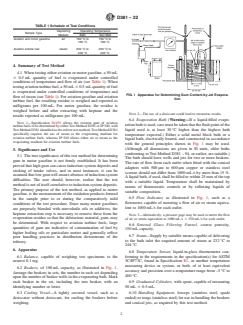
6.4 Evaporation Bath (Warning—If a liquid-filled evapo-
NOTE 1—Specification D1655 allows the existent gum of aviation
rationbathisused,caremustbetakenthattheflashpointofthe
turbinefuelstobedeterminedbyeitherTestMethodD381orIP540,with
liquid used is at least 30°C higher than the highest bath
TestMethodD381identifiedastherefereetestmethod.TestMethodD381
specifically requires the use of steam as the evaporating medium for
temperature expected.) Either a solid metal block bath or a
aviation turbine fuels, whereas IP 540 allows either air or steam as the
liquid bath, electrically heated, and constructed in accordance
evaporating medium for aviation turbine fuels.
with the general principles shown in Fig. 1 may be used.
(Although all dimensions are given in SI units, older baths
5. Significance and Use
conformingtoTestMethodD381–94,orearlier,aresuitable.)
5.1 Thetruesignificanceofthistestmethodfordetermining
The bath should have wells and jets for two or more beakers.
gum in motor gasoline is not firmly established. It has been
The rate of flow from each outlet when fitted with the conical
proved that high gum can cause induction-system deposits and
adapters with 500µm to 600µm copper or stainless steel
sticking of intake valves, and in most instances, it can be
screens should not differ from 1000mL⁄s by more than 15%.
assumedthatlowgumwillensureabsenceofinduction-system
Aliquidbath,ifused,shallbefilledtowithin25mmofthetop
difficulties. The user should, however, realize that the test
with a suitable liquid. Temperature shall be maintained by
methodisnotofitselfcorrelativetoinduction-systemdeposits.
means of thermostatic controls or by refluxing liquids of
The primary purpose of the test method, as applied to motor
suitable composition.
gasoline, is the measurement of the oxidation products formed
6.5 Flow Indicator, as illustrated in Fig. 1, such as a
in the sample prior to or during the comparatively mild
flowmeter, capable of metering a flow of air or steam equiva-
conditions of the test procedure. Since many motor gasolines
lent to 1000mL⁄s for each outlet.
are purposely blended with nonvolatile oils or additives, the
heptane extraction step is necessary to remove these from the
NOTE 3—Alternatively, a pressure gage may be used to meter the flow
evaporation residue so that the deleterious material, gum, may
of air or steam equivalent to 1000mL⁄s 6 150mL⁄s for each outlet.
be determined. With respect to aviation turbine fuels, large
6.6 Sintered Glass Filtering Funnel, coarse porosity,
quantities of gum are indicative of contamination of fuel by
150mL capacity.
higher boiling oils or particulate matter and generally reflect
6.7 Steam—Supply by suitable means capable of delivering
poor handling practices in distribution downstream of the
to the bath inlet the required amount of steam at 232°C to
refinery.
246°C.
6. Apparatus
6.8 Temperature Sensor, liquid-in-glass thermometer con-
6.1 Balance, capable of weighing test specimens to the forming to the requirements in the specification(s) for ASTM
nearest 0.1mg. 3C/IP73C, found in Specification E1, or another temperature
measuring device or system, or both, of at least equivalent
6.2 Beakers, of 100mL capacity, as illustrated in Fig. 1.
accuracyandprecisionoveratemperaturerangefrom–5°Cto
Arrange the beakers in sets, the number in each set depending
400°C.
uponthenumberofbeakerwellsintheevaporatingbath.Mark
each beaker in the set, including the tare beaker, with an 6.9 Graduated Cylinders, with spout, capable of measuring
identifying number or letter. 50mL 6 0.5mL.
6.3 Cooling Vessel—A tightly covered vessel, such as a 6.10 Handling Equipment, forceps (stainless steel, spade
desiccator without desiccant, for cooling the beakers before ended)ortongs(stainlesssteel)foruseinhandlingthebeakers
weighing. and conical jets, as required by this test method.
D381 − 22
7. Materials on performing the air flow calibration procedure. Note the
settingoftheflowindicatordeviceforusewithairandusethis
7.1 Air—Supply of filtered air at a pressure not more than
setting for subsequent tests.
35kPa.
10.1.1.1 One way to calibrate the air flow is to use a
7.2 Gum Solvent—A mixture of equal volumes of toluene
calibrated flow indicator device, such as a flowmeter, separate
and acetone.
from the device specified in 6.5, to check the air flow rate at
7.3 Heptane—Minimum purity of 99.7%. each outlet directly at room temperature and atmospheric
pressure. To obtain accurate results, ensure that the back
7.4 Steam—Supply of steam free of oily residue and at a
pressure of the flowmeter is less than 1kPa.
pressure not less than 35kPa. (Warning—If a steam super-
10.1.1.2 Alternatively, another way to calibrate the air flow
heater is used, there may be exposed hot surfaces on the steam
is to measure and adjust as appropriate the total air flow rate
superheater. Avoid contact with exposed skin by use of
(mL/s)suppliedtotheoutlets.Thetotalairflowrateequalsthe
protective equipment as required.)
expected air flow rate at each outlet times the number or outlet
8. Assembly of Air-Jet Apparatus positions (for example, instrument has 5 positions and a total
air flow rate measurement of 3000mL⁄s, indicating an ex-
8.1 Assemble the air-jet apparatus as shown in Fig. 1. With
pectedairflowrateof600mL⁄sateachoutlet).Onceverifying
the apparatus at room temperature, adjust the air flow to give a
the total flow supplied to the outlets is at the appropriate rate,
rate of 600mL⁄s 6 90mL⁄s for the outlet under test. Check
perform uniformity checks by comparing the relative air flow
the remaining outlets for uniform air flow.
rates at each outlet position versus the requirements in 10.1.1.
NOTE 4—A rate of 600mL⁄s 6 90mL⁄s from each outlet, at room
10.2 Steam Flow:
temperature and atmospheric pressure, will ensure delivery of 1000mL⁄s
6 150mL⁄s at the temperature of 155°C 6 5°C for each outlet. It is 10.2.1 Verifyorcalibratethesteamflowtoensurealloutlets
recommended to follow the manufacturers’ instructions to verify total
meet the 1000mL⁄s 6 150mL⁄s steam flow requirement.
flow/s (600mL⁄s air flow × number of outlets = total flow/s) and
Refer to the instrument manufacturer instructions for specific
uniformity from each outlet.
guidance on performing the steam flow calibration procedure.
8.2 Apply heat to the evaporation bath (see 6.4) until the
Notethesettingoftheflowindicatordeviceforusewithsteam
temperature of the bath is between 160°C and 165°C.
and use this setting for subsequent tests.
Introduce air into the apparatus at a rate indicated on the flow
10.2.1.1 One way to calibrate the steam flow, is to attach a
indicator(see6.5)fromtheexercisecarriedoutin8.1.Measure
copper tube to a steam outlet and extend the tube into a 2L
the temperature in each well with the temperature sensor (see
graduated cylinder that has been filled with crushed ice and
6.8) placed with the bulb or sensor tip resting on the bottom of
waterthathasbeenpreviouslyweighed.Exhaustthesteaminto
the beaker in the well. Do not use any well having a recorded
the cylinder for approximately 60s.Adjust the position of the
temperature outside the range from 150°C to 160°C.
cylinder so that the end of the copper tube is immersed in the
water to a depth of less than 50mm to prevent excessive back
9. Assembly of Steam-Jet Apparatus
pressure. After the appropriate time has elapsed, remove the
9.1 Assemble the steam-jet apparatus as shown in Fig. 1.
coppertubefromthecylinderandweighthecylinder.Thegain
(Warning—The sample and solvent vapors evaporated during
in mass represents the amount of steam condensed. Calculate
the performance of this test procedure can be extremely
the steam rate (mL/s) as follows:
fl
...
This document is not an ASTM standard and is intended only to provide the user of an ASTM standard an indication of what changes have been made to the previous version. Because
it may not be technically possible to adequately depict all changes accurately, ASTM recommends that users consult prior editions as appropriate. In all cases only the current version
of the standard as published by ASTM is to be considered the official document.
Designation: D381 − 19 D381 − 22
Standard Test Method for
Gum Content in Fuels by Jet Evaporation
This standard is issued under the fixed designation D381; the number immediately following the designation indicates the year of
original adoption or, in the case of revision, the year of last revision. A number in parentheses indicates the year of last reapproval. A
superscript epsilon (´) indicates an editorial change since the last revision or reapproval.
This standard has been approved for use by agencies of the U.S. Department of Defense.
1. Scope*
1.1 This test method covers the determination of the existent gum content of aviation fuels, and the gum content of motor gasolines
or other volatile distillates in their finished form, (including those containing alcohol and ether type oxygenates and deposit control
additives—see Note 7 for additional information) at the time of test.
1.2 Provisions are made for the determination of the heptane insoluble portion of the residue of non-aviation fuels.
1.3 The values stated in SI units are to be regarded as standard. No other units of measurement are included in this standard.
1.3.1 The accepted SI unit of pressure is the Pascal (Pa); the accepted SI unit for temperature is degrees Celsius.
1.4 WARNING—Mercury has been designated by many regulatory agencies as a hazardous substance that can cause serious
medical issues. Mercury, or its vapor, has been demonstrated to be hazardous to health and corrosive to materials. Use
Cautioncaution when handling mercury and mercury-containing products. See the applicable product Safety Data Sheet (SDS) for
additional information. The potential exists that selling mercury or mercury-containing products, or both, is prohibited by local or
national law. Users must determine legality of sales in their location.
1.5 This standard does not purport to address all of the safety concerns, if any, associated with its use. It is the responsibility
of the user of this standard to establish appropriate safety, health, and environmental practices and determine the applicability of
regulatory limitations prior to use. For specific warning statements, see 6.4, 7.4, and 9.1.
1.6 This international standard was developed in accordance with internationally recognized principles on standardization
established in the Decision on Principles for the Development of International Standards, Guides and Recommendations issued
by the World Trade Organization Technical Barriers to Trade (TBT) Committee.
2. Referenced Documents
2.1 ASTM Standards:
D1655 Specification for Aviation Turbine Fuels
D4057 Practice for Manual Sampling of Petroleum and Petroleum Products
D4175 Terminology Relating to Petroleum Products, Liquid Fuels, and Lubricants
E1 Specification for ASTM Liquid-in-Glass Thermometers
This test method is under the jurisdiction of ASTM Committee D02 on Petroleum Products, Liquid Fuels, and Lubricants and is the direct responsibility of Subcommittee
D02.14 on Stability, Cleanliness and Compatibility of Liquid Fuels.
Current edition approved Dec. 1, 2019April 1, 2022. Published December 2019May 2022. Originally approved in 1934. Last previous edition approved in 20172019 as
D381 – 12 (2017).D381 – 19. DOI: 10.1520/D0381-19.10.1520/D0381-22.
For referenced ASTM standards, visit the ASTM website, www.astm.org, or contact ASTM Customer Service at service@astm.org. For Annual Book of ASTM Standards
volume information, refer to the standard’s Document Summary page on the ASTM website.
*A Summary of Changes section appears at the end of this standard
Copyright © ASTM International, 100 Barr Harbor Drive, PO Box C700, West Conshohocken, PA 19428-2959. United States
D381 − 22
TABLE 1 Schedule of Test Conditions
Vaporizing Operating Temperature
Sample Type
Medium
Bath Test Well
Aviation and motor gasoline air 160 °C to 150 °C to
165 °C 160 °C
Aviation turbine fuel steam 232 °C to 229 °C to
246 °C 235 °C
E29 Practice for Using Significant Digits in Test Data to Determine Conformance with Specifications
2.2 Energy Institute Standard:
IP Standard Methods for Analysis and Testing of Petroleum Products
IP 540 Determination of the existent gum content of aviation turbine fuel – jet evaporation method
3. Terminology
3.1 Definitions:
3.1.1 For definitions of terms used in this test method, refer to Terminology D4175.
3.2 Definitions of Terms Specific to This Standard:
3.2.1 existent gum, n—the evaporation residue of aviation fuels, without any further treatment.
3.2.2 solvent washed gum content, n—the residue remaining when the evaporation residue (see 3.2.3) has been washed with
heptane and the washings discarded.
3.2.2.1 Discussion—
For motor gasoline or non-aviation gasoline, solvent washed gum content was previously referred to as existent gum.
3.2.3 unwashed gum content, n—the evaporation residue of the product or component under test, without any further treatment.
3.2 For non-aviation fuels, the following definitions apply.
3.3 solvent washed gum content, n—the residue remaining when the evaporation residue (see 3.4) has been washed with heptane
and the washings discarded.
3.3.1 Discussion—
For motor gasoline or non-aviation gasoline, solvent washed gum content was previously referred to as existent gum.
3.4 unwashed gum content, n—the evaporation residue of the product or component under test, without any further treatment.
4. Summary of Test Method
4.1 When testing either aviation or motor gasoline, a 50 mL 6 0.5 mL quantity of fuel is evaporated under controlled conditions
of temperature and flow of air (see Table 1). When testing aviation turbine fuel, a 50 mL 6 0.5 mL quantity of fuel is evaporated
under controlled conditions of temperature and flow of steam (see Table 1). For aviation gasoline and aviation turbine fuel, the
resulting residue is weighed and reported as milligrams per 100 mL. For motor gasoline, the residue is weighed before and after
extracting with heptane and the results reported as milligrams per 100 mL.
NOTE 1—Specification D1655 allows the existent gum of aviation turbine fuels to be determined by either Test Method D381 or IP 540, with Test Method
D381 identified as the referee test method. Test Method D381 specifically requires the use of steam as the evaporating medium for aviation turbine fuels,
whereas IP 540 allows either air or steam as the evaporating medium for aviation turbine fuels.
5. Significance and Use
5.1 The true significance of this test method for determining gum in motor gasoline is not firmly established. It has been proved
that high gum can cause induction-system deposits and sticking of intake valves, and in most instances, it can be assumed that low
gum will ensure absence of induction-system difficulties. The user should, however, realize that the test method is not of itself
Available from Energy Institute, 61 New Cavendish St., London, W1G 7AR, U.K., http://www.energyinst.org.
D381 − 22
FIG. 1 Apparatus for Determining Gum Content by Jet Evaporation
correlative to induction-system deposits. The primary purpose of the test method, as applied to motor gasoline, is the measurement
of the oxidation products formed in the sample prior to or during the comparatively mild conditions of the test procedure. Since
many motor gasolines are purposely blended with nonvolatile oils or additives, the heptane extraction step is necessary to remove
these from the evaporation residue so that the deleterious material, gum, may be determined. With respect to aviation turbine fuels,
large quantities of gum are indicative of contamination of fuel by higher boiling oils or particulate matter and generally reflect poor
handling practices in distribution downstream of the refinery.
6. Apparatus
6.1 Balance, capable of weighing test specimens to the nearest 0.1 mg.
6.2 Beakers, of 100 mL capacity, as illustrated in Fig. 1. Arrange the beakers in sets, the number in each set depending upon the
number of beaker wells in the evaporating bath. Mark each beaker in the set, including the tare beaker, with an identifying number
or letter.
6.3 Cooling Vessel—A tightly covered vessel, such as a desiccator without desiccant, for cooling the beakers before weighing.
NOTE 2—The use of a desiccant could lead to erroneous results.
6.4 Evaporation Bath (Warning—If a liquid-filled evaporation bath is used, care must be taken that the flash point of the liquid
used is at least 30 °C higher than the highest bath temperature expected.) Either a solid metal block bath or a liquid bath,
electrically heated, and constructed in accordance with the general principles shown in Fig. 1 may be used. (Although all
dimensions are given in SI units, older baths conforming to Test Method D381 – 94, or earlier, are suitable.) The bath should have
wells and jets for two or more beakers. The rate of flow from each outlet when fitted with the conical adapters with 500 μm to
600 μm copper or stainless steel screens should not differ from 1000 mL ⁄s by more than 15 %. A liquid bath, if used, shall be filled
to within 25 mm of the top with a suitable liquid. Temperature shall be maintained by means of thermostatic controls or by
refluxing liquids of suitable composition.
6.5 Flow Indicator, as illustrated in Fig. 1, such as a flowmeter, capable of metering a flow of air or steam equivalent to 1000 mL ⁄s
for each outlet.
NOTE 3—Alternatively, a pressure gage may be used to meter the flow of air or steam equivalent to 1000 mL ⁄s 6 150 mL ⁄s for each outlet.
6.6 Sintered Glass Filtering Funnel, coarse porosity, 150 mL capacity.
6.7 Steam—Supply by suitable means capable of delivering to the bath inlet the required amount of steam at 232 °C to 246 °C.
6.8 Temperature Sensor, liquid-in-glass thermometer conforming to the requirements in the specification(s) for ASTM 3C/IP73C,
found in Specification E1, or another temperature measuring device or system, or both, of at least equivalent accuracy and precision
over a temperature range from –5 °C to 400 °C.
D381 − 22
6.9 Graduated Cylinders, with spout, capable of measuring 50 mL 6 0.5 mL.
6.10 Handling Equipment, forceps (stainless steel, spade ended) or tongs (stainless steel) for use in handling the beakers and
conical jets, as required by this test method.
7. Materials
7.1 Air—Supply of filtered air at a pressure not more than 35 kPa.
7.2 Gum Solvent—A mixture of equal volumes of toluene and acetone.
7.3 Heptane—Minimum purity of 99.7 %.
7.4 Steam—Supply of steam free of oily residue and at a pressure not less than 35 kPa. (Warning—If a steam superheater is used,
there may be exposed hot surfaces on the steam superheater. Avoid contact with exposed skin by use of protective equipment as
required.)
8. Assembly of Air-Jet Apparatus
8.1 Assemble the air-jet apparatus as shown in Fig. 1. With the apparatus at room temperature, adjust the air flow to give a rate
of 600 mL ⁄s 6 90 mL ⁄s for the outlet under test. Check the remaining outlets for uniform air flow.
NOTE 4—A rate of 600 mL ⁄s 6 90 mL ⁄s from each outlet, at room temperature and atmospheric pressure, will ensure delivery of 1000 mL ⁄s 6 150 mL ⁄s
at the temperature of 155 °C 6 5 °C for each outlet. It is recommended to follow the manufacturers’ instructions to verify total flow/s (600 mL ⁄s air flow
× number of outlets = total flow/s) and uniformity from each outlet.
8.2 Apply heat to the evaporation bath (see 6.4) until the temperature of the bath is between 160 °C and 165 °C. Introduce air into
the apparatus at a rate indicated on the flow indicator (see 6.5) from the exercise carried out in 8.1. Measure the temperature in
each well with the temperature sensor (see 6.8) placed with the bulb or sensor tip resting on the bottom of the beaker in the well.
Do not use any well having a recorded temperature outside the range from 150 °C to 160 °C.
9. Assembly of Steam-Jet Apparatus
9.1 Assemble the steam-jet apparatus as shown in Fig. 1. (Warning—The sample and solvent vapors evaporated during the
performance of this test procedure can be extremely flammable or combustible and hazardous from the inhalation standpoint. The
evaporation bath must be provided with an effective exhaust hood to control such vapors and reduce the risk of thermal explosion.)
9.2 To place the apparatus in operation, apply heat to the bath. When the temperature reaches 232 °C, slowly introduce dry steam
into the system until a rate of 1000 mL ⁄s 6 150 mL ⁄s for each outlet is reached (see 10.2). Regulate the temperature of the bath
to a range from 232 °C to 246 °C to provide a well temperature of 232 °C 6 3 °C. Measure the temperature with the temperature
sensor, placed resting on the bottom of a beaker in one of the bath wells with the conical adapter in place. Any well having a
temperature that differs by more than 3 °C from 232 °C is not suitable for standard tests.
10. Calibration and Standardization
10.1 Air Flow:
10.1.1 Verify or calibrate the air flow to ensure all outlets meet the 600 mL ⁄s 6 90 mL ⁄s air flow requirement as measured at room
temperature and atmospheric pressure. Refer to the instrument manufacturer instructions for specific guidance on performing the
air flow calibration procedure. Note the setting of the flow indicator device for use with air and use this setting for subsequent tests.
10.1.1.1 One way to calibrate the air flow is to use a calibrated flow indicator device, such as a flowmeter, separate from the device
specified in 6.5, to check the air flow rate at each outlet directly at room temperature and atmospheric pressure. To obtain accurate
results, ensure that the back pressure of the flowmeter is less than 1 kPa.
D381 − 22
10.1.1.2 Alternatively, another way to calibrate the air flow is to measure and adjust as appropriate the total air flow rate (mL/s)
supplied to the outlets. The total air flow rate equals the expected air flow rate at each o
...