


ASTM F400-20
(Specification)Standard Consumer Safety Specification for Lighters
Standard Consumer Safety Specification for Lighters
SCOPE
1.1 This consumer safety specification covers all flame-producing consumer products commonly known as cigarette lighters, pipe lighters, and cigar lighters and such similar devices as defined in 3.1.9. Matches are specifically excluded from this safety specification; flame-producing products intended solely for igniting apparatus other than cigars, pipes, and cigarettes, including products covered by Specification F2201, are also specifically excluded from this safety specification. Lighters are specifically not intended for use as a candle, flashlight, or for other uses requiring an extended burn time.
1.2 This specification establishes requirements for lighters to ensure a reasonable degree of safety for normal use or reasonably foreseeable misuse of such lighters by users.
1.3 Lighters, being flame-producing devices, as do all flame sources, present a potential hazard to the consumer. This specification cannot eliminate all hazards, but is intended to minimize potential hazards of lighters to users.
1.4 The values stated in SI units are to be regarded as the standard. The values given in parentheses are for information only.
1.5 The following precautionary caveat pertains only to the test methods portion, Section 8, of this specification: This standard does not purport to address all of the safety concerns, if any, associated with its use. It is the responsibility of the user of this standard to establish appropriate safety, health, and environmental practices and determine the applicability of regulatory limitations prior to use.
1.6 This international standard was developed in accordance with internationally recognized principles on standardization established in the Decision on Principles for the Development of International Standards, Guides and Recommendations issued by the World Trade Organization Technical Barriers to Trade (TBT) Committee.
General Information
- Status
- Published
- Publication Date
- 31-Jul-2020
- Technical Committee
- F15 - Consumer Products
- Drafting Committee
- F15.02 - Safety Standards for Lighters
Relations
- Effective Date
- 01-Jan-2014
- Effective Date
- 01-May-2010
- Effective Date
- 01-Jul-2007
- Effective Date
- 10-Oct-2002
- Effective Date
- 10-Apr-2002
- Effective Date
- 10-Apr-2002
- Effective Date
- 01-Jan-1996
Overview
ASTM F400-20: Standard Consumer Safety Specification for Lighters is a critical safety standard published by ASTM International that establishes safety requirements for consumer lighters, including cigarette lighters, pipe lighters, and cigar lighters. This standard is designed to minimize potential hazards associated with flame-producing devices, protecting users during normal use and reasonably foreseeable misuse. The specification covers a wide range of manually operated lighters, both refillable and disposable, but specifically excludes matches and utility lighters designed for purposes other than lighting cigars, pipes, or cigarettes.
ASTM F400-20 sets forth clear definitions, performance criteria, labeling, and user instructions to improve lighter safety and reduce the risks of fire, burns, and accidental ignition, especially in the hands of consumers.
Key Topics
Product Scope
- Applies to all flame-producing consumer lighters (cigarette, pipe, cigar).
- Excludes matches and lighters not intended for personal tobacco use.
- Covers both refillable and non-refillable (disposable) lighters.
Safety Requirements
- Deliberate manual action is required to generate a flame.
- Flame height is limited by specific design and manufacturing controls.
- Maximum flame heights and after-burn durations are strictly defined for various types of lighters.
- No lighters may exhibit spitting, sputtering, or flaring during operation.
Structural Integrity
- Lighters must pass rigorous drop tests, temperature exposure, and continuous burn assessments.
- They must be free of sharp external edges to prevent consumer injury.
- Gas and fluid reservoirs must withstand pressure and fuel exposure tests.
Instructions and Labeling
- Lighters must be accompanied by clear safety instructions and warnings (e.g., "KEEP AWAY FROM CHILDREN").
- Instructions should cover correct usage, refilling (where applicable), and safe disposal.
- Safety information must be conspicuous and may include symbols and icons for user comprehension.
Applications
Consumer Product Safety
- Ensures lighters in the marketplace provide a reasonable degree of safety for typical and foreseeable consumer use.
- Helps prevent fire hazards, accidental burns, and unintentional ignition, especially among vulnerable populations such as children.
Manufacturing Compliance
- Used by manufacturers and importers to design, test, and certify their lighters.
- Guides product development to conform with recognized industry safety benchmarks.
- Supports global harmonization of lighter safety requirements and facilitates international trade.
Retail and Distribution
- Assists retailers in verifying the safety of lighter products offered to the public.
- Important for regulatory compliance and product recalls related to fire or injury hazards.
User Education
- Provides end-users with essential instructions to use lighters safely and avoid misuse.
- Enhances public awareness of lighter safety, storage, and refilling protocols.
Related Standards
- ASTM F2201: Consumer Safety Specification for Utility Lighters - covers lighters intended to ignite appliances or grills, not included in F400-20.
- UL 1439: Test for Sharpness of Edges on Equipment - referenced for assessing lighter safety regarding sharp edges.
- ISO 9994: International Standard for Lighter Safety - provides additional guidelines, especially for labeling and symbols.
- D2163 & D2598: ASTM test methods and practices for analysis and calculation related to liquefied petroleum gases used in lighters.
ASTM F400-20 serves as a foundational document for consumer lighter safety worldwide, helping manufacturers, regulators, and consumers mitigate the risks associated with flame-producing devices. For full compliance and the latest updates, always refer to the official ASTM publication.
Buy Documents
ASTM F400-20 - Standard Consumer Safety Specification for Lighters
REDLINE ASTM F400-20 - Standard Consumer Safety Specification for Lighters
Frequently Asked Questions
ASTM F400-20 is a technical specification published by ASTM International. Its full title is "Standard Consumer Safety Specification for Lighters". This standard covers: SCOPE 1.1 This consumer safety specification covers all flame-producing consumer products commonly known as cigarette lighters, pipe lighters, and cigar lighters and such similar devices as defined in 3.1.9. Matches are specifically excluded from this safety specification; flame-producing products intended solely for igniting apparatus other than cigars, pipes, and cigarettes, including products covered by Specification F2201, are also specifically excluded from this safety specification. Lighters are specifically not intended for use as a candle, flashlight, or for other uses requiring an extended burn time. 1.2 This specification establishes requirements for lighters to ensure a reasonable degree of safety for normal use or reasonably foreseeable misuse of such lighters by users. 1.3 Lighters, being flame-producing devices, as do all flame sources, present a potential hazard to the consumer. This specification cannot eliminate all hazards, but is intended to minimize potential hazards of lighters to users. 1.4 The values stated in SI units are to be regarded as the standard. The values given in parentheses are for information only. 1.5 The following precautionary caveat pertains only to the test methods portion, Section 8, of this specification: This standard does not purport to address all of the safety concerns, if any, associated with its use. It is the responsibility of the user of this standard to establish appropriate safety, health, and environmental practices and determine the applicability of regulatory limitations prior to use. 1.6 This international standard was developed in accordance with internationally recognized principles on standardization established in the Decision on Principles for the Development of International Standards, Guides and Recommendations issued by the World Trade Organization Technical Barriers to Trade (TBT) Committee.
SCOPE 1.1 This consumer safety specification covers all flame-producing consumer products commonly known as cigarette lighters, pipe lighters, and cigar lighters and such similar devices as defined in 3.1.9. Matches are specifically excluded from this safety specification; flame-producing products intended solely for igniting apparatus other than cigars, pipes, and cigarettes, including products covered by Specification F2201, are also specifically excluded from this safety specification. Lighters are specifically not intended for use as a candle, flashlight, or for other uses requiring an extended burn time. 1.2 This specification establishes requirements for lighters to ensure a reasonable degree of safety for normal use or reasonably foreseeable misuse of such lighters by users. 1.3 Lighters, being flame-producing devices, as do all flame sources, present a potential hazard to the consumer. This specification cannot eliminate all hazards, but is intended to minimize potential hazards of lighters to users. 1.4 The values stated in SI units are to be regarded as the standard. The values given in parentheses are for information only. 1.5 The following precautionary caveat pertains only to the test methods portion, Section 8, of this specification: This standard does not purport to address all of the safety concerns, if any, associated with its use. It is the responsibility of the user of this standard to establish appropriate safety, health, and environmental practices and determine the applicability of regulatory limitations prior to use. 1.6 This international standard was developed in accordance with internationally recognized principles on standardization established in the Decision on Principles for the Development of International Standards, Guides and Recommendations issued by the World Trade Organization Technical Barriers to Trade (TBT) Committee.
ASTM F400-20 is classified under the following ICS (International Classification for Standards) categories: 97.180 - Miscellaneous domestic and commercial equipment. The ICS classification helps identify the subject area and facilitates finding related standards.
ASTM F400-20 has the following relationships with other standards: It is inter standard links to ASTM D2163-14, ASTM F2201-10, ASTM D2598-02(2007), ASTM F2201-02e1, ASTM D2598-96(2001), ASTM D2598-02, ASTM D2163-91(1996). Understanding these relationships helps ensure you are using the most current and applicable version of the standard.
ASTM F400-20 is available in PDF format for immediate download after purchase. The document can be added to your cart and obtained through the secure checkout process. Digital delivery ensures instant access to the complete standard document.
Standards Content (Sample)
This international standard was developed in accordance with internationally recognized principles on standardization established in the Decision on Principles for the
Development of International Standards, Guides and Recommendations issued by the World Trade Organization Technical Barriers to Trade (TBT) Committee.
Designation:F400 −20 An American National Standard
Standard Consumer Safety Specification for
Lighters
ThisstandardisissuedunderthefixeddesignationF400;thenumberimmediatelyfollowingthedesignationindicatestheyearoforiginal
adoptionor,inthecaseofrevision,theyearoflastrevision.Anumberinparenthesesindicatestheyearoflastreapproval.Asuperscript
epsilon (´) indicates an editorial change since the last revision or reapproval.
1. Scope 2. Referenced Documents
1.1 This consumer safety specification covers all flame- 2.1 ASTM Standards:
D2163Test Method for Determination of Hydrocarbons in
producing consumer products commonly known as cigarette
Liquefied Petroleum (LP) Gases and Propane/Propene
lighters, pipe lighters, and cigar lighters and such similar
Mixtures by Gas Chromatography
devices as defined in 3.1.9. Matches are specifically excluded
D2598Practice for Calculation of Certain Physical Proper-
from this safety specification; flame-producing products in-
ties of Liquefied Petroleum (LP) Gases from Composi-
tended solely for igniting apparatus other than cigars, pipes,
tional Analysis
and cigarettes, including products covered by Specification
F2201Consumer Safety Specification for Utility Lighters
F2201, are also specifically excluded from this safety specifi-
cation. Lighters are specifically not intended for use as a
2.2 Other Standards:
candle, flashlight, or for other uses requiring an extended burn
ISO 7941Commerical Propane and Butane–Analysis by
time.
Gas Chromatography
UL 1439Test for Sharpness of Edges on Equipment
1.2 This specification establishes requirements for lighters
2.3 Other references for general information are noted in
to ensure a reasonable degree of safety for normal use or
Annex A1.
reasonably foreseeable misuse of such lighters by users.
1.3 Lighters,beingflame-producingdevices,asdoallflame
3. Terminology
sources, present a potential hazard to the consumer. This
3.1 Definitions of Terms Specific to This Standard:
specification cannot eliminate all hazards, but is intended to
3.1.1 burner valve—componentofagaslighterthatcontrols
minimize potential hazards of lighters to users.
the release of fuel.
1.4 The values stated in SI units are to be regarded as the
3.1.2 burner valve orifice—tip of the burner valve from
standard. The values given in parentheses are for information
which fuel is released.
only.
3.1.3 dual flame type lighter—gas lighter that employs a
1.5 The following precautionary caveat pertains only to the
burner valve system(s) that produces more than one type of
test methods portion, Section 8, of this specification: This
flame (premixing and postmixing), which allows for a flame to
standard does not purport to address all of the safety concerns,
be produced independently and separately (one flame at a
if any, associated with its use. It is the responsibility of the user
time), or dependently and concurrently (multiple flames at a
of this standard to establish appropriate safety, health, and
time).
environmental practices and determine the applicability of
3.1.4 flame—result of combustion of fuel that produces heat
regulatory limitations prior to use.
and often light which is visible with the naked eye under
1.6 This international standard was developed in accor-
normal or subdued lighting conditions.
dance with internationally recognized principles on standard-
3.1.5 flame height—linear distance from the tip of the
ization established in the Decision on Principles for the
visible flame to the top of the shield or, in the absence of a
Development of International Standards, Guides and Recom-
mendations issued by the World Trade Organization Technical
Barriers to Trade (TBT) Committee.
For referenced ASTM standards, visit the ASTM website, www.astm.org, or
contact ASTM Customer Service at service@astm.org. For Annual Book of ASTM
Standards volume information, refer to the standard’s Document Summary page on
This specification is under the jurisdiction of ASTM Committee F15 on the ASTM website.
Consumer Products and is the direct responsibility of Subcommittee F15.02 on Available from International Organization for Standardization (ISO), ISO
Safety Standards for Lighters. Central Secretariat, BIBC II, Chemin de Blandonnet 8, CP 401, 1214 Vernier,
Current edition approved Aug. 1, 2020. Published September 2020. Originally Geneva, Switzerland, http://www.iso.org.
approved in 1975. Last previous edition approved in 2019 as F400–19. DOI: Available from Underwriters Laboratories (UL), 2600 N.W. Lake Rd., Camas,
10.1520/F0400-20. WA 98607-8542, http://www.ul.com.
Copyright © ASTM International, 100 Barr Harbor Drive, PO Box C700, West Conshohocken, PA 19428-2959. United States
F400−20
shield, from the tip of the visible flame to the top of the burner (one flame at a time), or dependently and concurrently (mul-
valve orifice or to the bottom of the exposed wick. tiple flames at a time).
3.1.22 shield—structure that totally or partially surrounds
3.1.6 flaring—varianceofflameheightfromthesteady-state
the burner valve orifice of a gas lighter or the wick of a fluid
flame condition.
lighter.
3.1.7 fuel—a petrochemical based material in a lighter that
3.1.23 spitting or sputtering—flame phenomenon of a gas
is released and combusted to release energy as heat and often
lighter wherein escape of non-evaporated, liquefied gas pro-
light which is in the form of a flame.
duces a shower of burning liquid droplets which separate from
3.1.8 ignite—to produce a flame with a lighter by activating
the main flame.
the self-contained ignition and fuel release systems of that
3.1.24 sustained self-ignition—propagation of a flame by
lighter in the intended manner.
other than deliberate manual operation (for example, dropping
3.1.9 lighter—manually operated flame-producing device
the lighter), so as to cause the ignition element to be activated,
employing a fuel and an ignition system. It is intended and
producing a flame, and the flame continues to burn.
normally used for deliberately igniting cigarettes, pipes, and
cigars, and foreseeably be used to ignite materials such as
4. General Requirements
paper, wicks, candles, and lanterns.
4.1 Flame Generation—In order to minimize the possibility
3.1.10 lighter, adjustable—lighter provided with a mecha-
ofinadvertentorself-ignition,lightersshallrequireadeliberate
nism for the user to vary the height of the flame.
manual operation to produce a flame. This operation shall
conform to at least one of the following requirements:
3.1.11 lighter, automatic adjusting pipe—lighter designed
4.1.1 A system such that positive action on the part of the
specifically for the purpose of lighting pipes and characterized
user is required to generate and maintain a flame.
by an automatic increase in flame height when tilted from an
4.1.2 A system that requires two or more independent
upright position.
motions to generate a flame.
3.1.12 lighter, fluid—lighter that utilizes a hexane-type fluid
4.1.3 A system that requires an actuating force equal to or
such as petrol or naphtha whose vapor pressure at 24°C
greater than 15 N (3.4 lbf) to generate a flame (see Fig. 1 and
(75°F) does not exceed a gage pressure of 34 kPa (5 psi).
Fig. 2 for examples of test methods).
3.1.13 lighter, gas—lighter that utilizes a butane, isobutane,
4.1.4 Or any combination thereof (4.1.1, 4.1.2, 4.1.3).
propane, or other liquefied hydrocarbon mixture whose vapor
4.2 Flame Control—The maximum attainable flame height
pressure at 24°C (75°F) exceeds a gage pressure of 104 kPa
forlightersshallbelimitedwithasettingorbyproductdesign,
(15psi).
or both. For adjustable flame-height lighters, the maximum
3.1.14 lighter, nonadjustable—lighter that has a flame
flame height that a user will obtain on first striking the lighter
height preset by the manufacturer and is not provided with a
without adjustment shall also be limited. These limits shall
mechanism to adjust the flame height.
comply with the following requirements when tested in accor-
dance with 8.1:
3.1.15 lighter, non-refillable (disposable)—lighter provided
4.2.1 Nonadjustablefluidlighters,inaccordancewith3.1.12
with a supply of fuel from the manufacturer and that is not
and 3.1.14, shall not be capable of producing a flame height
intended to be refueled.
greater than 120 mm (4.75 in.) when tested in accordance with
3.1.16 lighter, non-self-extinguishing—lighter that, once
8.1.
ignited, does not require intentional or positive action by the
4.2.2 Nonadjustable, postmixing and premixing burner gas
user to maintain a flame and requires a subsequent, deliberate
lighters, in accordance with 3.1.14, 3.1.17, and 3.1.18, shall
user action to extinguish the flame.
3.1.17 lighter, postmixing burner—gas lighter in which fuel
and air is mixed at the point of combustion.
3.1.18 lighter, premixing burner—gas lighter in which fuel
and air is mixed before being supplied for combustion.
3.1.19 lighter, refillable—lighter that is intended to be refu-
eled either by decanting fuel from an external container or by
inserting a new prefilled fuel reservoir.
3.1.20 lighter, self-extinguishing—lighter that, once ignited,
requires continuous intentional and positive action to maintain
a flame and that is subsequently extinguished upon the termi-
nation of such positive action.
3.1.21 multiple flame type lighter—gas lighter that employs
a burner valve system(s) that produces more than one flame of
FIG. 1 Block Diagram for a Typical Example of Test Method for
the same type of flame (premixing or postmixing), which
Measuring the Flame Generation Actuating Force as Specified in
allowsforaflametobeproducedindependentlyandseparately 4.1.3
F400−20
4.2.10 Multiple flame type lighters, in accordance with
3.1.21, the flame height of each flame shall comply with the
corresponding requirement for that type of lighter and flame
provided in 4.2.
4.3 Flame-Height Adjustment—Adjustable flame height
lighters in accordance with 3.1.10 shall require a deliberate
action on the part of the user to increase or decrease the flame
height when the lighter is used in the normal fashion.
4.3.1 For flame control actuators that protrude from the
body of the lighter, it shall require a minimum actuating force
of 1 N (0.25 lbf) applied over the entire range of adjustment in
a tangential direction (see Fig. 3 for an example of the test
method).
4.3.2 Adjustablegaslightershavingrotarymovementflame
FIG. 2 Block Diagram for a Typical Example of Test Method for
control actuators approximately at right angles to the flame
Measuring Force as Specified in 4.1.3
shall perform as follows:
4.3.2.1 When the flame control actuator is at the top of the
lighter and the lighter held so the flame is oriented vertically
upward, and the user is facing the flame control actuator,
have a maximum attainable flame height of no more than
moving the actuator to the left shall produce a decrease in
50mm (2 in.) when tested in accordance with 8.1.
flame height.
4.2.3 Adjustable postmixing burner lighters, in accordance
4.3.2.2 When the flame control actuator is at the bottom of
with 3.1.10 and 3.1.17, shall not be capable of producing a
the lighter and the lighter held so that the user is looking at the
flameheightgreaterthan120mm(4.7in.)forrefillablelighters
actuator, a clockwise movement shall result in a decrease in
and no greater than 100 mm (4 in.) for non-refillable lighters
flame height.
when deliberately adjusted by the user to the manufacturer’s
4.3.3 Adjustable gas lighters requiring motion of the flame
design limit for maximum flame height and when tested in
control actuator approximately parallel to the flame axis shall
accordance with 8.1.
decreaseorincreasetheflameheightaccordingtothedirection
4.2.4 Adjustable premixing burner lighters, in accordance
of the movement.
with 3.1.10 and 3.1.18, shall not be capable of producing a
4.3.4 Adjustable flame height lighters shall indicate the
flame height greater than 75 mm (3 in.) when deliberately
direction of movement to produce a higher or lower flame
adjusted by the user to the manufacturer’s design limit for
height. On lighters whose adjusting mechanisms conform to
maximum flame height and when tested in accordance with
4.3.2 and 4.3.3, the direction of movement shall be perma-
8.1.
nently imprinted or engraved on the lighter. Such permanent
information shall be placed on the lighter in the vicinity of the
4.2.5 Adjustable postmixing burner lighters, in accordance
with 3.1.10 and 3.1.17, shall have the flame height adjusted by adjusting mechanism and be readily visible and understand-
able.
the manufacturer in such a manner that the lighter, when first
ignited by the user without changing the adjustment, will not
4.4 Spitting or Sputtering and Flaring—Gas lighters as
produceaflameheightinexcessof100mm(4in.)whentested
defined in 3.1.13 when set at the maximum flame height, shall
in accordance with 8.1.
exhibit no spitting or sputtering as defined in 3.1.23 or flaring
4.2.6 Adjustable premixing burner lighters, in accordance
as defined in 3.1.6, when tested in accordance with 8.2.
with 3.1.10 and 3.1.18, shall have the flame height adjusted by
4.5 Flame Extinction:
the manufacturer in such a manner that the lighter, when first
4.5.1 Adjustablepostmixingburnerlighters,aftera5-sburn
ignited by the user without changing the adjustment, will not
at maximum flame height, when extinguished in the intended
produce a flame height in excess of 60 mm (2.5 in.) when
tested in accordance with 8.1.
4.2.7 All adjustable flame height lighters, in accordance
with3.1.10,shallbecapableofproducingaflamenotinexcess
of 50 mm (2 in.) when set at the lowest possible flame height
when tested in accordance with 8.1.
4.2.8 Automatic adjusting pipe lighters, in accordance with
3.1.11,shallnotbecapableofproducingaflameheightgreater
than 100 mm (4 in.) when tested in accordance with 8.1 and
8.2.
4.2.9 Dual flame type lighters, in accordance with 3.1.3, for
each type of flame, the flame height shall comply with the
FIG. 3 Block Diagram for a Typical Example of Test Method for
corresponding requirement for that type of lighter and flame
Measuring the Flame Control Actuating Force as Specified in
provided in 4.2. 4.3.1
F400−20
manner, such as by closing a cover or releasing a button or ⁄min. For lighters that remain operable, the subsequent safe
lever, shall have any exposed flame completely extinguished operation of the lighter must not be impaired.
within 2 s after such action is completed when tested in 5.2.2 Fluid lighters as defined in 3.1.12 must be capable of
accordance with 8.3. In the case of postmixing burner lighters withstanding three separate 1.5-m 6 0.1-m (5-ft 6 0.3-ft or 6
thathaveshields,anadditional2-safterburnisacceptableonly 4-in.) drops conducted in accordance with 8.4, without fuel
when the flame height during this additional 2-s period does reservoir rupture, and without resulting in sustained self-
not extend above the shield. ignition as defined in 3.1.24. For lighters that remain operable,
4.5.2 Adjustable postmixing burner lighters at a flame the subsequent safe operation of the lighter must not be
heightof50mm(2in.),orthemaximumheighttheadjustment impaired.
allows, if lower than 50 mm (2 in.) or nonadjustable postmix- 5.2.3 Lighters that meet the requirements of 5.2.1 or 5.2.2,
ing burner lighters at their permanently set flame heights, after and that are able to be ignited in the intended manner shall
a10-sburn,whenextinguishedintheintendedmanner,suchas subsequently meet all the applicable requirements of 4.1 – 4.5,
byclosingacoverorreleasingabuttonorlever,shallhaveany inclusive.
exposed flame completely extinguished within 2 s after such
5.3 Temperature Test—Lighters shall be capable of with-
action is completed, when tested in accordance with8.3.Inthe
standing a temperature of 65°C 6 2°C (149°F 6 4°F) for 4
case of gas lighters that have shields, an additional 2-s
h when tested in accordance with 8.5.
afterburn is acceptable only when the flame height during this
5.3.1 Lightersthatmeettherequirementsof5.3andthatare
additional 2-s period does not extend above the shield.
able to be ignited in the intended manner shall subsequently
4.5.3 Adjustable premixing burner lighters, after a 5-s burn
meet all the applicable requirements of 4.1 – 4.5, inclusive.
at maximum flame height, when extinguished in the intended
5.4 Burning Test—Adjustable gas lighters with the flame
manner, such as by closing a cover or releasing a button or
height set at maximum, nonadjustable gas lighters at their
lever,shallhaveanyexposedflamecompletelyextinguishedin
permanently set flame heights, or fluid-type lighters shall be
no more than 5 s, when tested in accordance with 8.3.
capable of withstanding a burning time of 5 s with the lighter
4.5.4 Adjustable premixing burner lighters, when set at a
in a position 45° 6 5° below horizontal (see Fig. 4) without
flameheightof50mm(2in.)orthemaximumflameheightthe
evidence of any burning or distortion of components so as to
adjustment allows for flames lower than 50 mm, or nonadjust-
cause a hazardous condition.
able premixing burner lighters at their permanently set flame
5.4.1 Adjustable gas lighters with the flame height set at
heights, after a 10-s burn, when extinguished in the intended
50mm (2 in.) or the maximum flame height the adjustment
manner, such as by closing a cover or releasing a button or
allows, for flames lower than 50 mm, nonadjustable gas
lever,shallhaveanyexposedflamecompletelyextinguishedin
lighters at their permanently set flame heights, or fluid-type
no more than 5 s, when tested in accordance with 8.3.
lightersshallbecapableofwithstandingatotalburningtimeof
NOTE 1—In the case of premixing burner lighters, the total afterburn
10 s in two different attitudes (a) with the flame directed
time of5sin this specification will be reconsidered periodically with a
vertically upward and (b) with the flame directed 45º 6 5°
view to gradual reduction in line with technological progress.
below horizontal (see Fig. 4), without evidence of any burning
4.5.5 Dual flame type lighters, for each type of flame, the
or distortion of components so as to cause a hazardous
extinction time shall comply with the corresponding require-
condition.
ment for that type of lighter and flame provided in 4.5.
5.4.2 Lightersthatmeettherequirementsof5.4,andthatare
4.5.6 Multiple flame type lighters, for each flame, the
able to be ignited in the intended manner shall subsequently
extinction time shall comply with the corresponding require-
meet all the applicable requirements of 4.1 – 4.5, inclusive.
ment for that type of lighter and flame provided in 4.5.
5.5 Continuous Burn—Adjustable gas lighters with the
4.6 Volumetric Displacement—Forgaslightersshippedwith
flame set at 50 mm (2 in.) or the maximum flame height the
fuel, the liquid portion of the fuel shall not exceed 85% of the
adjustmentallows,forflameslowerthan50mm,nonadjustable
volumetric capacity of the fuel chamber when tested in
accordance with 8.14.
4.7 Weight of Fuel—For gas lighters shipped with fuel, the
weight of the liquefied fuel shall not exceed 10 g.
5. Structural Integrity Requirements
5.1 Lighters shall have structural integrity as specified in
requirements 5.2 – 5.9 (Table A2.1).
5.2 Drop Test:
5.2.1 Postmixing and premixing burner lighters as defined
in 3.1.17 and 3.1.18 must be capable of withstanding three
separate 1.5-m 6 0.1-m (5-ft 6 0.3-ft or 6 4-in.) drops
conducted in accordance with 8.4, without fuel reservoir
fragmentation, without resulting in sustained self-ignition as
defined in 3.1.24, and without gas escape exceeding 15mg- FIG. 4Lighter in a Position of 45° 6 5°
F400−20
gaslightersattheirpermanentlysetflameheights,orfluid-type 7. Instructions and Warnings
lighters shall be capable of withstanding a continuous burning
7.1 All lighters shall be accompanied by the appropriate
time of 2 min with the lighter and flame directed vertically
safety information (instructions or warnings, or both) commu-
upward without causing a hazardous condition, when tested in
nicating the proper method of use.
accordance with 8.6.
7.2 This safety information shall be either on the lighters
5.6 Cycling Burn—Adjustable gas lighters with the flame
themselves, or on a separate brochure or pamphlet packaged
set at 50 mm (2 in.) or the maximum flame height the
with the lighters, or on the product packaging at the point of
adjustmentallows,forflameslowerthan50mm,nonadjustable
sale. The format for this information shall emphasize the
gas lighters at their permanently set flame height, or fluid-type
warnings that are most appropriate to the type of lighter. This
lighters shall be capable of withstanding a burning time of 20
safetyinformationshallbeconspicuouslyplacedwithcontrast-
s, repeated 10 times, when tested in accordance with 8.7.
ing background color, type size, or style that makes it distinct
5.6.1 Gas and fluid lighters that meet this requirement, and from other information.
that are able to be ignited in the intended manner shall
7.3 For all lighters, the safety information shall be accom-
subsequently meet all the applicable requirements of 4.1 – 4.5,
panied by the specific signal word “WARNING” in close
inclusive. Any lighter that cannot make a flame shall not be
proximity to the safety information.
classified as a failure.
7.4 For all lighters, the safety information shall contain the
5.7 External Finish—Lighters shall have no external sharp
following statements:
edges that would cause accidental cuts or abrasions to the user
7.4.1 “KEEP AWAY FROM CHILDREN”or“KEEP
whenhandledorusedintheintendedmanner.Initialinspection
OUT OF REACH OF CHILDREN.” (The statement used
to be performed by visual and tactile (moving a finger slowly
shall be emphasized and distinctive.)
and carefully) assessments over the lighter to predetermine for
7.4.2 Ignite lighter away from face and clothing.
any sharp edges that are present. For any sharp edges found,
then test for sharp edges in accordance with UL 1439.
7.5 For all lighters, the safety information shall include the
substanceofthefollowingasappropriatetothetypeoflighter:
5.8 Compatibility:
7.5.1 Be sure the flame is out after use.
5.8.1 Components of gas lighters as defined in 3.1.13 that
7.5.2 This lighter does not self-extinguish; close cover to
come in contact with the fuel recommended by the manufac-
put out. (This statement shall accompany all non-self-
turershallnotdeteriorateaftertheexposuretothefuel,soasto
extinguishing lighters.)
cause the lighter to fail any of the criteria contained in this
7.5.3 Contains flammable gas under pressure.
specification or allow gas escape exceeding 15 mg/min when
7.5.4 When filled, will contain flammable gas under pres-
tested in accordance with 8.8.
sure.
5.8.2 Components of fluid lighters as defined in 3.1.12 that
7.5.5 Contains flammable fluid.
come in contact with the fuel recommended by the manufac-
turer shall not deteriorate after extended contact with that fuel, 7.5.6 When filled, will contain flammable fluid.
so as to fail any of the criteria contained in this specification
7.5.7 Never expose to heat above 50°C (122°F) or to
when tested in accordance with 8.9.
prolonged sunlight.
5.8.3 Gas and fluid lighters that meet this requirement, and
7.5.8 Never puncture or put in fire.
that are able to be ignited in the intended manner shall
7.5.9 Extreme heat is present above the visible flame. Extra
subsequently meet all the applicable requirements of 4.1 – 4.5,
care must be taken to prevent burn injury or fire. (This
inclusive.
statement shall accompany all premixing burner lighters.)
7.5.10 Do not keep lit for more than 10 s. (This statement
5.9 Pressure Tests—Gas lighters shall be capable of with-
shall accompany all premixing burner lighters.)
standing an internal pressure of two times the vapor pressure
occurring at 55°C (131°F) of the fuel recommended by the
7.6 Refilling Instructions for Gas Lighters—Refillable gas
manufacturer when tested in accordance with 8.10.
lighters, as defined in 3.1.13 and 3.1.19, shall be accompanied
by specific instructions as to the correct procedure to accom-
6. Refillable Lighters
plish the refill operation. These instructions shall include the
fuel recommended by the manufacturer and the appropriate
6.1 Refillable fluid lighters having a sealed fuel reservoir
information to ensure the proper mating between the refill
shall be free of fuel leakage from both the sealed reservoir and
container and the fuel tank of the lighter.
the sealing closure when tested in accordance with 8.11, when
such sealing closure is installed in the lighter by the user in the
7.7 Refilling Instructions for Fluid Lighters:
intended manner.
7.7.1 Fluid lighters, as defined in 3.1.12, shall be accompa-
nied by the substance of the following:
6.2 Refillable Gas Lighters—The refilling valve in a pres-
7.7.1.1 Fill only with the type of fluid recommended by the
surized fuel reservoir lighter shall be secure enough so as not
manufacturer.
to allow an escape of gas exceeding 15 mg/min when tested in
accordance with 8.13. 7.7.1.2 Fill slowly; do not overfill.
F400−20
7.7.1.3 After filling, wipe lighter and hands dry before 8.2.1 Test Specimens—The test specimens shall consist of
igniting. This is a special instruction that shall be provided lighters that are fueled in accordance with the manufacturer’s
from the manufacturer by at least one of the following specifications.
methods: 8.2.2 Procedure:
(1)On a label attached to the lighter.
8.2.2.1 Stabilize all lighters at 23°C 6 2°C (73°F 6 4°F)
(2)Printed directly on the lighter.
for at least 10 h prior to performing the test described in
(3)Printed in the safety information provided with the
8.2.2.3.
lighter.
8.2.2.2 For lighters that are adjustable as defined in 3.1.10,
adjust the flame to maximum flame height position.
7.8 Symbols, Signs, and Icons—In place of or in addition to
8.2.2.3 Ignite the lighter and observe for spitting or sputter-
theinstructionsandwarningsin7.4,theuseofappropriateand
ing as defined in 3.1.23 during a 5-s burn in any handheld
recognizable symbols, signs, and icons are acceptable to be
position. Any evidence of spitting or sputtering constitutes a
provided to the consumer. These safety symbols, signs, and
failure. For a lighter that does not fail, restabilize for a
iconsshallbesimilartothoseinothersafetystandards,suchas
minimum of 5 min at 23°C 6 2°C (73°F 6 4°F) before
ISO 9994 (as a reference listed in A1.2) or comply with
continuing with 8.2.2.4. For different gas lighters that are used
applicable government regulations or meet applicable industry
toconductthetestdescribedin8.2.2.4,stabilizeeachlighterin
safety standard guidelines.
accordance with 8.2.2.1.
8.2.2.4 Ignite the lighter with the flame directed vertically
8. Test Methods
upward and observe the flame height, and invert the lighter to
a position 45° 6 5° below horizontal (see Fig. 4). Any
SAFETY STATEMENT–Persons using this consumer
safety specification shall be familiar with normal variationinflameheightexceeding50mm(2in.)duringatotal
elapsed time of5sora flame height exceeding the require-
laboratory practices that are applicable. This consumer
safety specification does not propose to address all ments specified in 4.2 constitutes a failure. For a lighter that
does not fail, restabilize for a minimum of 5 min at 23°C 6
possible safety concerns that are associated with the use
of this standard. It is the responsibility of the user/tester 2°C (73°F 6 4°F) before continuing with 8.2.2.5. For
differentgaslightersthatareusedtoconductthetestdescribed
to establish appropriate safety and health practices and
to ensure compliance with any regulatory requirements. in 8.2.2.5, stabilize each lighter in accordance with 8.2.2.1.
Automatic adjusting pipe lighters as defined in 3.1.11 shall be
8.1 Flame-Height Measurement—The purpose of this pro-
excluded from this test.
cedure is to define the method of measurement of lighter flame
8.2.2.5 Invert the lighter for a period of 10 s. Return the
height.
lightertoanuprightpositionandignitethelighter.Observethe
8.1.1 Apparatus—A nonflammable board scribed in 5-mm
flame height during a 5-s burn. Any variation of flame
(0.25-in.) increments. The board shall be fitted with a standoff
exceeding 50 mm (2 in.) or a flame height exceeding the
atthebasepointthatpositionsthelighteratleast25mm(1in.)
requirements specified in 4.2 constitutes a failure. Automatic
from the board.The board shall be supported vertically by any
adjusting pipe lighters as defined in 3.1.11 shall be excluded
convenient means and tests conducted inside a draft-free
from this test.
chamber constructed from suitable nonflammable materials.
8.3 Flame Extinction Test—The purpose of this test is to
8.1.2 Test Specimens—The test specimens shall consist of
verify that lighters extinguish safely.
lightersthatarenew,complete,andfueledbythemanufacturer
8.3.1 Test Specimens—The test specimens shall consist of
or in accordance with the manufacturer’s specifications and
lighters that are fueled in accordance with the manufacturer’s
shall be free of pre-existing mechanical damage.
specifications.
8.1.3 Procedure:
8.3.2 Apparatus—The same as for flame height measure-
8.1.3.1 Stabilize all lighters at 23°C 6 2°C (73°F 6 4°F)
me
...
This document is not an ASTM standard and is intended only to provide the user of an ASTM standard an indication of what changes have been made to the previous version. Because
it may not be technically possible to adequately depict all changes accurately, ASTM recommends that users consult prior editions as appropriate. In all cases only the current version
of the standard as published by ASTM is to be considered the official document.
Designation: F400 − 19 F400 − 20 An American National Standard
Standard Consumer Safety Specification for
Lighters
This standard is issued under the fixed designation F400; the number immediately following the designation indicates the year of original
adoption or, in the case of revision, the year of last revision. A number in parentheses indicates the year of last reapproval. A superscript
epsilon (´) indicates an editorial change since the last revision or reapproval.
1. Scope
1.1 This consumer safety specification covers all flame-producing consumer products commonly known as cigarette lighters, pipe
lighters, and cigar lighters and such similar devices as defined in 3.1.9. Matches are specifically excluded from this safety
specification; flame-producing products intended solely for igniting apparatus other than cigars, pipes, and cigarettes, including
products covered by Specification F2201, are also specifically excluded from this safety specification. Lighters are specifically not
intended for use as a candle, flashlight, or for other uses requiring an extended burn time.
1.2 This specification establishes requirements for lighters to ensure a reasonable degree of safety for normal use or reasonably
foreseeable misuse of such lighters by users.
1.3 Lighters, being flame-producing devices, can, as do all flame sources, present a potential hazard to the consumer. This
specification cannot eliminate all hazards, but is intended to minimize potential hazards of lighters to users.
1.4 The values stated in SI units are to be regarded as the standard. The values given in parentheses are for information only.
1.5 The following precautionary caveat pertains only to the test methods portion, Section 8, of this specification: This standard
does not purport to address all of the safety concerns, if any, associated with its use. It is the responsibility of the user of this
standard to establish appropriate safety, health, and environmental practices and determine the applicability of regulatory
limitations prior to use.
1.6 This international standard was developed in accordance with internationally recognized principles on standardization
established in the Decision on Principles for the Development of International Standards, Guides and Recommendations issued
by the World Trade Organization Technical Barriers to Trade (TBT) Committee.
2. Referenced Documents
2.1 ASTM Standards:
D2163 Test Method for Determination of Hydrocarbons in Liquefied Petroleum (LP) Gases and Propane/Propene Mixtures by
Gas Chromatography
D2598 Practice for Calculation of Certain Physical Properties of Liquefied Petroleum (LP) Gases from Compositional Analysis
F2201 Consumer Safety Specification for Utility Lighters
This specification is under the jurisdiction of ASTM Committee F15 on Consumer Products and is the direct responsibility of Subcommittee F15.02 on Safety Standards
for Lighters.
Current edition approved May 1, 2019Aug. 1, 2020. Published June 2019September 2020. Originally approved in 1975. Last previous edition approved in 20102019 as
F400 – 10.F400 – 19. DOI: 10.1520/F0400-19.10.1520/F0400-20.
For referenced ASTM standards, visit the ASTM website, www.astm.org, or contact ASTM Customer Service at service@astm.org. For Annual Book of ASTM Standards
volume information, refer to the standard’s Document Summary page on the ASTM website.
Copyright © ASTM International, 100 Barr Harbor Drive, PO Box C700, West Conshohocken, PA 19428-2959. United States
F400 − 20
2.2 Other Standards:
ISO 7941 Commerical Propane and Butane – Analysis by Gas Chromatography
UL 1439 Test for Sharpness of Edges on Equipment
2.3 Other references for general information are noted in Annex A1.
3. Terminology
3.1 Definitions of Terms Specific to This Standard:
3.1.1 burner valve—component of a gas lighter that controls the release of fuel.
3.1.2 burner valve orifice—tip of the burner valve from which fuel is released.
3.1.3 dual flame type lighter—gas lighter that employs a burner valve system(s) that produces more than one type of flame
(premixing and postmixing), which could allows for a flame to be produced independently and separately (one flame at a time),
or dependently and concurrently (multiple flames at a time).
3.1.4 flame—result of combustion of fuel that produces heat and often light which may be is visible with the naked eye under
normal or subdued lighting conditions.
3.1.5 flame height—linear distance from the tip of the visible flame to the top of the shield or, in the absence of a shield, from
the tip of the visible flame to the top of the burner valve orifice or to the bottom of the exposed wick.
3.1.6 flaring—variance of flame height from the steady-state flame condition.
3.1.7 fuel—a petrochemical based material in a lighter that is released and combusted to release energy as heat and often light
which may be is in the form of a flame.
3.1.8 ignite—to produce a flame with a lighter by activating the self-contained ignition and fuel release systems of that lighter in
the intended manner.
3.1.9 lighter—manually operated flame-producing device employing a fuel and an ignition system. It is intended and normally
used for deliberately igniting cigarettes, pipes, and cigars, and may foreseeably be used to ignite materials such as paper, wicks,
candles, and lanterns.
3.1.10 lighter, adjustable—lighter provided with a mechanism for the user to vary the height of the flame.
3.1.11 lighter, automatic adjusting pipe—lighter designed specifically for the purpose of lighting pipes and characterized by an
automatic increase in flame height when tilted from an upright position.
3.1.12 lighter, fluid—lighter that utilizes a hexane-type fluid such as petrol or naphtha whose vapor pressure at 24°C (75°F)24 °C
(75 °F) does not exceed a gage pressure of 34 kPa (5 psi).
3.1.13 lighter, gas—lighter that utilizes a butane, isobutane, propane, or other liquefied hydrocarbon mixture whose vapor pressure
at 24°C (75°F)24 °C (75 °F) exceeds a gage pressure of 104 kPa (15 psi).(15 psi).
3.1.14 lighter, nonadjustable—lighter that has a flame height preset by the manufacturer and is not provided with a mechanism
to adjust the flame height.
3.1.15 lighter, non-refillable (disposable)—lighter provided with a supply of fuel from the manufacturer and that is not intended
to be refueled.
Available from International Organization for Standardization (ISO), ISO Central Secretariat, BIBC II, Chemin de Blandonnet 8, CP 401, 1214 Vernier, Geneva,
Switzerland, http://www.iso.org.
Available from Underwriters Laboratories (UL), 2600 N.W. Lake Rd., Camas, WA 98607-8542, http://www.ul.com.
F400 − 20
3.1.16 lighter, non-self-extinguishing—lighter that, once ignited, does not require intentional or positive action by the user to
maintain a flame and requires a subsequent, deliberate user action to extinguish the flame.
3.1.17 lighter, postmixing burner—gas lighter in which fuel and air is mixed at the point of combustion.
3.1.18 lighter, premixing burner—gas lighter in which fuel and air is mixed before being supplied for combustion.
3.1.19 lighter, refillable—lighter that is intended to be refueled either by decanting fuel from an external container or by inserting
a new prefilled fuel reservoir.
3.1.20 lighter, self-extinguishing—lighter that, once ignited, requires continuous intentional and positive action to maintain a flame
and that is subsequently extinguished upon the termination of such positive action.
3.1.21 multiple flame type lighter—gas lighter that employs a burner valve system(s) that produces more than one flame of the
same type of flame (premixing or postmixing), which could allows for a flame to be produced independently and separately (one
flame at a time), or dependently and concurrently (multiple flames at a time).
3.1.22 shield—structure that totally or partially surrounds the burner valve orifice of a gas lighter or the wick of a fluid lighter.
3.1.23 spitting or sputtering—flame phenomenon of a gas lighter wherein escape of non-evaporated, liquefied gas produces a
shower of burning liquid droplets which separate from the main flame.
3.1.24 sustained self-ignition—propagation of a flame by other than deliberate manual operation (for example, dropping the
lighter,lighter), so as to cause the ignition element to be activated, producing a flame, and the flame continues to burn.
3.1.24 spitting or sputtering—flame phenomenon of a gas lighter wherein escape of non-evaporated, liquefied gas produces a
shower of burning liquid droplets which separate from the main flame.
4. General Requirements
4.1 Flame Generation—In order to minimize the possibility of inadvertent or self-ignition, lighters shall require a deliberate
manual operation to produce a flame. This operation shall conform to at least one of the following requirements:
4.1.1 A system such that positive action on the part of the user is required to generate and maintain a flame.
4.1.2 A system that requires two or more independent motions to generate a flame.
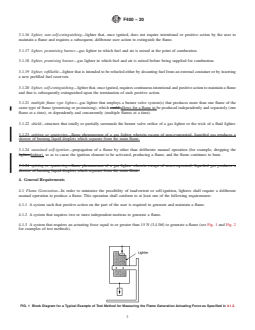
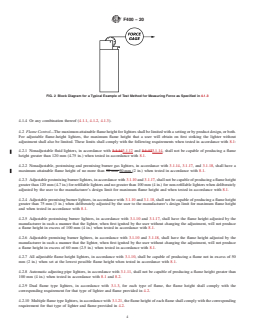
4.1.3 A system that requires an actuating force equal to or greater than 15 N (3.4 lbf) to generate a flame (see Fig. 1 and Fig. 2
for examples of test methods).
FIG. 1 Block Diagram for a Typical Example of Test Method for Measuring the Flame Generation Actuating Force as Specified in 4.1.3
F400 − 20
FIG. 2 Block Diagram for a Typical Example of Test Method for Measuring Force as Specified in 4.1.3
4.1.4 Or any combination thereof (4.1.1, 4.1.2, 4.1.3).
4.2 Flame Control—The maximum attainable flame height for lighters shall be limited with a setting or by product design, or both.
For adjustable flame-height lighters, the maximum flame height that a user will obtain on first striking the lighter without
adjustment shall also be limited. These limits shall comply with the following requirements when tested in accordance with 8.1:
4.2.1 Nonadjustable fluid lighters, in accordance with 3.1.143.1.12 and 3.1.123.1.14, shall not be capable of producing a flame
height greater than 120 mm (4.75 in.) when tested in accordance with 8.1.
4.2.2 Nonadjustable, postmixing and premixing burner gas lighters, in accordance with 3.1.14, 3.1.17, and 3.1.18, shall have a
maximum attainable flame height of no more than 50 mm 50 mm (2 in.) when tested in accordance with 8.1.
4.2.3 Adjustable postmixing burner lighters, in accordance with 3.1.10 and 3.1.17, shall not be capable of producing a flame height
greater than 120 mm (4.7 in.) for refillable lighters and no greater than 100 mm (4 in.) for non-refillable lighters when deliberately
adjusted by the user to the manufacturer’s design limit for maximum flame height and when tested in accordance with 8.1.
4.2.4 Adjustable premixing burner lighters, in accordance with 3.1.10 and 3.1.18, shall not be capable of producing a flame height
greater than 75 mm (3 in.) when deliberately adjusted by the user to the manufacturer’s design limit for maximum flame height
and when tested in accordance with 8.1.
4.2.5 Adjustable postmixing burner lighters, in accordance with 3.1.10 and 3.1.17, shall have the flame height adjusted by the
manufacturer in such a manner that the lighter, when first ignited by the user without changing the adjustment, will not produce
a flame height in excess of 100 mm (4 in.) when tested in accordance with 8.1.
4.2.6 Adjustable premixing burner lighters, in accordance with 3.1.10 and 3.1.18, shall have the flame height adjusted by the
manufacturer in such a manner that the lighter, when first ignited by the user without changing the adjustment, will not produce
a flame height in excess of 60 mm (2.5 in.) when tested in accordance with 8.1.
4.2.7 All adjustable flame height lighters, in accordance with 3.1.10, shall be capable of producing a flame not in excess of 50
mm (2 in.) when set at the lowest possible flame height when tested in accordance with 8.1.
4.2.8 Automatic adjusting pipe lighters, in accordance with 3.1.11, shall not be capable of producing a flame height greater than
100 mm (4 in.) when tested in accordance with 8.1 and 8.2.
4.2.9 Dual flame type lighters, in accordance with 3.1.3, for each type of flame, the flame height shall comply with the
corresponding requirement for that type of lighter and flame provided in 4.2.
4.2.10 Multiple flame type lighters, in accordance with 3.1.21, the flame height of each flame shall comply with the corresponding
requirement for that type of lighter and flame provided in 4.2.
F400 − 20
4.3 Flame-Height Adjustment—Adjustable flame height lighters in accordance with 3.1.10 shall require a deliberate action on the
part of the user to increase or decrease the flame height when the lighter is used in the normal fashion.
4.3.1 IfFor flame control actuators that protrude from the body of the lighter, it shall require a minimum actuating force of 1 N
(0.25 lbf) applied over the entire range of adjustment in a tangential direction (see Fig. 3 for an example of the test method).
4.3.2 Adjustable gas lighters having rotary movement flame control actuators approximately at right angles to the flame shall
perform as follows:
4.3.2.1 When the flame control actuator is at the top of the lighter and the lighter held so the flame is oriented vertically upward,
and the user is facing the flame control actuator, moving the actuator to the left shall produce a decrease in flame height.
4.3.2.2 When the flame control actuator is at the bottom of the lighter and the lighter held so that the user is looking at the actuator,
a clockwise movement shall result in a decrease in flame height.
4.3.3 Adjustable gas lighters requiring motion of the flame control actuator approximately parallel to the flame axis shall decrease
or increase the flame height according to the direction of the movement.
4.3.4 Adjustable flame height lighters shall indicate the direction of movement to produce a higher or lower flame height. On
lighters whose adjusting mechanisms conform to 4.3.2 and 4.3.3, the direction of movement shall be permanently imprinted or
engraved on the lighter. Such permanent information shall be placed on the lighter in the vicinity of the adjusting mechanism and
be readily visible and understandable.
4.4 Spitting or Sputtering and Flaring—Gas lighters as defined in 3.1.13 when set at the maximum flame height, shall exhibit no
spitting or sputtering as defined in 3.1.243.1.23 or flaring as defined in 3.1.6, when tested in accordance with 8.2.
4.5 Flame Extinction:
4.5.1 Adjustable postmixing burner lighters, after a 5-s burn at maximum flame height, when extinguished in the intended manner,
such as by closing a cover or releasing a button or lever, shall have any exposed flame completely extinguished within 2 s after
such action is completed when tested in accordance with 8.3. In the case of postmixing burner lighters that have shields, an
additional 2-s afterburn is acceptable if only when the flame height during this additional 2-s period does not extend above the
shield.
4.5.2 Adjustable postmixing burner lighters at a flame height of 50 mm (2 in.), or the maximum height the adjustment allows, if
lower than 50 mm (2 in.) or nonadjustable postmixing burner lighters at their permanently set flame heights, after a 10-s burn, when
extinguished in the intended manner, such as by closing a cover or releasing a button or lever, shall have any exposed flame
completely extinguished within 2 s after such action is completed, when tested in accordance with 8.3. In the case of gas lighters
that have shields, an additional 2-s afterburn is acceptable if only when the flame height during this additional 2-s period does not
extend above the shield.
4.5.3 Adjustable premixing burner lighters, after a 5-s burn at maximum flame height, when extinguished in the intended manner,
such as by closing a cover or releasing a button or lever, shall have any exposed flame completely extinguished in no more than
5 s, when tested in accordance with 8.3.
FIG. 3 Block Diagram for a Typical Example of Test Method for Measuring the Flame Control Actuating Force as Specified in 4.3.1
F400 − 20
4.5.4 Adjustable premixing burner lighters, when set at a flame height of 50 mm (2 in.) or the maximum flame height the
adjustment allows if for flames lower than 50 mm, or nonadjustable premixing burner lighters at their permanently set flame
heights, after a 10-s burn, when closedextinguished in the intended manner, such as by closing a cover or releasing a button or
lever, shall have any exposed flame completely extinguished in no more than 5 s, when tested in accordance with 8.3.
NOTE 1—In the case of premixing burner lighters, the total afterburn time of 5 s in this specification will be reconsidered periodically with a view to
gradual reduction in line with technological progress.
4.5.5 Dual flame type lighters, for each type of flame, the extinction time shall comply with the corresponding requirement for
that type of lighter and flame provided in 4.5.
4.5.6 Multiple flame type lighters, for each flame, the extinction time shall comply with the corresponding requirement for that
type of lighter and flame provided in 4.5.
4.6 Volumetric Displacement—For gas lighters shipped with fuel, the liquid portion of the fuel shall not exceed 85 % of the
volumetric capacity of the fuel chamber when tested in accordance with 8.14.
4.7 Weight of Fuel—For gas lighters shipped with fuel, the weight of the liquefied fuel shall not exceed 10 g.
5. Structural Integrity Requirements
5.1 Lighters shall have structural integrity as specified in requirements 5.2 – 5.9 (Table A2.1).
5.2 Drop Test:
5.2.1 Postmixing and premixing burner lighters as defined in 3.1.17 and 3.1.18 must be capable of withstanding three separate
1.5-m 6 0.1-m (5-ft 6 0.3-ft or 6 4-in.) drops conducted in accordance with 8.4, without fuel reservoir fragmentation, without
resulting in sustained self-ignition as defined in 3.1.233.1.24, and without gas escape exceeding 1515 mg mg/min and if operable,
without impairing ⁄min. For lighters that remain operable, the subsequent safe operation of the lighter.lighter must not be impaired.
5.2.2 Fluid lighters as defined in 3.1.12 must be capable of withstanding three separate 1.5-m 6 0.1-m (5-ft 6 0.3-ft or 6 4-in.)
drops conducted in accordance with 8.4, without fuel reservoir rupture, and without resulting in sustained self-ignition as defined
in 3.1.233.1.24, and if operable, without impairing. For lighters that remain operable, the subsequent safe operation of the
lighter.lighter must not be impaired.
5.2.3 Lighters that meet the requirements of 5.2.1 or 5.2.2, and that are able to be ignited in the intended manner shall subsequently
meet all the applicable requirements of 4.1 – 4.5, inclusive.
5.3 Temperature Test—Lighters shall be capable of withstanding a temperature of 65°C65 °C 6 2°C (149°F2 °C (149 °F 6
4°F)4 °F) for 4 h when tested in accordance with 8.5.
5.3.1 Lighters that meet the requirements of 5.3 and that are able to be ignited in the intended manner shall subsequently meet
all the applicable requirements of 4.1 – 4.5, inclusive.
5.4 Burning Test—Adjustable gas lighters with the flame height set at maximum, nonadjustable gas lighters at their permanently
set flame heights, or fluid-type lighters shall be capable of withstanding a burning time of 5 s with the lighter in a position 45°
6 5° below horizontal (see Fig. 4) without evidence of any burning or distortion of components so as to cause a hazardous
condition.
5.4.1 Adjustable gas lighters with the flame height set at 50 mm 50 mm (2 in.) or the maximum flame height the adjustment allows,
if for flames lower than 50 mm, nonadjustable gas lighters at their permanently set flame heights, or fluid-type lighters shall be
capable of withstanding a total burning time of 10 s in two different attitudes (a) with the flame directed vertically upward and
(b) with the flame directed 45º 6 5° below horizontal, horizontal (see Fig. 4), without evidence of any burning or distortion of
components so as to cause a hazardous condition.
F400 − 20
FIG. 4 Flame Height MeasurementLighter in a Position of 45° 6 5°
5.4.2 Lighters that meet the requirements of 5.4, and that are able to be ignited in the intended manner shall subsequently meet
all the applicable requirements of 4.1 – 4.5, inclusive.
5.5 Continuous Burn—Adjustable gas lighters with the flame set at 50 mm (2 in.) or the maximum flame height the adjustment
allows, if for flames lower than 50 mm, nonadjustable gas lighters at their permanently set flame heights, or fluid-type lighters shall
be capable of withstanding a continuous burning time of 2 min with the lighter and flame directed vertically upward without
causing a hazardous condition, when tested in accordance with 8.6.
5.6 Cycling Burn—Adjustable gas lighters with the flame set at 50 mm (2 in.) or the maximum flame height the adjustment allows,
if for flames lower than 50 mm, nonadjustable gas lighters at their permanently set flame height, or fluid-type lighters shall be
capable of withstanding a burning time of 20 s, repeated 10 times, when tested in accordance with 8.7.
5.6.1 Gas and fluid lighters that meet this requirement, and that are able to be ignited in the intended manner shall subsequently
meet all the applicable requirements of 4.1 – 4.5, inclusive. Any lighter that cannot make a flame shall not be classified as a failure.
5.7 External Finish—Lighters shall have no external sharp edges that couldwould cause accidental cuts or abrasions to the
consumeruser when handled or used in the intended manner. Test for sharp edges Initial inspection to be performed by visual and
tactile (moving a finger slowly and carefully) assessments over the lighter to predetermine for any sharp edges that are present.
For any sharp edges found, then test for sharp edges in accordance with UL 1439.
5.8 Compatibility:
5.8.1 Components of gas lighters as defined in 3.1.13 that come in contact with the fuel recommended by the manufacturer shall
not deteriorate after the exposure to the fuel, so as to cause the lighter to fail any of the criteria contained in this specification or
allow gas escape exceeding 15 mg/min when tested in accordance with 8.8.
5.8.2 Components of fluid lighters as defined in 3.1.12 that come in contact with the fuel recommended by the manufacturer shall
not deteriorate after extended contact with that fuel, so as to fail any of the criteria contained in this specification when tested in
accordance with 8.9.
5.8.3 Gas and fluid lighters that meet this requirement, and that are able to be ignited in the intended manner shall subsequently
meet all the applicable requirements of 4.1 – 4.5, inclusive.
5.9 Pressure Tests—Gas lighters shall be capable of withstanding an internal pressure of two times the vapor pressure occurring
at 55°C (131°F)55 °C (131 °F) of the fuel recommended by the manufacturer when tested in accordance with 8.10.
6. Refilling of Refillable Lighters
6.1 Refillable fluid lighters, as defined in 3.1.12 and 3.1.19, shall be accompanied with specific instructions and warnings as
applicable in accordance with Section 7.
F400 − 20
6.1 Refillable fluid lighters having a sealed fuel reservoir shall be free of fuel leakage from both the sealed reservoir and the sealing
closure when tested in accordance with 8.11, when such sealing closure is installed in the lighter by the user in the intended manner.
6.3 Refillable gas lighters, as defined in 3.1.13 and 3.1.19, shall have specific training instructions and warnings as applicable in
accordance with Section 7.
6.2 Refillable Gas Lighters—The refilling valve in a pressurized fuel reservoir lighter shall be secure enough so as not to allow
an escape of gas exceeding 15 mg/min when tested in accordance with 8.13.
7. Instructions and Warnings
7.1 All lighters shall be accompanied by the appropriate safety information (instructions or warnings, or both) communicating the
proper method of use.
7.2 This safety information shall be either on the lighters themselves, or on a separate brochure or pamphlet packaged with the
lighters, or on the product packaging at the point of sale. The format for this information shouldshall emphasize the warnings that
are most appropriate to the type of lighter. This safety information shall be conspicuously placed with contrasting background
color, type size, or style that makes it distinct from other information.
7.3 For all lighters, the safety information shall be accompanied by the specific signal word “WARNING” in close proximity to
the safety information.
7.4 For all lighters, the safety information shall contain the following statements:
7.4.1 “KEEP AWAY FROM CHILDREN” or “KEEP OUT OF REACH OF CHILDREN.” (The statement used shall be
emphasized and distinctive.)
7.4.2 Ignite lighter away from face and clothing.
7.5 For all lighters, the safety information shall include the substance of the following as appropriate to the type of lighter:
7.5.1 Be sure the flame is out after use.
7.5.2 This lighter does not self-extinguish; close cover to put out. (This statement shall accompany all non-self-extinguishing
lighters.)
7.5.3 Contains flammable gas under pressure.
7.5.4 When filled, will contain flammable gas under pressure.
7.5.5 Contains flammable fluid.
7.5.6 When filled, will contain flammable fluid.
7.5.7 Never expose to heat above 50°C (122°F)50 °C (122 °F) or to prolonged sunlight.
7.5.8 Never puncture or put in fire.
7.5.9 Extreme heat is present above the visible flame. Extra care shouldmust be taken to prevent burn injury or fire. (This statement
shall accompany all premixing burner lighters.)
7.5.10 Do not keep lit for more than 10 s. (This statement shall accompany all premixing burner lighters.)
7.6 Refilling Instructions for Gas Lighters—Refillable gas lighters, as defined in 3.1.13 and 3.1.19, shall be accompanied by
F400 − 20
specific instructions as to the correct procedure to accomplish the refill operation. These instructions shall include the fuel
recommended by the manufacturer and the appropriate information to ensure the proper mating between the refill container and
the fuel tank of the lighter.
7.7 Refilling Instructions for Fluid Lighters:
7.7.1 Fluid lighters, as defined in 3.1.12, shall be accompanied by the substance of the following:
7.7.1.1 Fill only with the type of fluid recommended by the manufacturer.
7.7.1.2 Fill slowly; never overfill (or, Fill slowly; do not overfill).overfill.
7.7.1.3 After filling, wipe lighter and hands dry before igniting. (ThisThis is a special instruction that shall be on a label attached
to the lighter, or it may be printed directly on the lighter, or be printed in the safety information provided with the lighter from
the manufacturer.)provided from the manufacturer by at least one of the following methods:
(1) On a label attached to the lighter.
(2) Printed directly on the lighter.
(3) Printed in the safety information provided with the lighter.
7.8 Symbols, Signs, and Icons—In place of or in addition to the instructions and warnings in 7.4, the use of appropriate and
recognizable symbols, signs, and icons could are acceptable to be provided to the consumer. These safety symbols, signs, and icons
mayshall be similar to those in other safety standards, such as ISO 9994 (as a reference listed in A1.2).) or comply with applicable
government regulations or meet applicable industry safety standard guidelines.
8. Test Methods
SAFETY STATEMENT–Persons using this consumer safety specification shouldshall be familiar with normal
laboratory practice, if practices that are applicable. This consumer safety specification does not propose to address all
possible safety concerns, if any,concerns that are associated with the use of this standard. It is the responsibility of the
user/tester to establish appropriate safety and health practices and to ensure compliance with any regulatory
requirements.
8.1 Flame-Height Measurement—The purpose of this procedure is to define the method of measurement of lighter flame height.
8.1.1 Apparatus—A nonflammable board scribed in 5-mm (0.25-in.) increments. The board shouldshall be fitted with a standoff
at the base point that positions the lighter at least 25 mm (1 in.) from the board. The board canshall be supported vertically by any
convenient means and tests conducted inside a draft-free chamber constructed from suitable nonflammable materials.
8.1.2 Test Specimens—The test specimens shall consist of lighters that are new, complete, and fueled by the manufacturer or in
accordance with the manufacturer’s specifications and shall be free of pre-existing mechanical damage.
8.1.3 Procedure:
8.1.3.1 Standardize the lighter flame-height measurements by stabilizing Stabilize all lighters at 2323 °C 6 2°C (732 °C (73 °F
6 4°F)4 °F) for at least 10 h prior to each flame-height measurement.
8.1.3.2 Place the lighter against the standoff with the flame directed vertically upward.
NOTE 2—In case of premixing burner lighters, it is recommended this test be conducted under subdued lighting conditions.
8.1.3.3 Ignite the lighter, allow the flame to stabilize for approximately 1.0 s, then measure the flame height to the nearest 5 mm
(0.25 in.) by determining where the tip of the visible flame registers in relation to the scribed marks on the board behind the lighter,
during a 5-s burn.
8.2 Spitting, Sputtering, and Flaring Tests—The purpose of these tests is to verify that gas lighters do not spit, sputter, or flare.
Fluid lighters, as defined in 3.1.12, are excluded from this test.
F400 − 20
8.2.1 Test Specimens—The test specimens shall consist of lighters that are fueled in accordance with the manufacturer’s
specifications.
8.2.2 Procedure:
8.2.2.1 Stabilize all lighters at 2323 °C 6 2°C (732 °C (73 °F 6 4°F)4 °F) for at least 10 h prior to performing the test described
in 8.2.2.3.
8.2.2.2 IfFor lighters that are adjustable as defined in 3.1.10, adjust the flame to maximum flame height position.
8.2.2.3 Ignite the lighter and observe for spitting or sputtering as defined in 3.1.243.1.23 during a 5-s burn in any handheld
position. Any evidence of spitting or sputtering constitutes a failure. If For a lighter that does not fail, restabilize for a minimum
of 5 min at 2323 °C 6 2°C (732 °C (73 °F 6 4°F)4 °F) before continuing with 8.2.2.4. IfFor different gas lighters that are used
to conduct the test described in 8.2.2.4, stabilize each lighter in accordance with 8.2.2.1.
8.2.2.4 Ignite the lighter with the flame directed vertically upward and observe the flame height, and invert the lighter to a position
45° 6 5° below the horizontal.horizontal (see Fig. 4). Any variation in flame height exceeding 50 mm (2 in.) during a total elapsed
time of 5 s or a flame height exceeding the requirements specified in 4.2 constitutes a failure. If For a lighter that does not fail,
restabilize for a minimum of 5 min at 2323 °C 6 2°C (732 °C (73 °F 6 4°F)4 °F) before continuing with 8.2.2.5. For different
gas lighters that are used to conduct the test described in 8.2.2.5, stabilize each lighter in accordance with 8.2.2.1. Automatic
adjusting pipe lighters as defined in 3.1.11 shall be excluded from this test.
NOTE 3—Measure the downward flame height in accordance with Fig. 4.
NOTE 4—If different lighters are used to conduct the tests described in 8.2.2.3 – 8.2.2.5 stabilize these in accordance with 8.2.2.1.
8.2.2.5 Invert the lighter for a period of 10 s. Return the lighter to an upright position and ignite the lighter. Observe the flame
height during a 5-s burn. Any variation of flame exceeding 50 mm (2 in.) or a flame height exceeding the requirements specified
in 4.2 constitutes a failure. Automatic adjusting pipe lighters as defined in 3.1.11 shall be excluded from this test.
8.3 Flame Extinction Test—The purpose of this test is to verify that lighters extinguish safely.
8.3.1 Test Specimens—The test specimens shall consist of lighters that are fueled in accordance with the manufacturer’s
specifications.
8.3.2 Apparatus—The same as for flame height measurement as described in 8.1.1.
8.3.3 Procedure:
8.3.3
...
Questions, Comments and Discussion
Ask us and Technical Secretary will try to provide an answer. You can facilitate discussion about the standard in here.
Loading comments...