

ASTM E2004-18
(Test Method)Standard Test Method for Facing Cleavage of Sandwich Panels
General Information
- Abstract
SIGNIFICANCE AND USE
4.1 This test method determines the cleavage force required to peel stiff facings from the core of sandwich panels, and is used to determine how well the facing is bonded to the core. Test Method D1781 only works well with flexible facings. As a guideline, the cleavage test method would work better on sandwich panels that have facings with a bending stiffness (EI) of greater than approximately 27.3 lb-in2/inch width (3.09 kN·mm 2/mm width). This converts to approximately 0.032 in. (0.81 mm) 6061 T6 aluminum alloy, 0.023 in. (0.57 mm) steel, and 0.046 in. (1.18 mm) fiberglass facings.
SCOPE
1.1 This test method covers the determination of the cleavage force to peel stiff facings from sandwich panels.
1.2 The values stated in inch-pound units are to be regarded as standard. The values given in parentheses are mathematical conversions to SI units that are provided for information only and are not considered standard.
1.3 This standard does not purport to address all of the safety concerns, if any, associated with its use. It is the responsibility of the user of this standard to establish appropriate safety, health, and environmental practices and determine the applicability of regulatory limitations prior to use.
1.4 This international standard was developed in accordance with internationally recognized principles on standardization established in the Decision on Principles for the Development of International Standards, Guides and Recommendations issued by the World Trade Organization Technical Barriers to Trade (TBT) Committee.
- Status
- Published
- Publication Date
- 30-Sep-2018
- Technical Committee
- E06 - Performance of Buildings


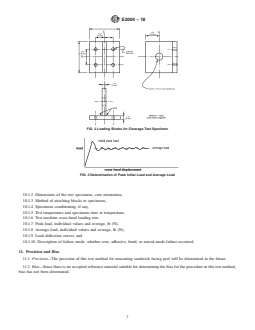

Overview
ASTM E2004-18: Standard Test Method for Facing Cleavage of Sandwich Panels provides a reliable method for evaluating the bond strength between stiff facings and the core material in sandwich panels. This standard is critical across various industries to assess the structural integrity and durability of composite panels used in construction, transportation, and other applications. Unlike methods designed for flexible facings, ASTM E2004-18 is specifically suitable for panels with stiff facings, ensuring accurate and meaningful results for materials with higher bending stiffness.
Key Topics
- Cleavage Force Measurement: Determines the force required to peel stiff facings from the core, directly assessing the quality of the facing-to-core bond.
- Failure Modes: Identifies and reports on several types of failure, including adhesive failure, bond failure (interface), core failure (tearing or rupture), and mixed-mode failure.
- Applicability to Stiff Facings: Best suited for facings with a bending stiffness (EI) exceeding approximately 27.3 lb-in²/inch width (or 3.09 kN·mm²/mm width). Typical materials include 6061 T6 aluminum alloy, steel, and fiberglass within specific thickness guidelines.
- Test Specimen Preparation: Specifies dimensions, loading block attachment, and recommended conditioning for specimens prior to testing.
- Testing Procedures: Details test machine requirements, loading rate, specimen mounting, and measurement techniques for obtaining load-deflection curves.
- Reporting Requirements: Outlines necessary details for accurate reporting, including specimen description, testing parameters, failure type, and load data.
- Safety and Compliance: Stresses the responsibility of users to ensure all safety, health, and environmental considerations are managed according to applicable regulations.
Applications
ASTM E2004-18 is widely used in quality control, product development, and research settings where sandwich panel construction is prevalent. Key applications include:
- Building and Construction: Evaluates panels used in facades, partitions, and modular buildings to ensure long-term durability and adhesion.
- Aerospace and Transportation: Essential for aircraft, automotive, rail, and marine panels where lightweight strength and reliable bonds are mission-critical.
- Industrial and Military Shelters: Applied to the validation of rigid wall relocatable shelters for robust and consistent performance.
- Material Development: Aids manufacturers and developers in comparing adhesives, core materials, and facings for optimal panel construction.
This test method supports the verification of product design, adherence to safety standards, and fulfillment of customer or regulatory requirements regarding sandwich panel performance.
Related Standards
Several standards and terminology documents are referenced or related to ASTM E2004-18:
- ASTM D1781 – Test Method for Climbing Drum Peel for Adhesives (recommended for flexible facings).
- ASTM E4 – Practices for Force Verification of Testing Machines, vital for ensuring test apparatus accuracy.
- ASTM E631 – Terminology of Building Constructions, providing definitions for construction-related terms.
- ASTM E1749 – Terminology Relating to Rigid Wall Relocatable Shelters.
By following ASTM E2004-18, organizations can confidently assess the facing cleavage strength of sandwich panels, enhance the performance and reliability of their products, and maintain compliance with internationally recognized testing protocols.
Relations
- Effective Date
- 01-Oct-2018
- Effective Date
- 01-Oct-2018
- Effective Date
- 01-Mar-2015
- Effective Date
- 01-Nov-2014
- Effective Date
- 01-Jun-2014
- Effective Date
- 01-Nov-2010
- Effective Date
- 01-Jun-2010
- Effective Date
- 01-Nov-2009
- Effective Date
- 01-Apr-2009
- Effective Date
- 01-Dec-2008
- Effective Date
- 01-Jan-2007
- Effective Date
- 01-Jun-2006
- Effective Date
- 01-Oct-2005
- Effective Date
- 01-Apr-2004
- Effective Date
- 10-Aug-2003
Get Certified
Connect with accredited certification bodies for this standard

DIN CERTCO
DIN Group product certification.

Smithers Quality Assessments
US management systems and product certification.
Sponsored listings
Frequently Asked Questions
ASTM E2004-18 is a standard published by ASTM International. Its full title is "Standard Test Method for Facing Cleavage of Sandwich Panels". This standard covers: SIGNIFICANCE AND USE 4.1 This test method determines the cleavage force required to peel stiff facings from the core of sandwich panels, and is used to determine how well the facing is bonded to the core. Test Method D1781 only works well with flexible facings. As a guideline, the cleavage test method would work better on sandwich panels that have facings with a bending stiffness (EI) of greater than approximately 27.3 lb-in2/inch width (3.09 kN·mm 2/mm width). This converts to approximately 0.032 in. (0.81 mm) 6061 T6 aluminum alloy, 0.023 in. (0.57 mm) steel, and 0.046 in. (1.18 mm) fiberglass facings. SCOPE 1.1 This test method covers the determination of the cleavage force to peel stiff facings from sandwich panels. 1.2 The values stated in inch-pound units are to be regarded as standard. The values given in parentheses are mathematical conversions to SI units that are provided for information only and are not considered standard. 1.3 This standard does not purport to address all of the safety concerns, if any, associated with its use. It is the responsibility of the user of this standard to establish appropriate safety, health, and environmental practices and determine the applicability of regulatory limitations prior to use. 1.4 This international standard was developed in accordance with internationally recognized principles on standardization established in the Decision on Principles for the Development of International Standards, Guides and Recommendations issued by the World Trade Organization Technical Barriers to Trade (TBT) Committee.
SIGNIFICANCE AND USE 4.1 This test method determines the cleavage force required to peel stiff facings from the core of sandwich panels, and is used to determine how well the facing is bonded to the core. Test Method D1781 only works well with flexible facings. As a guideline, the cleavage test method would work better on sandwich panels that have facings with a bending stiffness (EI) of greater than approximately 27.3 lb-in2/inch width (3.09 kN·mm 2/mm width). This converts to approximately 0.032 in. (0.81 mm) 6061 T6 aluminum alloy, 0.023 in. (0.57 mm) steel, and 0.046 in. (1.18 mm) fiberglass facings. SCOPE 1.1 This test method covers the determination of the cleavage force to peel stiff facings from sandwich panels. 1.2 The values stated in inch-pound units are to be regarded as standard. The values given in parentheses are mathematical conversions to SI units that are provided for information only and are not considered standard. 1.3 This standard does not purport to address all of the safety concerns, if any, associated with its use. It is the responsibility of the user of this standard to establish appropriate safety, health, and environmental practices and determine the applicability of regulatory limitations prior to use. 1.4 This international standard was developed in accordance with internationally recognized principles on standardization established in the Decision on Principles for the Development of International Standards, Guides and Recommendations issued by the World Trade Organization Technical Barriers to Trade (TBT) Committee.
ASTM E2004-18 is classified under the following ICS (International Classification for Standards) categories: 83.180 - Adhesives. The ICS classification helps identify the subject area and facilitates finding related standards.
ASTM E2004-18 has the following relationships with other standards: It is inter standard links to ASTM E2004-10, ASTM E1749-18, ASTM E631-15, ASTM E631-14, ASTM E4-14, ASTM E1749-10, ASTM E4-10, ASTM E4-09a, ASTM E4-09, ASTM E4-08, ASTM E4-07, ASTM E631-06, ASTM E1749-05, ASTM D1781-98(2004), ASTM E4-03. Understanding these relationships helps ensure you are using the most current and applicable version of the standard.
ASTM E2004-18 is available in PDF format for immediate download after purchase. The document can be added to your cart and obtained through the secure checkout process. Digital delivery ensures instant access to the complete standard document.
Standards Content (Sample)
This international standard was developed in accordance with internationally recognized principles on standardization established in the Decision on Principles for the
Development of International Standards, Guides and Recommendations issued by the World Trade Organization Technical Barriers to Trade (TBT) Committee.
Designation: E2004 − 18
Standard Test Method for
Facing Cleavage of Sandwich Panels
This standard is issued under the fixed designation E2004; the number immediately following the designation indicates the year of
original adoption or, in the case of revision, the year of last revision. A number in parentheses indicates the year of last reapproval. A
superscript epsilon (´) indicates an editorial change since the last revision or reapproval.
This standard has been approved for use by agencies of the U.S. Department of Defense.
1. Scope E631 and for general terms related to rigid wall relocatable
shelters, refer to Terminology E1749.
1.1 This test method covers the determination of the cleav-
age force to peel stiff facings from sandwich panels. 3.2 Definitions of Terms Specific to This Standard:
3.2.1 adhesive failure—failure that is completely within the
1.2 The values stated in inch-pound units are to be regarded
adhesive layer with no evidence of interfacial disbonding
as standard. The values given in parentheses are mathematical
between the core and the adhesive, between the adhesive and
conversions to SI units that are provided for information only
the facing, and no evidence of tearing or rupture within the
and are not considered standard.
core.
1.3 This standard does not purport to address all of the
3.2.2 bond failure—failure that is interfacial and is either (a)
safety concerns, if any, associated with its use. It is the
between the adhesive and the core, or (b) between the adhesive
responsibility of the user of this standard to establish appro-
and the facing; no core or adhesive failure will be in evidence
priate safety, health, and environmental practices and deter-
in this type of failure.
mine the applicability of regulatory limitations prior to use.
3.2.2.1 Discussion—If bond failure occurs it should be
1.4 This international standard was developed in accor-
specified as to whether it is type (a)or(b).
dance with internationally recognized principles on standard-
3.2.3 core failure—failure that is completely within the core
ization established in the Decision on Principles for the
material and is comprised of a tearing or rupture of the core
Development of International Standards, Guides and Recom-
material with no evidence of interfacial disbonding between
mendations issued by the World Trade Organization Technical
the core and the adhesive, within the adhesive itself, or
Barriers to Trade (TBT) Committee.
between the adhesive and the facing.
2. Referenced Documents
3.2.4 mixed-mode failure—failure that shows evidence of
more than one of the three failure modes described above.
2.1 ASTM Standards:
3.2.4.1 Discussion—Visually estimate and report the per-
D1781 Test Method for Climbing Drum Peel for Adhesives
centofthetotalfailuresurfaceareathatiscoveredbyeachtype
E4 Practices for Force Verification of Testing Machines
of failure.
E631 Terminology of Building Constructions
E1749 Terminology Relating to Rigid Wall Relocatable
4. Significance and Use
Shelters
4.1 This test method determines the cleavage force required
to peel stiff facings from the core of sandwich panels, and is
3. Terminology
used to determine how well the facing is bonded to the core.
3.1 Definitions:
Test Method D1781 only works well with flexible facings. As
3.1.1 For definitions of general terms related to building
a guideline, the cleavage test method would work better on
construction used in this test method, refer to Terminology
sandwich panels that have facings with a bending stiffness (EI)
of greater than approximately 27.3 lb-in /inch width (3.09
kN·mm /mm width). This converts to approximately 0.032 in.
This test method is under the jurisdiction of ASTM Committee E06 on
(0.81 mm) 6061 T6 aluminum alloy, 0.023 in. (0.57 mm) steel,
Performance of Buildings and is the direct responsibility of Subcommittee E06.53
and 0.046 in. (1.18 mm) fiberglass facings.
on Materials and Processes for Durable Rigidwall Relocatable Structures.
Current edition approved Oct. 1, 2018. Published November 2018. Originally
5. Apparatus
approved in 1999. Last previous edition approved in 2010 as E2004–10. DOI:
10.1520/E2004–18.
5.1 Test Machine, capable of maintaining a controlled load-
For referenced ASTM standards, v
...
This document is not an ASTM standard and is intended only to provide the user of an ASTM standard an indication of what changes have been made to the previous version. Because
it may not be technically possible to adequately depict all changes accurately, ASTM recommends that users consult prior editions as appropriate. In all cases only the current version
of the standard as published by ASTM is to be considered the official document.
Designation: E2004 − 10 E2004 − 18
Standard Test Method for
Facing Cleavage of Sandwich Panels
This standard is issued under the fixed designation E2004; the number immediately following the designation indicates the year of
original adoption or, in the case of revision, the year of last revision. A number in parentheses indicates the year of last reapproval. A
superscript epsilon (´) indicates an editorial change since the last revision or reapproval.
This standard has been approved for use by agencies of the U.S. Department of Defense.
1. Scope
1.1 This test method covers the determination of the cleavage force to peel stiff facings from sandwich panels.
1.2 The values stated in inch-pound units are to be regarded as standard. The values given in parentheses are mathematical
conversions to SI units that are provided for information only and are not considered standard.
1.3 This standard does not purport to address all of the safety concerns, if any, associated with its use. It is the responsibility
of the user of this standard to establish appropriate safety safety, health, and healthenvironmental practices and determine the
applicability of regulatory limitations prior to use.
1.4 This international standard was developed in accordance with internationally recognized principles on standardization
established in the Decision on Principles for the Development of International Standards, Guides and Recommendations issued
by the World Trade Organization Technical Barriers to Trade (TBT) Committee.
2. Referenced Documents
2.1 ASTM Standards:
D1781 Test Method for Climbing Drum Peel for Adhesives
E4 Practices for Force Verification of Testing Machines
E631 Terminology of Building Constructions
E1749 Terminology Relating to Rigid Wall Relocatable Shelters
3. Terminology
3.1 Definitions:
3.1.1 For definitions of general terms related to building construction used in this test method, refer to Terminology E631 and
for general terms related to rigid wall relocatable shelters, refer to Terminology E1749.
3.2 Definitions:Definitions of Terms Specific to This Standard:
3.2.1 adhesive failure—failure that is completely within the adhesive layer with no evidence of interfacial disbonding between
the core and the adhesive, between the adhesive and the facing, and no evidence of tearing or rupture within the core.
3.2.2 bond failure—failure that is interfacial and is either (a) between the adhesive and the core, or (b) between the adhesive
and the facing; no core or adhesive failure will be in evidence in this type of failure.
This test method is under the jurisdiction of ASTM Committee E06 on Performance of Buildings and is the direct responsibility of Subcommittee E06.53 on Materials
and Processes for Durable Rigidwall Relocatable Structures.
Current edition approved Oct. 1, 2010Oct. 1, 2018. Published October 2010November 2018. Originally approved in 1999. Last previous edition approved in 20042010
as E2004 – 04.E2004–10. DOI: 10.1520/E2004-10.10.1520/E2004–18.
For referenced ASTM standards, visit the ASTM website, www.astm.org, or contact ASTM Customer Service at service@astm.org. For Annual Book of ASTM Standards
volume information, refer to the standard’s Document Summary page on the ASTM website.
3.2.2.1 Discussion—
If bond failure occurs it should be specified as to whether it is type (a) or (b).
3.2.3 core failure—failure that is completely within the core material and is comprised of a tearing or rupture of the core material
with no evidence of interfacial disbonding between the core and the adhesive, within the adhesive itself, or between the adhesive
and the facing.
3.2.4 mixed-mode failure—failure that shows evidence of more than one of the three failure modes described above.
Copyright © ASTM International, 100 Barr Harbor Drive, PO Box C700, West Conshohocken, PA 19428-2959. United States
E2004 − 18
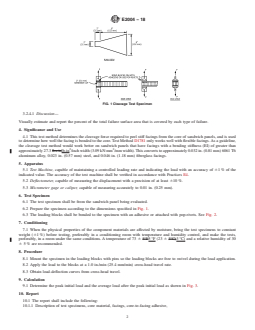
FIG. 1 Cleavage Test Specimen
3.2.4.1 Discussion—
Visually estimate and report the percent of the total failure surface area that is covered by each type of failure.
4. Significance and Use
4.1 This test method determines the cleavage force required to peel stiff facings from the core of sandwich panels, and is used
to determine how well the facing is bonded to the core
...