

ASTM C726-17
(Specification)Standard Specification for Mineral Wool Roof Insulation Board
General Information
- Abstract
ABSTRACT
This specification covers the composition and physical properties of mineral fiber insulation board used above structural roof decks as a base for built-up roofing and single ply membrane systems in building construction. The use of thermal insulation materials covered by this specification may be regulated by building codes or other agencies that address fire performance, or both. Specimens shall be sampled, prepared, tested, and conform accordingly to the following physical properties: compressive resistance, tensile strength, breaking load strength, water absorption, response to thermal and humid aging, linear dimensional change, thermal resistance, surface burning characteristics, and dimensions.
SCOPE
1.1 This specification covers the composition and physical properties of mineral wool insulation board used above structural roof decks in building construction. The mineral wool roof insulation acts as a base for systems such as single-ply, polymer-modified bitumen and built-up roof. This specification also covers mineral wool insulation boards that incorporate a fibrous high density upper layer on the top surface
1.2 It is possible that the use of thermal insulation materials covered by this specification will be regulated by building codes or other agencies that address fire performance, or both. The fire performance of the material needs to be addressed through standard fire test methods established by the appropriate governing documents.
1.3 The values stated in inch-pound units are to be regarded as standard. The values given in parentheses are mathematical conversions to SI units that are provided for information only and are not considered standard.
1.4 This standard does not purport to address all of the safety concerns, if any, associated with its use. It is the responsibility of the user of this standard to establish appropriate safety and health practices and determine the applicability of the regulatory limitations prior to use.
1.5 This international standard was developed in accordance with internationally recognized principles on standardization established in the Decision on Principles for the Development of International Standards, Guides and Recommendations issued by the World Trade Organization Technical Barriers to Trade (TBT) Committee.
- Status
- Published
- Publication Date
- 28-Feb-2017
- Technical Committee
- C16 - Thermal Insulation
- Drafting Committee
- C16.20 - Homogeneous Inorganic Thermal Insulations

Overview
ASTM C726-17: Standard Specification for Mineral Wool Roof Insulation Board is an important standard developed by ASTM International, overseeing the performance, composition, and testing requirements for mineral fiber insulation boards used above structural roof decks. Mineral wool boards serve as thermal insulation in roofing applications, providing a base for built-up and single-ply membrane roofing systems in building construction.
This standard outlines critical performance properties such as compressive and tensile strength, dimensional stability, water absorption, fire performance, thermal resistance, and workmanship. Compliance with ASTM C726-17 ensures that mineral wool insulation boards meet the demands of modern roofing systems, aligning with safety, building codes, and performance expectations.
Key Topics
Core requirements addressed in ASTM C726-17 include:
- Material Composition: Mineral wool insulation boards composed of mineral fibers, typically bonded with an organic resin or suitable binder.
- Physical Properties:
- Compressive resistance and tensile strength
- Breaking load and point load
- Water absorption limits
- Dimensional stability under thermal and humidity changes
- Thermal resistance (R-value)
- Surface burning characteristics, including reaction to fire
- Classifications and Types:
- Defined by density and construction (monolithic, layered, or singular density)
- Class 1 and Class 2 types based on upper and lower surface density, as well as minimum point loads
- Sampling and Testing: Procedures for sample preparation, testing methods, and performance benchmarks, referring to established ASTM and international test methods
- Dimensions and Tolerances: Requirements for board size, thickness, squareness, and flatness to ensure proper fit and installation consistency
- Marking and Packaging: Labeling for traceability and installation, including identification of specialized features (such as a high-density upper layer)
Applications
Mineral wool insulation boards covered by ASTM C726-17 are widely used in:
- Commercial and Industrial Roofing: Serving as a base layer for built-up roofs, single-ply membranes, and polymer-modified bitumen systems on commercial buildings, warehouses, and industrial facilities.
- Thermal Performance: Improving energy efficiency through effective insulation, reducing heat loss and contributing to more stable building temperatures.
- Fire Safety: Supporting compliance with fire regulations thanks to noncombustible core requirements and stringent surface burning characteristic limits.
- Moisture Control: Offering resilience against water absorption and durability under varied environmental conditions.
- Retrofit and New Construction: Suitable for both new roof installations and upgrading the thermal performance of existing roofs.
ASTM C726-17 is commonly invoked by architects, specifiers, contractors, building owners, and regulatory agencies to ensure reliable thermal insulation performance and standardization in roofing applications.
Related Standards
Mineral wool roof insulation boards are tested and specified alongside various standards to ensure comprehensive performance. Relevant related standards include:
- ASTM C665: Specification for Mineral-Fiber Blanket Thermal Insulation for Light Frame Construction
- ASTM C165, C203, C209, C303, C390, C518, C1363: Various methods addressing compressive, flexural, dimensional, and thermal transmission properties
- ASTM D312 & D450: Specifications for asphalts and coal-tar pitch in roofing applications
- ASTM E84 / CAN/ULC-S102: Test methods for measuring surface burning characteristics
- FM 4470: Approval standards for roofing assemblies in fire and other performance contexts
- ISO 1716: Determination of heat of combustion for building products
- EN 12430: Point load behavior for thermal insulating products
Keywords: mineral wool insulation, roof insulation board, ASTM C726-17, thermal insulation, roofing systems, fire performance, building code compliance, energy efficiency, built-up roofing, single-ply membrane
Relations
- Effective Date
- 15-Apr-2024
- Effective Date
- 01-Mar-2024
- Effective Date
- 01-Mar-2024
- Effective Date
- 01-Dec-2023
- Effective Date
- 01-Sep-2023
- Effective Date
- 01-May-2020
- Effective Date
- 15-Mar-2020
- Effective Date
- 15-Oct-2019
- Effective Date
- 15-Oct-2019
- Effective Date
- 01-Sep-2019
- Effective Date
- 01-Sep-2019
- Effective Date
- 01-Jul-2019
- Effective Date
- 01-Jul-2019
- Effective Date
- 15-Apr-2019
- Effective Date
- 01-Mar-2019
Get Certified
Connect with accredited certification bodies for this standard

DIBt (Deutsches Institut für Bautechnik)
German Institute for Building Technology.
DIN CERTCO
DIN Group product certification.

Aboma Certification B.V.
Specialized in construction, metal, and transport sectors.
Sponsored listings
Frequently Asked Questions
ASTM C726-17 is a technical specification published by ASTM International. Its full title is "Standard Specification for Mineral Wool Roof Insulation Board". This standard covers: ABSTRACT This specification covers the composition and physical properties of mineral fiber insulation board used above structural roof decks as a base for built-up roofing and single ply membrane systems in building construction. The use of thermal insulation materials covered by this specification may be regulated by building codes or other agencies that address fire performance, or both. Specimens shall be sampled, prepared, tested, and conform accordingly to the following physical properties: compressive resistance, tensile strength, breaking load strength, water absorption, response to thermal and humid aging, linear dimensional change, thermal resistance, surface burning characteristics, and dimensions. SCOPE 1.1 This specification covers the composition and physical properties of mineral wool insulation board used above structural roof decks in building construction. The mineral wool roof insulation acts as a base for systems such as single-ply, polymer-modified bitumen and built-up roof. This specification also covers mineral wool insulation boards that incorporate a fibrous high density upper layer on the top surface 1.2 It is possible that the use of thermal insulation materials covered by this specification will be regulated by building codes or other agencies that address fire performance, or both. The fire performance of the material needs to be addressed through standard fire test methods established by the appropriate governing documents. 1.3 The values stated in inch-pound units are to be regarded as standard. The values given in parentheses are mathematical conversions to SI units that are provided for information only and are not considered standard. 1.4 This standard does not purport to address all of the safety concerns, if any, associated with its use. It is the responsibility of the user of this standard to establish appropriate safety and health practices and determine the applicability of the regulatory limitations prior to use. 1.5 This international standard was developed in accordance with internationally recognized principles on standardization established in the Decision on Principles for the Development of International Standards, Guides and Recommendations issued by the World Trade Organization Technical Barriers to Trade (TBT) Committee.
ABSTRACT This specification covers the composition and physical properties of mineral fiber insulation board used above structural roof decks as a base for built-up roofing and single ply membrane systems in building construction. The use of thermal insulation materials covered by this specification may be regulated by building codes or other agencies that address fire performance, or both. Specimens shall be sampled, prepared, tested, and conform accordingly to the following physical properties: compressive resistance, tensile strength, breaking load strength, water absorption, response to thermal and humid aging, linear dimensional change, thermal resistance, surface burning characteristics, and dimensions. SCOPE 1.1 This specification covers the composition and physical properties of mineral wool insulation board used above structural roof decks in building construction. The mineral wool roof insulation acts as a base for systems such as single-ply, polymer-modified bitumen and built-up roof. This specification also covers mineral wool insulation boards that incorporate a fibrous high density upper layer on the top surface 1.2 It is possible that the use of thermal insulation materials covered by this specification will be regulated by building codes or other agencies that address fire performance, or both. The fire performance of the material needs to be addressed through standard fire test methods established by the appropriate governing documents. 1.3 The values stated in inch-pound units are to be regarded as standard. The values given in parentheses are mathematical conversions to SI units that are provided for information only and are not considered standard. 1.4 This standard does not purport to address all of the safety concerns, if any, associated with its use. It is the responsibility of the user of this standard to establish appropriate safety and health practices and determine the applicability of the regulatory limitations prior to use. 1.5 This international standard was developed in accordance with internationally recognized principles on standardization established in the Decision on Principles for the Development of International Standards, Guides and Recommendations issued by the World Trade Organization Technical Barriers to Trade (TBT) Committee.
ASTM C726-17 is classified under the following ICS (International Classification for Standards) categories: 91.100.60 - Thermal and sound insulating materials. The ICS classification helps identify the subject area and facilitates finding related standards.
ASTM C726-17 has the following relationships with other standards: It is inter standard links to ASTM C168-24, ASTM C1363-24, ASTM C390-08(2024), ASTM E84-23d, ASTM E84-23c, ASTM C1763-20, ASTM C209-20, ASTM C1763-19e1, ASTM C1763-19, ASTM C390-08(2019), ASTM C1363-19, ASTM E84-19b, ASTM E2058-19, ASTM E84-19a, ASTM E84-19. Understanding these relationships helps ensure you are using the most current and applicable version of the standard.
ASTM C726-17 is available in PDF format for immediate download after purchase. The document can be added to your cart and obtained through the secure checkout process. Digital delivery ensures instant access to the complete standard document.
Standards Content (Sample)
This international standard was developed in accordance with internationally recognized principles on standardization established in the Decision on Principles for the
Development of International Standards, Guides and Recommendations issued by the World Trade Organization Technical Barriers to Trade (TBT) Committee.
Designation: C726 − 17
Standard Specification for
Mineral Wool Roof Insulation Board
This standard is issued under the fixed designation C726; the number immediately following the designation indicates the year of
original adoption or, in the case of revision, the year of last revision. A number in parentheses indicates the year of last reapproval. A
superscript epsilon (´) indicates an editorial change since the last revision or reapproval.
This standard has been approved for use by agencies of the U.S. Department of Defense.
1. Scope 2. Referenced Documents
1.1 This specification covers the composition and physical 2.1 The following standards, of the issue in effect on the
properties of mineral wool insulation board used above struc- date of material purchase, form a part of this specification to
tural roof decks in building construction. The mineral wool the extent specified herein:
roof insulation acts as a base for systems such as single-ply, 2
2.2 ASTM Standards:
polymer-modified bitumen and built-up roof. This specification
C165 Test Method for Measuring Compressive Properties of
also covers mineral wool insulation boards that incorporate a
Thermal Insulations
fibrous high density upper layer on the top surface
C168 Terminology Relating to Thermal Insulation
1.2 It is possible that the use of thermal insulation materials C177 Test Method for Steady-State Heat Flux Measure-
covered by this specification will be regulated by building ments and Thermal Transmission Properties by Means of
codes or other agencies that address fire performance, or both. the Guarded-Hot-Plate Apparatus
The fire performance of the material needs to be addressed C203 Test Methods for Breaking Load and Flexural Proper-
through standard fire test methods established by the appropri- ties of Block-Type Thermal Insulation
ate governing documents. C209 Test Methods for Cellulosic Fiber Insulating Board
C303 Test Method for Dimensions and Density of Pre-
1.3 The values stated in inch-pound units are to be regarded
formed Block and Board–Type Thermal Insulation
as standard. The values given in parentheses are mathematical
C390 Practice for Sampling and Acceptance of Thermal
conversions to SI units that are provided for information only
Insulation Lots
and are not considered standard.
C518 Test Method for Steady-State Thermal Transmission
1.4 This standard does not purport to address all of the
Properties by Means of the Heat Flow Meter Apparatus
safety concerns, if any, associated with its use. It is the
C665 Specification for Mineral-Fiber Blanket Thermal Insu-
responsibility of the user of this standard to establish appro-
lation for Light Frame Construction and Manufactured
priate safety, health, and environmental practices and deter-
Housing
mine the applicability of regulatory limitations prior to use.
C1363 Test Method for Thermal Performance of Building
1.5 This international standard was developed in accor-
Materials and Envelope Assemblies by Means of a Hot
dance with internationally recognized principles on standard-
Box Apparatus
ization established in the Decision on Principles for the
C1763 Test Method for Water Absorption by Immersion of
Development of International Standards, Guides and Recom-
Thermal Insulation Materials
mendations issued by the World Trade Organization Technical
D312 Specification for Asphalt Used in Roofing
Barriers to Trade (TBT) Committee.
D482 Test Method for Ash from Petroleum Products
D450 Specification for Coal-Tar Pitch Used in Roofing,
Dampproofing, and Waterproofing
This specification is under the jurisdiction of ASTM Committee C16 on
Thermal Insulation and is the direct responsibility of Subcommittee C16.20 on
Homogeneous Inorganic Thermal Insulations. For referenced ASTM standards, visit the ASTM website, www.astm.org, or
Current edition approved March 1, 2017. Published April 2017. Originally contact ASTM Customer Service at service@astm.org. For Annual Book of ASTM
approved in 1972. Last previous edition approved in 2012 as C726 – 12. DOI: Standards volume information, refer to the standard’s Document Summary page on
10.1520/C0726-17. the ASTM website.
Copyright © ASTM International, 100 Barr Harbor Drive, PO Box C700, West Conshohocken, PA 19428-2959. United States
C726 − 17
D2126 Test Method for Response of Rigid Cellular Plastics 5.1.4 Quantity of material, and
to Thermal and Humid Aging 5.1.5 Special packaging or marking, (14.1 and 14.2) if
E84 Test Method for Surface Burning Characteristics of required.
Building Materials
6. Materials and Manufacture
E2058 Test Methods for Measurement of Material Flamma-
bility Using a Fire Propagation Apparatus (FPA)
6.1 Mineral wool roof insulation board shall consist of
2.3 Other Referenced Documents: mineral wool with an organic resin or other suitable binder.
CAN/ULC-S102 Standard Method of Test for Surface Burn-
6.2 For built-up roofing or polymer modified bitumen sys-
ing Characteristics of Building Materials and Assemblies
tems the board shall be faced during manufacture on one
EN 12430 :1998/A1 Thermal Insulating Product for Build-
surface with a cover adequate for the application of Specifica-
ing Applications – Determination of Behaviour Under
tion D312 asphalt or Specification D450 coal-tar pitch.
Point Load
6.3 For single ply membrane systems the board shall be
FM 4470 Approval Standard for Single-Ply, Polymer-
permitted to be faced or unfaced. For mechanically fastened
Modified Bitumen Sheet, Built-Up Roof (BUR) and Liq-
single ply membrane systems the board shall be permitted to be
uid Applied Roof Assemblies for use in Class 1 and
faced or unfaced. For adhered single ply membrane systems
Noncombustible Roof Deck Constructions
the board shall be permitted to be faced during manufacture on
ISO 1716 :2002, Reaction-to-Fire Tests for Building Prod-
one surface with a cover adequate for the application of the
ucts – Determination of the Heat of Combustion
adhesive used to secure the single ply membrane.
3. Terminology
7. Physical Properties
3.1 Definitions:Terms used in this specification are defined
7.1 The average thermal resistance, R, of specimens
in Terminology C168.
sampled in accordance with Practice C390 shall be as specified
3.1.1 noncombustible core—a fibrous roof insulation prod-
by the manufacturer.
uct conforming to the ash content, visible flaming and heat of
combustion requirements 12.11.
7.2 Nominal thickness required to obtain the specified
resistance or conductance shall be as stated by the manufac-
4. Classification
turer.
4.1 The thermal insulation shall be of the following types,
7.3 Roof insulation boards shall have the limiting property
classes and grades;
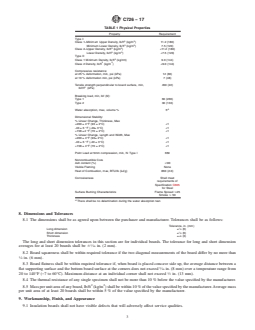
values shown in Table 1.
4.1.1 Type I—Roof insulation board comprised of a mono-
lithic fibrous material having a fibrous high density upper
8. Dimensions and Tolerances
surface layer and a lower density fibrous bottom layer.
8.1 The dimensions shall be as agreed upon between the
4.1.1.1 Class 1—Minimum upper surface layer actual den-
purchaser and manufacturer. Tolerances shall be as follows:
3 3
sity of 11.2 lb/ft (180 kg/m ) and a minimum lower layer
Tolerance, in. (mm)
actual density of 7.5 lb/ft (120 kg/m3).
Long dimension ± ⁄4 (6)
4.1.1.2 Class 2—Upper surface layer and lower surface 1
Short dimension ± ⁄4 (6)
Thickness ± ⁄8 (3)
layer density less than Class 1.
(1) Grade A – Minimum point load of 146 lbf (650 N). The long and short dimension tolerances in this section are
(2) Grade B – Point load < 146 lbf (650 N). for individual boards. The tolerance for long and short dimen-
4.1.2 Type II—Roof insulation board of singular density. sion averages for at least 20 boards shall be 6 ⁄16 in. (2 mm).
4.1.2.1 Class 1—Minimum actual density of 9 lb/ft (144
8.2 Board squareness shall be within required tolerance if
kg/m ).
the two diagonal measurements of the board differ by no more
4.1.2.2 Class 2—Actual density less than Class 1.
than ⁄4 in. (6 mm).
8.3 Board flatness shall be within required tolerance if,
5. Ordering Information
when board is placed concave side up, the average distance
5.1 Orders for material purchased under this specification
between a flat supporting surface and the bottom board surface
shall include:
at the corners does not exceed ⁄16 in. (8 mm) over a
5.1.1 Designation of this specification,
temperature range from 20 to 140°F (−7 to 60°C). Maximum
5.1.2 Product name,
distance at an individual corner shall not exceed ⁄2 in. (13
5.1.3 Board dimensions,
mm).
8.4 The thermal resistance of any single specimen shall not
Available from Underwriters Laboratories (UL), 2600 N.W. Lake Rd., Camas,
be more than 10 % below the value specified by the manufac-
WA 98607-8542, http://www.ul.com.
turer.
Available from European Committee for Standardization (CEN), Avenue
2 2
Marnix 17, B-1000, Brussels, Belgium, http://www.cen.eu.
8.5 Mass per unit area of any board, lb/ft (kg/m ) shall be
FM Approvals, 1151 Boston-Providence Turnpike, P.O. Box 9102, Norwood,
within 10 % of the value specified by the manufacturer.
MA 02062.
Average mass per unit area of at least 20 boards shall be within
Available from International Organization for Standardization (ISO), 1, ch. de
la Voie-Creuse, CP 56, CH-1211 Geneva 20, Switzerland, http://www.iso.org. 5 % of the value specified by the manufacturer.
C726 − 17
TABLE 1 Physical Properties
11.2 Unless otherwise specified, condition samples prior to
Property Requirement cutting specimens for at least 12 h at 73 6 2°F (24 6 1°C), 50
Type I: 6 5 % relative humidity before testing.
3 3
Class 1–Minimum Up
...
This document is not an ASTM standard and is intended only to provide the user of an ASTM standard an indication of what changes have been made to the previous version. Because
it may not be technically possible to adequately depict all changes accurately, ASTM recommends that users consult prior editions as appropriate. In all cases only the current version
of the standard as published by ASTM is to be considered the official document.
Designation: C726 − 12 C726 − 17
Standard Specification for
Mineral Wool Roof Insulation Board
This standard is issued under the fixed designation C726; the number immediately following the designation indicates the year of
original adoption or, in the case of revision, the year of last revision. A number in parentheses indicates the year of last reapproval. A
superscript epsilon (´) indicates an editorial change since the last revision or reapproval.
This standard has been approved for use by agencies of the U.S. Department of Defense.
1. Scope
1.1 This specification covers the composition and physical properties of mineral wool insulation board used above structural
roof decks in building construction. The mineral wool roof insulation acts as a base for systems such as single-ply,
polymer-modified bitumen and built-up roof. This specification also covers mineral wool insulation boards that incorporate a
fibrous high density upper layer on the top surface
1.2 It is possible that the use of thermal insulation materials covered by this specification will be regulated by building codes
or other agencies that address fire performance, or both. The fire performance of the material needs to be addressed through
standard fire test methods established by the appropriate governing documents.
1.3 The values stated in inch-pound units are to be regarded as standard. The values given in parentheses are mathematical
conversions to SI units that are provided for information only and are not considered standard.
1.4 This standard does not purport to address all of the safety concerns, if any, associated with its use. It is the responsibility
of the user of this standard to establish appropriate safety and health practices and determine the applicability of the regulatory
limitations prior to use.
1.5 This international standard was developed in accordance with internationally recognized principles on standardization
established in the Decision on Principles for the Development of International Standards, Guides and Recommendations issued
by the World Trade Organization Technical Barriers to Trade (TBT) Committee.
2. Referenced Documents
2.1 The following standards, of the issue in effect on the date of material purchase, form a part of this specification to the extent
specified herein:
2.2 ASTM Standards:
C165 Test Method for Measuring Compressive Properties of Thermal Insulations
C168 Terminology Relating to Thermal Insulation
C177 Test Method for Steady-State Heat Flux Measurements and Thermal Transmission Properties by Means of the
Guarded-Hot-Plate Apparatus
C203 Test Methods for Breaking Load and Flexural Properties of Block-Type Thermal Insulation
C209 Test Methods for Cellulosic Fiber Insulating Board
C303 Test Method for Dimensions and Density of Preformed Block and Board–Type Thermal Insulation
C390 Practice for Sampling and Acceptance of Thermal Insulation Lots
C518 Test Method for Steady-State Thermal Transmission Properties by Means of the Heat Flow Meter Apparatus
C665 Specification for Mineral-Fiber Blanket Thermal Insulation for Light Frame Construction and Manufactured Housing
C1363 Test Method for Thermal Performance of Building Materials and Envelope Assemblies by Means of a Hot Box Apparatus
C1763 Test Method for Water Absorption by Immersion of Thermal Insulation Materials
D312 Specification for Asphalt Used in Roofing
D482 Test Method for Ash from Petroleum Products
This specification is under the jurisdiction of ASTM Committee C16 on Thermal Insulation and is the direct responsibility of Subcommittee C16.20 on Homogeneous
Inorganic Thermal Insulations.
Current edition approved May 1, 2012March 1, 2017. Published May 2012April 2017. Originally approved in 1972. Last previous edition approved in 20112012 as
C726 – 11.C726 – 12. DOI: 10.1520/C0726-12. 10.1520/C0726-17.
For referenced ASTM standards, visit the ASTM website, www.astm.org, or contact ASTM Customer Service at service@astm.org. For Annual Book of ASTM Standards
volume information, refer to the standard’s Document Summary page on the ASTM website.
Copyright © ASTM International, 100 Barr Harbor Drive, PO Box C700, West Conshohocken, PA 19428-2959. United States
C726 − 17
D450 Specification for Coal-Tar Pitch Used in Roofing, Dampproofing, and Waterproofing
D2126 Test Method for Response of Rigid Cellular Plastics to Thermal and Humid Aging
E84 Test Method for Surface Burning Characteristics of Building Materials
E2058 Test Methods for Measurement of Material Flammability Using a Fire Propagation Apparatus (FPA)
2.3 Other Referenced Documents:
CAN/ULC-S102 Standard Method of Test for Surface Burning Characteristics of Building Materials and Assemblies
EN 12430 :1998/A1 Thermal Insulating Product for Building Applications – Determination of Behaviour Under Point Load
FM 4470 Approval Standard for Single-Ply, Polymer-Modified Bitumen Sheet, Built-Up Roof (BUR) and Liquid Applied Roof
Assemblies for use in Class 1 and Noncombustible Roof Deck Constructions
ISO 1716 :2002, Reaction-to-Fire Tests for Building Products – Determination of the Heat of Combustion
3. Terminology
3.1 Definitions:Terms used in this specification are defined in Terminology C168.
3.1.1 noncombustible core—a fibrous roof insulation product conforming to the ash content, visible flaming and heat of
combustion requirements 12.11.
4. Classification
4.1 The thermal insulation shall be of the following types, classes and grades;
4.1.1 Type I—Roof insulation board comprised of a monolithic fibrous material having a fibrous high density upper surface layer
and a lower density fibrous bottom layer.
3 3
4.1.1.1 Class 1—Minimum upper surface layer actual density of 11.2 lb/ft (180 kg/m ) and a minimum lower layer actual
density of 7.5 lb/ft (120 kg/m3).
4.1.1.2 Class 2—Upper surface layer and lower surface layer density less than Class 1.
(1) Grade A – Minimum point load of 146 lbf (650 N).
(2) Grade B – Point load < 146 lbf (650 N).
4.1.2 Type II—Roof insulation board of singular density.
3 3
4.1.2.1 Class 1—Minimum actual density of 9 lb/ft (144 kg/m ).
4.1.2.2 Class 2—Actual density less than Class 1.
5. Ordering Information
5.1 Orders for material purchased under this specification shall include:
5.1.1 Designation of this specification,
5.1.2 Product name,
5.1.3 Board dimensions,
5.1.4 Quantity of material, and
5.1.5 Special packaging or marking, (14.1 and 14.2) if required.
6. Materials and Manufacture
6.1 Mineral wool roof insulation board shall consist of mineral wool with an organic resin or other suitable binder.
6.2 For built-up roofing or polymer modified bitumen systems the board shall be faced during manufacture on one surface with
a cover adequate for the application of Specification D312 asphalt or Specification D450 coal-tar pitch.
6.3 For single ply membrane systems the board shall be permitted to be faced or unfaced. For mechanically fastened single ply
membrane systems the board shall be permitted to be faced or unfaced. For adhered single ply membrane systems the board shall
be permitted to be faced during manufacture on one surface with a cover adequate for the application of the adhesive used to secure
the single ply membrane.
7. Physical Properties
7.1 The average thermal resistance, R, of specimens sampled in accordance with Practice C390 shall be as specified by the
manufacturer.
7.2 Nominal thickness required to obtain the specified resistance or conductance shall be as stated by the manufacturer.
7.3 Roof insulation boards shall have the limiting property values shown in Table 1.
Available from Underwriters Laboratories (UL), 2600 N.W. Lake Rd., Camas, WA 98607-8542, http://www.ul.com.
Available from European Committee for Standardization (CEN), Avenue Marnix 17, B-1000, Brussels, Belgium, http://www.cen.eu.
FM Approvals, 1151 Boston-Providence Turnpike, P.O. Box 9102, Norwood, MA 02062.
Available from International Organization for Standardization (ISO), 1, ch. de la Voie-Creuse, CP 56, CH-1211 Geneva 20, Switzerland, http://www.iso.org.
C726 − 17
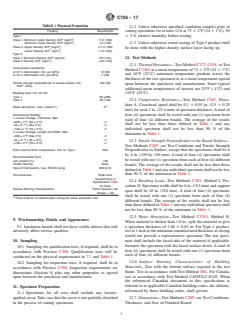
TABLE 1 Physical Properties
Property Requirement
Type I:
3 3
Class 1–Minimum Upper Density, lb/ft (kg/m ) 11.2 (180)
3 3
Minimum Lower Density, lb/ft (kg/m ) 7.5 (120)
3 3
Class 2–Upper Density, lb/ft (kg/m ) <11.2 (180)
3 3
Lower Density, lb/ft (kg/m ) <7.5 (120)
Type II:
Class 1 Minimum Density, lb/ft (kg/m3) 9.0 (144)
3 3
Class 2 Density, lb/ft (kg/m ) <9.0 (144)
Compressive resistance:
at 25 % deformation, min, psi (kPa) 12 (83)
at 10 % deformation min, psi (kPa) 7 (48)
Tensile strength perpendicular to board surface, min, 450 (22)
lbf/ft (kPa)
Breaking load, min, lbf (N):
Type 1 60 (266)
Type 2 30 (133)
A
Water absorption, max, volume % 5
Dimensional Stability:
% Linear Change, Thickness, Max
+200 ± 4°F (93 ± 2°C) <1
-40 ± 6 °F (-40± 3°C) <1
+158 ±4 °F (70 ± 2°C) <1
% Linear Change, Length and Width, Max
+200 ± 4°F (93± 2°C) <1
-40 ± 6 °F (-40 ± 3°C) <1
+158 ± 4°F (70 ± 2°C) <1
Point Load at 5mm compression, min, N: Type I 650
Noncombustible Core
Ash content (%) $90
Visible Flaming None
Heat of Combustion, max, BTU/lb (kJ/g) 860 (2.0)
Corrosiveness Shall meet
requirements of
Specification C665
for Steel
Surface Burning Characteristics Flame Spread #25
Smoke # 50
A
There shall be no delamination during the water absorption test.
8. Dimensions and Tolerances
8.1 The dimensions shall be as agreed upon between the purchaser and manufacturer. Tolerances shall be as follows:
Tolerance, in. (mm)
Long dimension ± ⁄4 (6)
Short dimension ± ⁄4 (6)
Thickness ± ⁄8 (3)
The long and short dimension tolerances in this sectio
...