

ASTM D5296-19
(Test Method)Standard Test Method for Molecular Weight Averages and Molecular Weight Distribution of Polystyrene by High Performance Size-Exclusion Chromatography
General Information
- Abstract
SIGNIFICANCE AND USE
5.1 General Utility—The molecular weight (MW) and molecular weight distribution (MWD) are fundamental characteristics of a polymer sample. They are used for a wide variety of correlations for fundamental studies, processing, or product applications. For example, the observed MWD is compared to one predicted from assumed kinetics or mechanisms for a polymerization reaction. Differences between the values will allow alteration of theory or experimental design. Similarly, the strength, melt flow, and other properties of a polymer sample usually are dependent on MW and MWD. Determinations of MW and MWD are used for quality control of polymers.
5.2 Limitations—Because of the need for specific calibration of the polymer type under study, and because of the specific nature of polymer/solvent/column-packing interactions, this test method is valid only for polystyrene and non-exclusion effects are to be avoided. However, many of the principles of the method have been applied in generating HPSEC methods for other polymer systems, for example, using the principles of universal calibration. (see Practice D3016).
SCOPE
1.1 This test method covers the determination of molecular weight (MW) averages and the distribution of molecular weights for linear, soluble polystyrene by high-performance size-exclusion chromatography (HPSEC). This test method is not absolute and requires the use of commercially available narrow molecular weight distribution (MWD) polystyrene standards for calibration. This test method is applicable for samples containing molecular weight components that have elution volumes falling within the elution volume range defined by polystyrene standards (that is, molecular weights generally from 2000 to 2 000 000 g·mol−1).
1.2 The HPSEC is differentiated from traditional size-exclusion chromatography SEC (also referred to as gel permeation chromatography (GPC)) in that the number of theoretical plates per metre with an HPSEC system is at least ten times greater than that for traditional SEC (see Terminology D883 and Practice D3016).2 The HPSEC systems employ low-volume liquid chromatography components and columns packed with relatively small (generally 3 to 20 μm) microporous particles. High-performance liquid chromatography instrumentation and automated data handling systems for data acquisition and processing are required.
1.3 The values stated in SI units are to be regarded as the standard.
1.4 This standard does not purport to address all of the safety concerns, if any, associated with its use. It is the responsibility of the user of this standard to establish appropriate safety, health, and environmental practices and determine the applicability of regulatory limitations prior to use. Specific precautionary statements are given in Section 9.
Note 1: There is no known ISO equivalent to this standard.
1.5 This international standard was developed in accordance with internationally recognized principles on standardization established in the Decision on Principles for the Development of International Standards, Guides and Recommendations issued by the World Trade Organization Technical Barriers to Trade (TBT) Committee.
- Status
- Published
- Publication Date
- 31-Oct-2019
- Technical Committee
- D20 - Plastics
- Drafting Committee
- D20.70 - Analytical Methods
Buy Documents
ASTM D5296-19 - Standard Test Method for Molecular Weight Averages and Molecular Weight Distribution of Polystyrene by High Performance Size-Exclusion Chromatography
REDLINE ASTM D5296-19 - Standard Test Method for Molecular Weight Averages and Molecular Weight Distribution of Polystyrene by High Performance Size-Exclusion Chromatography
Overview
ASTM D5296-19 is the internationally recognized standard titled "Standard Test Method for Molecular Weight Averages and Molecular Weight Distribution of Polystyrene by High Performance Size-Exclusion Chromatography." Issued by ASTM International, this method specifically addresses the accurate determination of molecular weight (MW) averages and the molecular weight distribution (MWD) of linear, soluble polystyrene samples using high-performance size-exclusion chromatography (HPSEC).
The standard method forms an important part of quality control, research, and product development in the plastics and polymer industry, providing laboratories and manufacturers with a framework for consistent and repeatable measurement of polystyrene molecular characteristics. Reliable MW and MWD determination is fundamental as these parameters significantly influence the physical properties and processability of polystyrene materials.
Key Topics
High Performance Size-Exclusion Chromatography (HPSEC):
HPSEC offers a highly efficient separation of polymer molecules based on size, leveraging columns packed with fine microporous particles and precision liquid chromatography instrumentation. This test method is distinguished from traditional size-exclusion chromatography (SEC) by greater efficiency and the requirement for automated data handling.Calibration and Accuracy:
This test method is not absolute; it relies on commercial polystyrene standards with narrow MWD for calibration. Accurate results depend on elution volumes or times falling within the reliable calibration range, generally from 2,000 to 2,000,000 g·mol⁻¹.Applicability and Scope:
The test is valid only for polystyrene and emphasizes avoiding non-exclusion effects tied to specific polymer and solvent interactions. The protocol employs SI units as the standard for all reported results.Instrumentation Requirements:
Essential system components include a solvent reservoir, pulseless pumping system, high-performance injector, precise columns, sensitive solute detectors (e.g., refractive index or photometric detectors), and an advanced data handling setup to record and process chromatographic data.Safety Considerations:
Users are responsible for implementing appropriate health, safety, and environmental practices due to the potential hazards of some solvents and reagents used in the test method.
Applications
The ASTM D5296-19 standard method is used extensively for:
Quality Control of Polystyrene Production:
MW and MWD evaluations are crucial for monitoring manufacturing consistency and ensuring that polystyrene products meet specific criteria for strength, processability, melt flow, and end-use performance.Fundamental Polymer Research:
The data generated allows for detailed comparison between observed molecular weight distributions and those predicted by polymerization theory, aiding in the investigation of polymerization kinetics and mechanisms.Product Development and Process Optimization:
Understanding MW and MWD facilitates the customization of polystyrene materials for specific applications, impacting mechanical properties, processing behavior, and final product qualities.Comparative Performance Testing:
The method is employed to benchmark new polystyrene grades or to assess the impact of changes in manufacturing processes on polymer properties.
Related Standards
For comprehensive analysis and system support, ASTM D5296-19 references and is related to the following standards:
- ASTM D883: Standard Terminology Relating to Plastics
- ASTM D2857: Practice for Dilute Solution Viscosity of Polymers
- ASTM D3016: Practice for Use of Liquid Exclusion Chromatography Terms and Relationships
- ASTM E685: Practice for Testing Fixed-Wavelength Photometric Detectors Used in Liquid Chromatography
- ASTM E691: Practice for Conducting an Interlaboratory Study to Determine the Precision of a Test Method
These standards collectively support consistent terminology, measurement accuracy, and best practices for laboratory operation and polymer analysis.
Keywords: ASTM D5296-19, molecular weight distribution, high performance size-exclusion chromatography, HPSEC, polystyrene, quality control, polymer analysis, standard test method, calibration, plastics industry
Relations
- Effective Date
- 01-Nov-2019
- Effective Date
- 01-Feb-2024
- Effective Date
- 01-Nov-2023
- Effective Date
- 01-Jan-2020
- Effective Date
- 01-Aug-2019
- Effective Date
- 15-Apr-2019
- Effective Date
- 01-Feb-2019
- Effective Date
- 01-Dec-2018
- Effective Date
- 01-Nov-2018
- Effective Date
- 01-Nov-2018
- Effective Date
- 15-Aug-2017
- Effective Date
- 01-May-2013
- Effective Date
- 15-Nov-2012
- Effective Date
- 01-Nov-2011
- Effective Date
- 15-May-2011
Buy Documents
ASTM D5296-19 - Standard Test Method for Molecular Weight Averages and Molecular Weight Distribution of Polystyrene by High Performance Size-Exclusion Chromatography
REDLINE ASTM D5296-19 - Standard Test Method for Molecular Weight Averages and Molecular Weight Distribution of Polystyrene by High Performance Size-Exclusion Chromatography
Get Certified
Connect with accredited certification bodies for this standard

CIS Institut d.o.o.
Personal Protective Equipment (PPE) certification body. Notified Body NB-2890 for EU Regulation 2016/425 PPE.

Kiwa BDA Testing
Building and construction product certification.
Kmetijski inštitut Slovenije
Agricultural Institute of Slovenia. Soil testing, plant health, agricultural product analysis.
Sponsored listings
Frequently Asked Questions
ASTM D5296-19 is a standard published by ASTM International. Its full title is "Standard Test Method for Molecular Weight Averages and Molecular Weight Distribution of Polystyrene by High Performance Size-Exclusion Chromatography". This standard covers: SIGNIFICANCE AND USE 5.1 General Utility—The molecular weight (MW) and molecular weight distribution (MWD) are fundamental characteristics of a polymer sample. They are used for a wide variety of correlations for fundamental studies, processing, or product applications. For example, the observed MWD is compared to one predicted from assumed kinetics or mechanisms for a polymerization reaction. Differences between the values will allow alteration of theory or experimental design. Similarly, the strength, melt flow, and other properties of a polymer sample usually are dependent on MW and MWD. Determinations of MW and MWD are used for quality control of polymers. 5.2 Limitations—Because of the need for specific calibration of the polymer type under study, and because of the specific nature of polymer/solvent/column-packing interactions, this test method is valid only for polystyrene and non-exclusion effects are to be avoided. However, many of the principles of the method have been applied in generating HPSEC methods for other polymer systems, for example, using the principles of universal calibration. (see Practice D3016). SCOPE 1.1 This test method covers the determination of molecular weight (MW) averages and the distribution of molecular weights for linear, soluble polystyrene by high-performance size-exclusion chromatography (HPSEC). This test method is not absolute and requires the use of commercially available narrow molecular weight distribution (MWD) polystyrene standards for calibration. This test method is applicable for samples containing molecular weight components that have elution volumes falling within the elution volume range defined by polystyrene standards (that is, molecular weights generally from 2000 to 2 000 000 g·mol−1). 1.2 The HPSEC is differentiated from traditional size-exclusion chromatography SEC (also referred to as gel permeation chromatography (GPC)) in that the number of theoretical plates per metre with an HPSEC system is at least ten times greater than that for traditional SEC (see Terminology D883 and Practice D3016).2 The HPSEC systems employ low-volume liquid chromatography components and columns packed with relatively small (generally 3 to 20 μm) microporous particles. High-performance liquid chromatography instrumentation and automated data handling systems for data acquisition and processing are required. 1.3 The values stated in SI units are to be regarded as the standard. 1.4 This standard does not purport to address all of the safety concerns, if any, associated with its use. It is the responsibility of the user of this standard to establish appropriate safety, health, and environmental practices and determine the applicability of regulatory limitations prior to use. Specific precautionary statements are given in Section 9. Note 1: There is no known ISO equivalent to this standard. 1.5 This international standard was developed in accordance with internationally recognized principles on standardization established in the Decision on Principles for the Development of International Standards, Guides and Recommendations issued by the World Trade Organization Technical Barriers to Trade (TBT) Committee.
SIGNIFICANCE AND USE 5.1 General Utility—The molecular weight (MW) and molecular weight distribution (MWD) are fundamental characteristics of a polymer sample. They are used for a wide variety of correlations for fundamental studies, processing, or product applications. For example, the observed MWD is compared to one predicted from assumed kinetics or mechanisms for a polymerization reaction. Differences between the values will allow alteration of theory or experimental design. Similarly, the strength, melt flow, and other properties of a polymer sample usually are dependent on MW and MWD. Determinations of MW and MWD are used for quality control of polymers. 5.2 Limitations—Because of the need for specific calibration of the polymer type under study, and because of the specific nature of polymer/solvent/column-packing interactions, this test method is valid only for polystyrene and non-exclusion effects are to be avoided. However, many of the principles of the method have been applied in generating HPSEC methods for other polymer systems, for example, using the principles of universal calibration. (see Practice D3016). SCOPE 1.1 This test method covers the determination of molecular weight (MW) averages and the distribution of molecular weights for linear, soluble polystyrene by high-performance size-exclusion chromatography (HPSEC). This test method is not absolute and requires the use of commercially available narrow molecular weight distribution (MWD) polystyrene standards for calibration. This test method is applicable for samples containing molecular weight components that have elution volumes falling within the elution volume range defined by polystyrene standards (that is, molecular weights generally from 2000 to 2 000 000 g·mol−1). 1.2 The HPSEC is differentiated from traditional size-exclusion chromatography SEC (also referred to as gel permeation chromatography (GPC)) in that the number of theoretical plates per metre with an HPSEC system is at least ten times greater than that for traditional SEC (see Terminology D883 and Practice D3016).2 The HPSEC systems employ low-volume liquid chromatography components and columns packed with relatively small (generally 3 to 20 μm) microporous particles. High-performance liquid chromatography instrumentation and automated data handling systems for data acquisition and processing are required. 1.3 The values stated in SI units are to be regarded as the standard. 1.4 This standard does not purport to address all of the safety concerns, if any, associated with its use. It is the responsibility of the user of this standard to establish appropriate safety, health, and environmental practices and determine the applicability of regulatory limitations prior to use. Specific precautionary statements are given in Section 9. Note 1: There is no known ISO equivalent to this standard. 1.5 This international standard was developed in accordance with internationally recognized principles on standardization established in the Decision on Principles for the Development of International Standards, Guides and Recommendations issued by the World Trade Organization Technical Barriers to Trade (TBT) Committee.
ASTM D5296-19 is classified under the following ICS (International Classification for Standards) categories: 13.300 - Protection against dangerous goods. The ICS classification helps identify the subject area and facilitates finding related standards.
ASTM D5296-19 has the following relationships with other standards: It is inter standard links to ASTM D5296-11, ASTM D883-24, ASTM D883-23, ASTM D883-20, ASTM D883-19c, ASTM D883-19a, ASTM D883-19, ASTM D883-18a, ASTM D883-18, ASTM D3016-97(2018), ASTM D883-17, ASTM E691-13, ASTM D883-12e1, ASTM E691-11, ASTM D883-11. Understanding these relationships helps ensure you are using the most current and applicable version of the standard.
ASTM D5296-19 is available in PDF format for immediate download after purchase. The document can be added to your cart and obtained through the secure checkout process. Digital delivery ensures instant access to the complete standard document.
Standards Content (Sample)
This international standard was developed in accordance with internationally recognized principles on standardization established in the Decision on Principles for the
Development of International Standards, Guides and Recommendations issued by the World Trade Organization Technical Barriers to Trade (TBT) Committee.
Designation: D5296 − 19
Standard Test Method for
Molecular Weight Averages and Molecular Weight
Distribution of Polystyrene by High Performance Size-
Exclusion Chromatography
This standard is issued under the fixed designation D5296; the number immediately following the designation indicates the year of
original adoption or, in the case of revision, the year of last revision.Anumber in parentheses indicates the year of last reapproval.A
superscript epsilon (´) indicates an editorial change since the last revision or reapproval.
1. Scope* 1.5 This international standard was developed in accor-
dance with internationally recognized principles on standard-
1.1 This test method covers the determination of molecular
ization established in the Decision on Principles for the
weight (MW) averages and the distribution of molecular
Development of International Standards, Guides and Recom-
weights for linear, soluble polystyrene by high-performance
mendations issued by the World Trade Organization Technical
size-exclusion chromatography (HPSEC). This test method is
Barriers to Trade (TBT) Committee.
not absolute and requires the use of commercially available
narrow molecular weight distribution (MWD) polystyrene
2. Referenced Documents
standards for calibration. This test method is applicable for
samples containing molecular weight components that have 2.1 ASTM Standards:
elution volumes falling within the elution volume range D883Terminology Relating to Plastics
D2857Practice for Dilute Solution Viscosity of Polymers
defined by polystyrene standards (that is, molecular weights
−1
generally from 2000 to 2000000 g·mol ). D3016Practice for Use of Liquid Exclusion Chromatogra-
phy Terms and Relationships
1.2 The HPSEC is differentiated from traditional size-
E685Practice for Testing Fixed-Wavelength Photometric
exclusion chromatography SEC (also referred to as gel perme-
Detectors Used in Liquid Chromatography
ation chromatography (GPC)) in that the number of theoretical
E691Practice for Conducting an Interlaboratory Study to
plates per metre with an HPSEC system is at least ten times
Determine the Precision of a Test Method
greater than that for traditional SEC (see Terminology D883
and Practice D3016). The HPSEC systems employ low-
3. Terminology
volume liquid chromatography components and columns
packed with relatively small (generally 3 to 20 µm) micropo- 3.1 Definitions—For definitions of technical terms pertain-
rous particles. High-performance liquid chromatography in- ing to plastics used in this test method see Terminology D883.
strumentation and automated data handling systems for data
acquisition and processing are required. 4. Summary of Test Method
4.1 In this test method a dilute solution of a polystyrene
1.3 The values stated in SI units are to be regarded as the
standard. sample is injected into a liquid mobile phase containing the
samesolventusedtopreparethepolymersolution.Themobile
1.4 This standard does not purport to address all of the
phase transports the polymer into and through a chromato-
safety concerns, if any, associated with its use. It is the
graphic column (or set of columns connected in series) packed
responsibility of the user of this standard to establish appro-
with a solid or semirigid, porous substrate which separates the
priate safety, health, and environmental practices and deter-
polymer molecules according to their size in solution. Starting
mine the applicability of regulatory limitations prior to use.
frominjection,adetectorcontinuouslymonitorstheeluateasa
Specific precautionary statements are given in Section 9.
function of elution volume (or time). Upon emerging from the
NOTE 1—There is no known ISO equivalent to this standard.
column(s), the size-separated molecules are detected and
recordedaccordingtotheirconcentration.Throughcalibration,
the elution volumes (or times) are converted to molecular
ThistestmethodisunderthejurisdictionofASTMCommitteeD20onPlastics
and is the direct responsibility of Subcommittee D20.70 on Analytical Methods.
Current edition approved Nov. 1, 2019. Published December 2019. Originally
approved in 1992. Last previous edition approved in 2011 as D5296–11. DOI: For referenced ASTM standards, visit the ASTM website, www.astm.org, or
10.1520/D5296-19. contact ASTM Customer Service at service@astm.org. For Annual Book of ASTM
Seealso AMD Bibliography and Bibliography SupplementsAMD 40-S1, 40-S2, Standards volume information, refer to the standard’s Document Summary page on
and 40-S3 on Size Exclusion Chromatography, availablefromASTMHeadquarters. the ASTM website.
*A Summary of Changes section appears at the end of this standard
Copyright © ASTM International, 100 Barr Harbor Drive, PO Box C700, West Conshohocken, PA 19428-2959. United States
D5296 − 19
weights, and various molecular weight parameters for the 7.2 Essential Components—The essential components of
samplearecalculatedfromthemolecularweight/concentration instrumentation are a solvent reservoir, solvent pumping
data. system,sampleinjector,packedcolumn(s),solutedetector,low
dead-volume liquid chromatography tubing and fittings, waste
5. Significance and Use container, recorder, and an automated data-handling system.
Any component used shall meet the safety and performance
5.1 General Utility—The molecular weight (MW) and mo-
requirements specified as follows.
lecular weight distribution (MWD) are fundamental character-
7.2.1 The interrelationships of the components are shown
istics of a polymer sample.They are used for a wide variety of
schematically in Fig. 1. For instruments that have injector,
correlations for fundamental studies, processing, or product
column(s), detector, or other components operated above
applications. For example, the observed MWD is compared to
ambient temperature, the use of a degasser located in the
one predicted from assumed kinetics or mechanisms for a
solventreservoirorbetweenthereservoirandpumpingsystem
polymerization reaction. Differences between the values will
is recommended to remove air from the solvent. Typical
allowalterationoftheoryorexperimentaldesign.Similarly,the
laboratoryglasswareandananalyticalbalancearealsoneeded.
strength, melt flow, and other properties of a polymer sample
usually are dependent on MW and MWD. Determinations of
NOTE2—AnumberofsystemsandcomponentsforperformingHPSEC
are available commercially.
MW and MWD are used for quality control of polymers.
7.3 Solvent Reservoir—The solvent reservoir must hold
5.2 Limitations—Because of the need for specific calibra-
sufficient solvent to ensure consistency of composition for a
tion of the polymer type under study, and because of the
number of runs or analyses. The reservoir shall permit control
specific nature of polymer/solvent/column-packing
of the environment in contact with the solvent, and be
interactions, this test method is valid only for polystyrene and
completely inert to the solvent employed. In addition, some
non-exclusion effects are to be avoided. However, many of the
means of agitation (for example, magnetic stirring) is recom-
principles of the method have been applied in generating
mended to ensure uniform composition.
HPSECmethodsforotherpolymersystems,forexample,using
the principles of universal calibration. (see Practice D3016).
7.4 Solvent Pumping System—The principal requirement of
a pumping system is production of a constant and pulseless
6. Units and Symbols
flow of solvent through the columns. In general, the rate of
flow shall be adjustable between 0.1 and 5.0 mL/min and
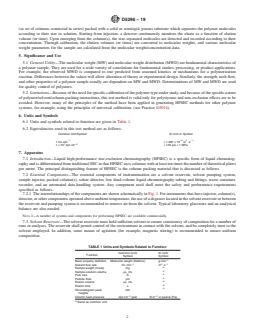
6.1 UnitsandsymbolsrelatedtofunctionaregiveninTable
back-pressures shall not exceed limits specified by the column
1.
manufacturer (for example, 28 MPa). If the elution volume is
6.2 Equivalencies used in this test method are as follows:
not being measured directly or corrected for systematic
Common Unit/Symbol SI Unit or Symbol
changes, the precision in the flow rate must be at least 60.3%
−1 −8 3 −1
as measured under the conditions and over the time interval
1 mL·min =1.667×10 m ·s¯
7 −2
1×10 dyn·cm = 145 psi = 1 MPa
required for running a typical analysis.
7.5 Sample Injector—The purpose of an injection system is
7. Apparatus
to generate a sharply defined zone of solution containing the
7.1 Introduction—Liquid high-performance size-exclusion
sample when introducing the sample into the flow stream. A
chromatography (HPSEC) is a specific form of liquid chroma-
valve and loop assembly or any of a number of commercially
tography and is differentiated from traditional SEC in that
available high-performance liquid chromatography automatic
HPSEC uses columns with at least ten times the number of
injection systems is suitable for this purpose. Requirements
theoretical plates per metre. The principal distinguishing fea-
includeminimalcontributiontobandspreading,injectorability
tureofHPSECisthecolumnpackingmaterialthatisdiscussed
to operate at the back-pressure generated by the columns,
as follows.
repeatability of injection volume, and no carryover.
7.6 Columns—Stainless steel columns with uniform and
highly polished inside walls are usually selected for HPSEC.
Columns with lengths ranging from 15 to 50 cm and special
TABLE 1 Units and Symbols Related to Function
end fittings, frits, and connectors designed to minimize dead
Common Unit/ SI Unit/
Function
Symbol Symbol volumeandmixingarerecommended.Micro-particulate,semi-
−1
Basic property definition Molecular weight (Daltons) g·mol
rigidorganicgels,andrigidsolid,porouspackingmaterialsare
−1 3 −1
Solvent flow rate mL·min m ·s
A
Sample weight (mass) mg
A
Sample solution volume µL, mL
A
Pore size Å
A
Particle Size µm
A
Elution volume µL, mL
A
Elution time s
A
Chromatogram peak mm
heights
−2 −2
Column back pressure dyn·cm (psi) N·m or pascal (Pa)
A
Same as common unit.
FIG. 1 Schematic of an HPSEC System
D5296 − 19
wavelength are important to ensure a MW-independent concentration
usedforHPSEC.Generally,thepackingmaterialshavenarrow
response. Failure to do so may result in erroneous MW-averages and a
particle size distributions with particle sizes in the range from
distorted MWD.
3 to 20 µm. Packing materials also are available in a variety of
7.8 Tubing and Fittings—All tubing between the sample
shapesandporesizes.Columnsareeitherpackedwithparticles
injector and the detector shall be no greater than 0.25-mm
of relatively uniform pore size or with a “mixed bed” of
[0.010-in.] internal diameter and of sufficient thickness for use
particles to produce a broad range of pore sizes for polymer
at pressures up to 42 MPa. Connecting tubings shall be kept as
separation. If a set of columns is used, it is recommended that
short as possible and all fittings and connectors must be
the columns be connected starting from the injector outlet in
designed to prevent mixing and have low dead volumes.
order of columns having the smallest to those having the
largest packing pore size.
7.9 Recorder/Plotter—Either a recording potentiometer
with a full-scale response of at least2sora printing device
NOTE 3—Column packing materials and packed HPSEC columns are
availablecommerciallyfromanumberofmanufacturers.Usersofthistest connected to a data handling system is recommended to plot
method are advised to follow manufacturers’ guidelines and recommen-
the chromatographic data. Choose a pen response and signal-
dations for the care and use of their HPSEC columns. For example,
to-noiseratiosothattheconcentrationsignalisnotappreciably
manufacturers’ guidelines may override the preceding recommendation
perturbed.
fororderingtheplacementofcolumnsinacolumnsetbecauseofconcern
about the fragility of smaller pore size packing materials.
7.10 Data Handling Systems—Means must be provided for
7.7 Detectors—The purpose of the detector is to continu-
determining chromatographic peak heights or integrated area
ously monitor the concentration of solute eluting from the
segments at prescribed intervals under the HPSEC chromato-
chromatographic column(s). Consequently, the detector must
gram and for handling and reporting the data. This is best
be sufficiently sensitive and respond linearly to the solute
accomplished by means of a computer or a real-time data
concentration. Additionally, the detector must not appreciably
acquisition system with either off-line or on-line data process-
distort the concentration gradient in the emerging stream. This
ing.
requirement imposes severe limitations on the volume of
NOTE 6—Data acquisition and handling systems for HPSEC have not
solution available for detection. For example, use of detectors
been standardized. However, it is noted that a number of different
with cell volumes greater than 15 µL generally will not be
manufacturers now provide chromatography data systems that include
accepted with this test method. Most detectors employed for
HPSEC software.Also, some users have developed their own specialized
HPSEC computer software.
HPSEC are based upon photometric measurements (refractive
index,UV-visible,fluorescenceandinfraredabsorbance).Prac-
7.11 Other Components—Special solvent line filters, pres-
tice E685 serves as a guide for testing the performance of
suremonitors,pulsedampers,flowmeters,thermostatedovens,
photometric detectors used in high-performance liquid chro-
syphon counters, plotters, raw data storage systems, software,
matographic systems. Other detectors with appropriate sensi-
and so forth are oftentimes incorporated with the essential
tivity are also acceptable. The differential refractometer has
components previously listed.
moderate sensitivity and general utility. It provides a signal
7.12 HPSEC System—Any satisfactory combination of the
proportionaltothedifferenceinrefractiveindex(∆RI)between
above components that will meet the performance require-
thesolventandthecolumneluate.Thedetectorshallbeableto
−7 −8
ments of Section 12.
respond to 10 to 10 ∆RI unit with cell volumes ≤ 10 µL.
NOTE 4—The change in the specific refractive index increment (dn/dc)
8. Reagents and Materials
of polystyrene is negligible at molecular weights greater than about 5000
−1
g·mol . No appreciable error in molecular weight averages will be
8.1 Solvent—Tetrahydrofuran(THF)isrecommendedasthe
introducedwiththisdetectorforpolystyreneaslongasitsnumber-average
solvent for this test method. However, any solvent that is
−1
molecular weight, M , is greater than 5000 g·mol . The principal
n
compatible with the HPSEC system components and column
disadvantage of the differential refractometer is that precise control of
packing materials and is considered to be a good solvent for
temperature, pressure, and flow rate is required to maintain a stable signal
for an appropriate level of sensitivity. For example, most organic liquids polystyrene is acceptable. To a certain extent, the choice of
−4
have a temperature coefficient of 10 RI units per K. Consequently, the
solvent dictates the operating temperature, as well as the
−4
temperature within the RI detector cell must be controlled to within 10
detector,selectedfortheHPSECsystem.Thetemperaturemust
°C.
be sufficiently high to keep the eluent viscosity low (usually 1
NOTE 5—Benzoyl peroxide is commonly used as a free radical initiator
cporless)andyetnottoohightocauseeluenttoboilordegas.
for styrene in the synthesis of polystyrene. The presence of small
concentrations of initiator fragments containing strong chromophores, Considering detector limitations, solvents having refractive
such as the benzoate group resulting from the decomposition of benzoyl
indices similar to that of polystyrene are not preferred for use
peroxide, as polymer end groups can significantly alter the ultraviolet
withdifferentialrefractiveindexdetectors;whilethoseabsorb-
(UV) absorption characteristics of polystyrene. Since the relative con-
ing strongly in the UV, such as toluene, shall not be used with
centrationofsuchendgroupsincreaseswithdecreasingpolymerMW,the
UV (254-nm) detectors. Solvent purity and consistency must
relationship between detector response and polymer concentration (molar
absorptivityintheBeer-Lambertlaw)maychangewithMW.Photometric
also be considered when choosing a solvent. For example,
detectors (UV and fluorescence) are particularly sensitive to the presence
unless freshly distilled and kept in an all glass (amber)
of strong chromophoric end groups. Choice of detector and selection of
container under an inert gas, THF will react with oxygen to
form peroxides that absorb in the UV and are hazardous upon
evaporative concentration.Therefore,THF must either contain
Garcia Rubio, L. H., Ro, N., and Patel, R. D., Macromolecules, 17, 1984, p.
1998. an antioxidant such as 0.025 to 0.1% w⁄v butylated hydroxy
D5296 − 19
toluene, or be continuously blanketed or sparged with an inert 10.5 Data Handling System—Users are advised to follow
gas like helium to prevent peroxide formation. recommendations of their computer or data system manufac-
turer for setting data acquisition and integration parameters.
¯ ¯
8.2 Polymer Standards—Unimodal, narrow MWD (M /M
w n
< 1.1) polystyrene standards of known molecular weight are
11. Preparation of Solutions
preferred for calibration. Ideally, the average molecular
weights of the standards are based on absolute MW methods 11.1 Polymer Samples—Solutionsarepreparedbyweighing
such as end-group analysis, osmometry, light scattering, or
10 to 50 mg of the polymer sample into a clean, dry, 50-mL
ultracentrifugation. flaskhavingascrewcaplinedwithsolvent-resistantmaterialor
into glasswares such as volumetric flasks fitted with ground
8.3 Low MW Standards—Low MW compounds, such as
glass stoppers. Next, the flask is filled two thirds with solvent
o-dichlorobenzene,thatareusedfordeterminingplatecountor
syphoned from the solvent reservoir and then stoppered. The
as internal standards must be of high purity. Sulfur is an
polymer must be dissolved at room temperature. Magnetic
excellent internal standard for monitoring changes in eluent
stirring devices or laboratory shakers are recommended to aid
flow rate in most HPSEC systems where THF is used as the
dissolution. Excessive temperature or ultrasonic devices have
solvent. Sulfur elutes after the HPSEC “junk” peak composed
been known to cause the polymer to degrade at times and
oflowMWcompoundsorinjectedair,orboth,andisavailable
therefore, must not be used with this test method. After the
in high purity.
polymer has dissolved, additional solvent from the solvent
9. Hazards reservoir is added to fill the flask. An alternative way is to
prepare the solution from “stock” solutions containing an
9.1 Solventsusedinthistestmethodarelikelytobetoxicor
internal standard as described in 11.3. Polystyrene solutions
highly flammable, or both. Direct contact with the skin and
prepared with solvents such as THF are very stable, as long as
inhalation of solvent vapors shall be avoided. The user is
−1
M<500000g·mol .However,itisagoodpracticetoanalyze
advised to consult literature and follow recommended proce-
the polymer solutions within 24 h of their preparation.
dures pertaining to the safe handling of the solvent. Similar
precautions are to be followed with respect to the handling of 11.2 Polymer Standards—The same procedure as described
low MW standards.
in 11.1 is used with the exception that “cocktails” of two or
morenarrowMWDpolymerstandardsbepreparedinthesame
10. Preparation of Apparatus
flask. Such cocktail solutions are useful for MW calibration
10.1 Assembly—The HPSEC system must be assembled and for determining resolution. It is recommended that higher
−1
MW polymer standards (M > 800000 g·mol ) be prepared as
into an integrated package as shown in Fig. 1 and readied for
operation. For commercial systems, manufacturers’ guidelines single, more dilute solutions to reduce problems relating to
polymer size in solution and concentration during calibration.
and recommendations shall be followed for assembly and
operation.
NOTE 7—To ensure good precision, the mass of each injected standard
and sample must be consistent from analysis to analysis.
10.2 Temperature—An operating temperature is not speci-
fied in this test method. Maintain a relatively constant tem-
11.3 Low MW Standards—Thesameprocedureasdescribed
perature of the critical internal components (injection loop,
in 11.1 is used to prepare dilute solutions (0.1% w/v) of low
column(s), detector, and connecting tubing) that is consistent
MW standards such as o-dichlorobenzene for determining the
with the choice of solvent. The temperature of the previously
plate count number (see 12.1). Dilute solutions (≤0.01% w⁄v)
mentioned internal components during an analysis must be
of low MW compounds also are sometimes prepared to
within 3°C of their temperature at calibration.
introduce internal standards into polymer solutions. “Stock”
solutions containing an internal standard, such as sulfur when
10.3 Flow Rate—Column and instrument manufacturers’
THF is the solvent, have been used directly in the preparation
recommendations shall be followed when selecting a flow rate
of polymer solutions or be added as aliquots to solutions
andstartingthesolventpumpingsystem.Aflowrateof1 60.1
−1
already prepared.
mL·min issuggested,butnotrequired,forthistestmethod.If
necessary, the pumping system is adjusted to deliver a rela-
NOTE 8—Atypical “stock” solution contains 0.03% w⁄v sulfur can be
tively constant and pulseless flow of eluent from the detector
prepared using THF from the solvent reservoir. It is sometimes desirable
touseanultrasonicdevicetoassistdissolutionofthesulfur.Sulfurcanbe
outlet.Flowrateismeasuredbydeterminingeitherthevolume
detected using differential refractive index and UV (254- nm) detectors.
or weight of solvent eluted over a sufficiently long period of
time and under suitable conditions to guarantee a precision of 11.4 Filtration—It is recommended that all solutions be
at least 60.3%. Flow rates must be determined during
filtered through membrane filters to remove lint and other
calibration and, if practical, before or after each analysis. materials likely to obstruct the columns and other system
Alternatively, use an internal standard (see 12.5) or a flow-
components. Except for very high MW samples, membrane
measuring device, such as a syphon dump, to monitor changes filters with pore sizes in the range from 0.2 to 0.5 µm are
in flow rate.
recommended. (The membrane pore size must not exceed 5
µm.) The filters must be inert to the solvent and not become
10.4 Detector—Detector settings and wavelength selection,
clogged during filtration.
in the case of photometric detectors, shall provide optimum
sensitivity for solute detection without causing undue baseline
NOTE 9—Filtration often reveals the presence of gel in solutions even
noise or overloading of the output signal. though the solutions appear clear to the eye, as is the case with many
D5296 − 19
microgels.Duringfiltration,gelparticlesarelikelytoplugtheporesofthe
W = peak width in elution volume (or time) units as
filter, noticeable by an excessive pressure needed for filtration. If such an
determined by measuring the distance between the
obstruction occurs, the soluble portion of the polymer may be partially
baseline intercepts of lines drawn tangent to the peak
removed during filtration, the obstructed membrane now acting as an
ultra-filtration device. In this case, the polymer in the filtrate may no inflection points as shown in Fig. 2.
longerberepresentativeofthesolubleportionofthesample.Therefore,if
12.1.2 Since Nisadimensionlessparameter,theplatecount
extensivepluggingofthemembraneporesisindicated,themeaningofthe
number has the same value, regardless, whether V and W are
R
chromatographic results is open to doubt.
measured in elution volume or elution time units. To compare
11.5 Test for Sample Solution Suitability—The mass of
platecountnumbersfordifferentsystems, Nisusuallynormal-
polymer injected for an HPSEC analysis is typically between
ized with respect to the total column(s) length, L; that is:
0.05 and 0.5 mg depending on the expected breadth of the
N' 5 N/L (2)
molecular weight distribution. Use smaller sample size for
polymers of narrower MW distribution or higher MW. This
12.1.3 TheHPSECcolumnsareexpectedtoequalorexceed
−1
method assumes that the mass of polymer injected is suffi-
N'=13100 plates·m . The HPSEC systems not meeting this
ciently small such that the hydrodynamic volume of the
performance requirement shall be examined and, if necessary,
polymer and the chromatographic separation mechanism do
the column(s) replaced. Occasional monitoring of the plate
not depend upon the mass or concentration of polymer in-
count is useful in trouble-shooting problems in the total
jected. However, if the injected solution concentration is too
HPSEC system as well as problems relating to column(s)
high, especially for higher polymer molecular weight samples,
performance.
thepeakelutionvolume(time)andshapeofthechromatogram
12.2 Resolution—Resolution, R, is a more meaningful pa-
will be affected and possible leads to an erroneous MW
rameter for chromatographic performance than plate count
determination. It is therefore advisable to rerun an unknown
number N'. R provides an indication of the separating
sample or standard at one half its original concentration (while
capability, as well as dispersion or band broadening effects, of
doubling detector sensitivity) to ensure that its peak elution is
a column or column set. The resolution of two standard
reproducible. If a change is observed, the run shall be repeated
¯
polymers having narrow MWDs (M /M < 1.1) is defined as
w n
with a still lower concentration of sample. The relationship
the specific resolution:
between log MW and mass injected is usually a continuous
function. Dilutions shall be made until a low-range mass is R 52·~V 2 V !/@~W 1W !·log ~M /M !# (3)
s R2 R1 1 2 10 1 2
achieved which still provides adequate signal-to-noise to
where:
distinguish between MW values of interest. For polystyrene in
V ,V = peak elution volumes or times measured at the
R 1 R 2
THF, the slope of the plot of log MW versus mass injected is
peak maximum of polymer Standards 1 and 2,
small; therefore, repeated dilutions will not greatly affect the
determined MW.
W ,W = peak widths of Standards 1 and 2 measured in
1 2
elution volume or times units as indicated in
12. Performance Requirements
Fig. 3, and
12.1 Plate Count Number—The plate count number, N,isa
M ,M = peak molecular weights of Standards 1 and 2.
1 2
dimensionless quantity related to column efficiency and pro-
12.2.1 The two standards shall differ in known molecular
vides an indication of dispersion processes in chromatographic
weight values by a factor of about ten and shall be chromato-
systems. Various procedures and methods of calculation have
graphed at a concentration of ≤0.05% w/v and an injection
been successfully applied to estimate N. Users of this test
volume ≤100 µL. It is recommended that the resolution
method are advised to follow recommendations of the column
parameter R be determined over each decade of molecular
s
manufacturer when initially evaluating their columns. The
weightforwhichthistestmethodappliesandthatatleastthree
plate count number are to be determined under the same
polymer standards be used. This test method requires that
conditions as those applied for this test method. For example,
calculated R values equal or exceed 1.7 for sufficient resolu-
s
utilize the following test conditions for both plate count
tion over the applicable molecular weight range for samples
determination and testing:
analyzed.Sinceresolutionisadimensionlessparameter,R will
s
Solvent—Tetrahydrofuran (THF)
havethesamevalueaslongasconsistentunits(elutionvolume
Temperature—30°C
−1 or elution time) are used for its evaluation.
Flow Rate—1 mL·min
Test Solute—o-dichlorobenzene
Concentration—# 0.1 % w ⁄v
Injection Volume—1 to5µL
12.1.1 Assumingthatthesolutepeakissymmetricalandhas
a nearly Gaussian shape, the following approximation is used
to calculate the plate count number:
platecount, N 5 16 V /W (1)
~ !
R
where:
V = peak elution volume (or time) measured at the peak
R
maximum of the test solute and
FIG. 2 Measurement of Peak Width
D5296 − 19
similar to that of a polymer peak (1 to 10 min) and therefore
must be minimized before analyses are conducted. The occur-
rence of long-term noise usually signifies that the chromato-
graphic system is not functioning properly. Long-term noise
shall not exceed 5% of the maximum polymer peak signal.
Drift is defined as the average slope of the noise envelope
measured over a period of 1 h. Drift is not a problem if the
slope is constant over the time required to run an HPSEC
analysis and if the data handling system is capable of correct-
ing for sloping baselines. Erroneous results is likely to o
...
This document is not an ASTM standard and is intended only to provide the user of an ASTM standard an indication of what changes have been made to the previous version. Because
it may not be technically possible to adequately depict all changes accurately, ASTM recommends that users consult prior editions as appropriate. In all cases only the current version
of the standard as published by ASTM is to be considered the official document.
Designation: D5296 − 11 D5296 − 19
Standard Test Method for
Molecular Weight Averages and Molecular Weight
Distribution of Polystyrene by High Performance Size-
Exclusion Chromatography
This standard is issued under the fixed designation D5296; the number immediately following the designation indicates the year of
original adoption or, in the case of revision, the year of last revision. A number in parentheses indicates the year of last reapproval. A
superscript epsilon (´) indicates an editorial change since the last revision or reapproval.
1. Scope*
1.1 This test method covers the determination of molecular weight (MW) averages and the distribution of molecular weights
for linear, soluble polystyrene by high-performance size-exclusion chromatography (HPSEC). This test method is not absolute and
requires the use of commercially available narrow molecular weight distribution (MWD) polystyrene standards for calibration.
This test method is applicable for samples containing molecular weight components that have elution volumes falling within the
−1
elution volume range defined by polystyrene standards (that is, molecular weights generally from 2000 to 2 000 000 g·mol ).
1.2 The HPSEC is differentiated from traditional size-exclusion chromatography SEC (also referred to as gel permeation
chromatography (GPC)) in that the number of theoretical plates per metre with an HPSEC system is at least ten times greater than
that for traditional SEC (see Terminology D883 and Practice D3016). The HPSEC systems employ low-volume liquid
chromatography components and columns packed with relatively small (generally 3 to 20 μm) microporous particles.
High-performance liquid chromatography instrumentation and automated data handling systems for data acquisition and
processing are required.
1.3 The values stated in SI units are to be regarded as the standard.
1.4 This standard does not purport to address all of the safety concerns, if any, associated with its use. It is the responsibility
of the user of this standard to establish appropriate safety safety, health, and healthenvironmental practices and determine the
applicability of regulatory limitations prior to use. Specific precautionary statements are given in Section 9.
NOTE 1—There is no known ISO equivalent to this standard.
1.5 This international standard was developed in accordance with internationally recognized principles on standardization
established in the Decision on Principles for the Development of International Standards, Guides and Recommendations issued
by the World Trade Organization Technical Barriers to Trade (TBT) Committee.
2. Referenced Documents
2.1 ASTM Standards:
D883 Terminology Relating to Plastics
D2857 Practice for Dilute Solution Viscosity of Polymers
D3016 Practice for Use of Liquid Exclusion Chromatography Terms and Relationships
E685 Practice for Testing Fixed-Wavelength Photometric Detectors Used in Liquid Chromatography
E691 Practice for Conducting an Interlaboratory Study to Determine the Precision of a Test Method
3. Terminology
3.1 Definitions—For definitions of technical terms pertaining to plastics used in this test method see Terminology D883.
4. Summary of Test Method
4.1 In this test method a dilute solution of a polystyrene sample is injected into a liquid mobile phase containing the same
solvent used to prepare the polymer solution. The mobile phase transports the polymer into and through a chromatographic column
This test method is under the jurisdiction of ASTM Committee D20 on Plastics and is the direct responsibility of Subcommittee D20.70 on Analytical Methods.
Current edition approved Sept. 1, 2011Nov. 1, 2019. Published September 2011December 2019. Originally approved in 1992. Last previous edition approved in 20052011
as D5296 - 05.D5296 – 11. DOI: 10.1520/D5296-11.10.1520/D5296-19.
See also AMD Bibliography and Bibliography Supplements AMD 40-S1, 40-S2, and 40-S3 on Size Exclusion Chromatography, available from ASTM Headquarters.
For referenced ASTM standards, visit the ASTM website, www.astm.org, or contact ASTM Customer Service at service@astm.org. For Annual Book of ASTM Standards
volume information, refer to the standard’s Document Summary page on the ASTM website.
*A Summary of Changes section appears at the end of this standard
Copyright © ASTM International, 100 Barr Harbor Drive, PO Box C700, West Conshohocken, PA 19428-2959. United States
D5296 − 19
(or set of columns connected in series) packed with a solid or semirigid, porous substrate which separates the polymer molecules
according to their size in solution. Starting from injection, a detector continuously monitors the eluate as a function of elution
volume (or time). Upon emerging from the column(s), the size-separated molecules are detected and recorded according to their
concentration. Through calibration, the elution volumes (or times) are converted to molecular weights, and various molecular
weight parameters for the sample are calculated from the molecular weight/concentration data.
5. Significance and Use
5.1 General Utility—The molecular weight (MW) and molecular weight distribution (MWD) are fundamental characteristics of
a polymer sample. They are used for a wide variety of correlations for fundamental studies, processing, or product applications.
For example, the observed MWD is compared to one predicted from assumed kinetics or mechanisms for a polymerization
reaction. Differences between the values will allow alteration of theory or experimental design. Similarly, the strength, melt flow,
and other properties of a polymer sample usually are dependent on MW and MWD. Determinations of MW and MWD are used
for quality control of polymers.
5.2 Limitations—Because of the need for specific calibration of the polymer type under study, and because of the specific nature
of polymer/solvent/column-packing interactions, this test method is valid only for polystyrene and non-exclusion effects are to be
avoided. However, many of the principles of the method have been applied in generating HPSEC methods for other polymer
systems, for example, using the principles of universal calibration. (see Practice D3016).
6. Units and Symbols
6.1 Units and symbols related to function are given in Table 1.
6.2 Equivalencies used in this test method are as follows:
Common Unit/Symbol SI Unit or Symbol
−1 −8 3 −1
1 mL·min = 1.667 × 10 m ·s¯
7 −2
1 × 10 dyn·cm = 145 psi = 1 MPa
7. Apparatus
7.1 Introduction—Liquid high-performance size-exclusion chromatography (HPSEC) is a specific form of liquid chromatog-
raphy and is differentiated from traditional SEC in that HPSEC uses columns with at least ten times the number of theoretical plates
per metre. The principal distinguishing feature of HPSEC is the column packing material that is discussed as follows.
7.2 Essential Components—The essential components of instrumentation are a solvent reservoir, solvent pumping system,
sample injector, packed column(s), solute detector, low dead-volume liquid chromatography tubing and fittings, waste container,
recorder, and an automated data-handling system. Any component used shall meet the safety and performance requirements
specified as follows.
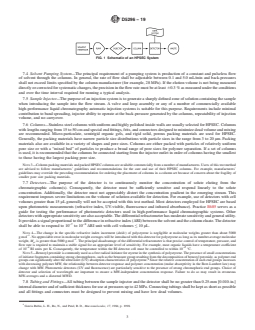
7.2.1 The interrelationships of the components are shown schematically in Fig. 1. For instruments that have injector, column(s),
detector, or other components operated above ambient temperature, the use of a degasser located in the solvent reservoir or between
the reservoir and pumping system is recommended to remove air from the solvent. Typical laboratory glassware and an analytical
balance are also needed.
NOTE 2—A number of systems and components for performing HPSEC are available commercially.
7.3 Solvent Reservoir—The solvent reservoir must hold sufficient solvent to ensure consistency of composition for a number of
runs or analyses. The reservoir shall permit control of the environment in contact with the solvent, and be completely inert to the
solvent employed. In addition, some means of agitation (for example, magnetic stirring) is recommended to ensure uniform
composition.
TABLE 1 Units and Symbols Related to Function
Common Unit/ SI Unit/
Function
Symbol Symbol
−1
Basic property definition Molecular weight (Daltons) g·mol
−1 3 −1
Solvent flow rate mL·min m ·s
A
Sample weight (mass) mg
A
Sample solution volume μL, mL
A
Pore size Å
A
Particle Size μm
A
Elution volume μL, mL
A
Elution time s
A
Chromatogram peak mm
heights
−2 −2
Column back pressure dyn·cm (psi) N·m or pascal (Pa)
A
Same as common unit.
D5296 − 19
FIG. 1 Schematic of an HPSEC System
7.4 Solvent Pumping System—The principal requirement of a pumping system is production of a constant and pulseless flow
of solvent through the columns. In general, the rate of flow shall be adjustable between 0.1 and 5.0 mL/min and back-pressures
shall not exceed limits specified by the column manufacturer (for example, 28 MPa). If the elution volume is not being measured
directly or corrected for systematic changes, the precision in the flow rate must be at least 60.3 % as measured under the conditions
and over the time interval required for running a typical analysis.
7.5 Sample Injector—The purpose of an injection system is to generate a sharply defined zone of solution containing the sample
when introducing the sample into the flow stream. A valve and loop assembly or any of a number of commercially available
high-performance liquid chromatography automatic injection systems is suitable for this purpose. Requirements include minimal
contribution to band spreading, injector ability to operate at the back-pressure generated by the columns, repeatability of injection
volume, and no carryover.
7.6 Columns—Stainless steel columns with uniform and highly polished inside walls are usually selected for HPSEC. Columns
with lengths ranging from 15 to 50 cm and special end fittings, frits, and connectors designed to minimize dead volume and mixing
are recommended. Micro-particulate, semirigid organic gels, and rigid solid, porous packing materials are used for HPSEC.
Generally, the packing materials have narrow particle size distributions with particle sizes in the range from 3 to 20 μm. Packing
materials also are available in a variety of shapes and pore sizes. Columns are either packed with particles of relatively uniform
pore size or with a “mixed bed” of particles to produce a broad range of pore sizes for polymer separation. If a set of columns
is used, it is recommended that the columns be connected starting from the injector outlet in order of columns having the smallest
to those having the largest packing pore size.
NOTE 3—Column packing materials and packed HPSEC columns are available commercially from a number of manufacturers. Users of this test method
are advised to follow manufacturers’ guidelines and recommendations for the care and use of their HPSEC columns. For example, manufacturers’
guidelines may override the preceding recommendation for ordering the placement of columns in a column set because of concern about the fragility of
smaller pore size packing materials.
7.7 Detectors—The purpose of the detector is to continuously monitor the concentration of solute eluting from the
chromatographic column(s). Consequently, the detector must be sufficiently sensitive and respond linearly to the solute
concentration. Additionally, the detector must not appreciably distort the concentration gradient in the emerging stream. This
requirement imposes severe limitations on the volume of solution available for detection. For example, use of detectors with cell
volumes greater than 15 μL generally will not be accepted with this test method. Most detectors employed for HPSEC are based
upon photometric measurements (refractive index, UV-visible, fluorescence and infrared absorbance). Practice E685 serves as a
guide for testing the performance of photometric detectors used in high-performance liquid chromatographic systems. Other
detectors with appropriate sensitivity are also acceptable. The differential refractometer has moderate sensitivity and general utility.
It provides a signal proportional to the difference in refractive index (ΔRI) between the solvent and the column eluate. The detector
−7 −8
shall be able to respond to 10 to 10 ΔRI unit with cell volumes ≤ 10 μL.
NOTE 4—The change in the specific refractive index increment (dn/dc) of polystyrene is negligible at molecular weights greater than about 5000
−1
g·mol . No appreciable error in molecular weight averages will be introduced with this detector for polystyrene as long as its number-average molecular
−1
weight, M , is greater than 5000 g·mol . The principal disadvantage of the differential refractometer is that precise control of temperature, pressure, and
n
flow rate is required to maintain a stable signal for an appropriate level of sensitivity. For example, most organic liquids have a temperature coefficient
−4 −4
of 10 RI units per K. Consequently, the temperature within the RI detector cell must be controlled to within 10 °C.
NOTE 5—Benzoyl peroxide is commonly used as a free radical initiator for styrene in the synthesis of polystyrene. The presence of small concentrations
of initiator fragments containing strong chromophores, such as the benzoate group resulting from the decomposition of benzoyl peroxide, as polymer end
groups can significantly alter the ultraviolet (UV) absorption characteristics of polystyrene. Since the relative concentration of such end groups increases
with decreasing polymer MW, the relationship between detector response and polymer concentration (molar absorptivity in the Beer-Lambert law) may
change with MW. Photometric detectors (UV and fluorescence) are particularly sensitive to the presence of strong chromophoric end groups. Choice of
detector and selection of wavelength are important to ensure a MW-independent concentration response. Failure to do so may result in erroneous
MW-averages and a distorted MWD.
7.8 Tubing and Fittings—All tubing between the sample injector and the detector shall be no greater than 0.25-mm [0.010-in.]
internal diameter and of sufficient thickness for use at pressures up to 42 MPa. Connecting tubings shall be kept as short as possible
and all fittings and connectors must be designed to prevent mixing and have low dead volumes.
Garcia Rubio, L. H., Ro, N., and Patel, R. D., Macromolecules, 17, 1984, p. 1998.
D5296 − 19
7.9 Recorder/Plotter—Either a recording potentiometer with a full-scale response of at least 2 s or a printing device connected
to a data handling system is recommended to plot the chromatographic data. Choose a pen response and signal-to-noise ratio so
that the concentration signal is not appreciably perturbed.
7.10 Data Handling Systems—Means must be provided for determining chromatographic peak heights or integrated area
segments at prescribed intervals under the HPSEC chromatogram and for handling and reporting the data. This is best
accomplished by means of a computer or a real-time data acquisition system with either off-line or on-line data processing.
NOTE 6—Data acquisition and handling systems for HPSEC have not been standardized. However, it is noted that a number of different manufacturers
now provide chromatography data systems that include HPSEC software. Also, some users have developed their own specialized HPSEC computer
software.
7.11 Other Components—Special solvent line filters, pressure monitors, pulse dampers, flowmeters, thermostated ovens, syphon
counters, plotters, raw data storage systems, software, and so forth are oftentimes incorporated with the essential components
previously listed.
7.12 HPSEC System—Any satisfactory combination of the above components that will meet the performance requirements of
Section 12.
8. Reagents and Materials
8.1 Solvent—Tetrahydrofuran (THF) is recommended as the solvent for this test method. However, any solvent that is
compatible with the HPSEC system components and column packing materials and is considered to be a good solvent for
polystyrene is acceptable. To a certain extent, the choice of solvent dictates the operating temperature, as well as the detector,
selected for the HPSEC system. The temperature must be sufficiently high to keep the eluent viscosity low (usually 1 cp or less)
and yet not too high to cause eluent to boil or degas. Considering detector limitations, solvents having refractive indices similar
to that of polystyrene are not preferred for use with differential refractive index detectors; while those absorbing strongly in the
UV, such as toluene, shall not be used with UV (254-nm) detectors. Solvent purity and consistency must also be considered when
choosing a solvent. For example, unless freshly distilled and kept in an all glass (amber) container under an inert gas, THF will
react with oxygen to form peroxides that absorb in the UV and are hazardous upon evaporative concentration. Therefore, THF must
either contain an antioxidant such as 0.025 to 0.1 % w/vw ⁄v butylated hydroxy toluene, or be continuously blanketed or sparged
with an inert gas like helium to prevent peroxide formation.
8.2 Polymer Standards—Unimodal, narrow MWD (M¯ /M¯ < 1.1) polystyrene standards of known molecular weight are
w n
preferred for calibration. Ideally, the average molecular weights of the standards are based on absolute MW methods such as
end-group analysis, osmometry, light scattering, or ultracentrifugation.
8.3 Low MW Standards—Low MW compounds, such as o-dichlorobenzene, that are used for determining plate count or as
internal standards must be of high purity. Sulfur is an excellent internal standard for monitoring changes in eluent flow rate in most
HPSEC systems where THF is used as the solvent. Sulfur elutes after the HPSEC “junk” peak composed of low MW compounds
or injected air, or both, and is available in high purity.
9. Hazards
9.1 Solvents used in this test method are likely to be toxic or highly flammable, or both. Direct contact with the skin and
inhalation of solvent vapors shall be avoided. The user is advised to consult literature and follow recommended procedures
pertaining to the safe handling of the solvent. Similar precautions are to be followed with respect to the handling of low MW
standards.
10. Preparation of Apparatus
10.1 Assembly—The HPSEC system must be assembled into an integrated package as shown in Fig. 1 and readied for operation.
For commercial systems, manufacturers’ guidelines and recommendations shall be followed for assembly and operation.
10.2 Temperature—An operating temperature is not specified in this test method. However, the Maintain a relatively constant
temperature of the critical internal components (injection loop, column(s), detector, and connecting tubing) should be relatively
constant and that is consistent with the choice of solvent. The temperature of the previously mentioned internal components during
an analysis must be within 3°C of their temperature at calibration.
10.3 Flow Rate—Column and instrument manufacturers’ recommendations shall be followed when selecting a flow rate and
−1
starting the solvent pumping system. A flow rate of 1 6 0.1 mL·min is suggested, but not required, for this test method. If
necessary, the pumping system is adjusted to deliver a relatively constant and pulseless flow of eluent from the detector outlet.
Flow rate is measured by determining either the volume or weight of solvent eluted over a sufficiently long period of time and
under suitable conditions to guarantee a precision of at least 60.3 %. Flow rates must be determined during calibration and, if
practical, before or after each analysis. Alternatively, use an internal standard (see 12.5) or a flow-measuring device, such as a
syphon dump, to monitor changes in flow rate.
D5296 − 19
10.4 Detector—Detector settings and wavelength selection, in the case of photometric detectors, shall provide optimum
sensitivity for solute detection without causing undue baseline noise or overloading of the output signal.
10.5 Data Handling System—Users are advised to follow recommendations of their computer or data system manufacturer for
setting data acquisition and integration parameters.
11. Preparation of Solutions
11.1 Polymer Samples—Solutions are prepared by weighing 10 to 50 mg of the polymer sample into a clean, dry, 50-mL flask
having a screw cap lined with solvent-resistant material or into glasswares such as volumetric flasks fitted with ground glass
stoppers. Next, the flask is filled two thirds with solvent syphoned from the solvent reservoir and then stoppered. The polymer must
be dissolved at room temperature. Magnetic stirring devices or laboratory shakers are recommended to aid dissolution. Excessive
temperature or ultrasonic devices have been known to cause the polymer to degrade at times and therefore, must not be used with
this test method. After the polymer has dissolved, additional solvent from the solvent reservoir is added to fill the flask. An
alternative way is to prepare the solution from “stock” solutions containing an internal standard as described in 11.3. Polystyrene
−1
solutions prepared with solvents such as THF are very stable, as long as M < 500 000 g·mol . However, it is a good practice to
analyze the polymer solutions within 24 h of their preparation.
11.2 Polymer Standards—The same procedure as described in 11.1 is used with the exception that “cocktails” of two or more
narrow MWD polymer standards be prepared in the same flask. Such cocktail solutions are useful for MW calibration and for
−1
determining resolution. It is recommended that higher MW polymer standards (M > 800 000 g·mol ) be prepared as single, more
dilute solutions to reduce problems relating to polymer size in solution and concentration during calibration.
NOTE 7—To ensure good precision, the mass of each injected standard and sample must be consistent from analysis to analysis.
11.3 Low MW Standards—The same procedure as described in 11.1 is used to prepare dilute solutions (0.1 % w/v) of low MW
standards such as o-dichlorobenzene for determining the plate count number (see 12.1). Dilute solutions (≤0.01 % w/v)w ⁄v) of low
MW compounds also are sometimes prepared to introduce internal standards into polymer solutions. “Stock” solutions containing
an internal standard, such as sulfur when THF is the solvent, have been used directly in the preparation of polymer solutions or
be added as aliquots to solutions already prepared.
NOTE 8—A typical “stock” solution contains 0.03 % w/vw ⁄v sulfur can be prepared using THF from the solvent reservoir. It is sometimes desirable
to use an ultrasonic device to assist dissolution of the sulfur. Sulfur can be detected using differential refractive index and UV (254- nm) detectors.
11.4 Filtration—It is recommended that all solutions be filtered through membrane filters to remove lint and other materials
likely to obstruct the columns and other system components. Except for very high MW samples, membrane filters with pore sizes
in the range from 0.2 to 0.5 μm are recommended. (The membrane pore size must not exceed 5 μm.) The filters must be inert to
the solvent and not become clogged during filtration.
NOTE 9—Filtration often reveals the presence of gel in solutions even though the solutions appear clear to the eye, as is the case with many microgels.
During filtration, gel particles are likely to plug the pores of the filter, noticeable by an excessive pressure needed for filtration. If such an obstruction
occurs, the soluble portion of the polymer may be partially removed during filtration, the obstructed membrane now acting as an ultra-filtration device.
In this case, the polymer in the filtrate may no longer be representative of the soluble portion of the sample. Therefore, if extensive plugging of the
membrane pores is indicated, the meaning of the chromatographic results is open to doubt.
11.5 Test for Sample Solution Suitability—The mass of polymer injected for an HPSEC analysis is typically between 0.05 and
0.5 mg depending on the expected breadth of the molecular weight distribution. Use smaller sample size for polymers of narrower
MW distribution or higher MW. This method assumes that the mass of polymer injected is sufficiently small such that the
hydrodynamic volume of the polymer and the chromatographic separation mechanism do not depend upon the mass or
concentration of polymer injected. However, if the injected solution concentration is too high, especially for higher polymer
molecular weight samples, the peak elution volume (time) and shape of the chromatogram will be affected and possible leads to
an erroneous MW determination. It is therefore advisable to rerun an unknown sample or standard at one half its original
concentration (while doubling detector sensitivity) to ensure that its peak elution is reproducible. If a change is observed, the run
shall be repeated with a still lower concentration of sample. The relationship between log MW and mass injected is usually a
continuous function. Dilutions shall be made until a low-range mass is achieved which still provides adequate signal-to-noise to
distinguish between MW values of interest. For polystyrene in THF, the slope of the plot of log MW versus mass injected is small;
therefore, repeated dilutions will not greatly affect the determined MW.
12. Performance Requirements
12.1 Plate Count Number—The plate count number, N, is a dimensionless quantity related to column efficiency and provides
an indication of dispersion processes in chromatographic systems. Various procedures and methods of calculation have been
successfully applied to estimate N. Users of this test method are advised to follow recommendations of the column manufacturer
when initially evaluating their columns. The plate count number are to be determined under the same conditions as those applied
for this test method. For example, utilize the following test conditions for both plate count determination and testing:
D5296 − 19
Solvent—Tetrahydrofuran (THF)
Temperature—30°C
−1
Flow Rate—1 mL·min
Test Solute—o-dichlorobenzene
Concentration—# 0.1 % w/v
Concentration—# 0.1 % w ⁄v
Injection Volume—1 to 5 μL
12.1.1 Assuming that the solute peak is symmetrical and has a nearly Gaussian shape, the following approximation can be is
used to calculate the plate count number:
plate count, N 5 16 V /W (1)
~ !
R
where:
V = peak elution volume (or time) measured at the peak maximum of the test solute and
R
W = peak width in elution volume (or time) units as determined by measuring the distance between the baseline intercepts of
lines drawn tangent to the peak inflection points as shown in Fig. 2.
12.1.2 Since N is a dimensionless parameter, the plate count number has the same value, regardless, whether V and W are
R
measured in elution volume or elution time units. To compare plate count numbers for different systems, N is usually normalized
with respect to the total column(s) length, L; that is:
N'5 N/L (2)
−1
12.1.3 The HPSEC columns are expected to equal or exceed N' = 13 100 plates·m . The HPSEC systems not meeting this
performance requirement shall be examined and, if necessary, the column(s) replaced. Occasional monitoring of the plate count
is useful in trouble-shooting problems in the total HPSEC system as well as problems relating to column(s) performance.
12.2 Resolution—Resolution, R, is a more meaningful parameter for chromatographic performance than plate count number N'.
R provides an indication of the separating capability, as well as dispersion or band broadening effects, of a column or column set.
The resolution of two standard polymers having narrow MWDs (M¯ /M < 1.1) is defined as the specific resolution:
w n
R 5 2· V 2 V / W 1W ·log M /M (3)
~ ! @~ ! ~ !#
s R2 R1 1 2 10 1 2
where:
V , V = peak elution volumes or times measured at the peak maximum of polymer Standards 1 and 2,
R 1 R 2
W , W = peak widths of Standards 1 and 2 measured in elution volume or times units as indicated in Fig. 3, and
1 2
M , M = peak molecular weights of Standards 1 and 2.
1 2
12.2.1 The two standards shall differ in known molecular weight values by a factor of about ten and shall be chromatographed
at a concentration of ≤0.05 % w/v and an injection volume ≤100 μL. It is recommended that the resolution parameter R be
s
determined over each decade of molecular weight for which this test method applies and that at least three polymer standards be
used. This test method requires that calculated R values equal or exceed 1.7 for sufficient resolution over the applicable molecular
s
weight range for samples analyzed. Since resolution is a dimensionless parameter, R will have the same value as long as consistent
s
units (elution volume or elution time) are used for its evaluation.
NOTE 10—Mixtures or “cocktails” of three or more polymer standards may be run to determine several R values with a single injection. For example,
s
−1
a mixture of polystyrene standards of molecular weight 10 000; 100 000 and 1 000 000 g·mol may be run to determine R over the MW range from
s
−1 −1
10 000 to 1 000 000 g·mol . Alternatively, a mixture of 2000; 20 000; 200 000 and 2 000 000 g·mol standards may be run to determine R over a
s
broader MW range. It is important to keep solution concentrations sufficiently low to avoid possible concentration effects (see 11.5).
12.2.2 Baseline resolution shouldshall be observed for the elution peaks generated by mixtures of standards as previously
described. Such mixtures are extremely useful in determining changes in HPSEC system performance and shall be run frequently
to ensure calibration (see 13.2).
12.2.3 Resolution has also been defined in terms of the slope of the HPSEC calibration curve (see 13.4). Present the calibration
curve using a straight line with Slope S over the elution volume region of the polymer samples being analyzed, and Eq 3 becomes:
R 5 @20.5 S·~W 1W !# (4)
s 1 2
FIG. 2 Measurement of Peak Width
D5296 − 19
FIG. 3 Determination of Resolution, R , Using Narrow MWD Polystyrene StandardsM >M
s 1 2
If W = W × W for polymer standards eluting within the straight region of the calibration curve, a limiting value of resolution
1 2
will be defined as follows:
limR 5 ~2W·S! (5)
s
In this case, changes in the slope of the calibration curve or peak wi
...