

ASTM E768-99(2018)
(Guide)Standard Guide for Preparing and Evaluating Specimens for Automatic Inclusion Assessment of Steel
General Information
- Abstract
SIGNIFICANCE AND USE
4.1 Inclusion ratings done either manually using Test Methods E45 or automatically using Practice E1122 or E1245 are influenced by the quality of specimen preparation. This guide provides examples of proven specimen preparation methods that retain inclusions in polished steel specimens.
4.2 This guide provides a procedure to determine if the prepared specimens are of suitable quality for subsequent rating of inclusions. None of these methods should be construed as defining or establishing specific procedures or limits of acceptability for any steel grade.
SCOPE
1.1 This guide2 covers two preparation methods for steel metallographic specimens that will be analyzed for nonmetallic inclusions with automatic image analysis (AIA) equipment. The two methods of preparation are offered as accepted methods used to retain nonmetallic inclusions in steel. This guide does not limit the user to these methods.
1.2 A procedure to test the suitability of the prepared specimen for AIA inclusion work, using differential interference contrast (DIC), is presented.
1.3 The values stated in SI units are to be regarded as standard. No other units of measurement are included in this standard.
1.4 This international standard was developed in accordance with internationally recognized principles on standardization established in the Decision on Principles for the Development of International Standards, Guides and Recommendations issued by the World Trade Organization Technical Barriers to Trade (TBT) Committee.
- Status
- Published
- Publication Date
- 30-Apr-2018
- Technical Committee
- E04 - Metallography
- Drafting Committee
- E04.01 - Specimen Preparation
Overview
ASTM E768-99(2018): Standard Guide for Preparing and Evaluating Specimens for Automatic Inclusion Assessment of Steel provides comprehensive guidance on the preparation and evaluation of metallographic specimens to assess nonmetallic inclusions in steel using automatic image analysis (AIA). Developed by ASTM International, this guide is essential for laboratories and professionals involved in metallography, steel quality control, and automatic inclusion rating. The quality of specimen preparation directly impacts the accuracy and reliability of inclusion assessments, making adherence to proven methods critical.
Key Topics
Specimen Preparation Methods
The standard details two accepted methods for preparing steel specimens:- Silicon Carbide Abrasive Paper Grinding: Utilizes a sequence of abrasives to retain inclusions in the plane of polish.
- Rigid Grinding Disk Procedure: Employs rigid grinding surfaces and specific polishing steps to produce specimens suitable for automatic evaluation.
Specimen Cleanliness
Proper cleaning between grinding and polishing steps is emphasized to prevent contamination and inaccurate inclusion ratings. The use of inhibitors during cleaning is recommended to reduce exaggerated inclusion sizes caused by certain cleaning methods.Evaluation of Prepared Specimens
The guide introduces a procedure using differential interference contrast (DIC) microscopy to assess whether the specimen preparation meets the requirements for automatic image analysis. This step ensures inclusions are clearly visible and have not been altered by preparation.Standard Units of Measurement
All values and procedures in the standard use SI units, supporting international applicability.
Applications
Steel Quality Control
Accurate assessment of nonmetallic inclusions is essential for determining steel quality and suitability for critical applications. ASTM E768-99(2018) provides laboratories and producers with reliable methods to prepare specimens that yield consistent and reproducible results.Automatic Image Analysis (AIA)
The guide enhances the effectiveness of AIA by ensuring specimens are prepared in a way that inclusions are preserved and clearly differentiated from the matrix, improving automated detection and quantification.Research and Development
R&D teams use this guide to standardize specimen preparation, facilitating comparable inclusion data across different studies and institutions.Metallography Training
Educational and training programs in metallography utilize this guide to teach best practices in specimen preparation and evaluation for inclusion analysis.
Related Standards
ASTM E3: Guide for Preparation of Metallographic Specimens
Establishes general specimen preparation procedures.ASTM E7: Terminology Relating to Metallography
Provides definitions related to metallographic practice.ASTM E45: Test Methods for Determining the Inclusion Content of Steel
Details manual methods for inclusion assessment.ASTM E883: Guide for Reflected-Light Photomicrography
Supports photomicrographic evaluation of specimens.ASTM E1122: Practice for Obtaining JK Inclusion Ratings Using Automatic Image Analysis (withdrawn 2006)
Former standard for automated inclusion evaluation.ASTM E1245: Practice for Determining Inclusion or Second-Phase Constituent Content of Metals by Automatic Image Analysis
Provides methodology for AIA.
Practical Value
Using ASTM E768-99(2018) ensures laboratories achieve reliable and repeatable preparation of steel specimens for automatic inclusion analysis. The guide’s detailed procedures help maximize accuracy in steel quality control, support international harmonization of testing methods, and bolster confidence in data used for production, certification, and research. Adopting these standardized practices minimizes errors related to specimen preparation, directly supporting efficient and precise steel evaluation.
Relations
- Effective Date
- 01-Apr-2024
- Effective Date
- 01-Nov-2023
- Effective Date
- 01-Jun-2017
- Effective Date
- 01-Jun-2015
- Effective Date
- 01-Nov-2014
- Effective Date
- 01-Oct-2011
- Effective Date
- 01-Jun-2011
- Effective Date
- 01-May-2011
- Effective Date
- 01-Nov-2010
- Effective Date
- 01-Oct-2009
- Effective Date
- 01-Oct-2008
- Effective Date
- 01-Jul-2007
- Effective Date
- 01-Jul-2007
- Effective Date
- 01-May-2007
- Effective Date
- 01-Nov-2005
Get Certified
Connect with accredited certification bodies for this standard

Element Materials Technology
Materials testing and product certification.

Inštitut za kovinske materiale in tehnologije
Institute of Metals and Technology. Materials testing, metallurgical analysis, NDT.
Sponsored listings
Frequently Asked Questions
ASTM E768-99(2018) is a guide published by ASTM International. Its full title is "Standard Guide for Preparing and Evaluating Specimens for Automatic Inclusion Assessment of Steel". This standard covers: SIGNIFICANCE AND USE 4.1 Inclusion ratings done either manually using Test Methods E45 or automatically using Practice E1122 or E1245 are influenced by the quality of specimen preparation. This guide provides examples of proven specimen preparation methods that retain inclusions in polished steel specimens. 4.2 This guide provides a procedure to determine if the prepared specimens are of suitable quality for subsequent rating of inclusions. None of these methods should be construed as defining or establishing specific procedures or limits of acceptability for any steel grade. SCOPE 1.1 This guide2 covers two preparation methods for steel metallographic specimens that will be analyzed for nonmetallic inclusions with automatic image analysis (AIA) equipment. The two methods of preparation are offered as accepted methods used to retain nonmetallic inclusions in steel. This guide does not limit the user to these methods. 1.2 A procedure to test the suitability of the prepared specimen for AIA inclusion work, using differential interference contrast (DIC), is presented. 1.3 The values stated in SI units are to be regarded as standard. No other units of measurement are included in this standard. 1.4 This international standard was developed in accordance with internationally recognized principles on standardization established in the Decision on Principles for the Development of International Standards, Guides and Recommendations issued by the World Trade Organization Technical Barriers to Trade (TBT) Committee.
SIGNIFICANCE AND USE 4.1 Inclusion ratings done either manually using Test Methods E45 or automatically using Practice E1122 or E1245 are influenced by the quality of specimen preparation. This guide provides examples of proven specimen preparation methods that retain inclusions in polished steel specimens. 4.2 This guide provides a procedure to determine if the prepared specimens are of suitable quality for subsequent rating of inclusions. None of these methods should be construed as defining or establishing specific procedures or limits of acceptability for any steel grade. SCOPE 1.1 This guide2 covers two preparation methods for steel metallographic specimens that will be analyzed for nonmetallic inclusions with automatic image analysis (AIA) equipment. The two methods of preparation are offered as accepted methods used to retain nonmetallic inclusions in steel. This guide does not limit the user to these methods. 1.2 A procedure to test the suitability of the prepared specimen for AIA inclusion work, using differential interference contrast (DIC), is presented. 1.3 The values stated in SI units are to be regarded as standard. No other units of measurement are included in this standard. 1.4 This international standard was developed in accordance with internationally recognized principles on standardization established in the Decision on Principles for the Development of International Standards, Guides and Recommendations issued by the World Trade Organization Technical Barriers to Trade (TBT) Committee.
ASTM E768-99(2018) is classified under the following ICS (International Classification for Standards) categories: 77.040.01 - Testing of metals in general. The ICS classification helps identify the subject area and facilitates finding related standards.
ASTM E768-99(2018) has the following relationships with other standards: It is inter standard links to ASTM E883-11(2024), ASTM E45-18a(2023), ASTM E883-11(2017), ASTM E7-15, ASTM E7-14, ASTM E45-11a, ASTM E45-11, ASTM E883-11, ASTM E45-10, ASTM E7-03(2009), ASTM E1245-03(2008), ASTM E3-01(2007), ASTM E3-01(2007)e1, ASTM E883-02(2007), ASTM E45-05. Understanding these relationships helps ensure you are using the most current and applicable version of the standard.
ASTM E768-99(2018) is available in PDF format for immediate download after purchase. The document can be added to your cart and obtained through the secure checkout process. Digital delivery ensures instant access to the complete standard document.
Standards Content (Sample)
This international standard was developed in accordance with internationally recognized principles on standardization established in the Decision on Principles for the
Development of International Standards, Guides and Recommendations issued by the World Trade Organization Technical Barriers to Trade (TBT) Committee.
Designation: E768 − 99 (Reapproved 2018)
Standard Guide for
Preparing and Evaluating Specimens for Automatic
Inclusion Assessment of Steel
This standard is issued under the fixed designation E768; the number immediately following the designation indicates the year of
original adoption or, in the case of revision, the year of last revision.Anumber in parentheses indicates the year of last reapproval.A
superscript epsilon (´) indicates an editorial change since the last revision or reapproval.
1. Scope E1245Practice for Determining the Inclusion or Second-
2 Phase Constituent Content of Metals byAutomatic Image
1.1 This guide covers two preparation methods for steel
Analysis
metallographicspecimensthatwillbeanalyzedfornonmetallic
2.2 ASTM Adjuncts:
inclusions with automatic image analysis (AIA) equipment.
ADJE0768 Differential Interference Contrast Magnification
The two methods of preparation are offered as accepted
100× and 500× (6 micrographs)
methods used to retain nonmetallic inclusions in steel. This
guide does not limit the user to these methods.
3. Terminology
1.2 A procedure to test the suitability of the prepared
3.1 Definitions:
specimen for AIA inclusion work, using differential interfer-
3.1.1 For definitions used in this practice, refer to Termi-
ence contrast (DIC), is presented.
nology E7.
1.3 The values stated in SI units are to be regarded as 3.1.2 differential interference contrast microscopy—a com-
standard. No other units of measurement are included in this
prehensive definition appears in Guide E883, section 11.8.
standard.
3.2 Definitions of Terms Specific to This Standard:
1.4 This international standard was developed in accor-
3.2.1 rigid grinding disk—a non-fabric support surface,
dance with internationally recognized principles on standard-
such as a composite of metal/ceramic or metal/polymer,
ization established in the Decision on Principles for the
charged with an abrasive (usually 6 to 15-µm diamond
Development of International Standards, Guides and Recom-
particles), and used as the fine grinding operation in a metal-
mendations issued by the World Trade Organization Technical
lographic preparation procedure.
Barriers to Trade (TBT) Committee.
4. Significance and Use
2. Referenced Documents
4.1 Inclusion ratings done either manually usingTest Meth-
ods E45 or automatically using Practice E1122 or E1245 are
2.1 ASTM Standards:
E3Guide for Preparation of Metallographic Specimens influenced by the quality of specimen preparation. This guide
provides examples of proven specimen preparation methods
E7Terminology Relating to Metallography
E45Test Methods for Determining the Inclusion Content of that retain inclusions in polished steel specimens.
Steel
4.2 This guide provides a procedure to determine if the
E883Guide for Reflected–Light Photomicrography
prepared specimens are of suitable quality for subsequent
E1122Practice for Obtaining JK Inclusion Ratings Using
rating of inclusions. None of these methods should be con-
Automatic Image Analysis (Withdrawn 2006)
strued as defining or establishing specific procedures or limits
of acceptability for any steel grade.
ThisguideisunderthejurisdictionofASTMCommitteeE04onMetallography
5. Preparation Methods
and is the direct responsibility of Subcommittee E04.01 on Specimen Preparation.
5.1 Background:
Current edition approved May 1, 2018. Published June 2018. Originally
ɛ1
approved in 1980. Last previous edition approved in 2010 as E768–99(2010) .
5.1.1 The inclusions in the plane of polish must be fully
DOI: 10.1520/E0768-99R18.
preserved and clearly visible. Preparation should not produce
Supporting data have been filed atASTM International Headquarters and may
excessive relief around the perimeter of the inclusions that
be obtained by requesting Research Report RR:E04-1002.
would exaggerate the size and number of inclusions on the
For referenced ASTM standards, visit the ASTM website, www.astm.org, or
contact ASTM Customer Service at service@astm.org. For Annual Book of ASTM
Standards volume information, refer to the standard’s Document Summary page on
the ASTM website. Acolored plate, consisting of six micrographs that illustrate the use of DIC in
The last approved version of this historical standard is referenced on determining a properly prepared sample (at 100x and 500x), is available from
www.astm.org. ASTM Headquarters. Order Adjuct: ADJE0768.
Copyright © ASTM International, 100 Barr Harbor Drive, PO Box C700, West Conshohocken, PA 19428-2959. United States
E768 − 99 (2018)
TABLE 1 Comparison of ANSI (CAMI) versus FEPA versus
plane of polish. In many cases, the preparation of specimens
Median Diameter of Grit Size in Micrometers
for inclusion rating is more readily performed after the
A B C
ANSI (CAMI) FEPA Approximate Median
specimens have been hardened by a suitable heat treatment
Diameter
procedure (austenize, quench to fully martensitic structure,
(µm)
temper at a relatively low temperature).
60 P60 250
80 P80 180
5.1.2 Cleanliness is an important consideration in all stages
100 P100 150
of specimen preparation.
120 P120 125
5.1.2.1 Heat-treated specimens should be wire brushed or
150 P150 90
180 P180 75
shot blasted or have the surface ground to remove adherent
220 P220 63
scale.
240 P240 58.5
5.1.2.2 After completing the grinding steps and before P280 52.2
280 P320 46.2
performing the polishing steps, the specimens and specimen
320 P360 40.5
holders must be cleaned to prevent contamination of the next
P400 35.0
preparationstep.Cleaningthespecimensandspecimenholders 360 P500 30.2
400 P600 25.8
between each grinding step can eliminate contamination of
P800 21.8
coarse abrasives to the following finer preparation step.
500 P1000 18.3
600 P1200 15.3
5.1.2.3 After the preparation is complete, swab the surface
800 P2400 8.4
carefully with cotton and a water/soap solution containing a
D
1200 P4000 3.0
corrosion inhibitor such as a machine coolant or ethyl alcohol
A
ANSI - American National Standards Institute
B
solution to remove any films or other debris that would
CAMI - Coated Abrasives Manufacturers Institute
C
interfere with the inclusion rating. FEPA - Federation of European Abrasive Producers
D
Not a FEPA designation
5.1.2.4 It is advisable to perform the inclusion analysis as
soonaspossibleafterpreparationtominimizestainingorother
problems that can affect the analysis.
5.1.3 The two methods that follow have been found to be
reliableproceduresforretaininginclusionsinsteelandachiev-
5.2.2.1 Low pressures are recommended to ensure the
ing the desired results when evaluated by DIC.There are other
retention of an assortment of inclusion types found in a variety
methods that will result in a quality specimen as revealed by
of steel grades. The relatively low pressures suggested in this
DIC. Each laboratory should develop preparation procedures
procedurewillnotnecessarilyresultinasatisfactorypolishfor
for their materials so that the prepared surfaces meet the
etching and the further evaluation of the specimen’s general
requirements presented in 6 of this guide.
microstructure. The pressures used in the following rigid disk
5.1.4 As described in Practice E3, the specimens may be
procedure are more likely to result in a surface more satisfac-
sectioned and mounted to ease handling during preparation. It
tory for revealing general microstructures.
is advisable to use a mounting medium that is hard enough to
5.2.3 Grind the specimens on ANSI 80 grit (P80 FEPA)
preserve edges and maintain flatness.
silicon carbide paper to ensure all sectioning artifacts and
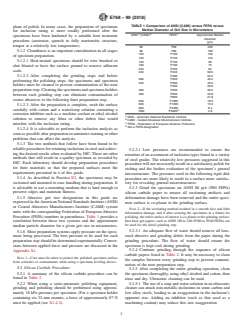
5.1.5 Abrasive grit size designations in this guide are
deformation damage have been removed and the entire speci-
expressedintheAmericanNationalStandardsInstitute(ANSI) men surface is co-planar to the grinding surface.
or Coated Abrasives Manufacturers Institute (CAMI) system
NOTE 2—If the sectioning method resulted in a smooth face and little
units with the corresponding Federation of EuropeanAbrasive
deformation damage, and if after securing the specimens in a fixture for
Procedure (FEPA) numbers in parentheses. Table 1 provides a
polishing,theentiresurfaceofinterestisco-planartothegrindingsurface,
then finer grit papers, such asANSI 180 to 240 (P180 to P240 FEPA) can
correlation between these two systems and the approximate
be used for the initial grinding step.
median particle diameter for a given grit size in micrometres.
5.2.3.1 An adequate flow of water should remove all loos-
5.1.6 Most preparation systems apply pressure on the speci-
ened abrasive and grinding debris from the paper during the
mens being processed. The best pressure to be used for each
grinding procedure. The flow of water should ensure the
preparationstepshouldbedeterminedexperimentally.Conver-
specimen is kept cool during grinding.
sions between applied force and pressure are discussed in the
5.2.4 Continue grinding through the sequence of silicon
Appendix X1.
carbide papers listed in Table 2. It may be necessary to clean
NOTE 1—Care must be taken to protect the polished specimen surface
the samples between every grinding step to prevent contami-
from scratches or contaminants when using a specimen leveling device.
nation of the next preparation step.
5.2 Silicon Carbide Procedure:
5.2.5 After completing the entire grinding operation, clean
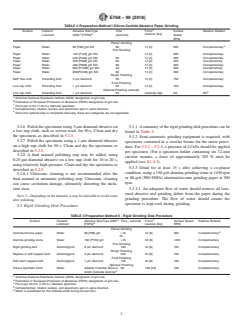
5.2.1 A summary of the silicon carbide procedure can be
the specimens thoroughly, using ethyl alcohol and cotton, then
found in Table 2.
rinse and dry. Ultrasonic cleaning can be used.
5.2.2 When using a semi-automatic polishing equipment, 5.2.5.1 Theuseofasoapandwatersolutioninanultrasonic
grinding and polishing should be performed using approxi- cleaner can attack non-metallic inclusions in some carbon and
mately 18 kPa pressure per specimen. (For a specimen holder low alloy steels, leading to an exaggeration in the inclusion’s
containing six 32-mm mounts, a force of approximately 87 N apparent size. Adding an inhibitor (such as that used as a
must be applied (see X1.4.2). machining coolant) may reduce this size exaggeration.
E768 − 99 (2018)
TABLE 2 Preparation Method I Silicon Carbide Abrasive Paper Grinding
C
Surface Coolent/ Abrasive Size/Type Time Force Surface Relative Rotation
A B
newtons [lbs]
Lubricant ANSI [FEPA] (seconds) Speed
RPM
Planar Grinding
D
Paper Water 80 [P80] grit SIC 60 14 [2] 300 Complementary
Fine Grinding
Paper Water 120 [P120] grit SIC 14 [2] 300 Complementary
Paper Water 240 [P240] grit SIC 60 14 [2] 300 Complementary
Paper Water 320 [P500] grit SIC 60 14 [2] 300 C
...