

ASTM D1748-22
(Test Method)Standard Test Method for Rust Protection by Metal Preservatives in the Humidity Cabinet
General Information
- Abstract
SIGNIFICANCE AND USE
4.1 This test method is used for measuring the relative abilities of metal preservatives to prevent the rusting of steel panels under conditions of high humidity. It should not be relied upon to predict the effectiveness of a metal preservative in which high humidity is not the principal factor in the rusting.
4.2 Comparisons made by this test method should normally be limited to similar metal preservative combinations designed for similar applications. The test life required for each type of metal preservative and for each intended application should be based on actual experience with that type of preservative in the intended service.
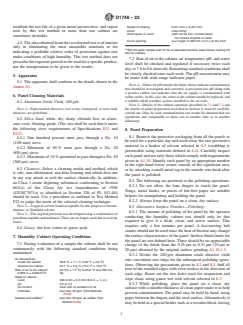
4.3 Since the precision of the test method appears to be less than desired, a number of repeat tests may be necessary to establish the test life of a given metal preservative, and repeat tests by this test method in more than one cabinet are sometimes desirable.
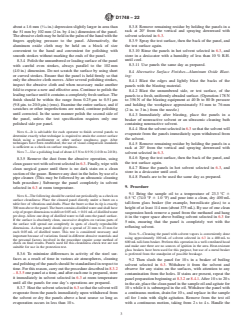
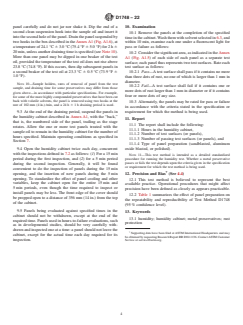
4.4 The data obtained from this accelerated test is of interest only in eliminating the most unsuitable materials or for indicating a probable relative order of protection against rust under conditions of high humidity. This test method does not prescribe the exposure periods to be used for a specific product, nor the interpretation to be given to the results.
SCOPE
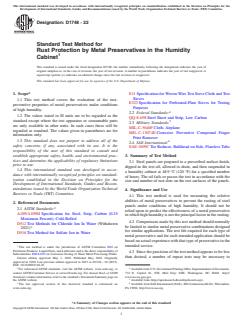
1.1 This test method covers the evaluation of the rust-preventive properties of metal preservatives under conditions of high humidity.
1.2 The values stated in SI units are to be regarded as the standard except where the test apparatus or consumable parts are only available in other units. In such cases these will be regarded as standard. The values given in parentheses are for information only.
1.3 This standard does not purport to address all of the safety concerns, if any, associated with its use. It is the responsibility of the user of this standard to consult and establish appropriate safety, health, and environmental practices and determine the applicability of regulatory limitations prior to use.
1.4 This international standard was developed in accordance with internationally recognized principles on standardization established in the Decision on Principles for the Development of International Standards, Guides and Recommendations issued by the World Trade Organization Technical Barriers to Trade (TBT) Committee.
- Status
- Published
- Publication Date
- 30-Apr-2022
- Technical Committee
- D02 - Petroleum Products, Liquid Fuels, and Lubricants
- Drafting Committee
- D02.L0.03 - Corrosion Testing of Sheet Metal Processing Fluids
Buy Documents
ASTM D1748-22 - Standard Test Method for Rust Protection by Metal Preservatives in the Humidity Cabinet
REDLINE ASTM D1748-22 - Standard Test Method for Rust Protection by Metal Preservatives in the Humidity Cabinet
Overview
ASTM D1748-22: Standard Test Method for Rust Protection by Metal Preservatives in the Humidity Cabinet provides a widely recognized procedure for evaluating the rust-preventive properties of metal preservatives under conditions of high humidity. Developed by ASTM International, this standard is intended to measure the relative ability of preservation materials to protect steel surfaces from rust in accelerated testing environments. It is particularly valuable for comparing similar products in applications where exposure to high humidity is a principal risk for rust formation.
The test uses steel panels coated with the metal preservative, which are then exposed to a controlled humid environment using a humidity cabinet. The results help to identify the most suitable or unsuitable preservatives for specific uses, but should not be viewed as a direct predictor of real-world performance in environments where humidity is not the main cause of corrosion.
Key Topics
- Test Method: Describes procedures for preparing steel panels, applying the preservative, and subjecting the panels to a high humidity environment in a humidity cabinet. The test duration and evaluation are based on visible rust formation.
- Significance and Use: Focuses on comparing the effectiveness of metal preservatives under high-humidity conditions-ideal for eliminating unsuitable products rather than predicting service life in other conditions.
- Panel Preparation: Outlines strict protocols for surface finishing, cleaning, and handling of the steel panels to ensure consistency and reproducibility across tests.
- Cabinet Operation: Specifies temperature, humidity, air flow, and water quality requirements inside the humidity cabinet to create standardized test conditions.
- Evaluation and Reporting: Defines criteria for pass/fail judgments based on the size and number of rust spots, and details required reporting parameters.
- Precision and Repeatability: Notes potential variability in test results, recommending multiple repetitions and testing across different cabinets to improve reliability.
Applications
ASTM D1748-22 is primarily used in:
- Quality Control: Manufacturers of metal preservatives and rust-preventive oils employ this method to assess and compare products during development and batch release.
- Comparative Analysis: Enables side-by-side evaluation of similar preservative formulations for use in high-humidity environments.
- Material Selection: Assists end-users in selecting appropriate rust-preventive coatings or compounds for steel components subject to humid storage or transport conditions.
- Military and Industrial Standards Compliance: Referenced by defense and industrial organizations for procurement and inspection of rust-prevention materials.
This standard is particularly relevant in industries such as automotive, aerospace, marine, and heavy machinery, where metal components are likely to be exposed to moisture-laden atmospheres either during storage, shipment, or service.
Related Standards
- ASTM A109/A109M: Specification for Steel Strip, Carbon (0.25 Maximum Percent), Cold-Rolled - used for preparing test panels.
- ASTM D516: Test Method for Sulfate Ion in Water - cited for assessing water quality used in the humidity cabinet.
- ASTM E11 and E323: Specifications for test sieves-referenced for abrasive and blasting material grading.
- Federal QQ-S-698 and Military MIL-C-5646F, MIL-C-15074E: Specifications for steel sheet and corrosion-preventive compounds, relevant for test material sourcing.
- SAE 1009C: Standard for steel grade used in test panels.
Practical Value
By standardizing the humidity cabinet test method, ASTM D1748-22 enables more effective rust protection assessment, product development, and quality assurance in high-humidity applications. While the method is not suited for all corrosion scenarios, it provides a critical filter for product suitability and helps uphold industry-wide corrosion protection standards, supporting durability, safety, and performance in demanding environments.
Keywords: ASTM D1748-22, rust prevention, metal preservatives, humidity cabinet, corrosion protection, test standard, steel panels, quality control, comparative testing, industrial standards.
Relations
- Effective Date
- 01-Mar-2024
- Effective Date
- 01-Nov-2018
- Effective Date
- 01-Sep-2016
- Effective Date
- 01-Nov-2015
- Effective Date
- 01-May-2014
- Effective Date
- 01-Oct-2013
- Effective Date
- 01-Oct-2013
- Effective Date
- 15-Nov-2011
- Effective Date
- 01-Sep-2011
- Effective Date
- 15-Sep-2010
- Effective Date
- 01-Nov-2009
- Effective Date
- 01-May-2009
- Effective Date
- 01-Oct-2008
- Effective Date
- 01-Aug-2007
- Effective Date
- 01-Oct-2004
Buy Documents
ASTM D1748-22 - Standard Test Method for Rust Protection by Metal Preservatives in the Humidity Cabinet
REDLINE ASTM D1748-22 - Standard Test Method for Rust Protection by Metal Preservatives in the Humidity Cabinet
Get Certified
Connect with accredited certification bodies for this standard

Element Materials Technology
Materials testing and product certification.

Inštitut za kovinske materiale in tehnologije
Institute of Metals and Technology. Materials testing, metallurgical analysis, NDT.
Sponsored listings
Frequently Asked Questions
ASTM D1748-22 is a standard published by ASTM International. Its full title is "Standard Test Method for Rust Protection by Metal Preservatives in the Humidity Cabinet". This standard covers: SIGNIFICANCE AND USE 4.1 This test method is used for measuring the relative abilities of metal preservatives to prevent the rusting of steel panels under conditions of high humidity. It should not be relied upon to predict the effectiveness of a metal preservative in which high humidity is not the principal factor in the rusting. 4.2 Comparisons made by this test method should normally be limited to similar metal preservative combinations designed for similar applications. The test life required for each type of metal preservative and for each intended application should be based on actual experience with that type of preservative in the intended service. 4.3 Since the precision of the test method appears to be less than desired, a number of repeat tests may be necessary to establish the test life of a given metal preservative, and repeat tests by this test method in more than one cabinet are sometimes desirable. 4.4 The data obtained from this accelerated test is of interest only in eliminating the most unsuitable materials or for indicating a probable relative order of protection against rust under conditions of high humidity. This test method does not prescribe the exposure periods to be used for a specific product, nor the interpretation to be given to the results. SCOPE 1.1 This test method covers the evaluation of the rust-preventive properties of metal preservatives under conditions of high humidity. 1.2 The values stated in SI units are to be regarded as the standard except where the test apparatus or consumable parts are only available in other units. In such cases these will be regarded as standard. The values given in parentheses are for information only. 1.3 This standard does not purport to address all of the safety concerns, if any, associated with its use. It is the responsibility of the user of this standard to consult and establish appropriate safety, health, and environmental practices and determine the applicability of regulatory limitations prior to use. 1.4 This international standard was developed in accordance with internationally recognized principles on standardization established in the Decision on Principles for the Development of International Standards, Guides and Recommendations issued by the World Trade Organization Technical Barriers to Trade (TBT) Committee.
SIGNIFICANCE AND USE 4.1 This test method is used for measuring the relative abilities of metal preservatives to prevent the rusting of steel panels under conditions of high humidity. It should not be relied upon to predict the effectiveness of a metal preservative in which high humidity is not the principal factor in the rusting. 4.2 Comparisons made by this test method should normally be limited to similar metal preservative combinations designed for similar applications. The test life required for each type of metal preservative and for each intended application should be based on actual experience with that type of preservative in the intended service. 4.3 Since the precision of the test method appears to be less than desired, a number of repeat tests may be necessary to establish the test life of a given metal preservative, and repeat tests by this test method in more than one cabinet are sometimes desirable. 4.4 The data obtained from this accelerated test is of interest only in eliminating the most unsuitable materials or for indicating a probable relative order of protection against rust under conditions of high humidity. This test method does not prescribe the exposure periods to be used for a specific product, nor the interpretation to be given to the results. SCOPE 1.1 This test method covers the evaluation of the rust-preventive properties of metal preservatives under conditions of high humidity. 1.2 The values stated in SI units are to be regarded as the standard except where the test apparatus or consumable parts are only available in other units. In such cases these will be regarded as standard. The values given in parentheses are for information only. 1.3 This standard does not purport to address all of the safety concerns, if any, associated with its use. It is the responsibility of the user of this standard to consult and establish appropriate safety, health, and environmental practices and determine the applicability of regulatory limitations prior to use. 1.4 This international standard was developed in accordance with internationally recognized principles on standardization established in the Decision on Principles for the Development of International Standards, Guides and Recommendations issued by the World Trade Organization Technical Barriers to Trade (TBT) Committee.
ASTM D1748-22 is classified under the following ICS (International Classification for Standards) categories: 77.060 - Corrosion of metals. The ICS classification helps identify the subject area and facilitates finding related standards.
ASTM D1748-22 has the following relationships with other standards: It is inter standard links to ASTM A109/A109M-24, ASTM A109/A109M-16(2018), ASTM A109/A109M-16, ASTM A109/A109M-15, ASTM A109/A109M-14, ASTM E11-13, ASTM A109/A109M-13, ASTM E323-11, ASTM D516-11, ASTM D512-10, ASTM E323-09, ASTM E11-09e1, ASTM A109/A109M-08, ASTM D516-07, ASTM E323-80(2004). Understanding these relationships helps ensure you are using the most current and applicable version of the standard.
ASTM D1748-22 is available in PDF format for immediate download after purchase. The document can be added to your cart and obtained through the secure checkout process. Digital delivery ensures instant access to the complete standard document.
Standards Content (Sample)
This international standard was developed in accordance with internationally recognized principles on standardization established in the Decision on Principles for the
Development of International Standards, Guides and Recommendations issued by the World Trade Organization Technical Barriers to Trade (TBT) Committee.
Designation: D1748 − 22
Standard Test Method for
Rust Protection by Metal Preservatives in the Humidity
Cabinet
This standard is issued under the fixed designation D1748; the number immediately following the designation indicates the year of
original adoption or, in the case of revision, the year of last revision. A number in parentheses indicates the year of last reapproval. A
superscript epsilon (´) indicates an editorial change since the last revision or reapproval.
This standard has been approved for use by agencies of the U.S. Department of Defense.
1. Scope* E11 Specification for Woven Wire Test Sieve Cloth and Test
Sieves
1.1 This test method covers the evaluation of the rust-
E323 Specification for Perforated-Plate Sieves for Testing
preventive properties of metal preservatives under conditions
Purposes
of high humidity.
2.2 Federal Standards:
1.2 The values stated in SI units are to be regarded as the
QQ-S-698 Steel Sheet and Strip, Low Carbon
standard except where the test apparatus or consumable parts
2.3 Military Standards:
are only available in other units. In such cases these will be
MIL-C-5646F Cloth, Airplane
regarded as standard. The values given in parentheses are for
MIL-C-15074E Corrosive Preventive Compound Finger
information only.
Print Remover
1.3 This standard does not purport to address all of the
2.4 SAE International:
safety concerns, if any, associated with its use. It is the
SAE 1009C Tee Reducer, Bulkhead on Side, Flareless Tube
responsibility of the user of this standard to consult and
establish appropriate safety, health, and environmental prac- 3. Summary of Test Method
tices and determine the applicability of regulatory limitations
3.1 Steel panels are prepared to a prescribed surface finish,
prior to use.
dipped in the test oil, allowed to drain, and then suspended in
1.4 This international standard was developed in accor-
a humidity cabinet at 48.9 °C (120 °F) for a specified number
dance with internationally recognized principles on standard-
of hours. The oil fails or passes the test in accordance with the
ization established in the Decision on Principles for the
size and number of rust dots on the test surfaces of the panels.
Development of International Standards, Guides and Recom-
mendations issued by the World Trade Organization Technical
4. Significance and Use
Barriers to Trade (TBT) Committee.
4.1 This test method is used for measuring the relative
abilities of metal preservatives to prevent the rusting of steel
2. Referenced Documents
panels under conditions of high humidity. It should not be
2.1 ASTM Standards:
relied upon to predict the effectiveness of a metal preservative
A109/A109M Specification for Steel, Strip, Carbon (0.25
inwhichhighhumidityisnottheprincipalfactorintherusting.
Maximum Percent), Cold-Rolled
4.2 Comparisons made by this test method should normally
D512 Test Methods for Chloride Ion In Water (Withdrawn
3 be limited to similar metal preservative combinations designed
2021)
for similar applications. The test life required for each type of
D516 Test Method for Sulfate Ion in Water
metal preservative and for each intended application should be
based on actual experience with that type of preservative in the
1 intended service.
This test method is under the jurisdiction of ASTM Committee D02 on
Petroleum Products, Liquid Fuels, and Lubricants and is the direct responsibility of
4.3 Since the precision of the test method appears to be less
Subcommittee D02.L0.03 on Corrosion Testing of Sheet Metal Processing Fluids.
than desired, a number of repeat tests may be necessary to
Current edition approved May 1, 2022. Published May 2022. Originally
approved in 1960. Last previous edition approved in 2015 as D1748 – 10 (2015).
DOI: 10.1520/D1748-22.
2 4
For referenced ASTM standards, visit the ASTM website, www.astm.org, or AvailablefromU.S.GovernmentPrintingOfficeSuperintendentofDocuments,
contact ASTM Customer Service at service@astm.org. For Annual Book of ASTM 732 N. Capitol St., NW, Mail Stop: SDE, Washington, DC 20401, http://
Standards volume information, refer to the standard’s Document Summary page on www.access.gpo.gov.
the ASTM website. Available from https://quicksearch.dla.mil/qaSearch.aspx.
3 6
The last approved version of this historical standard is referenced on Available from SAE International (SAE), 400 Commonwealth Dr.,Warrendale,
www.astm.org. PA 15096, http://www.sae.org.
*A Summary of Changes section appears at the end of this standard
Copyright © ASTM International, 100 Barr Harbor Drive, PO Box C700, West Conshohocken, PA 19428-2959. United States
D1748 − 22
establish the test life of a given metal preservative, and repeat
Speed of rotating 0.33 r ⁄min ± 0.03 r ⁄min
Cover close fitting
tests by this test method in more than one cabinet are
Cloth layers in cover shall not be torn, contaminated,
sometimes desirable.
nor contain droplets of water
Cover opening to a height of 355 mm (14 in.) at the front
4.4 Thedataobtainedfromthisacceleratedtestisofinterest
only in eliminating the most unsuitable materials or for
A
Boil the water sample with 10 mL of saturated bromine water before making the
indicating a probable relative order of protection against rust
test for sulfates.
under conditions of high humidity. This test method does not
7.2 Rate of air to the cabinet, air temperature, pH, and water
prescribetheexposureperiodstobeusedforaspecificproduct,
level shall be checked and regulated if necessary twice each
nor the interpretation to be given to the results.
day,at7 hto8 hintervals.Remainingstandardconditionsshall
be closely checked once each week.The pH measurement may
5. Apparatus
be made with wide-range indicator paper.
5.1 The apparatus shall conform to the details shown in the
NOTE4—ValuesforpHoutsidethelimitsshownindicatecontamination
Annex A1.
that should be investigated and corrected.Apersistent low pH along with
a positive sulfate test indicates that the air supply is contaminated with
6. Panel Cleaning Materials
sulfur oxides. In this case, the water in the cabinet should be replaced, and
a suitable alkali scrubber system installed in the air train.
6.1 Aluminum Oxide Cloth, 240 grit.
NOTE 5—Details of the cabinet operation described in 7.1 and 7.2 and
the details of panel preparation described in Section 8, must be carefully
NOTE 1—Paper-backed abrasives, wet or dry, waterproof, or iron oxide
abrasives are prohibited. carried out. Only by such standardization can results be obtained that are
significant and comparable to those run at another time or in another
6.2 Silica Sand, white, dry, sharp, chloride free, or alumi-
laboratory.
num oxide, blasting grade. (The size shall be such that it meets
the following sieve requirements of Specifications E11 and
8. Panel Preparation
E323.
8.1 Remove the protective packaging from all the panels to
6.2.1 One hundred percent must pass through a No. 10
be used for a particular day and wash away the rust preventive
(2.00 mm) sieve.
material in a beaker of solvent selected in 6.3 (swabbing is
6.2.2 Minimum of 90 % must pass through a No. 20
permissible using materials defined in 6.4). Carefully inspect
(850 µm) sieve.
eachpanelanduseonlythosewhichcomplywithrequirements
6.2.3 Maximum of 10 % permitted to pass through a No. 50
given in A1.10. Identify each panel by an appropriate number
(300 µm) sieve.
in the right-hand lower corner, outside of the significant area,
6.3 Cleaners—Select a cleaning media and method, which
or by attaching a small metal tag to the outside wire hook after
is safe, non-chlorinated, non-film forming and which does not
the panel is polished.
in any way attack or etch the surface chemically. In addition,
8.2 The following are pertinent to the polishing operations:
no Class 1 ozone depleting substances conforming to Section
8.2.1 Do not allow the bare fingers to touch the panel.
602(a) of the Clean Air Act Amendments of 1990
Tongs, metal hooks, or pieces of lint-free paper are suitable
(42USC7671a) as identified in Section 326 of PL 102-484
helpers for manipulating and holding the panel.
should be used. Use a procedure as outlined in Test Method
8.2.2 Always keep the panel on a clean, dry surface.
F22 to judge the merit of the selected cleaning technique.
NOTE 2—Atypical solvent found acceptable for this purpose is hexane,
8.3 Alternative Surface Finishes—Polishing:
heptane, or Stoddard solvent.
8.3.1 The amount of polishing of the panel by the operator
NOTE 3—The original precision was developed using a combination of
conducting the humidity cabinet test should only be that
petroleum naphtha and methanol.These are no longer used due to toxicity
required to give it a fresh, clean, and active surface. This
issues.
requires only a few minutes per panel. A fast-moving belt
6.4 Gauze, lint free cotton or gauze pads.
sandershouldnotbeusedsincetheheatoffrictionmaychange
the surface characteristics of the panel. Surface finish limits for
7. Humidity Cabinet Operating Conditions
the panel are not defined here. There should be no appreciable
7.1 During evaluation of a sample the cabinet shall be run
change of the finish from the 0.25 µm to 0.51 µm (10 µm to
continuously with the following standard conditions being
20 µm) obtained by the original surface grinding A1.10.1.3.
maintained:
8.3.2 Divide the 240 grit aluminum oxide abrasive cloth
Air temperature:
into convenient size strips for the subsequent polishing opera-
Inside the cabinet 48.9 °C ± 1.1 °C (120 °F ± 2.0 °F)
tions. Observing the precautions given in 8.2 and 8.3, buff all
Outside the cabinet 24.1 °C ± 5.5 °C (75.4 °F ± 10.0 °F)
Rate of air to the cabinet (31.0ft ± 1ft /h) at 25.0 °C and 760 mm four of the rounded edges with even strokes in the direction of
0.878 m ± 0.028 m /h Hg
each edge. Ream out the two holes used for suspension and
Water in cabinet:
wipe clean, using gauze wet with solvent selected in 6.3.
Level 203.0 mm ± 6.4 mm (8.0 in. ± ⁄4 in.)
pH 5.5 to 7.5 8.3.3 While polishing, place the panel on a clean, dry
Oil content clear with no evidence of oil
surface with a suitable thickness of clean paper under it to help
Chlorides less than 20 ppm (Test Methods
prevent contamination. The panel may be held by hand, using
D512)
A
Sulfates and sulfites less than 20 ppm as sulfate (Test paper between the fingers and the steel surface.Alternatively it
Method D516)
maybeheldinaspecialholdersuchasawoodenblock,having
D1748 − 22
about a 1.6 mm ( ⁄16 in.) depression slightly larger in area than 8.3.8 Remove remaining residue by holding the panels in a
the 51 mm by 102 mm (2 in. by 4 in.) dimension of the panel. rack at 20° from the vertical and spraying downward with
Theabrasiveclothmaybeheldinthepalmofthehandwiththe solvent selected in 6.3.
fingers applying pressure to the panel. Alternatively, the 8.3.9 Spray the test surface, then the back of the panel, and
the test surface again.
aluminum oxide cloth may be held on a block of size
convenient to the hand and convenient for polishing with 8.3.10 Rinse the panels in hot solvent selected in 6.3, and
smooth strokes without marking the ends of the panel. store in a desiccator with a humidity of less than 10 % R.H.
until cool.
8.3.4 Polish the unnumbered or leading surface of the panel
8.3.11 Use panels the same day as prepared.
with careful even strokes, always parallel to the 102 mm
(4.0 in.) dimension. Do not scratch the surface by using short
8.4 Alternative Surface Finishes—Aluminum Oxide Blast-
or curved strokes. Ensure that the panel is held firmly so that
ing:
only the abrasive cloth moves.After several polishing strokes,
8.4.1 Blast the edges and lightly blast the backs of the
inspect the abrasive cloth and when necessary make another
panels with the blasting material.
fold to expose a new and effective area. Continue to polish the
8.4.2 Blast the unnumbered side, or test surface, of the
leadingsurfaceuntilitcontainsacompletelyfreshsurface.The
panels to a fresh, uniformly abraded surface. (Operation 178 N
finish should be within the range from 0.25 µm to 0.51 µm
to 356 N of the blasting equipment at 40 lb to 80 lb pressure
(9.8 µin. to 20.0 µin.) (rms). Examine the entire surface, and if
and holding the workpiece approximately 51 mm to 76 mm
scratches or other imperfections are noted, continue polishing
(2 in. to 3 in.) from the nozzle.)
until corrected. In the same manner polish the second side of
8.4.3 Immediately after blasting, place the panels in a
the panel, unless the test specification requires only one
beaker of nonreactive solvent or an ultrasonic cleaning bath
polished side per panel.
containing nonreactive solvent.
8.4.4 Heat the solvent selected in 6.3 so that the solvent will
NOTE 6—It is advisable for each operator to finish several panels to
evaporate from the panels immediately upon withdrawal from
determine exactly what technique is required to attain the correct surface
the solvent.
finish using a profilometer or other surface roughness gage. After
techniques have been established, the use of visual comparison standards
8.4.5 Remove remaining residue by holding the panels in a
is sufficient as a check on surface roughness.
rack at 20° from the vertical and spraying downward with
NOTE 7—Use a polishing load of about 4.5 N to 8.9 N (1.0 lb to 2.0 lb).
solvent selected in 6.3.
8.4.6 Spray the test surface, then the back of the panel, and
8.3.5 Remove the dust from the abrasive operation, using
the test surface again.
clean gauze wet with solvent selected in 6.3. Finally, wipe with
8.4.7 Rinse the panels in hot solvent selected in 6.3, and
clean surgical gauze until there is no dark stain on a clean
store in a desiccator until cool.
section of the gauze. Remove any dust in the holes by use of a
8.4.8 Panels are to be used the same day as prepared.
pipe cleaner. (This may be followed by an ultrasonic cleaning
bath procedure.) Submerge the panel completely in solvent
9. Procedure
selected in 6.3 at room temperature.
9.1 Bring the sample oil to a temperature of 23.3 °C 6
NOTE8—Thefollowingshouldbecarriedoutperiodicallyasacheckon
0.5 °C (74.0 °F 6 1.0 °F) and pour into a clean, dry 400 mL
surface cleanliness: Place the cleaned panel directly under a buret on a
tall-form glass beaker (for example, borosilicate glass) to a
table free of vibrations and drafts. Place the buret so that its tip is exactly
300 mm above the panel.The buret contains distilled water and shall have
height of at least 114 mm (about 375 mL). By use of one clean
atipofproperdimensionstodeliver0.05 mL 60.01 mLofdistilledwater
suspension hook remove a panel from the methanol and hang
per drop. Allow one drop of distilled water to fall onto the panel surface.
it in the vapor space above boiling solvent selected in 6.3 for
If the surface is absolutely clean, successive droplets on various parts of
5 min, ensuring that the panel is completely wet with the
the surface will spread out completely in spots of closely reproducible
refluxing solvent.
dimensions. A clean panel should give a spread of 21 mm to 23 mm for
each 0.05 mL of distilled water. This test is considered necessary and
NOTE 9—Cleaning the panel with solvent vapors is conveniently done
important because of variations found in different abrasive materials and
using approximately 100 mL of solvent selected in 6.3 in a 400 mL to
the personal factors involved in the procedure require some method of
600 mLtall-form beaker. Perform this operation in a well-ventilated hood
check on final results. Panels used for this cleanliness check test are not
and make sure there are no sources of ignition in the area. Heat-resistant
suitable for use in the protection test.
glass beakers have been used for this purpose, but use of a metal beaker
is preferred from the standpoint of possible breakage.
8.3.6 To minimize differences in activity of the steel sur-
faces as a result of time in various air atmospheres, cleaning
9.2 Then slush the panel for 10 s in a beaker of boiling
and polishing of the panels should be standardized in respect to
solvent selected in 6.3. Withdraw it from the solvent and
time.Forthisreason,carryouttheproceduredescribedin8.3.2
observe for any stains on the surfaces, with attention to any
–8.3.5onepanelatatime,andaftereachoneisprepared,store
contamination from the holes. If stains are present, repeat the
it immediately in solvent selected in 6.3 at room tempera
...
This document is not an ASTM standard and is intended only to provide the user of an ASTM standard an indication of what changes have been made to the previous version. Because
it may not be technically possible to adequately depict all changes accurately, ASTM recommends that users consult prior editions as appropriate. In all cases only the current version
of the standard as published by ASTM is to be considered the official document.
Designation: D1748 − 10 (Reapproved 2015) D1748 − 22
Standard Test Method for
Rust Protection by Metal Preservatives in the Humidity
Cabinet
This standard is issued under the fixed designation D1748; the number immediately following the designation indicates the year of
original adoption or, in the case of revision, the year of last revision. A number in parentheses indicates the year of last reapproval. A
superscript epsilon (´) indicates an editorial change since the last revision or reapproval.
This standard has been approved for use by agencies of the U.S. Department of Defense.
1. Scope Scope*
1.1 This test method covers the evaluation of the rust-preventive properties of metal preservatives under conditions of high
humidity.
1.2 The values stated in SI units are to be regarded as the standard except where the test apparatus or consumable parts are only
available in other units. In such cases these will be regarded as standard. The values given in parentheses are for information only.
1.3 This standard does not purport to address all of the safety concerns, if any, associated with its use. It is the responsibility
of the user of this standard to consult and establish appropriate safety safety, health, and healthenvironmental practices and
determine the applicability of regulatory limitations prior to use.
1.4 This international standard was developed in accordance with internationally recognized principles on standardization
established in the Decision on Principles for the Development of International Standards, Guides and Recommendations issued
by the World Trade Organization Technical Barriers to Trade (TBT) Committee.
2. Referenced Documents
2.1 ASTM Standards:
A109/A109M Specification for Steel, Strip, Carbon (0.25 Maximum Percent), Cold-Rolled
D512 Test Methods for Chloride Ion In Water (Withdrawn 2021)
D516 Test Method for Sulfate Ion in Water
E11 Specification for Woven Wire Test Sieve Cloth and Test Sieves
E323 Specification for Perforated-Plate Sieves for Testing Purposes
2.2 Federal Standards:
QQ-S-698 Steel Sheet and Strip, Low Carbon
2.3 Military Standards:
MIL-C-5646F Cloth, Airplane
MIL-C-15074E Corrosive Preventive Compound Finger Print Remover
This test method is under the jurisdiction of ASTM Committee D02 on Petroleum Products, Liquid Fuels, and Lubricants and is the direct responsibility of Subcommittee
D02.L0.03 on Corrosion Testing of Sheet Metal Processing Fluids.
Current edition approved July 1, 2015May 1, 2022. Published July 2015May 2022. Originally approved in 1960. Last previous edition approved in 20102015 as
D1748 – 10.D1748 – 10 (2015). DOI: 10.1520/D1748-10R15.10.1520/D1748-22.
For referenced ASTM standards, visit the ASTM website, www.astm.org, or contact ASTM Customer Service at service@astm.org. For Annual Book of ASTM Standards
volume information, refer to the standard’s Document Summary page on the ASTM website.
The last approved version of this historical standard is referenced on www.astm.org.
Available from U.S. Government Printing Office Superintendent of Documents, 732 N. Capitol St., NW, Mail Stop: SDE, Washington, DC 20401, http://
www.access.gpo.gov.
Available from Standardization Documents Order Desk, Bldg. 4, Section D, 700 Robbins Ave., Philadelphia, PA 19111-5094, Attn: NPODS.https://quicksearch.dla.mil/
qaSearch.aspx.
*A Summary of Changes section appears at the end of this standard
Copyright © ASTM International, 100 Barr Harbor Drive, PO Box C700, West Conshohocken, PA 19428-2959. United States
D1748 − 22
2.4 Society of Automotive Engineers:SAE International:
SAE 1009C Tee Reducer, Bulkhead on Side, Flareless Tube
3. Summary of Test Method
3.1 Steel panels are prepared to a prescribed surface finish, dipped in the test oil, allowed to drain, and then suspended in a
humidity cabinet at 48.9 °C (120 °F) for a specified number of hours. The oil fails or passes the test in accordance with the size
and number of rust dots on the test surfaces of the panels.
4. Significance and Use
4.1 This test method is used for measuring the relative abilities of metal preservatives to prevent the rusting of steel panels under
conditions of high humidity. It should not be relied upon to predict the effectiveness of a metal preservative in which high humidity
is not the principal factor in the rusting.
4.2 Comparisons made by this test method should normally be limited to similar metal preservative combinations designed for
similar applications. The test life required for each type of metal preservative and for each intended application should be based
on actual experience with that type of preservative in the intended service.
4.3 Since the precision of the test method appears to be less than desired, a number of repeat tests may be necessary to establish
the test life of a given metal preservative, and repeat tests by this test method in more than one cabinet are sometimes desirable.
4.4 The data obtained from this accelerated test is of interest only in eliminating the most unsuitable materials or for indicating
a probable relative order of protection against rust under conditions of high humidity. This test method does not prescribe the
exposure periods to be used for a specific product, nor the interpretation to be given to the results.
5. Apparatus
5.1 The apparatus shall conform to the details shown in the Annex A1.
6. Panel Cleaning Materials
6.1 Aluminum Oxide Cloth, 240 grit.
NOTE 1—Paper-backed abrasives, wet or dry, waterproof, or iron oxide abrasives are prohibited.
6.2 Silica Sand, white, dry, sharp, chloride free, or aluminum oxide, blasting grade. (The size shall be such that it meets the
following sieve requirements of Specifications E11 and E323.
6.2.1 One hundred percent must pass through a No. 10 (2.00 mm) sieve.
6.2.2 Minimum of 90 % must pass through a No. 20 (850 μm) sieve.
6.2.3 Maximum of 10 % permitted to pass through a No. 50 (300 μm) sieve.
6.3 Cleaners—Select a cleaning media and method, which is safe, non-chlorinated, non-film forming and which does not in any
way attack or etch the surface chemically. In addition, no Class 1 ozone depleting substances conforming to Section 602(a) of the
Clean Air Act Amendments of 1990 (42USC7671a) as identified in Section 326 of PL 102-484 should be used. Use a procedure
as outlined in Test Method F22 to judge the merit of the selected cleaning technique.
NOTE 2—A typical solvent found acceptable for this purpose is hexane hexane, heptane, or Stoddard solvent.
NOTE 3—The original precision was developed using a combination of petroleum naphtha and methanol. These are no longer used due to toxicity issues.
Available from SAE International (SAE), 400 Commonwealth Dr., Warrendale, PA 15096, http://www.sae.org.
D1748 − 22
6.4 Gauze, lint free cotton or gauze pads.
7. Humidity Cabinet Operating Conditions
7.1 During evaluation of a sample the cabinet shall be run continuously with the following standard conditions being maintained:
Air temperature:
Inside the cabinet 48.9 °C ± 1.1 °C (120 °F ± 2.0 °F)
Outside the cabinet 24.1 °C ± 5.5 °C (75.4 °F ± 10.0 °F)
Rate of air to the cabinet (31.0 ft ± 1 ft /h) at 25.0 °C and 760 mm
0.878 m ± 0.028 m /h Hg
Water in cabinet:
Level 203.0 mm ± 6.4 mm (8.0 in. ± ⁄4 in.)
pH 5.5 to 7.5
Oil content clear with no evidence of oil
Chlorides less than 20 ppm (Test Methods
D512)
A
Sulfates and sulfites less than 20 ppm as sulfate (Test
Method D516)
Speed of rotating 0.33 r ⁄min ± 0.03 r ⁄min
Cover close fitting
Cloth layers in cover shall not be torn, contaminated,
nor contain droplets of water
Cover opening to a height of 355 mm (14 in.) at the front
A
Boil the water sample with 10 mL of saturated bromine water before making the test for sulfates.
7.2 Rate of air to the cabinet, air temperature, pH, and water level shall be checked and regulated if necessary twice each day, at
7 h to 8 h intervals. Remaining standard conditions shall be closely checked once each week. The pH measurement may be made
with wide-range indicator paper.
NOTE 4—Values for pH outside the limits shown indicate contamination that should be investigated and corrected. A persistent low pH along with a
positive sulfate test indicates that the air supply is contaminated with sulfur oxides. In this case, the water in the cabinet should be replaced, and a suitable
alkali scrubber system installed in the air train.
NOTE 5—Details of the cabinet operation described in 7.1 and 7.2 and the details of panel preparation described in Section 8, must be carefully carried
out. Only by such standardization can results be obtained that are significant and comparable to those run at another time or in another laboratory.
8. Panel Preparation
8.1 Remove the protective packaging from all the panels to be used for a particular day and wash away the rust preventive material
in a beaker of solvent selected in 6.3 (swabbing is permissible using materials defined in 6.4). Carefully inspect each panel and
use only those which comply with requirements given in A1.10. Identify each panel by an appropriate number in the right-hand
lower corner, outside of the significant area, or by attaching a small metal tag to the outside wire hook after the panel is polished.
8.2 The following are pertinent to the polishing operations:
8.2.1 Do not allow the bare fingers to touch the panel. Tongs, metal hooks, or pieces of lint-free paper are suitable helpers for
manipulating and holding the panel.
8.2.2 Always keep the panel on a clean, dry surface.
8.3 Alternative Surface Finishes—Polishing:
8.3.1 The amount of polishing of the panel by the operator conducting the humidity cabinet test should only be that required to
give it a fresh, clean, and active surface. This requires only a few minutes per panel. A fast-moving belt sander should not be used
since the heat of friction may change the surface characteristics of the panel. Surface finish limits for the panel are not defined here.
There should be no appreciable change of the finish from the 0.25 μm to 0.51 μm (10 μm to 20 μm) obtained by the original surface
grinding A1.10.1.3.
8.3.2 Divide the 240 grit aluminum oxide abrasive cloth into convenient size strips for the subsequent polishing operations.
D1748 − 22
Observing the precautions given in 8.2 and 8.3, buff all four of the rounded edges with even strokes in the direction of each edge.
Ream out the two holes used for suspension and wipe clean, using gauze wet with solvent selected in 6.3.
8.3.3 While polishing, place the panel on a clean, dry surface with a suitable thickness of clean paper under it to help prevent
contamination. The panel may be held by hand, using paper between the fingers and the steel surface. Alternatively it may be held
in a special holder such as a wooden block, having about a 1.6-mm1.6 mm ( ⁄16-in.) in.) depression slightly larger in area than the
51-51 mm by 102-mm (2-102 mm (2 in. by 4-in.)4 in.) dimension of the panel. The abrasive cloth may be held in the palm of the
hand with the fingers applying pressure to the panel. Alternatively, the aluminum oxide cloth may be held on a block of size
convenient to the hand and convenient for polishing with smooth strokes without marking the ends of the panel.
8.3.4 Polish the unnumbered or leading surface of the panel with careful even strokes, always parallel to the 102 mm (4.0 in.)
dimension. Use a polishing pressure of about 4.5 N to 8.9 N (1.0 lb to 2.0 lb). Do not scratch the surface by using short or curved
strokes. Ensure that the panel is held firmly so that only the abrasive cloth moves. After several polishing strokes, inspect the
abrasive cloth and when necessary make another fold to expose a new and effective area. Continue to polish the leading surface
until it contains a completely fresh surface. The finish should be within the range from 0.25 μm to 0.51 μm (9.8 μin. to 20.0 μin.)
(rms). Examine the entire surface, and if scratches or other imperfections are noted, continue polishing until corrected. In the same
manner polish the second side of the panel, unless the test specification requires only one polished side per panel.
NOTE 6—It is advisable for each operator to finish several panels to determine exactly what technique is required to attain the correct surface finish using
a profilometer or other surface roughness gage. After techniques have been established, the use of visual comparison standards is sufficient as a check
on surface roughness.
NOTE 7—Use a polishing load of about 4.5 N to 8.9 N (1.0 lb to 2.0 lb).
8.3.5 Remove the dust from the abrasive operation, using clean gauze wet with solvent selected in 6.3. Finally, wipe with clean
surgical gauze until there is no dark stain on a clean section of the gauze. Remove any dust in the holes by use of a pipe cleaner.
(This may be followed by an ultrasonic cleaning bath procedure.) Submerge the panel completely in solvent selected in 6.3 at room
temperature.
NOTE 8—The following should be carried out periodically as a check on surface cleanliness: Place the cleaned panel directly under a buret on a table free
of vibrations and drafts. Place the buret so that its tip is exactly 300 mm above the panel. The buret contains distilled water and shall have a tip of proper
dimensions to deliver 0.05 mL 6 0.01 mL of distilled water per drop. Allow one drop of distilled water to fall onto the panel surface. If the surface is
absolutely clean, successive droplets on various parts of the surface will spread out completely in spots of closely reproducible dimensions. A clean panel
should give a spread of 21 mm to 23 mm for each 0.05 mL of distilled water. This test is considered necessary and important because of variations found
in different abrasive materials and the personal factors involved in the procedure require some method of check on final results. Panels used for this
cleanliness check test are not suitable for use in the protection test.
8.3.6 To minimize differences in activity of the steel surfaces as a result of time in various air atmospheres, cleaning and polishing
of the panels should be standardized in respect to time. For this reason, carry out the procedure described in 8.3.2 – 8.3.5 one panel
at a time, and after each one is prepared, store it immediately in solvent selected in 6.3 at room temperature until all the panels
for one day’s operations are prepared.
8.3.7 Heat the solvent selected in 6.3 so that the solvent will evaporate from the panels immediately upon withdrawal from the
solvent.solvent or dry the panels above a heat source so long as evaporation occurs in less than 10 s.
8.3.8 Remove remaining residue by holding the panels in a rack at 20° from the vertical and spraying downward with solvent
selected in 6.3.
8.3.9 Spray the test surface, then the back of the panel, and the test surface again.
8.3.10 Rinse the panels in hot solvent selected in 6.3, and store in a desiccator with a humidity of less than 10 % R.H. until cool.
8.3.11 Use panels the same day as prepared.
8.4 Alternative Surface Finishes—Sand or Aluminum Finishes—Aluminum Oxide Blasting:
8.4.1 Blast the edges and lightly blast the backs of the panels with the blasting material.
8.4.2 Blast the unnumbered side, or test surface, of the panels to a fresh, uniformly abraded surface. (Operation 177.9 N178 N to
D1748 − 22
355.8 N356 N of the blasting equipment at 40 lb to 80 lb pressure and holding the workpiece 50.8 mm approximately 51 mm to
76.2 mm76 mm (2 in. to 3 in.) from the nozzle is recommended.)nozzle.)
8.4.3 Immediately after blasting, place the panels in a beaker of nonreactive solvent or an ultrasonic cleaning bath containing
nonreactive solvent.
8.4.4 Heat the solvent selected in 6.3 so that the solvent will evaporate from the panels immediately upon withdrawal from the
solvent.
8.4.5 Remove remaining residue by holding the panels in a rack at 20° from the vertical and spraying downward with solvent
selected in 6.3.
8.4.6 Spray the test surface, then the back of the panel, and the test surface again.
8.4.7 Rinse the panels in hot solvent selected in 6.3, and store in a desiccator until cool.
8.4.8 Panels are to be used the same day as prepared.
9. Procedure
9.1 Bring the sample oil to a temperature of 23.3 °C 6 0.5 °C (74.0 °F 6 1.0 °F) and pour into a clean, dry 400 mL tall-form glass
beaker (for example, borosilicate glass) to a height of at least 114 mm (about 375 mL). By use of one clean suspension hook
remove a panel from the methanol and hang it in the vapor space above boiling solvent selected in 6.3 for 5 min, ensuring that
the panel is completely wet with the refluxing solvent.
NOTE 9—Cleaning the panel with solvent vapors is conveniently done using approximately 100 mL of solvent selected in 6.3 in a 400 mL to 600 mL
tall-form beaker. Perform this operation in a well-ventilated hood and make sure there are no sources of ignition in the area. Heat-resistant glass beakers
have been used for this purpose, but use of a metal beaker is preferred from the standpoint of possible breakage.
9.2 Then slush the panel for 10 s in a beaker of boiling solvent selected in 6.3. Withdraw it from the solvent and observe for any
stains on the surfaces, with attention to any contamination from the holes. If stains are present, repeat the panel preparation
beginning at 8.3.2 or 8.4.1. After 10 s to 20 s in the air, place the c
...