

ASTM A109/A109M-24
(Specification)Standard Specification for Steel, Strip, Carbon (0.25 Maximum Percent), Cold-Rolled
General Information
- Abstract
ABSTRACT
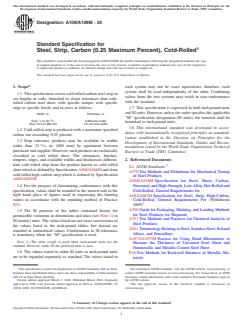
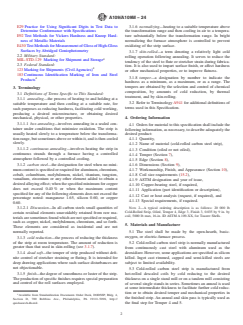
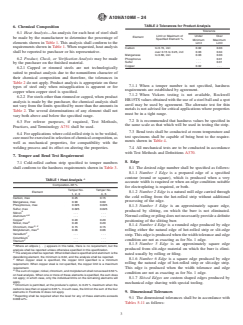
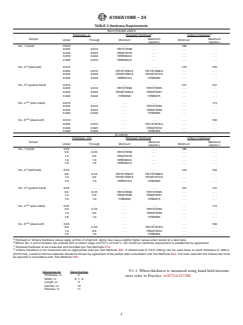
This specification covers cold-rolled carbon steel strip in cut lengths or coils, furnished to closer tolerances than cold-rolled carbon steel sheet. The steel shall be made by the open-hearth, basic-oxygen, or electric-furnace process. Cold-rolled carbon strip specified to temper numbers shall conform to the Rockwell hardness requirements. Bend tests shall be conducted in accordance with requirements specified.
SCOPE
1.1 This specification covers cold-rolled carbon steel strip in cut lengths or coils, furnished to closer tolerances than cold-rolled carbon steel sheet, with specific temper, with specific edge or specific finish, and in sizes as follows:
Width, in.
Thickness, in.
Over 1/2 to 23 15/16
0.300 and under
Over 12.5 to 600 mm
7.6 mm and under
1.2 Cold-rolled strip is produced with a maximum specified carbon not exceeding 0.25 percent.
1.3 Strip tolerance products may be available in widths wider than 23 15/16 in. [600 mm] by agreement between purchaser and supplier. However, such products are technically classified as cold rolled sheet. The tolerances, finishes, tempers, edges, and available widths and thicknesses differentiate cold rolled strip from the product known as cold rolled sheet which is defined by Specification A568/A568M and from cold rolled high carbon strip which is defined by Specification A682/A682M.
1.4 For the purpose of determining conformance with this specification, values shall be rounded to the nearest unit in the right hand place of figures used in expressing the limiting values in accordance with the rounding method of Practice E29.
1.5 The SI portions of the tables contained herein list permissible variations in dimensions and mass (see Note 1) in SI (metric) units. The values listed are not exact conversions of the values listed in the inch-pound tables, but instead are rounded or rationalized values. Conformance to SI tolerances is mandatory when the “M” specification is used.
Note 1: The term weight is used when inch-pound units are the standard. However, under SI the preferred term is mass.
1.6 The values stated in either SI units or inch-pound units are to be regarded separately as standard. The values stated in each system may not be exact equivalents; therefore, each system shall be used independently of the other. Combining values from the two systems may result in non-conformance with the standard.
1.7 This specification is expressed in both inch-pound units and SI units. However, unless the order specifies the applicable “M” specification designation (SI units), the material shall be furnished to inch-pound units.
1.8 This international standard was developed in accordance with internationally recognized principles on standardization established in the Decision on Principles for the Development of International Standards, Guides and Recommendations issued by the World Trade Organization Technical Barriers to Trade (TBT) Committee.
- Status
- Published
- Publication Date
- 29-Feb-2024
- Technical Committee
- A01 - Steel, Stainless Steel and Related Alloys
- Drafting Committee
- A01.19 - Steel Sheet and Strip
Buy Documents
ASTM A109/A109M-24 - Standard Specification for Steel, Strip, Carbon (0.25 Maximum Percent), Cold-Rolled
REDLINE ASTM A109/A109M-24 - Standard Specification for Steel, Strip, Carbon (0.25 Maximum Percent), Cold-Rolled
Overview
ASTM A109/A109M-24 is the standard specification for cold-rolled carbon steel strip with a maximum carbon content of 0.25%. Developed by ASTM International, this standard defines requirements for cold-rolled steel strip supplied in both cut lengths and coils. The standard covers closer tolerances and specific tempers, finishes, edges, widths, and thicknesses compared to cold-rolled carbon steel sheet. ASTM A109/A109M-24 ensures uniformity and quality for manufacturers and users working in industries that rely on the precise performance of cold-rolled steel strips.
Key Topics
- Material Requirements: Specifies steel produced by open-hearth, basic-oxygen, or electric-furnace processes. The strip’s composition must have a maximum carbon content not exceeding 0.25%.
- Product Forms: Covers cold-rolled steel strip supplied in cut lengths or coils, with precise dimensional tolerances.
- Tempers: Includes various temper designations, each defined by minimum or maximum Rockwell hardness and corresponding mechanical properties.
- Edge and Finish Options: Details several edge conditions (1 through 6, including skived) and surface finishes (matte, regular bright, better bright, best bright) for customer selection.
- Dimensional Tolerances: Strictly outlines permissible variations in thickness, width, length, camber, and flatness-separately specified in both inch-pound and SI units.
- Testing and Inspection: Requires chemical analysis, mechanical testing (including Rockwell hardness and bend tests), and visual inspection to ensure conformance.
- Ordering and Certification: Outlines essential ordering information such as quantity, dimensions, temper, edge, finish, special requirements, and the need for certification or test reports, as required.
Applications
Cold-rolled carbon steel strip covered by ASTM A109/A109M-24 is widely used in industries requiring high precision and consistent mechanical properties:
- Automotive: Parts requiring uniform surface quality and reliable forming characteristics, such as brackets, clips, and housings.
- Appliances: Components for electrical and household appliances, including transformer laminations and motor parts.
- Electronics: Precision stampings, springs, and connectors where tight dimensional control is crucial.
- General Manufacturing: Hardware, fasteners, can components, typewriter parts, and more, benefiting from the strip’s consistent hardness and bendability.
- Stamping and Forming: Suitable for deep drawing, bending, and punching operations, with tempers tailored to the desired degree of formability and strength.
- Plating and Coating: Bright finishes make certain edge and surface conditions ideal for applications where subsequent plating or coating is required.
Related Standards
- ASTM A568/A568M: General requirements for carbon steel sheet, both hot-rolled and cold-rolled, distinct from strip by finish, tolerance, and dimension.
- ASTM A370: Test methods and definitions for mechanical testing of steel products, as referenced for mechanical property validation.
- ASTM A700: Guide for packaging, marking, and loading methods for steel products, relevant for shipment.
- ASTM E18/E92: Test methods for Rockwell/Vickers hardness testing of metallic materials.
- ASTM A682/A682M: (Withdrawn) Specification for high-carbon cold-rolled steel strip, once used for distinction with products of higher carbon content.
Practical Value
Adopting ASTM A109/A109M-24 provides clear guidelines for manufacturers and purchasers, streamlines procurement, reduces the risk of non-conformity, and ensures optimal performance in critical manufacturing operations. The ability to specify tempers, edges, finishes, and dimensions allows precise customization for diverse industry needs, from high-volume stamping to intricate deep-drawn parts. Compliance with this international steel strip standard enhances quality, reliability, and efficiency across supply chains.
Keywords: cold-rolled carbon steel strip, ASTM A109, steel strip standard, precision steel, steel strip tolerances, steel strip temper, steel strip applications
Relations
- Effective Date
- 01-Mar-2024
- Effective Date
- 01-Mar-2024
- Effective Date
- 01-Mar-2024
- Effective Date
- 15-Sep-2023
- Effective Date
- 01-May-2023
- Effective Date
- 01-Mar-2024
- Effective Date
- 01-Mar-2024
- Effective Date
- 01-Mar-2024
- Effective Date
- 01-Mar-2024
- Effective Date
- 01-Mar-2024
- Effective Date
- 01-Mar-2024
- Effective Date
- 01-Mar-2024
- Effective Date
- 01-Mar-2024
- Effective Date
- 01-Mar-2024
- Effective Date
- 01-Mar-2024
Buy Documents
ASTM A109/A109M-24 - Standard Specification for Steel, Strip, Carbon (0.25 Maximum Percent), Cold-Rolled
REDLINE ASTM A109/A109M-24 - Standard Specification for Steel, Strip, Carbon (0.25 Maximum Percent), Cold-Rolled
Get Certified
Connect with accredited certification bodies for this standard

Element Materials Technology
Materials testing and product certification.

Inštitut za kovinske materiale in tehnologije
Institute of Metals and Technology. Materials testing, metallurgical analysis, NDT.
Sponsored listings
Frequently Asked Questions
ASTM A109/A109M-24 is a technical specification published by ASTM International. Its full title is "Standard Specification for Steel, Strip, Carbon (0.25 Maximum Percent), Cold-Rolled". This standard covers: ABSTRACT This specification covers cold-rolled carbon steel strip in cut lengths or coils, furnished to closer tolerances than cold-rolled carbon steel sheet. The steel shall be made by the open-hearth, basic-oxygen, or electric-furnace process. Cold-rolled carbon strip specified to temper numbers shall conform to the Rockwell hardness requirements. Bend tests shall be conducted in accordance with requirements specified. SCOPE 1.1 This specification covers cold-rolled carbon steel strip in cut lengths or coils, furnished to closer tolerances than cold-rolled carbon steel sheet, with specific temper, with specific edge or specific finish, and in sizes as follows: Width, in. Thickness, in. Over 1/2 to 23 15/16 0.300 and under Over 12.5 to 600 mm 7.6 mm and under 1.2 Cold-rolled strip is produced with a maximum specified carbon not exceeding 0.25 percent. 1.3 Strip tolerance products may be available in widths wider than 23 15/16 in. [600 mm] by agreement between purchaser and supplier. However, such products are technically classified as cold rolled sheet. The tolerances, finishes, tempers, edges, and available widths and thicknesses differentiate cold rolled strip from the product known as cold rolled sheet which is defined by Specification A568/A568M and from cold rolled high carbon strip which is defined by Specification A682/A682M. 1.4 For the purpose of determining conformance with this specification, values shall be rounded to the nearest unit in the right hand place of figures used in expressing the limiting values in accordance with the rounding method of Practice E29. 1.5 The SI portions of the tables contained herein list permissible variations in dimensions and mass (see Note 1) in SI (metric) units. The values listed are not exact conversions of the values listed in the inch-pound tables, but instead are rounded or rationalized values. Conformance to SI tolerances is mandatory when the “M” specification is used. Note 1: The term weight is used when inch-pound units are the standard. However, under SI the preferred term is mass. 1.6 The values stated in either SI units or inch-pound units are to be regarded separately as standard. The values stated in each system may not be exact equivalents; therefore, each system shall be used independently of the other. Combining values from the two systems may result in non-conformance with the standard. 1.7 This specification is expressed in both inch-pound units and SI units. However, unless the order specifies the applicable “M” specification designation (SI units), the material shall be furnished to inch-pound units. 1.8 This international standard was developed in accordance with internationally recognized principles on standardization established in the Decision on Principles for the Development of International Standards, Guides and Recommendations issued by the World Trade Organization Technical Barriers to Trade (TBT) Committee.
ABSTRACT This specification covers cold-rolled carbon steel strip in cut lengths or coils, furnished to closer tolerances than cold-rolled carbon steel sheet. The steel shall be made by the open-hearth, basic-oxygen, or electric-furnace process. Cold-rolled carbon strip specified to temper numbers shall conform to the Rockwell hardness requirements. Bend tests shall be conducted in accordance with requirements specified. SCOPE 1.1 This specification covers cold-rolled carbon steel strip in cut lengths or coils, furnished to closer tolerances than cold-rolled carbon steel sheet, with specific temper, with specific edge or specific finish, and in sizes as follows: Width, in. Thickness, in. Over 1/2 to 23 15/16 0.300 and under Over 12.5 to 600 mm 7.6 mm and under 1.2 Cold-rolled strip is produced with a maximum specified carbon not exceeding 0.25 percent. 1.3 Strip tolerance products may be available in widths wider than 23 15/16 in. [600 mm] by agreement between purchaser and supplier. However, such products are technically classified as cold rolled sheet. The tolerances, finishes, tempers, edges, and available widths and thicknesses differentiate cold rolled strip from the product known as cold rolled sheet which is defined by Specification A568/A568M and from cold rolled high carbon strip which is defined by Specification A682/A682M. 1.4 For the purpose of determining conformance with this specification, values shall be rounded to the nearest unit in the right hand place of figures used in expressing the limiting values in accordance with the rounding method of Practice E29. 1.5 The SI portions of the tables contained herein list permissible variations in dimensions and mass (see Note 1) in SI (metric) units. The values listed are not exact conversions of the values listed in the inch-pound tables, but instead are rounded or rationalized values. Conformance to SI tolerances is mandatory when the “M” specification is used. Note 1: The term weight is used when inch-pound units are the standard. However, under SI the preferred term is mass. 1.6 The values stated in either SI units or inch-pound units are to be regarded separately as standard. The values stated in each system may not be exact equivalents; therefore, each system shall be used independently of the other. Combining values from the two systems may result in non-conformance with the standard. 1.7 This specification is expressed in both inch-pound units and SI units. However, unless the order specifies the applicable “M” specification designation (SI units), the material shall be furnished to inch-pound units. 1.8 This international standard was developed in accordance with internationally recognized principles on standardization established in the Decision on Principles for the Development of International Standards, Guides and Recommendations issued by the World Trade Organization Technical Barriers to Trade (TBT) Committee.
ASTM A109/A109M-24 is classified under the following ICS (International Classification for Standards) categories: 77.140.50 - Flat steel products and semi-products. The ICS classification helps identify the subject area and facilitates finding related standards.
ASTM A109/A109M-24 has the following relationships with other standards: It is inter standard links to ASTM A109/A109M-16(2018), ASTM A941-24, ASTM A370-24, ASTM A370-23, ASTM A941-23, ASTM A794/A794M-18, ASTM F2805-16(2022), ASTM A684/A684M-17, ASTM A1008/A1008M-23e1, ASTM D1002-10(2019), ASTM F868-17, ASTM D3953-15(2022), ASTM F1387-23, ASTM D6412/D6412M-99(2020), ASTM C1936-23. Understanding these relationships helps ensure you are using the most current and applicable version of the standard.
ASTM A109/A109M-24 is available in PDF format for immediate download after purchase. The document can be added to your cart and obtained through the secure checkout process. Digital delivery ensures instant access to the complete standard document.
Standards Content (Sample)
This international standard was developed in accordance with internationally recognized principles on standardization established in the Decision on Principles for the
Development of International Standards, Guides and Recommendations issued by the World Trade Organization Technical Barriers to Trade (TBT) Committee.
Designation: A109/A109M − 24
Standard Specification for
Steel, Strip, Carbon (0.25 Maximum Percent), Cold-Rolled
This standard is issued under the fixed designation A109/A109M; the number immediately following the designation indicates the year
of original adoption or, in the case of revision, the year of last revision. A number in parentheses indicates the year of last reapproval.
A superscript epsilon (´) indicates an editorial change since the last revision or reapproval.
This standard has been approved for use by agencies of the U.S. Department of Defense.
1. Scope* each system may not be exact equivalents; therefore, each
system shall be used independently of the other. Combining
1.1 This specification covers cold-rolled carbon steel strip in
values from the two systems may result in non-conformance
cut lengths or coils, furnished to closer tolerances than cold-
with the standard.
rolled carbon steel sheet, with specific temper, with specific
edge or specific finish, and in sizes as follows: 1.7 This specification is expressed in both inch-pound units
and SI units. However, unless the order specifies the applicable
Width, in. Thickness, in.
“M” specification designation (SI units), the material shall be
1 15
Over ⁄2 to 23 ⁄16 0.300 and under
furnished to inch-pound units.
Over 12.5 to 600 mm 7.6 mm and under
1.8 This international standard was developed in accor-
1.2 Cold-rolled strip is produced with a maximum specified
dance with internationally recognized principles on standard-
carbon not exceeding 0.25 percent.
ization established in the Decision on Principles for the
1.3 Strip tolerance products may be available in widths
Development of International Standards, Guides and Recom-
wider than 23 ⁄16 in. [600 mm] by agreement between
mendations issued by the World Trade Organization Technical
purchaser and supplier. However, such products are technically
Barriers to Trade (TBT) Committee.
classified as cold rolled sheet. The tolerances, finishes,
tempers, edges, and available widths and thicknesses differen- 2. Referenced Documents
tiate cold rolled strip from the product known as cold rolled 2
2.1 ASTM Standards:
sheet which is defined by Specification A568/A568M and from
A370 Test Methods and Definitions for Mechanical Testing
cold rolled high carbon strip which is defined by Specification
of Steel Products
A682/A682M.
A568/A568M Specification for Steel, Sheet, Carbon,
1.4 For the purpose of determining conformance with this Structural, and High-Strength, Low-Alloy, Hot-Rolled and
specification, values shall be rounded to the nearest unit in the
Cold-Rolled, General Requirements for
right hand place of figures used in expressing the limiting A682/A682M Specification for Steel, Strip, High-Carbon,
values in accordance with the rounding method of Practice
Cold-Rolled, General Requirements For (Withdrawn
E29. 2009)
A700 Guide for Packaging, Marking, and Loading Methods
1.5 The SI portions of the tables contained herein list
for Steel Products for Shipment
permissible variations in dimensions and mass (see Note 1) in
A751 Test Methods and Practices for Chemical Analysis of
SI (metric) units. The values listed are not exact conversions of
Steel Products
the values listed in the inch-pound tables, but instead are
A941 Terminology Relating to Steel, Stainless Steel, Related
rounded or rationalized values. Conformance to SI tolerances
Alloys, and Ferroalloys
is mandatory when the “M” specification is used.
A1073/A1073M Practice for Using Hand Micrometers to
NOTE 1—The term weight is used when inch-pound units are the
Measure the Thickness of Uncoated Steel Sheet and
standard. However, under SI the preferred term is mass.
Nonmetallic and Metallic-Coated Steel Sheet
1.6 The values stated in either SI units or inch-pound units
E18 Test Methods for Rockwell Hardness of Metallic Ma-
are to be regarded separately as standard. The values stated in
terials
1 2
This specification is under the jurisdiction of ASTM Committee A01 on Steel, For referenced ASTM standards, visit the ASTM website, www.astm.org, or
Stainless Steel and Related Alloys and is the direct responsibility of Subcommittee contact ASTM Customer Service at service@astm.org. For Annual Book of ASTM
A01.19 on Steel Sheet and Strip. Standards volume information, refer to the standard’s Document Summary page on
Current edition approved March 1, 2024. Published March 2024. Originally the ASTM website.
approved in 1926. Last previous edition approved in 2018 as A109/A109M – 16 The last approved version of this historical standard is referenced on
(2018). DOI: 10.1520/A0109_A0109M-24. www.astm.org.
*A Summary of Changes section appears at the end of this standard
Copyright © ASTM International, 100 Barr Harbor Drive, PO Box C700, West Conshohocken, PA 19428-2959. United States
A109/A109M − 24
E29 Practice for Using Significant Digits in Test Data to 3.1.6 normalizing—heating to a suitable temperature above
Determine Conformance with Specifications the transformation range and then cooling in air to a tempera-
E92 Test Methods for Vickers Hardness and Knoop Hard- ture substantially below the transformation range. In bright
ness of Metallic Materials normalizing the furnace atmosphere is controlled to prevent
E430 Test Methods for Measurement of Gloss of High-Gloss oxidizing of the strip surface.
Surfaces by Abridged Goniophotometry
3.1.7 skin-rolled—a term denoting a relatively light cold
2.2 Military Standard:
rolling operation following annealing. It serves to reduce the
MIL-STD-129 Marking for Shipment and Storage
tendency of the steel to flute or stretcher strain during fabrica-
2.3 Federal Standard:
tion. It is also used to impart surface finish, or affect hardness
123 Marking for Shipments (Civil Agencies)
or other mechanical properties, or to improve flatness.
183 Continuous Identification Marking of Iron and Steel
3.1.8 temper—a designation by number to indicate the
Products
hardness as a minimum, as a maximum, or as a range. The
tempers are obtained by the selection and control of chemical
3. Terminology
composition, by amounts of cold reduction, by thermal
3.1 Definitions of Terms Specific to This Standard:
treatment, and by skin-rolling.
3.1.1 annealing—the process of heating to and holding at a
3.2 Refer to Terminology A941 for additional definitions of
suitable temperature and then cooling at a suitable rate, for
terms used in this Specification.
such purposes as reducing hardness, facilitating cold working,
producing a desired microstructure, or obtaining desired
4. Ordering Information
mechanical, physical, or other properties.
3.1.1.1 box annealing—involves annealing in a sealed con-
4.1 Orders for material to this specification shall include the
tainer under conditions that minimize oxidation. The strip is following information, as necessary, to describe adequately the
usually heated slowly to a temperature below the transforma-
desired product:
tion range, but sometimes above or within it, and is then cooled
4.1.1 Quantity,
slowly.
4.1.2 Name of material (cold-rolled carbon steel strip),
3.1.1.2 continuous annealing—involves heating the strip in
4.1.3 Condition (oiled or not oiled),
continuous strands through a furnace having a controlled
4.1.4 Temper (Section 7),
atmosphere followed by a controlled cooling.
4.1.5 Edge (Section 8),
3.1.2 carbon steel—the designation for steel when no mini- 4.1.6 Dimensions (Section 9),
mum content is specified or required for aluminum, chromium,
4.1.7 Workmanship, Finish, and Appearance (Section 10),
cobalt, columbium, molybdenum, nickel, titanium, tungsten,
4.1.8 Coil size requirements (15.2),
vanadium, zirconium or any other element added to obtain a
4.1.9 ASTM designation and year of issue,
desired alloying effect; when the specified minimum for copper
4.1.10 Copper-bearing steel, if required,
does not exceed 0.40 % or when the maximum content
4.1.11 Application (part identification or description),
specified for any of the following elements does not exceed the
4.1.12 Cast or heat analysis (request, if required), and
percentage noted: manganese 1.65, silicon 0.60, or copper
4.1.13 Special requirements, if required.
0.60.
3.1.2.1 Discussion—In all carbon steels small quantities of NOTE 2—A typical ordering description is as follows: 20 000 lb
Cold-Rolled Strip, Oiled, Temper 4, Edge 3, Finish 3, 0.035 by 9 in. by
certain residual elements unavoidably retained from raw ma-
coil, 5000 lb max, 16-in. ID ASTM A 109-XX, for Toaster Shells.
terials are sometimes found which are not specified or required,
such as copper, nickel, molybdenum, chromium, and so forth.
5. Materials and Manufacture
These elements are considered as incidental and are not
normally reported. 5.1 The steel shall be made by the open-hearth, basic-
oxygen, or electric-furnace process.
3.1.3 cold reduction—the process of reducing the thickness
of the strip at room temperature. The amount of reduction is
5.2 Cold-rolled carbon steel strip is normally manufactured
greater than that used in skin-rolling (see 3.1.7).
from continuously cast steel with aluminum used as the
deoxidizer. However, some applications are specified as silicon
3.1.4 dead soft—the temper of strip produced without defi-
killed. Ingot cast rimmed, capped and semi-killed steels are
nite control of stretcher straining or fluting. It is intended for
subject to limited availability.
deep drawing applications where such surface disturbances are
not objectionable.
5.3 Cold-rolled carbon steel strip is manufactured from
3.1.5 finish—the degree of smoothness or luster of the strip.
hot-rolled descaled coils by cold reducing to the desired
The production of specific finishes requires special preparation
thickness on a single stand mill or on a tandem mill consisting
and control of the roll surfaces employed.
of several single stands in series. Sometimes an anneal is used
at some intermediate thickness to facilitate further cold reduc-
tion or to obtain desired temper and mechanical properties in
Available from Standardization Documents Order Desk, DODSSP, Bldg. 4,
the finished strip. An anneal and skin pass is typically used as
Section D, 700 Robbins Ave., Philadelphia, PA 19111-5098, http://
quicksearch.dla.mil. the final step for Temper 4 and 5.
A109/A109M − 24
TABLE 2 Tolerances for Product Analysis
6. Chemical Composition
Tolerance
6.1 Heat Analysis—An analysis for each heat of steel shall
Limit or Maximum of
Under Over
Element
be made by the manufacturer to determine the percentage of
Specified Element %
Minimum Maximum
elements shown in Table 1. This analysis shall conform to the
Limit Limit
requirements shown in Table 1. When requested, heat analysis
Carbon to 0.15, incl 0.02 0.03
over 0.15 to 0.25, incl 0.03 0.04
shall be reported to purchaser or his representative.
Manganese to 0.60, incl 0.03 0.03
6.2 Product, Check, or Verification Analysis may be made
Phosphorus . . . 0.01
Sulfur . . . 0.01
by the purchaser on the finished material.
Copper 0.02 . . .
6.2.1 Capped or rimmed steels are not technologically
suited to product analysis due to the nonuniform character of
their chemical composition and therefore, the tolerances in
Table 2 do not apply. Product analysis is appropriate on these
7.1.1 When a temper number is not specified, hardness
types of steel only when misapplication is apparent or for
requirements are established by agreement.
copper when copper steel is specified.
7.1.2 When Vickers testing is not available, Rockwell
6.2.2 For steels other than rimmed or capped, when product
HR15TS values obtained with the use of a steel ball and a spot
analysis is made by the purchaser, the chemical analysis shall
anvil may be used by agreement. The alternate test for thin
not vary from the limits specified by more than the amounts in
metals is not advised for critical applications where properties
Table 2. The several determinations of any element shall not
must be in a tight range.
vary both above and below the specified range.
7.2 It is recommended that hardness values be specified in
6.3 For referee purposes, if required, Test Methods,
the same scale as that which will be used in testing the strip.
Practices, and Terminology A751 shall be used.
7.3 Bend tests shall be conducted at room temperature and
6.4 For applications where cold-rolled strip is to be welded,
test specimens shall be capable of being bent to the require-
care must be exercised in selection of chemical composition, as
ments shown in Table 4.
well as mechanical properties, for compatibility with the
7.4 All mechanical tests are to be conducted in accordance
welding process and its effect on altering the properties.
with Test Methods and Definitions A370.
7. Temper and Bend Test Requirement
8. Edge
7.1 Cold-rolled carbon strip specified to temper numbers
shall conform to the hardness requirements shown in Table 3.
8.1 The desired edge number shall be specified as follows:
8.1.1 Number 1 Edge is a prepared edge of a specified
contour (round or square), which is produced when a very
A
TABLE 1 Heat Analysis
accurate width is required or when an edge condition suitable
Composition–Wt %
for electroplating is required, or both.
Temper No. Temper No.
Element 8.1.2 Number 2 Edge is a natural mill edge carried through
1, 2, 3 4, 5
the cold rolling from the hot-rolled strip without additional
Carbon, max 0.25 0.15
processing of the edge.
Manganese, max 0.90 0.60
Phosphorous, max 0.025 0.025
8.1.3 Number 3 Edge is an approximately square edge,
Sulfur, max 0.025 0.025
produced by slitting, on which the burr is not eliminated.
A
Silicon . . . . . .
A,B
Normal coiling or piling does not necessarily provide a definite
Aluminum . . . . . .
C
Copper 0.20 0.20
positioning of the slitting burr.
D
Nickel, max 0.20 0.20
8.1.4 Number 4 Edge is a rounded edge produced by edge
D, E
Chromium, max 0.15 0.15
D
rolling either the natural edge of hot-rolled strip or slit-edge
Molybdenum, max 0.06 0.06
F
Vanadium . . . . . .
strip. This edge is produced when the width tolerance and edge
F
Columbium . . . . . .
condition are not as exacting as for No. 1 edge.
F
Titanium . . . . . .
8.1.5 Number 5 Edge is an approximately square edge
A
Where an ellipsis (. . .) appears in this table, there is no requirement, but the
produced from slit-edge material on which the burr is elimi-
analysis shall be reported unless otherwise specified in this specification.
B
The analysis shall be reported. When killed steel is specified and aluminum is the
nated usually by rolling or filing.
deoxidizing element, the minimum is 0.02, and the analysis shall be reported.
8.1.6 Number 6 Edge is a square edge produced by edge
C
When copper steel is specified, the copper limit specified is a minimum
rolling the natural edge of hot-rolled strip or slit-edge strip.
requirement. When copper steel is not specified, the copper limit is a maximum
requirement.
This edge is produced when the width tolerance and edge
D
The sum of copper, nickel, chromium, and molybdenum shall not exceed 0.50 %
condition are not as exacting as for No. 1 edge.
on heat analysis. When one or more of these elements is specified, the sum does
8.1.7 Skived Edges are custom shaped edges produced by
not apply; in which case, only the individual limits on the remaining elements will
apply.
mechanical edge shaving with special tooling.
E
Chromium is permitted, at the producer’s option, to 0.25 % maximum when the
carbon is less than or equal to 0.05 %. In such case, the limit on the sum of the four
9. Dimensional Tolerances
elements in Footnote D does not apply.
F
Reporting shall be required when the level for any of these elements exceeds
9.1 The dimensional tolerances shall be in accordance with
0.008 wt%.
Tables 5-11 as follows:
A109/A109M − 24
TABLE 3 Hardness Requirements
INCH-POUND UNITS
C D
Thickness, in. Rockwell Hardness Vickers Hardness
Temper Maximum Maximum
Under Through Minimum Minimum
(approx.) (approx.)
No. 1 (hard) 0.010 . . . . . . . . . 185 . . .
0.025 0.010 HR15TW90 . . . . . . . . .
0.040 0.025 HR30TW76 . . . . . . . . .
0.070 0.040 HRBW90.0 . . . . . . . . .
0.300 0.070 HRBW84.0 . . . . . . . . .
A
No. 2 (half-hard) 0.010 . . . . . . . . . 125 165
0.025 0.010 HR15TW83.5 HR15TW88.5 . . . . . .
0.040 0.025 HR30TW63.5 HR30TW73.5 . . . . . .
0.300 0.040 HRBW70.0 HRBW85 . . . . . .
A
No. 3 (quarter-hard) 0.010 . . . . . . . . . 107 137
0.025 0.010 HR15TW80 HR15TW85 . . . . . .
0.040 0.025 HR30TW56.5 HR30TW67 . . . . . .
0.300 0.040 HRBW60 HRBW75 . . . . . .
A,B
No. 4 (skin-rolled) 0.010 . . . . . . . . . . . . 115
0.025 0.010 . . . HR15TW82 . . . . . .
0.040 0.025 . . . HR30TW60 . . . . . .
0.300 0.040 . . . HRBW65 . . . . . .
A,B
No. 5 (dead-soft) 0.010 . . . . . . . . . . . . 100
0.025 0.010 . . . . HR15TW78.5 . . . . . .
0.040 0.025 . . . HR30TW53 . . . . . .
0.300 0.040 . . . HRBW55 . . . . . .
SI UNITS
C D
Thickness, mm Rockwell Hardness Vickers Hardness
Temper Maximun Maximum
Under Through Minimum Minimum
(approx.) (approx.)
No. 1 (hard) 0.25 . . . . . . . . . 185 . . .
0.6 0.25 HR15TW90 . . . . . . . . .
1.0 0.6 HR30TW76 . . . . . . . . .
1.8 1.0 HRBW90.0 . . . . . . . . .
7.6 1.8 HRBW84.0 . . . . . . . . .
A
No. 2 (half-hard) 0.25 . . . . . . . . . 125 165
0.6 0.25 HR15TW83.5 HR15TW88.5 . . . . . .
1.0 0.6 HR30TW63.5 HR30TW73.5 . . . . . .
7.6 1.0 HRBW70.0 HRBW85 . . . . . .
A
No. 3 (quarter-hard) 0.25 . . . . . . . . . 107 137
0.6 0.25 HR15TW80 HR15TW85 . . . . . .
1.0 0.6 HR30TW56 HR30TW67 . . . . . .
7.6 1.0 HRBW60 HRBW75 . . . . . .
A,B
No. 4 (skin-rolled) 0.25 . . . . . . . . . . . . 115
0.6 0.25 . . . HR15TW82 . . . . . .
1.0 0.6 . . . HR30TW60 . . . . . .
7.6 1.0 . . . HRBW65 . . . . . .
A,B
No. 5 (dead-soft) 0.25 . . . . . . . . . . . . 100
0.6 0.25 . . . HR15TW78.5 . . . . . .
1.0 0.6 . . . HR30TW53 . . . . . .
7.6 1.0 . . . HRBW55 . . . . . .
A
Rockwell or Vickers hardness values apply at time of shipment. Aging may cause slightly higher values when tested at a later date.
B
Where No. 4 and 5 tempers are ordered with a carbon range of 0.15 % to 0.25 %, the maximum hardness requirement is established by agreement.
C
Rockwell Hardness to be measured and recorded per Test Methods E18.
D
Vickers Hardness to be measured with an appropriate load per Test Methods E92. A default load of 4.9 N (500 g) can be used down to stock thickness of .006 in.
(0.016 mm). Loads for thinner materials should be chosen by agreement of the parties after consultation with Test Methods E92. The load used with the Vickers test must
be reported in accordance with Test Methods E92.
9.1.1 When thickness is measured using hand held microm-
Tolerances for Table Number
Thickness, in. 5
eters refer to Practice A1073/A1073M.
Width, in. 6, 7, 8
Length, in. 9
Camber, in. 10
Flatness, in. 11
A109/A109M − 24
TABLE 4 Bend Test Requirement
turer’s operation. All tests and inspection (except product
analysis) shall be made at the place of manufacture unless
NOTE 1—Test specimens shall be capable of being bent as specified
otherwise agreed.
above without cracking on the outside of the bent portion. (See applicable
figure in Test Methods and Definitions A370.)
12. Rejection and Rehearing
Temper Bend Test Requirement
No. 1 (hard) Not required to make bends in any directi
...
This document is not an ASTM standard and is intended only to provide the user of an ASTM standard an indication of what changes have been made to the previous version. Because
it may not be technically possible to adequately depict all changes accurately, ASTM recommends that users consult prior editions as appropriate. In all cases only the current version
of the standard as published by ASTM is to be considered the official document.
Designation: A109/A109M − 16 (Reapproved 2018) A109/A109M − 24
Standard Specification for
Steel, Strip, Carbon (0.25 Maximum Percent), Cold-Rolled
This standard is issued under the fixed designation A109/A109M; the number immediately following the designation indicates the year
of original adoption or, in the case of revision, the year of last revision. A number in parentheses indicates the year of last reapproval.
A superscript epsilon (´) indicates an editorial change since the last revision or reapproval.
This standard has been approved for use by agencies of the U.S. Department of Defense.
1. Scope*
1.1 This specification covers cold-rolled carbon steel strip in cut lengths or coils, furnished to closer tolerances than cold-rolled
carbon steel sheet, with specific temper, with specific edge or specific finish, and in sizes as follows:
Width, in. Thickness, in.
1 15
Over ⁄2 to 23 ⁄16 0.300 and under
1 15
Over ⁄2 to 23 ⁄16 0.300 and under
Over 12.5 to 600 mm 7.6 mm and under
1.2 Cold-rolled strip is produced with a maximum specified carbon not exceeding 0.25 percent.
1.3 Strip tolerance products may be available in widths wider than 2323 ⁄16 in. [600 mm] by agreement between purchaser and
supplier. However, such products are technically classified as cold rolled sheet. The tolerances, finishes, tempers, edges, and
available widths and thicknesses differentiate cold rolled strip from the product known as cold rolled sheet which is defined by
Specification A568/A568M and from cold rolled high carbon strip which is defined by Specification A682/A682M.
1.4 For the purpose of determining conformance with this specification, values shall be rounded to the nearest unit in the right
hand place of figures used in expressing the limiting values in accordance with the rounding method of Practice E29.
1.5 The SI portions of the tables contained herein list permissible variations in dimensions and mass (see Note 1) in SI (metric)
units. The values listed are not exact conversions of the values listed in the inch-pound tables, but instead are rounded or
rationalized values. Conformance to SI tolerances is mandatory when the “M” specification is used.
NOTE 1—The term weight is used when inch-pound units are the standard. However, under SI the preferred term is mass.
1.6 The values stated in either SI units or inch-pound units are to be regarded separately as standard. The values stated in each
system may not be exact equivalents; therefore, each system shall be used independently of the other. Combining values from the
two systems may result in non-conformance with the standard.
1.7 This specification is expressed in both inch-pound units and SI units. However, unless the order specifies the applicable “M”
specification designation (SI units), the material shall be furnished to inch-pound units.
This specification is under the jurisdiction of ASTM Committee A01 on Steel, Stainless Steel and Related Alloys and is the direct responsibility of Subcommittee A01.19
on Steel Sheet and Strip.
Current edition approved Nov. 1, 2018March 1, 2024. Published November 2018March 2024. Originally approved in 1926. Last previous edition approved in 20162018
as A109/A109M – 16.A109/A109M – 16 (2018). DOI: 10.1520/A0109_A0109M-18.10.1520/A0109_A0109M-24.
*A Summary of Changes section appears at the end of this standard
Copyright © ASTM International, 100 Barr Harbor Drive, PO Box C700, West Conshohocken, PA 19428-2959. United States
A109/A109M − 24
1.8 This international standard was developed in accordance with internationally recognized principles on standardization
established in the Decision on Principles for the Development of International Standards, Guides and Recommendations issued
by the World Trade Organization Technical Barriers to Trade (TBT) Committee.
2. Referenced Documents
2.1 ASTM Standards:
A370 Test Methods and Definitions for Mechanical Testing of Steel Products
A568/A568M Specification for Steel, Sheet, Carbon, Structural, and High-Strength, Low-Alloy, Hot-Rolled and Cold-Rolled,
General Requirements for
A682/A682M Specification for Steel, Strip, High-Carbon, Cold-Rolled, General Requirements For (Withdrawn 2009)
A700 Guide for Packaging, Marking, and Loading Methods for Steel Products for Shipment
A751 Test Methods and Practices for Chemical Analysis of Steel Products
A941 Terminology Relating to Steel, Stainless Steel, Related Alloys, and Ferroalloys
A1073/A1073M Practice for Using Hand Micrometers to Measure the Thickness of Uncoated Steel Sheet and Nonmetallic and
Metallic-Coated Steel Sheet
E18 Test Methods for Rockwell Hardness of Metallic Materials
E29 Practice for Using Significant Digits in Test Data to Determine Conformance with Specifications
E92 Test Methods for Vickers Hardness and Knoop Hardness of Metallic Materials
E430 Test Methods for Measurement of Gloss of High-Gloss Surfaces by Abridged Goniophotometry
2.2 Military Standard:
MIL-STD-129 Marking for Shipment and Storage
2.3 Federal Standard:
123 Marking for Shipments (Civil Agencies)
183 Continuous Identification Marking of Iron and Steel Products
3. Terminology
3.1 Definitions of Terms Specific to This Standard:
3.1.1 annealing—the process of heating to and holding at a suitable temperature and then cooling at a suitable rate, for such
purposes as reducing hardness, facilitating cold working, producing a desired microstructure, or obtaining desired mechanical,
physical, or other properties.
3.1.1.1 box annealing—involves annealing in a sealed container under conditions that minimize oxidation. The strip is usually
heated slowly to a temperature below the transformation range, but sometimes above or within it, and is then cooled slowly.
3.1.1.2 continuous annealing—involves heating the strip in continuous strands through a furnace having a controlled
atmosphere followed by a controlled cooling.
3.1.2 carbon steel—the designation for steel when no minimum content is specified or required for aluminum, chromium, cobalt,
columbium, molybdenum, nickel, titanium, tungsten, vanadium, zirconium or any other element added to obtain a desired alloying
effect; when the specified minimum for copper does not exceed 0.40 % or when the maximum content specified for any of the
following elements does not exceed the percentage noted: manganese 1.65, silicon 0.60, or copper 0.60.
3.1.2.1 Discussion—
In all carbon steels small quantities of certain residual elements unavoidably retained from raw materials are sometimes found
which are not specified or required, such as copper, nickel, molybdenum, chromium, and so forth. These elements are considered
as incidental and are not normally reported.
3.1.3 cold reduction—the process of reducing the thickness of the strip at room temperature. The amount of reduction is greater
than that used in skin-rolling (see 3.1.7).
3.1.4 dead soft—the temper of strip produced without definite control of stretcher straining or fluting. It is intended for deep
drawing applications where such surface disturbances are not objectionable.
For referenced ASTM standards, visit the ASTM website, www.astm.org, or contact ASTM Customer Service at service@astm.org. For Annual Book of ASTM Standards
volume information, refer to the standard’s Document Summary page on the ASTM website.
The last approved version of this historical standard is referenced on www.astm.org.
Available from Standardization Documents Order Desk, DODSSP, Bldg. 4, Section D, 700 Robbins Ave., Philadelphia, PA 19111-5098, http://quicksearch.dla.mil.
A109/A109M − 24
3.1.5 finish—the degree of smoothness or luster of the strip. The production of specific finishes requires special preparation and
control of the roll surfaces employed.
3.1.6 normalizing—heating to a suitable temperature above the transformation range and then cooling in air to a temperature
substantially below the transformation range. In bright normalizing the furnace atmosphere is controlled to prevent oxidizing of
the strip surface.
3.1.7 skin-rolled—a term denoting a relatively light cold rolling operation following annealing. It serves to reduce the tendency
of the steel to flute or stretcher strain during fabrication. It is also used to impart surface finish, or affect hardness or other
mechanical properties, or to improve flatness.
3.1.8 temper—a designation by number to indicate the hardness as a minimum, as a maximum, or as a range. The tempers are
obtained by the selection and control of chemical composition, by amounts of cold reduction, by thermal treatment, and by
skin-rolling.
3.2 Refer to Terminology A941 for additional definitions of terms used in this Specification.
4. Ordering Information
4.1 Orders for material to this specification shall include the following information, as necessary, to describe adequately the
desired product:
4.1.1 Quantity,
4.1.2 Name of material (cold-rolled carbon steel strip),
4.1.3 Condition (oiled or not oiled),
4.1.4 Temper (Section 7),
4.1.5 Edge (Section 8),
4.1.6 Dimensions (Section 9),
4.1.7 Workmanship, Finish, and Appearance (Section 10),
4.1.8 Coil size requirements (15.2),
4.1.9 ASTM designation and year of issue,
4.1.10 Copper-bearing steel, if required,
4.1.11 Application (part identification or description),
4.1.12 Cast or heat analysis (request, if required), and
4.1.13 Special requirements, if required.
NOTE 2—A typical ordering description is as follows: 20 000 lb Cold-Rolled Strip, Oiled, Temper 4, Edge 3, Finish 3, 0.035 by 9 in. by coil, 5000 lb
max, 16-in. ID ASTM A 109-XX, for Toaster Shells.
5. Materials and Manufacture
5.1 The steel shall be made by the open-hearth, basic-oxygen, or electric-furnace process.
A109/A109M − 24
5.2 Cold-rolled carbon steel strip is normally manufactured from continuously cast steel with aluminum used as the deoxidizer.
However, some applications are specified as silicon killed. Ingot cast rimmed, capped and semi-killed steels are subject to limited
availability.
5.3 Cold-rolled carbon steel strip is manufactured from hot-rolled descaled coils by cold reducing to the desired thickness on a
single stand mill or on a tandem mill consisting of several single stands in series. Sometimes an anneal is used at some intermediate
thickness to facilitate further cold reduction or to obtain desired temper and mechanical properties in the finished strip. An anneal
and skin pass is typically used as the final step for Temper 4 and 5.
6. Chemical Composition
6.1 Heat Analysis—An analysis for each heat of steel shall be made by the manufacturer to determine the percentage of elements
shown in Table 1. This analysis shall conform to the requirements shown in Table 1. When requested, heat analysis shall be
reported to purchaser or his representative.
6.2 Product, Check, or Verification Analysis may be made by the purchaser on the finished material.
6.2.1 Capped or rimmed steels are not technologically suited to product analysis due to the nonuniform character of their chemical
composition and therefore, the tolerances in Table 2 do not apply. Product analysis is appropriate on these types of steel only when
misapplication is apparent or for copper when copper steel is specified.
6.2.2 For steels other than rimmed or capped, when product analysis is made by the purchaser, the chemical analysis shall not vary
from the limits specified by more than the amounts in Table 2. The several determinations of any element shall not vary both above
and below the specified range.
6.3 For referee purposes, if required, Test Methods, Practices, and Terminology A751 shall be used.
A
TABLE 1 Heat Analysis
Composition– Wt Composition–Wt %
Temper No. Temper No.
Element
1, 2, 3 4, 5
Carbon, max 0.25 0.15
Manganese, max 0.90 0.60
Phosphorous, max 0.025 0.025
Sulfur, max 0.025 0.025
A
Silicon . . . . . .
A,B
Aluminum . . . . . .
C
Copper 0.20 0.20
D
Nickel, max 0.20 0.20
D, E
Chromium, max 0.15 0.15
D
Molybdenum, max 0.06 0.06
F
Vanadium . . . . . .
F
Columbium . . . . . .
F
Titanium . . . . . .
A
Where an ellipsis (. . .) appears in this table, there is no requirement, but the
analysis shall be reported unless otherwise specified in this specification.
B
The analysis shall be reported. When killed steel is specified and aluminum is the
deoxidizing element, the minimum is 0.02, and the analysis shall be reported.
C
When copper steel is specified, the copper limit specified is a minimum
requirement. When copper steel is not specified, the copper limit is a maximum
requirement.
D
The sum of copper, nickel, chromium, and molybdenum shall not exceed 0.50 %
on heat analysis. When one or more of these elements is specified, the sum does
not apply; in which case, only the individual limits on the remaining elements will
apply.
E
Chromium is permitted, at the producer’s option, to 0.25 % maximum when the
carbon is less than or equal to 0.05 %. In such case, the limit on the sum of the four
elements in Footnote D does not apply.
F
Reporting shall be required when the level for any of these elements exceeds
0.008 wt%.
A109/A109M − 24
TABLE 2 Tolerances for Product Analysis
Tolerance
Limit or Maximum of
Under Over
Element
Specified Element %
Minimum Maximum
Limit Limit
Carbon to 0.15, incl 0.02 0.03
over 0.15 to 0.25, incl 0.03 0.04
Manganese to 0.60, incl 0.03 0.03
Phosphorus . . . 0.01
Sulfur . . . 0.01
Copper 0.02 . . .
6.4 For applications where cold-rolled strip is to be welded, care must be exercised in selection of chemical composition, as well
as mechanical properties, for compatibility with the welding process and its effect on altering the properties.
7. Temper and Bend Test Requirement
7.1 Cold-rolled carbon strip specified to temper numbers shall conform to the Rockwell hardness requirements shown in Table 3.
7.1.1 When a temper number is not specified, Rockwell hardness requirements are established by agreement.
7.1.2 When Vickers testing is not available, Rockwell HR15TS values obtained with the use of a steel ball and a spot anvil may
be used by agreement. The alternate test for thin metals is not advised for critical applications where properties must be in a tight
range.
7.2 It is recommended that hardness values be specified in the same scale as that which will be used in testing the strip.
7.3 Bend tests shall be conducted at room temperature and test specimens shall be capable of being bent to the requirements shown
in Table 4.
7.4 All mechanical tests are to be conducted in accordance with Test Methods and Definitions A370.
8. Edge
8.1 The desired edge number shall be specified as follows:
8.1.1 Number 1 Edge is a prepared edge of a specified contour (round or square), which is produced when a very accurate width
is required or when an edge condition suitable for electroplating is required, or both.
8.1.2 Number 2 Edge is a natural mill edge carried through the cold rolling from the hot-rolled strip without additional processing
of the edge.
8.1.3 Number 3 Edge is an approximately square edge, produced by slitting, on which the burr is not eliminated. Normal coiling
or piling does not necessarily provide a definite positioning of the slitting burr.
8.1.4 Number 4 Edge is a rounded edge produced by edge rolling either the natural edge of hot-rolled strip or slit-edge strip. This
edge is produced when the width tolerance and edge condition are not as exacting as for No. 1 edge.
8.1.5 Number 5 Edge is an approximately square edge produced from slit-edge material on which the burr is eliminated usually
by rolling or filing.
8.1.6 Number 6 Edge is a square edge produced by edge rolling the natural edge of hot-rolled strip or slit-edge strip. This edge
is produced when the width tolerance and edge condition are not as exacting as for No. 1 edge.
8.1.7 Skived Edges are custom shaped edges produced by mechanical edge shaving with special tooling.
A109/A109M − 24
TABLE 3 Hardness Requirements
INCH-POUND UNITS
C D
Thickness, in. Rockwell Hardness Vickers Hardness
Temper Maximum Maximum
Under Through Minimum Minimum
(approx.) (approx.)
No. 1 (hard) 0.010 . . . . . . . . . 185 . . .
No. 1 (hard) 0.025 . . . 15T90 . . .
0.025 0.010 HR15TW90 . . . . . . . . .
0.040 0.025 30T76 . . .
0.040 0.025 HR30TW76 . . . . . . . . .
0.070 0.040 B90.0 . . .
0.070 0.040 HRBW90.0 . . . . . . . . .
0.300 0.070 B84.0 . .
0.300 0.070 HRBW84.0 . . . . . . . . .
A
No. 2 (half-hard) 0.025 . . . 15T83.5 15T88.5
A
No. 2 (half-hard) 0.010 . . . . . . . . . 125 165
0.025 0.010 HR15TW83.5 HR15TW88.5 . . . . . .
0.040 0.025 30T63.5 30T73.5
0.040 0.025 HR30TW63.5 HR30TW73.5 . . . . . .
0.300 0.040 B70.0 B85
0.300 0.040 HRBW70.0 HRBW85 . . . . . .
A
No. 3 (quarter-hard) 0.025 . . . 15T80 15T85
A
No. 3 (quarter-hard) 0.010 . . . . . . . . . 107 137
0.025 0.010 HR15TW80 HR15TW85 . . . . . .
0.040 0.025 30T56.5 30T67
0.040 0.025 HR30TW56.5 HR30TW67 . . . . . .
0.300 0.040 B60 B75
0.300 0.040 HRBW60 HRBW75 . . . . . .
A,B
No. 4 (skin-rolled) 0.025 . . . . . . 15T82
A,B
No. 4 (skin-rolled) 0.010 . . . . . . . . . . . . 115
0.025 0.010 . . . HR15TW82 . . . . . .
0.040 0.025 . . . 30T60
0.040 0.025 . . . HR30TW60 . . . . . .
0.300 0.040 . . . B65
0.300 0.040 . . . HRBW65 . . . . . .
A,B
No. 5 (dead-soft) 0.025 . . . . . . . 15T78.5
A,B
No. 5 (dead-soft) 0.010 . . . . . . . . . . . . 100
0.025 0.010 . . . . HR15TW78.5 . . . . . .
0.040 0.025 . . . 30T53
0.040 0.025 . . . HR30TW53 . . . . . .
0.300 0.040 . . . B55
0.300 0.040 . . . HRBW55 . . . . . .
SI UNITS
C D
Thickness, mm Rockwell Hardness Vickers Hardness
Temper Maximun Maximum
Under Through Minimum Minimum
(approx.) (approx.)
No. 1 (hard) 0.25 . . . . . . . . . 185 . . .
No. 1 (hard) 0.6 . . . 15T90 . . .
0.6 0.25 HR15TW90 . . . . . . . . .
1.0 0.6 30T76 . . .
1.0 0.6 HR30TW76 . . . . . . . . .
1.8 1.0 B90.0 . . .
1.8 1.0 HRBW90.0 . . . . . . . . .
7.6 1.8 B84.0 . . .
7.6 1.8 HRBW84.0 . . . . . . . . .
A
No. 2 (half-hard) 0.6 . . . 15T83.5 15T88.5
A
No. 2 (half-hard) 0.25 . . . . . . . . . 125 165
0.6 0.25 HR15TW83.5 HR15TW88.5 . . . . . .
1.0 0.6 30T63.5 30T73.5
1.0 0.6 HR30TW63.5 HR30TW73.5 . . . . . .
7.6 1.0 B70.0 B85
7.6 1.0 HRBW70.0 HRBW85 . . . . . .
A
No. 3 (quarter-hard) 0.6 . . . 15T80 15T85
A
No. 3 (quarter-hard) 0.25 . . . . . . . . . 107 137
0.6 0.25 HR15TW80 HR15TW85 . . . . . .
1.0 0.6 30T56 30T67
1.0 0.6 HR30TW56 HR30TW67 . . . . . .
7.6 1.0 B60 B75
7.6 1.0 HRBW60 HRBW75 . . . . . .
A,B
No. 4 (skin-rolled) 0.6 . . . . . . 15T82
A109/A109M − 24
A,B
No. 4 (skin-rolled) 0.25 . . . . . . . . . . . . 115
0.6 0.25 . . . HR15TW82 . . . . . .
1.0 0.6 . . . 30T60
1.0 0.6 . . . HR30TW60 . . . . . .
7.6 1.0 . . . B65
7.6 1.0 . . . HRBW65 . . . . . .
A,B
No. 5 (dead-soft) 0.6 . . . . . . 15T78.5
A,B
No. 5 (dead-soft) 0.25 . . . . . . . . . . . . 100
0.6 0.25 . . . HR15TW78.5 . . . . . .
1.0 0.6 . . . 30T53
1.0 0.6 . . . HR30TW53 . . . . . .
7.6 1.0 . . . B55
7.6 1.0 . . . HRBW55 . . . . . .
A
Rockwell or Vickers hardness values apply at time of shipment. Aging may cause slightly higher values when tested at a later date.
B
Where No. 4 and 5 tempers are ordered with a carbon range of 0.150.15 % to 0.25 %, the maximum hardness requirement is established by agreement.
C
Rockwell Hardness to be measured and recorded per Test Methods E18.
D
Vickers Hardness to be measured with an appropriate load per Test Methods E92. A default load of 4.9 N (500 g) can be used down to stock thickness of .006 in.
(0.016 mm). Loads for thinner materials should be chosen by agreement of the parties after consultation with Test Methods E92. The load used with the Vickers test must
be reported in accordance with Test Methods E92.
TABLE 4 Bend Test Requirement
NOTE 1—Test specimens shall be capable of being bent as specified
above without cracking on the outside of the bent portion. (See applicable
figure in Test Methods and Definitions A370.)
Temper Bend Test Requirement
No. 1 (hard) Not required to make bends in any direction.
No. 2 (half-hard) Bend 90° transverse around a radius equal to that
of the thickness.
No. 3 (quarter-hard) Bend 180° transverse over one thickness of the
strip and 90° longitudinal around a radius equal
to the thickness.
No. 4 (skin-rolled) Bend flat upon itself in any direction.
No. 5 (dead-soft) Bend flat upon itself in any direction.
9. Dimensional Toleran
...