

ASTM D5929-18
(Test Method)Standard Test Method for Determining Biodegradability of Materials Exposed to Source-Separated Organic Municipal Solid Waste Mesophilic Composting Conditions by Respirometry
General Information
- Abstract
SIGNIFICANCE AND USE
5.1 MSW composting is considered an important component in the overall solid waste management strategy. The volume reduction achieved by composting, combined with the production of a usable end product (for example, compost as a soil amendment), has resulted in municipalities analyzing and selecting source-separated organic MSW composting as an alternative to landfill disposal of biodegradable organic materials. This standard provides a method to analyze and determine the effect of materials on the compost process and the performance, utility, and feasibility of the composting process as a method for managing organic solid waste material.5 Using this method, key parameters of process performance, including theoretical oxygen uptake (ThOU) and theoretical carbon dioxide production (ThCO2P) are determined.
5.2 This test method provides a simulation of the overall compost process while maintaining reproducibility. Exposing the test material with several other types of organic materials that are typically in MSW provides an environment which provides the key characteristics of the composting process, including direct measurement of organism respiration.
SCOPE
1.1 This test method covers the biodegradation properties of a material by reproducibly exposing materials to conditions typical of source-separated organic municipal solid waste (MSW) composting. A material is composted under controlled conditions using a synthetic compost matrix and determining the acclimation time, cumulative oxygen uptake, cumulative carbon dioxide production, and percent of theoretical biodegradation over the period of the test. This test method does not establish the suitability of the composted product for any use.
1.2 This test is performed at mesophilic temperatures. Some municipal compost operations reach thermophilic temperatures during operation. Thermophilic temperatures can affect the biodegradation of some materials. This test is not intended to replicate conditions within municipal compost operations that reach thermophilic temperatures.
1.3 The values stated in both inch-pound and SI units are to be regarded separately as the standard. The values given in parentheses are for information only.
1.4 This standard does not purport to address all of the safety concerns, if any, associated with its use. It is the responsibility of the user of this standard to establish appropriate safety, health, and environmental practices and determine the applicability of regulatory limitations prior to use.
1.5 This international standard was developed in accordance with internationally recognized principles on standardization established in the Decision on Principles for the Development of International Standards, Guides and Recommendations issued by the World Trade Organization Technical Barriers to Trade (TBT) Committee.
- Status
- Published
- Publication Date
- 31-Jan-2018
- Technical Committee
- D34 - Waste Management
- Drafting Committee
- D34.03 - Treatment, Recovery and Reuse
Buy Documents
ASTM D5929-18 - Standard Test Method for Determining Biodegradability of Materials Exposed to Source-Separated Organic Municipal Solid Waste Mesophilic Composting Conditions by Respirometry
REDLINE ASTM D5929-18 - Standard Test Method for Determining Biodegradability of Materials Exposed to Source-Separated Organic Municipal Solid Waste Mesophilic Composting Conditions by Respirometry
Overview
ASTM D5929-18 is the standard test method developed by ASTM International for determining the biodegradability of materials when exposed to source-separated organic municipal solid waste (MSW) under mesophilic composting conditions. Utilizing compost respirometry, this method evaluates the oxygen uptake and carbon dioxide production of materials, simulating the real-world degradation of organic waste in controlled laboratory settings at mesophilic temperatures. This test is vital for municipalities, composting facilities, and product developers aiming to responsibly manage organic material and select alternatives to landfill disposal.
Key Topics
- Biodegradability Assessment: ASTM D5929-18 establishes how to measure the breakdown of organic materials in a simulated MSW compost environment, providing reproducible results.
- Process Parameters: The method determines critical composting metrics, such as acclimation time, cumulative oxygen uptake, cumulative carbon dioxide production, and the percent of theoretical biodegradation.
- Compost Simulation: Materials are composted with a synthetic MSW matrix that mimics typical waste streams, ensuring results are relevant to actual solid waste management scenarios.
- Respirometry Measurement: The standard employs respirometry to directly measure microbial respiration, an indicator of biodegradation activity.
- Controlled Test Environment: The procedure is conducted at mesophilic temperatures, which reflect the moderate heat conditions found in many municipal composting operations, though not capturing thermophilic peak phases.
- Reporting and Reproducibility: The standard outlines rigorous reporting requirements, including data on oxygen and carbon dioxide production, physical characterization of materials, and detailed apparatus documentation.
Applications
- Municipal Waste Management: The test method helps municipalities evaluate which organic materials can be composted effectively through source-separated MSW composting, supporting landfill diversion strategies.
- Product Development and Certification: Manufacturers use ASTM D5929-18 to validate the biodegradability claims of packaging, single-use products, or other materials intended for the organic waste stream.
- Composting Facility Operations: Facilities can apply this standard to assess how new waste streams or additives might affect composting process performance and end-product quality.
- Environmental Compliance and Policy: Regulatory agencies and procurement specialists may reference the test method to set criteria for procurement or compliance with waste reduction goals.
- Performance Benchmarking: This standard enables objective comparison of materials' biodegradability under standardized composting conditions, facilitating market differentiation for sustainable products.
Related Standards
- ASTM D5338: Standard Test Method for Determining Aerobic Biodegradation of Plastic Materials Under Controlled Composting Conditions.
- ASTM D6400: Specification for Labeling of Plastics Designed to be Aerobically Composted.
- ASTM D6139: Standard Test Method for Determining the Aerobic Decomposition of Solid Waste in Controlled Composting Conditions by Measuring the Oxygen Consumption.
- EN 13432: European standard for compostability of packaging.
- Referenced Methods within ASTM D5929-18:
- ASTM D513 - Test Methods for Total and Dissolved Carbon Dioxide in Water.
- ASTM D1129 - Terminology Relating to Water.
- ASTM D1293 - Test Methods for pH of Water.
- ASTM D2908 - Practice for Measuring Volatile Organic Matter in Water.
- ASTM D6247 - Determination of Elemental Content of Polyolefins by Wavelength Dispersive X-Ray Fluorescence.
- ASTM E1621 - Guide for Elemental Analysis by Wavelength Dispersive X-Ray Fluorescence.
ASTM D5929-18 provides the framework for meaningful assessment of compostable materials, supporting global trends in sustainable waste management and circular economy initiatives. For all stakeholders in composting and biodegradable product fields, adherence to this standard promotes consistency, transparency, and environmentally sound decision-making.
Relations
- Effective Date
- 01-Feb-2018
- Effective Date
- 01-Apr-2024
- Effective Date
- 01-May-2020
- Effective Date
- 01-Oct-2018
- Effective Date
- 15-Dec-2017
- Effective Date
- 06-Feb-2012
- Effective Date
- 01-Jan-2012
- Effective Date
- 01-May-2011
- Effective Date
- 01-Mar-2010
- Effective Date
- 15-Dec-2006
- Effective Date
- 01-Sep-2006
- Effective Date
- 01-Sep-2006
- Effective Date
- 15-Feb-2006
- Effective Date
- 01-Dec-2005
- Effective Date
- 15-Jul-2005
Buy Documents
ASTM D5929-18 - Standard Test Method for Determining Biodegradability of Materials Exposed to Source-Separated Organic Municipal Solid Waste Mesophilic Composting Conditions by Respirometry
REDLINE ASTM D5929-18 - Standard Test Method for Determining Biodegradability of Materials Exposed to Source-Separated Organic Municipal Solid Waste Mesophilic Composting Conditions by Respirometry
Get Certified
Connect with accredited certification bodies for this standard

CIS Institut d.o.o.
Personal Protective Equipment (PPE) certification body. Notified Body NB-2890 for EU Regulation 2016/425 PPE.

Kiwa BDA Testing
Building and construction product certification.
Kmetijski inštitut Slovenije
Agricultural Institute of Slovenia. Soil testing, plant health, agricultural product analysis.
Sponsored listings
Frequently Asked Questions
ASTM D5929-18 is a standard published by ASTM International. Its full title is "Standard Test Method for Determining Biodegradability of Materials Exposed to Source-Separated Organic Municipal Solid Waste Mesophilic Composting Conditions by Respirometry". This standard covers: SIGNIFICANCE AND USE 5.1 MSW composting is considered an important component in the overall solid waste management strategy. The volume reduction achieved by composting, combined with the production of a usable end product (for example, compost as a soil amendment), has resulted in municipalities analyzing and selecting source-separated organic MSW composting as an alternative to landfill disposal of biodegradable organic materials. This standard provides a method to analyze and determine the effect of materials on the compost process and the performance, utility, and feasibility of the composting process as a method for managing organic solid waste material.5 Using this method, key parameters of process performance, including theoretical oxygen uptake (ThOU) and theoretical carbon dioxide production (ThCO2P) are determined. 5.2 This test method provides a simulation of the overall compost process while maintaining reproducibility. Exposing the test material with several other types of organic materials that are typically in MSW provides an environment which provides the key characteristics of the composting process, including direct measurement of organism respiration. SCOPE 1.1 This test method covers the biodegradation properties of a material by reproducibly exposing materials to conditions typical of source-separated organic municipal solid waste (MSW) composting. A material is composted under controlled conditions using a synthetic compost matrix and determining the acclimation time, cumulative oxygen uptake, cumulative carbon dioxide production, and percent of theoretical biodegradation over the period of the test. This test method does not establish the suitability of the composted product for any use. 1.2 This test is performed at mesophilic temperatures. Some municipal compost operations reach thermophilic temperatures during operation. Thermophilic temperatures can affect the biodegradation of some materials. This test is not intended to replicate conditions within municipal compost operations that reach thermophilic temperatures. 1.3 The values stated in both inch-pound and SI units are to be regarded separately as the standard. The values given in parentheses are for information only. 1.4 This standard does not purport to address all of the safety concerns, if any, associated with its use. It is the responsibility of the user of this standard to establish appropriate safety, health, and environmental practices and determine the applicability of regulatory limitations prior to use. 1.5 This international standard was developed in accordance with internationally recognized principles on standardization established in the Decision on Principles for the Development of International Standards, Guides and Recommendations issued by the World Trade Organization Technical Barriers to Trade (TBT) Committee.
SIGNIFICANCE AND USE 5.1 MSW composting is considered an important component in the overall solid waste management strategy. The volume reduction achieved by composting, combined with the production of a usable end product (for example, compost as a soil amendment), has resulted in municipalities analyzing and selecting source-separated organic MSW composting as an alternative to landfill disposal of biodegradable organic materials. This standard provides a method to analyze and determine the effect of materials on the compost process and the performance, utility, and feasibility of the composting process as a method for managing organic solid waste material.5 Using this method, key parameters of process performance, including theoretical oxygen uptake (ThOU) and theoretical carbon dioxide production (ThCO2P) are determined. 5.2 This test method provides a simulation of the overall compost process while maintaining reproducibility. Exposing the test material with several other types of organic materials that are typically in MSW provides an environment which provides the key characteristics of the composting process, including direct measurement of organism respiration. SCOPE 1.1 This test method covers the biodegradation properties of a material by reproducibly exposing materials to conditions typical of source-separated organic municipal solid waste (MSW) composting. A material is composted under controlled conditions using a synthetic compost matrix and determining the acclimation time, cumulative oxygen uptake, cumulative carbon dioxide production, and percent of theoretical biodegradation over the period of the test. This test method does not establish the suitability of the composted product for any use. 1.2 This test is performed at mesophilic temperatures. Some municipal compost operations reach thermophilic temperatures during operation. Thermophilic temperatures can affect the biodegradation of some materials. This test is not intended to replicate conditions within municipal compost operations that reach thermophilic temperatures. 1.3 The values stated in both inch-pound and SI units are to be regarded separately as the standard. The values given in parentheses are for information only. 1.4 This standard does not purport to address all of the safety concerns, if any, associated with its use. It is the responsibility of the user of this standard to establish appropriate safety, health, and environmental practices and determine the applicability of regulatory limitations prior to use. 1.5 This international standard was developed in accordance with internationally recognized principles on standardization established in the Decision on Principles for the Development of International Standards, Guides and Recommendations issued by the World Trade Organization Technical Barriers to Trade (TBT) Committee.
ASTM D5929-18 is classified under the following ICS (International Classification for Standards) categories: 13.080.30 - Biological properties of soils. The ICS classification helps identify the subject area and facilitates finding related standards.
ASTM D5929-18 has the following relationships with other standards: It is inter standard links to ASTM D5929-96(2009), ASTM D2908-91(2024), ASTM D1129-13(2020)e2, ASTM D6247-18, ASTM D2908-91(2017), ASTM D513-11e1, ASTM D1293-12, ASTM D2908-91(2011), ASTM D1129-10, ASTM D513-06, ASTM D1129-06a, ASTM D1129-06ae1, ASTM D1129-06, ASTM D2908-91(2005), ASTM E1621-05. Understanding these relationships helps ensure you are using the most current and applicable version of the standard.
ASTM D5929-18 is available in PDF format for immediate download after purchase. The document can be added to your cart and obtained through the secure checkout process. Digital delivery ensures instant access to the complete standard document.
Standards Content (Sample)
This international standard was developed in accordance with internationally recognized principles on standardization established in the Decision on Principles for the
Development of International Standards, Guides and Recommendations issued by the World Trade Organization Technical Barriers to Trade (TBT) Committee.
Designation: D5929 − 18
Standard Test Method for
Determining Biodegradability of Materials Exposed to
Source-Separated Organic Municipal Solid Waste Mesophilic
Composting Conditions by Respirometry
This standard is issued under the fixed designation D5929; the number immediately following the designation indicates the year of
original adoption or, in the case of revision, the year of last revision. A number in parentheses indicates the year of last reapproval. A
superscript epsilon (´) indicates an editorial change since the last revision or reapproval.
1. Scope 2. Referenced Documents
1.1 Thistestmethodcoversthebiodegradationpropertiesof 2.1 ASTM Standards:
a material by reproducibly exposing materials to conditions D513 Test Methods for Total and Dissolved Carbon Dioxide
typical of source-separated organic municipal solid waste in Water
(MSW) composting.Amaterial is composted under controlled D1129 Terminology Relating to Water
conditions using a synthetic compost matrix and determining D1293 Test Methods for pH of Water
the acclimation time, cumulative oxygen uptake, cumulative D2908 Practice for Measuring Volatile Organic Matter in
carbon dioxide production, and percent of theoretical biodeg- Water by Aqueous-Injection Gas Chromatography
radation over the period of the test. This test method does not D6247 Test Method for Determination of Elemental Content
establish the suitability of the composted product for any use. of Polyolefins by Wavelength Dispersive X-ray Fluores-
cence Spectrometry
1.2 This test is performed at mesophilic temperatures. Some
E1621 Guide for ElementalAnalysis by Wavelength Disper-
municipal compost operations reach thermophilic temperatures
sive X-Ray Fluorescence Spectrometry
during operation. Thermophilic temperatures can affect the
2.2 APHA-AWWA-WEF Standard Method:
biodegradation of some materials. This test is not intended to
2540G Total, Fixed, and Volatile Solids in Solid and Semi-
replicate conditions within municipal compost operations that
solid Samples
reach thermophilic temperatures.
1.3 The values stated in both inch-pound and SI units are to
3. Terminology
be regarded separately as the standard. The values given in
3.1 Definitions—Definitions of terms applying to this test
parentheses are for information only.
method appear in Terminology D1129.
1.4 This standard does not purport to address all of the
3.2 Definitions of Terms Specific to This Standard:
safety concerns, if any, associated with its use. It is the
3.2.1 acclimation time, n—the time required for the oxygen
responsibility of the user of this standard to establish appro-
uptake to reach 10 % of the total measured cumulative oxygen
priate safety, health, and environmental practices and deter-
uptake.
mine the applicability of regulatory limitations prior to use.
1.5 This international standard was developed in accor-
3.2.2 inoculum, n—a mixture of organic substances in
dance with internationally recognized principles on standard-
varying degrees of biodegradation to provide microbial-rich
ization established in the Decision on Principles for the
substrate in which to perform biodegradation testing.
Development of International Standards, Guides and Recom-
mendations issued by the World Trade Organization Technical
Barriers to Trade (TBT) Committee. 2
For referenced ASTM standards, visit the ASTM website, www.astm.org, or
contact ASTM Customer Service at service@astm.org. For Annual Book of ASTM
Standards volume information, refer to the standard’s Document Summary page on
the ASTM website.
1 3
This test method is under the jurisdiction of ASTM Committee D34 on Waste Available from American Public Health Assoc., 1015 15th Street, NW,
Management and is the direct responsibility of Subcommittee D34.03 on Treatment, Washington, DC 20005, Standard Methods for the Examination of Water and Waste
Recovery and Reuse. Water, 18th ed., 1992.
Current edition approved Feb. 1, 2018. Published February 2018. Originally Tabak, H. H. and Lewis, R. F., “CEC/OECD Ring Test of Respiration Method
approved in 1996. Last previous edition approved in 2009 as D5929 – 96 (2009). for Determination of Biodegradability,” U.S. Environmental ProtectionAgency, pp.
DOI: 10.1520/D5929-18. 1–3.
Copyright © ASTM International, 100 Barr Harbor Drive, PO Box C700, West Conshohocken, PA 19428-2959. United States
D5929 − 18
3.2.3 oxygen uptake, n—the cumulative oxygen consumed 5.2 This test method provides a simulation of the overall
by the organisms during the test. compost process while maintaining reproducibility. Exposing
the test material with several other types of organic materials
3.2.4 theoretical carbon dioxide production (ThCO P),
that are typically in MSW provides an environment which
n—the maximum carbon dioxide that can be produced by a
provides the key characteristics of the composting process,
material as calculated by the carbon content of the material.
including direct measurement of organism respiration.
3.2.5 theoretical oxygen uptake (ThOU), n—the maximum
oxygen consumption required to fully oxidize a material based
6. Apparatus
on the elemental content of the material.
6.1 Compost Respirometry Apparatus (see Fig. 1):
3.2.6 virgin newsprint—nonprinted newspaper roll stock.
6.1.1 Aminimum of six reactors, 2 to 6-L volume, with the
test material in triplicate and the controls in triplicate. The
4. Test Method
reactors should be surrounded with efficient insulation to
4.1 This test method consists of the following:
minimize heat loss and be gastight. Insulation should be 8 cm
4.1.1 The test samples are prepared by cutting or forming
ofurethanefoamorequivalent.Atemperature-controlledwater
the material into the form it would most likely be seen in the
bath may be used as an alternative to insulating the vessels.
waste stream. A theoretical maximum carbon dioxide produc-
6.1.2 Tubing, with high resistance to gas permeation.
tion and oxygen uptake are determined from an elemental
6.1.3 Peristaltic Pump, to control and maintain gas flow
analysis.
through each reactor.
4.1.2 An inoculum is obtained from a source-separated
6.1.4 4-L Scrubber Vessel, for each reactor fitted with a
organic MSW or yard waste compost facility. It is procured
scrubber solution sampling port.
from compost that has been composting for at least two
6.1.5 Differential Pressure Switch, for each reactor that
months.
actuates between 2 and 5 in. (51 and 127 mm) of water.
4.1.3 The synthetic organic MSW is prepared from virgin
6.1.6 Solenoid and Mass Flowmeter, to control and measure
newsprint, pine bark or wood chips, corn starch, corn oil,
the addition of pure (99.997+) oxygen to system.
bovine casein, and urea. A buffer/dilution water is prepared
6.1.7 Temperature Probe, situated in the middle of the
from magnesium, calcium, iron, and a phosphate buffer.
compost.
4.1.4 The test material, synthetic compost, inoculum, and
6.1.8 DataAcquisitionandControlSystem,forthemeasure-
dilution water are combined and placed in a temperature-
ment of temperature and the control and measurement of the
controlled reactor which monitors oxygen consumption and
oxygen addition.
temperature and captures all evolved carbon dioxide.
6.2 Miscellaneous:
4.1.5 The system is monitored, and oxygen uptake rates,
6.2.1 Temperature Control Room, water bath, or hood to
temperature profiles, and total carbon dioxide produced are
maintain the external temperature of the apparatus at 40 6
recorded.
2 °C.
4.1.6 The total oxygen uptake and carbon dioxide produced
6.2.2 Flow Meter, to measure recirculation flow in each
are compared with the theoretical values obtained from the
reactor (optional).
elemental analysis, and a percent of biodegradation is calcu-
6.2.3 Computer Control of Peristaltic Pump, for automatic
lated. Possible negative effects of the material are evaluated by
recirculation flow control (optional).
observing the acclimation time of the synthetic MSW and
6.3 Suitable devices for the measurement of pH, dry solids
evaluating the oxygen uptake rate.
(105 °C), elemental analysis of material, carbon dioxide con-
tent of scrubbers, weight, and volume of the final compost
5. Significance and Use
material.
5.1 MSW composting is considered an important compo-
NOTE 1—All apparatus components should be made of nonreactive and
nent in the overall solid waste management strategy. The
nonabsorbing material.
volume reduction achieved by composting, combined with the
production of a usable end product (for example, compost as a
7. Test Materials
soil amendment), has resulted in municipalities analyzing and
selecting source-separated organic MSW composting as an 7.1 The test materials can be in any form as long as their
alternative to landfill disposal of biodegradable organic mate- dimensions do not exceed 3 by 3 by 12 cm. The test materials
rials. This standard provides a method to analyze and deter- should be in the form that they would be present in the waste
mine the effect of materials on the compost process and the stream. A representative sample must be obtained by using
performance, utility, and feasibility of the composting process appropriate ASTM methods or other documented method.
as a method for managing organic solid waste material. Using
7.2 Analyze the test materials for carbon, hydrogen,
this method, key parameters of process performance, including
nitrogen, oxygen, phosphorus, sulfur, and any other elements
theoretical oxygen uptake (ThOU) and theoretical carbon
that are suspected to be present at a level to affect microbial
dioxide production (ThCO P) are determined.
metabolism and oxygen uptake. The ThOU must be calculated
for each material.
7.2.1 Guide E1621, Test Method D6247, or other reliable
The Biocycle Guide to Composting Municipal Wastes, JG Press, Inc., 1989. methods may be used for elemental analysis.
D5929 − 18
Constituent Chemical Used Dry Weight, %
Cellulosics shredded, virgin newsprint 41
Inerts pine bark or wood chips 39
Carbohydrates corn starch 5.2
Lipids corn oil 5.4
Proteins bovine casein 2.0
Organic nitrogen urea 1.4
Buffer/Nutrient as listed 5.8
8.4 Polyethylene, or another non-biodegradable material is
the negative control material. It should be in the same form as
the test materials to provide the same physical conditions in all
reactors.ThesyntheticMSWactsasapositivecontroltoverify
the viability of the inoculum, see 13.4 for requirements.
9. Hazards
9.1 This test method requires the use of hazardous chemi-
cals. Avoid contact with the chemicals and follow the manu-
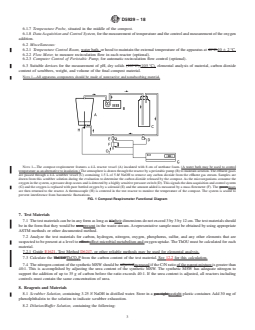
NOTE 1—The compost respirometer features a 4-L reactor vessel (A)
facturer’s instructions and Safety Data Sheets.
insulated with 8 cm of urethane foam. (A water bath may be used to
control temperature as an alternative to insulation.) The atmosphere is
9.2 This test method does not address all of the health and
drawn through the reactor by a peristaltic pump (B) to maintain aeration.
safetyissuesrelatedtoitsuse.Itistheresponsibilityoftheuser
The effluent gases are passed through a 4-Lscrubber vessel (C) containing
to establish appropriate safety measures.
1.5 L of 5 M NaOH to remove any carbon dioxide from the effluent gas
stream. Samples are drawn from this scrubber solution during the
9.3 High-purity,high-pressuregasescanbedangerousifnot
evaluation to determine the carbon dioxide released by the compost. As
handled correctly. Follow all safety precautions and monitor
the microorganisms consume the oxygen in the system, a pressure drop
the system often to ensure proper operation.
occurs and is detected by a highly sensitive pressure switch (D). This
signals the data acquisition and control system (G) and the oxygen is
replacedwithpurebottledoxygenbyasolenoid(E)and
...
This document is not an ASTM standard and is intended only to provide the user of an ASTM standard an indication of what changes have been made to the previous version. Because
it may not be technically possible to adequately depict all changes accurately, ASTM recommends that users consult prior editions as appropriate. In all cases only the current version
of the standard as published by ASTM is to be considered the official document.
Designation: D5929 − 96 (Reapproved 2009) D5929 − 18
Standard Test Method for
Determining Biodegradability of Materials Exposed to
Source-Separated Organic Municipal Solid Waste Mesophilic
Composting Conditions by Compost Respirometry
This standard is issued under the fixed designation D5929; the number immediately following the designation indicates the year of
original adoption or, in the case of revision, the year of last revision. A number in parentheses indicates the year of last reapproval. A
superscript epsilon (´) indicates an editorial change since the last revision or reapproval.
1. Scope
1.1 This test method covers the biodegradation properties of a material by reproducibly exposing materials to conditions typical
of source-separated organic municipal solid waste (MSW) composting. A material is composted under controlled conditions using
a synthetic compost matrix and determining the acclimation time, cumulative oxygen uptake, cumulative carbon dioxide
production, and percent of theoretical biodegradation over the period of the test. This test method does not establish the suitability
of the composted product for any use.
1.2 This test is performed at mesophilic temperatures. Some municipal compost operations reach thermophilic temperatures
during operation. Thermophilic temperatures can affect the biodegradation of some materials. This test is not intended to replicate
conditions within municipal compost operations that reach thermophilic temperatures.
1.3 The values stated in both inch-pound and SI units are to be regarded separately as the standard. The values given in
parentheses are for information only.
1.4 This standard does not purport to address all of the safety concerns, if any, associated with its use. It is the responsibility
of the user of this standard to establish appropriate safety safety, health, and healthenvironmental practices and determine the
applicability of regulatory limitations prior to use.
1.5 This international standard was developed in accordance with internationally recognized principles on standardization
established in the Decision on Principles for the Development of International Standards, Guides and Recommendations issued
by the World Trade Organization Technical Barriers to Trade (TBT) Committee.
2. Referenced Documents
2.1 ASTM Standards:
D513 Test Methods for Total and Dissolved Carbon Dioxide in Water
D1129 Terminology Relating to Water
D1293 Test Methods for pH of Water
D2908 Practice for Measuring Volatile Organic Matter in Water by Aqueous-Injection Gas Chromatography
D6247 Test Method for Determination of Elemental Content of Polyolefins by Wavelength Dispersive X-ray Fluorescence
Spectrometry
E1621 Guide for Elemental Analysis by Wavelength Dispersive X-Ray Fluorescence Spectrometry
2.2 APHA-AWWA-WEF Standard Methods:Method:
2540G Total, Fixed, and Volatile Solids in Solid and Semisolid Samples
3. Terminology
3.1 Definitions—Definitions of terms applying to this test method appear in Terminology D1129.
3.2 Definitions of Terms Specific to This Standard:
This test method is under the jurisdiction of ASTM Committee D34 on Waste Management and is the direct responsibility of Subcommittee D34.03 on Treatment,
Recovery and Reuse.
Current edition approved Sept. 1, 2009Feb. 1, 2018. Published November 2009February 2018. Originally approved in 1996. Last previous edition approved in 20042009
as D5929-96(2004).D5929 – 96 (2009). DOI: 10.1520/D5929-96R09.10.1520/D5929-18.
For referenced ASTM standards, visit the ASTM website, www.astm.org, or contact ASTM Customer Service at service@astm.org. For Annual Book of ASTM Standards
volume information, refer to the standard’s Document Summary page on the ASTM website.
Available from American Public Health Assoc., 1015 15th Street, NW, Washington, DC 20005, Standard Methods for the Examination of Water and Waste Water, 18th
ed., 1992.
Copyright © ASTM International, 100 Barr Harbor Drive, PO Box C700, West Conshohocken, PA 19428-2959. United States
D5929 − 18
3.2.1 acclimation time, n—the time required for the oxygen uptake to reach 10 % of the total measured cumulative oxygen
uptake.
3.2.2 inoculum, n—a mixture of organic substances in varying degrees of biodegradation to provide microbial-rich substrate in
which to perform biodegradation testing.
3.2.3 oxygen uptake, n—the cumulative oxygen consumed by the organisms during the test.
3.2.4 theoretical carbon dioxide production (ThCDP),(ThCO P), n—the maximum carbon dioxide that can be produced by a
material as calculated by the carbon content of the material.
3.2.5 theoretical oxygen uptake (ThOU), n—the maximum oxygen consumption required to fully oxidize a material based on
the elemental content of the material.
3.2.6 virgin newsprint—nonprinted newspaper roll stock.
4. Summary of Test Method
4.1 This test method consists of the following:
4.1.1 The test samples are prepared by cutting or forming the material into the form it would most likely be seen in the waste
stream. A theoretical maximum carbon dioxide production and oxygen uptake are determined from an elemental analysis.
4.1.2 An inoculum is obtained from a municipal source-separated organic MSW or yard waste compost facility. It is procured
from a static pile compost that has been composting for at least two months.
4.1.3 The synthetic organic MSW is prepared from virgin newsprint, pine bark or wood chips, corn starch, corn oil, bovine
casein, and urea. A buffer/dilution water is prepared from magnesium, calcium, iron, and a phosphate buffer.
4.1.4 The test material, synthetic compost, inoculum, and dilution water are combined and placed in a highly insulated
temperature-controlled reactor which monitors oxygen consumption and temperature and captures all evolved carbon dioxide.
4.1.5 The system is monitored, and oxygen uptake rates, temperature profiles, and total carbon dioxide produced are recorded.
4.1.6 The total oxygen uptake and carbon dioxide produced are compared with the theoretical values obtained from the
elemental analysis, and a percent of biodegradation is generated.calculated. Possible negative effects of the material are evaluated
by observing the acclimation time of the synthetic MSW and evaluating the oxygen uptake rate.
5. Significance and Use
5.1 As the crisis in solid waste continues to grow, MSW composting is increasingly being considered as oneconsidered an
important component in the overall solid waste management strategy. The volume reduction achieved by composting, combined
with the production of a usable end product, is resulting in increasing numbers of product (for example, compost as a soil
amendment), has resulted in municipalities analyzing and selecting source-separated organic MSW composting as an alternative
to incineration or to reduce reliance on landfill disposal. This test method will help landfill disposal of biodegradable organic
materials. This standard provides a method to analyze and determine the effect of materials on the compost process and establish
if the material can be properly disposed through solid waste composting facilities.the performance, utility, and feasibility of the
composting process as a method for managing organic solid waste material. Using this method, key parameters of process
performance, including theoretical oxygen uptake (ThOU) and theoretical carbon dioxide production (ThCO P) are determined.
5.2 This test method attempts to provide provides a simulation of the overall compost process while maintaining reproducibility.
Exposing the test material with several other types of organic materials that are typically in MSW provides an environment which
provides the key characteristics of composting: material not in a sole carbon source environment which allows co-metabolism,
compost system is self heating, and provides a the composting process, including direct measurement of organism respiration.
6. Apparatus
6.1 Compost Respirometry Apparatus (see Fig. 1):
6.1.1 A minimum of six reactors, 2 to 6-L volume, with the test material in triplicate and the controls in triplicate. The reactors
should be surrounded with efficient insulation to minimize heat loss and be gastight. Insulation should be 8 cm of urethane foam
or equivalent. A temperature-controlled water bath may be used as an alternative to insulating the vessels.
6.1.2 Tubing, with high resistance to gas permeation.
6.1.3 Peristaltic Pump, to control and maintain gas flow through each reactor.
6.1.4 4-L Scrubber Vessel, for each reactor fitted with a scrubber solution sampling port.
6.1.5 Differential Pressure Switch, for each reactor that actuates between 2 and 5 in. (51 and 127 mm) of water.
6.1.6 Solenoid and Mass Flowmeter, to control and measure the addition of pure (99.997 + )(99.997+) oxygen to system.
Tabak, Henry H. and Lewis, Ronald F., CEC/OECD Ring Test of Respiration Method for Determination of Biodegradability, U. S. Environmental Protection Agency,
pp. 1–3.Tabak, H. H. and Lewis, R. F., “CEC/OECD Ring Test of Respiration Method for Determination of Biodegradability,” U.S. Environmental Protection Agency, pp.
1–3.
Biocycle: Journal of Waste Recycling Staff, eds., The Biocycle Guide to Composting Municipal Wastes, JG Press, Inc., 1989.The Biocycle Guide to Composting Municipal
Wastes, JG Press, Inc., 1989.
D5929 − 18
6.1.7 Temperature Probe, situated in the middle of the compost.
6.1.8 Data Acquisition and Control System, for the measurement of temperature and the control and measurement of the oxygen
addition.
6.2 Miscellaneous:
6.2.1 Temperature Control Room, water bath, or hood to maintain the external temperature of the apparatus at 40°C.40 6 2 °C.
6.2.2 Flow Meter, to measure recirculation flow in each reactor (optional).
6.2.3 Computer Control of Peristaltic Pump, for automatic recirculation flow control (optional).
6.3 Suitable devices for the measurement of pH, dry solids (105°C),(105 °C), elemental analysis of material, carbon dioxide
content of scrubbers, weight, and volume of the final compost material.
NOTE 1—All apparatus components should be made of nonreactive and nonabsorbing material.
NOTE 1—The compost respirometer features a 4-L reactor vessel (A) insulated with 8 cm of urethane foam. (A water bath may be used to control
temperature as an alternative to insulation.) The atmosphere is drawn through the reactor by a peristaltic pump (B) to maintain aeration. The effluent gases
are passed through a 4-L scrubber vessel (C) containing 1.5 L of 5 M NaOH to remove any carbon dioxide from the effluent gas stream. Samples are
drawn from this scrubber solution during the evaluation to determine the carbon dioxide released by the compost. As the microorganisms consume the
oxygen in the system, a pressure drop occurs and is detected by a highly sensitive pressure switch (D). This signals the data acquisition and control system
(G) and the oxygen is replaced with pure bottled oxygen by a solenoid (E) and the amount added is measured by a mass flowmeter (F). The gassesgases
are then returned to the reactor. A thermocouple (H) is centered in the test reactor to monitor the temperature of the compost. The system is sealed to
prevent interference from barometric fluctuations.
FIG. 1 Compost Respirometer Functional Diagram
7. Test Materials
7.1 The test materials can be in any form as long as it’stheir dimensions do not exceed 3 by 3 by 12 cm. The test materials should
be in the form that they would be seenpresent in the waste stream. A representative sample must be obtained by using appropriate
ASTM methods or other documented method.
7.2 Analyze the test materials for carbon, hydrogen, nitrogen, oxygen, phosphorus, sulfur, and any other elements that are
suspected to be present at a level to effect affect microbial metabolism and oxygen uptake. The ThOU must be calculated for each
material.
7.2.1 Guide E1621, Test Method D6247, or other reliable methods may be used for elemental analysis.
7.3 Calculate the ThCDPThCO P from the carbon content of the test material. See 12.2 for this calculation.
7.4 The nitrogen content of the synthetic MSW should be adjustedincreased if the C/N ratio of the parent mixture is greater than
40:1. This is accomplished by adjusting the urea content of the synthetic MSW. The synthetic MSW has adequate nitrogen to
support the addition of up to 35 g of carbon before the ratio exceeds 40:1. If the urea content is adjusted, all reactors including
controls must contain the same concentration of urea.
8. Reagents and Materials
8.1 Scrubber Solution, containing 3.25 N NaOH in distilled water. Store in a gas-tightgastight plastic container. Add 30 mg of
phenolphthalein to the solution to indicate scrubber exhaustio
...