

ASTM F1334-24
(Test Method)Standard Test Method for Determining A-Weighted Sound Power Level of Vacuum Cleaners
General Information
- Abstract
SIGNIFICANCE AND USE
4.1 The test results enable the comparison of A-weighted sound emission from vacuum cleaners, backpack vacuum cleaners, extractors, or hard-floor cleaning machines when tested under the condition of this test method.
SCOPE
1.1 This test method calculates the overall A-weighted sound power level emitted by small portable upright, canister, combination vacuum cleaners, backpack vacuum cleaners, hard-floor cleaning machines, extractors, and central vacuum cleaner motorized nozzles intended for operation in domestic and commercial applications.
1.1.1 To determine the Sound Power Level of a central vacuum at the power unit location refer to Test Method F2544.
1.2 A-weighted sound pressure measurements are performed on a stationary vacuum cleaner, extractor, hard-floor cleaning machine, or backpack vacuum cleaner in a semi-reverberant room. This test method determines sound power by a comparison method for small noise sources, that is, comparison to a broadband reference sound source.
1.3 This test method describes a procedure for determining the approximate A-weighted sound power level of small noise sources. This test method uses a non-special semi-reverberant room.
1.4 Results are expressed as A-weighted sound power level in decibels (referenced to one picowatt).
1.5 The values stated in inch-pound units are to be regarded as the standard. The values in parentheses are for information only.
Note 1: The F11.21 subcommittee is actively pursuing new market relevant carpets with the assistance of the carpet industry. Although plush and Freize carpet panels are no longer available for purchase, some laboratories may still have samples for testing. In such cases, the table values remain valid.
1.6 This standard does not purport to address all of the safety concerns, if any, associated with its use. It is the responsibility of the user of this standard to establish appropriate safety, health, and environmental practices and determine the applicability of regulatory limitations prior to use.
1.7 This international standard was developed in accordance with internationally recognized principles on standardization established in the Decision on Principles for the Development of International Standards, Guides and Recommendations issued by the World Trade Organization Technical Barriers to Trade (TBT) Committee.
- Status
- Published
- Publication Date
- 31-Dec-2023
- Technical Committee
- F11 - Vacuum Cleaners
- Drafting Committee
- F11.25 - Sound Measurement
Buy Documents
ASTM F1334-24 - Standard Test Method for Determining A-Weighted Sound Power Level of Vacuum Cleaners
REDLINE ASTM F1334-24 - Standard Test Method for Determining A-Weighted Sound Power Level of Vacuum Cleaners
Overview
ASTM F1334-24: Standard Test Method for Determining A-Weighted Sound Power Level of Vacuum Cleaners establishes a reliable method for measuring and reporting the sound output of various vacuum cleaning devices. This standard provides procedures to calculate the overall A-weighted sound power level (expressed in decibels, dB) emitted by small portable upright, canister, combination, and backpack vacuum cleaners, as well as hard-floor cleaning machines, extractors, and central vacuum cleaner motorized nozzles. By offering a reproducible, comparative framework, ASTM F1334-24 enables manufacturers, laboratories, and regulatory bodies to gauge and compare the acoustic performance of vacuum cleaners used in both domestic and commercial environments.
Key Topics
- Scope of Application
The method applies to most small portable and central vacuum components except the central vacuum power unit, which is covered under ASTM F2544. - Measurement Conditions
- Tests are performed in a semi-reverberant room using sound pressure measurements at six microphone positions.
- Instruments and microphones must comply with ANSI S1.43 and be calibrated as per ANSI S1.10.
- Sample Selection and Testing
- At least three units of each vacuum cleaner model are randomly selected and tested.
- Each unit is subject to a series of three repeatable test runs to ensure statistical confidence.
- Procedural Framework
- Devices are tested in their standard operating configurations, reflecting normal use conditions for both carpet and hard floors.
- The A-weighted sound power level is found by comparing measurements from the test unit to those from a reference sound source.
- Data Reporting
- Results are reported as A-weighted sound power levels in decibels referenced to one picowatt.
- Documentation includes detailed sample identification, test conditions, calibration verification, and environmental data.
Applications
- Product Development and Quality Control
- Manufacturers utilize the standard to assess and optimize the acoustic properties of vacuum cleaners, ensuring compliance with noise regulations and customer expectations.
- Comparative Benchmarking
- The method enables objective comparison between models and brands, supporting purchasing decisions for both consumers and commercial buyers.
- Regulatory Compliance and Market Access
- Conformance with ASTM F1334-24 can assist in meeting national or international regulations concerning maximum sound output for household and commercial appliances.
- Consumer Information and Labeling
- Test results support accurate noise labeling, a growing concern for environmentally conscious consumers and workplace safety standards.
Related Standards
- ASTM F2544 - Test Method for Determining A-Weighted Sound Power Level of Central Vacuum Power Units
- ASTM F608 - Test Method for Evaluation of Carpet Embedded Dirt Removal Effectiveness of Household/Commercial Vacuum Cleaners
- ASTM F2607 - Test Method for Measuring the Hard Surface Floor-Cleaning Ability of Household/Commercial Vacuum Cleaners
- ANSI S1.10 - Method for the Calibration of Microphones
- ANSI S1.43 - Specifications for Integrating-Averaging Sound Level Meters
- ISO 3741 & 3743 - Acoustics - Determination of sound power levels of noise sources
By following ASTM F1334-24, stakeholders ensure consistent, repeatable evaluation of vacuum cleaner sound emissions, contributing to safer, quieter, and more transparent product development and selection. This standard supports industry efforts to improve user comfort and environmental noise management across residential and commercial cleaning markets.
Relations
- Replaces
ASTM F1334-18 - Standard Test Method for Determining A-Weighted Sound Power Level of Vacuum Cleaners - Effective Date
- 01-Jan-2024
- Effective Date
- 01-Jan-2024
- Effective Date
- 01-Nov-2022
- Effective Date
- 01-Jan-2024
- Effective Date
- 01-Jan-2024
- Effective Date
- 01-Jan-2024
- Effective Date
- 01-Jan-2024
- Effective Date
- 01-Jan-2024
- Referred By
ASTM F2609-11(2021) - Standard Test Method for Litter-Cleaning Effectiveness of Vacuum Cleaners - Effective Date
- 01-Jan-2024
Buy Documents
ASTM F1334-24 - Standard Test Method for Determining A-Weighted Sound Power Level of Vacuum Cleaners
REDLINE ASTM F1334-24 - Standard Test Method for Determining A-Weighted Sound Power Level of Vacuum Cleaners
Get Certified
Connect with accredited certification bodies for this standard

BSMI (Bureau of Standards, Metrology and Inspection)
Taiwan's standards and inspection authority.
Sponsored listings
Frequently Asked Questions
ASTM F1334-24 is a standard published by ASTM International. Its full title is "Standard Test Method for Determining A-Weighted Sound Power Level of Vacuum Cleaners". This standard covers: SIGNIFICANCE AND USE 4.1 The test results enable the comparison of A-weighted sound emission from vacuum cleaners, backpack vacuum cleaners, extractors, or hard-floor cleaning machines when tested under the condition of this test method. SCOPE 1.1 This test method calculates the overall A-weighted sound power level emitted by small portable upright, canister, combination vacuum cleaners, backpack vacuum cleaners, hard-floor cleaning machines, extractors, and central vacuum cleaner motorized nozzles intended for operation in domestic and commercial applications. 1.1.1 To determine the Sound Power Level of a central vacuum at the power unit location refer to Test Method F2544. 1.2 A-weighted sound pressure measurements are performed on a stationary vacuum cleaner, extractor, hard-floor cleaning machine, or backpack vacuum cleaner in a semi-reverberant room. This test method determines sound power by a comparison method for small noise sources, that is, comparison to a broadband reference sound source. 1.3 This test method describes a procedure for determining the approximate A-weighted sound power level of small noise sources. This test method uses a non-special semi-reverberant room. 1.4 Results are expressed as A-weighted sound power level in decibels (referenced to one picowatt). 1.5 The values stated in inch-pound units are to be regarded as the standard. The values in parentheses are for information only. Note 1: The F11.21 subcommittee is actively pursuing new market relevant carpets with the assistance of the carpet industry. Although plush and Freize carpet panels are no longer available for purchase, some laboratories may still have samples for testing. In such cases, the table values remain valid. 1.6 This standard does not purport to address all of the safety concerns, if any, associated with its use. It is the responsibility of the user of this standard to establish appropriate safety, health, and environmental practices and determine the applicability of regulatory limitations prior to use. 1.7 This international standard was developed in accordance with internationally recognized principles on standardization established in the Decision on Principles for the Development of International Standards, Guides and Recommendations issued by the World Trade Organization Technical Barriers to Trade (TBT) Committee.
SIGNIFICANCE AND USE 4.1 The test results enable the comparison of A-weighted sound emission from vacuum cleaners, backpack vacuum cleaners, extractors, or hard-floor cleaning machines when tested under the condition of this test method. SCOPE 1.1 This test method calculates the overall A-weighted sound power level emitted by small portable upright, canister, combination vacuum cleaners, backpack vacuum cleaners, hard-floor cleaning machines, extractors, and central vacuum cleaner motorized nozzles intended for operation in domestic and commercial applications. 1.1.1 To determine the Sound Power Level of a central vacuum at the power unit location refer to Test Method F2544. 1.2 A-weighted sound pressure measurements are performed on a stationary vacuum cleaner, extractor, hard-floor cleaning machine, or backpack vacuum cleaner in a semi-reverberant room. This test method determines sound power by a comparison method for small noise sources, that is, comparison to a broadband reference sound source. 1.3 This test method describes a procedure for determining the approximate A-weighted sound power level of small noise sources. This test method uses a non-special semi-reverberant room. 1.4 Results are expressed as A-weighted sound power level in decibels (referenced to one picowatt). 1.5 The values stated in inch-pound units are to be regarded as the standard. The values in parentheses are for information only. Note 1: The F11.21 subcommittee is actively pursuing new market relevant carpets with the assistance of the carpet industry. Although plush and Freize carpet panels are no longer available for purchase, some laboratories may still have samples for testing. In such cases, the table values remain valid. 1.6 This standard does not purport to address all of the safety concerns, if any, associated with its use. It is the responsibility of the user of this standard to establish appropriate safety, health, and environmental practices and determine the applicability of regulatory limitations prior to use. 1.7 This international standard was developed in accordance with internationally recognized principles on standardization established in the Decision on Principles for the Development of International Standards, Guides and Recommendations issued by the World Trade Organization Technical Barriers to Trade (TBT) Committee.
ASTM F1334-24 is classified under the following ICS (International Classification for Standards) categories: 17.140.20 - Noise emitted by machines and equipment; 97.080 - Cleaning appliances. The ICS classification helps identify the subject area and facilitates finding related standards.
ASTM F1334-24 has the following relationships with other standards: It is inter standard links to ASTM F1334-18, ASTM F608-24, ASTM F608-22, ASTM F1284-24, ASTM F1411-11(2018), ASTM F2544-11(2018), ASTM F2608-15(2022), ASTM F1409-23, ASTM F2609-11(2021). Understanding these relationships helps ensure you are using the most current and applicable version of the standard.
ASTM F1334-24 is available in PDF format for immediate download after purchase. The document can be added to your cart and obtained through the secure checkout process. Digital delivery ensures instant access to the complete standard document.
Standards Content (Sample)
This international standard was developed in accordance with internationally recognized principles on standardization established in the Decision on Principles for the
Development of International Standards, Guides and Recommendations issued by the World Trade Organization Technical Barriers to Trade (TBT) Committee.
Designation: F1334 − 24
Standard Test Method for
Determining A-Weighted Sound Power Level of Vacuum
Cleaners
This standard is issued under the fixed designation F1334; the number immediately following the designation indicates the year of
original adoption or, in the case of revision, the year of last revision. A number in parentheses indicates the year of last reapproval. A
superscript epsilon (´) indicates an editorial change since the last revision or reapproval.
1. Scope 1.7 This international standard was developed in accor-
dance with internationally recognized principles on standard-
1.1 This test method calculates the overall A-weighted
ization established in the Decision on Principles for the
sound power level emitted by small portable upright, canister,
Development of International Standards, Guides and Recom-
combination vacuum cleaners, backpack vacuum cleaners,
mendations issued by the World Trade Organization Technical
hard-floor cleaning machines, extractors, and central vacuum
Barriers to Trade (TBT) Committee.
cleaner motorized nozzles intended for operation in domestic
and commercial applications.
2. Referenced Documents
1.1.1 To determine the Sound Power Level of a central
2.1 ASTM Standards:
vacuum at the power unit location refer to Test Method F2544.
C634 Terminology Relating to Building and Environmental
1.2 A-weighted sound pressure measurements are per-
Acoustics
formed on a stationary vacuum cleaner, extractor, hard-floor
E177 Practice for Use of the Terms Precision and Bias in
cleaning machine, or backpack vacuum cleaner in a semi-
ASTM Test Methods
reverberant room. This test method determines sound power by
E691 Practice for Conducting an Interlaboratory Study to
a comparison method for small noise sources, that is, compari-
Determine the Precision of a Test Method
son to a broadband reference sound source.
F608 Test Method for Evaluation of Carpet Embedded Dirt
Removal Effectiveness of Household/Commercial
1.3 This test method describes a procedure for determining
Vacuum Cleaners
the approximate A-weighted sound power level of small noise
F655 Specification for Test Carpets and Pads for Vacuum
sources. This test method uses a non-special semi-reverberant
Cleaner Testing (Withdrawn 2022)
room.
F2544 Test Method for Determining A-Weighted Sound
1.4 Results are expressed as A-weighted sound power level
Power Level of Central Vacuum Power Units
in decibels (referenced to one picowatt).
F2607 Test Method for Measuring the Hard Surface Floor-
1.5 The values stated in inch-pound units are to be regarded Cleaning Ability of Household/Commercial Vacuum
Cleaners
as the standard. The values in parentheses are for information
only. 2.2 ANSI Standards:
NOTE 1—The F11.21 subcommittee is actively pursuing new market ANSI S1.10 Method for the Calibration of Microphones
relevant carpets with the assistance of the carpet industry. Although plush
ANSI S1.43 Specifications for Integrating-Averaging Sound
and Freize carpet panels are no longer available for purchase, some
Level Meters
laboratories may still have samples for testing. In such cases, the table
ANSI S12.51/ISO 3741 Acoustics - Determination of sound
values remain valid.
power levels of noise sources using sound pressure -
1.6 This standard does not purport to address all of the
Precision methods for reverberation rooms
safety concerns, if any, associated with its use. It is the
ANSI S12.53/ISO 3743 Acoustics - Determination of sound
responsibility of the user of this standard to establish appro-
power levels of noise sources - Engineering methods for
priate safety, health, and environmental practices and deter-
small, movable sources in reverberant fields
mine the applicability of regulatory limitations prior to use.
For referenced ASTM standards, visit the ASTM website, www.astm.org, or
contact ASTM Customer Service at service@astm.org. For Annual Book of ASTM
This test method is under the jurisdiction of ASTM Committee F11 on Vacuum Standards volume information, refer to the standard’s Document Summary page on
Cleaners and is the direct responsibility of Subcommittee F11.25 on Sound the ASTM website.
Measurement. The last approved version of this historical standard is referenced on
Current edition approved Jan. 1, 2024. Published February 2024. Originally www.astm.org.
approved in 1991. Last previous edition approved in 2018 as F1334 – 18. DOI: Available from American National Standards Institute, 11 W. 42nd St., 13th
10.1520/F1334-24. Floor, New York, NY 10036.
Copyright © ASTM International, 100 Barr Harbor Drive, PO Box C700, West Conshohocken, PA 19428-2959. United States
F1334 − 24
ANSI S12.57/ISO 3747 Standard Acoustics - Determination
of sound power levels of noise sources using sound
pressure - Comparison method in situ
2.3 ISO Standards:
ISO 11201 Acoustics – Noise emitted by machinery and
equipment – Determination of emission sound pressure
levels at a work station and at other specified positions in
an essentially free field over a reflecting plane with
negligible environmental corrections
3. Terminology
3.1 Definitions:
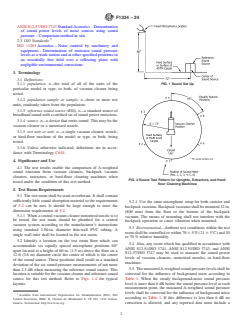
FIG. 1 Sound Set Up
3.1.1 population, n—the total of all of the units of the
particular model or type, or both, of vacuum cleaner being
tested.
3.1.2 population sample or sample, n—three or more test
units, randomly taken from the population.
3.1.3 reference sound source (RSS), n—a standard source of
broadband sound with a certified set of sound power emissions.
3.1.4 source, n—a device that emits sound. This may be the
vacuum cleaner or a motorized nozzle.
3.1.5 test unit or unit, n—a single vacuum cleaner, nozzle,
or hard-floor machine of the model or type, or both, being
tested.
3.1.6 Unless otherwise indicated, definitions are in accor-
dance with Terminology C634.
4. Significance and Use
4.1 The test results enable the comparison of A-weighted
sound emission from vacuum cleaners, backpack vacuum
cleaners, extractors, or hard-floor cleaning machines when
FIG. 2 Sound Test Pattern for Uprights, Extractors, and Hard-
tested under the condition of this test method.
floor Cleaning Machines
5. Test Room Requirements
5.1 The test room shall be semi-reverberant. It shall contain
sufficiently little sound absorption material so the requirements
5.2.1 Use the same microphone setup for both canister and
of 5.2 can be met. It should be large enough to meet the
backpack vacuums. Backpack vacuums shall be mounted 32 in.
dimension requirements of 5.2.
(800 mm) from the floor to the bottom of the backpack
5.1.1 When a central vacuum cleaner motorized nozzle is to
vacuum. The means of mounting shall not interfere with the
be tested, the test room should be plumbed for a central
backpack operation or cause vibration when mounted.
vacuum system according to the manufacturer’s instructions
5.3 Environmental—Ambient test conditions within the test
using standard 2.00-in. diameter thin-wall PVC tubing. A
room shall be controlled to within 70 6 5°F (21 6 3°C) and 30
single wall inlet shall be located in the test room.
to 70 % relative humidity.
5.2 Identify a location on the test room floor which can
5.4 Also, any room which has qualified in accordance with
accommodate six equally spaced microphone positions 60°
ANSI S12.51/ISO 3741, ANSI S12.53/ISO 3743, and ANSI
apart located at a height of 60 in. (1.5 m) above the floor on a
S12.57/ISO 3747 may be used to measure the sound power
12 ft (3.6 m) diameter circle the center of which is the center
levels of vacuum cleaners, motorized nozzles, or hard-floor
of the sound source. These positions shall result in a standard
machines.
deviation of the six sound pressure measurements of not more
than 2.3 dB when measuring the reference sound source. This 5.5 The measured A-weighted sound pressure levels shall be
corrected for the influence of background noise according to
location is suitable for the vacuum cleaner and reference sound
source for this test method. Refer to Figs. 1-4 for typical Table 1. When the steady background-noise sound pressure
level is more than 6 dB below the sound pressure level at each
layouts.
measurement point, the measured A-weighted sound pressure
levels shall be corrected for the influence of background noise
Available from International Organization for Standardization (ISO), ISO
according to Table 1. If this difference is less than 6 dB no
Central Secretariat, BIBC II, Chemin de Blandonnet 8, CP 401, 1214 Vernier,
Geneva, Switzerland, http://www.iso.org. correction is allowed, and any reported data must include a
F1334 − 24
6. Instrumentation and Equipment
6.1 Acoustical Instrumentation—The sound measurement
system shall be as specified in ANSI S1.43.
6.2 Voltage Regulator System—The regulator shall be ca-
pable of maintaining the vacuum cleaner’s rated voltage
(61 %) and frequency (61 Hz) having a waveform that is
essentially sinusoidal with 3% maximum harmonic distortion
for the duration of the test.
6.3 Test Carpet and Pad—The test carpet and pad shall be
54 in. wide (137 cm) and 72 in. (183 cm) long. The carpet shall
be multilevel. Carpet and pad shall be as specified in Specifi-
cation F655.
NOTE 2—For this test method two standard size 27 by 72-in. (69 by
183-cm) long test carpets could be placed side by side to make it 54 by 72
in. (138 by 183 cm) long. It is recommended that the two pieces of test
carpet be taped to the floor, side by side with the pile running in the same
direction.
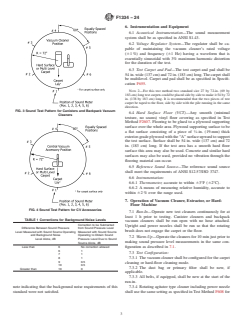
FIG. 3 Sound Test Pattern for Canisters and Backpack Vacuum
6.4 Hard Surface Floor (VCT)—Any smooth (minimal
Cleaners
texture, no seams) vinyl floor covering as specified in Test
Method F2607. Flooring to be glued to a plywood supporting
surface over the whole area. Plywood supporting surface to be
a flat surface consisting of a piece of ⁄4-in. (19-mm) thick
exterior-grade plywood with the “A” surface upward to support
the test surface. Surface shall be 54 in. wide (137 cm) and 72
in. (183 cm) long. If the test area has a smooth hard floor
surface this area may also be used. Concrete and similar hard
surfaces may also be used, provided no vibration through the
flooring material can occur.
6.5 Reference Sound Source—The reference sound source
shall meet the requirements of ANSI S12.57/ISO 3747.
6.6 Instrumentation:
6.6.1 Thermometer, accurate to within 63°F (62°C).
6.6.2 A means of measuring relative humidity, accurate to
within 62 % over the range used.
7. Operation of Vacuum Cleaner, Extractor, or Hard-
Floor Machine
FIG. 4 Sound Test Pattern for CV Accessories
7.1 Run-In—Operate new test cleaners continuously for at
least 1 h prior to testing. Canister cleaners and backpack
TABLE 1 Corrections for Background Noise Levels
vacuum cleaners shall be run open with no hose attached.
Correction to be Subtracted
Upright and power nozzles shall be run so that the rotating
Difference Between Sound Pressure from Sound Pressure Level
brush does not engage the carpet or the floor.
Level Measured with Sound Source Operating Measured with Sound Source
and Background Noise Operating to Obtain Sound
7.2 Warm-Up—Operate the cleaners for 10 min just prior to
Level Alone, dB Pressure Level Due to Sound
making sound pressure level measurements in the same con-
Source Alone, dB
figuration as described in 7.1.
Less than 6 No correction allowed
6 1
7.3 Test Configuration:
7 1
8 1
7.3.1 The vacuum cleaner shall be configured for the carpet
9 0.5
cleaning or hard-floor cleaning mode.
10 0.5
7.3.2 The dust bag or primary filter shall be new, if
Greater than 10 0
applicable.
7.3.3 All belts, if equipped, shall be new at the start of the
run-in.
note indicating that the background noise requirements of this 7.3.4 Rotating agitator type cleaner including power nozzle
standard were not satisfied. shall use the same setting as specified in Test Method F608 for
F1334 − 24
cleaning level loop carpet or in Test Method F2607 for hard versa. For example, a position shall be such that air exhaust
floor cleaning, which is as follows: noise will radiate into the room in a direction other than toward
7.3.4.1 If various settings are provided, set the motor speed the second module.
setting, suction regulator, or nozzle height, or combination 8.2.3 Handle—Any operating handle shall be separately
thereof, using the manufacturer’s specified setting for cleaning supported in a position such that the handle grip is 31 ⁄2 in. (80
level loop carpet or hard-floor surfaces. Momentary or instan- cm) above the carpet surface or hard surface. Take care that the
taneous speeds are not to be used. support structure does not introduce additional rattles, etc.
7.3.5 For straight air canister cleaners and backpack There shall be a resilient clamping of the handle to the support
vacuum cleaners, use the same setting specified in Test Method structure.
F608 for cleaning level loop carpet or in Test Method F2607 8.2.4 Central Vacuum Cleaner Power (or Straight Air)
for hard floor cleaning, which is as follows: Nozzles—For central vacuum power (or straight air) nozzles,
7.3.5.1 If various settings are provided, set the motor the hose is connected to the wall inlet valve. The hose assembly
setting, suction regulator, or nozzle height, or combination with power (or straight air) nozzle is then positioned in the
thereof, using the manufacturer’s specific setting for cleaning same manner as the hose assembly and power head for a
level loop carpet or hard-floor surfaces. If no specific instruc- canister vacuum cleaner. See 8.2.2 – 8.2.3.
tions are given, or if judged to be inadequate or unclear,
9. Sampling
position the nozzle on the carpet so the maximum suction is
9.1 Test a sufficient number of samples of each vacuum
provided, taking care to maintain the tilt angle throughout the
cleaner model until a 90 % confidence level is established
test. Momentary or instantaneous speeds are not to be used.
within 62.0 dBA of the mean value. Test a minimum of three
7.3.6 Voltage—Tests are to be conducted at the nameplate
samples.
voltage (61 %) and frequency (61 Hz) throughout the test.
For cleaners with dual nameplate voltage ratings, conduct
10. Measurement Procedure
sound tests at the highest voltage.
10.1 Check the calibration of each microphone according to
7.3.7 Central Vacuum Power Unit—The central vacuum
the instrument manufacturer’s directions (further information
power unit shall be remotely located (outside the semi-
provided in ANSI S1.10).
reverberate room) so that the noise levels generated by the
power unit do not affect the test results of the central vacuum
10.2 At each of the six microphone positions determined in
(motorized or straight air) nozzle being tested.
5.2, measure the background A-weighted sound pressure level.
This step can be ignored if it is known that the background
8. Location of Sound Sources and Equipment
sound pressure levels are more than 10 dB below the sound
pressure levels of all sources being considered at all micro-
8.1 Carpet and Pad—Lay the carpet and pad or the VCT
phone locations.
flooring, or other hard surface, on the floor with the geometric
center of the carpet directly over the center of the circle defined
10.3 With the reference sound source in the location defined
in 5.2.
in Section 8 and running in accordance to the manufacturer’s
recommendations, measure the A-weighted sound pressure
8.2 Locate the vacuum cleaner or the reference sound
level at the six microphone positions. After making the
source at the position determined in 5.2. All modules (generally
necessary corrections for the influence of the background noise
the motor/blower and its housing in the base of an upright unit,
at each microphone location and ensuring that the standard
or in the canister of a canister unit) shall be adequately secured
deviation requirement of 5.2 is met, calculate the space-
in a manner which will not affect the sound pressure readings.
averaged A-weighted sound pressure level of the reference
8.2.1 Reference Sound Source Location—Position the center
sound source, L , using the equation:
of the radiating portion (fan blades, for an aerodynamic source) pr
N
m
over the location defined above. The reference sound source is
L /10
i
L or L 5 10log 10 (1)
H J
p pr (
placed directly on the carpet or hard surface.
N
i51
m
8.2.1.1 When testing a backpack vacuum cleaner, the RSS
where:
shall be set at the height of the bottom of the backpack
L or L = A-weighted sound pressure level averaged over
equipment. p pr
all microphone positions, for a single source
8.2.2 Vacuum Cleaner Location:
location, dB,
8.2.2.1 Center the principal module over the source location
th
L = A-weighted sound pressure level for the i
i
as determined in 5.2.
microphone position, dB, and
8.2.2.2 Take care to ensure the rotating brush model does
N = number of microphone positions.
m
not damage the carpet seam (that is, center upright on carpet on
center of carpet with the rotating brush perpendicular to seam). 10.4 Replace the reference sound source with the test unit.
8.2.2.3 Second Module—If there is a second module not With the test unit operating in accordance to Section 7,
integral with the basic unit (for example, the power nozzle), it measure the A-weighted sound pressure level at the six
shall be positioned on the side of the principle module away microphone locations. After making the necessary corrections
from the center of the room. Position the second module in for the influence of the background noise at each microphone
such a way that, to the maximum extent possible, its sound location, calculate the space-averaged A-weighted sound pres-
emissions are not shielded by the principal module, and vice sure level, L , of the test unit using Eq 1.
p
F1334 − 24
the measured sound pressure level shall be normalized to the reference
10.5 Using the space-averaged A-weighted sound pressure
meteorological conditions using the following equation:
levels, L and L , and the known A-weighted sound power
pr p
The A-weighted sound pressure level, L , in decibels, shall be normalized
p
level of the reference sound source, calculate the A-weighted
to the reference meteorological conditions:
sound power level of the test unit using the procedure of 11.1.
Pa 5 1.01325 × 10 Pa (3)
amb,0
10.6 Using the same test unit repeat steps 10.2 – 10.5 two
(2) additional times for a total of three (3) test runs.
θ = 296 K
by using the following equation to obtain the emission sound pressure
10.7 The so
...
This document is not an ASTM standard and is intended only to provide the user of an ASTM standard an indication of what changes have been made to the previous version. Because
it may not be technically possible to adequately depict all changes accurately, ASTM recommends that users consult prior editions as appropriate. In all cases only the current version
of the standard as published by ASTM is to be considered the official document.
Designation: F1334 − 18 F1334 − 24
Standard Test Method for
Determining A-Weighted Sound Power Level of Vacuum
Cleaners
This standard is issued under the fixed designation F1334; the number immediately following the designation indicates the year of
original adoption or, in the case of revision, the year of last revision. A number in parentheses indicates the year of last reapproval. A
superscript epsilon (´) indicates an editorial change since the last revision or reapproval.
1. Scope
1.1 This test method calculates the overall A-weighted sound power level emitted by small portable upright, canister, combination
vacuum cleaners, backpack vacuum cleaners, hard-floor cleaning machines, extractors, and central vacuum cleaner motorized
nozzles intended for operation in domestic and commercial applications.
1.1.1 To determine the Sound Power Level of a central vacuum at the power unit location refer to Test Method F2544.
1.2 A-weighted sound pressure measurements are performed on a stationary vacuum cleaner, extractor, hard-floor cleaning
machine, or backpack vacuum cleaner in a semi-reverberant room. This test method determines sound power by a comparison
method for small noise sources, that is, comparison to a broadband reference sound source.
1.3 This test method describes a procedure for determining the approximate A-weighted sound power level of small noise sources.
This test method uses a non-special semi-reverberant room.
1.4 Results are expressed as A-weighted sound power level in decibels (referenced to one picowatt).
1.5 The values stated in inch-pound units are to be regarded as the standard. The values in parentheses are for information only.
NOTE 1—The F11.21 subcommittee is actively pursuing new market relevant carpets with the assistance of the carpet industry. Although plush and Freize
carpet panels are no longer available for purchase, some laboratories may still have samples for testing. In such cases, the table values remain valid.
1.6 This standard does not purport to address all of the safety concerns, if any, associated with its use. It is the responsibility
of the user of this standard to establish appropriate safety, health, and environmental practices and determine the applicability of
regulatory limitations prior to use.
1.7 This international standard was developed in accordance with internationally recognized principles on standardization
established in the Decision on Principles for the Development of International Standards, Guides and Recommendations issued
by the World Trade Organization Technical Barriers to Trade (TBT) Committee.
2. Referenced Documents
2.1 ASTM Standards:
C634 Terminology Relating to Building and Environmental Acoustics
This test method is under the jurisdiction of ASTM Committee F11 on Vacuum Cleaners and is the direct responsibility of Subcommittee F11.25 on Sound Measurement.
Current edition approved Oct. 1, 2018Jan. 1, 2024. Published October 2018February 2024. Originally approved in 1991. Last previous edition approved in 20142018 as
F1334 – 14.F1334 – 18. DOI: 10.1520/F1334-18.10.1520/F1334-24.
For referenced ASTM standards, visit the ASTM website, www.astm.org, or contact ASTM Customer Service at service@astm.org. For Annual Book of ASTM Standards
volume information, refer to the standard’s Document Summary page on the ASTM website.
Copyright © ASTM International, 100 Barr Harbor Drive, PO Box C700, West Conshohocken, PA 19428-2959. United States
F1334 − 24
E177 Practice for Use of the Terms Precision and Bias in ASTM Test Methods
E691 Practice for Conducting an Interlaboratory Study to Determine the Precision of a Test Method
F608 Test Method for Evaluation of Carpet Embedded Dirt Removal Effectiveness of Household/Commercial Vacuum Cleaners
F655 Specification for Test Carpets and Pads for Vacuum Cleaner Testing (Withdrawn 2022)
F2544 Test Method for Determining A-Weighted Sound Power Level of Central Vacuum Power Units
F2607 Test Method for Measuring the Hard Surface Floor-Cleaning Ability of Household/Commercial Vacuum Cleaners
2.2 ANSI Standards:
ANSI S1.10 Method for the Calibration of Microphones
ANSI S1.43 Specifications for Integrating-Averaging Sound Level Meters
ANSI S12.51/ISO 3741 Acoustics - Determination of sound power levels of noise sources using sound pressure - Precision
methods for reverberation rooms
ANSI S12.53/ISO 3743 Acoustics - Determination of sound power levels of noise sources - Engineering methods for small,
movable sources in reverberant fields
ANSI S12.57/ISO 3747 Standard Acoustics - Determination of sound power levels of noise sources using sound pressure -
Comparison method in situ
2.3 ISO Standards:
ISO 11201 Acoustics – Noise emitted by machinery and equipment – Determination of emission sound pressure levels at a work
station and at other specified positions in an essentially free field over a reflecting plane with negligible environmental
corrections
3. Terminology
3.1 Definitions:
3.1.1 population, n—the total of all of the units of the particular model or type, or both, of vacuum cleaner being tested.
3.1.2 population sample or sample, n—three or more test units, randomly taken from the population.
3.1.3 reference sound source (RSS), n—a standard source of broadband sound with a certified set of sound power emissions.
3.1.4 source, n—a device that emits sound. This may be the vacuum cleaner or a motorized nozzle.
3.1.5 test unit or unit, n—a single vacuum cleaner, nozzle, or hard-floor machine of the model or type, or both, being tested.
3.1.6 Unless otherwise indicated, definitions are in accordance with Terminology C634.
4. Significance and Use
4.1 The test results enable the comparison of A-weighted sound emission from vacuum cleaners, backpack vacuum cleaners,
extractors, or hard-floor cleaning machines when tested under the condition of this test method.
5. Test Room Requirements
5.1 The test room shall be semi-reverberant. It shall contain sufficiently little sound absorption material so the requirements of 5.2
can be met. It should be large enough to meet the dimension requirements of 5.2.
5.1.1 When a central vacuum cleaner motorized nozzle is to be tested, the test room should be plumbed for a central vacuum
system according to the manufacturer’s instructions using standard 2.00-in. diameter thin-wall PVC tubing. A single wall inlet shall
be located in the test room.
5.2 Identify a location on the test room floor which can accommodate six equally spaced microphone positions 60° apart located
at a height of 60 in. (1.5 m) above the floor on a 12 ft (3.6 m) diameter circle the center of which is the center of the sound source.
These positions shall result in a standard deviation of the six sound pressure measurements of not more than 2.3 dB when
The last approved version of this historical standard is referenced on www.astm.org.
Available from American National Standards Institute, 11 W. 42nd St., 13th Floor, New York, NY 10036.
Available from International Organization for Standardization (ISO), ISO Central Secretariat, BIBC II, Chemin de Blandonnet 8, CP 401, 1214 Vernier, Geneva,
Switzerland, http://www.iso.org.
F1334 − 24
measuring the reference sound source. This location is suitable for the vacuum cleaner and reference sound source for this test
method. Refer to Figs. 1-4 for typical layouts.
5.2.1 Use the same microphone setup for both canister and backpack vacuums. Backpack vacuums shall be mounted 32 in. (800
mm) from the floor to the bottom of the backpack vacuum. The means of mounting shall not interfere with the backpack operation
or cause vibration when mounted.
5.3 Environmental—Ambient test conditions within the test room shall be controlled to within 70 6 5°F (21 6 3°C) and 30 to
70 % relative humidity.
5.4 Also, any room which has qualified in accordance with ANSI S12.51/ISO 3741, ANSI S12.53/ISO 3743, and ANSI
S12.57/ISO 3747 may be used to measure the sound power levels of vacuum cleaners, motorized nozzles, or hard-floor machines.
5.5 The measured A-weighted sound pressure levels shall be corrected for the influence of background noise according to Table
1. When the steady background-noise sound pressure level is more than 6 dB below the sound pressure level at each measurement
point, the measured A-weighted sound pressure levels shall be corrected for the influence of background noise according to Table
1. If this difference is less than 6 dB no correction is allowed, and any reported data must include a note indicating that the
background noise requirements of this standard were not satisfied.
6. Instrumentation and Equipment
6.1 Acoustical Instrumentation—The sound measurement system shall be as specified in ANSI S1.43.
6.2 Voltage Regulator System—The regulator shall be capable of maintaining the vacuum cleaner’s rated voltage (61 %) and
frequency (61 Hz) having a waveform that is essentially sinusoidal with 3% maximum harmonic distortion for the duration of the
test.
6.3 Test Carpet and Pad—The test carpet and pad shall be 54 in. wide (137 cm) and 72 in. (183 cm) long. The carpet shall be
multilevel. Carpet and pad shall be as specified in Specification F655.
NOTE 2—For this test method two standard size 27 by 72-in. (69 by 183-cm) long test carpets could be placed side by side to make it 54 by 72 in. (138
by 183 cm) long. It is recommended that the two pieces of test carpet be taped to the floor, side by side with the pile running in the same direction.
6.4 Hard Surface Floor (VCT)—Any smooth (minimal texture, no seams) vinyl floor covering as specified in Test Method F2607.
Flooring to be glued to a plywood supporting surface over the whole area. Plywood supporting surface to be a flat surface
consisting of a piece of ⁄4-in. (19-mm) thick exterior-grade plywood with the “A” surface upward to support the test surface.
Surface shall be 54 in. wide (137 cm) and 72 in. (183 cm) long. If the test area has a smooth hard floor surface this area may also
be used. Concrete and similar hard surfaces may also be used, provided no vibration through the flooring material can occur.
6.5 Reference Sound Source—The reference sound source shall meet the requirements of ANSI S12.57/ISO 3747.
FIG. 1 Sound Set Up
F1334 − 24
FIG. 2 Sound Test Pattern for Uprights, Extractors, and Hard-floor Cleaning Machines
FIG. 3 Sound Test Pattern for Canisters and Backpack Vacuum Cleaners
6.6 Instrumentation:
6.6.1 Thermometer, accurate to within 63°F (62°C).
6.6.2 A means of measuring relative humidity, accurate to within 62 % over the range used.
7. Operation of Vacuum Cleaner, Extractor, or Hard-Floor Machine
7.1 Run-In—Operate new test cleaners continuously for at least 1 h prior to testing. Canister cleaners and backpack vacuum
cleaners shall be run open with no hose attached. Upright and power nozzles shall be run so that the rotating brush does not engage
the carpet or the floor.
7.2 Warm-Up—Operate the cleaners for 10 min just prior to making sound pressure level measurements in the same configuration
as described in 7.1.
7.3 Test Configuration:
F1334 − 24
FIG. 4 Sound Test Pattern for CV Accessories
TABLE 1 Corrections for Background Noise Levels
Correction to be Subtracted
Difference Between Sound Pressure from Sound Pressure Level
Level Measured with Sound Source Operating Measured with Sound Source
and Background Noise Operating to Obtain Sound
Level Alone, dB Pressure Level Due to Sound
Source Alone, dB
Less than 6 No correction allowed
6 1
7 1
8 1
9 0.5
10 0.5
Greater than 10 0
7.3.1 The vacuum cleaner shall be configured for the carpet cleaning or hard-floor cleaning mode.
7.3.2 The dust bag or primary filter shall be new, if applicable.
7.3.3 All belts, if equipped, shall be new at the start of the run-in.
7.3.4 Rotating agitator type cleaner including power nozzle shall use the same setting as specified in Test Method F608 for
cleaning multilevel level loop carpet or in Test Method F2607 for hard floor cleaning, which is as follows:
7.3.4.1 If various settings are provided, set the motor speed setting, suction regulator, or nozzle height, or combination thereof,
using the manufacturer’s specified setting for cleaning multilevel level loop carpet or hard-floor surfaces. Momentary or
instantaneous speeds are not to be used.
7.3.5 For straight air canister cleaners and backpack vacuum cleaners, use the same setting specified in Test Method F608 for
cleaning multilevel level loop carpet or in Test Method F2607 for hard floor cleaning, which is as follows:
7.3.5.1 If various settings are provided, set the motor setting, suction regulator, or nozzle height, or combination thereof, using
the manufacturer’s specific setting for cleaning multilevel level loop carpet or hard-floor surfaces. If no specific instructions are
given, or if judged to be inadequate or unclear, position the nozzle on the carpet so the maximum suction is provided, taking care
to maintain the tilt angle throughout the test. Momentary or instantaneous speeds are not to be used.
7.3.6 Voltage—Tests are to be conducted at the nameplate voltage (61 %) and frequency (61 Hz) throughout the test. For cleaners
with dual nameplate voltage ratings, conduct sound tests at the highest voltage.
F1334 − 24
7.3.7 Central Vacuum Power Unit—The central vacuum power unit shall be remotely located (outside the semi-reverberate room)
so that the noise levels generated by the power unit do not affect the test results of the central vacuum (motorized or straight air)
nozzle being tested.
8. Location of Sound Sources and Equipment
8.1 Carpet and Pad—Lay the carpet and pad or the VCT flooring, or other hard surface, on the floor with the geometric center
of the carpet directly over the center of the circle defined in 5.2.
8.2 Locate the vacuum cleaner or the reference sound source at the position determined in 5.2. All modules (generally the
motor/blower and its housing in the base of an upright unit, or in the canister of a canister unit) shall be adequately secured in a
manner which will not affect the sound pressure readings.
8.2.1 Reference Sound Source Location—Position the center of the radiating portion (fan blades, for an aerodynamic source) over
the location defined above. The reference sound source is placed directly on the carpet or hard surface.
8.2.1.1 When testing a backpack vacuum cleaner, the RSS shall be set at the height of the bottom of the backpack equipment.
8.2.2 Vacuum Cleaner Location:
8.2.2.1 Center the principal module over the source location as determined in 5.2.
8.2.2.2 Take care to ensure the rotating brush model does not damage the carpet seam (that is, center upright on carpet on center
of carpet with the rotating brush perpendicular to seam).
8.2.2.3 Second Module—If there is a second module not integral with the basic unit (for example, the power nozzle), it shall be
positioned on the side of the principle module away from the center of the room. Position the second module in such a way that,
to the maximum extent possible, its sound emissions are not shielded by the principal module, and vice versa. For example, a
position shall be such that air exhaust noise will radiate into the room in a direction other than toward the second module.
8.2.3 Handle—Any operating handle shall be separately supported in a position such that the handle grip is 31 ⁄2 in. (80 cm) above
the carpet surface or hard surface. Take care that the support structure does not introduce additional rattles, etc. There shall be a
resilient clamping of the handle to the support structure.
8.2.4 Central Vacuum Cleaner Power (or Straight Air) Nozzles—For central vacuum power (or straight air) nozzles, the hose is
connected to the wall inlet valve. The hose assembly with power (or straight air) nozzle is then positioned in the same manner as
the hose assembly and power head for a canister vacuum cleaner. See 8.2.2 – 8.2.3.
9. Sampling
9.1 Test a sufficient number of samples of each vacuum cleaner model until a 90 % confidence level is established within 62.0
dBA of the mean value. Test a minimum of three samples.
10. Measurement Procedure
10.1 Check the calibration of each microphone according to the instrument manufacturer’s directions (further information
provided in ANSI S1.10).
10.2 At each of the six microphone positions determined in 5.2, measure the background A-weighted sound pressure level. This
step can be ignored if it is known that the background sound pressure levels are more than 10 dB below the sound pressure levels
of all sources being considered at all microphone locations.
10.3 With the reference sound source in the location defined in Section 8 and running in accordance to the manufacturer’s
recommendations, measure the A-weighted sound pressure level at the six microphone positions. After making the necessary
corrections for the influence of the background noise at each microphone location and ensuring that the standard deviation
requirement of 5.2 is met, calculate the space-averaged A-weighted sound pressure level of the reference sound source, L , using
pr
the equation:
F1334 − 24
N
m
L /10
i
L or L 5 10log 10 (1)
H J
p pr (
N
i51
m
where:
L or L = A-weighted sound pressure level averaged over all microphone positions, for a single source location, dB,
p pr
th
L = A-weighted sound pressure level for the i microphone position, dB, and
i
N = number of microphone positions.
m
10.4 Replace the reference sound source with the test unit. With the test unit operating in accordance to Section 7, measure the
A-weighted sound pressure level at the six microphone locations. After making the necessary corrections for the influence of the
background noise at each microphone location, calculate the space-averaged A-weighted sound pressure level, L , of the test unit
p
using Eq 1.
10.5 Using the space-averaged A-weighted sound pressure levels, L and L , and the known A-weighted sound power level of
pr p
the reference sound source, calculate the A-weighted sound power level of the test unit using the procedure of 11.1.
10.6 Using the same test unit repeat steps 10.2 – 10.5 two (2) additional times for a total of three (3) test runs.
10.7 The sound power level (score) for each individual test unit is the arithmetic average of the A-weighted sound power levels
of three test runs which meet the repeatability requirements of Section 14. See Annex A1 for a procedural example and to
determine if additional test runs need to be conducted.
10.8 A minimum of two additi
...