

ASTM C1662-18
(Practice)Standard Practice for Measurement of the Glass Dissolution Rate Using the Single-Pass Flow-Through Test Method
General Information
- Abstract
SIGNIFICANCE AND USE
5.1 This practice provides a prescriptive description of the design of a SPFT test apparatus and identifies aspects of the performance of SPFT tests and interpretation of test results that must be addressed by the experimenter to provide confidence in the measured dissolution rate.
5.2 The SPFT test method described in this practice can be used to characterize various aspects of glass corrosion behavior that can be utilized in a mechanistic model for calculating long-term behavior of a nuclear waste glass.
5.3 Depending on the values of test parameters that are used, the results of SPFT tests can be used to measure the intrinsic dissolution rate of a glass, the temperature and pH dependencies of the rate, and the effects of various dissolved species on the dissolution rate.
5.4 The reacted sample recovered from a test may be examined with surface analytical techniques, such as scanning electron microscopy, to further characterize the corrosion behavior. Such examinations may provide evidence regarding whether the glass is dissolving stoichiometrically, if particular leached layers and secondary phases were formed on the specimen surface, and so forth. These occurrences may impact the accuracy of the glass dissolution rate that is measured using this method. This practice does not address the analysis of solid reaction materials.
SCOPE
1.1 This practice describes a single-pass flow-through (SPFT) test method that can be used to measure the dissolution rate of a homogeneous silicate glass, including nuclear waste glasses, in various test solutions at temperatures less than 100°C. Tests may be conducted under conditions in which the effects from dissolved species on the dissolution rate are minimized to measure the forward dissolution rate at specific values of temperature and pH, or to measure the dependence of the dissolution rate on the concentrations of various solute species.
1.2 Tests are conducted by pumping solutions in either a continuous or pulsed flow mode through a reaction cell that contains the test specimen. Tests must be conducted at several solution flow rates to evaluate the effect of the flow rate on the glass dissolution rate.
1.3 This practice excludes static test methods in which flow is simulated by manually removing solution from the reaction cell and replacing it with fresh solution.
1.4 Tests may be conducted with demineralized water, chemical solutions (such as pH buffer solutions, simulated groundwater solutions, and brines), or actual groundwater.
1.5 Tests may be conducted with crushed glass of a known size fraction or monolithic specimens having known geometric surface area. The reacted solids may be examined to provide additional information regarding the behavior of the material in the test and the reaction mechanism.
1.6 Tests may be conducted with glasses containing radionuclides. However, this test method does not address safety issues for radioactive samples.
1.7 Data from these tests can be used to determine the values of kinetic model parameters needed to calculate the glass corrosion behavior in a disposal system over long periods (for example, see Practice C1174).
1.8 This practice must be performed in accordance with all quality assurance requirements for acceptance of the data.
1.9 The values stated in SI units are to be regarded as the standard. The values given in parentheses are for information only.
1.10 This standard does not purport to address all of the safety concerns, if any, associated with its use. It is the responsibility of the user of this standard to establish appropriate safety, health, and environmental practices and determine the applicability of regulatory limitations prior to use.
1.11 This international standard was developed in accordance with internationally recognized principles on standardization established in the Decision on Principles for the Development of International Standards, Guid...
- Status
- Published
- Publication Date
- 31-Aug-2018
- Technical Committee
- C26 - Nuclear Fuel Cycle
- Drafting Committee
- C26.13 - Spent Fuel and High Level Waste
Buy Documents
ASTM C1662-18 - Standard Practice for Measurement of the Glass Dissolution Rate Using the Single-Pass Flow-Through Test Method
REDLINE ASTM C1662-18 - Standard Practice for Measurement of the Glass Dissolution Rate Using the Single-Pass Flow-Through Test Method
Overview
ASTM C1662-18: Standard Practice for Measurement of the Glass Dissolution Rate Using the Single-Pass Flow-Through (SPFT) Test Method provides a detailed and reliable framework for measuring the dissolution rate of homogeneous silicate glasses. This includes critical materials such as nuclear waste glass, using a single-pass flow-through approach under controlled laboratory conditions. The test method enables researchers and engineers to determine how glass materials respond to various chemical environments and predict their long-term durability, especially in high-stakes applications like nuclear waste containment.
Key Topics
- SPFT Apparatus Design: The standard details requirements for the design and setup of a single-pass flow-through apparatus, including solution reservoirs, pumps, reaction cells, and effluent sample collection, to ensure consistent and accurate results.
- Test Procedure: It prescribes a methodology for introducing a test solution through a reaction cell containing the glass specimen, either in crushed or monolithic form, while maintaining specified temperatures (below 100°C) and flow rates.
- Control of Test Parameters: Users can alter temperature, pH, and solution composition (e.g., demineralized water, buffer solutions, simulated or actual groundwater) to investigate their effects on glass dissolution.
- Data Interpretation: Emphasis is placed on evaluating the influence of various parameters, extracting steady-state data, measuring intrinsic dissolution rates, and understanding contributions from factors such as glass surface area and solution flow rate.
- Surface Analysis: Post-test examination of the glass specimen with techniques like scanning electron microscopy can reveal corrosion features, confirming whether dissolution is stoichiometric and identifying secondary phase formation.
Applications
- Nuclear Waste Management: The primary application of ASTM C1662-18 is in the evaluation of nuclear waste glass. The SPFT method provides data essential for mechanistic models that predict the long-term behavior of vitrified waste in geological disposal systems.
- Durability Assessment: The test helps in determining the intrinsic dissolution rate of glasses and elucidating the impact of temperature, pH, and dissolved species. This information guides the selection or design of glass compositions for use in environments where resistance to aqueous corrosion is critical.
- Regulatory Compliance: By following this standardized method, laboratories ensure their glass durability data meets international expectations for quality and reliability, supporting compliance with national and international regulations.
- Research and Development: Researchers in material science, geochemistry, and waste management use this method to develop new glass formulations and validate predicted performance, advancing the state-of-the-art in durable glass technologies.
Related Standards
- ASTM C1285: Test methods for determining chemical durability of nuclear, hazardous, and mixed waste glasses via the Product Consistency Test (PCT).
- ASTM C1220: Static leaching test methods for evaluating monolithic waste forms used in radioactive waste disposal.
- ASTM C1463: Practices for dissolving glass containing radioactive and mixed waste for chemical and radiochemical analysis.
- ASTM C1109: Practice for analysis of aqueous leachates from nuclear waste materials using inductively coupled plasma-atomic emission spectroscopy.
- ASTM C1174: Practice for evaluation of long-term behavior of materials used in engineered barrier systems for geological disposal of high-level radioactive waste.
- ASTM C693: Test method for density of glass by buoyancy.
Practical Value
Utilizing ASTM C1662-18 enables organizations and laboratories to produce reliable, reproducible results when evaluating glass corrosion behavior. Such data is vital for:
- Predicting glass stability in disposal environments
- Supporting licensing and safety assessments for nuclear waste repositories
- Optimizing waste form composition for enhanced long-term performance
- Ensuring that glass products used for hazardous or radioactive waste containment meet stringent durability and environmental standards
By adhering to this standard, users not only enhance the technical validity of their glass dissolution testing but also strengthen the defensibility of their results in regulatory, scientific, and engineering contexts.
Relations
- Effective Date
- 01-Sep-2018
- Effective Date
- 01-Jan-2024
- Effective Date
- 01-Dec-2023
- Effective Date
- 01-Oct-2023
- Effective Date
- 01-May-2020
- Effective Date
- 15-Feb-2020
- Effective Date
- 01-Aug-2019
- Effective Date
- 01-Feb-2019
- Effective Date
- 01-Jul-2017
- Effective Date
- 01-Nov-2015
- Effective Date
- 01-Jun-2015
- Effective Date
- 15-Jun-2014
- Effective Date
- 15-Jan-2014
- Effective Date
- 01-Oct-2013
- Effective Date
- 01-Jul-2013
Buy Documents
ASTM C1662-18 - Standard Practice for Measurement of the Glass Dissolution Rate Using the Single-Pass Flow-Through Test Method
REDLINE ASTM C1662-18 - Standard Practice for Measurement of the Glass Dissolution Rate Using the Single-Pass Flow-Through Test Method
Frequently Asked Questions
ASTM C1662-18 is a standard published by ASTM International. Its full title is "Standard Practice for Measurement of the Glass Dissolution Rate Using the Single-Pass Flow-Through Test Method". This standard covers: SIGNIFICANCE AND USE 5.1 This practice provides a prescriptive description of the design of a SPFT test apparatus and identifies aspects of the performance of SPFT tests and interpretation of test results that must be addressed by the experimenter to provide confidence in the measured dissolution rate. 5.2 The SPFT test method described in this practice can be used to characterize various aspects of glass corrosion behavior that can be utilized in a mechanistic model for calculating long-term behavior of a nuclear waste glass. 5.3 Depending on the values of test parameters that are used, the results of SPFT tests can be used to measure the intrinsic dissolution rate of a glass, the temperature and pH dependencies of the rate, and the effects of various dissolved species on the dissolution rate. 5.4 The reacted sample recovered from a test may be examined with surface analytical techniques, such as scanning electron microscopy, to further characterize the corrosion behavior. Such examinations may provide evidence regarding whether the glass is dissolving stoichiometrically, if particular leached layers and secondary phases were formed on the specimen surface, and so forth. These occurrences may impact the accuracy of the glass dissolution rate that is measured using this method. This practice does not address the analysis of solid reaction materials. SCOPE 1.1 This practice describes a single-pass flow-through (SPFT) test method that can be used to measure the dissolution rate of a homogeneous silicate glass, including nuclear waste glasses, in various test solutions at temperatures less than 100°C. Tests may be conducted under conditions in which the effects from dissolved species on the dissolution rate are minimized to measure the forward dissolution rate at specific values of temperature and pH, or to measure the dependence of the dissolution rate on the concentrations of various solute species. 1.2 Tests are conducted by pumping solutions in either a continuous or pulsed flow mode through a reaction cell that contains the test specimen. Tests must be conducted at several solution flow rates to evaluate the effect of the flow rate on the glass dissolution rate. 1.3 This practice excludes static test methods in which flow is simulated by manually removing solution from the reaction cell and replacing it with fresh solution. 1.4 Tests may be conducted with demineralized water, chemical solutions (such as pH buffer solutions, simulated groundwater solutions, and brines), or actual groundwater. 1.5 Tests may be conducted with crushed glass of a known size fraction or monolithic specimens having known geometric surface area. The reacted solids may be examined to provide additional information regarding the behavior of the material in the test and the reaction mechanism. 1.6 Tests may be conducted with glasses containing radionuclides. However, this test method does not address safety issues for radioactive samples. 1.7 Data from these tests can be used to determine the values of kinetic model parameters needed to calculate the glass corrosion behavior in a disposal system over long periods (for example, see Practice C1174). 1.8 This practice must be performed in accordance with all quality assurance requirements for acceptance of the data. 1.9 The values stated in SI units are to be regarded as the standard. The values given in parentheses are for information only. 1.10 This standard does not purport to address all of the safety concerns, if any, associated with its use. It is the responsibility of the user of this standard to establish appropriate safety, health, and environmental practices and determine the applicability of regulatory limitations prior to use. 1.11 This international standard was developed in accordance with internationally recognized principles on standardization established in the Decision on Principles for the Development of International Standards, Guid...
SIGNIFICANCE AND USE 5.1 This practice provides a prescriptive description of the design of a SPFT test apparatus and identifies aspects of the performance of SPFT tests and interpretation of test results that must be addressed by the experimenter to provide confidence in the measured dissolution rate. 5.2 The SPFT test method described in this practice can be used to characterize various aspects of glass corrosion behavior that can be utilized in a mechanistic model for calculating long-term behavior of a nuclear waste glass. 5.3 Depending on the values of test parameters that are used, the results of SPFT tests can be used to measure the intrinsic dissolution rate of a glass, the temperature and pH dependencies of the rate, and the effects of various dissolved species on the dissolution rate. 5.4 The reacted sample recovered from a test may be examined with surface analytical techniques, such as scanning electron microscopy, to further characterize the corrosion behavior. Such examinations may provide evidence regarding whether the glass is dissolving stoichiometrically, if particular leached layers and secondary phases were formed on the specimen surface, and so forth. These occurrences may impact the accuracy of the glass dissolution rate that is measured using this method. This practice does not address the analysis of solid reaction materials. SCOPE 1.1 This practice describes a single-pass flow-through (SPFT) test method that can be used to measure the dissolution rate of a homogeneous silicate glass, including nuclear waste glasses, in various test solutions at temperatures less than 100°C. Tests may be conducted under conditions in which the effects from dissolved species on the dissolution rate are minimized to measure the forward dissolution rate at specific values of temperature and pH, or to measure the dependence of the dissolution rate on the concentrations of various solute species. 1.2 Tests are conducted by pumping solutions in either a continuous or pulsed flow mode through a reaction cell that contains the test specimen. Tests must be conducted at several solution flow rates to evaluate the effect of the flow rate on the glass dissolution rate. 1.3 This practice excludes static test methods in which flow is simulated by manually removing solution from the reaction cell and replacing it with fresh solution. 1.4 Tests may be conducted with demineralized water, chemical solutions (such as pH buffer solutions, simulated groundwater solutions, and brines), or actual groundwater. 1.5 Tests may be conducted with crushed glass of a known size fraction or monolithic specimens having known geometric surface area. The reacted solids may be examined to provide additional information regarding the behavior of the material in the test and the reaction mechanism. 1.6 Tests may be conducted with glasses containing radionuclides. However, this test method does not address safety issues for radioactive samples. 1.7 Data from these tests can be used to determine the values of kinetic model parameters needed to calculate the glass corrosion behavior in a disposal system over long periods (for example, see Practice C1174). 1.8 This practice must be performed in accordance with all quality assurance requirements for acceptance of the data. 1.9 The values stated in SI units are to be regarded as the standard. The values given in parentheses are for information only. 1.10 This standard does not purport to address all of the safety concerns, if any, associated with its use. It is the responsibility of the user of this standard to establish appropriate safety, health, and environmental practices and determine the applicability of regulatory limitations prior to use. 1.11 This international standard was developed in accordance with internationally recognized principles on standardization established in the Decision on Principles for the Development of International Standards, Guid...
ASTM C1662-18 is classified under the following ICS (International Classification for Standards) categories: 81.040.30 - Glass products. The ICS classification helps identify the subject area and facilitates finding related standards.
ASTM C1662-18 has the following relationships with other standards: It is inter standard links to ASTM C1662-17, ASTM C859-24, ASTM C1109-23, ASTM C162-23, ASTM D1129-13(2020)e2, ASTM C1174-20, ASTM C693-93(2019), ASTM C1463-19, ASTM C1174-17, ASTM C162-05(2015), ASTM C1109-10(2015), ASTM C859-14a, ASTM C859-14, ASTM C693-93(2013), ASTM C1463-13. Understanding these relationships helps ensure you are using the most current and applicable version of the standard.
ASTM C1662-18 is available in PDF format for immediate download after purchase. The document can be added to your cart and obtained through the secure checkout process. Digital delivery ensures instant access to the complete standard document.
Standards Content (Sample)
This international standard was developed in accordance with internationally recognized principles on standardization established in the Decision on Principles for the
Development of International Standards, Guides and Recommendations issued by the World Trade Organization Technical Barriers to Trade (TBT) Committee.
Designation: C1662 − 18
Standard Practice for
Measurement of the Glass Dissolution Rate Using the
Single-Pass Flow-Through Test Method
This standard is issued under the fixed designation C1662; the number immediately following the designation indicates the year of
original adoption or, in the case of revision, the year of last revision.Anumber in parentheses indicates the year of last reapproval.A
superscript epsilon (´) indicates an editorial change since the last revision or reapproval.
1. Scope 1.8 This practice must be performed in accordance with all
quality assurance requirements for acceptance of the data.
1.1 This practice describes a single-pass flow-through
(SPFT)testmethodthatcanbeusedtomeasurethedissolution 1.9 The values stated in SI units are to be regarded as the
rate of a homogeneous silicate glass, including nuclear waste standard. The values given in parentheses are for information
glasses, in various test solutions at temperatures less than only.
100°C. Tests may be conducted under conditions in which the
1.10 This standard does not purport to address all of the
effects from dissolved species on the dissolution rate are
safety concerns, if any, associated with its use. It is the
minimized to measure the forward dissolution rate at specific
responsibility of the user of this standard to establish appro-
valuesoftemperatureandpH,ortomeasurethedependenceof
priate safety, health, and environmental practices and deter-
the dissolution rate on the concentrations of various solute
mine the applicability of regulatory limitations prior to use.
species.
1.11 This international standard was developed in accor-
dance with internationally recognized principles on standard-
1.2 Tests are conducted by pumping solutions in either a
ization established in the Decision on Principles for the
continuous or pulsed flow mode through a reaction cell that
Development of International Standards, Guides and Recom-
contains the test specimen. Tests must be conducted at several
mendations issued by the World Trade Organization Technical
solution flow rates to evaluate the effect of the flow rate on the
Barriers to Trade (TBT) Committee.
glass dissolution rate.
1.3 This practice excludes static test methods in which flow
2. Referenced Documents
is simulated by manually removing solution from the reaction
2.1 ASTM Standards:
cell and replacing it with fresh solution.
C92Test Methods for Sieve Analysis and Water Content of
1.4 Tests may be conducted with demineralized water,
Refractory Materials
chemical solutions (such as pH buffer solutions, simulated
C162Terminology of Glass and Glass Products
groundwater solutions, and brines), or actual groundwater.
C429Test Method for Sieve Analysis of Raw Materials for
Glass Manufacture
1.5 Tests may be conducted with crushed glass of a known
C693Test Method for Density of Glass by Buoyancy
sizefractionormonolithicspecimenshavingknowngeometric
C859Terminology Relating to Nuclear Materials
surface area. The reacted solids may be examined to provide
C1109Practice for Analysis of Aqueous Leachates from
additionalinformationregardingthebehaviorofthematerialin
Nuclear Waste Materials Using Inductively Coupled
the test and the reaction mechanism.
Plasma-Atomic Emission Spectroscopy
1.6 Tests may be conducted with glasses containing radio-
C1174PracticeforEvaluationoftheLong-TermBehaviorof
nuclides. However, this test method does not address safety
Materials Used in Engineered Barrier Systems (EBS) for
issues for radioactive samples.
Geological Disposal of High-Level Radioactive Waste
1.7 Data from these tests can be used to determine the
C1220TestMethodforStaticLeachingofMonolithicWaste
values of kinetic model parameters needed to calculate the
Forms for Disposal of Radioactive Waste
glasscorrosionbehaviorinadisposalsystemoverlongperiods
C1285Test Methods for Determining Chemical Durability
(for example, see Practice C1174).
of Nuclear, Hazardous, and Mixed Waste Glasses and
MultiphaseGlassCeramics:TheProductConsistencyTest
(PCT)
This practice is under the jurisdiction of ASTM Committee C26 on Nuclear
Fuel Cycle and is the direct responsibility of Subcommittee C26.13 on Spent Fuel
and High Level Waste. For referenced ASTM standards, visit the ASTM website, www.astm.org, or
Current edition approved Sept. 1, 2018. Published October 2018. Originally contact ASTM Customer Service at service@astm.org. For Annual Book of ASTM
approved in 2007. Last previous edition approved in 2017 as C1662–17. DOI: Standards volume information, refer to the standard’s Document Summary page on
10.1520/C1662-18. theASTM website.
Copyright © ASTM International, 100 Barr Harbor Drive, PO Box C700, West Conshohocken, PA 19428-2959. United States
C1662 − 18
C1463Practices for Dissolving Glass Containing Radioac- of a soluble glass component (i) in the effluent solution exiting
tive and Mixed Waste for Chemical and Radiochemical thesamplecellisusedtocalculatetheamountofglassthathas
Analysis dissolved. The flow rate is determined by dividing the mass of
D1129Terminology Relating to Water solution that is collected for analysis by the duration over
D1193Specification for Reagent Water which it was collected. The dissolution rate of the glass is
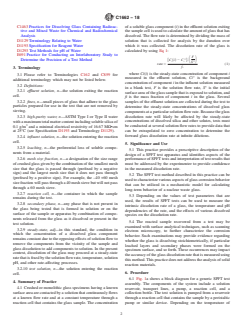
D1293Test Methods for pH of Water calculated by using Eq 1:
E691Practice for Conducting an Interlaboratory Study to
F
@C ~i! 2 C °#·
Determine the Precision of a Test Method S D
i i
S°
rate 5 (1)
f
i
3. Terminology
where Ci(i) is the steady-state concentration of component i
3.1 Please refer to Terminologies C162 and C859 for
measured in the effluent solution, Ci° is the background
additional terminology which may not be listed below.
concentration of component i in the influent solution measured
3.2 Definitions:
in a blank test, F is the solution flow rate, S° is the initial
3.2.1 effluent solution, n—the solution exiting the reaction
surfaceareaoftheglasssamplethatisexposedtosolution,and
cell.
fi is the mass fraction of component i in the glass. Several
3.2.2 fines, n—small pieces of glass that adhere to the glass
samples of the effluent solution are collected during the test to
particles prepared for use in the test that are not removed by
determine the steady-state concentrations of dissolved glass
sieving.
componentsataparticularsolutionflowrate.Becausetheglass
dissolution rate will likely be affected by the steady-state
3.2.3 high-purity water, n—ASTM Type I or Type II water
concentrations of dissolved silica and other solutes, tests must
withamaximumtotalmattercontentincludingsolublesilicaof
be conducted at several solution flow rates to provide data that
0.1 g/m and a minimal electrical resistivity of 16.67 MΩ•cm
can be extrapolated to zero concentration to determine the
at 25°C (see Specification D1193 and Terminology D1129).
forward glass dissolution rate at infinite dilutions.
3.2.4 influent solution, n—the solution entering the reaction
cell.
5. Significance and Use
3.2.5 leaching, n—the preferential loss of soluble compo-
5.1 This practice provides a prescriptive description of the
nents from a material.
design of a SPFT test apparatus and identifies aspects of the
3.2.6 mesh size fraction, n—a designation of the size range
performanceofSPFTtestsandinterpretationoftestresultsthat
ofcrushedglassgivenbythecombinationofthesmallestmesh
must be addressed by the experimenter to provide confidence
size that the glass is passed through (prefixed by a negative
in the measured dissolution rate.
sign) and the largest mesh size that it does not pass through
5.2 The SPFT test method described in this practice can be
(prefixed by a positive sign). For example, the –40 +60 mesh
usedtocharacterizevariousaspectsofglasscorrosionbehavior
sizefractionwillpassthrougha40meshsievebutwillnotpass
that can be utilized in a mechanistic model for calculating
through a 60 mesh sieve.
long-term behavior of a nuclear waste glass.
3.2.7 reaction cell, n—the container in which the sample
5.3 Depending on the values of test parameters that are
remains during the test.
used, the results of SPFT tests can be used to measure the
3.2.8 secondary phase, n—any phase that is not present in
intrinsic dissolution rate of a glass, the temperature and pH
the glass being tested that is formed in solution or on the
dependencies of the rate, and the effects of various dissolved
surface of the sample or apparatus by combination of compo-
species on the dissolution rate.
nents released from the glass as it dissolved or present in the
5.4 The reacted sample recovered from a test may be
test solution.
examined with surface analytical techniques, such as scanning
3.2.9 steady-state, adj—in this standard, the condition in
electron microscopy, to further characterize the corrosion
which the concentration of a dissolved glass component
behavior. Such examinations may provide evidence regarding
remainsconstantduetotheopposingeffectsofsolutionflowto
whether the glass is dissolving stoichiometrically, if particular
remove the components from the vicinity of the sample and
leached layers and secondary phases were formed on the
glass dissolution to add components to solution. In the present
specimen surface, and so forth.These occurrences may impact
context, dissolution of the glass may proceed at a steady-state
theaccuracyoftheglassdissolutionratethatismeasuredusing
ratethatisfixedbythesolutionflowrate,temperature,solution
thismethod.Thispracticedoesnotaddresstheanalysisofsolid
pH, and other rate-affecting processes.
reaction materials.
3.2.10 test solution, n—the solution entering the reaction
6. Procedure
cell.
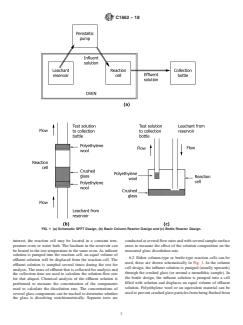
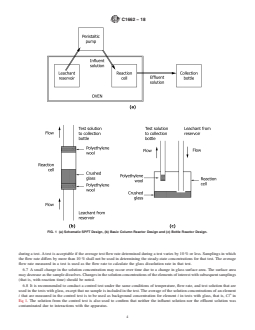
6.1 Fig. 1a shows a block diagram for a generic SPFT test
4. Summary of Practice
assembly. The components of the system include a solution
4.1 Crushed or monolithic glass specimens having a known reservoir, transport lines, a pump, a reaction cell, and a
surfaceareaarecontactedbyasolutionthatcontinuouslyflows collection bottle. The test solution is pumped from a reservoir
at a known flow rate and at a constant temperature through a through a reaction cell that contains the sample by a peristaltic
reaction cell that contains the glass sample. The concentration pump or similar device. Depending on the temperature of
C1662 − 18
FIG. 1 (a) Schematic SPFT Design, (b) Basic Column Reactor Design and (c) Bottle Reactor Design.
interest, the reaction cell may be located in a constant tem- conductedatseveralflowratesandwithseveralsamplesurface
perature oven or water bath. The leachant in the reservoir can
areas to measure the effect of the solution composition on the
be heated to the test temperature in the same oven.As influent
measured glass dissolution rate.
solution is pumped into the reaction cell, an equal volume of
6.2 Either column-type or bottle-type reaction cells can be
effluent solution will be displaced from the reaction cell. The
used; these are shown schematically in Fig. 1. In the column
effluent solution is sampled several times during the test for
cell design, the influent solution is pumped (usually upwards)
analysis. The mass of effluent that is collected for analysis and
through the crushed glass (or around a monolithic sample). In
the collection time are used to calculate the solution flow rate
the bottle design, the influent solution is pumped into a cell
for that aliquot. Chemical analysis of the effluent solution is
filled with solution and displaces an equal volume of effluent
performed to measure the concentration of the components
solution. Polyethylene wool or an equivalent material can be
used to calculate the dissolution rate. The concentrations of
usedtopreventcrushedglassparticlesfrombeingflushedfrom
several glass components can be tracked to determine whether
the glass is dissolving stoichiometrically. Separate tests are
C1662 − 18
the reaction cell during the test, or the effluent solution can be solution concentrations of the elements of interest with subse-
filtered after it is collected. quent samplings (that is, with reaction time) should be noted.
6.8 It is recommended to conduct a control test under the
6.3 Crushed glass can be used to provide high surface area
sameconditionsoftemperature,flowrate,andtestsolutionthat
samples. Crushed glass is to be prepared following the proce-
are used in the tests with glass, except that no sample is
dure for crushed sample preparation in Test Method C1285
included in the test.The average of the solution concentrations
(seeSection19inC1285;seealsoTestMethodsC92andC429
of an element i that are measured in the control test is to be
for sieving methods). The surface area of crushed and sieved
used as background concentration for element i in tests with
glass is estimated based on the size fraction that is used in the
o
glass, that is, Ci in Eq 1. The solution from the control test is
test.Theparticlesizeofcrushedsamplesmustbelargeenough
also used to confirm that neither the influent solution nor the
that the decrease in surface area during the test is less than 30
effluent solution was contaminated due to interactions with the
percent. The initial surface area can be calculated from the
apparatus.
specific surface area and using the arithmetic average of the
sizes of the sieve mesh and the density of the glass (see
6.9 The steady-state condition established in a flow-through
Appendix X1 in C1285). The final surface area can be
test depends on the dissolution rate of the glass and the flow
calculated based on the amount of glass that dissolved during
rate of test solution through the reaction cell. The glass
the test, if the particles can be modeled to have geometric
dissolution rate will depend on the concentrations of dissolved
shapes. The crushed glass used in a series of SPFT tests must
glass components in the solution contacting the glass and,
be from the same source to represent the homogeneity of the
therefore, on the rate at which these solutes are flushed from
glass on the scale of the test sample size. (A series of SPFT
the vicinity of the sample.
tests refers to tests conducted with the same glass and test
6.9.1 An upper threshold value of the flow-rate-to-surface-
solution but with different masses of glass or at different flow
area exists for which a glass will dissolve at a maximum rate
rates.) It is recommended that a small amount of the crushed
at a particular temperature and pH. Further increases in the
glassbeexaminedwithascanningelectronmicroscopepriorto
flow rate will not affect the glass dissolution rate, although the
testing to document the size of the particles and the absence of
steady-state concentrations will become lower, and possibly
fines.
below the limit of quantification, as the flow rate is increased.
The value of the threshold flow rate depends on the glass
6.4 Monolithicsamplescanbeusedtoprovidesampleswith
dissolution rate in the particular test conditions.
low surface areas. Samples can be prepared with any shape for
6.9.2 A lower threshold value of the flow-rate-to-surface-
which the geometric surface area can be measured directly.
area exists below which the glass dissolution rate will be
Monolithic samples are to be prepared following the sample
independent of the flow rate and will dissolve as if the system
preparation procedure in Test Method C1220 (see Section 8 in
was static. Further decreases in the flow rate will not affect the
C1220).Enoughmonolithicglasssamplesshallbepreparedfor
glass dissolution rate. The value of the threshold flow rate
use in a series of SPFT tests. The surface finishes of the
depends on the glass dissolution rate in the particular test
monoliths to be used in the series of tests shall be consistent
conditions.
and shall be reported with the test results. For example, if the
6.9.3 The glass dissolution rate is expected to vary with the
faces of the samples are polished with silica carbide paper, the
solution flow-rate-to-surface-area when the flow-rate-to-
grit and lubricating fluid shall be reported.
surface-area is between these extreme values.
6.5 Themassfractionsofelementalsiliconintheglassmust
6.10 Todeterminetheforwarddissolutionrate,testsmustbe
be known to determine the glass dissolution rate (see also
conducted at several flow-rate-to-surface-area to measure the
9.4.5). This may be determined by direct analysis of the glass
effect of the flow-rate-to-surface-area (which occurs through
(see Test Method C1463) or based on the as-batched compo-
the effect of the solution composition) on the glass dissolution
sition of the glass.
rate. A plot of the measured dissolution rates against the
6.6 The flow rate of the solution through the reaction cell is
steady-state concentrations of dissolved silica (which are
calculatedbydividingthemassoftestsolutioncollectedbythe
measured in tests conducted at different solution flow-rate-to-
duration over which it was collected.Although the flow rate is
surface-area) is used to extrapolate the glass dissolution rate to
setbeforethesampleisplacedinthereactioncell,theflowrate
an infinitely dilute solution (a dissolved silica concentration of
measured with the sample in place is used for the calculations.
zero) to determine the forward glass dissolution rate in the
The flow rate is likely to vary slightly with each aliquot that is
particular test conditions.
taken during a test.Atest is acceptable if the average test flow
6.10.1 Because the total amount of silica (or other selected
ratedeterminedduringatestvariesby10%orless.Samplings
component) in the effluent is used to represent the amount of
in which the flow rate differs by more than 10% shall not be
glass that has dissolved, the effluent solutions are not filtered
used in determining the steady-state concentrations for that
prior to analysis unless contaminants are observed in the
test.Theaverageflowratemeasuredinatestisusedastheflow
solution. This is because the silica present in any colloidal or
rate to calculate the glass dissolution rate in that test.
precipitated material that is removed by filtration represents
dissolved glass.
6.7 Asmall change in the solution concentration may occur
over time due to a change in glass surface area. The surface 6.10.2 If particulates of glass have been flushed out of the
area may decrease as the sample dissolves. Changes in the reaction cell and collected with the effluent solution, that
C1662 − 18
sample should be discarded and the test terminated. Previous 7.7.2 Aliquots of effluent solution that are taken for mea-
solutions are suspected of containing glass particles, even if surementofthepHshallbestoredinsealedcontainers,andthe
none were seen, and the test results should be discarded. The pH must be measured within 1 h after the aliquot is collected
test apparatus should be inspected and repaired to prevent the to minimize effects of dissolved carbon dioxide. The aliquot
loss of glass particles in subsequent tests. used to measure the pH may be sparged with an inert gas if the
influent solution was sparged.
6.11 If a leached layer is observed on the reacted glass, the
7.7.3 Aliquots of effluent solution taken to measure dis-
possible effect of that layer on the measured dissolution rate
solved glass components are used to determine the solution
should be investigated.
flow rate.
7. Requirements of the Apparatus
7.7.4 The use of some solution pumps may result in pulsed
7.1 The test solution should not interact with the apparatus. flow through the reaction cell and the solution concentrations
inthereactioncellmayvarybetweenpulses.Thealiquotoftest
Acontroltestmustbeconductedtodetectinteractionsbetween
the test solution and the apparatus and, if necessary, adjust test solution shall be collected for a duration long enough to
include several solution pulses to minimize the effects of
results to take the interactions into account.
pulsed flow on the measured solution concentrations.
7.2 Solutions may be purged with an inert gas (such as N )
tomitigateagainsttheeffectsofdissolvedgasesduringthetest 7.8 The system shall be airtight to prevent the formation of
(such as drift in pH due to the uptake of CO ). The solution air bubbles. Outgassing of the solution during the test can be
reservoir may be placed in an oven set at or near the test minimized by maintaining the solution reservoir at or near the
temperature so gases that exsolve and form the solution as it is test temperature, so that most exsolved gases collect in the
heated are retained within the solution reservoir. The reservoir reservoir rather than in the pump line or reaction cell. An air
can be placed in the same oven or water bath used for the trap may be incorporated into the influent line.
reaction cell.
7.9 The length of the transfer line exiting the reaction cell
7.3 The mechanism for transferring the solution from the
shallbeasshortaspossibletominimizethedelayincollecting
reservoir to the reaction cell (that is, the mechanical pump or
the solution after it exits the reaction cell.
other device) must be capable of maintaining an average flow
7.10 Polypropylene or quartz wool may be used to prevent
rate that is constant within 10% over the entire test duration.
crushed glass from being flushed out of the reaction cell; the
7.4 The temperature of the solution entering the reaction
same material must then also be used in the control test.
cell shall remain within 2ºC of the desired test temperature.
7.11 Monolithic samples shall be positioned or supported in
This can be accomplished by placing at least the final 0.5 m of
thereactioncellsothatatleast98%ofthesurfaceiscontacted
the inlet line inside the temperature control device (that is, the
by solution. This can be accomplished using a Teflon screen
oven or water bath) and by maintaining the temperature of the
support.
solution reservoir near the test temperature.
7.12 The tubing and reaction cell shall be cleaned between
7.5 The temperature of the reaction cell shall be monitored
tests. Cleaning may consist of passing either DIW or dilute
with a thermocouple or similar device and recorded at the
nitric acid through the tubing.
beginning and end of the test. It is recommended that the
temperature be recorded prior to each sampling of the test
8. Test Method
solution.
8.1 Pre-test system cleaning.The system is flushed with the
7.6 For bottle type reaction cells, influent solution injected
test solution prior to running a test with glass. Inspect tube
into the reaction cell must mix with the solution in the cell to
connections to detect leaks during the system flushes.
minimizeconcentrationgradients.Mixingthatresultsnaturally
8.1.1 Place inlet line in reservoir of test solution.
as solution enters the cell at high flow rates or convection at
8.1.2 Pump at least three system volumes of test solution
high test temperatures will likely be adequate under most test
through system with the system at the highest test temperature
conditions.
to be used. The system volume can be estimated from the
7.6.1 For tests at low flow rates and low temperatures, an
length of tubing and the volume of the reaction cell or
inert magnetic stirring bar can be used. However, it must be
measured based on the volume of water required to fill the
situated such that it does not contact the glass.
system initially.Test solution can be pumped at a different rate
7.7 Effluent solution shall be collected as soon as possible
during the flushing steps than the rate at which the test is to be
after it exits the reaction cell to minimize the time difference
run. Collect effluent in a waste container and discard.
between when the solution was in the cell and when it is
8.2 Pre-test flow rate determination.
collected. Separate aliquots shall be collected for measurement
of the solution pH and the dissolved glass components. 8.2.1 Determine the flow rate and sample surface area
required to attain the desired quotient F/Sº (see 9.1 for
7.7.1 Effluentsolutionexitingthesystemduringthefirstday
ofthetestorpriortothefirstsystemvolumeexchangeshallnot calculation of surface area for crushed glass).
8.2.2 Set pump to desired flow rate and pass test solution
be used to determine the glass dissolution rate.This is because
the composition of the effluent early in the test will likely be through system.
affected by the dissolution of fines and initial surface rough- 8.2.3 Collect effluent in a clean, empty, tared, and labeled
ness. solution bottle and determine the duration, in seconds or
C1662 − 18
minutes, that effluent was collected. Solution bottles are to be through a 0.45-µm pore size filter. This is expected to remove
cleaned by rinsing with a dilute nitric acid solution (approxi- glass particles that were flushed out of the reaction cell from
mately 0.1 M HNO ), then three rinses with demineralized thesolution.Theoriginoftheparticulatesshouldbeevaluated.
water and air dried prior to use. Whether the particles are test materials flushed from the
reaction cell or alteration phases that precipitated from the test
8.2.4 Determine the mass of effluent solution that was
collected. solution, determine if and how the measured glass dissolution
rate is expected to be affected.
8.2.5 Determine the volume of effluent collected by divid-
ing the mass of effluent solution by the density of the solution 8.3.12.1 If the particles are glass that has been flushed from
(for most test solutions, the density can be approximated as thereactioncell,thatsamplingisinvalidandthetestshouldbe
1000 kg/m ). discontinued. This is because the glass surface area remaining
in the reaction cell has decreased by an unknown amount, and
8.2.6 Calculate the flow rate (mL/d or m /s) by dividing the
volume of effluent that was collected by the duration it was may decrease further as additional glass is flushed out.
collected. 8.3.12.2 If the particles are secondary phase(s) that contain
the element being used to determine the dissolution rate (for
8.2.7 Adjust the pump rate and repeat 8.2.2 – 8.2.7 as
necessary to achieve desired flow rate. example,Si),thenthesecondaryphase(s)shouldberetainedin
subsequentsamplesandtheamountsequesteredincludedinthe
8.2.8 The final volume of effluent solution may be retained
for analysis and used to determine background concentrations mass released. The dissolved concentration now represents the
coupled effects of specimen dissolution and secondary phase
in lieu of a control test.
precipitation. Precipitation of secondary phases is only ex-
8.2.9 Record flow rate.
pected at near the low threshold value of F/S°.
8.3 Test with glass.
8.3.12.3 If the particles are contaminants (for example,
8.3.1 Place glass sample of known mass in reaction cell.
material from an in-line filter) that contribute to the concen-
8.3.2 Pump at least one system volume of test solution
tration of the element being used to determine the dissolution
through the system before collecting first aliquot of effluent
rate, than the solution should be filtered to remove the
solutionforanalysis.Thetimerequiredforthisiscalculatedby
contaminants prior to analysis.
dividing the system volume by the flow rate.
8.3.12.4 Routine filtration of the test solutions is not recom-
8.3.3 Collecteffluentforelementanalysisinataredsolution
mended due to the possible sorption of solutes to the filter
bottle labeled to identify test and aliquot number. This aliquot
material. If filtration is necessary for a particular effluent
isusedtodeterminetheflowrate.Amountofeffluentcollected
sample (for example, due to the presence of contaminants),
must be sufficient to meet analytical requirements. If solution
then the filter should be pre-conditioned by passing a small
bottles are to be reused, solution bottles are to be cleaned by
amount of the test solution through the filter to occupy any
rinsing with a dilute nitric acid solution (approximately 0.1 M
sorption sites. The filtrate solution resulting from the pre-
HNO ), then three rinses with demineralized water and air
conditioning step should be discarded. Then pass the effluent
dried prior to use.
solution to be analyzed through the pre-conditioned filter.
8.3.4 Collect a separate aliquot of effluent solution in a
8.3.13 Acidify the effluent that was collected for element
clean, labeled container for measurement of pH. The pH must
analysis by adding 3 to 5 drops of ultrapure concentrated nitric
be measured within1hofthe aliquot being collected (seeTest
acid.
Method D1293 regarding measurement of solution pH). Ali-
8.3.14 Determine and record new total mass of aliquot.
quots for additional analyses, for example, for analysis of
8.3.15 Record the temperature of the reaction cell.
anions, can be collected separately or taken from this aliquot.
8.3.16 Repeat 8.3.3 – 8.3.14 at a pre-determined time
8.3.5 Record the date and time that the aliquot colle
...
This document is not an ASTM standard and is intended only to provide the user of an ASTM standard an indication of what changes have been made to the previous version. Because
it may not be technically possible to adequately depict all changes accurately, ASTM recommends that users consult prior editions as appropriate. In all cases only the current version
of the standard as published by ASTM is to be considered the official document.
Designation: C1662 − 17 C1662 − 18
Standard Practice for
Measurement of the Glass Dissolution Rate Using the
Single-Pass Flow-Through Test Method
This standard is issued under the fixed designation C1662; the number immediately following the designation indicates the year of
original adoption or, in the case of revision, the year of last revision. A number in parentheses indicates the year of last reapproval. A
superscript epsilon (´) indicates an editorial change since the last revision or reapproval.
1. Scope
1.1 This practice describes a single-pass flow-through (SPFT) test method that can be used to measure the dissolution rate of
a homogeneous silicate glass, including nuclear waste glasses, in various test solutions at temperatures less than 100°C. Tests may
be conducted under conditions in which the effects from dissolved species on the dissolution rate are minimized to measure the
forward dissolution rate at specific values of temperature and pH, or to measure the dependence of the dissolution rate on the
concentrations of various solute species.
1.2 Tests are conducted by pumping solutions in either a continuous or pulsed flow mode through a reaction cell that contains
the test specimen. Tests must be conducted at several solution flow rates to evaluate the effect of the flow rate on the glass
dissolution rate.
1.3 This practice excludes static test methods in which flow is simulated by manually removing solution from the reaction cell
and replacing it with fresh solution.
1.4 Tests may be conducted with demineralized water, chemical solutions (such as pH buffer solutions, simulated groundwater
solutions, and brines), or actual groundwater.
1.5 Tests may be conducted with crushed glass of a known size fraction or monolithic specimens having known geometric
surface area. The reacted solids may be examined to provide additional information regarding the behavior of the material in the
test and the reaction mechanism.
1.6 Tests may be conducted with glasses containing radionuclides. However, this test method does not address safety issues for
radioactive samples.
1.7 Data from these tests can be used to determine the values of kinetic model parameters needed to calculate the glass corrosion
behavior in a disposal system over long periods (for example, see Practice C1174).
1.8 This practice must be performed in accordance with all quality assurance requirements for acceptance of the data.
1.9 The values stated in SI units are to be regarded as the standard. The values given in parentheses are for information only.
1.10 This standard does not purport to address all of the safety concerns, if any, associated with its use. It is the responsibility
of the user of this standard to establish appropriate safety, health, and environmental practices and determine the applicability of
regulatory limitations prior to use.
1.11 This international standard was developed in accordance with internationally recognized principles on standardization
established in the Decision on Principles for the Development of International Standards, Guides and Recommendations issued
by the World Trade Organization Technical Barriers to Trade (TBT) Committee.
2. Referenced Documents
2.1 ASTM Standards:
C92 Test Methods for Sieve Analysis and Water Content of Refractory Materials
C162 Terminology of Glass and Glass Products
C429 Test Method for Sieve Analysis of Raw Materials for Glass Manufacture
This practice is under the jurisdiction of ASTM Committee C26 on Nuclear Fuel Cycle and is the direct responsibility of Subcommittee C26.13 on Spent Fuel and High
Level Waste.
Current edition approved Nov. 15, 2017Sept. 1, 2018. Published December 2017October 2018. Originally approved in 2007. Last previous edition approved in 20102017
as C1662 – 10.C1662 – 17. DOI: 10.1520/C1662-17.10.1520/C1662-18.
For referenced ASTM standards, visit the ASTM website, www.astm.org, or contact ASTM Customer Service at service@astm.org. For Annual Book of ASTM Standards
volume information, refer to the standard’s Document Summary page on the ASTM website.
Copyright © ASTM International, 100 Barr Harbor Drive, PO Box C700, West Conshohocken, PA 19428-2959. United States
C1662 − 18
C693 Test Method for Density of Glass by Buoyancy
C859 Terminology Relating to Nuclear Materials
C1109 Practice for Analysis of Aqueous Leachates from Nuclear Waste Materials Using Inductively Coupled Plasma-Atomic
Emission Spectroscopy
C1174 Practice for Evaluation of the Long-Term Behavior of Materials Used in Engineered Barrier Systems (EBS) for
Geological Disposal of High-Level Radioactive Waste
C1220 Test Method for Static Leaching of Monolithic Waste Forms for Disposal of Radioactive Waste
C1285 Test Methods for Determining Chemical Durability of Nuclear, Hazardous, and Mixed Waste Glasses and Multiphase
Glass Ceramics: The Product Consistency Test (PCT)
C1463 Practices for Dissolving Glass Containing Radioactive and Mixed Waste for Chemical and Radiochemical Analysis
D1129 Terminology Relating to Water
D1193 Specification for Reagent Water
D1293 Test Methods for pH of Water
E691 Practice for Conducting an Interlaboratory Study to Determine the Precision of a Test Method
3. Terminology
3.1 Please refer to Terminologies C162 and C859 for additional terminology which may not be listed below.
3.2 Definitions:
3.2.1 effluent solution, n—the solution exiting the reaction cell.
3.2.2 fines, n—small pieces of glass that adhere to the glass particles prepared for use in the test that are not removed by sieving.
3.2.3 high-purity water, n—ASTM Type I or Type II water with a maximum total matter content including soluble silica of 0.1
g/m and a minimal electrical resistivity of 16.67 MΩ•cm at 25°C (see Specification D1193 and Terminology D1129).
3.2.4 influent solution, n—the solution entering the reaction cell.
3.2.5 leaching, n—the preferential loss of soluble components from a material.
3.2.6 mesh size fraction, n—a designation of the size range of crushed glass given by the combination of the smallest mesh size
that the glass is passed through (prefixed by a negative sign) and the largest mesh size that it does not pass through (prefixed by
a positive sign). For example, the –40 +60 mesh size fraction will pass through a 40 mesh sieve but will not pass through a 60
mesh sieve.
3.2.7 reaction cell, n—the container in which the sample remains during the test.
3.2.8 secondary phase, n—any phase that is not present in the glass being tested that is formed in solution or on the surface of
the sample or apparatus by combination of components released from the glass as it dissolved or present in the test solution.
3.2.9 steady-state, adj—in this standard, the condition in which the concentration of a dissolved glass component remains
constant due to the opposing effects of solution flow to remove the components from the vicinity of the sample and glass
dissolution to add components to solution. In the present context, dissolution of the glass may proceed at a steady-state rate that
is fixed by the solution flow rate, temperature, solution pH, and other rate-affecting processes.
3.2.10 test solution, n—the solution entering the reaction cell.
4. Summary of Practice
4.1 Crushed or monolithic glass specimens having a known surface area are contacted by a solution that continuously flows at
a known flow rate and at a constant temperature through a reaction cell that contains the glass sample. The concentration of a
soluble glass component (i) in the effluent solution exiting the sample cell is used to calculate the amount of glass that has
dissolved. The flow rate is determined by dividing the mass of solution that is collected for analysis by the duration over which
it was collected. The dissolution rate of the glass is calculated by using Eq 1Eq 1::
F
C i 2 C ° ·
@ ~ ! #S D
i i
S°
rate 5 (1)
f
i
where Ci(i) is the steady-state concentration of component i measured in the effluent solution, Ci° is the background
concentration of component i in the influent solution measured in a blank test, F is the solution flow rate, S° is the initial surface
area of the glass sample that is exposed to solution, and fi is the mass fraction of component i in the glass. Several samples of the
effluent solution are collected during the test to determine the steady-state concentrations of dissolved glass components at a
particular solution flow rate. Because the glass dissolution rate will likely be affected by the steady-state concentrations of
dissolved silica and other solutes, tests must be conducted at several solution flow rates to provide data that can be extrapolated
to zero concentration to determine the forward glass dissolution rate at infinite dilutions.
C1662 − 18
5. Significance and Use
5.1 This practice provides a prescriptive description of the design of a SPFT test apparatus and identifies aspects of the
performance of SPFT tests and interpretation of test results that must be addressed by the experimenter to provide confidence in
the measured dissolution rate.
5.2 The SPFT test method described in this practice can be used to characterize various aspects of glass corrosion behavior that
can be utilized in a mechanistic model for calculating long-term behavior of a nuclear waste glass.
5.3 Depending on the values of test parameters that are used, the results of SPFT tests can be used to measure the intrinsic
dissolution rate of a glass, the temperature and pH dependencies of the rate, and the effects of various dissolved species on the
dissolution rate.
5.4 The reacted sample recovered from a test may be examined with surface analytical techniques, such as scanning electron
microscopy, to further characterize the corrosion behavior. Such examinations may provide evidence regarding whether the glass
is dissolving stoichiometrically, if particular leached layers and secondary phases were formed on the specimen surface, and so
forth. These occurrences may impact the accuracy of the glass dissolution rate that is measured using this method. This practice
does not address the analysis of solid reaction materials.
6. Procedure
6.1 Fig. 1a shows a block diagram for a generic SPFT test assembly. The components of the system include a solution reservoir,
transport lines, a pump, a reaction cell, and a collection bottle. The test solution is pumped from a reservoir through a reaction cell
that contains the sample by a peristaltic pump or similar device. Depending on the temperature of interest, the reaction cell may
be located in a constant temperature oven or water bath. The leachant in the reservoir can be heated to the test temperature in the
same oven. As influent solution is pumped into the reaction cell, an equal volume of effluent solution will be displaced from the
reaction cell. The effluent solution is sampled several times during the test for analysis. The mass of effluent that is collected for
analysis and the collection time are used to calculate the solution flow rate for that aliquot. Chemical analysis of the effluent
solution is performed to measure the concentration of the components used to calculate the dissolution rate. The concentrations
of several glass components can be tracked to determine whether the glass is dissolving stoichiometrically. Separate tests are
conducted at several flow rates and with several sample surface areas to measure the effect of the solution composition on the
measured glass dissolution rate.
6.2 Either column-type or bottle-type reaction cells can be used; these are shown schematically in Fig. 1. In the column cell
design, the influent solution is pumped (usually upwards) through the crushed glass (or around a monolithic sample). In the bottle
design, the influent solution is pumped into a cell filled with solution and displaces an equal volume of effluent solution.
Polyethylene wool or an equivalent material can be used to prevent crushed glass particles from being flushed from the reaction
cell during the test, or the effluent solution can be filtered after it is collected.
6.3 Crushed glass can be used to provide high surface area samples. Crushed glass is to be prepared following the procedure
for crushed sample preparation in Test Method C1285 (see Section 19 in C1285; see also Test Methods C92 and C429 for sieving
methods). The surface area of crushed and sieved glass is estimated based on the size fraction that is used in the test. The particle
size of crushed samples must be large enough that the decrease in surface area during the test is less than 30 percent. The initial
surface area can be calculated from the specific surface area and using the arithmetic average of the sizes of the sieve mesh and
the density of the glass (see Appendix X1 in C1285). The final surface area can be calculated based on the amount of glass that
dissolved during the test, if the particles can be modeled to have geometric shapes. The crushed glass used in a series of SPFT
tests must be from the same source to represent the homogeneity of the glass on the scale of the test sample size. (A series of SPFT
tests refers to tests conducted with the same glass and test solution but with different masses of glass or at different flow rates.)
It is recommended that a small amount of the crushed glass be examined with a scanning electron microscope prior to testing to
document the size of the particles and the absence of fines.
6.4 Monolithic samples can be used to provide samples with low surface areas. Samples can be prepared with any shape for
which the geometric surface area can be measured directly. Monolithic samples are to be prepared following the sample preparation
procedure in Test Method C1220 (see Section 8 in C1220). Enough monolithic glass samples shall be prepared for use in a series
of SPFT tests. The surface finishes of the monoliths to be used in the series of tests shall be consistent and shall be reported with
the test results. For example, if the faces of the samples are polished with silica carbide paper, the grit and lubricating fluid shall
be reported.
6.5 The mass fractions of elemental silicon in the glass must be known to determine the glass dissolution rate (see also 9.4.5).
This may be determined by direct analysis of the glass (see Test Method C1463) or based on the as-batched composition of the
glass.
6.6 The flow rate of the solution through the reaction cell is calculated by dividing the mass of test solution collected by the
duration over which it was collected. Although the flow rate is set before the sample is placed in the reaction cell, the flow rate
measured with the sample in place is used for the calculations. The flow rate is likely to vary slightly with each aliquot that is taken
C1662 − 18
FIG. 1 (a) Schematic SPFT Design, (b) Basic Column Reactor Design and (c) Bottle Reactor Design.
during a test. A test is acceptable if the average test flow rate determined during a test varies by 10 % or less. Samplings in which
the flow rate differs by more than 10 % shall not be used in determining the steady-state concentrations for that test. The average
flow rate measured in a test is used as the flow rate to calculate the glass dissolution rate in that test.
6.7 A small change in the solution concentration may occur over time due to a change in glass surface area. The surface area
may decrease as the sample dissolves. Changes in the solution concentrations of the elements of interest with subsequent samplings
(that is, with reaction time) should be noted.
6.8 It is recommended to conduct a control test under the same conditions of temperature, flow rate, and test solution that are
used in the tests with glass, except that no sample is included in the test. The average of the solution concentrations of an element
o
i that are measured in the control test is to be used as background concentration for element i in tests with glass, that is, Ci in
Eq 1. The solution from the control test is also used to confirm that neither the influent solution nor the effluent solution was
contaminated due to interactions with the apparatus.
C1662 − 18
6.9 The steady-state condition established in a flow-through test depends on the dissolution rate of the glass and the flow rate
of test solution through the reaction cell. The glass dissolution rate will depend on the concentrations of dissolved glass
components in the solution contacting the glass and, therefore, on the rate at which these solutes are flushed from the vicinity of
the sample.
6.9.1 An upper threshold value of the flow-rate-to-surface-area exists for which a glass will dissolve at a maximum rate at a
particular temperature and pH. Further increases in the flow rate will not affect the glass dissolution rate, although the steady-state
concentrations will become lower, and possibly below the limit of quantification, as the flow rate is increased. The value of the
threshold flow rate depends on the glass dissolution rate in the particular test conditions.
6.9.2 A lower threshold value of the flow-rate-to-surface-area exists below which the glass dissolution rate will be independent
of the flow rate and will dissolve as if the system was static. Further decreases in the flow rate will not affect the glass dissolution
rate. The value of the threshold flow rate depends on the glass dissolution rate in the particular test conditions.
6.9.3 The glass dissolution rate is expected to vary with the solution flow-rate-to-surface-area when the flow-rate-to-surface-
area is between these extreme values.
6.10 To determine the forward dissolution rate, tests must be conducted at several flow-rate-to-surface-area to measure the effect
of the flow-rate-to-surface-area (which occurs through the effect of the solution composition) on the glass dissolution rate. A plot
of the measured dissolution rates against the steady-state concentrations of dissolved silica (which are measured in tests conducted
at different solution flow-rate-to-surface-area) is used to extrapolate the glass dissolution rate to an infinitely dilute solution (a
dissolved silica concentration of zero) to determine the forward glass dissolution rate in the particular test conditions.
6.10.1 Because the total amount of silica (or other selected component) in the effluent is used to represent the amount of glass
that has dissolved, the effluent solutions are not filtered prior to analysis unless contaminants are observed in the solution. This is
because the silica present in any colloidal or precipitated material that is removed by filtration represents dissolved glass.
6.10.2 If particulates of glass have been flushed out of the reaction cell and collected with the effluent solution, that sample
should be discarded and the test terminated. Previous solutions are suspected of containing glass particles, even if none were seen,
and the test results should be discarded. The test apparatus should be inspected and repaired to prevent the loss of glass particles
in subsequent tests.
6.11 If a leached layer is observed on the reacted glass, the possible effect of that layer on the measured dissolution rate should
be investigated.
7. Requirements of the Apparatus
7.1 The test solution should not interact with the apparatus. A control test must be conducted to detect interactions between the
test solution and the apparatus and, if necessary, adjust test results to take the interactions into account.
7.2 Solutions may be purged with an inert gas (such as N ) to mitigate against the effects of dissolved gases during the test (such
as drift in pH due to the uptake of CO ). The solution reservoir may be placed in an oven set at or near the test temperature so
gases that exsolve and form the solution as it is heated are retained within the solution reservoir. The reservoir can be placed in
the same oven or water bath used for the reaction cell.
7.3 The mechanism for transferring the solution from the reservoir to the reaction cell (that is, the mechanical pump or other
device) must be capable of maintaining an average flow rate that is constant within 10 % over the entire test duration.
7.4 The temperature of the solution entering the reaction cell shall remain within 2 ºC of the desired test temperature. This can
be accomplished by placing at least the final 0.5 m of the inlet line inside the temperature control device (that is, the oven or water
bath) and by maintaining the temperature of the solution reservoir near the test temperature.
7.5 The temperature of the reaction cell shall be monitored with a thermocouple or similar device and recorded at the beginning
and end of the test. It is recommended that the temperature be recorded prior to each sampling of the test solution.
7.6 For bottle type reaction cells, influent solution injected into the reaction cell must mix with the solution in the cell to
minimize concentration gradients. Mixing that results naturally as solution enters the cell at high flow rates or convection at high
test temperatures will likely be adequate under most test conditions.
7.6.1 For tests at low flow rates and low temperatures, an inert magnetic stirring bar can be used. However, it must be situated
such that it does not contact the glass.
7.7 Effluent solution shall be collected as soon as possible after it exits the reaction cell to minimize the time difference between
when the solution was in the cell and when it is collected. Separate aliquots shall be collected for measurement of the solution pH
and the dissolved glass components.
7.7.1 Effluent solution exiting the system during the first day of the test or prior to the first system volume exchange shall not
be used to determine the glass dissolution rate. This is because the composition of the effluent early in the test will likely be affected
by the dissolution of fines and initial surface roughness.
7.7.2 Aliquots of effluent solution that are taken for measurement of the pH shall be stored in sealed containers, and the pH must
be measured within 1 h after the aliquot is collected to minimize effects of dissolved carbon dioxide. The aliquot used to measure
the pH may be sparged with an inert gas if the influent solution was sparged.
C1662 − 18
7.7.3 Aliquots of effluent solution taken to measure dissolved glass components are used to determine the solution flow rate.
7.7.4 The use of some solution pumps may result in pulsed flow through the reaction cell and the solution concentrations in the
reaction cell may vary between pulses. The aliquot of test solution shall be collected for a duration long enough to include several
solution pulses to minimize the effects of pulsed flow on the measured solution concentrations.
7.8 The system shall be airtight to prevent the formation of air bubbles. Outgassing of the solution during the test can be
minimized by maintaining the solution reservoir at or near the test temperature, so that most exsolved gases collect in the reservoir
rather than in the pump line or reaction cell. An air trap may be incorporated into the influent line.
7.9 The length of the transfer line exiting the reaction cell shall be as short as possible to minimize the delay in collecting the
solution after it exits the reaction cell.
7.10 Polypropylene or quartz wool may be used to prevent crushed glass from being flushed out of the reaction cell; the same
material must then also be used in the control test.
7.11 Monolithic samples shall be positioned or supported in the reaction cell so that at least 98 % of the surface is contacted
by solution. This can be accomplished using a Teflon screen support.
7.12 The tubing and reaction cell shall be cleaned between tests. Cleaning may consist of passing either DIW or dilute nitric
acid through the tubing.
8. Test Method
8.1 Pre-test system cleaning. The system is flushed with the test solution prior to running a test with glass. Inspect tube
connections to detect leaks during the system flushes.
8.1.1 Place inlet line in reservoir of test solution.
8.1.2 Pump at least three system volumes of test solution through system with the system at the highest test temperature to be
used. The system volume can be estimated from the length of tubing and the volume of the reaction cell or measured based on
the volume of water required to fill the system initially. Test solution can be pumped at a different rate during the flushing steps
than the rate at which the test is to be run. Collect effluent in a waste container and discard.
8.2 Pre-test flow rate determination.
8.2.1 Determine the flow rate and sample surface area required to attain the desired quotient F/Sº (see 9.1 for calculation of
surface area for crushed glass).
8.2.2 Set pump to desired flow rate and pass test solution through system.
8.2.3 Collect effluent in a clean, empty, tared, and labeled solution bottle and determine the duration, in seconds or minutes, that
effluent was collected. Solution bottles are to be cleaned by rinsing with a dilute nitric acid solution (approximately 0.1 M HNO ),
then three rinses with demineralized water and air dried prior to use.
8.2.4 Determine the mass of effluent solution that was collected.
8.2.5 Determine the volume of effluent collected by dividing the mass of effluent solution by the density of the solution (for most
test solutions, the density can be approximated as 1000 kg/m ).
8.2.6 Calculate the flow rate (mL/d or m /s) by dividing the volume of effluent that was collected by the duration it was
collected.
8.2.7 Adjust the pump rate and repeat 8.2.2 – 8.2.7 as necessary to achieve desired flow rate.
8.2.8 The final volume of effluent solution may be retained for analysis and used to determine background concentrations in lieu
of a control test.
8.2.9 Record flow rate.
8.3 Test with glass.
8.3.1 Place glass sample of known mass in reaction cell.
8.3.2 Pump at least one system volume of test solution through the system before collecting first aliquot of effluent solution for
analysis. The time required for this is calculated by dividing the system volume by the flow rate.
8.3.3 Collect effluent for element analysis in a tared solution bottle labeled to identify test and aliquot number. This aliquot is
used to determine the flow rate. Amount of effluent collected must be sufficient to meet analytical requirements. If solution bottles
are to be reused, solution bottles are to be cleaned by rinsing with a dilute nitric acid solution (approximately 0.1 M HNO ), then
three rinses with demineralized water and air dried prior to use.
8.3.4 Collect a separate aliquot of effluent solution in a clean, labeled container for measurement of pH. The pH must be
measured within 1 h of the aliquot being collected (see Test Method D1293 regarding measurement of solution pH). Aliquots for
additional analyses, for example, for analysis of anions, can be collected separately or taken from this aliquot.
8.3.5 Record the date and time that the aliquot collection was started.
8.3.6 Determine and record the duration, in minutes, that the effluent sample for element analysis was collected.
8.3.7 Determine and record the mass of effluent solution that was collected for element analysis and the bottle tare mass.
8.3.8 Calculate and record the mass of effluent by subtracting the bottle tare from the total mass.
C1662 − 18
8.3.9 Calculate and record the volume of effluent for element analysis collected by dividing the mass of effluent solution by the
density of the solution.
8.3.10 Calculate and record the flow rate (mL/d or m /s) by dividing the volume of the effluent that was collected by the duration
of its collection.
8.3.11 If the calculated flow rate deviates by more than 10 % from the target flow rate, adjust the pump speed and record new
pump setting.
8.3.12 If particulate material is observed in the effluent solution, the solution collected for analysis must be passed through a
0.45-μm pore size filter. This is expected to remove glass particles that were flushed out of the reaction cell from the solution. The
origin of the particulates should be evaluated. Whether the particles are test materials flushed from the reaction cell or alteration
phases that precipitated from the test solution, determine if and how the measured glass dissolution rate is expected to be affected.
8.3.12.1 If the particles are glass that has been flushed from the reaction cell, that sampling is invalid and the test should be
discontinued. This is because the glass surface area remaining in the reaction cell has decreased by an unknown amount, and may
decrease further as additional glass is flushed out.
8.3.12.2 If the particles are secondary phase(s) that contain the element being used to determine the dissolution rate (for
example, Si), then the secondary phase(s) should be retained in subsequent samples and the amount sequestered included in the
mass released. The dissolved concentration now represents the coupled effects of specimen dissolution and secondary phase
precipitation. Precipitation of secondary phases is only expected at near the low threshold value of F/S°.
8.3.12.3 If the particles are contaminants (for example, material from an in-line filter) that contribute to the concentration of the
element being used to determine the dissolution rate, than the solution
...