

ASTM E967-18
(Test Method)Standard Test Method for Temperature Calibration of Differential Scanning Calorimeters and Differential Thermal Analyzers
General Information
- Abstract
SIGNIFICANCE AND USE
5.1 Differential scanning calorimeters and differential thermal analyzers are used to determine the transition temperatures of materials. For this information to be meaningful in an absolute sense, temperature calibration of the apparatus and comparison of the resulting data to that of known standard materials is required.
5.2 This test method is useful in calibrating the temperature axis of differential scanning calorimeters and differential thermal analyzers.
SCOPE
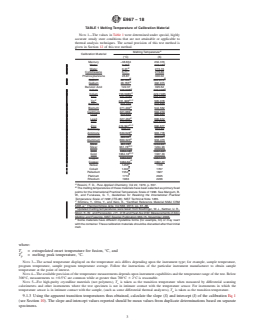
1.1 This test method describes the temperature calibration of differential thermal analyzers and differential scanning calorimeters over the temperature range from −40°C to +2000°C.
1.2 The values stated in SI units are to be regarded as standard. No other units of measurement are included in this standard.
1.3 This test method is similar to ISO standard 11357–1.
1.4 This standard does not purport to address all of the safety concerns, if any, associated with its use. It is the responsibility of the user of this standard to establish appropriate safety, health, and environmental practices and determine the applicability of regulatory limitations prior to use. Specific precautionary statements are given in Section 7.
1.5 This international standard was developed in accordance with internationally recognized principles on standardization established in the Decision on Principles for the Development of International Standards, Guides and Recommendations issued by the World Trade Organization Technical Barriers to Trade (TBT) Committee.
- Status
- Published
- Publication Date
- 14-Mar-2018
- Technical Committee
- E37 - Thermal Measurements
- Drafting Committee
- E37.01 - Calorimetry and Mass Loss
Buy Documents
ASTM E967-18 - Standard Test Method for Temperature Calibration of Differential Scanning Calorimeters and Differential Thermal Analyzers
REDLINE ASTM E967-18 - Standard Test Method for Temperature Calibration of Differential Scanning Calorimeters and Differential Thermal Analyzers
Overview
ASTM E967-18: Standard Test Method for Temperature Calibration of Differential Scanning Calorimeters and Differential Thermal Analyzers defines reliable procedures for calibrating the temperature axis of differential scanning calorimeters (DSC) and differential thermal analyzers (DTA). Accurate temperature calibration is critical for the determination of material transition temperatures, such as melting points and thermal transitions, making measurement results meaningful and comparable across laboratories and equipment. This standard supports calibration over a wide temperature range, from −40°C to +2000°C, using SI units exclusively.
Temperature calibration following this method ensures results traceable to internationally recognized fixed points and improves the accuracy and reproducibility of thermal analysis data.
Key Topics
Calibration Procedure
The standard outlines both two-point and one-point calibration methods, using high-purity materials with known melting points. Two-point calibration enhances accuracy by correcting for both offset (intercept) and scale (slope) factors in the instrument's temperature indication.Reference Materials
Temperature calibration is based on the use of reference materials with precisely known melting temperatures, such as mercury, water, indium, zinc, and lead. The selection of calibration points should bracket the temperature range of interest.Instrument Requirements
Specific requirements for DSC and DTA instruments are detailed, including controlled heating/cooling rates, suitable sample environments (such as nitrogen purge), and precise temperature measurement and recording.Reporting
The procedure mandates detailed documentation, including identification and purity of reference materials, equipment details, sample information, atmosphere conditions, and calculated calibration parameters.Precision and Repeatability
The standard defines criteria for repeatability and reproducibility, based on interlaboratory studies, and addresses the expected measurement bias when using the standardized method.
Applications
Material Characterization
Research and industrial laboratories analyzing transition temperatures in polymers, metals, pharmaceuticals, and ceramics use calibrated DSC and DTA instruments to ensure valid results.Quality Control
Manufacturers rely on accurate thermal analysis to verify the identity and purity of materials and to comply with regulatory or industry specifications.Calibration Services
Instrument service providers and calibration laboratories use this standard to certify compliance and performance of thermal analysis instruments.R&D and Academic Research
Academic and industrial research teams employ ASTM E967-18 to support the development and comparison of new materials by ensuring consistency in thermal property data.
Related Standards
ASTM E473 - Terminology Relating to Thermal Analysis and Rheology
Provides definitions for terms used throughout ASTM E967-18.ASTM E1142 - Terminology Relating to Thermophysical Properties
Supports understanding of thermal property measurement terms.ISO 11357-1 - Plastics-Differential Scanning Calorimetry (DSC)-General Principles
Similar in scope, this ISO standard is referenced for alignment with international practices in plastics analysis.
Practical Value
Using ASTM E967-18 for temperature calibration of DSC and DTA instruments ensures confidence in thermal analysis results, enabling accurate determination of melting points, crystallization, and other phase transitions. By adhering to consistent calibration procedures and documented fixed points, laboratories can achieve greater data reliability, support regulatory compliance, and maintain competitiveness in quality assurance for materials characterization across global markets.
Keywords: temperature calibration, differential scanning calorimetry, DSC, differential thermal analysis, DTA, melting temperature, ASTM E967-18, thermal analysis standards, material transitions, instrument calibration.
Relations
- Effective Date
- 01-Oct-2023
- Effective Date
- 01-Oct-2023
- Effective Date
- 01-May-2015
- Effective Date
- 15-Aug-2014
- Effective Date
- 15-Aug-2014
- Effective Date
- 01-Apr-2014
- Effective Date
- 15-Feb-2014
- Effective Date
- 01-Sep-2012
- Effective Date
- 01-Aug-2011
- Effective Date
- 15-Jun-2011
- Effective Date
- 15-Jun-2011
- Effective Date
- 01-Apr-2011
- Effective Date
- 01-Apr-2011
- Effective Date
- 01-Mar-2010
- Effective Date
- 01-Aug-2009
Buy Documents
ASTM E967-18 - Standard Test Method for Temperature Calibration of Differential Scanning Calorimeters and Differential Thermal Analyzers
REDLINE ASTM E967-18 - Standard Test Method for Temperature Calibration of Differential Scanning Calorimeters and Differential Thermal Analyzers
Get Certified
Connect with accredited certification bodies for this standard

BSMI (Bureau of Standards, Metrology and Inspection)
Taiwan's standards and inspection authority.
Sponsored listings
Frequently Asked Questions
ASTM E967-18 is a standard published by ASTM International. Its full title is "Standard Test Method for Temperature Calibration of Differential Scanning Calorimeters and Differential Thermal Analyzers". This standard covers: SIGNIFICANCE AND USE 5.1 Differential scanning calorimeters and differential thermal analyzers are used to determine the transition temperatures of materials. For this information to be meaningful in an absolute sense, temperature calibration of the apparatus and comparison of the resulting data to that of known standard materials is required. 5.2 This test method is useful in calibrating the temperature axis of differential scanning calorimeters and differential thermal analyzers. SCOPE 1.1 This test method describes the temperature calibration of differential thermal analyzers and differential scanning calorimeters over the temperature range from −40°C to +2000°C. 1.2 The values stated in SI units are to be regarded as standard. No other units of measurement are included in this standard. 1.3 This test method is similar to ISO standard 11357–1. 1.4 This standard does not purport to address all of the safety concerns, if any, associated with its use. It is the responsibility of the user of this standard to establish appropriate safety, health, and environmental practices and determine the applicability of regulatory limitations prior to use. Specific precautionary statements are given in Section 7. 1.5 This international standard was developed in accordance with internationally recognized principles on standardization established in the Decision on Principles for the Development of International Standards, Guides and Recommendations issued by the World Trade Organization Technical Barriers to Trade (TBT) Committee.
SIGNIFICANCE AND USE 5.1 Differential scanning calorimeters and differential thermal analyzers are used to determine the transition temperatures of materials. For this information to be meaningful in an absolute sense, temperature calibration of the apparatus and comparison of the resulting data to that of known standard materials is required. 5.2 This test method is useful in calibrating the temperature axis of differential scanning calorimeters and differential thermal analyzers. SCOPE 1.1 This test method describes the temperature calibration of differential thermal analyzers and differential scanning calorimeters over the temperature range from −40°C to +2000°C. 1.2 The values stated in SI units are to be regarded as standard. No other units of measurement are included in this standard. 1.3 This test method is similar to ISO standard 11357–1. 1.4 This standard does not purport to address all of the safety concerns, if any, associated with its use. It is the responsibility of the user of this standard to establish appropriate safety, health, and environmental practices and determine the applicability of regulatory limitations prior to use. Specific precautionary statements are given in Section 7. 1.5 This international standard was developed in accordance with internationally recognized principles on standardization established in the Decision on Principles for the Development of International Standards, Guides and Recommendations issued by the World Trade Organization Technical Barriers to Trade (TBT) Committee.
ASTM E967-18 is classified under the following ICS (International Classification for Standards) categories: 17.200.10 - Heat. Calorimetry. The ICS classification helps identify the subject area and facilitates finding related standards.
ASTM E967-18 has the following relationships with other standards: It is inter standard links to ASTM E1142-23b, ASTM E473-23b, ASTM E1142-15, ASTM E473-14, ASTM E1142-14b, ASTM E1142-14a, ASTM E1142-14, ASTM E1142-12, ASTM E1142-11b, ASTM E473-11a, ASTM E1142-11a, ASTM E473-11, ASTM E1142-11, ASTM E473-10, ASTM E473-09. Understanding these relationships helps ensure you are using the most current and applicable version of the standard.
ASTM E967-18 is available in PDF format for immediate download after purchase. The document can be added to your cart and obtained through the secure checkout process. Digital delivery ensures instant access to the complete standard document.
Standards Content (Sample)
This international standard was developed in accordance with internationally recognized principles on standardization established in the Decision on Principles for the
Development of International Standards, Guides and Recommendations issued by the World Trade Organization Technical Barriers to Trade (TBT) Committee.
Designation: E967 − 18
Standard Test Method for
Temperature Calibration of Differential Scanning
Calorimeters and Differential Thermal Analyzers
This standard is issued under the fixed designation E967; the number immediately following the designation indicates the year of
original adoption or, in the case of revision, the year of last revision.Anumber in parentheses indicates the year of last reapproval.A
superscript epsilon (´) indicates an editorial change since the last revision or reapproval.
1. Scope 3. Terminology
1.1 This test method describes the temperature calibration 3.1 Definitions—Specific technical terms used in this test
of differential thermal analyzers and differential scanning method are defined in Terminologies E473 and E1142.
calorimeters over the temperature range from −40°C
4. Summary of Test Method
to+2000°C.
4.1 This test method consists of heating the calibration
1.2 The values stated in SI units are to be regarded as
materials at a controlled rate in a controlled atmosphere
standard. No other units of measurement are included in this
through a region of known thermal transition. The heat flow
standard.
into the calibration material or the difference of temperature
1.3 This test method is similar to ISO standard 11357–1.
between the calibration material and a reference sample is
1.4 This standard does not purport to address all of the
monitored and continuously recorded. A transition is marked
safety concerns, if any, associated with its use. It is the
by the absorption of energy by the specimen resulting in a
responsibility of the user of this standard to establish appro-
corresponding endothermic peak in the heating curve.
priate safety, health, and environmental practices and deter-
NOTE 1—Heat flow calibrations are sometimes determined in conjunc-
mine the applicability of regulatory limitations prior to use.
tion with temperature calibration. Some differential scanning calorimeters
Specific precautionary statements are given in Section 7.
permitbothheatflowandtemperaturecalibrationstobeobtainedfromthe
1.5 This international standard was developed in accor-
same experimental procedure.
dance with internationally recognized principles on standard-
5. Significance and Use
ization established in the Decision on Principles for the
Development of International Standards, Guides and Recom-
5.1 Differential scanning calorimeters and differential ther-
mendations issued by the World Trade Organization Technical
malanalyzersareusedtodeterminethetransitiontemperatures
Barriers to Trade (TBT) Committee.
of materials. For this information to be meaningful in an
absolute sense, temperature calibration of the apparatus and
2. Referenced Documents
comparison of the resulting data to that of known standard
materials is required.
2.1 ASTM Standards:
E473Terminology Relating to Thermal Analysis and Rhe-
5.2 This test method is useful in calibrating the temperature
ology
axis of differential scanning calorimeters and differential ther-
E1142Terminology Relating to Thermophysical Properties
mal analyzers.
2.2 ISO Standards:
6. Apparatus
11357–1Plastics-Differential Scanning Calorimetry (DSC)-
Part 1: General Principles
6.1 Apparatus shall be of either type listed below:
6.1.1 Differential Scanning Calorimeter (DSC), capable of
heatingatestspecimenandareferencematerialatacontrolled
ThistestmethodisunderthejurisdictionofASTMCommitteeE37onThermal
rate and of automatically recording the differential heat flow
Measurements and is the direct responsibility of Subcommittee E37.01 on Calo-
rimetry and Mass Loss.
between the sample and the reference material to the required
Current edition approved March 15, 2018. Published March 2018. Originally
sensitivity and precision.
approved in 1983. Last previous edition approved in 2014 as E967–08 (2014).
6.1.1.1 A Furnace(s), to provide uniform controlled heating
DOI: 10.1520/E0967-18.
or cooling of a specimen and reference to a constant tempera-
For referenced ASTM standards, visit the ASTM website, www.astm.org, or
contact ASTM Customer Service at service@astm.org. For Annual Book of ASTM
ture or at a constant rate within the applicable temperature
Standards volume information, refer to the standard’s Document Summary page on
range of this test method.
the ASTM website.
6.1.1.2 A Temperature Sensor, to provide an indication of
Available from International Organization for Standardization (ISO), 1, ch. de
la Voie-Creuse, CP 56, CH-1211 Geneva 20, Switzerland, http://www.iso.org. the specimen temperature.
Copyright © ASTM International, 100 Barr Harbor Drive, PO Box C700, West Conshohocken, PA 19428-2959. United States
E967 − 18
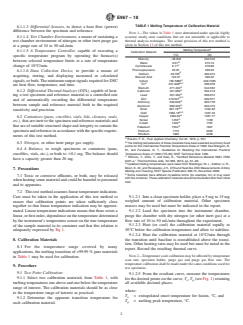
TABLE 1 Melting Temperature of Calibration Material
6.1.1.3 Differential Sensors, to detect a heat flow (power)
difference between the specimen and reference.
NOTE 1—The values in Table 1 were determined under special, highly
6.1.1.4 Test Chamber Environment, a means of sustaining a accurate steady state conditions that are not attainable or applicable to
thermal analysis techniques. The actual precision of this test method is
test chamber environment of nitrogen or other inert purge gas
given in Section 12 of this test method.
at a purge rate of 10 to 50 mL/min.
A
Melting Temperature
6.1.1.5 A Temperature Controller, capable of executing a
Calibration Material
(°C) (K)
specific temperature program by operating the furnace(s)
Mercury −38.834 234.316
between selected temperature limits at a rate of temperature
B
Water 0.01 273.16
C
change of 10°C/min.
Cyclohexane 6.71 279.86
Phenoxybenzene 26.87 300.02
6.1.1.6 Data Collection Device, to provide a means of
B
Gallium 29.765 302.915
acquiring, storing, and displaying measured or calculated
Benzoic Acid 122.37 395.52
D
signals,orboth.TheminimumoutputsignalsrequiredforDSC Indium 156.5985 429.7485
E B,D
Tin 231.928 505.078
are heat flow, temperature, and time.
D
Bismuth 271.402 544.552
D
6.1.2 Differential Thermal Analyzer (DTA), capable of heat-
Cadmium 321.069 594.219
D
Lead 327.462 600.612
ing a test specimen and reference material at a controlled rate
B,D
Zinc 419.527 692.677
and of automatically recording the differential temperature
D
Antimony 630.628 903.778
D
between sample and reference material both to the required
Aluminum 660.323 933.473
B,D
Silver 961.78 1234.93
sensitivity and precision.
B,D
Gold 1064.18 1337.33
B
6.2 Containers (pans, crucibles, vials, lids, closures, seals, Copper 1084.62 1357.77
D
Nickel 1455 1728
etc.),thatareinerttothespecimenandreferencematerialsand
D
Cobalt 1494 1767
that are of suitable structural shape and integrity to contain the D
Palladium 1554 1827
Platinum 1772 2045
specimenandreferenceinaccordancewiththespecificrequire-
Rhodium 1963 2236
ments of this test method.
A
Rossini, F. D., Pure Applied Chemistry, Vol 22, 1970, p. 557.
B
6.3 Nitrogen, or other inert purge gas supply.
The melting temperatures of these materials have been selected as primary fixed
points for the International Practical Temperature Scale of 1990. See Mangum, B.
6.4 A Balance, to weigh specimens or containers (pans,
W., and Furukawa, G. T., Guidelines for Realizing the International Practical
Temperature Scale of 1990 (ITS-90), NIST Technical Note 1265.
crucibles, vials, etc.), or both to 60.1 mg. The balance should
C
Shimizu, Y., Ohte, Y., and Kato, K., “Certified Reference Material NMIJ CRM
have a capacity greater than 20 mg.
5401-a,” Thermochimica Acta, Vol 568, 2013, pp. 61–66.
D
Updated melting temperatures were taken from Boettinger, W. J., Kattner, U. R.,
Moon, K.-W., and Perepezko, J.H.,DTAandHeat-fluxDSCMeasurementsofAlloy
7. Precautions
Melting and Freezing, NIST Special Publication 960-15, November 2006.
E
Some materials have different crystalline forms (for example, tin) or may react
7.1 Toxic or corrosive effluents, or both, may be released
with the container. These calibration materials should be discarded after their initial
whenheatingsomematerialandcouldbeharmfultopersonnel
melt.
and to apparatus.
7.2 Thistestmethodassumeslineartemperatureindication.
Care must be taken in the application of this test method to 9.1.2.1 Into a clean specimen holder, placea5mgto15mg
weighed amount of calibration material. Other specimen
ensure that calibration points are taken sufficiently close
together so that linear temperature indication may be approxi- masses may be used but must be indicated in the report.
9.1.2.2 Load the specimen into the instrument chamber,
mated.Lineartemperatureindicationsmeansthatthereexistsa
linear,orfirstorder,dependenceonthetemperaturedetermined purge the chamber with dry nitrogen (or other inert gas) at a
flow rate of 10 to 50 mL/min throughout the experiment.
bytheinstrument’stemperaturesensoronthetruetemperature
of the sample material in its container and that this relation is 9.1.2.3 Heat (or cool) the calibration material rapidly to
30°C below the calibration temperature and allow to stabilize.
adequately expressed by Eq 1.
9.1.2.4 Heat the calibration material at 10°C/min through
the transition until baseline is reestablished above the transi-
8. Calibration Materials
tion. Other heating rates may be used but must be noted in the
8.1 For the temperature range covered by many
report. Record the resulting thermal curve.
applications, the melting transition of >99.99 % pure materials
NOTE2—Temperaturescalecalibrationmaybeaffectedbytemperature
in Table 1 may be used for calibration.
scan rate, specimen holder, purge gas and purge gas flow rate. The
temperature calibration shall be made under the same conditions used for
9. Procedure
test specimens.
9.1 Two Point Calibration:
9.1.2.5 From the resultant curve, measure the temperatures
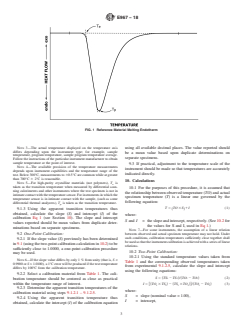
9.1.1 Select two calibration materials from Table 1, with forthedesiredpointsonthecurve, T , T (seeFig.1)retaining
e p
meltingtemperaturesoneaboveandonebelowth
...
This document is not an ASTM standard and is intended only to provide the user of an ASTM standard an indication of what changes have been made to the previous version. Because
it may not be technically possible to adequately depict all changes accurately, ASTM recommends that users consult prior editions as appropriate. In all cases only the current version
of the standard as published by ASTM is to be considered the official document.
Designation: E967 − 08 (Reapproved 2014) E967 − 18
Standard Test Method for
Temperature Calibration of Differential Scanning
Calorimeters and Differential Thermal Analyzers
This standard is issued under the fixed designation E967; the number immediately following the designation indicates the year of
original adoption or, in the case of revision, the year of last revision. A number in parentheses indicates the year of last reapproval. A
superscript epsilon (´) indicates an editorial change since the last revision or reapproval.
1. Scope
1.1 This test method describes the temperature calibration of differential thermal analyzers and differential scanning
calorimeters over the temperature range from −40 to +2500°C.from −40°C to +2000°C.
1.2 The values stated in SI units are to be regarded as standard. No other units of measurement are included in this standard.
1.3 This test method is similar to ISO standard 11357–1.
1.4 This standard does not purport to address all of the safety concerns, if any, associated with its use. It is the responsibility
of the user of this standard to establish appropriate safety safety, health, and healthenvironmental practices and determine the
applicability of regulatory limitations prior to use. Specific precautionary statements are given in Section 7.
1.5 This international standard was developed in accordance with internationally recognized principles on standardization
established in the Decision on Principles for the Development of International Standards, Guides and Recommendations issued
by the World Trade Organization Technical Barriers to Trade (TBT) Committee.
2. Referenced Documents
2.1 ASTM Standards:
E473 Terminology Relating to Thermal Analysis and Rheology
E1142 Terminology Relating to Thermophysical Properties
2.2 ISO Standards:
11357–1 Plastics-Differential Scanning Calorimetry (DSC)-Part 1: General Principles
3. Terminology
3.1 Definitions—Specific technical terms used in this test method are defined in Terminologies E473 and E1142.
4. Summary of Test Method
4.1 This test method consists of heating the calibration materials at a controlled rate in a controlled atmosphere through a region
of known thermal transition. The heat flow into the calibration material or the difference of temperature between the calibration
material and a reference sample and a reference material is monitored and continuously recorded. A transition is marked by the
absorption of energy by the specimen resulting in a corresponding endothermic peak in the heating curve.
NOTE 1—Heat flow calibrations are sometimes determined in conjunction with temperature calibration. Some differential scanning calorimeters permit
both heat flow and temperature calibrations to be obtained from the same experimental procedure.
5. Significance and Use
5.1 Differential scanning calorimeters and differential thermal analyzers are used to determine the transition temperatures of
materials. For this information to be meaningful in an absolute sense, temperature calibration of the apparatus orand comparison
of the resulting data to that of known standard materials is required.
This test method is under the jurisdiction of ASTM Committee E37 on Thermal Measurements and is the direct responsibility of Subcommittee E37.01 on Calorimetry
and Mass Loss.
Current edition approved March 15, 2014March 15, 2018. Published April 2014March 2018. Originally approved in 1983. Last previous edition approved in 20082014
as E967 – 08.E967 – 08 (2014). DOI: 10.1520/E0967-08R14.10.1520/E0967-18.
For referenced ASTM standards, visit the ASTM website, www.astm.org, or contact ASTM Customer Service at service@astm.org. For Annual Book of ASTM Standards
volume information, refer to the standard’s Document Summary page on the ASTM website.
Available from International Organization for Standardization (ISO), 1, ch. de la Voie-Creuse, CP 56, CH-1211 Geneva 20, Switzerland, http://www.iso.org.
Copyright © ASTM International, 100 Barr Harbor Drive, PO Box C700, West Conshohocken, PA 19428-2959. United States
E967 − 18
5.2 This test method is useful in calibrating the temperature axis of differential scanning calorimeters and differential thermal
analyzers.
6. Apparatus
6.1 Apparatus shall be of either type listed below:
6.1.1 Differential Scanning Calorimeter (DSC), capable of heating a test specimen and a reference material at a controlled rate
and of automatically recording the differential heat flow between the sample and the reference material to the required sensitivity
and precision.
6.1.1.1 A Furnace(s), to provide uniform controlled heating or cooling of a specimen and reference to a constant temperature
or at a constant rate within the applicable temperature range of this test method.
6.1.1.2 A Temperature Sensor, to provide an indication of the specimen temperature.
6.1.1.3 Differential sensors,Sensors, to detect a heat flow (power) difference between the specimen and reference.
6.1.1.4 Test Chamber Environment, a means of sustaining a test chamber environment of nitrogen or other inert purge gas at
a purge rate of 10 to 50 mL/min.
6.1.1.5 A Temperature Controller, capable of executing a specific temperature program by operating the furnace(s) between
selected temperature limits at a rate of temperature change of 10K/min.10°C/min.
6.1.1.6 Data Collection Device, to provide a means of acquiring, storing, and displaying measured or calculated signals, or both.
The minimum output signals required for DSC are heat flow, temperature, and time.
6.1.2 Differential Thermal Analyzer (DTA), capable of heating a test specimen and reference material at a controlled rate and
of automatically recording the differential temperature between sample and reference material both to the required sensitivity and
precision.
6.2 Containers (pans, crucibles, vials, lids, closures, seals, etc.), that are inert to the specimen and reference materials and that
are of suitable structural shape and integrity to contain the specimen and reference in accordance with the specific requirements
of this test method.
6.3 Nitrogen, or other inert purge gas supply.
6.4 A Balance, to weigh specimens or containers (pans, crucibles, vials, etc.), or both to 60.1 mg. The balance should have a
capacity greater than 20 mg.
7. Precautions
7.1 Toxic or corrosive effluents, or both, may be released when heating some material and could be harmful to personnel and
to apparatus.
7.2 This test method assumes linear temperature indication. Care must be taken in the application of this test method to ensure
that calibration points are taken sufficiently close together so that linear temperature indication may be approximated. Linear
temperature indications means that there exists a linear, or first order, dependence on the temperature determined by the
instrument’s temperature sensor on the true temperature of the sample material in its container and that this relation is adequately
expressed by Eq 1.
8. Calibration Materials
8.1 For the temperature range covered by many applications, the melting transition of >99.99 % >99.99 % pure materials in
Table 1 may be used for calibration.
9. Procedure
9.1 Two Point Calibration:
9.1.1 Select two calibration materials from Table 1, with melting temperatures one above and one below the temperature range
of interest. The calibration materials should be as close to the temperature range of interest as practical.
9.1.2 Determine the apparent transition temperature for each calibration material.
9.1.2.1 Into a clean specimen holder, place a 5 mg to 15-mg 15 mg weighed amount of calibration material. Other specimen
masses may be used but must be indicated in the report.
9.1.2.2 Load the specimen into the instrument chamber, purge the chamber with dry nitrogen (or other inert gas) at a flow rate
of 10 to 50 cmmL/min /min throughout the experiment.
9.1.2.3 Heat (or cool) the calibration material rapidly to 30°C below the calibration temperature and allow to stabilize.
9.1.2.4 Heat the calibration material at 10°C/min through the transition until baseline is reestablished above the transition. Other
heating rates may be used but must be noted in the report. Record the resulting thermal curve.
NOTE 2—Temperature scale calibration may be affected by temperature scan rate, specimen holder, purge gas and purge gas flow rate. The temperature
calibration shall be made under the same conditions used for test specimens.
9.1.2.5 From the resultant curve, measure the temperatures for the desired points on the curve, T , T (see Fig. 1) retaining all
e p
available decimal places.
E967 − 18
TABLE 1 Melting Temperature of Calibration Material
NOTE 1—The values in Table 1 were determined under special, highly
accurate steady state conditions that are not attainable or applicable to
thermal analysis techniques. The actual precision of this test method is
given in Section 12 of this test method.
A
Melting Temperature
Calibration Material
(°C) (K)
Mercury −38.834 234.316
B B
Water 0.01 273.16
B
Water 0.01 273.16
C
Cyclohexane 6.71 279.86
Phenoxybenzene 26.87 300.02
B B
Gallium 29.765 302.915
B
Gallium 29.765 302.915
Benzoic Acid 122.37 395.52
B B
Indium 156.598 429.748
D
Indium 156.5985 429.7485
C B B
Tin 231.928 505.078
E B,D
Tin 231.928 505.078
Bismuth 271.442 544.592
D
Bismuth 271.402 544.552
D
Cadmium 321.069 594.219
Lead 327.502 600.652
D
Lead 327.462 600.612
B B
Zinc 419.527 692.677
B,D
Zinc 419.527 692.677
Antimony 630.74 903.89
D
Antimony 630.628 903.778
B B
Aluminum 660.32 933.47
D
Aluminum 660.323 933.473
B B
Silver 961.78 1234.93
B,D
Silver 961.78 1234.93
B B
Gold 1064.18 1337.33
B,D
Gold 1064.18 1337.33
B B
Copper 1084.62 1357.77
B
Copper 1084.62 1357.77
D
Nickel 1455 1728
D
Cobalt 1494 1767
D
Palladium 1554 1827
Platinum 1772 2045
Rhodium 1963 2236
A
Rossini, F. D., Pure Applied Chemistry, Vol 22, 1970, p. 557.
B
The melting temperatures of these materials have been selected as primary fixed
points for the International Practical Temperature Scale of 1990. See Mangum, B.
W., and Furukawa, G. T., Guidelines for Realizing the International Practical
Temperature Scale of 1990 (ITS-90), NIST Technical Note 1265.
C
Shimiz
...