

ASTM D7688-18
(Test Method)Standard Test Method for Evaluating Lubricity of Diesel Fuels by the High-Frequency Reciprocating Rig (HFRR) by Visual Observation
General Information
- Abstract
SIGNIFICANCE AND USE
5.1 Diesel fuel injection equipment has some reliance on lubricating properties of the diesel fuel. Shortened life of engine components, such as diesel fuel injection pumps and injectors, has sometimes been ascribed to lack of lubricity in a diesel fuel.
5.2 The trend of HFRR test results to diesel injection system pump component distress due to wear has been demonstrated in pump rig tests for some fuel/hardware combinations where boundary lubrication is believed to be a factor in the operation of the component.5
5.3 The wear scar generated in the HFRR test is sensitive to contamination of the fluids and test materials, the temperature of the test fuel, and the ambient relative humidity. Lubricity evaluations are also sensitive to trace contaminants acquired during test fuel sampling and storage.
5.4 The HFRR and Scuffing Load Ball on Cylinder Lubricity Evaluator (SLBOCLE, Test Method D6078) are two methods for evaluating diesel fuel lubricity. No absolute correlation has been developed between the two test methods.
5.5 The HFRR may be used to evaluate the relative effectiveness of diesel fuels for preventing wear under the prescribed test conditions. Correlation of HFRR test results with field performance of diesel fuel injection systems has not yet been determined.
5.6 This test method is designed to evaluate boundary lubrication properties. While viscosity effects on lubricity in this test method are not totally eliminated, they are minimized.
SCOPE
1.1 This test method covers the evaluation of the lubricity of diesel fuels using a high-frequency reciprocating rig (HFRR).
1.2 This test method is applicable to middle distillate fuels, such as Grades No. 1-D S15, S500, and S5000, and Grades No. 2-D S15, S500, and S5000 diesel fuels, in accordance with Specification D975; and other similar petroleum-based fuels which can be used in diesel engines. This test method also is applicable to biodiesel blends. B5 was included in the round robin program that determined the precision statement.
Note 1: It is not known that this test method will predict the performance of all additive/fuel combinations. Additional work is underway to establish this correlation and future revisions of this test method may be necessary once this work is complete.
1.3 The values stated in SI units are to be regarded as standard. No other units of measurement are included in this standard.
1.4 This standard does not purport to address all of the safety concerns, if any, associated with its use. It is the responsibility of the user of this standard to establish appropriate safety, health, and environmental practices and determine the applicability of regulatory limitations prior to use. Specific warning statements are given in Section 7.
1.5 This international standard was developed in accordance with internationally recognized principles on standardization established in the Decision on Principles for the Development of International Standards, Guides and Recommendations issued by the World Trade Organization Technical Barriers to Trade (TBT) Committee.
- Status
- Published
- Publication Date
- 31-Jul-2018
- Technical Committee
- D02 - Petroleum Products, Liquid Fuels, and Lubricants
- Drafting Committee
- D02.E0 - Burner, Diesel and Non-Aviation Gas Turbine Fuels
Buy Documents
ASTM D7688-18 - Standard Test Method for Evaluating Lubricity of Diesel Fuels by the High-Frequency Reciprocating Rig (HFRR) by Visual Observation
REDLINE ASTM D7688-18 - Standard Test Method for Evaluating Lubricity of Diesel Fuels by the High-Frequency Reciprocating Rig (HFRR) by Visual Observation
Overview
ASTM D7688-18 is the standard test method for evaluating the lubricity of diesel fuels using the High-Frequency Reciprocating Rig (HFRR) by visual observation. Developed by ASTM International, this test method is important for assessing the lubricating properties of middle distillate diesel fuels, including petroleum-based and biodiesel blends. Diesel fuel lubricity is crucial for ensuring the durability and efficient operation of engine components such as fuel injection pumps and injectors.
Engine performance and longevity can be impacted by the lubricity of the diesel fuel, making consistent testing essential for fuel producers, laboratories, and engine manufacturers. The HFRR test described in ASTM D7688-18 is widely recognized for its ability to evaluate the boundary lubrication properties of diesel fuels under controlled laboratory conditions.
Key Topics
- Test Methodology: Utilizes a high-frequency reciprocating rig where a steel ball and disk are submerged in a small volume of fuel and rubbed under specific conditions. The resulting wear scar on the ball is measured to determine lubricity.
- Applicable Fuels: The method applies to Grades No. 1-D S15, S500, S5000 and Grades No. 2-D S15, S500, S5000 as per ASTM D975, and other similar diesel fuels including biodiesel blends such as B5.
- Importance of Lubricity: Low lubricity fuels can accelerate wear and reduce the lifespan of fuel injection equipment.
- Test Sensitivity: The test results are highly sensitive to contamination, ambient humidity, and sampling procedures. Proper cleaning and sample handling are essential for reliable results.
- Boundary Lubrication: The method focuses on evaluating the oil film and protective layer properties that minimize metal-to-metal contact under high pressure.
Applications
ASTM D7688-18 is widely used in the following scenarios:
- Fuel Production Quality Control: Refineries and fuel producers use this standard to monitor and control the lubricity characteristics of diesel fuels, ensuring they meet engine manufacturers’ requirements.
- Research and Development: Laboratories apply the test to assess the performance of new diesel formulations and additives aimed at improving lubricity.
- Biodiesel Blending: The test supports evaluating how blending biodiesel into petroleum diesel affects overall lubricity performance.
- Equipment Manufacturer Specifications: Engine and fuel system manufacturers reference ASTM D7688-18 in their purchasing and operational specifications to reduce warranty claims and improve equipment reliability.
- Regulatory Compliance: The method supports compliance with engine emission and performance standards which often require minimum lubricity for diesel fuels.
Related Standards
- ASTM D975: Specification for Diesel Fuel Oils
- ASTM D6078: Test Method for Evaluating Lubricity of Diesel Fuels by Scuffing Load Ball-on-Cylinder Lubricity Evaluator (SLBOCLE)
- ASTM D4057 and D4177: Practices for manual and automatic sampling of petroleum products
- ASTM D4306: Practice for selecting sample containers for fuels to prevent contamination
- ISO 3290: Roller Bearings, Balls – Dimensions and tolerances
- ISO 12156: International standard for assessing lubricity by HFRR
Practical Value
Applying ASTM D7688-18 helps:
- Extend Equipment Life: By ensuring fuel meets lubricity requirements, wear on injection pumps and injectors is minimized, reducing maintenance costs.
- Ensure Operational Efficiency: Properly lubricated diesel fuels contribute to smoother engine operation and consistent fuel performance.
- Support Product Development: Enables the development and verification of fuel additives or alternative fuels to achieve required lubricity standards.
Keywords
diesel fuel lubricity, HFRR, ASTM D7688-18, boundary lubrication, fuel injection system wear, biodiesel blends, diesel fuel testing, wear scar, fuel quality control, lubricity test method
Relations
- Effective Date
- 15-Dec-2023
- Effective Date
- 01-Feb-2019
- Effective Date
- 01-Dec-2018
- Effective Date
- 01-Jul-2018
- Effective Date
- 15-Dec-2017
- Effective Date
- 01-Jul-2017
- Effective Date
- 01-May-2017
- Effective Date
- 01-Oct-2016
- Effective Date
- 01-Sep-2016
- Effective Date
- 01-Oct-2015
- Effective Date
- 01-Oct-2015
- Effective Date
- 01-Jul-2015
- Effective Date
- 01-Jun-2015
- Effective Date
- 01-Mar-2015
- Effective Date
- 01-Jul-2014
Buy Documents
ASTM D7688-18 - Standard Test Method for Evaluating Lubricity of Diesel Fuels by the High-Frequency Reciprocating Rig (HFRR) by Visual Observation
REDLINE ASTM D7688-18 - Standard Test Method for Evaluating Lubricity of Diesel Fuels by the High-Frequency Reciprocating Rig (HFRR) by Visual Observation
Get Certified
Connect with accredited certification bodies for this standard

Element Materials Technology
Materials testing and product certification.

ABS Group Brazil
ABS Group certification services in Brazil.

ABS Quality Evaluations Inc.
American Bureau of Shipping quality certification.
Sponsored listings
Frequently Asked Questions
ASTM D7688-18 is a standard published by ASTM International. Its full title is "Standard Test Method for Evaluating Lubricity of Diesel Fuels by the High-Frequency Reciprocating Rig (HFRR) by Visual Observation". This standard covers: SIGNIFICANCE AND USE 5.1 Diesel fuel injection equipment has some reliance on lubricating properties of the diesel fuel. Shortened life of engine components, such as diesel fuel injection pumps and injectors, has sometimes been ascribed to lack of lubricity in a diesel fuel. 5.2 The trend of HFRR test results to diesel injection system pump component distress due to wear has been demonstrated in pump rig tests for some fuel/hardware combinations where boundary lubrication is believed to be a factor in the operation of the component.5 5.3 The wear scar generated in the HFRR test is sensitive to contamination of the fluids and test materials, the temperature of the test fuel, and the ambient relative humidity. Lubricity evaluations are also sensitive to trace contaminants acquired during test fuel sampling and storage. 5.4 The HFRR and Scuffing Load Ball on Cylinder Lubricity Evaluator (SLBOCLE, Test Method D6078) are two methods for evaluating diesel fuel lubricity. No absolute correlation has been developed between the two test methods. 5.5 The HFRR may be used to evaluate the relative effectiveness of diesel fuels for preventing wear under the prescribed test conditions. Correlation of HFRR test results with field performance of diesel fuel injection systems has not yet been determined. 5.6 This test method is designed to evaluate boundary lubrication properties. While viscosity effects on lubricity in this test method are not totally eliminated, they are minimized. SCOPE 1.1 This test method covers the evaluation of the lubricity of diesel fuels using a high-frequency reciprocating rig (HFRR). 1.2 This test method is applicable to middle distillate fuels, such as Grades No. 1-D S15, S500, and S5000, and Grades No. 2-D S15, S500, and S5000 diesel fuels, in accordance with Specification D975; and other similar petroleum-based fuels which can be used in diesel engines. This test method also is applicable to biodiesel blends. B5 was included in the round robin program that determined the precision statement. Note 1: It is not known that this test method will predict the performance of all additive/fuel combinations. Additional work is underway to establish this correlation and future revisions of this test method may be necessary once this work is complete. 1.3 The values stated in SI units are to be regarded as standard. No other units of measurement are included in this standard. 1.4 This standard does not purport to address all of the safety concerns, if any, associated with its use. It is the responsibility of the user of this standard to establish appropriate safety, health, and environmental practices and determine the applicability of regulatory limitations prior to use. Specific warning statements are given in Section 7. 1.5 This international standard was developed in accordance with internationally recognized principles on standardization established in the Decision on Principles for the Development of International Standards, Guides and Recommendations issued by the World Trade Organization Technical Barriers to Trade (TBT) Committee.
SIGNIFICANCE AND USE 5.1 Diesel fuel injection equipment has some reliance on lubricating properties of the diesel fuel. Shortened life of engine components, such as diesel fuel injection pumps and injectors, has sometimes been ascribed to lack of lubricity in a diesel fuel. 5.2 The trend of HFRR test results to diesel injection system pump component distress due to wear has been demonstrated in pump rig tests for some fuel/hardware combinations where boundary lubrication is believed to be a factor in the operation of the component.5 5.3 The wear scar generated in the HFRR test is sensitive to contamination of the fluids and test materials, the temperature of the test fuel, and the ambient relative humidity. Lubricity evaluations are also sensitive to trace contaminants acquired during test fuel sampling and storage. 5.4 The HFRR and Scuffing Load Ball on Cylinder Lubricity Evaluator (SLBOCLE, Test Method D6078) are two methods for evaluating diesel fuel lubricity. No absolute correlation has been developed between the two test methods. 5.5 The HFRR may be used to evaluate the relative effectiveness of diesel fuels for preventing wear under the prescribed test conditions. Correlation of HFRR test results with field performance of diesel fuel injection systems has not yet been determined. 5.6 This test method is designed to evaluate boundary lubrication properties. While viscosity effects on lubricity in this test method are not totally eliminated, they are minimized. SCOPE 1.1 This test method covers the evaluation of the lubricity of diesel fuels using a high-frequency reciprocating rig (HFRR). 1.2 This test method is applicable to middle distillate fuels, such as Grades No. 1-D S15, S500, and S5000, and Grades No. 2-D S15, S500, and S5000 diesel fuels, in accordance with Specification D975; and other similar petroleum-based fuels which can be used in diesel engines. This test method also is applicable to biodiesel blends. B5 was included in the round robin program that determined the precision statement. Note 1: It is not known that this test method will predict the performance of all additive/fuel combinations. Additional work is underway to establish this correlation and future revisions of this test method may be necessary once this work is complete. 1.3 The values stated in SI units are to be regarded as standard. No other units of measurement are included in this standard. 1.4 This standard does not purport to address all of the safety concerns, if any, associated with its use. It is the responsibility of the user of this standard to establish appropriate safety, health, and environmental practices and determine the applicability of regulatory limitations prior to use. Specific warning statements are given in Section 7. 1.5 This international standard was developed in accordance with internationally recognized principles on standardization established in the Decision on Principles for the Development of International Standards, Guides and Recommendations issued by the World Trade Organization Technical Barriers to Trade (TBT) Committee.
ASTM D7688-18 is classified under the following ICS (International Classification for Standards) categories: 75.160.20 - Liquid fuels. The ICS classification helps identify the subject area and facilitates finding related standards.
ASTM D7688-18 has the following relationships with other standards: It is inter standard links to ASTM D975-23a, ASTM D975-19, ASTM D975-18a, ASTM E18-18, ASTM D975-17a, ASTM E18-17, ASTM D975-17, ASTM D975-16a, ASTM D975-16, ASTM D975-15c, ASTM D4306-15, ASTM D975-15b, ASTM D975-15a, ASTM D975-15, ASTM D975-14a. Understanding these relationships helps ensure you are using the most current and applicable version of the standard.
ASTM D7688-18 is available in PDF format for immediate download after purchase. The document can be added to your cart and obtained through the secure checkout process. Digital delivery ensures instant access to the complete standard document.
Standards Content (Sample)
This international standard was developed in accordance with internationally recognized principles on standardization established in the Decision on Principles for the
Development of International Standards, Guides and Recommendations issued by the World Trade Organization Technical Barriers to Trade (TBT) Committee.
Designation: D7688 − 18
Standard Test Method for
Evaluating Lubricity of Diesel Fuels by the High-Frequency
Reciprocating Rig (HFRR) by Visual Observation
This standard is issued under the fixed designation D7688; the number immediately following the designation indicates the year of
original adoption or, in the case of revision, the year of last revision.Anumber in parentheses indicates the year of last reapproval.A
superscript epsilon (´) indicates an editorial change since the last revision or reapproval.
1. Scope* 2. Referenced Documents
2.1 ASTM Standards:
1.1 Thistestmethodcoverstheevaluationofthelubricityof
D975Specification for Diesel Fuel Oils
diesel fuels using a high-frequency reciprocating rig (HFRR).
D4057Practice for Manual Sampling of Petroleum and
1.2 This test method is applicable to middle distillate fuels,
Petroleum Products
suchasGradesNo.1-DS15,S500,andS5000,andGradesNo.
D4177Practice for Automatic Sampling of Petroleum and
2-D S15, S500, and S5000 diesel fuels, in accordance with
Petroleum Products
Specification D975; and other similar petroleum-based fuels
D4306Practice for Aviation Fuel Sample Containers for
which can be used in diesel engines. This test method also is
Tests Affected by Trace Contamination
applicable to biodiesel blends. B5 was included in the round
D6078TestMethodforEvaluatingLubricityofDieselFuels
robin program that determined the precision statement.
by the Scuffing Load Ball-on-Cylinder Lubricity Evalua-
tor (SLBOCLE)
NOTE 1—It is not known that this test method will predict the
E18Test Methods for Rockwell Hardness of Metallic Ma-
performance of all additive/fuel combinations.Additional work is under-
terials
way to establish this correlation and future revisions of this test method
may be necessary once this work is complete.
E92Test Methods for Vickers Hardness and Knoop Hard-
ness of Metallic Materials
1.3 The values stated in SI units are to be regarded as
standard. No other units of measurement are included in this 2.2 SAE Standard:
SAE-AMS 6440Steel, Bars, Forgings, and Tubing, 1.45 Cr
standard.
(0.93-1.05C) (SAE 52100), for Bearing Applications
1.4 This standard does not purport to address all of the
2.3 ISO Standard:
safety concerns, if any, associated with its use. It is the
ISO 3290Roller Bearings, Balls – Dimensions and toler-
responsibility of the user of this standard to establish appro-
ances
priate safety, health, and environmental practices and deter-
mine the applicability of regulatory limitations prior to use.
3. Terminology
Specific warning statements are given in Section 7.
3.1 Definitions:
1.5 This international standard was developed in accor-
3.1.1 boundary lubrication, n—a condition in which the
dance with internationally recognized principles on standard-
ization established in the Decision on Principles for the friction and wear between two surfaces in relative motion are
determined by the properties of the surfaces and the properties
Development of International Standards, Guides and Recom-
mendations issued by the World Trade Organization Technical of the contacting fluid, other than bulk viscosity.
3.1.1.1 Discussion—Metal to metal contact occurs and the
Barriers to Trade (TBT) Committee.
chemistry of the system is involved. Physically adsorbed or
This test method is under the jurisdiction of ASTM Committee D02 on
Petroleum Products, Liquid Fuels, and Lubricants and is the direct responsibility of For referenced ASTM standards, visit the ASTM website, www.astm.org, or
Subcommittee D02.E0 on Burner, Diesel, Non-Aviation Gas Turbine, and Marine contact ASTM Customer Service at service@astm.org. For Annual Book of ASTM
Fuels. Standards volume information, refer to the standard’s Document Summary page on
Current edition approved Aug. 1, 2018. Published September 2018. Originally the ASTM website.
published in 2011. Last previous edition approved in 2016 as D7688–11 (2016). AvailablefromSAEInternational(SAE),400CommonwealthDr.,Warrendale,
DOI: 10.1520/D7688-18. PA 15096-0001, http://www.sae.org.
This test method was developed by ISO/TC22/SC7/WG6 and is a part of ISO Available fromAmerican National Standards Institute (ANSI), 25 W. 43rd St.,
12156. 4th Floor, New York, NY 10036, http://www.ansi.org.
*A Summary of Changes section appears at the end of this standard
Copyright © ASTM International, 100 Barr Harbor Drive, PO Box C700, West Conshohocken, PA 19428-2959. United States
D7688 − 18
chemically reacted soft films (usually very thin) support
contact loads. As a result, some wear is inevitable.
3.1.2 lubricity, n—a qualitative term describing the ability
of a fluid to affect friction between, and wear to, surfaces in
relative motion under load.
3.1.2.1 Discussion—In this test method, the lubricity of a
fluid is evaluated by the wear scar, in microns, produced on an
oscillatingballfromcontactwithastationarydiskimmersedin
the fluid operating under defined and controlled conditions.
3.2 Abbreviations:
3.2.1 HFRR—high frequency reciprocating rig
FIG. 1 Schematic Diagram of HFRR (not including instrumenta-
3.2.2 WSD—wear scar diameter
tion)
4. Summary of Test Method
4.1 A 2-mL test specimen of fuel is placed in the test
reservoir of an HFRR.
scribed test conditions. Correlation of HFRR test results with
field performance of diesel fuel injection systems has not yet
4.2 A vibrator arm holding a nonrotating steel ball and
been determined.
loadedwitha200gmassislowereduntilitcontactsatestdisk
completely submerged in the fuel. When the fuel temperature
5.6 This test method is designed to evaluate boundary
has stabilized, the ball is caused to rub against the disk with a
lubrication properties. While viscosity effects on lubricity in
1mm stroke at a frequency of 50Hz for 75min.
this test method are not totally eliminated, they are minimized.
4.3 The test fuel temperature is maintained at 60°C and the
6. Apparatus
ambient relative humidity is maintained between 30% and
6,7
85%. 6.1 High-Frequency Reciprocating Rig (HFRR), —(see
Fig.1)capableofrubbingasteelballloadedwitha200gmass
4.4 At the conclusion of the test, the upper specimen holder
against a stationary steel disk completely submerged in a test
isremovedfromthevibratorarmandcleaned.Thedimensions
fuel.Theapparatususesa1mmstrokelengthatafrequencyof
of the major and minor axes of the wear scar are measured
50Hz for 75min. Complete operating conditions are listed in
under 100× magnification and recorded.
Table 1.
5. Significance and Use
6.2 Test Reservoir, capable of holding a test disk in a rigid
mannerbeneaththetestfuel.Thetemperatureofthisreservoir,
5.1 Diesel fuel injection equipment has some reliance on
and consequently the test fuel contained in it, is maintained by
lubricating properties of the diesel fuel. Shortened life of
means of a closely attached electrically controlled heater pad.
engine components, such as diesel fuel injection pumps and
6,7
injectors, has sometimes been ascribed to lack of lubricity in a
6.3 Control Unit for controlling stroke length, frequency,
diesel fuel.
test reservoir temperature, friction force, electrical contact
potential, and test duration, with an electronic data acquisition
5.2 ThetrendofHFRRtestresultstodieselinjectionsystem
and control system.
pump component distress due to wear has been demonstrated
in pump rig tests for some fuel/hardware combinations where
6.4 Microscope, capable of 100× magnification in gradua-
boundary lubrication is believed to be a factor in the operation
tions of 0.1mm and incremented in divisions of 0.01mm.
7,8
of the component.
6.4.1 Glass Slide Micrometer with a scale ruled in
0.01mm divisions.
5.3 ThewearscargeneratedintheHFRRtestissensitiveto
contamination of the fluids and test materials, the temperature
6.5 Cleaning Bath, ultrasonic seamless stainless steel tank
of the test fuel, and the ambient relative humidity. Lubricity
with adequate capacity and a cleaning power of 40W or
evaluations are also sensitive to trace contaminants acquired
greater.
during test fuel sampling and storage.
6.6 Desiccator, capable of storing test disks, balls, and
5.4 The HFRR and Scuffing Load Ball on Cylinder Lubric-
hardware.
ity Evaluator (SLBOCLE, Test Method D6078) are two meth-
ods for evaluating diesel fuel lubricity. No absolute correlation
has been developed between the two test methods.
The sole source of supply of the apparatus known to the committee at this time
is PCS Instruments, 78 Stanley Gardens, London W3 7SZ, England.
5.5 The HFRR may be used to evaluate the relative effec-
If you are aware of alternative suppliers, please provide this information to
tiveness of diesel fuels for preventing wear under the pre-
ASTM International Headquarters. Your comments will receive careful consider-
ation at a meeting of the responsible technical committee, which you may attend.
The sole source of supply of the apparatus known to the committee at this time
Nikanjam, M., Crosby, T., Henderson, P., Gray, C., Meyer, K, and Davenport, is Catalog No. 31-16-99 from Bausch & LombWorld Headquarters, One Bausch &
N., “ISO Diesel Fuel Lubricity Round Robin Program,” SAE, Paper No. 952372, Lomb Place, Rochester, NY 14604-2701. A certificate of traceability from the
SAE Fuels and Lubricants Meeting, Oct. 16-19, 1995, Toronto, Canada. National Institute of Standards and Technology is available.
D7688 − 18
TABLE 1 Test Conditions demonstrating that test balls and test disks meet the requirements listed in
7.8 and 7.9.
Fluid volume 2 mL ± 0.20 mL
Stroke length 1 mm ± 0.02 mm
7.10 Wiper,wipingtissue,light-duty,lint-free,hydrocarbon-
Frequency 50 Hz±1Hz
free, disposable.
Fluid temperature 60 °C ± 2°C
Relative humidity between 30 % and 85 %
Appliedload 200g±1g
8. Sampling and Sample Containers
Test duration 75 min ± 0.1 min
2 2
Bath surface area 6 cm ±1cm 8.1 Unless otherwise specified, samples shall be taken by
the procedure described in Practice D4057 or Practice D4177.
8.2 Because of the sensitivity of lubricity measurements to
7. Reagents and Materials
trace materials, sample containers shall be only fully epoxy-
7.1 Acetone, reagent grade (Warning—Extremely flam- lined metal, amber borosilicate glass, or polytetrafluorethylene
mable. Vapors may cause flash fire). (PTFE),cleanedandrinsedthoroughlyatleastthreetimeswith
the product to be sampled before use, as specified under
7.2 Compressed Air, containing less than 0.1ppmv hydro-
Containers for Lubricity Testing in Practice D4306.
carbons and 50ppmv water. (Warning—Compressed gas
under high pressure. Use with extreme caution in the presence 8.3 New sample containers are preferred, but if not
of combustible material.) available, the Containers for Lubricity Testing section of
PracticeD4306givesguidanceonsuitablecleaningprocedures
7.3 Gloves, appropriate for the reagents used.
for each type of container.
7.4 Reference Fluids:
7.4.1 Fluid A —High lubricity reference (Warning—
9. Preparation of Apparatus
Flammable). Store in clean, borosilicate glass with an alumi-
9.1 Test Disks, (as received):
numfoil-linedinsertcaporafullyepoxy-linedmetalcontainer.
9.1.1 Place disks in a clean beaker. Transfer a sufficient
Store in dark area.
volume of heptane or 50/50 isooctane/2-propan
...
This document is not an ASTM standard and is intended only to provide the user of an ASTM standard an indication of what changes have been made to the previous version. Because
it may not be technically possible to adequately depict all changes accurately, ASTM recommends that users consult prior editions as appropriate. In all cases only the current version
of the standard as published by ASTM is to be considered the official document.
Designation: D7688 − 11 (Reapproved 2016) D7688 − 18
Standard Test Method for
Evaluating Lubricity of Diesel Fuels by the High-Frequency
Reciprocating Rig (HFRR) by Visual Observation
This standard is issued under the fixed designation D7688; the number immediately following the designation indicates the year of
original adoption or, in the case of revision, the year of last revision. A number in parentheses indicates the year of last reapproval. A
superscript epsilon (´) indicates an editorial change since the last revision or reapproval.
1. Scope Scope*
1.1 This test method covers the evaluation of the lubricity of diesel fuels using a high-frequency reciprocating rig (HFRR).
1.2 This test method is applicable to middle distillate fuels, such as Grades No. 1-D S15, S500, and S5000, and Grades No. 2-D
S15, S500, and S5000 diesel fuels, in accordance with Specification D975; and other similar petroleum-based fuels which can be
used in diesel engines. This test method also is applicable to biodiesel blends. B5 was included in the round robin program that
determined the precision statement.
NOTE 1—It is not known that this test method will predict the performance of all additive/fuel combinations. Additional work is underway to establish
this correlation and future revisions of this test method may be necessary once this work is complete.
1.3 The values stated in SI units are to be regarded as standard. No other units of measurement are included in this standard.
1.4 This standard does not purport to address all of the safety concerns, if any, associated with its use. It is the responsibility
of the user of this standard to establish appropriate safety safety, health, and healthenvironmental practices and determine the
applicable applicability of regulatory limitations prior to use. Specific warning statements are given in Section 7.
1.5 This international standard was developed in accordance with internationally recognized principles on standardization
established in the Decision on Principles for the Development of International Standards, Guides and Recommendations issued
by the World Trade Organization Technical Barriers to Trade (TBT) Committee.
2. Referenced Documents
2.1 ASTM Standards:
D975 Specification for Diesel Fuel Oils
D4057 Practice for Manual Sampling of Petroleum and Petroleum Products
D4177 Practice for Automatic Sampling of Petroleum and Petroleum Products
D4306 Practice for Aviation Fuel Sample Containers for Tests Affected by Trace Contamination
D6078 Test Method for Evaluating Lubricity of Diesel Fuels by the Scuffing Load Ball-on-Cylinder Lubricity Evaluator
(SLBOCLE)
E18 Test Methods for Rockwell Hardness of Metallic Materials
E92 Test Methods for Vickers Hardness and Knoop Hardness of Metallic Materials
2.2 SAE Standard:
SAE-AMS 6440 Steel, Bars, Forgings, and Tubing, 1.45 Cr (0.93-1.05C) (SAE 52100), for Bearing Applications
2.3 ISO Standard:
ISO 3290 Roller Bearings, Balls – Dimensions and tolerances
3. Terminology
3.1 Definitions:
This test method is under the jurisdiction of ASTM Committee D02 on Petroleum Products, Liquid Fuels, and Lubricants and is the direct responsibility of Subcommittee
D02.E0 on Burner, Diesel, Non-Aviation Gas Turbine, and Marine Fuels.
Current edition approved April 1, 2016Aug. 1, 2018. Published May 2016September 2018. Originally published in 2011. Last previous edition approved in 20112016 as
D7688 – 11.D7688 – 11 (2016). DOI: 10.1520/D7688-11R16.10.1520/D7688-18.
This test method was developed by ISO/TC22/SC7/WG6 and is a part of ISO 12156.
For referenced ASTM standards, visit the ASTM website, www.astm.org, or contact ASTM Customer Service at service@astm.org. For Annual Book of ASTM Standards
volume information, refer to the standard’s Document Summary page on the ASTM website.
Available from SAE International (SAE), 400 Commonwealth Dr., Warrendale, PA 15096-0001, http://www.sae.org.
Available from American National Standards Institute (ANSI), 25 W. 43rd St., 4th Floor, New York, NY 10036, http://www.ansi.org.
*A Summary of Changes section appears at the end of this standard
Copyright © ASTM International, 100 Barr Harbor Drive, PO Box C700, West Conshohocken, PA 19428-2959. United States
D7688 − 18
3.1.1 boundary lubrication, n—a condition in which the friction and wear between two surfaces in relative motion are
determined by the properties of the surfaces and the properties of the contacting fluid, other than bulk viscosity.
3.1.1.1 Discussion—
Metal to metal contact occurs and the chemistry of the system is involved. Physically adsorbed or chemically reacted soft films
(usually very thin) support contact loads. As a result, some wear is inevitable.
3.1.2 lubricity, n—a qualitative term describing the ability of a fluid to affect friction between, and wear to, surfaces in relative
motion under load.
3.1.2.1 Discussion—
In this test method, the lubricity of a fluid is evaluated by the wear scar, in microns, produced on an oscillating ball from contact
with a stationary disk immersed in the fluid operating under defined and controlled conditions.
3.2 Abbreviations:
3.2.1 HFRR—high frequency reciprocating rig
3.2.2 WSD—wear scar diameter
4. Summary of Test Method
4.1 A 2-mL test specimen of fuel is placed in the test reservoir of an HFRR.
4.2 A vibrator arm holding a nonrotating steel ball and loaded with a 200 g mass is lowered until it contacts a test disk
completely submerged in the fuel. When the fuel temperature has stabilized, the ball is caused to rub against the disk with a 1 mm
stroke at a frequency of 50 Hz for 75 min.
4.3 The test fuel temperature is maintained at 60 °C and the ambient relative humidity is maintained between 30 % and 85 %.
4.4 At the conclusion of the test, the upper specimen holder is removed from the vibrator arm and cleaned. The dimensions of
the major and minor axes of the wear scar are measured under 100× magnification and recorded.
5. Significance and Use
5.1 Diesel fuel injection equipment has some reliance on lubricating properties of the diesel fuel. Shortened life of engine
components, such as diesel fuel injection pumps and injectors, has sometimes been ascribed to lack of lubricity in a diesel fuel.
5.2 The trend of HFRR test results to diesel injection system pump component distress due to wear has been demonstrated in
pump rig tests for some fuel/hardware combinations where boundary lubrication is believed to be a factor in the operation of the
component.
5.3 The wear scar generated in the HFRR test is sensitive to contamination of the fluids and test materials, the temperature of
the test fuel, and the ambient relative humidity. Lubricity evaluations are also sensitive to trace contaminants acquired during test
fuel sampling and storage.
5.4 The HFRR and Scuffing Load Ball on Cylinder Lubricity Evaluator (SLBOCLE, Test Method D6078) are two methods for
evaluating diesel fuel lubricity. No absolute correlation has been developed between the two test methods.
5.5 The HFRR may be used to evaluate the relative effectiveness of diesel fuels for preventing wear under the prescribed test
conditions. Correlation of HFRR test results with field performance of diesel fuel injection systems has not yet been determined.
5.6 This test method is designed to evaluate boundary lubrication properties. While viscosity effects on lubricity in this test
method are not totally eliminated, they are minimized.
6. Apparatus
6,7
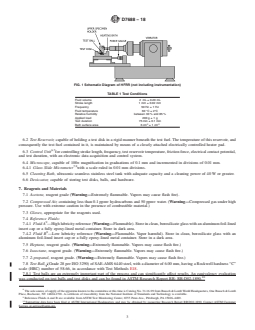
6.1 High-Frequency Reciprocating Rig (HFRR), —(see Fig. 1) capable of rubbing a steel ball loaded with a 200 g mass against
a stationary steel disk completely submerged in a test fuel. The apparatus uses a 1 mm stroke length at a frequency of 50 Hz for
75 min. Complete operating conditions are listed in Table 1.
Nikanjam, M., Crosby, T., Henderson, P., Gray, C., Meyer, K, and Davenport, N., “ISO Diesel Fuel Lubricity Round Robin Program,” SAE, Paper No. 952372, SAE
Fuels and Lubricants Meeting, Oct. 16-19, 1995, Toronto, Canada.
The sole source of supply of the apparatus known to the committee at this time is PCS Instruments, 78 Stanley Gardens, London W3 7SZ, England.
If you are aware of alternative suppliers, please provide this information to ASTM International Headquarters. Your comments will receive careful consideration at a
meeting of the responsible technical committee, which you may attend.
D7688 − 18
FIG. 1 Schematic Diagram of HFRR (not including instrumentation)
TABLE 1 Test Conditions
Fluid volume 2 mL ± 0.20 mL
Stroke length 1 mm ± 0.02 mm
Frequency 50 Hz ± 1 Hz
Fluid temperature 60 °C ± 2°C
Relative humidity between 30 % and 85 %
Applied load 200 g ± 1 g
Test duration 75 min ± 0.1 min
2 2
Bath surface area 6 cm ± 1 cm
6.2 Test Reservoir, capable of holding a test disk in a rigid manner beneath the test fuel. The temperature of this reservoir, and
consequently the test fuel contained in it, is maintained by means of a closely attached electrically controlled heater pad.
6,7
6.3 Control Unit for controlling stroke length, frequency, test reservoir temperature, friction force, electrical contact potential,
and test duration, with an electronic data acquisition and control system.
6.4 Microscope, capable of 100× magnification in graduations of 0.1 mm and incremented in divisions of 0.01 mm.
7,8
6.4.1 Glass Slide Micrometer with a scale ruled in 0.01 mm divisions.
6.5 Cleaning Bath, ultrasonic seamless stainless steel tank with adequate capacity and a cleaning power of 40 W or greater.
6.6 Desiccator, capable of storing test disks, balls, and hardware.
7. Reagents and Materials
7.1 Acetone, reagent grade (Warning—Extremely flammable. Vapors may cause flash fire).
7.2 Compressed Air, containing less than 0.1 ppmv hydrocarbons and 50 ppmv water. (Warning—Compressed gas under high
pressure. Use with extreme caution in the presence of combustible material.)
7.3 Gloves, appropriate for the reagents used.
7.4 Reference Fluids:
7.4.1 Fluid A —High lubricity reference (Warning—Flammable). Store in clean, borosilicate glass with an aluminum foil-lined
insert cap or a fully epoxy-lined metal container. Store in dark area.
7.4.2 Fluid B —Low lubricity reference (Warning—Flammable. Vapor harmful). Store in clean, borosilicate glass with an
aluminum foil-lined insert cap or a fully epoxy-lined metal container. Store in a dark area.
7.5 Heptane, reagent grade. (Warning—Extremely flammable. Vapors may cause flash fire.)
7.6 Isooctane, reagent grade. (Warning—Extremely flammable. Vapors may cause flash fire.)
7.7 2-propanol, reagent grade. (Warning—Extremely flammable. Vapors may cause flash fire.)
,
7.8 Test Ball, (Grade 28 per ISO 3290) of SAE-AMS 6440 steel, with a diameter of 6.00 mm, having a Rockwell hardness “C”
scale (HRC) number of 58-66, in accordance with Test Methods E18.
7.8.1 Test balls are an extremely important part of the process and can significantly affect results. An equivalency evaluation
was conducted on test balls and test disks and can be found in ASTM Research Report RR: RR:D02-1890.
The sole source of supply of the apparatus known to the committee at this time is Catalog No. 31-16-99 from Bausch & Lomb World Headquarters, One Bausch & Lomb
Place, Rochester, NY 14604-2701. A certificate of traceability from the National Institute of Standards and Technology is available.
Reference Fluids A and B are available from ASTM Test Monitoring Center, 6555 Penn Ave., Pittsburgh, PA 15026
...