


ASTM D2783-03(2014)
(Test Method)Standard Test Method for Measurement of Extreme-Pressure Properties of Lubricating Fluids (Four-Ball Method)
Standard Test Method for Measurement of Extreme-Pressure Properties of Lubricating Fluids (Four-Ball Method)
SIGNIFICANCE AND USE
5.1 This test method, used for specification purposes, differentiates between lubricating fluids having low, medium, and high level of extreme-pressure properties. The user of this method should determine to his own satisfaction whether results of this test procedure correlate with field performance or other bench test machines.
SCOPE
1.1 This test method covers the determination of the load-carrying properties of lubricating fluids. The following two determinations are made:
1.1.1 Load-wear index (formerly Mean-Hertz load).
1.1.2 Weld point by means of the four-ball extreme-pressure (EP) tester.
1.2 For the determination of the load-carrying properties of lubricating greases, see Test Method D2596.
1.3 This standard does not purport to address all of the safety concerns, if any, associated with its use. It is the responsibility of the user of this standard to establish appropriate safety and health practices and determine the applicability of regulatory limitations prior to use.
1.4 The values stated in SI units are to be regarded as the standard. The values given in parentheses are for information only.
General Information
Relations
Buy Standard
Standards Content (Sample)
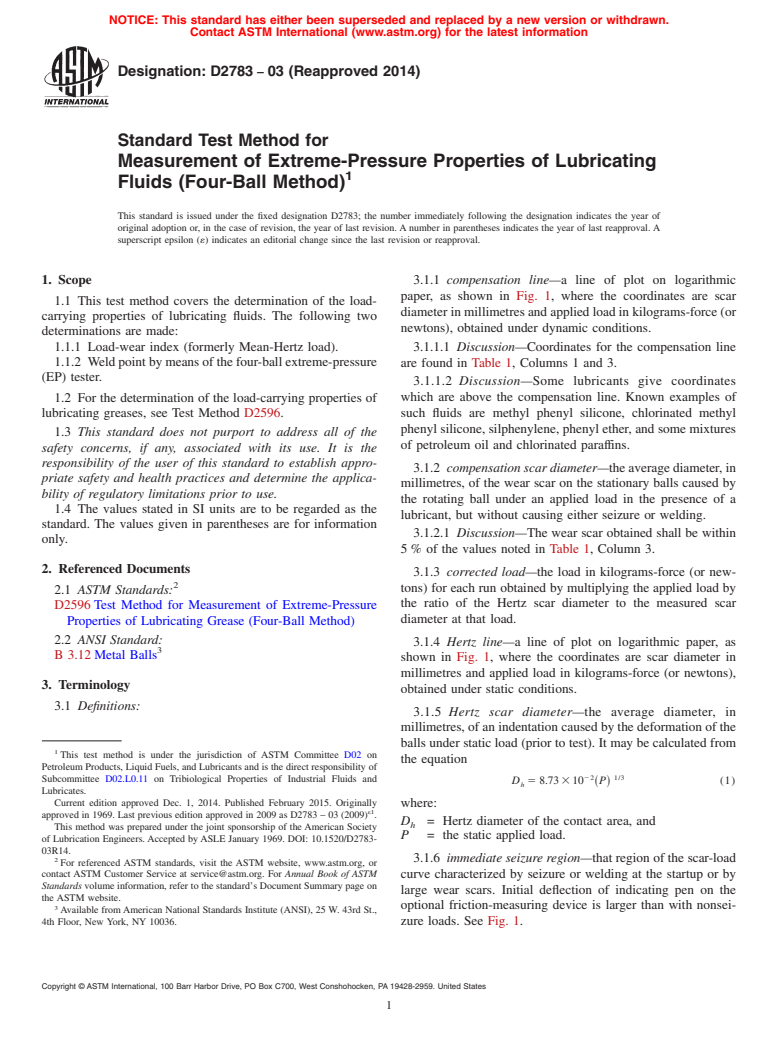
NOTICE: This standard has either been superseded and replaced by a new version or withdrawn.
Contact ASTM International (www.astm.org) for the latest information
Designation: D2783 − 03 (Reapproved 2014)
Standard Test Method for
Measurement of Extreme-Pressure Properties of Lubricating
1
Fluids (Four-Ball Method)
This standard is issued under the fixed designation D2783; the number immediately following the designation indicates the year of
original adoption or, in the case of revision, the year of last revision. A number in parentheses indicates the year of last reapproval. A
superscript epsilon (´) indicates an editorial change since the last revision or reapproval.
1. Scope 3.1.1 compensation line—a line of plot on logarithmic
paper, as shown in Fig. 1, where the coordinates are scar
1.1 This test method covers the determination of the load-
diameter in millimetres and applied load in kilograms-force (or
carrying properties of lubricating fluids. The following two
newtons), obtained under dynamic conditions.
determinations are made:
1.1.1 Load-wear index (formerly Mean-Hertz load). 3.1.1.1 Discussion—Coordinates for the compensation line
1.1.2 Weldpointbymeansofthefour-ballextreme-pressure
are found in Table 1, Columns 1 and 3.
(EP) tester.
3.1.1.2 Discussion—Some lubricants give coordinates
1.2 For the determination of the load-carrying properties of which are above the compensation line. Known examples of
lubricating greases, see Test Method D2596. such fluids are methyl phenyl silicone, chlorinated methyl
phenyl silicone, silphenylene, phenyl ether, and some mixtures
1.3 This standard does not purport to address all of the
of petroleum oil and chlorinated paraffins.
safety concerns, if any, associated with its use. It is the
responsibility of the user of this standard to establish appro-
3.1.2 compensation scar diameter—the average diameter, in
priate safety and health practices and determine the applica-
millimetres, of the wear scar on the stationary balls caused by
bility of regulatory limitations prior to use.
the rotating ball under an applied load in the presence of a
1.4 The values stated in SI units are to be regarded as the
lubricant, but without causing either seizure or welding.
standard. The values given in parentheses are for information
3.1.2.1 Discussion—The wear scar obtained shall be within
only.
5 % of the values noted in Table 1, Column 3.
2. Referenced Documents
3.1.3 corrected load—the load in kilograms-force (or new-
2
tons) for each run obtained by multiplying the applied load by
2.1 ASTM Standards:
the ratio of the Hertz scar diameter to the measured scar
D2596 Test Method for Measurement of Extreme-Pressure
diameter at that load.
Properties of Lubricating Grease (Four-Ball Method)
2.2 ANSI Standard:
3.1.4 Hertz line—a line of plot on logarithmic paper, as
3
B 3.12 Metal Balls
shown in Fig. 1, where the coordinates are scar diameter in
millimetres and applied load in kilograms-force (or newtons),
3. Terminology
obtained under static conditions.
3.1 Definitions:
3.1.5 Hertz scar diameter—the average diameter, in
millimetres, of an indentation caused by the deformation of the
balls under static load (prior to test). It may be calculated from
1
This test method is under the jurisdiction of ASTM Committee D02 on
the equation
Petroleum Products, Liquid Fuels, and Lubricants and is the direct responsibility of
22 1/3
Subcommittee D02.L0.11 on Tribiological Properties of Industrial Fluids and
D 5 8.73 310 P (1)
~ !
h
Lubricates.
Current edition approved Dec. 1, 2014. Published February 2015. Originally
where:
ε1
approved in 1969. Last previous edition approved in 2009 as D2783 – 03 (2009) .
D = Hertz diameter of the contact area, and
h
This method was prepared under the joint sponsorship of the American Society
P = the static applied load.
of Lubrication Engineers. Accepted by ASLE January 1969. DOI: 10.1520/D2783-
03R14.
2 3.1.6 immediate seizure region—that region of the scar-load
For referenced ASTM standards, visit the ASTM website, www.astm.org, or
contact ASTM Customer Service at service@astm.org. For Annual Book of ASTM
curve characterized by seizure or welding at the startup or by
Standards volume information, refer to the standard’s Document Summary page on
large wear scars. Initial deflection of indicating pen on the
the ASTM website.
3 optional friction-measuring device is larger than with nonsei-
Available fromAmerican National Standards Institute (ANSI), 25 W. 43rd St.,
4th Floor, New York, NY 10036. zure loads. See Fig. 1.
Copyright © ASTM International, 100 Barr Harbor Drive, PO Box C700, West Conshohocken, PA 19428-2959. United States
1
---------------------- Page: 1 ----------------------
D2783 − 03 (2014)
index is the average of the sum of the corrected loads
determinedforthetenappliedloadsimmediatelyprecedingthe
weld point.
3.1.10 weld point—under the conditions of this test, the
lowest applied load in kilograms at which the rotating ball
welds to the three stationa
...
This document is not an ASTM standard and is intended only to provide the user of an ASTM standard an indication of what changes have been made to the previous version. Because
it may not be technically possible to adequately depict all changes accurately, ASTM recommends that users consult prior editions as appropriate. In all cases only the current version
of the standard as published by ASTM is to be considered the official document.
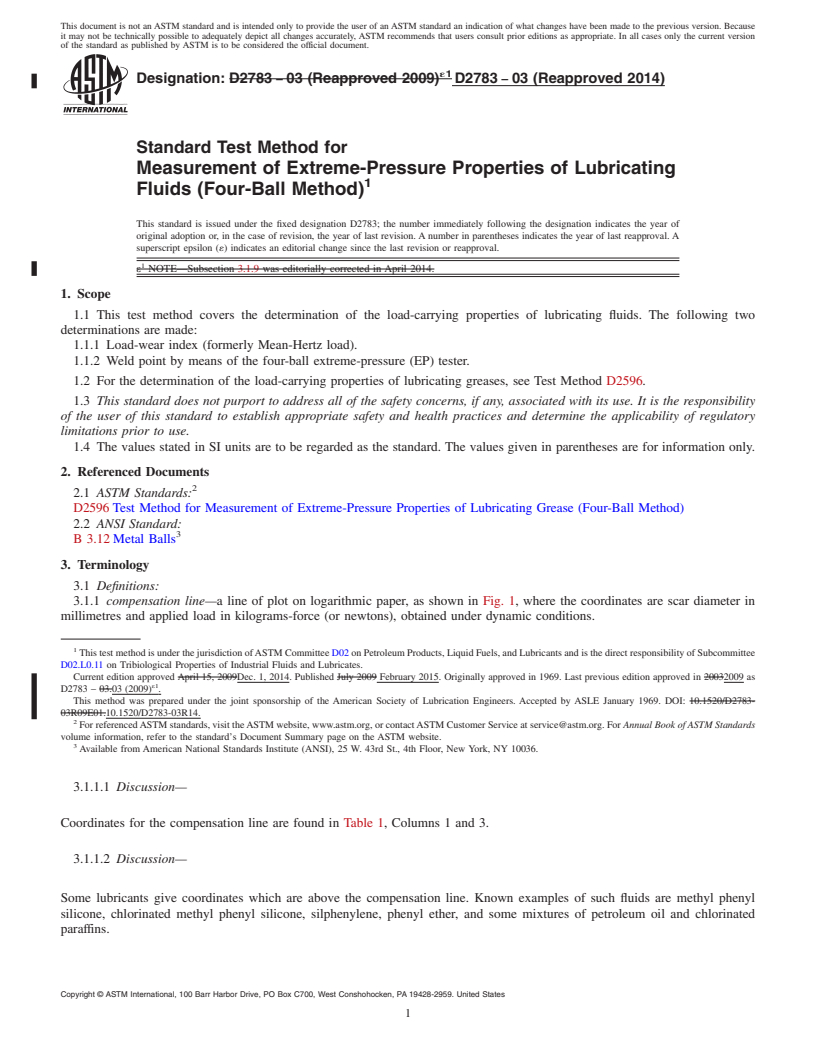
´1
Designation: D2783 − 03 (Reapproved 2009) D2783 − 03 (Reapproved 2014)
Standard Test Method for
Measurement of Extreme-Pressure Properties of Lubricating
1
Fluids (Four-Ball Method)
This standard is issued under the fixed designation D2783; the number immediately following the designation indicates the year of
original adoption or, in the case of revision, the year of last revision. A number in parentheses indicates the year of last reapproval. A
superscript epsilon (´) indicates an editorial change since the last revision or reapproval.
1
ε NOTE—Subsection 3.1.9 was editorially corrected in April 2014.
1. Scope
1.1 This test method covers the determination of the load-carrying properties of lubricating fluids. The following two
determinations are made:
1.1.1 Load-wear index (formerly Mean-Hertz load).
1.1.2 Weld point by means of the four-ball extreme-pressure (EP) tester.
1.2 For the determination of the load-carrying properties of lubricating greases, see Test Method D2596.
1.3 This standard does not purport to address all of the safety concerns, if any, associated with its use. It is the responsibility
of the user of this standard to establish appropriate safety and health practices and determine the applicability of regulatory
limitations prior to use.
1.4 The values stated in SI units are to be regarded as the standard. The values given in parentheses are for information only.
2. Referenced Documents
2
2.1 ASTM Standards:
D2596 Test Method for Measurement of Extreme-Pressure Properties of Lubricating Grease (Four-Ball Method)
2.2 ANSI Standard:
3
B 3.12 Metal Balls
3. Terminology
3.1 Definitions:
3.1.1 compensation line—a line of plot on logarithmic paper, as shown in Fig. 1, where the coordinates are scar diameter in
millimetres and applied load in kilograms-force (or newtons), obtained under dynamic conditions.
1
This test method is under the jurisdiction of ASTM Committee D02 on Petroleum Products, Liquid Fuels, and Lubricants and is the direct responsibility of Subcommittee
D02.L0.11 on Tribiological Properties of Industrial Fluids and Lubricates.
Current edition approved April 15, 2009Dec. 1, 2014. Published July 2009 February 2015. Originally approved in 1969. Last previous edition approved in 20032009 as
ε1
D2783 – 03.03 (2009) .
This method was prepared under the joint sponsorship of the American Society of Lubrication Engineers. Accepted by ASLE January 1969. DOI: 10.1520/D2783-
03R09E01.10.1520/D2783-03R14.
2
For referenced ASTM standards, visit the ASTM website, www.astm.org, or contact ASTM Customer Service at service@astm.org. For Annual Book of ASTM Standards
volume information, refer to the standard’s Document Summary page on the ASTM website.
3
Available from American National Standards Institute (ANSI), 25 W. 43rd St., 4th Floor, New York, NY 10036.
3.1.1.1 Discussion—
Coordinates for the compensation line are found in Table 1, Columns 1 and 3.
3.1.1.2 Discussion—
Some lubricants give coordinates which are above the compensation line. Known examples of such fluids are methyl phenyl
silicone, chlorinated methyl phenyl silicone, silphenylene, phenyl ether, and some mixtures of petroleum oil and chlorinated
paraffins.
Copyright © ASTM International, 100 Barr Harbor Drive, PO Box C700, West Conshohocken, PA 19428-2959. United States
1
---------------------- Page: 1 ----------------------
D2783 − 03 (2014)
ABE—Compensation line.
B—Point of last nonseizure load.
BC—Region of incipient seizure.
CD—Region of immediate seizure.
D—Weld point.
FIG. 1 Schematic Plot of Scar Diameter Versus Applied Load
TABLE 1 Suggested Form for Recording Test Results
Column 2 Column 3 Column 5
Column 1
Column4
Applied Average Scar Compensation Corrected
LD
h
A
Diameter, Scar Diameter, Load,
Load, kg
Factor
A
(L)
mm (X) mm kg (LD /X)
h
6 0.95
8 1.40
10 0.21 1.88
13 0.23 2.67
16 0.25 3.52
20 0.27 4.74
24 0.28 6.05
32 0.31 8.87
40 0.33 11.96
50 0.36 16.10
63 0.39 21.86
80 0.42 30.08
100 0.46 40.5
126 0.50 55.2
160 0.54 75.8
200 0.59 102.2
250 137.5
315 187.1
400 258
500 347
620 462
800 649
A
To convert from kilograms-force to newtons, multiply by 9.806.
3.1.2 compensation scar diameter—the average diameter, in millimetres, of the wear scar on the stationary balls caused by the
rotating ball under an applied load in the presence of a lubricant, but without causing either seizure or welding.
3.1.2.1 Discussion—
The wear scar obtained shall be within 5 % of the values noted in Table 1, Column 3.
3.1.3 corrected load—the load in kilograms-force (or newtons) for each run obtained by
...
Questions, Comments and Discussion
Ask us and Technical Secretary will try to provide an answer. You can facilitate discussion about the standard in here.