

ASTM D5760-19
(Specification)Standard Specification for Performance of Manual Transmission Gear Lubricants
General Information
- Abstract
ABSTRACT
This specification provides a list of test methods and acceptance criteria for determining the performance acceptability of gear lubricants used in nonsynchronized heavy duty manual transmission (MT-1). The test methods listed here shall be able to examine the following properties of the gear lubricants: viscosity increase; pentane insolubles; toluene insolubles; carbon/varnish rating; sludge rating; hardness and volume change, and elongation of polyacrylate and fluoroelastomer; falling load stage; and foam tendency.
SCOPE
1.1 This specification lists the test methods and acceptance criteria for determining the acceptability of lubricants used in nonsynchronized heavy duty manual transmissions.
1.2 The values stated in SI units are to be regarded as standard. No other units of measurement are included in this standard.
1.3 This international standard was developed in accordance with internationally recognized principles on standardization established in the Decision on Principles for the Development of International Standards, Guides and Recommendations issued by the World Trade Organization Technical Barriers to Trade (TBT) Committee.
- Status
- Published
- Publication Date
- 30-Apr-2019
- Technical Committee
- D02 - Petroleum Products, Liquid Fuels, and Lubricants
- Drafting Committee
- D02.B0.03 - Automotive Gear Lubricants & Fluids
Buy Documents
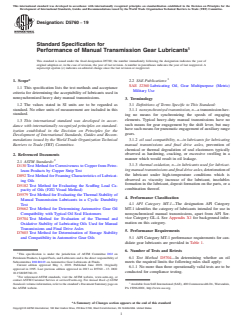
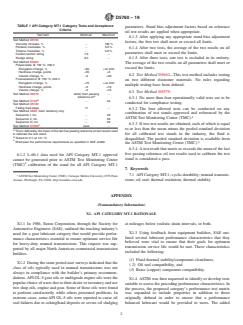


ASTM D5760-19 - Standard Specification for Performance of Manual Transmission Gear Lubricants
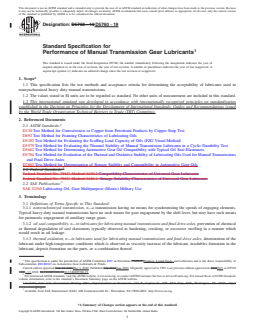
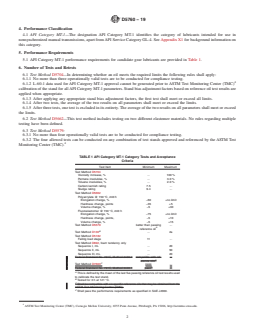

REDLINE ASTM D5760-19 - Standard Specification for Performance of Manual Transmission Gear Lubricants
Overview
ASTM D5760-19 is the internationally recognized standard specification issued by ASTM International for assessing the performance of gear lubricants used in nonsynchronized heavy duty manual transmissions (API Category MT-1). This standard outlines comprehensive test methods and acceptance criteria for evaluating critical lubricant properties that impact the reliability, durability, and service life of manual transmission systems. Developed under the principles established by the WTO Technical Barriers to Trade (TBT) Committee, ASTM D5760-19 supports consistent, high-quality lubricant performance across global markets.
Key Topics
- Performance Criteria: This standard defines stringent performance requirements for gear lubricants, focusing on properties essential for heavy-duty, non-synchronized manual transmissions.
- Test Methods: ASTM D5760-19 references a suite of standard ASTM and federal test methods to assess aspects such as:
- Viscosity increase
- Pentane and toluene insolubles
- Sludge and carbon/varnish ratings
- Thermal and oxidative stability
- Oil seal (elastomer) compatibility (polyacrylate and fluoroelastomer materials)
- Load carrying capacity (scuffing resistance)
- Foam tendency and stability
- Storage and compatibility characteristics
- API Category MT-1: The specification is designed for gear lubricants meeting API MT-1 requirements, suitable for severe-duty use in transmissions where synchronization is not provided.
- OEM and Industry Support: The standard responds to the heavy vehicle industry’s need for reliable gear lubricant categories, drawing on input from OEMs and industry research to define vital lubricant performance attributes.
Applications
ASTM D5760-19 is essential for manufacturers, suppliers, and end-users involved with:
- Nonsynchronized Heavy Duty Manual Transmissions: Ensuring lubricants provide appropriate protection, cleanliness, and compatibility for transmissions in commercial trucks, off-road vehicles, and other demanding applications.
- Lubricant Formulation and Quality Assurance: Providing a reliable benchmark for developing and testing new gear oils, enabling lubricant blenders to certify products that meet critical technical requirements for transmission protection.
- Maintenance and Fleet Management: Assisting maintenance professionals in selecting lubricants that optimize service intervals, minimize component wear, and reduce unscheduled downtime caused by lubricant-related failures.
- Regulatory Compliance and OEM Approvals: Serving as a central reference for lubricant specifications in international markets, facilitating compliance with OEM recommendations and regulatory requirements.
Related Standards
ASTM D5760-19 references a range of related standards and guidelines:
- ASTM D130: Corrosiveness to copper from petroleum products
- ASTM D892: Foaming characteristics of lubricating oils
- ASTM D5182: Scuffing load capacity of oils
- ASTM D5579: Thermal stability of manual transmission lubricants
- ASTM D5662: Gear oil compatibility with automotive oil seals
- ASTM D5704: Thermal and oxidative stability for manual transmission/axle oils
- ASTM D7603: Storage stability and compatibility in automotive gear oils
- Federal Standards 791C, Method 3430.2 & 3440.1: Compatibility and storage solubility of universal gear lubricants
- SAE J2360: Lubricating oil standards for military and multipurpose gear oil use
Practical Value
By conforming to ASTM D5760-19, gear lubricant suppliers enhance product reliability and performance, while end-users benefit from extended equipment life and reduced maintenance costs. Adopting this standard enables international harmonization of lubricant performance requirements, streamlined product approvals, and improved confidence in transmission operation under severe conditions.
Keywords: ASTM D5760-19, manual transmission gear lubricants, API MT-1, lubricant performance, heavy duty manual transmissions, oil seal compatibility, thermal stability, gear oil standard, ASTM gear oil standard
Relations
- Replaces
ASTM D5760-13 - Standard Specification for Performance of Manual Transmission Gear Lubricants - Effective Date
- 01-May-2019
- Effective Date
- 01-Nov-2023
- Effective Date
- 01-Oct-2023
- Effective Date
- 01-Dec-2019
- Effective Date
- 01-Jul-2019
- Effective Date
- 01-Oct-2017
- Effective Date
- 01-May-2017
- Effective Date
- 01-May-2017
- Effective Date
- 01-Apr-2016
- Effective Date
- 01-Apr-2016
- Effective Date
- 01-Apr-2016
- Effective Date
- 01-Oct-2015
- Effective Date
- 01-Apr-2015
- Effective Date
- 01-Apr-2015
- Effective Date
- 01-Oct-2014
Buy Documents
ASTM D5760-19 - Standard Specification for Performance of Manual Transmission Gear Lubricants
REDLINE ASTM D5760-19 - Standard Specification for Performance of Manual Transmission Gear Lubricants
Get Certified
Connect with accredited certification bodies for this standard

Element Materials Technology
Materials testing and product certification.

ABS Group Brazil
ABS Group certification services in Brazil.

ABS Quality Evaluations Inc.
American Bureau of Shipping quality certification.
Sponsored listings
Frequently Asked Questions
ASTM D5760-19 is a technical specification published by ASTM International. Its full title is "Standard Specification for Performance of Manual Transmission Gear Lubricants". This standard covers: ABSTRACT This specification provides a list of test methods and acceptance criteria for determining the performance acceptability of gear lubricants used in nonsynchronized heavy duty manual transmission (MT-1). The test methods listed here shall be able to examine the following properties of the gear lubricants: viscosity increase; pentane insolubles; toluene insolubles; carbon/varnish rating; sludge rating; hardness and volume change, and elongation of polyacrylate and fluoroelastomer; falling load stage; and foam tendency. SCOPE 1.1 This specification lists the test methods and acceptance criteria for determining the acceptability of lubricants used in nonsynchronized heavy duty manual transmissions. 1.2 The values stated in SI units are to be regarded as standard. No other units of measurement are included in this standard. 1.3 This international standard was developed in accordance with internationally recognized principles on standardization established in the Decision on Principles for the Development of International Standards, Guides and Recommendations issued by the World Trade Organization Technical Barriers to Trade (TBT) Committee.
ABSTRACT This specification provides a list of test methods and acceptance criteria for determining the performance acceptability of gear lubricants used in nonsynchronized heavy duty manual transmission (MT-1). The test methods listed here shall be able to examine the following properties of the gear lubricants: viscosity increase; pentane insolubles; toluene insolubles; carbon/varnish rating; sludge rating; hardness and volume change, and elongation of polyacrylate and fluoroelastomer; falling load stage; and foam tendency. SCOPE 1.1 This specification lists the test methods and acceptance criteria for determining the acceptability of lubricants used in nonsynchronized heavy duty manual transmissions. 1.2 The values stated in SI units are to be regarded as standard. No other units of measurement are included in this standard. 1.3 This international standard was developed in accordance with internationally recognized principles on standardization established in the Decision on Principles for the Development of International Standards, Guides and Recommendations issued by the World Trade Organization Technical Barriers to Trade (TBT) Committee.
ASTM D5760-19 is classified under the following ICS (International Classification for Standards) categories: 75.100 - Lubricants, industrial oils and related products. The ICS classification helps identify the subject area and facilitates finding related standards.
ASTM D5760-19 has the following relationships with other standards: It is inter standard links to ASTM D5760-13, ASTM D5662-23, ASTM D892-23, ASTM D5182-19, ASTM D5662-19, ASTM D5662-17a, ASTM D5662-17, ASTM D5704-17, ASTM D5579-16, ASTM D5662-16, ASTM D5704-16, ASTM D5704-15a, ASTM D5704-15, ASTM D5579-15, ASTM D5662-14. Understanding these relationships helps ensure you are using the most current and applicable version of the standard.
ASTM D5760-19 is available in PDF format for immediate download after purchase. The document can be added to your cart and obtained through the secure checkout process. Digital delivery ensures instant access to the complete standard document.
Standards Content (Sample)
This international standard was developed in accordance with internationally recognized principles on standardization established in the Decision on Principles for the
Development of International Standards, Guides and Recommendations issued by the World Trade Organization Technical Barriers to Trade (TBT) Committee.
Designation:D5760 −19
Standard Specification for
Performance of Manual Transmission Gear Lubricants
This standard is issued under the fixed designation D5760; the number immediately following the designation indicates the year of
original adoption or, in the case of revision, the year of last revision. A number in parentheses indicates the year of last reapproval. A
superscript epsilon (´) indicates an editorial change since the last revision or reapproval.
1. Scope* 2.2 SAE Publications:
SAE J2360 Lubricating Oil, Gear Multipurpose (Metric)
1.1 This specification lists the test methods and acceptance
Military Use
criteria for determining the acceptability of lubricants used in
nonsynchronized heavy duty manual transmissions.
3. Terminology
1.2 The values stated in SI units are to be regarded as
3.1 Definitions of Terms Specific to This Standard:
standard. No other units of measurement are included in this
3.1.1 nonsynchronized transmission, n—a transmission hav-
standard.
ing no means for synchronizing the speeds of engaging
elements. Typical heavy-duty manual transmissions have no
1.3 This international standard was developed in accor-
such means for gear engagement by the shift lever, but may
dance with internationally recognized principles on standard-
have such means for pneumatic engagement of auxiliary range
ization established in the Decision on Principles for the
gears.
Development of International Standards, Guides and Recom-
mendations issued by the World Trade Organization Technical 3.1.2 oil seal compatibility, n—in lubricants for lubricating
Barriers to Trade (TBT) Committee.
manual transmissions and final drive axles, prevention of
chemical or thermal degradation of seal elastomers typically
observed as hardening, cracking, or excessive swelling in a
2. Referenced Documents
manner which would result in oil leakage.
2.1 ASTM Standards:
3.1.3 thermal oxidation, n—in lubricants used for lubricat-
D130 Test Method for Corrosiveness to Copper from Petro-
ing manual transmissions and final drive axles,deteriorationof
leum Products by Copper Strip Test
the lubricant under high-temperature conditions which is
D892 Test Method for Foaming Characteristics of Lubricat-
observed as viscosity increase of the lubricant, insolubles
ing Oils
formation in the lubricant, deposit formation on the parts, or a
D5182 Test Method for Evaluating the Scuffing Load Ca-
combination thereof.
pacity of Oils (FZG Visual Method)
D5579 Test Method for Evaluating the Thermal Stability of
4. Performance Classification
Manual Transmission Lubricants in a Cyclic Durability
4.1 API Category MT-1—The designation API Category
Test
MT-1 identifies the category of lubricants intended for use in
D5662 Test Method for Determining Automotive Gear Oil
nonsynchronized manual transmissions, apart from API Ser-
Compatibility with Typical Oil Seal Elastomers
vice Category GL-4. See Appendix X1 for background infor-
D5704 Test Method for Evaluation of the Thermal and
mation on this category.
Oxidative Stability of Lubricating Oils Used for Manual
Transmissions and Final Drive Axles
5. Performance Requirements
D7603 Test Method for Determination of Storage Stability
and Compatibility in Automotive Gear Oils 5.1 API Category MT-1 performance requirements for can-
didate gear lubricants are provided in Table 1.
6. Number of Tests and Retests
This specification is under the jurisdiction of ASTM Committee D02 on
6.1 Test Method D5704—In determining whether an oil
Petroleum Products, Liquid Fuels, and Lubricants and is the direct responsibility of
Subcommittee D02.B0.03 on Automotive Gear Lubricants & Fluids.
meets the required limits the following rules shall apply:
Current edition approved May 1, 2019. Published June 2019. Originally
6.1.1 No more than three operationally valid tests are to be
approved in 1995. Last previous edition approved in 2013 as D5760 – 13. DOI:
conducted for compliance testing.
10.1520/D5760-19.
For referenced ASTM standards, visit the ASTM website, www.astm.org, or
contact ASTM Customer Service at service@astm.org. For Annual Book of ASTM
Standards volume information, refer to the standard’s Document Summary page on Available from SAE International (SAE), 400 Commonwealth Dr.,Warrendale,
the ASTM website. PA 15096-0001, http://www.sae.org.
*A Summary of Changes section appears at the end of this standard
Copyright © ASTM International, 100 Barr Harbor Drive, PO Box C700, West Conshohocken, PA 19428-2959. United States
D5760−19
TABLE 1 API Category MT-1 Category Tests and Acceptance
parameters. Stand bias adjustment factors based on reference
Criteria
oil test results are applied when appropriate.
Test Item Minimum Maximum
6.1.3 After applying any appropriate stand bias adjustment
Test Method D5704
factors, the first test shall meet or exceed all limits.
Viscosity increase, % . 100 %
Pentane insolubles, % . 3.0 %
6.1.4 After two tests, the average of the two results on all
Toluene insolubles, % . 2.0 %
parameters shall meet or exceed the limits.
Carbon/varnish rating 7.5 .
Sludge rating 9.4 . 6.1.5 After three tests, one test is excluded in its entirety.
Test Method D5662
The average of the two results on all parameters shall meet or
Polyacrylate @ 150 °C, 240 h
exceed the limits.
Elongation change, % −60 +no limit
Hardness change, points −35 +5
6.2 Test Method D5662—This test method includes testing
Volume change, % −5 +30
Fluoroelastomer @ 150 °C, 240 h
on two different elastomer materials. No rules regarding
Elongation change, % −75 +no limit
multiple testing have been defined.
Hardness change, points, −5 +10
Volume change, % −5 +15
6.3 Test Method D5579:
Test Method D5579 better than passing .
A
reference oil
6.3.1 No more than four operationally valid tests are to be
B
Test Method D130 . 2a
cond
...
This document is not an ASTM standard and is intended only to provide the user of an ASTM standard an indication of what changes have been made to the previous version. Because
it may not be technically possible to adequately depict all changes accurately, ASTM recommends that users consult prior editions as appropriate. In all cases only the current version
of the standard as published by ASTM is to be considered the official document.
Designation: D5760 − 13 D5760 − 19
Standard Specification for
Performance of Manual Transmission Gear Lubricants
This standard is issued under the fixed designation D5760; the number immediately following the designation indicates the year of
original adoption or, in the case of revision, the year of last revision. A number in parentheses indicates the year of last reapproval. A
superscript epsilon (´) indicates an editorial change since the last revision or reapproval.
1. Scope*
1.1 This specification lists the test methods and acceptance criteria for determining the acceptability of lubricants used in
nonsynchronized heavy duty manual transmissions.
1.2 The values stated in SI units are to be regarded as standard. No other units of measurement are included in this standard.
1.3 This international standard was developed in accordance with internationally recognized principles on standardization
established in the Decision on Principles for the Development of International Standards, Guides and Recommendations issued
by the World Trade Organization Technical Barriers to Trade (TBT) Committee.
2. Referenced Documents
2.1 ASTM Standards:
D130 Test Method for Corrosiveness to Copper from Petroleum Products by Copper Strip Test
D892 Test Method for Foaming Characteristics of Lubricating Oils
D5182 Test Method for Evaluating the Scuffing Load Capacity of Oils (FZG Visual Method)
D5579 Test Method for Evaluating the Thermal Stability of Manual Transmission Lubricants in a Cyclic Durability Test
D5662 Test Method for Determining Automotive Gear Oil Compatibility with Typical Oil Seal Elastomers
D5704 Test Method for Evaluation of the Thermal and Oxidative Stability of Lubricating Oils Used for Manual Transmissions
and Final Drive Axles
D7603 Test Method for Determination of Storage Stability and Compatibility in Automotive Gear Oils
2.2 Federal Standards:
Federal Standard No. 791C, Method 3430.2 Compatibility Characteristics of Universal Gear Lubricants
Federal Standard No. 791C, Method 3440.1 Storage Solubility Characteristics of Universal Gear Lubricants
2.2 SAE Publications:
SAE J2360 Lubricating Oil, Gear Multipurpose (Metric) Military Use
3. Terminology
3.1 Definitions of Terms Specific to This Standard:
3.1.1 nonsynchronized transmission, n—a transmission having no means for synchronizing the speeds of engaging elements.
Typical heavy-duty manual transmissions have no such means for gear engagement by the shift lever, but may have such means
for pneumatic engagement of auxiliary range gears.
3.1.2 oil seal compatibility, n—in lubricants for lubricating manual transmissions and final drive axles, prevention of chemical
or thermal degradation of seal elastomers typically observed as hardening, cracking, or excessive swelling in a manner which
would result in oil leakage.
3.1.3 thermal oxidation, n—in lubricants used for lubricating manual transmissions and final drive axles, deterioration of the
lubricant under high-temperature conditions which is observed as viscosity increase of the lubricant, insolubles formation in the
lubricant, deposit formation on the parts, or a combination thereof.
This specification is under the jurisdiction of ASTM Committee D02 on Petroleum Products Products, Liquid Fuels, and Lubricants and is the direct responsibility of
Subcommittee D02.B0.03 on Automotive Gear Lubricants & Fluids.
Current edition approved June 15, 2013May 1, 2019. Published July 2013June 2019. Originally approved in 1995. Last previous edition approved in 20092013 as D5760
– 09.– 13. DOI: 10.1520/D5760-13.10.1520/D5760-19.
For referenced ASTM standards, visit the ASTM website, www.astm.org, or contact ASTM Customer Service at service@astm.org. For Annual Book of ASTM Standards
volume information, refer to the standard’s Document Summary page on the ASTM website.
Available from U.S. Government Printing Office Superintendent of Documents, 732 N. Capitol St., NW, Mail Stop: SDE, Washington, DC 20401, http://
www.access.gpo.gov.
Available from SAE International (SAE), 400 Commonwealth Dr., Warrendale, PA 15096-0001, http://www.sae.org.
*A Summary of Changes section appears at the end of this standard
Copyright © ASTM International, 100 Barr Harbor Drive, PO Box C700, West Conshohocken, PA 19428-2959. United States
D5760 − 19
4. Performance Classification
4.1 API Category MT-1—The designation API Category MT-1 identifies the category of lubricants intended for use in
nonsynchronized manual transmissions, apart from API Service Category GL-4. See Appendix X1 for background information on
this category.
5. Performance Requirements
5.1 API Category MT-1 performance requirements for candidate gear lubricants are provided in Table 1.
6. Number of Tests and Retests
6.1 Test Method D5704—In determining whether an oil meets the required limits the following rules shall apply:
6.1.1 No more than three operationally valid tests are to be conducted for compliance testing.
6.1.2 L-60-1 data used for API Category MT-1 approval cannot be generated prior to ASTM Test Monitoring Center (TMC)
calibration of the stand for all API Category MT-1 parameters. Stand bias adjustment factors based on reference oil test results are
applied when appropriate.
6.1.3 After applying any appropriate stand bias adjustment factors, the first test shall meet or exceed all limits.
6.1.4 After two tests, the average of the two results on all parameters shall meet or exceed the limits.
6.1.5 After three tests, one test is excluded in its entirety. The average of the two results on all parameters shall meet or exceed
the limits.
6.2 Test Method D5662—This test method includes testing on two different elastomer materials. No rules regarding multiple
testing have been defined.
6.3 Test Method D5579:
6.3.1 No more than four operationally valid tests are to be conducted for compliance testing.
6.3.2 The four allowed tests can be conducted on any combination of test stands approved and referenced by the ASTM Test
Monitoring Center (TMC).
TABLE 1 API Category MT-1 Category Tests and Acceptance
Criteria
Test Item Minimum Maximum
Test Method D5704
Viscosity increase, % . 100 %
Pentane insolubles, % . 3.0 %
Toluene insol
...