

ASTM F3327-23
(Practice)Standard Practice for Recording the A-UGV Test Configuration
General Information
- Abstract
SIGNIFICANCE AND USE
5.1 The significance of the information to be recorded in a test report allows for A-UGV performance to be contextualized with A-UGV configuration.
5.2 Limitations of the practice are that not all A-UGVs have the same capabilities or configuration parameters. For example, for capabilities, a vehicle that remaps during navigation versus another vehicle that uses a static map may behave differently in repeated runs of an obstacle avoidance test. For configuration, a vehicle that remaps during navigation may have varying times that obstacles remain in the map for test recreation.
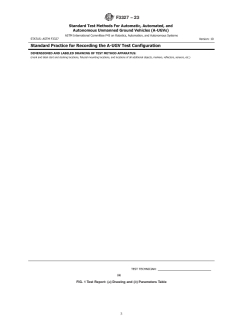
5.3 The environment map used by the A-UGV, developed through localization including any landmarks, shall be saved as used on the A-UGV and should be saved and provided as a human-readable layout on or off the A-UGV (see Appendix X1 showing a sample layout drawing).
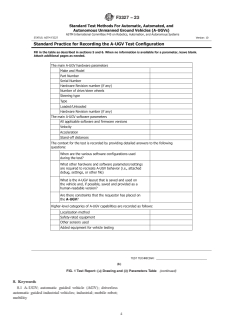
5.4 The main A-UGV hardware parameters shall be recorded as follows:
5.4.1 Make and model;
5.4.2 Part number;
5.4.3 Serial number;
5.4.4 Hardware revision number (if any);
5.4.5 Number of drive/steer wheels;
5.4.6 Steering type;
5.4.7 A-UGV Type—For example, fork, tugger, unit load, cart; and
5.4.8 Loaded/unloaded.
5.5 The main A-UGV software parameters shall be recorded as follows:
5.5.1 All applicable software and firmware versions;
5.5.2 Velocity—Translation and rotation, minimum/maximum;
5.5.3 Acceleration—Translation and rotation, minimum/maximum; and
5.5.4 Stand-off Distances—Safety sensor thresholds, obstacle avoidance thresholds.
5.6 The context for the test shall be recorded by providing detailed answers to the following questions:
5.6.1 When are the various software configurations used during the test? For example, two software versions may be required as follows: Use configuration A for straight aisles and configuration B for turns.
5.6.2 What other hardware and software parameters/settings are required to recreate the A-UGV behavior (that is, attached debug, settin...
SCOPE
1.1 This practice describes a means to record the Automatic, Automated, or Autonomous – Uncrewed Ground Vehicle (A-UGV) configuration when testing. The practice provides a method for recording A-UGV hardware and software control parameters and describes high-level capabilities, such as used for A-UGV safety and navigation.
1.2 This practice: contextualizes the A-UGV configuration during a test, including the identification and adjustment of main configuration parameters; provides the proper context for test results; provides a basis for comparison of the test circumstances across different vehicles or tests, or both; and allows a test to be recreated.
1.3 The values stated in SI units are to be regarded as the standard. The values given in parentheses are not precise mathematical conversions to imperial units. They are close approximate equivalents for the purpose of specifying A-UGV characteristics while maintaining repeatability and reproducibility of the test method results. These values given in parentheses are provided for information only and are not considered standard.
1.4 This standard does not purport to address all of the safety concerns, if any, associated with its use. It is the responsibility of the user of this standard to establish appropriate safety, health, and environmental practices and determine the applicability of regulatory limitations prior to use.
1.5 This international standard was developed in accordance with internationally recognized principles on standardization established in the Decision on Principles for the Development of International Standards, Guides and Recommendations issued by the World Trade Organization Technical Barriers to Trade (TBT) Committee.
- Status
- Published
- Publication Date
- 30-Nov-2023
- Technical Committee
- F45 - Robotics, Automation, and Autonomous Systems
- Drafting Committee
- F45.91 - Terminology
Overview
ASTM F3327-23: Standard Practice for Recording the A-UGV Test Configuration is a widely recognized practice developed by ASTM International for documenting the configuration of Automatic, Automated, or Autonomous Uncrewed Ground Vehicles (A-UGVs) during performance testing. The standard provides a comprehensive framework to record both hardware and software parameters, enabling accurate contextualization of A-UGV test results. This ensures that any analysis, comparison, or recreation of tests is based on a consistent and well-documented set of vehicle configurations.
By following ASTM F3327-23, organizations can maintain repeatability, reproducibility, and transparency in A-UGV testing, supporting standards compliance and effective product validation within industrial automation, robotics, and mobile robotics sectors.
Key Topics
ASTM F3327-23 emphasizes the importance of clearly documenting factors that may influence A-UGV performance during testing. The standard outlines the following critical areas:
Hardware Parameters
- Make and model identification
- Part and serial numbers
- Hardware revision numbers
- Drive/steer wheel count and steering type
- A-UGV type (e.g., fork, tugger, unit load, cart)
- Loaded or unloaded status
Software Parameters
- Software and firmware versions
- Translation and rotation velocity (minimum/maximum)
- Acceleration parameters (minimum/maximum)
- Safety sensor and obstacle avoidance thresholds
Test Context
- When and how different software configurations are utilized
- Additional hardware or software settings required for test reproduction
- Description and human-readable version of the environmental map used
- Any constraints imposed by the test requestor (e.g., test environment, speed limits, path restrictions)
High-Level Capabilities
- Localization method (e.g., natural features, markers)
- Safety-rated equipment (such as scanning lasers)
- Integration and configuration of additional sensors
- Temporary equipment used solely for testing purposes
This structured approach allows for the accurate recording and comparison of A-UGV tests, where changing configurations or differing capabilities can directly impact test outcomes.
Applications
ASTM F3327-23 is essential for organizations and professionals involved in A-UGV design, testing, and validation. Key use cases include:
- Comparing A-UGV Performance: Standardized recording enables direct comparison of test results across different A-UGVs or across repeat tests, identifying which parameters affect performance most significantly.
- Test Reproducibility: Accurate documentation ensures that test setups can be consistently recreated, which is critical for validation, troubleshooting, and auditing processes.
- Safety and Compliance: Recording configuration details supports regulatory compliance and the establishment of robust safety practices for industrial mobile robots.
- Benchmarking and Development: Manufacturers can benchmark their products, assess new configurations, or debug issues with deeper contextual understanding.
Industries benefiting from this practice include manufacturing, warehousing, logistics, and any domain deploying A-UGVs for autonomous or automated material handling.
Related Standards
Organizations implementing ASTM F3327-23 may also reference several related standards to ensure comprehensive A-UGV system validation and integration:
- ASTM F3200: Terminology for Robotics, Automation, and Autonomous Systems, providing essential definitions and context for A-UGV documentation.
- Additional ASTM standards for A-UGV testing or validation, as well as international guidance on robotic and automated systems performance.
Keywords: A-UGV, automated guided vehicle, AGV, autonomous mobile robot, test configuration, industrial robotics, mobile robot testing, ASTM F3327, automation, test documentation, reproducibility, standardization.
Relations
- Effective Date
- 01-Dec-2023
- Referred By
ASTM F3243-21 - Standard Practice for Implementing Communications Impairments on A-UGV Systems - Effective Date
- 01-Dec-2023
- Effective Date
- 01-Dec-2023
- Effective Date
- 01-Dec-2023
- Effective Date
- 01-Dec-2023
Get Certified
Connect with accredited certification bodies for this standard

TÜV Rheinland
TÜV Rheinland is a leading international provider of technical services.

TÜV SÜD
TÜV SÜD is a trusted partner of choice for safety, security and sustainability solutions.

BSI Group
BSI (British Standards Institution) is the business standards company that helps organizations make excellence a habit.
Sponsored listings
Frequently Asked Questions
ASTM F3327-23 is a standard published by ASTM International. Its full title is "Standard Practice for Recording the A-UGV Test Configuration". This standard covers: SIGNIFICANCE AND USE 5.1 The significance of the information to be recorded in a test report allows for A-UGV performance to be contextualized with A-UGV configuration. 5.2 Limitations of the practice are that not all A-UGVs have the same capabilities or configuration parameters. For example, for capabilities, a vehicle that remaps during navigation versus another vehicle that uses a static map may behave differently in repeated runs of an obstacle avoidance test. For configuration, a vehicle that remaps during navigation may have varying times that obstacles remain in the map for test recreation. 5.3 The environment map used by the A-UGV, developed through localization including any landmarks, shall be saved as used on the A-UGV and should be saved and provided as a human-readable layout on or off the A-UGV (see Appendix X1 showing a sample layout drawing). 5.4 The main A-UGV hardware parameters shall be recorded as follows: 5.4.1 Make and model; 5.4.2 Part number; 5.4.3 Serial number; 5.4.4 Hardware revision number (if any); 5.4.5 Number of drive/steer wheels; 5.4.6 Steering type; 5.4.7 A-UGV Type—For example, fork, tugger, unit load, cart; and 5.4.8 Loaded/unloaded. 5.5 The main A-UGV software parameters shall be recorded as follows: 5.5.1 All applicable software and firmware versions; 5.5.2 Velocity—Translation and rotation, minimum/maximum; 5.5.3 Acceleration—Translation and rotation, minimum/maximum; and 5.5.4 Stand-off Distances—Safety sensor thresholds, obstacle avoidance thresholds. 5.6 The context for the test shall be recorded by providing detailed answers to the following questions: 5.6.1 When are the various software configurations used during the test? For example, two software versions may be required as follows: Use configuration A for straight aisles and configuration B for turns. 5.6.2 What other hardware and software parameters/settings are required to recreate the A-UGV behavior (that is, attached debug, settin... SCOPE 1.1 This practice describes a means to record the Automatic, Automated, or Autonomous – Uncrewed Ground Vehicle (A-UGV) configuration when testing. The practice provides a method for recording A-UGV hardware and software control parameters and describes high-level capabilities, such as used for A-UGV safety and navigation. 1.2 This practice: contextualizes the A-UGV configuration during a test, including the identification and adjustment of main configuration parameters; provides the proper context for test results; provides a basis for comparison of the test circumstances across different vehicles or tests, or both; and allows a test to be recreated. 1.3 The values stated in SI units are to be regarded as the standard. The values given in parentheses are not precise mathematical conversions to imperial units. They are close approximate equivalents for the purpose of specifying A-UGV characteristics while maintaining repeatability and reproducibility of the test method results. These values given in parentheses are provided for information only and are not considered standard. 1.4 This standard does not purport to address all of the safety concerns, if any, associated with its use. It is the responsibility of the user of this standard to establish appropriate safety, health, and environmental practices and determine the applicability of regulatory limitations prior to use. 1.5 This international standard was developed in accordance with internationally recognized principles on standardization established in the Decision on Principles for the Development of International Standards, Guides and Recommendations issued by the World Trade Organization Technical Barriers to Trade (TBT) Committee.
SIGNIFICANCE AND USE 5.1 The significance of the information to be recorded in a test report allows for A-UGV performance to be contextualized with A-UGV configuration. 5.2 Limitations of the practice are that not all A-UGVs have the same capabilities or configuration parameters. For example, for capabilities, a vehicle that remaps during navigation versus another vehicle that uses a static map may behave differently in repeated runs of an obstacle avoidance test. For configuration, a vehicle that remaps during navigation may have varying times that obstacles remain in the map for test recreation. 5.3 The environment map used by the A-UGV, developed through localization including any landmarks, shall be saved as used on the A-UGV and should be saved and provided as a human-readable layout on or off the A-UGV (see Appendix X1 showing a sample layout drawing). 5.4 The main A-UGV hardware parameters shall be recorded as follows: 5.4.1 Make and model; 5.4.2 Part number; 5.4.3 Serial number; 5.4.4 Hardware revision number (if any); 5.4.5 Number of drive/steer wheels; 5.4.6 Steering type; 5.4.7 A-UGV Type—For example, fork, tugger, unit load, cart; and 5.4.8 Loaded/unloaded. 5.5 The main A-UGV software parameters shall be recorded as follows: 5.5.1 All applicable software and firmware versions; 5.5.2 Velocity—Translation and rotation, minimum/maximum; 5.5.3 Acceleration—Translation and rotation, minimum/maximum; and 5.5.4 Stand-off Distances—Safety sensor thresholds, obstacle avoidance thresholds. 5.6 The context for the test shall be recorded by providing detailed answers to the following questions: 5.6.1 When are the various software configurations used during the test? For example, two software versions may be required as follows: Use configuration A for straight aisles and configuration B for turns. 5.6.2 What other hardware and software parameters/settings are required to recreate the A-UGV behavior (that is, attached debug, settin... SCOPE 1.1 This practice describes a means to record the Automatic, Automated, or Autonomous – Uncrewed Ground Vehicle (A-UGV) configuration when testing. The practice provides a method for recording A-UGV hardware and software control parameters and describes high-level capabilities, such as used for A-UGV safety and navigation. 1.2 This practice: contextualizes the A-UGV configuration during a test, including the identification and adjustment of main configuration parameters; provides the proper context for test results; provides a basis for comparison of the test circumstances across different vehicles or tests, or both; and allows a test to be recreated. 1.3 The values stated in SI units are to be regarded as the standard. The values given in parentheses are not precise mathematical conversions to imperial units. They are close approximate equivalents for the purpose of specifying A-UGV characteristics while maintaining repeatability and reproducibility of the test method results. These values given in parentheses are provided for information only and are not considered standard. 1.4 This standard does not purport to address all of the safety concerns, if any, associated with its use. It is the responsibility of the user of this standard to establish appropriate safety, health, and environmental practices and determine the applicability of regulatory limitations prior to use. 1.5 This international standard was developed in accordance with internationally recognized principles on standardization established in the Decision on Principles for the Development of International Standards, Guides and Recommendations issued by the World Trade Organization Technical Barriers to Trade (TBT) Committee.
ASTM F3327-23 is classified under the following ICS (International Classification for Standards) categories: 43.020 - Road vehicles in general; 43.040.15 - Car informatics. On board computer systems. The ICS classification helps identify the subject area and facilitates finding related standards.
ASTM F3327-23 has the following relationships with other standards: It is inter standard links to ASTM F3327-18, ASTM F3243-21, ASTM F3244-21, ASTM F3470-20, ASTM F3499-21. Understanding these relationships helps ensure you are using the most current and applicable version of the standard.
ASTM F3327-23 is available in PDF format for immediate download after purchase. The document can be added to your cart and obtained through the secure checkout process. Digital delivery ensures instant access to the complete standard document.
Standards Content (Sample)
This international standard was developed in accordance with internationally recognized principles on standardization established in the Decision on Principles for the
Development of International Standards, Guides and Recommendations issued by the World Trade Organization Technical Barriers to Trade (TBT) Committee.
Designation: F3327 − 23
Standard Practice for
Recording the A-UGV Test Configuration
This standard is issued under the fixed designation F3327; the number immediately following the designation indicates the year of
original adoption or, in the case of revision, the year of last revision. A number in parentheses indicates the year of last reapproval. A
superscript epsilon (´) indicates an editorial change since the last revision or reapproval.
1. Scope 2. Referenced Documents
2.1 ASTM Standards:
1.1 This practice describes a means to record the Automatic,
F3200 Terminology for Robotics, Automation, and Autono-
Automated, or Autonomous – Uncrewed Ground Vehicle
mous Systems
(A-UGV) configuration when testing. The practice provides a
method for recording A-UGV hardware and software control
3. Terminology
parameters and describes high-level capabilities, such as used
3.1 Terms used within this practice refer to Terminology
for A-UGV safety and navigation.
F3200.
1.2 This practice: contextualizes the A-UGV configuration
during a test, including the identification and adjustment of
4. Summary of Practice
main configuration parameters; provides the proper context for
4.1 This practice describes a method for recording the
test results; provides a basis for comparison of the test
A-UGV test configuration when performing tests described in
circumstances across different vehicles or tests, or both; and
A-UGV test methods. A-UGVs have a series of hardware and
allows a test to be recreated.
software parameters that vary the vehicle functionality, for
example:
1.3 The values stated in SI units are to be regarded as the
4.1.1 Different A-UGVs may perform differently dependent
standard. The values given in parentheses are not precise
upon their hardware setup and software capabilities and
mathematical conversions to imperial units. They are close
settings; or
approximate equivalents for the purpose of specifying A-UGV
4.1.2 The same A-UGV may perform differently dependent
characteristics while maintaining repeatability and reproduc-
upon its hardware setup and software settings.
ibility of the test method results. These values given in
parentheses are provided for information only and are not
4.2 Main configuration parameters are, for example:
considered standard.
4.2.1 Hardware—A-UGV weight, size, wheelbase, drive/
steer method, load carry or pull method, sensors, and onboard
1.4 This standard does not purport to address all of the
equipment (for example, roller tables or robot arms); and
safety concerns, if any, associated with its use. It is the
4.2.2 Software—Control and monitor software, firmware
responsibility of the user of this standard to establish appro-
versions, and software settings for maximum accelerations and
priate safety, health, and environmental practices and deter-
velocities, preferred paths, and restricted areas, among many
mine the applicability of regulatory limitations prior to use.
other possible hardware and software configuration param-
1.5 This international standard was developed in accor-
eters.
dance with internationally recognized principles on standard-
4.3 High Level Capabilities—For example, obstacle
ization established in the Decision on Principles for the
avoidance, path planning, localization method, and safety.
Development of International Standards, Guides and Recom-
mendations issued by the World Trade Organization Technical
4.4 This practice also contextualizes test results of a test
Barriers to Trade (TBT) Committee.
method by identifying main configuration parameters as re-
quested prior to the test method. A-UGV configuration is
reported using a standard method, defined in this practice,
This practice is under the jurisdiction of ASTM Committee F45 on Robotics,
Automation, and Autonomous Systems and is the direct responsibility of Subcom-
mittee F45.91 on Terminology. For referenced ASTM standards, visit the ASTM website, www.astm.org, or
Current edition approved Dec. 1, 2023. Published January 2024. Originally contact ASTM Customer Service at service@astm.org. For Annual Book of ASTM
approved in 2018. Last previous edition approved in 2018 as F3327 – 18. DOI: Standards volume information, refer to the standard’s Document Summary page on
10.1520/F3327-23. the ASTM website.
Copyright © ASTM International, 100 Barr Harbor Drive, PO Box C700, West Conshohocken, PA 19428-2959. United States
F3327 − 23
which includes the documentation of the context for test 5.6.4.1 Generic Test Environment—For example, outdoors
results. For example, the result of a timed test could be or indoors, day or night, defined or undefined test areas?
dependent upon varying speed constraints: an A-UGV having a
5.6.4.2 Velocity and acceleration that are below the maxi-
speed constraint of 1.5 m/s as compared to a speed constraint mum capability?
of 2.0 m/s. As such, comparing two A-UGV configurations
5.6.4.3 Clearances between the A-UGV and an obstacle
could allude to which parameters affect vehicle performance. during obstacle avoidance maneuvering?
5.6.4.4 Negative obstacle measurement capability enabled?
5. Significance and Use
5.6.4.5 Choose its own path or is required to use a preferred
5.1 The significance of the information to be recorded in a path?
test report allows for A-UGV performance to be contextualized
5.7 Higher-level categories of A-UGV capabilities shall be
with A-UGV configuration.
recorded as follows:
5.2 Limitations of the practice are that not all A-UGVs have 5.7.1 Localization Method—For example, natural features,
the same capabilities or configuration parameters. For example,
reflective markers, tape on ground, matrix barcodes/visual
for capabilities, a vehicle that remaps during navigation versus fiducial system, lights in ceiling.
another vehicle that uses a static map may behave differently in
5.7.2 Safety-rated Equipment—For example, scanning la-
repeated runs of an obstacle avoidance test. For configuration,
sers and their make and model numbers; other functions of
a vehicle that remaps during navigation may have varying
safety sensors.
times that obstacles remain in the map for test recreation.
5.7.3 Other Sensors Used—For example, cameras, includ-
ing their make and model numbers, and image processing
5.3 The environment map used by the A-UGV, developed
software used for path planning.
through localization including any landmarks, shall be saved as
5.7.4 Added Equipment for A-UGV Testing—For example,
used on the A-UGV and should be saved and provided as a
cameras, including their make and model numbers, and image
human-readable layout on or off the A-UGV (see Appendix X1
processing software used for capturing docking performance.
showing a sample layout drawing).
5.4 The main A-UGV hardware parameters shall be re-
6. Procedure
corded as follows:
6.1 When conducting the Committee F45 test methods, the
5.4.1 Make and model;
test requestor can choose the A-UGV configuration to be
5.4.2 Part number;
recorded as described in Section 4. The test requestor can elect
5.4.3 Serial number;
and apply any of the configuration methods and parameters to
5.4.4 Hardware revision number (if any);
the A-UGV-under-test included herein and record the levels as
5.4.5 Number of drive/steer wheels;
described in Section 7.
5.4.6 Steering type;
5.4.7 A-UGV Type—For example, fork, tugger, unit load,
6.2 A-UGV configuration may be changed prior to a test. At
cart; and
any time after the start of a test, as instructed by th
...
This document is not an ASTM standard and is intended only to provide the user of an ASTM standard an indication of what changes have been made to the previous version. Because
it may not be technically possible to adequately depict all changes accurately, ASTM recommends that users consult prior editions as appropriate. In all cases only the current version
of the standard as published by ASTM is to be considered the official document.
Designation: F3327 − 18 F3327 − 23
Standard Practice for
Recording the A-UGV Test Configuration
This standard is issued under the fixed designation F3327; the number immediately following the designation indicates the year of
original adoption or, in the case of revision, the year of last revision. A number in parentheses indicates the year of last reapproval. A
superscript epsilon (´) indicates an editorial change since the last revision or reapproval.
1. Scope
1.1 This practice describes a means to record the A-UGV Automatic, Automated, or Autonomous – Uncrewed Ground Vehicle
(A-UGV) configuration when testing. The practice provides a method for recording A-UGV hardware and software control
parameters and describes high-level capabilities, such as used for A-UGV safety and navigation.
1.2 This practice: contextualizes the A-UGV configuration during a test, including the identification and adjustment of main
configuration parameters; provides the proper context for test results; provides a basis for comparison of the test circumstances
across different vehicles or tests, or both; and allows a test to be recreated.
1.3 The values stated in SI units are to be regarded as the standard. The values given in parentheses are not precise mathematical
conversions to imperial units. They are close approximate equivalents for the purpose of specifying A-UGV characteristics while
maintaining repeatability and reproducibility of the test method results. These values given in parentheses are provided for
information only and are not considered standard.
1.4 This standard does not purport to address all of the safety concerns, if any, associated with its use. It is the responsibility
of the user of this standard to establish appropriate safety, health, and environmental practices and determine the applicability of
regulatory limitations prior to use.
1.5 This international standard was developed in accordance with internationally recognized principles on standardization
established in the Decision on Principles for the Development of International Standards, Guides and Recommendations issued
by the World Trade Organization Technical Barriers to Trade (TBT) Committee.
2. Referenced Documents
2.1 ASTM Standards:
F3200 Terminology for Robotics, Automation, and Autonomous Systems
3. Terminology
3.1 Terms used within this practice refer to Terminology F3200.
4. Summary of Practice
4.1 This practice describes a method for recording the A-UGV test configuration when performing tests described in A-UGV test
methods. A-UGVs have a series of hardware and software parameters that vary the vehicle functionality, for example:
This practice is under the jurisdiction of ASTM Committee F45 on Driverless Automatic Guided Industrial VehiclesRobotics, Automation, and Autonomous Systems and
is the direct responsibility of Subcommittee F45.91 on Terminology.
Current edition approved July 1, 2018Dec. 1, 2023. Published August 2018January 2024. Originally approved in 2018. Last previous edition approved in 2018 as
F3327 – 18. DOI: 10.1520/F3327-18.10.1520/F3327-23.
For referenced ASTM standards, visit the ASTM website, www.astm.org, or contact ASTM Customer Service at service@astm.org. For Annual Book of ASTM Standards
volume information, refer to the standard’s Document Summary page on the ASTM website.
Copyright © ASTM International, 100 Barr Harbor Drive, PO Box C700, West Conshohocken, PA 19428-2959. United States
F3327 − 23
4.1.1 Different A-UGVs may perform differently dependent upon their hardware setup and software capabilities and settings; or
4.1.2 The same A-UGV may perform differently dependent upon its hardware setup and software settings.
4.2 Main configuration parameters are, for example:
4.2.1 Hardware—Hardware: A-UGV weight, size, wheelbase, drive/steer method, load carry or pull method, sensors, and onboard
equipment (for example, roller tables or robot arms); and
4.2.2 Software—Software: control Control and monitor software, firmware versions, and software settings for maximum
accelerations and velocities, preferred paths, and restricted areas, among many other possible hardware and software configuration
parameters.
4.3 High Level Capabilities—High level capabilities are, for example: For example, obstacle avoidance, path planning,
localization method, and safety.
4.4 This practice also contextualizes test results of a test method by identifying main configuration parameters as requested prior
to the test method. A-UGV configuration is reported using a standard method, defined in this practice, which includes the
documentation of the context for test results. For example, the result of a timed test could be dependent upon varying speed
constraints – anconstraints: an A-UGV having a speed constraint of 1.5 m/s as compared to a speed constraint of 2.0 m/s. As such,
comparing two A-UGV configurations could allude to which parameters affect vehicle performance.
5. Significance and Use
5.1 The significance of the information to be recorded in a test report allows for A-UGV performance to be contextualized with
A-UGV configuration.
5.2 Limitations of the practice are that not all A-UGVs have the same capabilities or configuration parameters. For example, for
capabilities, a vehicle that remaps during navigation versus another vehicle that uses a static map may behave differently in
repeated runs of an obstacle avoidance test. For configuration, a vehicle that remaps during navigation may have varying times
that obstacles remain in the map for test recreation.
5.3 The environment map used by the A-UGV, developed through localization including any landmarks, shall be saved as used
on the A-UGV and should be saved and provided as a human-readable layout on or off the A-UGV (see Appendix X1 showing
a sample layout drawing).
5.4 The main A-UGV hardware parameters shall be recorded as follows:
5.4.1 Make and Modelmodel;
5.4.2 Part Numbernumber;
5.4.3 Serial Numbernumber;
5.4.4 Hardware Revisionrevision number (if any)any);
5.4.5 Number of drive/steer wheelswheels;
5.4.6 Steering typetype;
5.4.7 Type: for example, Fork, Tugger, Unit Load, CartA-UGV Type—For example, fork, tugger, unit load, cart; and
5.4.8 Loaded/UnloadedLoaded/unloaded.
5.5 The main A-UGV software parameters shall be recorded as follows:
F3327 − 23
5.5.1 All applicable software and firmware versions.versions;
5.5.2 Velocity—Velocity – translationTranslation and rotation, minimum/maximum.minimum/maximum;
5.5.3 Acceleration—Acceleration – translationTranslation and rotation, minimum/maximum.minimum/maximum; and
5.5.4 Stand-off Distances—Stand-off distances – safety Safety sensor thresholds, obstacle avoidance thresholds.
5.6 The context for the test shall be recorded by providing detailed answers to the following questions:
5.6.1 When are the various software configurations used during the test? For example, two software versions may be required as
follows: Use configuration A for straight aisles and configuration B for turns.
5.6.2 What other hardware and software parameters/settings are required to recreate the A-UGV behavior (that is, attached debug,
settings, or other files)?
5.6.3 What is the A-UGV layout that is saved and used on the vehicle and, if possible, saved and provided as a human-readable
version?
5.6.4 Are there constraints that the requestor has placed on the A-UGV? Examples may include the following:
5.6.4.1 Generic Test Environment—generic test environment: for For example, outdoors or indoors, day or night, defined or
undefined test areas?
5.6.4.2 velocityVelocity and acceleration that are below the maximum capability?
5.6.4.3 clearancesClearances between the A-UGV and an obstacle during obstacle avoidance maneuvering?
5.6.4.4 negativeNegative obstacle measurement capability enabled?
5.6.4.5 chooseChoose its own path or is required to use a preferred path?
5.
...