

ASTM C12-22a
(Practice)Standard Practice for Installing Vitrified Clay Pipe Lines
General Information
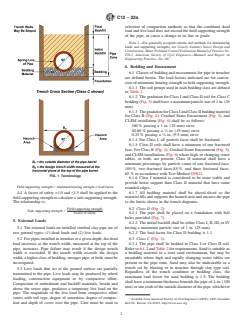
- Abstract
ABSTRACT
This practice covers the proper methods of installing vitified clay pipe lines in order to fully utilize the structural properties of such pipe. The external loads on installed vitrified clay pipe are of two general types: (I) dead loads and (2) live loads. For pipes installed in trenches at a given depth, the dead load increases as the trench width, measured at the top of the pipe, increases. Live loads that act at the ground surface are partially transmitted to the pipe. Live loads may be produced by wheel loading, construction equipment or by compactive effort. Classes of bedding and encasements for pipe in trenches are defined as Class D wherein the pipe shall be placed on a firm and unyielding trench bottom with bell holes provided, Class C wherein the pipe shall be bedded in clean coarse-grained gravels and sands, Class B wherein the pipe shall be bedded in suitable material and Class A. Trenches shall be excavated to a width that will provide adequate working space, but not more than the maximum design width. Trench walls shall not be undercut. Bell holes shall be excavated to prevent point loading of the bells or couplings of laid pipe, and to establish full-length support of the pipe barrel. Final backfill need not be compacted to develop field supporting strength of the pipe. Final backfill may require compaction to prevent settlement of the ground surface.
SCOPE
1.1 This practice covers the proper methods of installing vitrified clay pipe lines by open trench construction methods in order to fully utilize the structural properties of such pipe.
1.2 The values stated in inch-pound units are to be regarded as standard. The values given in parentheses are mathematical conversions to SI units that are provided for information only and are not considered standard.
1.3 This standard does not purport to address all of the safety concerns, if any, associated with its use. It is the responsibility of the user of this standard to establish appropriate safety, health, and environmental practices and determine the applicability of regulatory limitations prior to use.
1.4 This international standard was developed in accordance with internationally recognized principles on standardization established in the Decision on Principles for the Development of International Standards, Guides and Recommendations issued by the World Trade Organization Technical Barriers to Trade (TBT) Committee.
- Status
- Published
- Publication Date
- 31-Aug-2022
- Technical Committee
- C04 - Vitrified Clay Pipe
- Drafting Committee
- C04.20 - Methods of Test and Specifications
Overview
ASTM C12-22a: Standard Practice for Installing Vitrified Clay Pipe Lines provides essential guidance for the proper installation of vitrified clay pipe by open trench methods. Published by ASTM International, this standard ensures that the structural properties of vitrified clay pipes are fully utilized during installation. The document addresses key factors affecting field supporting strength, including trench excavation, bedding, backfilling, and external loads such as dead loads and live loads. The requirements detailed in ASTM C12-22a help promote safe, reliable, and durable vitrified clay pipeline installations for sewage and drainage systems.
Key Topics
- Trench Excavation and Foundation Preparation: Specifies excavation width, stabilization of trench walls, and avoidance of over-excavation. Provides requirements for preparing the trench foundation to adequately support both bedding and pipe.
- Bedding Classes and Materials: Defines multiple bedding and encasement classes (Classes D, C, B, Crushed Stone Encasement, Controlled Low Strength Material (CLSM), Concrete Cradle, and Concrete Encasement) and details allowable bedding materials and backfill gradations according to soil types.
- Pipe Handling and Laying: Outlines best practices for carefully handling, inspecting, and joining vitrified clay pipes, including requirements for joint deflection, alignment, and prevention of point loading at bells or couplings.
- Backfilling Techniques: Provides methods for initial and final backfill, including material specifications and compaction practices to prevent future ground settlement and pipe misalignment.
- Load Considerations: Discusses calculation and management of dead and live loads acting on installed pipes, including the use of load factors and factors of safety to ensure field supporting strength is not exceeded.
- Field Performance and Testing: Recommends testing procedures for line integrity, including infiltration and air tests, to verify installation and compliance with engineering specifications.
Applications
The recommendations provided by ASTM C12-22a are applicable to:
- Sanitary Sewer Systems: Ensures proper installation of vitrified clay pipelines used in municipal and industrial sewage conveyance.
- Stormwater Drainage Lines: Guides installation for stormwater management systems, maximizing pipe performance under variable load conditions.
- Subdrain and Leachate Lines: Offers installation options for perforated vitrified clay pipes in subsurface drainage and leachate collection applications, with specific recommendations for bedding, backfill, and filter fabric use.
- Infrastructure Rehabilitation and New Construction: Suitable for both new pipeline construction and replacement/repair of existing vitrified clay pipelines in open trench scenarios.
Related Standards
Several other ASTM standards are referenced and aligned with ASTM C12-22a, including:
- ASTM C301: Test Methods for Vitrified Clay Pipe
- ASTM C425: Specification for Compression Joints for Vitrified Clay Pipe and Fittings
- ASTM C700: Specification for Vitrified Clay Pipe, Extra Strength, Standard Strength, and Perforated
- ASTM C828: Test Method for Low-Pressure Air Test of Vitrified Clay Pipe Lines
- ASTM C923/C923M: Specification for Resilient Connectors Between Reinforced Concrete Manhole Structures, Pipes, and Laterals
- ASTM D1586/D1586M: Test Method for Standard Penetration Test (SPT) and Split-Barrel Sampling of Soils
- ASTM D2487/D2488: Practice for Soil Classification and Identification (Unified Soil Classification System)
Compliance with ASTM C12-22a supports proper pipeline installation, enhances long-term durability, and reduces risks of failure and costly repairs. By following these guidelines, engineers, contractors, and utilities can ensure safe, effective, and standards-based vitrified clay pipe installations in a variety of applications.
Relations
- Effective Date
- 01-Apr-2024
- Effective Date
- 15-Dec-2017
- Effective Date
- 15-Dec-2017
- Effective Date
- 01-Dec-2017
- Effective Date
- 15-Jul-2017
- Effective Date
- 01-Jun-2017
- Effective Date
- 15-Dec-2016
- Effective Date
- 01-Dec-2016
- Effective Date
- 01-Dec-2015
- Effective Date
- 01-Jul-2015
- Effective Date
- 01-Sep-2014
- Effective Date
- 01-Dec-2013
- Effective Date
- 01-Dec-2013
- Effective Date
- 01-Dec-2013
- Effective Date
- 01-Jan-2013
Get Certified
Connect with accredited certification bodies for this standard

Institut za varilstvo d.o.o. (Welding Institute)
Slovenia's leading welding institute since 1952. ISO 3834, EN 1090, pressure equipment certification, NDT personnel, welder qualification. Only IIW Au
Sponsored listings
Frequently Asked Questions
ASTM C12-22a is a standard published by ASTM International. Its full title is "Standard Practice for Installing Vitrified Clay Pipe Lines". This standard covers: ABSTRACT This practice covers the proper methods of installing vitified clay pipe lines in order to fully utilize the structural properties of such pipe. The external loads on installed vitrified clay pipe are of two general types: (I) dead loads and (2) live loads. For pipes installed in trenches at a given depth, the dead load increases as the trench width, measured at the top of the pipe, increases. Live loads that act at the ground surface are partially transmitted to the pipe. Live loads may be produced by wheel loading, construction equipment or by compactive effort. Classes of bedding and encasements for pipe in trenches are defined as Class D wherein the pipe shall be placed on a firm and unyielding trench bottom with bell holes provided, Class C wherein the pipe shall be bedded in clean coarse-grained gravels and sands, Class B wherein the pipe shall be bedded in suitable material and Class A. Trenches shall be excavated to a width that will provide adequate working space, but not more than the maximum design width. Trench walls shall not be undercut. Bell holes shall be excavated to prevent point loading of the bells or couplings of laid pipe, and to establish full-length support of the pipe barrel. Final backfill need not be compacted to develop field supporting strength of the pipe. Final backfill may require compaction to prevent settlement of the ground surface. SCOPE 1.1 This practice covers the proper methods of installing vitrified clay pipe lines by open trench construction methods in order to fully utilize the structural properties of such pipe. 1.2 The values stated in inch-pound units are to be regarded as standard. The values given in parentheses are mathematical conversions to SI units that are provided for information only and are not considered standard. 1.3 This standard does not purport to address all of the safety concerns, if any, associated with its use. It is the responsibility of the user of this standard to establish appropriate safety, health, and environmental practices and determine the applicability of regulatory limitations prior to use. 1.4 This international standard was developed in accordance with internationally recognized principles on standardization established in the Decision on Principles for the Development of International Standards, Guides and Recommendations issued by the World Trade Organization Technical Barriers to Trade (TBT) Committee.
ABSTRACT This practice covers the proper methods of installing vitified clay pipe lines in order to fully utilize the structural properties of such pipe. The external loads on installed vitrified clay pipe are of two general types: (I) dead loads and (2) live loads. For pipes installed in trenches at a given depth, the dead load increases as the trench width, measured at the top of the pipe, increases. Live loads that act at the ground surface are partially transmitted to the pipe. Live loads may be produced by wheel loading, construction equipment or by compactive effort. Classes of bedding and encasements for pipe in trenches are defined as Class D wherein the pipe shall be placed on a firm and unyielding trench bottom with bell holes provided, Class C wherein the pipe shall be bedded in clean coarse-grained gravels and sands, Class B wherein the pipe shall be bedded in suitable material and Class A. Trenches shall be excavated to a width that will provide adequate working space, but not more than the maximum design width. Trench walls shall not be undercut. Bell holes shall be excavated to prevent point loading of the bells or couplings of laid pipe, and to establish full-length support of the pipe barrel. Final backfill need not be compacted to develop field supporting strength of the pipe. Final backfill may require compaction to prevent settlement of the ground surface. SCOPE 1.1 This practice covers the proper methods of installing vitrified clay pipe lines by open trench construction methods in order to fully utilize the structural properties of such pipe. 1.2 The values stated in inch-pound units are to be regarded as standard. The values given in parentheses are mathematical conversions to SI units that are provided for information only and are not considered standard. 1.3 This standard does not purport to address all of the safety concerns, if any, associated with its use. It is the responsibility of the user of this standard to establish appropriate safety, health, and environmental practices and determine the applicability of regulatory limitations prior to use. 1.4 This international standard was developed in accordance with internationally recognized principles on standardization established in the Decision on Principles for the Development of International Standards, Guides and Recommendations issued by the World Trade Organization Technical Barriers to Trade (TBT) Committee.
ASTM C12-22a is classified under the following ICS (International Classification for Standards) categories: 23.040.01 - Pipeline components and pipelines in general. The ICS classification helps identify the subject area and facilitates finding related standards.
ASTM C12-22a has the following relationships with other standards: It is inter standard links to ASTM C896-24, ASTM D2487-17e1, ASTM D2487-17, ASTM C896-17a, ASTM D2488-17, ASTM C896-17, ASTM D4832-16, ASTM D6024/D6024M-16, ASTM C896-15, ASTM D6024/D6024M-15, ASTM C896-14, ASTM D5821-13, ASTM C896-13, ASTM C1091-03a(2013), ASTM C700-13. Understanding these relationships helps ensure you are using the most current and applicable version of the standard.
ASTM C12-22a is available in PDF format for immediate download after purchase. The document can be added to your cart and obtained through the secure checkout process. Digital delivery ensures instant access to the complete standard document.
Standards Content (Sample)
This international standard was developed in accordance with internationally recognized principles on standardization established in the Decision on Principles for the
Development of International Standards, Guides and Recommendations issued by the World Trade Organization Technical Barriers to Trade (TBT) Committee.
Designation:C12 −22a
Standard Practice for
Installing Vitrified Clay Pipe Lines
ThisstandardisissuedunderthefixeddesignationC12;thenumberimmediatelyfollowingthedesignationindicatestheyearoforiginal
adoptionor,inthecaseofrevision,theyearoflastrevision.Anumberinparenthesesindicatestheyearoflastreapproval.Asuperscript
epsilon (´) indicates an editorial change since the last revision or reapproval.
This standard has been approved for use by agencies of the U.S. Department of Defense.
1. Scope C1091Test Method for Hydrostatic Infiltration Testing of
Vitrified Clay Pipe Lines
1.1 This practice covers the proper methods of installing
D1586/D1586MTest Method for Standard Penetration Test
vitrifiedclaypipelinesbyopentrenchconstructionmethodsin
(SPT) and Split-Barrel Sampling of Soils
order to fully utilize the structural properties of such pipe.
D2487Practice for Classification of Soils for Engineering
1.2 The values stated in inch-pound units are to be regarded
Purposes (Unified Soil Classification System)
as standard. The values given in parentheses are mathematical
D2488Practice for Description and Identification of Soils
conversions to SI units that are provided for information only
(Visual-Manual Procedures)
and are not considered standard.
D4832Test Method for Preparation and Testing of Con-
1.3 This standard does not purport to address all of the trolled Low Strength Material (CLSM) Test Cylinders
safety concerns, if any, associated with its use. It is the
D5821Test Method for Determining the Percentage of
responsibility of the user of this standard to establish appro- Fractured Particles in Coarse Aggregate
priate safety, health, and environmental practices and deter-
D6024/D6024MTest Method for Ball Drop on Controlled
mine the applicability of regulatory limitations prior to use. Low Strength Material (CLSM) to Determine Suitability
1.4 This international standard was developed in accor-
for Load Application
dance with internationally recognized principles on standard- D6103/D6103MTest Method for Flow Consistency of Con-
ization established in the Decision on Principles for the
trolled Low Strength Material (CLSM)
Development of International Standards, Guides and Recom-
3. Terminology
mendations issued by the World Trade Organization Technical
Barriers to Trade (TBT) Committee.
3.1 General—Terminology C896 can be used for clarifica-
tion of terminology in this specification.
2. Referenced Documents
2 3.2 See Fig. 1.
2.1 ASTM Standards:
C301Test Methods for Vitrified Clay Pipe
DESIGN CONSIDERATIONS
C425SpecificationforCompressionJointsforVitrifiedClay
Pipe and Fittings
4. Supporting Strength
C700Specification for Vitrified Clay Pipe, Extra Strength,
4.1 The field supporting strength of vitrified clay pipe is
Standard Strength, and Perforated
materially affected by the methods of installation. The field
C828Test Method for Low-Pressure Air Test of Vitrified
supporting strength of a pipe is defined as its capacity to
Clay Pipe Lines
support dead and live loads under actual field conditions. It is
C896Terminology Relating to Clay Products
dependent upon two factors: (1) the inherent strength of the
C923/C923MSpecification for Resilient Connectors Be-
pipe and (2) the bedding of the pipe.
tween Reinforced Concrete Manhole Structures, Pipes,
4.2 The minimum bearing strength requirement in accor-
and Laterals
dance with Specification C700, as determined by the 3-edge-
bearingtestofTestMethodsC301,isameasureoftheinherent
This practice is under the jurisdiction of ASTM Committee C04 on Vitrified
strength of the pipe.
Clay Pipe and is the direct responsibility of Subcommittee C04.20 on Methods of
Test and Specifications.
4.3 The tests used to measure bearing strength determine
Current edition approved Sept. 1, 2022. Published September 2022. Originally
relative pipe strengths but do not represent actual field condi-
approved in 1915. Last previous edition approved in 2022 as C12–22. DOI:
10.1520/C0012-22A.
tions. Therefore, an adjustment called a load factor is intro-
For referenced ASTM standards, visit the ASTM website, www.astm.org, or
duced to convert minimum bearing strength to field supporting
contact ASTM Customer Service at service@astm.org. For Annual Book of ASTM
strength.The magnitude of the load factor depends on how the
Standards volume information, refer to the standard’s Document Summary page on
the ASTM website. pipe is bedded. The relationship is:
Copyright © ASTM International, 100 Barr Harbor Drive, PO Box C700, West Conshohocken, PA 19428-2959. United States
C12−22a
selection of compaction methods so that the combined dead
loadandliveloaddoesnotexceedthefieldsupportingstrength
of the pipe, or cause a change in its line or grade.
NOTE 1—For generally accepted criteria and methods for determining
loads and supporting strengths, see Gravity Sanitary Sewer Design and
Construction, Water Pollution Control Federation Manual of Practice No.
FD-5, American Society of Civil Engineers—Manuals and Report on
Engineering Practice—No. 60.
6. Bedding and Encasement
6.1 Classesofbeddingandencasementsforpipeintrenches
are defined herein. The load factors indicated are for conver-
sion of minimum bearing strength to field supporting strength.
6.1.1 Thesoilgroupsusedineachbeddingclassaredefined
in Table 1.
6.1.2 The gradation for Class I and Class II soil for Class C
bedding(Fig.3)shallhaveamaximumparticlesizeof1in.(25
mm).
6.1.3 ThegradationforClassIandClassIIbeddingmaterial
for Class B (Fig. 4), Crushed Stone Encasement (Fig. 5), and
CLSM installation (Fig. 6) shall be as follows:
100% passing a 1 in. (25 mm) sieve
40-60% passing a ⁄4 in. (19 mm) sieve
0-25% passing a ⁄8 in. (9.5 mm) sieve
6.1.4 For Class I, all particle faces shall be fractured.
6.1.5 Class II soils shall have a minimum of one fractured
face. For Class B (Fig. 4), Crushed Stone Encasement (Fig. 5),
andCLSMinstallations(Fig.6)wherehigh,orchangingwater
tables, or both, are present; Class II material shall have a
minimum percentage by particle count of one fractured face-
100%, two fractured faces-85%, and three fractured faces-
65% in accordance with Test Method D5821.
FIG. 1 Terminology
6.1.6 Class I material is considered to be more stable and
provide better support than Class II material that have some
Fieldsupportingstrength 5 minimumbearingstrength 3loadfactor
rounded edges.
6.1.7 All bedding material shall be shovel-sliced so the
4.4 A factor of safety >1.0 and ≤1.5 shall be applied to the
fieldsupportingstrengthtocalculateasafesupportingstrength. materialfillsandsupportsthehaunchareaandencasesthepipe
to the limits shown in the trench diagrams.
The relationship is:
Fieldsupportingstrength 6.2 Class D (Fig. 2):
Safesupportingstrength 5
Factorofsafety 6.2.1 The pipe shall be placed on a foundation with bell
holes provided (Fig. 7).
5. External Loads
6.2.2 The initial backfill shall be either Class I, II, III, or IV
5.1 The external loads on installed vitrified clay pipe are of having a maximum particle size of 1 in. (25 mm).
two general types: (1) dead loads and (2) live loads. 6.2.3 The load factor for Class D bedding is 1.1.
5.2 Forpipesinstalledintrenchesatagivendepth,thedead 6.3 Class C (Fig. 3):
load increases as the trench width, measured at the top of the 6.3.1 The pipe shall be bedded in Class I or Class II soil.
pipe, increases. Pipe failure may result if the design trench Referto6.1.2andTable2forrequirements.Sandissuitableas
width is exceeded. If the trench width exceeds the design a bedding material in a total sand environment, but may be
width,ahigherclassofbedding,strongerpipe,orboth,mustbe unsuitable where high and rapidly changing water tables are
investigated. present in the pipe zone. Sand may also be undesirable in a
trench cut by blasting or in trenches through clay type soil.
5.3 Live loads that act at the ground surface are partially
Regardless of the trench condition or bedding class, the
transmitted to the pipe. Live loads may be produced by wheel
maximum load factor for sand bedding is 1.5. The bedding
loading, construction equipment or by compactive effort.
shall have a minimum thickness beneath the pipe of 4 in. (100
Compaction of embedment and backfill materials, beside and
mm)oronesixthoftheoutsidediameterofthepipe,whichever
above the sewer pipe, produces a temporary live load on the
pipe. The magnitude of the live load from compactive effort
varies with soil type, degree of saturation, degree of compac-
Available fromAmerican Society of Civil Engineers (ASCE), 1801Alexander
tion and depth of cover over the pipe. Care must be used in Bell Dr., Reston, VA 20191, http://www.asce.org.
C12−22a
TABLE 1 Uniform Soil Groups for Pipe Installation
NOTE 1—Soil Classification descriptions and symbols are in accordance with Practice D2487 and Practice D2488.
NOTE 2—For Class I, all particle faces shall be fractured.
NOTE 3—Materials such as broken coral, shells, slag, and recycled concrete (with less than 12% passing a #200 sieve) should be treated as Class II
soils.
NOTE 4—Class V soil is not suitable for use as a bedding or initial backfill material.
Class I crushed rock
100 % passing 1- ⁄2 in. (38 mm) sieve,
(9.5 mm) sieve,
Class II clean, coarse grained soils GW, GP, SW, SP
or any soil beginning with one of these symbols
(can contain fines up to 12 %)
uniform fine sands (SP) with more than 50 %
passing a #100 sieve should be treated as Class III
material
coarse grained soils with fines GM, GC, SM, SC
or any soil beginning with one of these symbols
Class III sandy or gravelly fine grained soils ML, CL
or any soil beginning with one of these symbols
with >/= 30 % retained on #200 sieve
Class IV fine-grained soils ML, CL
or any soil beginning with one of these symbols
with <30 % retained on #200 sieve
Class V fine-grained soils, organic soils MH, CH, OL, OH, Pt
high compressibility silts and clays, organic soil
FIG. 4 Class B
FIG. 2 Class D
6.3.2 The initial backfill shall be either Class I, II, III, or IV
having maximum particle size of 1- ⁄2 in. (38 mm) (see Table
2).
6.3.3 The load factor for Class C bedding is 1.5.
6.4 Class B (Fig. 4):
6.4.1 The pipe shall be bedded in Class I or Class II soil.
Refer to 6.1.3, 6.1.5, and Table 2 for requirements. The
bedding shall have a minimum thickness beneath the pipe of 4
in. (100 mm) or one sixth of the outside diameter of the pipe,
whichever is greater, and shall extend up the haunches of the
pipe to the springline.
6.4.2 The initial backfill shall be either Class I, II, III, or IV
having a maximum particle size of 1- ⁄2 in. (38 mm).
FIG. 3 Class C
6.4.3 The load factor for Class B bedding is 1.9.
6.5 Crushed Stone Encasement (Fig. 5):
is greater, and shall extend up the haunches of the pipe one 6.5.1 The pipe shall be bedded in Class I or Class II soil.
sixth of the outside diameter of the pipe. Refer to 6.1.3, 6.1.5, and Table 2 for requirements. The
C12−22a
6.6 Controlled Low Strength Material(Fig. 6)—Controlled
low strength material (CLSM) is used as an effective material
for the bedding of vitrified clay pipe.
6.6.1 The pipe shall be bedded on Class I or Class II soil.
Refer to 6.1.3, 6.1.5, and Table 2 for requirements. The
bedding shall have a minimum thickness beneath the pipe of 4
in. (100 mm) or one sixth of the outside diameter of the pipe,
whichever is greater.
6.6.2 Forpipediameters8to21in.(205to535mm),CLSM
shall extend a minimum of 9 in. (230 mm) on each side of the
pipe barrel. For pipe diameters 24 in. (610 mm) and larger,
CLSM shall extend a minimum of 12 in. (305 mm) on each
side of the pipe barrel (Fig. 6).
FIG. 5 Crushed Stone Encasement
6.6.3 When placed, CLSM shall have a measured flowabil-
ity of 8 to 12in. (205to 305mm) spread diameter as deter-
mined by Test Method D6103/D6103M.
6.6.4 28-day compressive strength shall be 100 to 200 psi
(0.69 to 1.38 MPa) as determined by Test Method D4832.
6.6.5 CLSM shall be directed to the top of the pipe to flow
down equally on both sides to prevent misalignment. Place
CLSM to the top of the pipe barrel.
6.6.6 The initial backfill shall be either Class I, II, III, or IV
having a maximum particle size of 1- ⁄2 in. (38 mm).
6.6.7 Initial backfill shall only commence after a Ball Drop
test is conducted and the measured diameter of the indentation
left by the ball is 3 in. or less as determined by Test Method
D6024/D6024M.
6.6.8 The load factor for controlled low strength material is
2.8.
This type of construction requires the fill to extend from the pipe to the trench
wall,nottoextendabovethetopofthepipeorbelowthebottomofthepipe.Where
6.7 Concrete Cradle (Fig. 8):
native soils are expansive, further investigation may be necessary.
6.7.1 The pipe shall be bedded in a cradle of reinforced
FIG. 6 Controlled Low Strength Material (CLSM)
concrete having a thickness under the barrel of at least 6 in.
(150 mm) or one fourth of the outside diameter of the pipe,
whicheverisgreater,andextendingupthehaunchestoaheight
of at least one half the outside diameter of the pipe.The cradle
width shall be at least equal to the outside diameter of the pipe
plus 4 in. (100 mm) on each side or one and one fourth times
the outside diameter of the pipe, whichever is greater. If the
trench width is greater than either of these dimensions,
concrete may be placed to full trench width.
6.7.2 The initial backfill shall be either Class I, II, III, or IV
having a maximum particle size of 1- ⁄2 in. (38 mm).
6.7.3 The load factor for ClassAconcrete cradle bedding is
3.4 for reinforced concrete with p=0.4%, where p is the
percentageoftheareaoftransversesteeltotheareaofconcrete
FIG. 7 Uniform Pipe Support
at the bottom of the pipe barrel as shown in Fig. 8.
6.8 Concrete Encasement:
bedding shall have a minimum thickness beneath the pipe of 4
6.8.1 There are specific sites where concrete encasement
in. (100 mm) or one sixth of the outside diameter of the pipe,
may be desirable. Concrete encasement shall completely sur-
whichever is greater, and shall extend upward to a horizontal
round the pipe and shall have a minimum thickness, at any
plane at the
...
This document is not an ASTM standard and is intended only to provide the user of an ASTM standard an indication of what changes have been made to the previous version. Because
it may not be technically possible to adequately depict all changes accurately, ASTM recommends that users consult prior editions as appropriate. In all cases only the current version
of the standard as published by ASTM is to be considered the official document.
Designation: C12 − 22 C12 − 22a
Standard Practice for
Installing Vitrified Clay Pipe Lines
This standard is issued under the fixed designation C12; the number immediately following the designation indicates the year of original
adoption or, in the case of revision, the year of last revision. A number in parentheses indicates the year of last reapproval. A superscript
epsilon (´) indicates an editorial change since the last revision or reapproval.
This standard has been approved for use by agencies of the U.S. Department of Defense.
1. Scope
1.1 This practice covers the proper methods of installing vitrified clay pipe lines by open trench construction methods in order to
fully utilize the structural properties of such pipe.
1.2 The values stated in inch-pound units are to be regarded as standard. The values given in parentheses are mathematical
conversions to SI units that are provided for information only and are not considered standard.
1.3 This standard does not purport to address all of the safety concerns, if any, associated with its use. It is the responsibility
of the user of this standard to establish appropriate safety, health, and environmental practices and determine the applicability of
regulatory limitations prior to use.
1.4 This international standard was developed in accordance with internationally recognized principles on standardization
established in the Decision on Principles for the Development of International Standards, Guides and Recommendations issued
by the World Trade Organization Technical Barriers to Trade (TBT) Committee.
2. Referenced Documents
2.1 ASTM Standards:
C301 Test Methods for Vitrified Clay Pipe
C403/C403M Test Method for Time of Setting of Concrete Mixtures by Penetration Resistance
C425 Specification for Compression Joints for Vitrified Clay Pipe and Fittings
C700 Specification for Vitrified Clay Pipe, Extra Strength, Standard Strength, and Perforated
C828 Test Method for Low-Pressure Air Test of Vitrified Clay Pipe Lines
C896 Terminology Relating to Clay Products
C923/C923M Specification for Resilient Connectors Between Reinforced Concrete Manhole Structures, Pipes, and Laterals
C1091 Test Method for Hydrostatic Infiltration Testing of Vitrified Clay Pipe Lines
D1586/D1586M Test Method for Standard Penetration Test (SPT) and Split-Barrel Sampling of Soils
D2487 Practice for Classification of Soils for Engineering Purposes (Unified Soil Classification System)
D2488 Practice for Description and Identification of Soils (Visual-Manual Procedures)
D4832 Test Method for Preparation and Testing of Controlled Low Strength Material (CLSM) Test Cylinders
D5821 Test Method for Determining the Percentage of Fractured Particles in Coarse Aggregate
D6024/D6024M Test Method for Ball Drop on Controlled Low Strength Material (CLSM) to Determine Suitability for Load
Application
This practice is under the jurisdiction of ASTM Committee C04 on Vitrified Clay Pipe and is the direct responsibility of Subcommittee C04.20 on Methods of Test and
Specifications.
Current edition approved April 1, 2022Sept. 1, 2022. Published April 2022September 2022. Originally approved in 1915. Last previous edition approved in 20212022 as
C12 – 21.C12 – 22. DOI: 10.1520/C0012-22.10.1520/C0012-22A.
For referenced ASTM standards, visit the ASTM website, www.astm.org, or contact ASTM Customer Service at service@astm.org. For Annual Book of ASTM Standards
volume information, refer to the standard’s Document Summary page on the ASTM website.
Copyright © ASTM International, 100 Barr Harbor Drive, PO Box C700, West Conshohocken, PA 19428-2959. United States
C12 − 22a
D6103/D6103M Test Method for Flow Consistency of Controlled Low Strength Material (CLSM)
3. Terminology
3.1 General—Terminology C896 can be used for clarification of terminology in this specification.
3.2 See Fig. 1.
DESIGN CONSIDERATIONS
4. Supporting Strength
4.1 The field supporting strength of vitrified clay pipe is materially affected by the methods of installation. The field supporting
strength of a pipe is defined as its capacity to support dead and live loads under actual field conditions. It is dependent upon two
factors: (1) the inherent strength of the pipe and (2) the bedding of the pipe.
4.2 The minimum bearing strength requirement in accordance with Specification C700, as determined by the 3-edge-bearing test
of Test Methods C301, is a measure of the inherent strength of the pipe.
4.3 The tests used to measure bearing strength determine relative pipe strengths but do not represent actual field conditions.
Therefore, an adjustment called a load factor is introduced to convert minimum bearing strength to field supporting strength. The
magnitude of the load factor depends on how the pipe is bedded. The relationship is:
Field supporting strength 5 minimum bearing strength 3load factor
FIG. 1 Terminology
C12 − 22a
4.4 A factor of safety >1.0 and ≤1.5 shall be applied to the field supporting strength to calculate a safe supporting strength. The
relationship is:
Field supporting strength
Safe supporting strength 5
Factor of safety
5. External Loads
5.1 The external loads on installed vitrified clay pipe are of two general types: (1) dead loads and (2) live loads.
5.2 For pipes installed in trenches at a given depth, the dead load increases as the trench width, measured at the top of the pipe,
increases. Pipe failure may result if the design trench width is exceeded. If the trench width exceeds the design width, a higher
class of bedding, stronger pipe, or both, must be investigated.
5.3 Live loads that act at the ground surface are partially transmitted to the pipe. Live loads may be produced by wheel loading,
construction equipment or by compactive effort. Compaction of embedment and backfill materials, beside and above the sewer
pipe, produces a temporary live load on the pipe. The magnitude of the live load from compactive effort varies with soil type,
degree of saturation, degree of compaction and depth of cover over the pipe. Care must be used in selection of compaction methods
so that the combined dead load and live load does not exceed the field supporting strength of the pipe, or cause a change in its
line or grade.
NOTE 1—For generally accepted criteria and methods for determining loads and supporting strengths, see Gravity Sanitary Sewer Design and
Construction, Water Pollution Control Federation Manual of Practice No. FD-5, American Society of Civil Engineers—Manuals and Report on
Engineering Practice—No. 60.
6. Bedding and Encasement
6.1 Classes of bedding and encasements for pipe in trenches are defined herein. The load factors indicated are for conversion of
minimum bearing strength to field supporting strength.
TABLE 1 Uniform Soil Groups for Pipe Installation
NOTE 1—Soil Classification descriptions and symbols are in accordance with Practice D2487 and Practice D2488.
NOTE 2—For Class I, all particle faces shall be fractured.
NOTE 3—Materials such as broken coral, shells, slag, and recycled concrete (with less than 12 % passing a #200 sieve) should be treated as Class II
soils.
NOTE 4—Class V soil is not suitable for use as a bedding or initial backfill material.
Class I crushed rock
100 % passing 1- ⁄2 in. (38 mm) sieve,
(9.5 mm) sieve,
Class II clean, coarse grained soils GW, GP, SW, SP
or any soil beginning with one of these symbols
(can contain fines up to 12 %)
uniform fine sands (SP) with more than 50 %
passing a #100 sieve should be treated as Class III
material
coarse grained soils with fines GM, GC, SM, SC
or any soil beginning with one of these symbols
Class III sandy or gravelly fine grained soils ML, CL
or any soil beginning with one of these symbols
with >/= 30 % retained on #200 sieve
Class IV fine-grained soils ML, CL
or any soil beginning with one of these symbols
with <30 % retained on #200 sieve
Class V fine-grained soils, organic soils MH, CH, OL, OH, Pt
high compressibility silts and clays, organic soil
Available from American Society of Civil Engineers (ASCE), 1801 Alexander Bell Dr., Reston, VA 20191, http://www.asce.org.
C12 − 22a
6.1.1 The soil groups used in each bedding class are defined in Table 1.
6.1.2 The gradation for Class I and Class II soil for Class C bedding (Fig. 3) shall have a maximum particle size of 1 in. (25 mm).
6.1.3 The gradation for Class I and Class II bedding material for Class B (Fig. 4), Crushed Stone Encasement (Fig. 5), and CLSM
installation (Fig. 6) shall be as follows:
100 % passing a 1 in. (25 mm) sieve
40-60 % passing a ⁄4 in. (19 mm) sieve
0-25 % passing a ⁄8 in. (9.5 mm) sieve
6.1.4 For Class I, all particle faces shall be fractured.
6.1.5 Class II soils shall have a minimum of one fractured face. For Class B (Fig. 4), Crushed Stone Encasement (Fig. 5), and
CLSM installations (Fig. 6) where high, or changing water tables, or both, are present; Class II material shall have a minimum
percentage by particle count of one fractured face-100 %, two fractured faces-85 %, and three fractured faces-65 % in accordance
with Test Method D5821.
6.1.6 Class I material is considered to be more stable and provide better support than Class II material that have some rounded
edges.
6.1.7 All bedding material shall be shovel-sliced so the material fills and supports the haunch area and encases the pipe to the
limits shown in the trench diagrams.
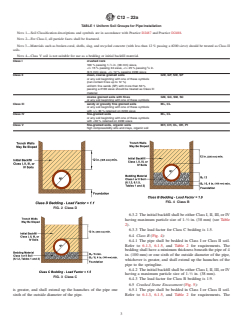
6.2 Class D (Fig. 2):
6.2.1 The pipe shall be placed on a foundation with bell holes provided (Fig. 7).
6.2.2 The initial backfill shall be either Class I, II, III, or IV having a maximum particle size of 1 in. (25 mm).
6.2.3 The load factor for Class D bedding is 1.1.
6.3 Class C (Fig. 3):
6.3.1 The pipe shall be bedded in Class I or Class II soil. Refer to 6.1.2 and Table 2 for requirements. Sand is suitable as a bedding
material in a total sand environment, but may be unsuitable where high and rapidly changing water tables are present in the pipe
zone. Sand may also be undesirable in a trench cut by blasting or in trenches through clay type soil. Regardless of the trench
condition or bedding class, the maximum load factor for sand bedding is 1.5. The bedding shall have a minimum thickness beneath
the pipe of 4 in. (100 mm) or one sixth of the outside diameter of the pipe, whichever is greater, and shall extend up the haunches
of the pipe one sixth of the outside diameter of the pipe.
6.3.2 The initial backfill shall be either Class I, II, III, or IV having maximum particle size of 1- ⁄2 in. (38 mm) (see Table 2).
FIG. 2 Class D
C12 − 22a
FIG. 3 Class C
FIG. 4 Class B
FIG. 5 Crushed Stone Encasement
6.3.3 The load factor for Class C bedding is 1.5.
6.4 Class B (Fig. 4):
6.4.1 The pipe shall be bedded in Class I or Class II soil. Refer to 6.1.3, 6.1.5, and Table 2 for requirements. The bedding shall
have a minimum thickness beneath the pipe of 4 in. (100 mm) or one sixth of the outside diameter of the pipe, whichever is greater,
and shall extend up the haunches of the pipe to the springline.
6.4.2 The initial backfill shall be either Class I, II, III, or IV having a maximum particle size of 1- ⁄2 in. (38 mm).
6.4.3 The load factor for Class B bedding is 1.9.
6.5 Crushed Stone Encasement (Fig. 5):
C12 − 22a
This type of construction requires the fill to extend from the pipe to the trench wall, not to extend above the top of the pipe or below the bottom of the pipe. Where native
soils are expansive, further investigation may be necessary.
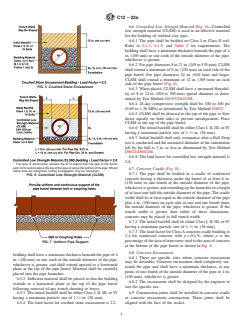
FIG. 6 Controlled Low Strength Material (CLSM)
FIG. 7 Uniform Pipe Support
6.5.1 The pipe shall be bedded in Class I or Class II soil. Refer to 6.1.3, 6.1.5, and Table 2 for requirements. The bedding shall
have a minimum thickness beneath the pipe of 4 in. (100 mm) or one sixth of the outside diameter of the pipe, whichever is greater,
and shall extend upward to a horizontal plane at the top of the pipe barrel. Material shall be carefully placed into the pipe haunches.
6.5.2 Sufficient material shall be placed so that the bedding extends to a horizontal plane at the top of the pipe barrel following
removal of any trench sheeting or boxes.
6.5.3 The initial backfill shall be either Class I, II, III, or IV having a maximum particle size of 1- ⁄2 in. (38 mm).
6.5.4 The load factor for crushed stone encasement is 2.2.
6.6 Controlled Low Strength Material (Fig. 6)—Controlled low strength material (CLSM) is used as an effective material for the
bedding of vitrified clay pipe.
6.6.1 The pipe shall be bedded on Class I or Class II soil. Refer to 6.1.3, 6.1.5, and Table 2 for requirements. The bedding shall
have a minimum thickness beneath the pipe of 4 in. (100 mm) or one sixth of the outside diameter of the pipe, whichever is greater.
6.6.2 For pipe diameters 8 to 21 in. (205 to 535 mm), CLSM shall extend a minimum of 9 in. (230 mm) on each side of the pipe
barrel. For pipe diameters 24 in. (610 mm) and larger, CLSM shall extend a minimum of 12 in. (305 mm) on each side of the pipe
barrel (Fig. 6).
6.6.3 When placed, CLSM shall have a measured flowability of 8 6 1 in. (205 6 25 mm) 8 to 12 in. (205 to 305 mm) spread
diameter as determined by Test Method D6103/D6103M.
6.6.4 28-day compressive strength shall be 100 to 300200 psi (0.69 to 2.071.38 MPa) as determined by Test Method D4832.
C12 − 22a
TABLE 2 Allowable Bedding Material and Initial Backfill Per Bedding Class
Bedding Class Allowable Bedding Material Allowable Initial Backfill
Class Gradation Maximum Particle Size Class Maximum Particle Size
Table 1 Table 1
Class D N/A N/A N/A I, II, III, or IV 1 in. (25 mm)
Class C I or II 1 in. (25 mm) I, II, III, or IV 1- ⁄2 in. (38 mm)
I or II 100 % passing a 1 in. 1 in. (25 mm) I, II, III, or IV 1- ⁄2 in. (38 mm)
(25 mm) sieve
40-60 % passing a ⁄4
Class B
in. (19 mm) sieve
0-25 % passing a ⁄8 in.
(9.5 mm) sieve
I or II 100 % passing a 1 in. 1 in. (25 mm) I, II, III, or IV 1- ⁄2 in. (38 mm)
(25 mm) sieve
Crushed
40-60% passing a ⁄4 in.
Stone
(19 mm) sieve
Encasement
0-25% passing a ⁄8 in.
(9.5 mm) sieve
I or II 100 % passing a 1 in. 1 in. (25 mm) I, II, III, or IV 1- ⁄2 in. (38 mm)
(25 mm) sieve
I or II 100 % passing a 1 in. 1 in. (25 mm) I, II, III, IV, or CLSM 1- ⁄2 in. (38
CLSM
(25 mm) sieve
40-60 % passing a ⁄4
CLSM
in. (19 mm) sieve
0-25 % passing a ⁄8 in.
(9.5 mm) sieve
Concrete N/A N/A N/A I, II, III, or IV 1- ⁄2 in. (38 mm)
Cradle
6.6.5 CLSM shall be directed to the top of the pipe to flow down equally on both sides to prevent misalignment. Place CLSM to
the top of the pipe barrel.
6.6.6 The initial backfill shall be either Class I, II, III, or IV having a maximum particle size of 1- ⁄2 in. (38 mm).
6.6.7 Initial backfi
...